An Open Letter To The Lord Mayor Of Birmingham
My blood was boiling yesterday after struggling to get to the football at Birmingham and feel that this post is the best way to respond.
I am an Ipswich Town supporter who lives in London, so I came up to the match on Saturday, by Virgin Trains to New Street and then took the local train to Bordesley for St. Andrews. I should also say, I’m 66 and had a serious stroke three years ago, but I don’t find walking a kilometre or so, much of a problem.
I know New Street station is in a state of reconstruction at the moment, but the information on how to get to Bordesley was non-existent at the station. It probably took me about twenty minutes to find anybody, who knew how to get there. Some signage and tourist information in the station would have helped.
I was eventually told to walk to Moor Street station and as there was only a few temporary signs outside, I got lost and it took me at least thirty minutes to get to the other station. The signs petered out and I ended up lost in the Bull Ring shopping centre. Judging by the number of people I saw in Ipswich Town football shirts, I wasn’t the only lost soul either. Some were getting a big edgy, but then Ipswich fans are generally a calm bunch.
I know Bordesley station isn’t the most modern, but at least the trains work well to get there. However, the walk from the station to the ground, must be the most dangerous walk to get to any football ground from its local station in the UK. In the end fans have to rush a busy road and then a dual-carriageway, as there is no controlled crossing or any other help.
I wonder how many people will get seriously injured or even killed on that route in the next few years.
If Birmingham is serious in attracting business and tourism, then it should do something to make walking around the city, easier with more information and safe walking routes.
It is probably the worst major city in England for pedestrians.
They’ve Painted Bordesley Station
Bordesley station is how you’d imagine a station would look if it served a very large prison. It was originally built to bring cattle to the markets at the Bull Ring.
But it would appear someone has given it a coat of paint.
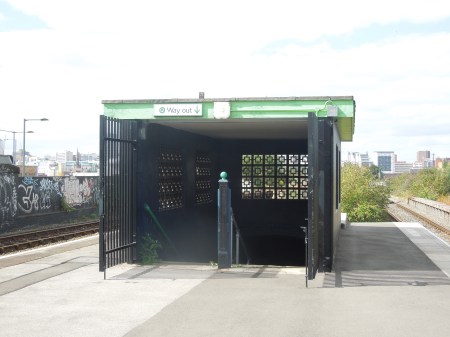
They’ve Painted Bordesley Station
It really, is the worst station, I’ve used in recent years. But it was marginally better than last year.
Is This A Legitimate Use Of The Word Cripple?
Cripple is a word that was very common when I was growing up. But it is now one of those words that gets exchanged these days for something more politically correct.
On reading the latest Modern Railways, they talked about a cripple siding at Ipswich. Searching the Internet for the term found this article on the history of railway sidings. It says this about cripple sidings.
The first justification for a siding today is as a “cripple siding”. Basically if a train cannot move at normal speed under its own power, the controller will be desperate to get it off the running lines as soon as possible so that the service can continue. In effect, this is the railway operational equivalent of “any port in a storm”.
The article goes on to give two examples of such a siding in the London Underground.
A Response To HS2 Sceptics
Alistair Darling and others are right to question the current proposal for HS2.
I have a lot of experience of the history and implementation of large infrastructure projects, as many were built with the help of project management software that I created.
Many of these projects get built in a form, that is very different to first envisaged and in some cases, as with the London end of HS1, they get built twice due to the mistakes and lack of vision of politicians.
Looking at the rail system in the UK, there are some major problems that must be addressed on routes from London and the South East to the North and Scotland.
Some stations like Leeds and Birmingham have been or are being rebuilt to a modern standard, but Euston and Manchester Piccadilly are in urgent need of serious improvement, as they both suffer from severe 1960s short-termism.
Most freight now arrives in the UK through the South East ports and there are no fully-electrified routes to the Midlands and the North. We’ve even worsened this situation by building the new London Gateway superport in East London, which means heavy freight trains must mix it with the London Overground.
North of Warrington and Darlington on the West Coast and East Coast Main Lines, there is a serious lack of capacity.
There are serious bottlenecks on the main routes like the Welwyn viaduct and various crossings and stations could be improved.
As Alistair Darling indicated in his article, politicians haven’t decided on what to do with Heathrow. Anybody who called themselves a project manager would say that is the first decision you must do, as it effectively defines the southern route of HS2.
I believe that the first thing we should do after deciding about the airport, is rectify the mistakes of the Victorians and their successors, and convert the East and West Coast Main Lines into continuous quadruple-tracked railways from London to Scotland. If this was accompanied by modern in-cab signalling and overhead wiring, it would be possible with the existing trains to run services at 225 kph. This could mean that London to both Edinburgh and Glasgow would be under four hours.
This high-speed ladder, would be matched by two or three electrified cross routes like Liverpool to Hull, Manchester to Sheffield and Peterborough To Nuneaton. These would not only provide more passenger capacity, but the last route would help to alleviate the freight problem, by taking all Felixstowe traffic to and from the Midlands.
Hitachi are building a factory to make new 225 kph trains at Newton Aycliffe for the East Coast Main and Great Western Main Lines. Surely, for reasons of economy of scale, these designs should also be deployed on the East Midland Main Line and the East-West routes. We must finally rid ourselves of British Rail’s different train for each route policy.
Obviously, better stations are needed, with Manchester Piccadilly and Euston at the head of the list. Perhaps these new stations could interface a lot better with the local bus routes, which is a particular failing of Piccadilly and many other important stations.
And finally, if more capacity is proven to be needed between London and Birmingham, why not electrify the Chiltern Route from Marylebone? And of course, run new Hitachi trains on the line!
the one thing we should actually do with HS2 is safeguard the route, for when it is eventually needed.
We need more capacity and faster journeys in the near future and not on some vague whim and date conjured from the air by politicians, who want to get elected in 2015.
More Demolition At London Bridge Station
As I came back, I passed through London Bridge station.



Very little is now left of the old station.
Note the pristine refurbished Class 465 in one picture.
Some may decry our trains, but we have one of the newest fleets in the world and even ones like these, which are wenty years old, look almost fresh out of the factory.
Out Of Charing Cross Station For The First Time
It may seem strange, but yesterday was the first time, I took a train out of Charing Cross station. Here are a few pictures, as the train travelled to London Bridge.




Note the Victorian replica of Charing Cross outside the station,one of the Golden Jubilee footbridges on the Hungerford Railway Bridge and Southwark Cathedral.
Stratford Depot Remembered
This plaque is inside Stratford International station and remembers Stratford TMD, which used to occupy the site.
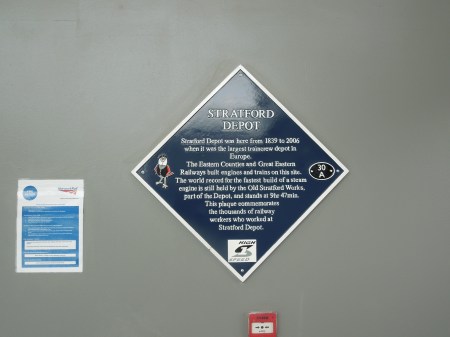
Stratford Depot Remembered
As a member of a group of children, who were keen train-spotters, I visited the depot a couple of times. In those days it was nearly all steam with a selection of new diesels, which nobody liked much.
There’s more about the plaque and those who worked in the depot, here on the Newham Recorder web site.
Waterloo’s Disgrace
Behind the Premier Inn at Lambeth are the old Eurostar platforms at Waterloo International station.
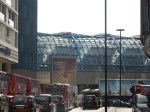


They have been virtually derelict since services transferred to St. Pancras in 2007.
I suppose they must be one of most expensive ruins of recent years.
If we were going to move the services to St. Pancras, why did we build such a grand station as an interim measure? Especially, when the French just made do, with what they had at Gare du Nord. And of course, they still do!
Are These Trains The Key To Improved Rail Services in The UK?
I must admit I’ve been critical of the Hitachi Super Express Train to be built in the North East of England.
As an engineer, I don’t like the idea of an electro-diesel version, that lugs diesel engines around, so it can be self-propelled on non-electrified lines.
I also feel, that the last government wanted the project for overtly political reasons and hence the decision to build the trains in the North East.
But now the orders are being made for both the Class 800 and Class 801 trains, I’m warming to the project.
This is partly because, I have travelled into Kent several times by the Class 395 trains, which are to a similar design by Hitachi, as proposed for the Class 800 and Class 801. Although, they are probably less grand, as they are essentially commuter trains. But even these humbler trains have a top speed of 225 kph, which is the same as the Inter City 225 units on the East Coast Main Line.
If all of the improvements to the East Coast Main Line detailed here are implemented, then the line could be a 225 kph four-track line all the way from London to Newcastle.
The major problems then to adding capacity and obtaining that speed most of the way, are the slower 160 kph trains, that run from London to Cambridge and Peterborough and share the lines to the north of York and Doncaster. But if these units like the current Class 365 and Class 185 were replaced with another electrical multiple unit from the same 800/801 family capable of working at 225 kph, this problem would be alleviated.
If we look at the West Coast Main Line, the Class 390 Pendelions could travel on a lot of the line at 225 kph with improved signalling, but again they are held up by other slower services. in fact, there is talk of ordering more mini-Pendelinos to serve places like Holyhead, Chester, Blackpool and Shrewsbury.
Once the Great Western Main Line is fully electrified to Bristol and South Wales, it should be a 225 kph railway, virtually run by the 800/801 family of trains, with a few Inter City 125s, still working down to Devon and Cornwall. So I suspect we’ll see the Oxford, Cheltenham and Worcester services run by faster trains to reduce capacity constraints.
But all this does show again, how by running more 225 kph trains under better signalling systems, with probably more selective quadruple tracking can greatly increase the capacity on our railways.
It could be argued than one of the successes of the Inter City 125s, is that because there are so many they can be moved between operators and reconfigured easily for changing circumstances. If ever there was a chameleon train, it is these.
i suspect that if we had a large number of 800/801 trains or in fact any other type, then this would make them cheaper to purchase and support and probably more reliable. We have too many one route only classes of trains.
So what other lines could benefit from 225 kph trains, such as the 800/801 family?
Obviously, the East Midland Main Line is a candidate, especially as there have been plans to make a lot of the line capable of speeds of 200 kph. It would be an easier and earlier way to substantially speed up journey times to Sheffield. Dual voltage versions of the 800/801 family aren’t proposed, but the closely related Class 395 can run on overhead wires or third rail. So could we see a high-speed service from Sheffield to Brighton, through the Thameslink tunnels, stopping in Central London and Gatwick Airport?
The Great Eastern Main Line on the other hand is probably not a candidate, as it is only a 160 kph line, as like most East Anglian infrastructure, it was built on the cheap. But the line is crying out for new trains and I have heard that electrical multiple units would save time to Ipswich and Norwich.
The Trans Pennine Lines are a disgrace and at least are scheduled for electrification. As the trains using these lines often travel over the East and West Coast Main lines, faster trains are needed for some routes like Liverpool to Newcastle and Glasgow to Manchester.
I would also electrify the Chiltern Line to Birmingham and replace the third rail systems south of London to perhaps, Brighton, Portsmouth, Southampton and Bournemouth. For freight purposes this is being done partly already.
So I think we’ll see lots of the 800/801 family of high speed trains.
Do We Need A Rolling HS2?
The report today by the think tank, the Institute of Economic Affairs, which says that HS2 will cost a lot more than is currently budgetted for. It’s all reported here on the BBC.
They make a lot of good points in the report.
Extra infrastructure such as trams and trains, will be needed to link other areas to the route.
Extra tunnels and other infrastructure will be needed to buy off the opposition.
The BBC summarises it like this.
The report said HS2 “and the add-on transport schemes will be heavily loss-making in commercial terms – hence the requirement for massive taxpayer support”.
As someone, who is very familiar with project management, I’ve always felt that the logic of HS2 and the way it is being implemented could and will be improved.
If we look at the current rail network, it has problems that will eventually be solved or helped by HS2.
Euston station is not fit for purpose and should be redeveloped and/or relieved. I favour a second terminus of the West Coast Main Line at Old Oak Common, as I mused here.
There are very severe capacity problems on the northern part of the West Coast Min Line between Wigan and Glasgow. This is not part of the current HS2, so perhaps it should be done to make sure the Scots get their connections to the South improved.
The East Coast Main Line to Leeds and Newcastle, has a notorious bottleneck at the Digswell Viaduct and according to this report on the BBC web site, it could be removed for under half a billion.
One problem that HS2 doesn’t solve is the bad connections across the north of England from Liverpool to Leeds and Hull. This BBC report includes an estimate of a billion plus.
So should we just define the route for HS2 and then break it into a series of manageable projects, that are implemented over the years.
We might design large stretches for say 300 kph, but most of the upgraded network would have limits of around 200 to 250 kph. Effectively large sections of the East and West Coast Main Lines can now handle 225 kph and just need resignalling.
The new Class 800 and Class 801 trains will be built to a design speed of 225 kph.
In some ways these trains may be the key to the whole of the expansion of high-speed services. I suspect, we’ll see them on London to Sheffield and Norwich for a start.
 The Anonymous Widower