A Trip To Caterham
On Monday, I took a trip to Caterham station, as it is one of the Thameslink destinations. This Google Map shows shows the station.
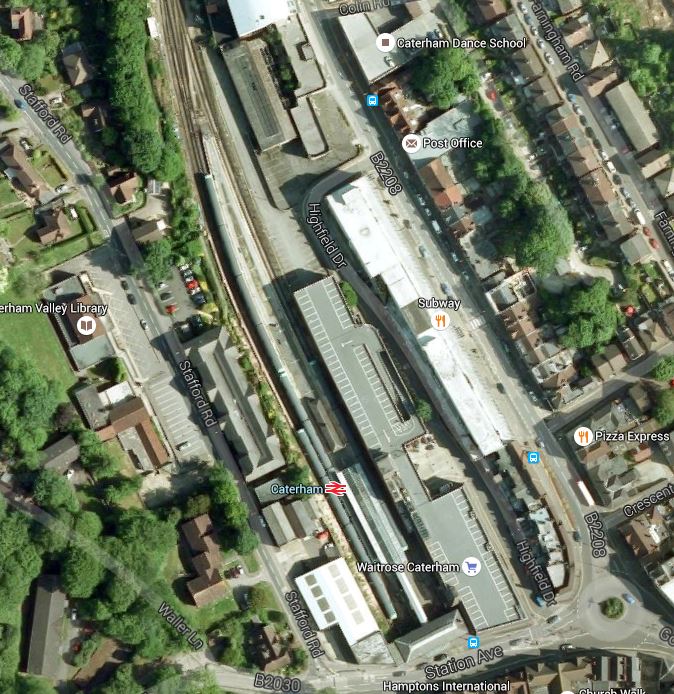
Caterham Station
Note how it is a two-platform station in a confined space. There would appear to be a large car psrk on one side of the station, with a Waitrose underneath.
I took these pictures whilst I was there.

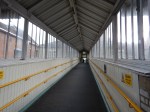
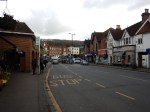
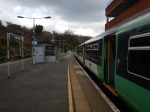
The Caterham branch and the station is typical of many branch lines in the UK and has a four trains per hour service to London; two to each of Victoria and London Bridge.
A Trip To Tattenham Corner
Tattenham Corner station was built to serve the racecourse at Epsom as this Goggle Map shows.
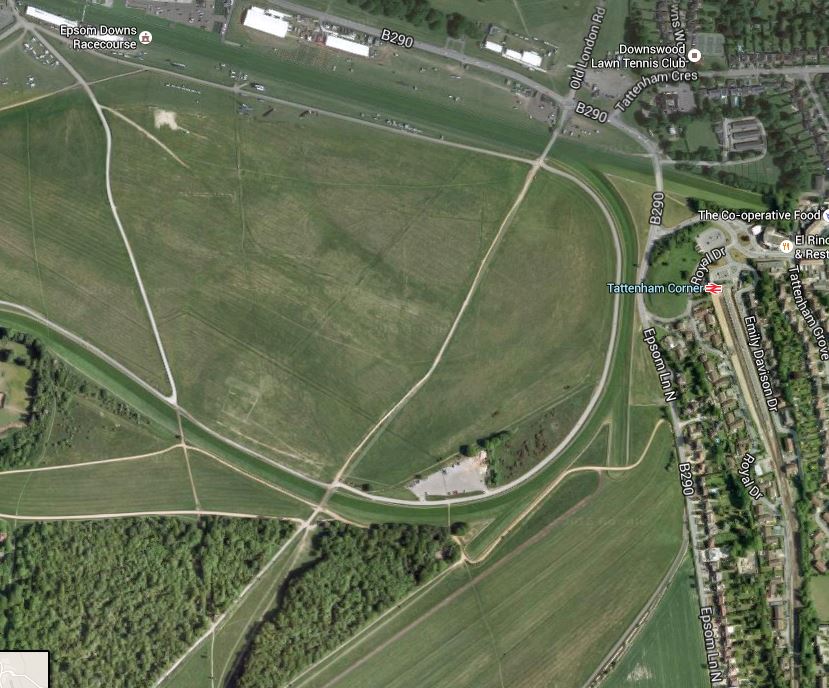
Tattenham Corner Station And Epsom Racecoiurse
Perhaps because of the racecourse and the Downs, unlike Epsom which is in Fare Zone 7, Tattenham Corner is in Fare Zone 6, so it is in Freedom Pass territory.
I went to take these pictures and it should have been an easy trip from London Bridge, but I got the wrong train and had to change at South Croydon and Purley.
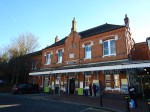
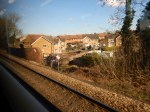

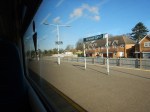
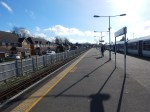
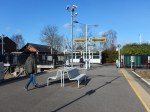
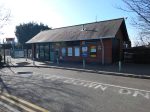
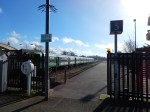
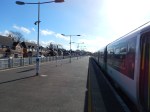



It was very much a trundle through typical Surrey countryside of woods, fields and semi-detached houses.
I do wonder if the team that decided that Cambridge would be the other end of the Thameslink service from Tattenham Corner were racing enthusiasts, but it will certainly come in handy for racing, as driving from Newmarket to Epsom is not that easy.
I also wonder, if as Thameslink develops, then this station will get used as a Park-and-Ride station close to the M25 for London, as the Class 700 trains will be a large increase ion capacity.
More Pictures Of The Bermondsey Dive-Under
I took these pictures from the other track of the Bermondsey Dive-Under.

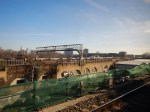


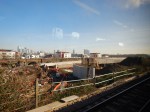

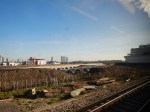
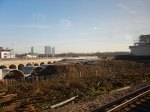
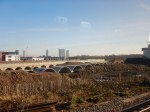

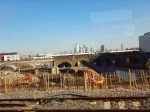
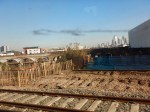
I think they are better than those I posted under Works Around The Bermondsey Dive-Under.
New Track South Of London Bridge
These pictures were taken as I took the 10:29 to Caterham from London Bridge.

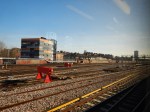
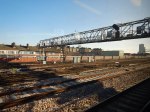
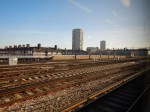
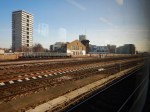
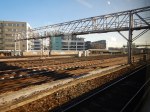
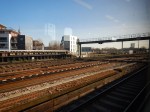
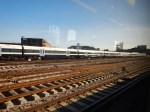
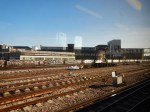
There certainly seems to be a lot of new track going in.
Last Ever Class 66 Locomotives Arrive In UK
The title of this post in the headline in an article on Global Rail News. It describes how the last seven Class 66 freight locomotives have now been delivered to the UK.
In my view it is mixed news.
- We need more freight locomotives to get cargo traffic off the roads and these seven will help.
- Class 66 locomotives don’t meet the current EU emission regulations as is explained here.
- They are extremely noisy, vibrate badly and are a constant source of complaints, where they run through built-up areas.
- Once they are imported, will we ever see the back of them?
In addition, we are electrifying more and more lines and in particular freight routes, so where are orders for new electric locomotives?
Will We Get Trams On The Isle Of Wight?
The Island Line on the Isle of Wight, is an oddity in that it is part-tourist attraction, part-commuter link and part-important railway, run using old London Underground tube trains. I wrote about my only ride on the line in A Trip On The Island Line.
According to this report on Rail Magazine, which is entitled Garnett report advises trams for the Isle of Wight, it would be better if the line was redeveloped using trams or light rail, and probably run under much greater local control.
I agree, but I can already hear moans from people who want to keep the line as it is. But it must be a maintenance and operational nightmare! All credit should probably go to South West Trains and their partners, who keep this museum piece running.
I also feel that there could be some innovative form of light rail, run on this difficult line, using a mix of all the new technologies now coming in to the mainstream.
- Ability to run on a well-laid standard gauge track, without electrification.
- Battery/flywheel and electric operation with charging at end and interchanges to give a range of five to ten miles between charging stations.
- Spacious, step-free and enough vehicles, with the capacity of probably a three-car tram.
- Street running capability.
- Totally automatic or semi-automatic one-man operation.
- Tramway-style infrastructure and rules, so stops would be safe and simple.
- Several trips an hour frequency
- Contactless bank card ticketing.
In some ways the nearest form of transport at present is a Parry People Mover. But these are just not big or automated enough. However a modern tram run with more automation and on batteries could be a solution.
I think there is an opportunity on the Isle of Wight to create the prototype of an advanced form of self-contained, environmentally-friendly transport system.
The Island Line is unique in the UK at the moment, but I can think of several places, where this form of automatic light rail people mover might be a solution.
- Chessington South to Chessington World of Adventures
- Greenhithe to Bluewater
- Ipswich to Felixstowe – It could even extend to the seafront along pedestrianised streets.
- Romford to Upminster – Surely, running a four-car Class 710 train is an expensive solution!
- St. Erth to St. Ives
There must be many places in the UK and around the world, where a simple standard drop-in automatic light rail system can be applied.
Many could even be built by local commercial interests or authorities.
The Last Class 378 Train Has Been Lengthened
The last Class 378 train to be lengthened to five cars has a special board on the front.
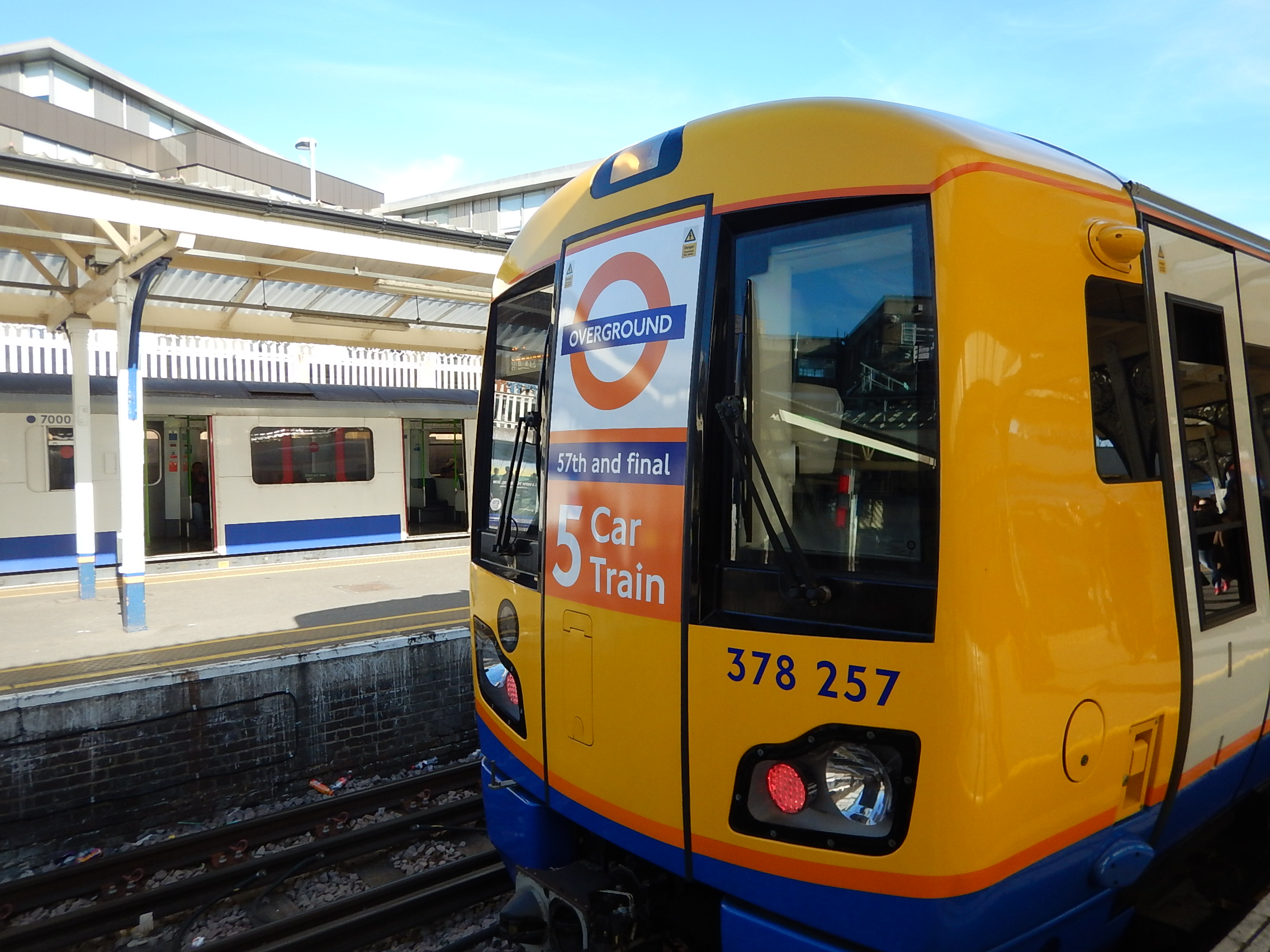
The Last Class 378 Train Has Been Lengthened
According to this article on RailStaff, the trains won’t be going to six cars. This is said.
Six car is not really an option on either the North London Line or particularly the East London Line because of the constraints of the tunnels.
If that is the case, then to get more capacity, they will need an increased frequency and probably more trains. The Wikipedia entry for the Class 710 trains that will be used on other Overground lines says this.
TfL invited expressions of interest for a total of 39 four-car EMUs in April 2014, with 30 required for the Cheshunt and Chingford routes, 8 for the Gospel Oak to Barking, and 1 for the Romford to Upminster. Since then the planned procurement has been increased to 45 four-car EMUs, with the additional 6 units intended for the Watford DC Line. The intention is that the five-car Class 378 trains used on the Watford route will be cascaded back to the North London and East London Lines to allow for strengthened services.
So it looks like the Watford DC Lines will be running different trains, although they will be the same as those on the Gospel Oak to Barking Line. So the GOBlin will be getting dual-voltage trains, so this means that in future an extension to invade South London via Acton and Hounslow is not compromised.
Thameslink’s Proposed Service In A Few Years
I’m putting this up for my own help, as I often need to answer my own questions about the services and where they call.
Much of what I am using here has come from the Wikipedia entry for the Thameslink Programme. Imporant sections are.
- Bermondsey Dive-Under
- Provisional Timestable
- Rolling Stock
- The Last Phase Of The Programme (Key Output 2)
This a map of Thameslink Services.
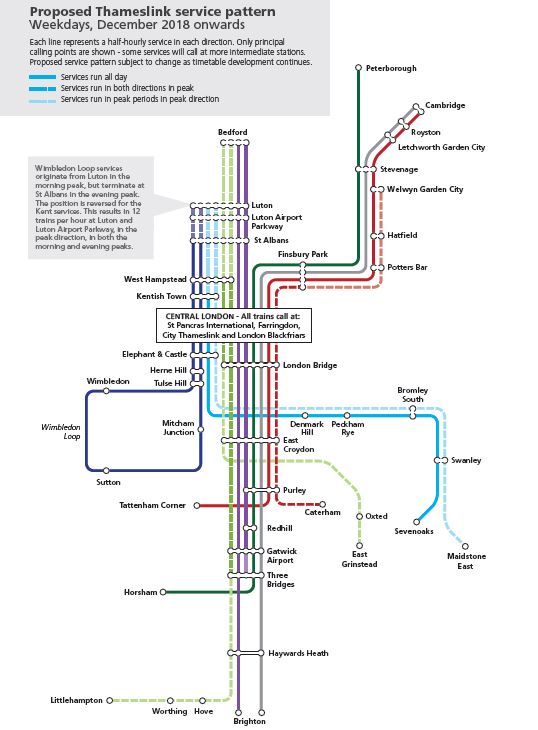
ThamesLink Programme Map
I shall finish with a section of Questions and Answers..
At Which Stations Will All Thameslink Services Call?
St. Pancras International, Farringdon, City Thameslink and London Blackfriars.
So if you want to change your destination tro another Thameslink branch, you would get off your train at any of these stations and wait for one that serves your destination.
At Which Stations Will Thameslink Call Between London Bridge and East Croydon?
None!
How Will You Get To Thameslink From Dalston Junction And The East London Line?
It would appear that there will be no easy way to do it, as no Thameslink trains will stop anywhere between London Bridge and East Croydon.
Where Is The Journey Time Calculator?
You tell me! I can’t find one!
Why Is The Sutton Loop Still in the Programme?
Under Political Developments, the Wikipedia entry says this.
Network Rail had planned to terminate Sutton Loop Thameslink trains at Blackfriars station, rather than have them continue through central London as at present. This upset many residents in South London and their local politicians, who saw it as a reduction in services rather than an improvement. In response to pressure, government has ordered Network Rail to reverse the decision.
I will add a few more questiuons later.
Contactless Between East Croydon and Gatwick Airport
I recently travelled to Gatwick Airport and went via East Croydon station, which is a Zone 6 station and thus Freedom Pass territory for lucky Londoners like me!
I used my Freedom Pass to get to East Croydon, by changing at New Cross Gate from the East London Line.
At East Croydon, I found myself on the well-appointed Platform 5, with its coffee stall, waiting room, information booth and toilets.
The only thing that the platform lacks is an Oyster reader, so that those like me, who need to touch-out and touch-in again, as they are changing from a Zone 6 ticket to contactless for Gatwick Airport, don’t have to walk up and through the barrier.
Incidentally, for those like me who have a Freedom Pass, there is an interesting anomaly. After going through the barrier, I then re-entered the station using my AMEX card, before catching a Bognor Regis/Southampton Central service to Gatwick Airport.
At Gatwick I entered the Airport using my AMEX card and when I checked the statement I found that I’d been charged three pounds for the journey.
Coming back, I bought a ticket in a machine from Gatwick Airport to East Croydon and I was charged three pounds and forty-five pence.
So contactless cards may be cheaper! And the return ticket used my Senior Railcard!
I shall have to travel between East Croydon and Gatwick Airport on a Gatwick Express and see how much I’m charged.
It would seem to me that for Freedom Pass holders, the cheapest way to get to Gatwick, is to use the pass to get to East Croydon, exit the station and then re-enter the station using an Oyster or contactless bank card.
It’s just a pity, there isn’t an Oyster reader on the platform at East Croydon, so that those changing for Gatwick at the station can touch out and touch in again.
But this simple exercise showed that for those wanting to go to Gatwick, using contactless ticketing is the way to go.
Untangling The Brighton Main Line
I like difficult problems and getting more capacity out of the Brighton Main Line between London and Brighton is one of the most difficult problems on the UK rail network.
I have just read this document on the Government web site, which is entitled Brighton Main Line – Emerging Capacity Strategy for CP6.
Most of the problems are at the London end of the line and can probably be blamed on the fact that the Brighton Main Line was built by two companoes; the London Brighton and South Coast Railway and the South Eastern Railway.
There is this little history lesson in the document.
The London and South Western Railway, which operated today’s Wessex Route area for example, was able to grade separate almost all of its major junctions between London and Basingstoke in the Victorian era. The London, Brighton and South Coast Railway which operated the Brighton Main Line was unable to fund grade separation at key junctions. Even when further opportunities presented themselves for remodelling with stimulus funds in the 1930s, the by then amalgamated Southern Railway, despite developing plans for several grade separations, chose to prioritise the South West Main Line (delivering the grade separation of slow and fast lines north of Wimbledon).
The only sorting of the line done in recent years, was the creation of the Thameslink opening in the 1980s.
But as with many British Rail projects of the era, it was not done rigorously, with all major junctions, stations and other issues fully sorted.
A section in the document lists some of the bad points on the line and some possible solutions. Going South they are as follows.
Victoria Main Line Platforms
The document talks of a major reorganisation of the operation of the station. This is said.
The terminus of the BML, Victoria has seven terminating platforms available to Fast Line services although two of these are dedicated to the 4tph Gatwick Express service to simplify access for airport passengers. This leaves the remaining platforms to handle a higher volume of traffic. Development either side and above the station means the options for building additional platforms at the terminus are extremely limited.
Could it be that there has been a bit too much development around the station?
Clapham Junction Main Line Platforms
The document says this about Clapham Junction’s affect on services.
Clapham Junction is the key platform-based constraint on the route into Victoria. The station has single Up BML Fast and Down BML Fast platforms, and the majority of Fast Line services call here. The platforms have a booked dwell time of one minute and a platform re-occupation time of two minutes3 . This effectively pegs the maximum theoretical capacity of the BML Fast Lines into Victoria at 20tph – although when combined with constraints elsewhere on the route it is effectively less.
The solutions proposed at Clapham Junction station are complex and would probably be difficult to impl;ement given space and political considerations.
Windmill Bridge Junction
This is a major junction just North of East Croydon station, where one set of lines goes North-West through Selhurst and Clapham junction stations to Victoria and another set of lines goes North-East through Norwood Junction and New Cross Gate stations to London Bridge.
To complicate matters, Selhurst Depot lies in the junction, as this Google Map shows.

Windmill Bridge Junction
Selhurst station is at the top by the depot and East Croydon station is to the South.
The document says this should be done.
Grade separation of remaining flat junction conflicts (Down Victoria Fast with Up London Bridge Fast) and Up London Bridge slow with Down Victoria slow) under development.
Effectively, this means putting a flyover to separate trains going to London Bridge from those coming from Victoria.
At least the map shows that there is some green space between the two sets of lines.
East Croydon Station
This station is another station with not enough capacity. This is said in the document.
East Croydon has three Fast Line platforms but their use is complicated by the track layout at the London end of the station that involves conflicting moves between Up London Bridge fast and Down Victoria fast services at Windmill Bridge (listed above), as well as requiring reversible use of Platform 2.
The solution is mapped out in the document.
Scheme providing an additional 1 Line platforms and or 2 platforms under development. associated track layouts Scheme would also provide additional track East Croydon to Windmill Bridge Junction and track layout and signalling changes in the immediate East Croydon area including to relieve platform 4 and 5.
I think with all the development going on around East Croydon station, that this might help the addition of extra platforms. Wikipedia gives more details about the future development of East Croydon station.
South Croydon Junction
This junction just south of South Croydon station causes conflicts, where Oxted Line services conflict with down slow services.
This Google Map shows South Croydon station and the junction.
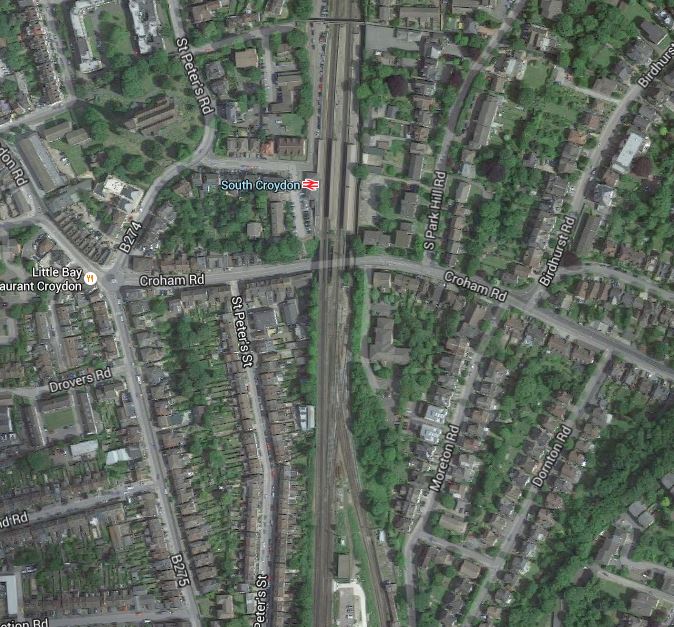
South Croydon Station And Junction
The document says this about a solution.
No viable solution currently available. Relief of other constraints may allow current layout to remain, as the flat junction constraint predominantly affects Slow Line services (although potentially constrains the pathing of services that use the Fast Lines north of Croydon).
But it is now probably more complicated as longer trains are proposed for the Uckfield Branch.
Stoat’s Nest Junction
The wonderfully-named Stoat’s Nest Junction is south of Purley station and causes the odd delay. The document talks about a solution.
A grade separation option for Up Slow to Up Fast moves under development.
It is probably a smaller but important project.
Gatwick Airport
There will be twenty trains an hour through the station at Gatwick Airport.
Given the investment being put into the station by Gatwick and the importance of the station as a hub, I feel that a way could be found to use the station to squeeze some more capacity out of the line.
Keymer Junction
Keymer Junction is south of Wivelfield station and causes delays =. The document says this about a solution.
Several options under consideration from grade separation to a third track option – case yet to be proven and would not be required if reliability and capacity uplift was focused on Gatwick inwards only.
This is one solution, that I think will be a bit different, as it could unlock capacity in Brighton and on the two Coastway Lines.
Crossrail 2
You may wonder how Crossrail 2 will affect the Brighton Main Line?
There are three stations in common between the two lines.
- Victoria
- Clapham Junction
- Balham
Will passengers switch between the two lines at stations before Victoria?
If they do, the major effect will be to perhaps free-up Victoria station by a small amnlunt.
Conclusions
There would appear to be several places where capacity improvements can be made.
But don’t be surprised if something radical happens at Gatwick!
If a second runway were to be built at the airport, then this would need more capacity to London, which would have effects on the trains south of the airport.
 The Anonymous Widower