Are Tram-Trains A Good Idea?
After my trip around Germany and France, have I come to any conclusions about the concept of tram-trains?
I must admit, I was sceptical when I set out, as some of the claims about the advantages of tram-trains seemed too good to be true!
So what are their strengths? And how would they fit the planned test route to Rotherham that will extend the Sheffield Supertram?
Dual Voltage
In both Mulhouse and Paris, the tram-trains are dual voltage and can run on both 750 V DC and 25kV AC. This type of tram-train will become the standard as main lines are increasingly electrified with the higher AC voltage.
In the case of Sheffield, which will be electrified to London, Doncaster and other places in the next decade or so, dual voltage Class 399 tram-trains will be essential to future proof the system.
Standard Gauge
All except one of the tram and tram-train systems I used or saw were standard gauge systems. The exception was Darmstadt, where trams were of a narrow gauge. Any standard gauge system could be used by tram-trains of the same gauge. In the UK, France and Germany that means to incorporate tram-trains on a tram network, that the tram network must be standard gauge.
There are no tram systems in the UK, that are not standard gauge.
Tram-Trains Can Be Low Floor
Buses and trains are moving towards totally flat and low floors, where to enter you just step or wheel yourself across.
The Mulhouse and Paris Siemens Avanto tram-trains achieve this and it has been stated that the Class 399 tram-trains for Sheffield will be low-floor.
Tram-Trains Are Larger Than Trams
Generally tram-trains are larger than trams. I don’t know for sure, but this could be for crash-worthiness reasons when running as trains.
With Sheffield this is an advantage as the Sheffield trams are bigger than most of those in other systems.
Tram-Trains Are Faster Than Trams
I don’t know at what speed the tram-trains that I rode ran, but it was certainly faster than the average tram.
Tram-Trains Are Almost As Fast As Pacers
A Class 142 Pacer has a top speed of 120 km/hr, whereas the Siemens Avanto used in Mulhouse and Paris has a top speed of a hundred and the Class 399 tram-trains for Sheffield have a top speed of 110 km/hr.
I suspect though that the electric vehicles have better acceleration and braking, so they might even be quicker over a route like the Hope Valley Line. I won’t comment on the passenger experience, but I will say that they probably have a slightly higher capacity of over two hundred, if you count standing passengers.
Tram-Trains Release Platforms In City Centres
This was well-illustrated in Kassel, where the Hauptbahnhof has been effectively released for other uses after the building of two underground island platforms.
By joining services together it might also be possible to release platform needs, just as Thameslink and Crossrail will do in London.
I’ve spent a lot of time waiting for local train services in Sheffield, so is there any scope for joining more services together.
Acting Like Trams In A City Centre
This was impressively shown in Kassel, where except for the colour and size, you couldn’t tell which vehicles were trams and which were tram-trains.
Sheffield’s tram line layout is very like Kassel with a shared centre section.
Acting Like Trains On Train Lines
Once on a railway line, the trams must be able to use the voltage of that line, have the same crash protection and signalling of a train and have the performance not to interfere with all other traffic.
Tram-Trains Can Have Alternative Power Sources
Around the world, there are several examples of tram-trains that have on-board diesel engines as well. Kassel has ten for a start.
And there are of course the battery trams in Nice and Seville.
Tram-Trains Don’t Need Lines To Be Converted
If tram-trains need to use a line they don’t stop other traffic like freight trains and express passenger services using that line. In some places in the UK, tram lines have been created by ripping up heavy rail tracks, which might need to be used again.
Tram-Trains Can Create An Extensive Network
The Manchester Metrolink has a network of around ninety kilometres, whilst Sheffield’s Supertram has a length of around thirty.
Compare this to Kassel at over a hundred and eighty kilometres and Karlsruhe at over two hundred and sixty.
The two German cities are substantially smaller than the two major English ones.
Tram-Trains And Sheffield
Tram-trains are not some difficult concept, but any competent group of railway, tram, electrical and control engineers should be able to create a system that works pretty well.
At least in choosing the line to Rotherham, they haven’t set themselves too difficult a task. Sheffield also has a very good layout in the area to the east and north of the main line station.
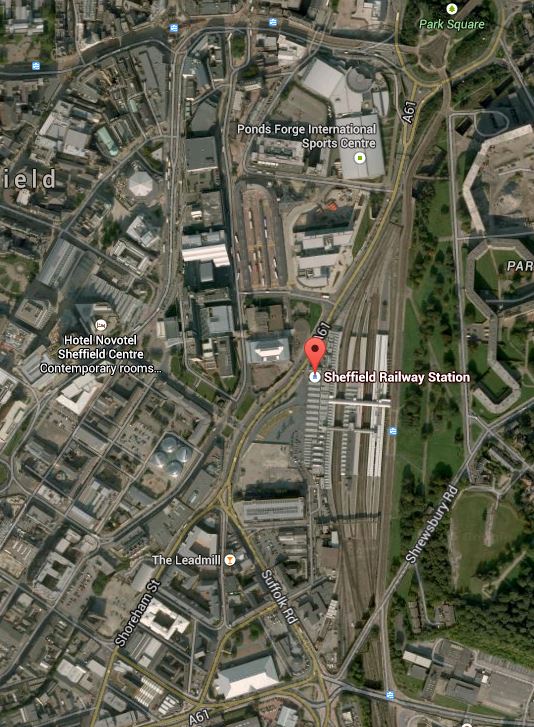
The Trams Around Sheffield Station
There are some things to note in this Google Earth map.
1. At the top right of the map, the three branches of the system meet in a triangular junction. The northern branch goes to Meadowhall and in the future Rotherham, the southern branch goes past the rail station and the western branch goes through the city centre. I don’t think that services use this junction in every posible direction, but it appears to have been future-proofed to cater for all eventualities.
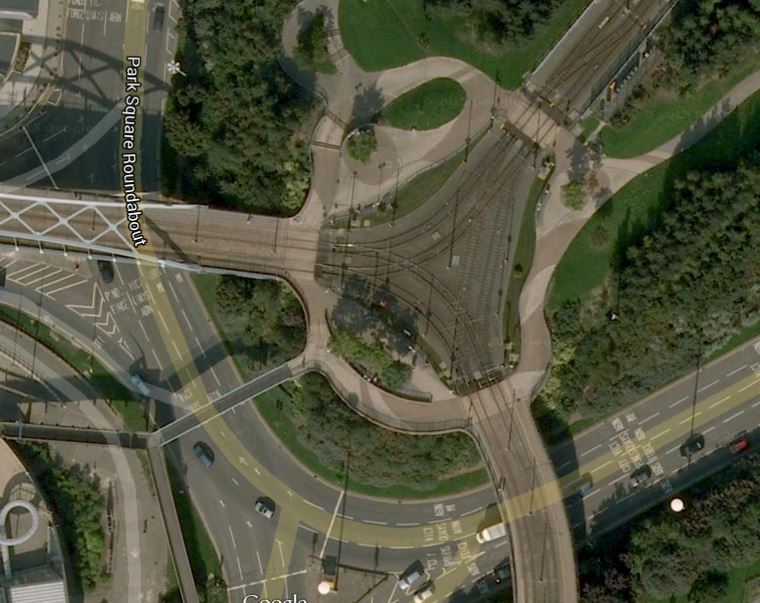
In this enlargement, the tracks and wires are clearly shown.
2. The southern branch past the station runs parallel to the rail lines.
3. There is quite a bit of space to put in extra tracks.
I also think, that after seeing the systems in Kassel and Karlsruhe, Sheffield could incorporate tram-trains fairly easily. Not being the first is a definite advantage, as ideas, designs and technology have moved on, as the Mulhouse system showed.
At some point in the future a lot of rail lines in the Sheffield area are going to be electrified to the main line standard of 25 kV AC and this might mean that the line used by the tram-trains to get to Rotherham in future may have this voltage. The Class 399 tram-trains themselves will be bought with a dual voltage capability, so they won’t care, but it seems a pity to put up one set of wires and then rip them down for another. Perhaps, you put up main line catenary initially and use it to provide a 750 DC supply! I’ll leave that one to the engineers.
An Extension To Dore
Plans have existed in the past to extend the Sheffield Supertram to Dore and some reports state that Dore will be linked to Meadowhall to improve HS2 connectivity. This Google Earth map shows Sheffield and Dore and Totley stations.
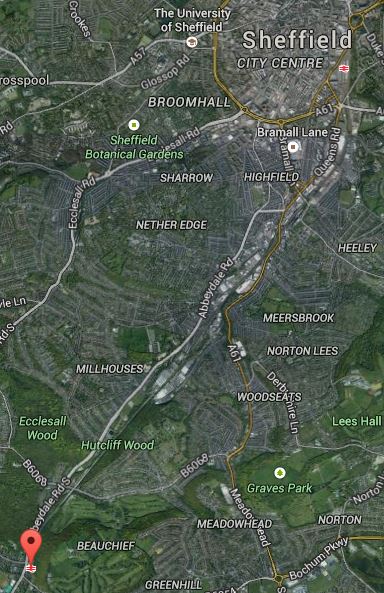
Sheffield To Dore
Dore and Totley station is on the Hope Valley Line, which will probably be electrified in the next ten years or so.
So could tram-trains come past Sheffield station and then go down an electrified Hope Valley Line?
I know little of the area, but because plans have been drawn up in the past, others must have a good idea. This document from Sheffield University written in 2003, gives a summary of what might happen.
But it predates any thought of tram-trains in Sheffield.
Could The Hope Valley Line Run Tram-Trains To Both Sheffield And Manchester?
This section in Wikipedia’s article about the Hope Valley Line, talks about proposals to to extend the Manchester Metrolink to Rose Hill Marple station on a spur off the line. Tram-trains could be used.
As Dore and Totley station is at the Sheffield end of the Hope Valley Line, could we see tram-trains going to both Manchester and Sheffield?
And What About Manchester And Sheffield?
I can remember reading in my Meccano Magazine in the 1950s about the ground-breaking electric-hauled Woodhead Line between the two cities.
This is said about tram-trains in the Wikipedia section for extensions to the Manchester Metrolink.
Metrolink and the TfGM Committee have prepared five costed proposals for extending Metrolink using tram-train technology over the existing heavy rail network in the region; along the Mid-Cheshire Line (between Stockport and Hale), the Hope Valley Line (between Manchester and Marple), the Glossop Line (between Manchester and the dual termini at Hadfield and Glossop), the Manchester to Sheffield Line (between Manchester and Hazel Grove), and along the Manchester to Southport Line (between Manchester and Wigan via Atherton), with an estimated total funding requirement of £870 million as of 2013.[197] TfGM intend to proceed to the identification of potential rail industry funding options, subject to a review of lessons from a tram-train pilot scheme in Sheffield.
So could we see the opening up of routes between the two cities using tram-trains, if the trial in Sheffield to Rotherham is successful.
The old Woodhead Line is just over sixty kilometres long, which means that from what I saw in Karlsruhe and Kassel, tram-trains could easily handle the distance between Manchester and Sheffield.
An interesting possibility for which the technology exists is a dual voltage tram-train leaving Manchester and taking the Hope Valley Line, which is electrified at its western end, which then travels over the Pennines to Dore, using either diesel or battery power, from where it becomes a tram on Sheffield’s network.
It won’t happen soon, but it is no fantasy, as I’ve seen all the technology needed in Kassel, Karlsruhe and Essex.
So will we see, heresy-of-heresies, an operational merging of the tram systems across the Pennines?
But imagine two, three or even four new tram-trains an hour on each of the routes between Manchester and Sheffield, that would extend their journeys into the city-centres, rather than need valuable platform space at Sheffield or Manchester Piccadilly stations.
I don’t know the lines well, so this might be pure speculation, but as the systems in Germany showed, if you get the track, power and signalling working, then good tram-trains can go virtually anywhere they’re needed.
A Vision For The North?
Let’s assume that the tram-train experiment from Sheffield to Rotherham is a success, which after my German and French experiences, I wouldn’t bet against.
So what happens next?
That is very much in the hands of the politicians, at both a national and local level, but from Sheffield and Manchester I could see tram-trains getting used on the numerous local lines that fan out from Manchester and Sheffield.
1. At present many of these lines are served by dreaded diesel Pacers, so the new tram-trains would be very welcome.
2. Some lines like the Hallam Line between Sheffield and Leeds via Barnsley could probably be just electrified with 750 V DC, to allow tram-trains to run.
3. As at Kassel not all lines would need to be electrified, as other technologies exist.
Everybody needs to have a bit of vision and if the Class 399 tram-trains, do what it says in the specification, we could be seeing them all over a dense network of lines in the north.
If all of these lines were upgraded, there is one thing that will happen for certain. The areas will improve in all ways, with better housing, more jobs and business and leisure opportunities.
Conclusion
To answer my original question, tram-trains are not a good idea, but a brilliant affordable solution to the big problem of urban transport all over the world.
In the UK, we must prove that the technology will work in a UK environment and I suspect there are many councils, tram and train operators eagerly awaiting the outcome.
A Diversion In Paris
As I had some time in Paris, I went to look at their first tram-train line, T4.
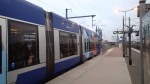

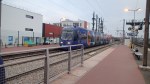


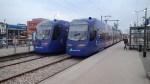
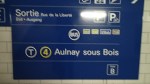
I didn’t ride the tram-train, as it was very crowded and I couldn’t find out how you bought a ticket.
But as it appeared the tram-trains were the same as those in Mulhouse, it was an experience I could pass.
The trams run from Bondy on RER Line E to Aulnay sous Bois on RER Line B.
A Quick Exploration In Mulhouse
On the way from Basel to Strasbourg, I stopped off at Mulhouse to have a look at the city and ride its tram-trains.
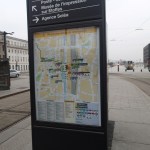

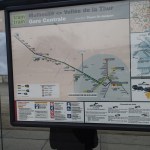
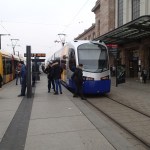
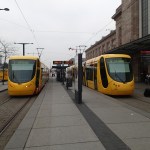
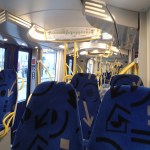

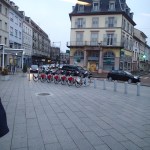
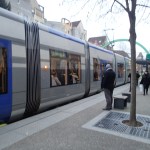

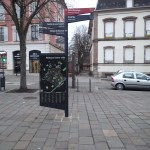

The line is a good bit short of its planned length and rather infrequent at the moment, but compared to the two German systems in Karlsruhe and Kassel, it is a step up in design quality.
I should also say, I was impressed with both Mulhouse and its trams and tram-trains.
There was a lot of information maps everywhere and this was an order of magnitude better than anything I’d seen in Germany.
The Germans could do a lot worse than hop over the border with a camera and pinch the designs used in Mulhouse.
I particularly liked the red finger on the finger post, which always pointed to the historic city centre. So simple, I wonder why I’ve not seen it before!
If you look at the proposal for the extension of the Sheffield Supertram to Rotherham using a tram-train, it has similarities to the system in Mulhouse.
The Siemens S70/Avanto tram-trains used in Mulhouse are dual voltage capable of running on 750 V DC or 25kV AC. The Class 399 Sheffield tram-trains which are being made by Vossloh are said to have a similar capability. You could argue that being able to run on both these voltages is akin to the dual-voltage Class 378 which run on both voltages. The Class 378 halts for the changeover at places like Acton, but surely modern electric systems can be designed that handle the changeover between voltages automatically.
From Karlsruhe To Basel
I left Karlsruhe for Basel and one of the tram-trains had even turned up in the station.
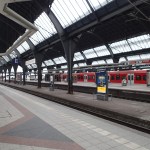

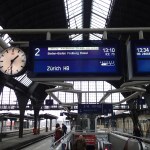
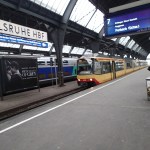
Again it was another of those journeys which would have been better in the sun.
There is though the chance of having a stop in Baden-Baden to break up the journey.
Exploring Karlsruhe And Its Trams And Tram/Trains
As the main reason I went to Karlsruhe was to see their tram/trains, properly called the Karlsruhe Stadtbahn, in action, I’m combining all the posts in the city in one.
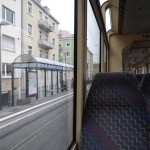
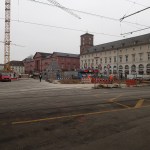
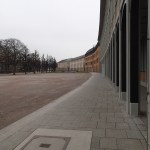
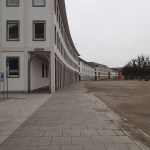
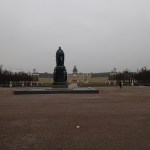
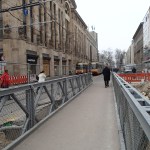
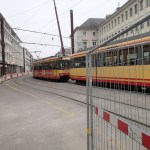
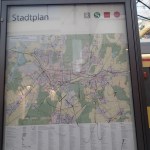
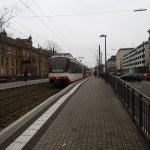
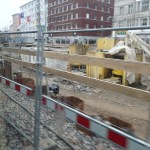
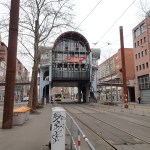
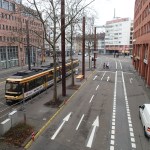
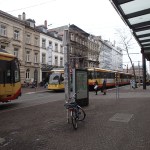
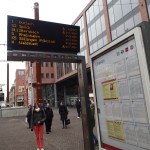
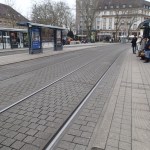
It’s also probably a good idea to combine the pictures, as the main street of the city is being dug up to create a new tunnel for the tram/trains across the city. So you can’t really see any of the city’s attractions.
Notice that Karlsruhe’s tram/trains can be quite large and I think I saw some of four or possibly five coaches. Their network is also over two hundred and fifty kilometres, so small it is not! By comparison the Sheffield Supertram is just thirty kilometres, but Sheffield has a population twice that of Karlsruhe. These figures show how undeveloped our tram systems are compared to those in Germany.
It will certainly be worth returning to Karlsruhe, when the tunnel is complete and the network is expanded.
The operation of Karlsruhe’s tram-trains are often described as the Karlsruhe model. Kassel is described as working to this and so is the Tyne and Wear Metro, although that is not a tram-train, but it does share tracks with heavy rail.
Karldruhe also uses Vossloh Citylink tram-trains, which are similar to the Class 399 ordered for Sheffield for operation as tram-trains to Rotherham.
A Design Crime – Crap Station Design In Kassel
Some parts of Kassel’s urban tram system might well have been good, but these images of some of the stations, show the crap level of some of the design.

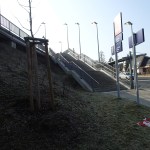
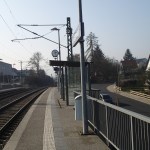
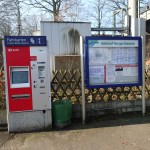
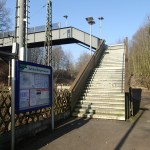
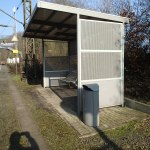
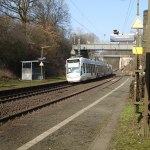
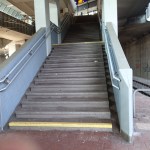
One thing that surprised me was the crudeness of some of the stations I visited, which just had steep steps and no lifts. This certainly wouldn’t be acceptable in the UK for a new station and I’m surprised that German disability rules allowed such a station design.
I nominate their stations as a Design Crime.
The Trams And Tram-Trains Of Kassel
Kassel’s urban tram system mixes both regular trams and larger tram-trains on lines that cross the city. I took these pictures as I sat in a cafe on the Königsplatz in the centre.
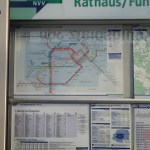
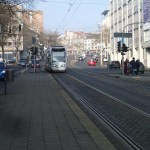
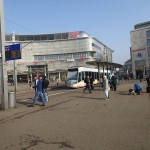
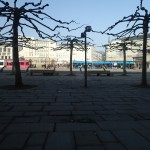

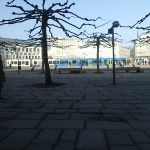
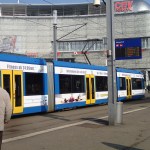
The smaller generally blue ones are trams, whereas the larger silver ones are the tram-trains, which have routes that reach far into the suburbs.
The passengers could be seen alighting, boarding and transferring between the various trams, very much as they do in Piccadilly Gardens in Manchester, East Croydon and Fitzalan Square in Sheffield. It is interesting to note that the current Sheffield Supertrams are more the size of Kassel’s tram-trains, rather than their trams. Comparing Sheffield to Kassel, it is a bigger city, but its tram network, is nowhere near the size of that in Kassel, which is about six times as large.
After sitting for half-an-hour or so, I decided to explore the outer reaches of the system on a tram-train.
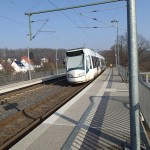
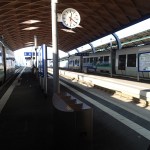

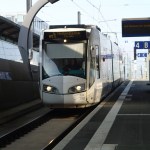

One thing that surprised me was the crudeness of some of the stations I visited, which are shown separately in this post.
There also only seems to be a train in places only once every thirty minutes.
On the core section of the East London Line near where I live it’s sixteen trains per hour, and limbs of the line to places like West Croydon and Clapham Junction, there are four trains per hour. Like much of the transport in London, these trains are also step-free from the platform, which I think a modern transport system should be. As the picture shows there was a protected gap in Kassel, which would have been difficult in a wheel-chair.
Kassel seems to have about half London’s frequencies. This low frequency and the poor street access probably explains, why in the middle of a Monday, there wasn’t a large number of passengers about.
A Hauptbahnhof But Not As The Germans Know It!
Hauptbahnhof, which is often abbreviated to Hbf, is the German equivalent of Central.
But Kassel Hauptbahnhof is a station that the high speed line from Hanover to Wurzburg, ignored to call at a new station of Kassel-Wilhelmshohe. So as it now gets only a few trains, and has been transformed into a culture station, with a tram-train station underneath.

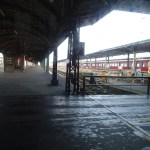

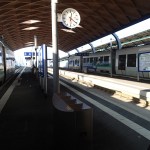
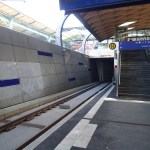
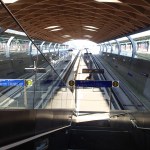

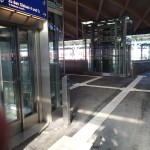


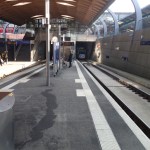
It struck me that the people of Kassel could find a better use for it, although the tram-train station appeared to work well.
According to Wikipedia it is the only Hauptbahnhof, that is not the main station for the town or city. So when you book a hotel in Kassel and you’re coming by train, make sure the hotel is by Kassel-Wilhemshohe station
What Is Happening To The Sheffield-Rotherham Tram-Train?
The Sheffield-Rotherham Tram-Train is a pilot project to prove whether the technology can work on UK railways.
It’s a laudable aim, but I don’t like pilot projects as if they work, then you usually end up with an inadequately funded permanent one, that is lacking in certain areas and has to be upgraded. On the other hand, if they don’t work you have all the expense of ripping them out.
It is much better to take proven technology and phase the introduction of the system, funding and building every phase adequately.
This Google Earth map shows the area where the tram-train will run.
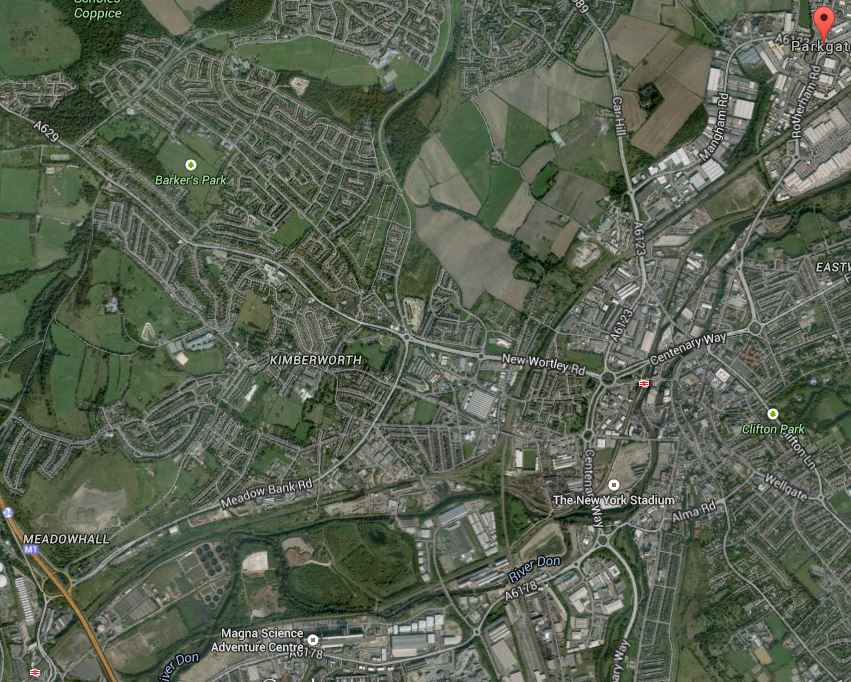
Sheffield Rotherham Tram Train
In the top right or north east corner of the image is the Rotherham Parkgate Retail Park, which will be the terminus of the route. In the bottom left hand corner is Meadowhall Shopping Centre, with the associated Interchange station, where the tram-train will join the Sheffield Supertram network. Tram-trains are proposed to run three times in an hour, which would be in saddition to the two or three trains per hour on the route.
This Google Map shows the layout of train tracks around Rotherham Central station.
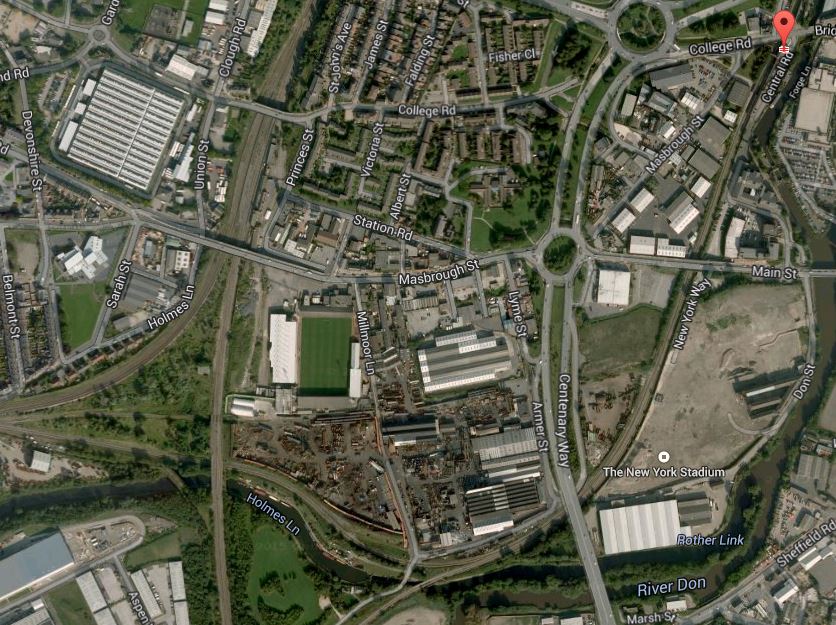
Lines Through Rotherham
Note the New York stadium marked on the map, but not shown, as the image was taken before the stadium was built. Just after the stadium, the lines split with one going west to join other lines and go direct to the Meadowhall Interchange and the other, which is now a freight route, going more south-west over the river towards Sheffield.
This Google Map shows the layout of the railway lines and the tram tracks around Meadowhall Interchange.
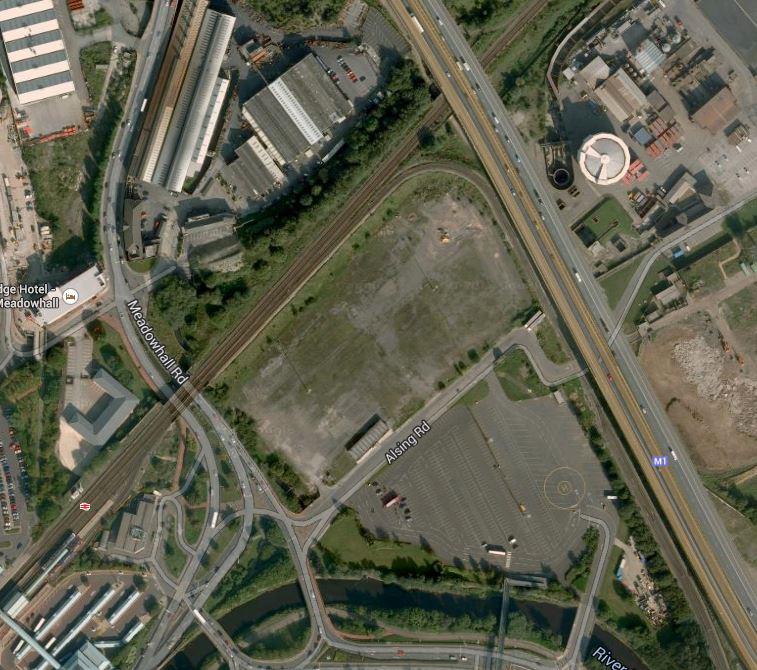
Meadowhall Tram-Train Connection
Meadowhall Shopping Centre itself, is just off the bottom of this map and is connected to the station by a bridge over bus, tram and train stations, which can just be seen in the bottom-left corner.
Note how the railway to the east from Sheffield goes under the M1 motorway, with the Sheffield Supertram coming up parallel to the motorway and then turning into the interchange.
It will be difficult to get this connection right, as a direct tram-train from Rotherham will come under the motorway and then stop in the Meadowhall Interchange station. I would assume that it would stop in the Sheffield Supertram platforms and then reverse direction to go on to Sheffield.
This must be wrong, as it would be a difficult scheme to run efficiently with three tram-trains an hour in each direction reversing in the tram platforms and then Rotherham-bound trams sometimes waiting there to cross the westbound rail line to get on the right track for Rotherham.
So I would assume the second route that breaks off to the south-west from Rotherham would be used. This Google Earth map shows where the line meets the Sheffield Supertram around Meadowhall South station.
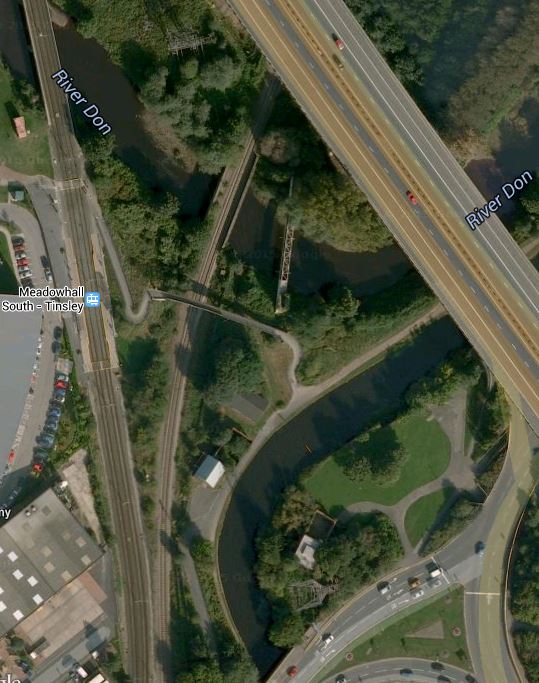
Medowhall South
This would be a much easier connection and I think this is the way the tram-trains will go to and from Rotherham.
The Sheffield-Rotherham tram-train has been a long time coming since the decision to start. I wonder if the reason is that the engineering of both track and signalling has been much more difficult than first thought. The first direct route is difficult if not impossible operationally, but sorting out the tracks for the second route may not be too easy, as looking at the image there is a lot of water about, that might need to be bridged, by the tight turn.
I think too, that as it’s only a trial, we might see a single track curve, as the tram-trains will be reversing at Meadowhall Interchange. That would at least cut costs and men less disruption to the Supertram, whilst the connection is being made.
One issue that has to be thrown into the pudding, is the electrification for the trams, which is 750 volts DC overhead. If at some future date the planned electrification of the Midland Main Line and trans-Pennine routes at Sheffield is extended to Meadowhall and Doncaster, then the new station at Rotherham Central would possibly be electrified at 25kV AC.
So it could be that extending the tram-train pilot scheme between Sheffield and Rotherham into the future, might be scuppered by electrification plans for the North.
It does strike me that the £60million or so being spent on the tram-train pilot, might be better spent on providing extra trams for the Sheffield Supertram and trains for more services through Rotherham.
Could it be that just as the great and good in the Department for Transport, forced Cambridge to have a guided busway, they are persuading Sheffield and Rotherham to have a tram-train?

