Lord Adonis On Crossrail Of The North
There has been a lot of talk recently about HS3, Northern Powerhouse Rail or Crossrail Of The North.
On Radio 5 Live, this morning, Lord Adonis said a lot of sensible things about the high speed line from Liverpool to Hull via Manchester and Leeds.
His plea was for a plan for a start and he suggested that an objective would be to halve the journey time from Manchester to Leeds and have a train every few minutes.
He suggested it could be probably built using a mixture of new track alignments and existing railways.
I agree with what he said, but the problem is that every Tom, Dick and Harriet has their own ideas of what they want.
How Would I Design Crossrail Of The North?
I can at least look at this without favouring any one of the North’s great urban area.
Urban Areas Of The North
I will list those with populations of over 200,000,, from this list in Wikipedia.
- Manchester – 2,553,379
- West Yorkshire – 1,777,934
- Liverpool – 864,122
- Tyneside – 774,891
- Nottingham – 729,977
- Sheffield – 685,368
- Teeside – 376,633
- Stoke-on-Trent – 372,775
- Sunderland – 335,415
- Birkenhead – 325,264
- Hull – 314,018
- Preston – 313,322
- Blackpool – 239,409
- Barnsley – 223,281
Urban areas with populations between 100,000 and 200,000 include Wigan, Mansfield, Warrington, Doncaster, York, Burnley, Blackburn, Grimsby, Accrington, Burton, Lincoln and Chesterfield.
Some of the connections between pairs of these areas are truly dreadful despite being only fifty or so files apart.
Northern Connect
I would think it reasonable that all these centres of population have good, preferably direct, connections between them.
Northern obviously think this way as they are creating a concept called Northern Connect, using new Class 195 trains to connect many of these areas with a quality service.
The North TransPennine Routes
TransPennine operate these North Pennine routes.
- 1 train per hour (tph) – Liverpool Lime Street to Newcastle
- 1 tph – Manchester Airport to Middlesbrough
- 1 tph – Manchester Airport to York
- 1 tph – Liverpool Lime Street – Scarborough
- 1 tph – Manchester Piccadilly to Hull
Note that the opening of the Ordsal Chord iin a few months, might change the routing of some of these services.
All of these services use the Huddersfield Line between Manchester and Leeds, stopping at both Huddersfield and Leeds stations.
Manchester Victoria To Leeds
As Lord Adonis said, the important section is between Manchester Victoria and Leeds stations.
I’ll start with a comparison of a series of rail journeys, all of which are about the same length.
- The fastest trains between Manchester Victoria and Leeds take forty-nine minutes, with a stop at Huddersfield, and are just 1 tph
- Norwich to Ipswich in a couple of years, will take 30 minutes at a frequency of 3 tph.
- Glasgow to Edinburgh currently takes about fifty minutes, at a frequency of 4 tph.
- Cardiff to Swansea currently takes 52-54 minutes, at a frequency of 2 tph.
It does seem that the North has a point if two of East Anglia’s larger cities get a better service than Leeds and Manchester.
The Huddersfield Line And The Great Eastern Main Line Compared
It is also enlightening to compare the Manchester to Leeds Line via Huddersfield to Ipswich To Norwich section of the Great Eastern Main Line.
It should be noted that I’m comparing these two lines, as both have lived on scraps from Central Government for decades. I also know the Great Eastern Main Line well!
- Both lines are double-track.
- Norwich-Ipswich is flat.
- The Huddersfield Line is rather hilly
- Norwich-Ipswich has only two stations and only the occasional slower service.
- The Huddersfield Line has numerous stations and local services.
- Norwich-Ipswich is electrified to a robust standard.
- On the Huddersfield Line, only Manchester to Stalybridge is scheduled for electrification.
- Norwich-Ipswich has a 100 mph speed limit, that could possibly be raised in places.
- I can’t find the speed limit on the Huddersfield Line, but suspect it could be less than 100 mph.
It is truthful to say that the Huddersfield Line is a much more challenging route than the Norwich to Ipswich.
The Effect Of Electrification On The Great Eastern Main Line
It might appear that the electrification of the Great Eastern Main Line makes for the difference in times.
But it should also be remembered that Ipswich to Norwich wasn’t electrified until the mid 1980s and if I remember correctly before that date, the fastest expresses were timed at two hours from Norwich to London with just two stops. The fastest services now are ten minutes under two hours with four stops.
With the introduction of the new Class 745 trains, timings of ninety minutes have been promised to the Department for Transport.
Timings did not drop significantly with the electrification in the mid-1980s, Services just became more reliable with more stops, as electric trains can accelerate better.
The decrease in timings over the next few years will be down to the following.
- Removal of bottlenecks like Trowse Bridge.
- Increase in speed limits.
- Trains with a shorter dwell time at stations.
- Trains with better acceleration and braking.
- Improved track and signalling.
- All passenger trains on the line will have the same performance.
I will be very interested to see what timings, the Class 745 trains eventually achieve!
Electrifying Between Leeds And Manchester Victoria Stations
It looks like the electrification between Manchester Victoria and Stalybridge stations will be complete by the end of this year.
The central section of the route is problematical with the Grade 1 Listed Huddersfield station and large numbers of bridges.
In TransPennine Electrification And Piccadilly Upgrade Now Also In Doubt, I came to these conclusions about electrifying the route.
-
Electrification would not go anywhere near Huddersfield, as the heritage lobby and their lawyers would have a field day.
-
Standedge and Morley tunnels are over 2,000 metres long, double track and Standedge is level. If they needed refurbishment in the future, perhaps they could be electrified with an overhead rail, so that bi-modes could have a couple of miles of electricity.
-
Electrification might be extended at the Manchester and Leeds ends of the line, so that the two cities could improve their local suburban electric networks.
-
An alternative would be that the Leeds and Manchester suburban electric networks were provided with a few Class 769 trains or even some brand new four-car bi-modes.
-
Services between Leeds and Manchester would be run by fast bi-modes.
Is there a more difficult stretch of possible electrification in the UK?
The Ultimate Bi-Mode Train
Currently four bi-mode trains are planned for introduction into the UK.
- Hitachi Class 800 trains and Class 802 trains.
- Stadler Class 755 trains
- Porterbrook Class 769 trains
Note.
- Two hundred and eleven bi-mode trains have been ordered.
- Nineteen Class 802 trains have been ordered for TransPennine routes.
In Do Class 800/801/802 Trains Use Batteries For Regenerative Braking?, I look at the prospect of using energy storage in Hitachi’s bi-mode trains.
The Class 802 train is probably something like the ultimate bi-mode train.
- 125 mph using electrification.
- 100 mph under diesel power
- Regenerative braking at all times using energy storage.
- Automatic pantograph raising and lowering.
- Sophisticated in-cab signalling.
Obviously, interior fitment would be up to the operator.
Class 195 Trains
Northern is acquiring 25 x two-car and 30 x three-car Class 195 trains.
These are 100 mph trains, so it must be a good idea to make sure all Northern services that use the same routes as TransPennine services are run by these faster trains.
Short/Medium Term – A Classic Manchester Victoria To Leeds Route
TransPennine Express are already planning to run Class 802 trains between Liverpool and Newcastle via Manchester and Leeds. It looks to me, that whoever plans their train policy, saw the electrification crisis coming.
I wonder what times they can achieve between Leeds and Manchester Victoria, if the following were to be done.
- Stalybridge to Manchester Victoria electrification is complete.
- Track and signalling is the best it can be.
- The route has a 100 mph operating speed.
- All trains on the route are 100 mph capable.
- Northern replaces their scrapyard specials with Class 195 trains.
The reason for the same operating speed of 100 mph, enables trains to follow each other in a stream. It could be 90 mph, if that was easier for the route.
Station dwell times can also be reduced.
Due to overcrowding, the TransPennine dwell times, must currently be some of the worst in the UK.
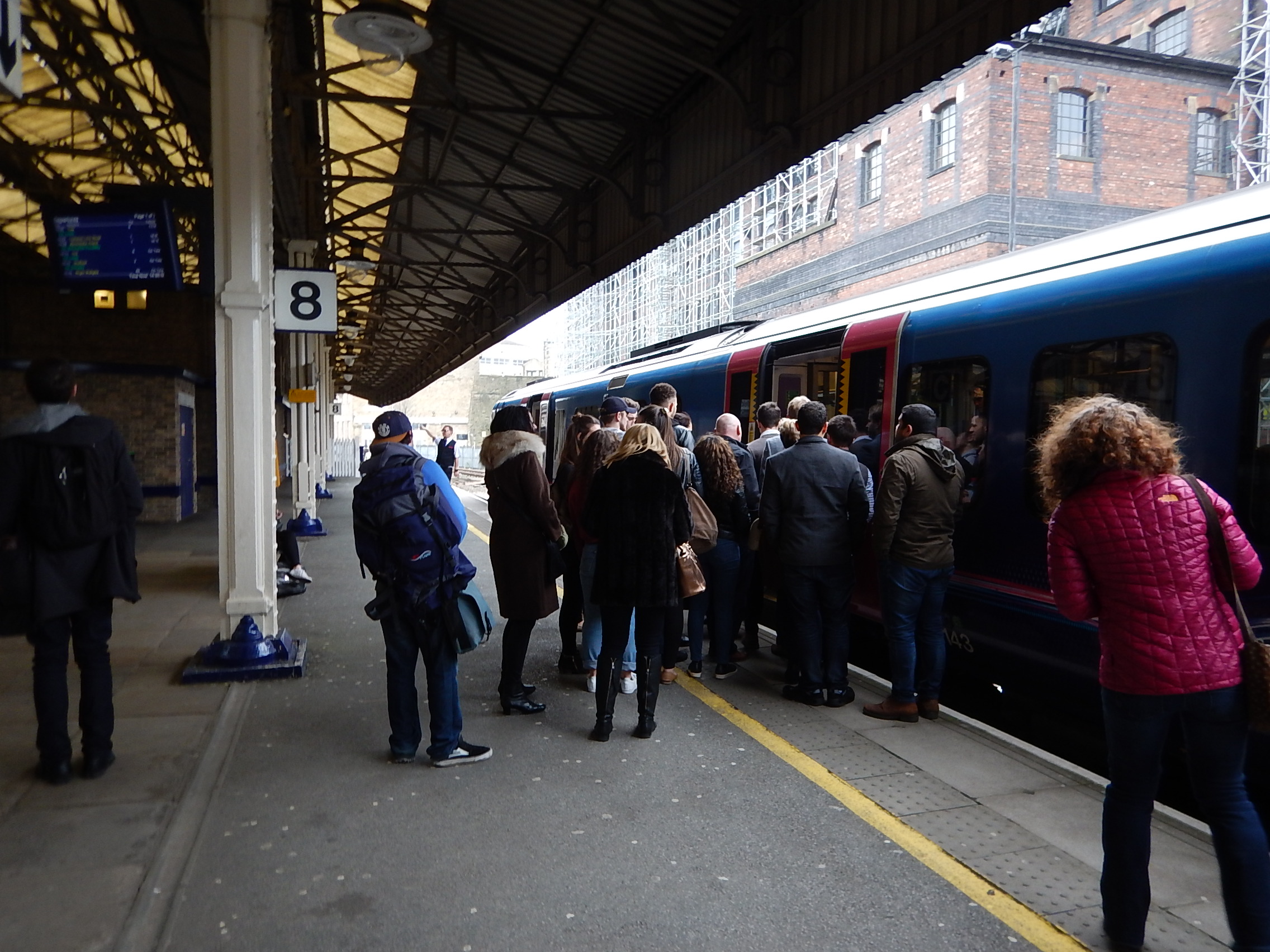
This is typical at Huddersfield.
Not even the Japanese with their pushers could get this to work.
But a modern train like the Class 802 train with wide lobbies and adequate capacity should cope.
So what time could be possible, if everything goes as planned?
If Norwich to Ipswich which is about the same distance as Leeds to Manchester, can be achieved in thirty minutes, I believe it is possible that the Northern route could be achieved in the same time or perhaps thirty-five minutes.
Thirty-five minutes should be adequate for a few years, if say there was a train every ten minutes!
Long Term – A Genuine High Speed Manchester Victoria To Leeds Route
I’ve flown my virtual helicopter between Manchester and Leeds and it is not flat agricultural land like seventy percent of the route of HS2.
I believe that creating a genuine high speed route, with say a 140 mph top speed across the Pennines will be a major engineering challenge that will make Crossrail in London look easy.
It may even be more economic to develop 140 mph hydrogen-powered tilting trains, that can run on the classic route at 125 mph.
Only one thing matters to passengers; a fast reliable and very comfortable and affordable train service across the country.
Manchester Victoria To Manchester Airport
When the Ordsall Chord opens any Leeds to Manchester Victoria service can continue to Deansgate, Oxford Road, Manchester Piccadilly and Manchester Airport stations.
Manchester Victoria To Liverpool
Currently, services between Liverpool Lime Street and Manchester Victoria stations take a few minutes over half-an-hour.
I would suspect that thirty minutes is achievable, if the following is done.
- The four-tracking at Huyton is completed.
- Track and signalling is the best it can be.
- The route has a 100 mph operating speed.
- All trains on the route are 100 mph capable.
- Northern replaces their scrapyard specials with Class 195 trains.
I suspect all of this is in progress.
Note, this is very similar work, to that needed between Manchester and Leeds.
Leeds To Hull
Currently, services between Leeds and Hull stations take a few minutes under an hour.
A few thoughts on the route.
- The Selby Line from Leeds to Hull is double-track and not electrified.
- From my virtual helicopter, it appears to be straight in very flat country, so it is no wonder Hull Trains offered to electrify the line.
- If the Selby swing bridge were to be sorted, it could become a 100 mph line with trains to match.
- Northern replaces their scrapyard specials with Class 195 trains.
- Modern in-cab signalling.
I suspect quite a few minutes could be taken off this route which is about fifty miles.
I suspect this line will eventually be electrified, as it could give sound time savings and it looks relatively easy.
York To Scarborough
Currently, services between York and Scarborough stations take forty-nine minutes, with one tph.
- Similar improvements to the double-track unelectrified line as for the Leeds to Hull route, could be made.
- But if the line has a problem , it is that it has 89 level crossings, although Network Rail intends to close them all before 2025.
I wonder, if the time can be reduced between York and Scarborough, such that two tph can be timetabled.
I doubt York to Scarborough will be electrified.
Northallerton To Middlesbrough
This short line is quite heavily used and is a valuable diversion route, so I suspect nothing urgent needs to be done.
Like Leeds to Hull, I suspect this line will eventually be electrified.
Conclusions
I have come to the following conclusions.
- Manchester Victoria to Leeds is achievable in half-an-hour with the new trains on order and no major infrastructure, other than that already planned.
- Any line where TransPennine Express services run needs to have the highest possible operating speed and no slow trains.
- Northern need to get their Class 195 trains into service as soon as possible.
Improvements are much-needed in the North, which could include.
- A short/medium term plan to deliver the best possible service with the new trains ordered by Northern and TransPennine Express.
- A long term plan to deliver a genuine 140 mph service across the North of England.
- A plan to improve the Calder Valley and Hope Valley Lines across the Pennines.
- A plan to improve some of the poor connections across the North.
- A strategy to make the best use of connections with HS2.
A detailed plan is needed that lays down what should be done in the next ten to twenty years.
The plan is also needed as soon as possible.
TransPennine Electrification And Piccadilly Upgrade Now Also In Doubt
The title of this post is the same as this article in Rail Technology Magazine.
A Digression About The Next Generation Of Trains
After digging through the various pages on Hitachi’s web site, I wrote Do Class 800/801/802 Trains Use Batteries For Regenerative Braking?.
My conclusion was this.
I will be very surprised if Class 800/801/802 trains don’t have batteries.
Will the Class 385 trains for ScotRail have similar traction system?
But having thought about it more, I’m now convinced that by 2030, the average long distance train will have the following characteristics.
- Ability to work from 25 KVAC overhead wires.
- Ability if required to work from 750 VDC third rail.
- Ability to raise and lower pantograph and switch beween modes at line speed.
- Batteries to handle regenerative braking.
- A generator unit to power the train.
- A sophisticated control system to choose the appropriate power source and drive the train according to terrain, passenger load, weather and traffic.
The more I read about Hitachi’s Class 800, Class 801 and Class 802 trains, the more I’m convinced that the features I have listed, is their ultimate goal. I suspect too, that the suburban Class 385 train has the capability of meeting the same objectives.
I would be very surprised if Alstom, Bombardier, CAF, Siemens, Stadler and others are not thinking along the same lines, as this document from Hitachi entitled Development of Class 800/801 High-speed Rolling Stock for UK Intercity Express Programme has been freely available since 2014.
It contains this diagram of the traction system of a Class 800 train.

Note the generator unit and the battery charger.
I’ve ridden the new Class 345 trains for Crossrail, a few times and after a trip yesterday in the gold-standard train;a 1970s British Rail Mark 3 coach, I can honestly say that the ride, noise and vibration in ombardier’s new train, is the best I’ve ridden.
So are Bombardier using a new traction system to achieve this smoothness? I suspect they are.
I also can’t find anything to say how a train will be removed from the tunnel under London, in the event of a complete power failure. No sane engineer would allow a rescue involving diesel or hydrogen in an emergency. However, batteries on the train with the capability of getting passengers to a safe disembarking point would be an obvious solution..
TransPennine Electrification
The major rail route across the Pennines between Leeds and Manchester is the Huddersfield Line.
The following stations are open on the route.
- Leeds *
- Cottingley
- Morley
- Batley
- Dewsbury
- Ravensthorpe
- Mirfield
- Deighton
- Huddersfield
- Slaithwaite
- Marsden
- Greenfield
- Mossley
- Stalybridge *
- Ashton-under-Lyne *
- Manchester Victoria *
The stations marked with asterisks (*) have electrification or will do soon.
Note the following about the route.
- Stalybridge to Leeds is under forty miles by road, so it could be even shorter by rail.
- Huddersfield station is one of a select group of Grade I Listed railway stations..
- Greater Manchester is developing a suburban electric network.
- Greenfield is the last station in Greater Manchester towards Leeds.
- Leeds is developing a suburban electric network.
- Cottingley is the last station in Leeds towards Manchester.
- Currently, trains from Manchester Piccadilly to Leeds can take a diferent route to Stalybridge, that is electrified as far as Guide Bridge station.
- I counted four tunnels, including Standedge tunnel, and over twenty bridges between Stalybridge and Huddersfield.
- Electrification of this section, would probably mean closure for at least a year.
- Between Huddersfield and Leeds the electrification would be a lot easier with about fifteen bridges and Morley tunnel.
My philosophy for this route would be as follows.
- Electrification would not go anywhere near Huddersfield, as the heritage lobby and their lawyers would have a field day.
- Standedge and Morley tunnels are over 2,000 metres long, double track and Standedge is level. If they needed refurbishment in the future, perhaps they could be electrified with an overhead rail, so that bi-modes could have a couple of miles of electricity.
- Electrification might be extended at the Manchester and Leeds ends of the line, so that the two cities could improve their local suburban electric networks.
- An alternative would be that the Leeds and Manchester suburban electric networks were provided with a few Class 769 trains or even some brand new four-car bi-modes.
- Services between Leeds and Manchester would be run by fast bi-modes.
TransPennine Express are already planning to run Class 802 trains between Liverpool and Newcastle via Manchester and Leeds. It looks to me, that whoever plans their train policy, saw this electrification crisis coming.
The money saved on the electrification would be spent on improving track and stations.
Currently the fastest journeys between Manchester and Leeds take just under fifty minutes.
What time could a Class 802 train achieve if the following were done.
- Manchester to Stalybridge is fully electrified.
- Some extra electrification was installed at Leeds.
- The track is improved.
My money would be on thirty-five minutes.
Manchester Piccadilly Upgrade
I hate using the isolated island Platforms 13 and 14 at Manchester Piccadilly station.
They are just too crowded and the steps and escalators down to the platform aren’t well-designed.
The Frequency Of Trains Through Platforms 13/14
The two platforms can be considered equivalent to these busy two-platform stations.
- Canada Water on the East London Line.- 20 trains per hour (tph) from 2020
- St. Pancras on Thameslink – 24 tph from 2018
- West Ham on Essex Thameside – 8 tph
All of these stations handle more trains than Plstforms 13./14 at Manchester Piccadilly.
Provided the signalling can handle it, it should be possible to schedule more trains through these two platforms.
One piece of information I viewed seemed to show that some services terminate in these two platforms. Surely, that is a way to reduce capacity.
Ordsall Chord And Class 769 Train Implications
The Ordsall Chord should change the pattern of trains, when it opens later this year.
The main implication will be that cross-city services can be developed.
The new Class 769 trains will help too, in that current diesel and electric services can be run using one type of train across the city.
A simple example would be Buxton to Blackburn.
These services release platform space in Manchester Piccadilly and other stations, which can be used for new services.
Access To Platforms 13/14
I’ve felt for some time, that if the access to the platform was better designed that a lot of the problems could be reduced.
I sometimes wonder, if when people see that their train is leaving from Platform 13 or 14, that they go there immediately and instead of waiting upstairs in the lounge, they descend to the platform.
When the Ordsall Chord is opened, because of the pattern of services passengers will sometimes change at one of the string of stations on the line.
Perhaps Oxford Road or Deansgate should be designated the preferred interchange station and fixed up with wider platforms, various kiosks and a waiting room to encourage passengers to change away from Piccadilly.
This Google Map shows Oxford Road station.
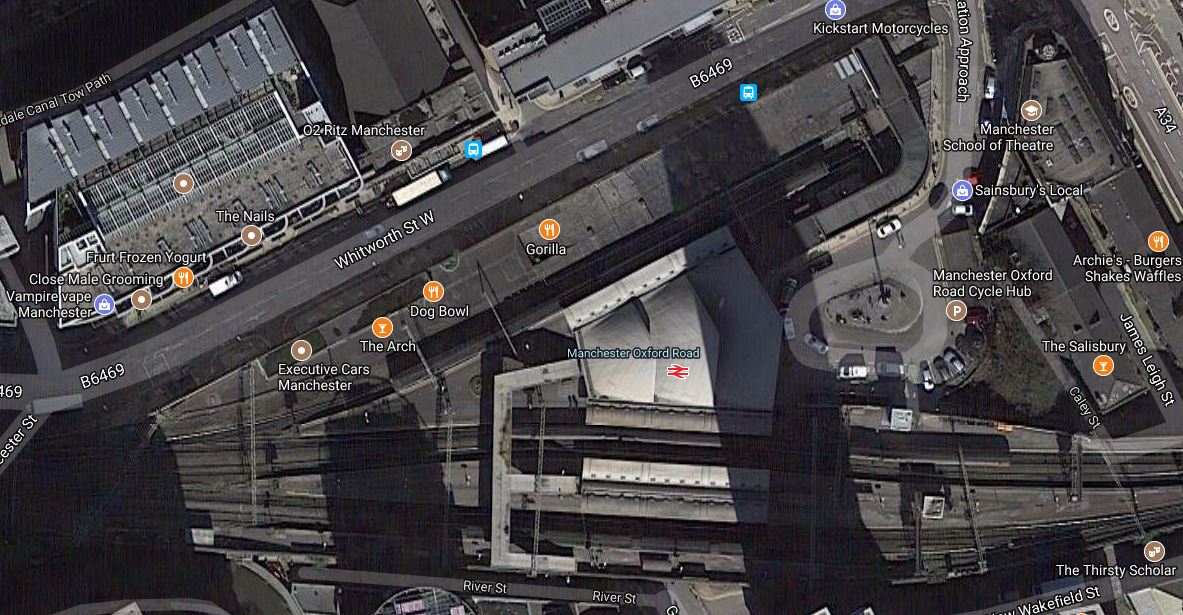
Oxford Road certainly seems to have space for passengers to use it as an exchange, when crossing the city.
But does Oxford Road have a stop on the Metrolink?
This Google Map shows Deansgate station.
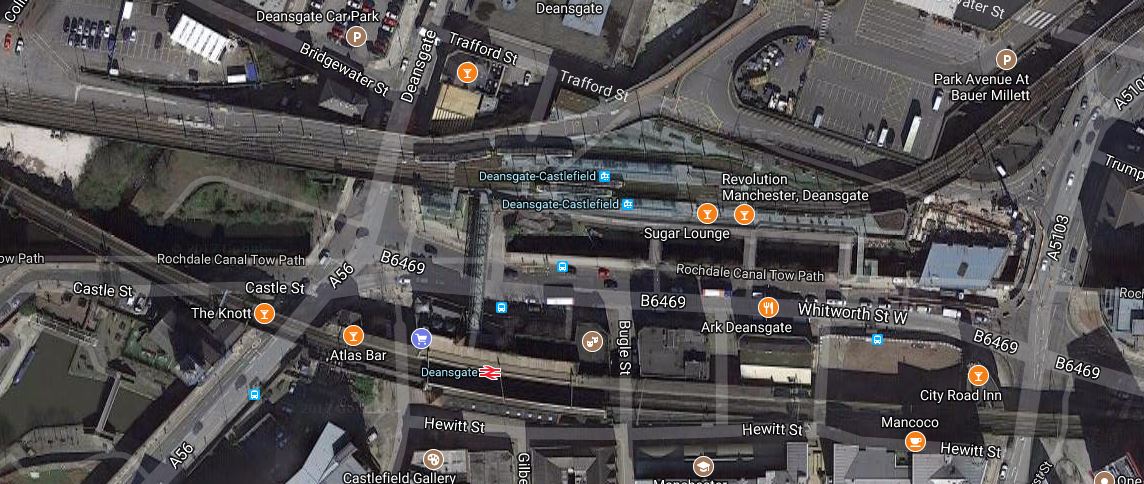
Deansgate doesn’t seem to have the space of Oxford Road. But it does have a good connection to the Metrolink.
The Forgotten Salford Stations
The other stations that could help are the two forgotten Salford stations; Salford Crescent and Salford Central.
This Google Map shows Salford Crescent station.
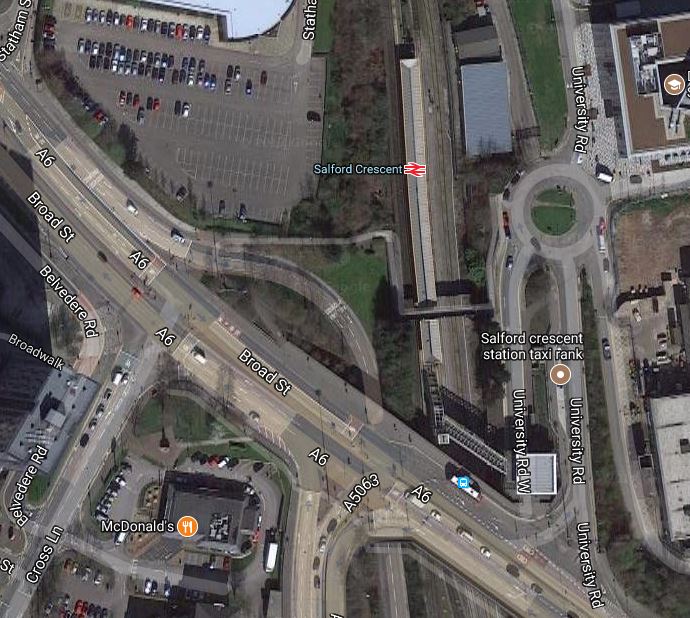
I believe that this station is going to get more platforms. Could it become a sort of triage station, where passengers from the North of Greater Manchester changed for.
- Trains for Manchester Victoria station.
- Trains for Manchester Piccadilly station.
- Metrolink to the city centre.
Surely, space could be found to run trams along Broad Street.
It would also look to be a station, where there is considerable scope to put housing or commercial developments above the station.
This Google Map shows Salford Central station.
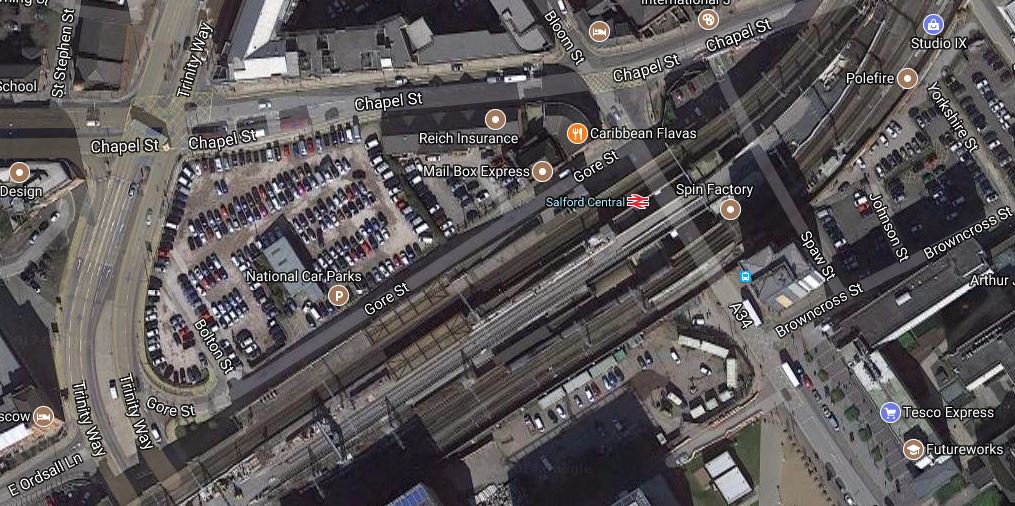
With a bit of thinking Salford Central must have interchange possibilities.
But as with Salford Crescent, this station doesn’t have a Metrolink connection.
The Wikipedia entry for Salford Central has a section called Future Development. This is said.
A Network Rail report suggests building platforms on the line to Liverpool (via Newton-le-Willows), the lines of which run through the station but are not provided with platforms. This scheme has since been adopted by Transport for Greater Manchester and included in their Capital Works Programme for 2015–16 to 2020–21. This will see three additional platforms built, at a cost of £20.5 million and will allow Liverpool, Chester & Manchester Airport-bound trains (using the Ordsall Chord) to call here.
I’ll believe it when I see it.
Conclusion About Manchester Piccadilly Upgrade
I am inevitably drawn to the following conclusions about the upgrade to Manchester Piccadilly.
The Ordsall Chord and the new electric services offered by the bi-mode trains will create a duckers-and-divers network across Manchester City Centre.
The following should be done.
- Access to Platforms 13/14 at Manchester Piccadilly should be greatly improved.
- Deansgate, Oxford Road, Salford Central and Salford Crescent should be improved with extra platforms, same- and cross-platform interchange.
- The Metrolink should be extended to both Salford stations.
- Greater Manchester should adopt a ticketing system based on bank cards to encourage use of the transport network.
Perhaps Mancunians need to be taught to duck-and-dive.
Crossrails For The North
Regularly there are references in the media for Crossrail for the North.
This article in Rochdale Online is entitled Andy Burham calls for ‘Crossrail for North’
Note that the misspelling of Andy Burnham; the Mayor of Manchester’s name is from the web site.
Andy Burnham and many others have a point that West-East connections across the North are not good, but it is not that simple.
Hence the reason, I’ve called this post Crossrails For The North and not Crossrail For The North.
Northern And London Crossrails Compared
If you look at Greater London, the distance between Reading and Shenfield stations, which are two of the termini of London’s Crossrail, is about eighty miles and when Crossrail opens a train will take about one hour forty minutes.
By comparison, Liverpool to Leeds is just over seventy miles and the current fastest trains take ninety minutes with two stops at Manchester Victoria and Huddersfield stations.
Those that live East of Leeds, keep reading.
The differences between the two routes, when Crossrail opens will be mainly down to the number of stops, frequency and connectivity.
- The Northern Route is shorter and hence marginally faster.
- The London route has more stops.
- The London route has a higher frequency.
- The London route is electrified.
- The London route will be served by specially-designed Class 345 trains.
But possibly most importantly, the London route connects to a large number of North-South cross-city railways.
It is sensible to think of London’s Crossrail as a loose ball of chunky knitting wool with a big fat needle stuck through it.
The ball of knitting wool is Central London with all its Underground and Overground Lines.
- Bakerloo Line – North-West – South-East through City Centre
- Central Line – West-East through City Centre
- District Line – West-East through City Centre
- East London Line – North-South to East of City Centre
- Gospel Oak to Barking Line – West – East to North of City Centre
- Hammersmith and City Line – West – East through City Centre
- Jubilee Line – North-East through City Centre
- Metropolitan Line – West – East through City Centre
- Northern Line – North-South through City Centre
- Northern City Line – North from the City Centre.
- North London Line – West – East to North of City Centre
- Piccadilly Line – North – West through City Centre
- Thameslink – North – South through City Centre
- Victoria Line – North-East – South-West through City Centre
- Waterloo and City Line – South from the Centre Centre
- West London Line – North-South to West of City Centre
Crossrail is the big fat needle struck right through the middle.
You could actually argue that not just one big fat needle is through the middle, as Crossrail is paralleled by some of London’s historic Underground Lines.
- The Central Line connects at Stratford, Liverpool Street, Tottenham Court Road, Bond Street and Ealing Broadway stations.
- The District Line connects at Whitechapel and Ealing Broadway stations.
- The Metropolitan Line connects at Whitechapel, Farringdon and Paddington stations.
- In the future, the North London Line will connect at Stratford and the new Old Oak Common station.
Crossrail is going to be a massive playground for the duckers-and-divers, as they search for the fastest route.
How London Crossrail Will Develop
London Crossrail is not a complete system, with certain connections not of the best.
- Eurostar from St. Psncras International
- HighSpeed services from Stratford International
- HS2
- Piccadilly Line
- Scottish and Northern services from Euston and Kings Cross
- Victoria Line
Several of these connections can be addressed by smaller projects like the necessary rebuilding of tube stations like Bank, Charing Cross, Euston and Oxford Circus.
A lot of London politicians are pushing for Crossrail 2 , but London will be given a big increase in capacity with Crossrail and I think there is an opportunity to redefine the scope of the later project, in the light of what happens after Crossrail opens.
Consider the following, which will happen after Crossrail opens.
- Huge pedestrianisation will happen in the City of London and the West End.
- Hopefully, walking in large parts of Central London will improve to the standard of the bus- and car-free Central Liverpool.
- On foot interchanges like Oxford Circus-Bond Street and Bank-Liverpool Street will be easier and quicker than now.
- The long-neglected and ill-fated Northern City Line is getting new trains, higher frequencies and hopefully a deep-clean of the stations.
- Liverpool Street and Moorgate stations will effectively become one station with world class connectivity.
- The Waterloo and City Line will be improved and probably go 24/7!
- Waterloo station will get a forty percent capacity increase this summer.
- The Northern Line Extension to Battersea will open in 2020.
- New trains will have been delivered for London Overground’s Liverpool Street and Gospel Oak to Barking services.
Londoners will fully exploit the network and importantly Transport for London will have detailed information from the ticketing system on the routes taken and the bottlenecks as they develop.
Access For All
Access for All is a National programme, that is making stations all over the country accessible to as many passengers as possible.
Check the list of stations being updated under Access For All
After the General Election, I would not be surprised to see funding for this programme increased all over the country, as it is both necessary and a quick way to attract more passengers to the railways.
New Stations
Since 2000, seventy-four new stations have opened or reopened.
I can rarely remember stations reopening last century, but the 4-5 new stations every year since the turn of the Millennium, seems to have continued this year with the opening of Cambridge North, Ilkeston and Low Moor
The New Franchises
Five franchises have been awarded lately.
- Greater Anglia
- Northern
- ScotRail
- South Western Trains
- TransPennine
A feature of all these franchises is that the operators are introducing a lot of new trains and substantially refurbishing others.
Will this trend continue?
Obviously, the operators have done their sums and find that new trains attract more passengers.
There is a major problem with new trains, in that capacity to build them must be getting very short. I also don’t think that Chinese trains will be welcomed.
If I was Prime Minister, I’d make sure there was enough capacity to build and refurbish trains in the United Kingdom.
Building Crossrail 2
There is no doubt that at some time in the future, Crossrail 2 will be built.
But unlike Crossrail, which is a massive project similar in size to the Channel Tunnel,, the electrification of the Great Western Railway or HS2, it is a collection of smaller projects that can be phased over the years, with each phase giving substantial benefits to London, train companies and passengers, be they Londoners, commuters, visitors or tourists.
I would build it in the following sequence of sub-projects.
- Four-Tracking Of The West Anglia Main Line – Extra capacity on the West Anglia Main Line is needed for both improved London-Stansted-Cambridge services and Crossrail 2.
- New High-Capacity Crossrail-Compatible Trains North of London – Greater Anglia and London Overground have already ordered these trains to replace the current thirty-year-old trains.
- Station Improvements North of London – Improvement are much needed and are already planned and underway at Tottenham Hale and Meridian Water.
- Improve Connection To Sub-Surface Lines At St. Pancras Station – The current connectivity is terrible between these lines and Thameslink and the HighSpeed lines to Kent.
- Connect Euston Square Tube Station To Euston Station To Give Extra Capacity During Euston Rebuilding For HS2
- Introduction Of A New Stratford-Tottenham Hale-Angel Road Service – The delivery date for STAR is 2019.
- Introduction Of Chingford-Walthamstow-Stratford Services – This would improve access to Crossrail and take pressure from the Victoria Line.
- New Stansted And Cambridge Services From Stratford – Greater Anglia have suggested this and there’s even an unused loop at Stratford, that could be used to turn trains and allow them to call at Stratford International for Eurostar to the Continent and HighSpeed services to Kent.
- More Terminal Capacity for Trains From North of London – The Stratford loop would increase the terminal capacity for Greater Anglia and also give access to the Jubilee Line for London Bridge, Waterloo and Westminster.
- Use Improved Capacity At Waterloo To Increase Services On Proposed Crossrail 2 Southern Branches – The extra capacity should help.
- New High-Capacity Crossrail-Compatible Trains South of London – South Western Trains have indicated this will happen.
- Station Improvements South of London – Improvements are much needed.
- Rebuild Euston Tube Station In Cnjunction With HS2 –
Only when these phases are completed, would the central tunnel be bored.
This step-by-step approach has several advantages.
- The pace of the project can be geared to the finance and resources available.
- Some developments can have a significant local design and scope input.
- Much needed stations can be built early to generate passengers and cash flow.
- Trains can be follow-on orders to Crossrail.
- The suburban sections of the route will always be available for passenger traffic.
When Crossrail 2 is complete, the second big fat knitting needle has been stuck in the ball of wool.
What Can The North Learn From London?
I would argue that one of the keys to London’s success over the years has been its comprehensive multi-layered public transport system.
- Crossrail, Crossrail 2, Thameslink and the Overground could be considered the top layer.
- The Underground, the Docklands Light Railway and the suburban electric trains are the middle layer.
- Buses form the local and bottom layer.
Underneath a walking and cycling layer is emerging.
The North of England can be considered a series of local transport networks, which are connected by a series of major lines, which are equivalent to London’s Crossrail, Crossrail 2 etc.
Northern Connect
I find it interesting that Northern are introducing a Northern Connect service, which Wikipedia describes as follows.
From December 2019, Northern will operate a network of twelve Northern Connect interurban express services. Eleven of these will be operated by brand-new Class 195 diesel multiple units and Class 331 electric multiple units, whilst the Middlesbrough to Carlisle via Newcastle route will be operated by refurbished Class 158 units.
Places that will be served by Northern Connect routes include Bradford, Chester, Halifax, Leeds, Liverpool, Manchester, Middlesbrough, Nottingham, Newcastle, Preston, Sheffield, Barnsley, Lincoln, Wakefield and York.
Local Networks In The North
Some of the local Northern networks in places like Leeds, Liverpool, Manchester, Newcastle, Nottingham and Sheffield are certainly better than others.
It could also be argued that the six cities I named, are among the most successful and vibrant cities of the North.
I feel that for the railways to be successful in the North and for some cities to have a major improvement in prosperity, that some of the local networks need substantial improvement.
TransPennine And Feeder Routes
The starting point is to detail the Northern Connect and TransPennine Express services in the North.
The Northern Connect services given in the January 2016 Edition of Modern Railways are as follows.
- Middlesbrough to Newcastle
- Newcastle to Carlisle
- Hull to Sheffield
- Nottingham to Bradford via Leeds
- Lincoln to Leeds via Sheffield and Barnsley
- Liverpool to Manchester Airport via Warrington
- Chester to Leeds via Warrington, Manchester Victoria and the Calder Valley
- Blackpool North to York via Preston and Leeds
- Barrow to Manchester Airport
- Bradford to Manchester Airport via the Calder Valley.
- Blackpool to Manchester Airport
- Windermere to Manchester Airport
I suspect plans have changed since January 2016, but the possible routes are a good start.
According to Wikipedia, TransPennine routes are as follows.
- Liverpool Lime Street to Newcastle via Manchester Victoria, Huddersfield, Leeds and York
- Manchester Airport to Middlesbrough via Manchester Piccadilly, Huddersfield, Leeds and York
- Manchester Airport to York via Manchester Piccadilly, Huddersfield and Leeds
- Liverpool Lime Street to Scarborough via Manchester Piccadilly, Huddersfield, Dewsbury, Leeds and York
- Manchester Piccadilly to Hull via Huddersfield, Dewsbury, Leeds and Selby
- Manchester Airport to Cleethorpes via Manchester Piccadilly, Stockport, Sheffield, Meadowhall and Doncaster
- Manchester Airport to Edinburgh Waverley/Glasgow Central via Manchester Piccadilly
These routes will change in the next year, when the Ordsall Chord opens.
The opening of the chord, may mean that certain services to Manchester Airport, will not need to reverse at Manchester Piccadilly.
Summarising the East-West routes across the Pennines gives.
- Newcastle to Carlisle
- Manchester Victoria to Leeds via the Calder Valley Line
- Manchester Victoria to Leeds via Huddersfield
- Blackpool North to Leeds via Preston and the Calder Valley Line
- Manchester Piccadilly to Doncaster via the Hope Valley Line and Sheffield
None of these lines are fully electrified.
They are also connected to their ultimate destinations by feeder lines.
- Liverpool to Manchester Airport via Warrington
- Chester to Manchester Victoria via Warrington
- Liverpool to Manchester Victoria
- Leeds to Newcastle via York
- York to Middlesbrough
- York to Scarborough
- Leeds to Hull
Only the following lines will be fully electrified by December 2017.
- Liverpool to Manchester Victoria
- The West Coast Main Line
- The East Coast Main Line
- Some Suburban Routes in Blackpool, Liverpool, Manchester and Preston
- Some Suburban Routes in Bradford and Leeds
Most of the routes will have to be run by diesel or bi-mode trains.
The Crossrails For The North
There are five East-West routes across the Pennines used by Northern Connect and TransPennine Express.
- Newcastle to Carlisle
- Manchester Victoria to Leeds via the Calder Valley Line
- Manchester Victoria to Leeds via Huddersfield
- Blackpool North to Leeds via Preston and the Calder Valley Line
- Manchester Piccadilly to Doncaster via the Hope Valley Line and Sheffield
To these I would add two extra lines.
- Leeds to Carlisle via Settle
- Preston to Leeds via Burnley, Colne and Skipton.
Note
- I have added the Settle-Carlisle Line, as it is world-renowned, is in excellent condition and if provided with a decent train service, could be a major attraction, that would bring tourists to the area.
- The Skipton to Colne Line should be reinstated, to create a direct connection between the electrified local networks servingLeeds/Bradford and Liverpool/Manchester/Preston.
But there would be seven magnificent routes across the Pennines, which could be updated to the following objectives.
- Frequent trains on all lines with at least two trains per hour (tph)
- 100 mph running where possible.
- As high a frequency as possible on the core section between Manchester Victoria and Leeds. Plans exist for six tph, which is a good start.
- In the East trains would fan out to Cleethorpes, Grimsby, Hull, Newcastle and Scarborough, as they do now.
- In the West trains would fan out to Blackpool, Chester, Crewe and Liverpool.
- Lots of cross-platform connections at stations like Leeds, Liverpool, Manchester Victoria, Newcastle, Preston and York with long distance North-South services to London and the South and Scotland.
- All stations would be step-free with lifts or ramps.
In addition provision should be made early to make sure that there are good connections to HS2.
Electrification
Obviously, electrification would be an ultimate goal on all these East-West routes.
But there are various problems with the electrification of the Peenine sections of the routes.
- These lines have large numbers of low bridges and high viaducts.
- Electrification would need to be robust because of the weather.
- Electrification gantries might not fit well in the scenery.
- Installation and servicing of overhead electrification may not be an easy process.
On the other hand, the noise of diesel trains might not be welcomed.
However, I believe that in the next ten years much quieter self-powered trains will be commonplace.
At the present time, if diesel or bi-mode trains are acceptable, then they should be used to provide a service.
Looking at the various feeder routes to the East and West of the Pennine sections, it is a different matter.
- Routes are less challenging.
- There are fewer bridges and viaducts.
- Installation and servicing of overhead electrification would be easier.
There is already a lot of electrification at the East and West, which could be extended to places like Chester, Hull and Middlesbrough.
A Pennine core without difficult electrification, between electrified feeder routes may be the most efficient way to run the routes using bi-mode trains.
It might be sensible to use Class 88 bi-mode locomotives instead of the currently proposed Class 68 locomotives with rakes of coaches, as is planned by TransPennine Express.
A Hull to Liverpool service would run under the following power.
- Hull to Bradford via Leeds – Electricity
- Bradford to Stalybridge- Diesel
- Stalybridge to Liverpool via Manchester Victoria – Electricity.
Around thirty miles would be on diesel and the difficult electrification in the Pennines would be avoided.
Infrastructure
This table is a brief summary of the routes.
- Newcastle to Carlisle – Double track, 18 stations
- Manchester Victoria to Leeds via the Calder Valley Line – Double track – 17 stations
- Manchester Victoria to Leeds via Huddersfield – Double track – 14 stations
- Blackpool North to Leeds via Preston and the Calder Valley Line – Double track – 14 stations
- Manchester Piccadilly to Doncaster via the Hope Valley Line and Sheffield – Double track – 18 stations
- Leeds to Carlisle via Settle – Double track – 10 stations
- Preston to Leeds via Burnley, Colne and Skipton – Part Single track
Note.
- Most routes are double track, which aids train scheduling.
- All except Skipton to Colne seem to be in good condition.
- I can’t find much information about speed limits.
I think it is true to say, that none of the routes could be a high speed line, although a large proportion could have substantial speed increases.
From what I have seen in East Anglia, I suspect most routes could be upgraded to 100 mph, which with the train frequencies of say four tph could give a substantial increase in service quality.
Stations
Many of the secondary stations on these routes are not blessed with facilities like ticket machines, lifts and step-free access.
If I compare, what I see on the web, with what I have experienced in East Anglia, the quality of the smaller stations is not good.
Services
The services along the lines are not of a high frequency or of a high speed, but Northern and TransPennine Express intend to increase frequencies and speed.
The new trains with their faster stops will help.
This is said about the Future Services of TransPennine Express on Wikipedia.
A twice-hourly service between Manchester and Newcastle will be phased in between December 2016 and December 2017, made up of the existing service from Liverpool and a reinstated service from Manchester Airport. Trains between Liverpool and Newcastle will be extended to Edinburgh via the East Coast Main Line, giving a twice-hourly service between Leeds and Edinburgh together with an hourly CrossCountry service. Trains between Liverpool and Scarborough will be rerouted via Manchester Victoria and Newton-le-Willows to provide a half-hourly fast service between Liverpool and Manchester. It is also planned to operate a six train per hour frequency between Manchester and Leeds, up from five today.
I can’t find anything about timings.
A High Speed Line
Building a new high speed line will be difficult, expensive and may take years, as there will probably be a need for a costly tunnel through solid rock between Manchester and Leeds.
So a prudent Project Management strategy could be phased in the same way I proposed for London’s Crossrail 2.
- Increase Line Speed – This would probably give the largest benefit, as it would enable more and faster trains.
- Electrify From Leeds To York – This would enable TransPennine’s Class 802 trains between Liverpool/Manchester Airport and Newcastle/Edinburgh to run more efficiently.
- Electrify From Liverpool To Manchester Airport Via Warrington – This would tidy up electrification between Liverpool and Manchester.
- Electrify To Chester From Crewe and Warrington – This would link North Wales to the TransPennine routes.
- Electrify From Leeds To Hull – This would be a comparatively easy electrification.
- Create The Skipton To Colne Link – This would link the two Norhern suburban electric networks and become a valuable transport asset for both local residents and visitors.
- Improve Stations – Better facilities and atep-free access is desperately needed. Especially at secondary stations.
- Improve Local Networks In Selected Cities – Some are much better than others.
- Increase Train Frequencies – Run at least two tph on all routes.
Hopefully, a decent service can be provided, until a new high speed route can be built.
One great advantage that this project has compared say to the electrification of the Great Western Railway, is that because there are several current routes, if one needs to be closed for a short time, there is a suitable alternative.
Improvements To The East Coast Main Line Through West Yorkshire
This article in Rail Technology Magazine is entitled West Yorkshire to agree £3bn ‘whole route ethos’ investment in ECML.
The article doesn’t go into much detail, but it does explain how a lot of work is needed not only to improve London to Newcastle and |Edinburgh times, but to accommodate high speed services across the North of England.
Looking at the East Coast Main Line on Wikipedia, throws up these improvements.
- Creation of a platform 0 at Doncaster station, which was completed in December 2016.
- Improvements through York station.
- South of Newcastle to Northallerton (which is also predominately double track), leading to proposals to reopen the Leamside line to passenger and freight traffic.
- Electrification of Northallerton to Middlesbrough.
- Electrification the line between Leeds and York (Neville Hill Depot to Colton Junction) as a diversionary route and a route for Liverpool to Newcastle services via Manchester and Leeds.
- Upgrade the line for 140 mph running under ERMTS.
I also think that the Treasury-specified economy electrification should be upgraded to a modern standard. They didn’t make much of a saving as upgrading the line to a modern standard will cost £1.3billion.
Hopefully, these improvements will allow London to Edinburgh in four hours.
Also helping with this goal is the project announced in this article on the Rail Magazine web site, which is entitled NR seeks fourth track north of Huntingdon. The article indicates that this work together with improvements at Werrington Junction, which I wrote about in To Dive Or Fly At Werrington, would improve capacity on the East Coast Main Line.
TransPennine Express To Edinburgh
In the July 2016 Edition of Modern Railways, there is an article entitled CAF to build new TPE trains.
This is said.
Once TPE extends its services via the East Coast Main Line to Edinburgh from December 2019, it intends to use pricing and frequency to encourage journeys on this route to mitigate crowding on its West Coast Main Line services.
I don’t think the Scots will object to this competition to Virgin.
It would also appear that because of the success of the Borders Railway, that there are suggestions to add new stations on the East Coast Main Line at Reston and East Linton. These would fit in well with an increased frequency of fast passenger trains up the East Coast Main Line.
TransPennine Express Buys Spanish Trains
After Arriva Rail North bought 98 Civity trains from CAF, which I wroye about in Arriva Rail North’s New Trains, it probably wasn’t much of a surprise that TransPennine Express have gone to the same source for twenty-five new trains, as is detailed in this article in Global Rail News. This is said.
The new fleet, which will be maintained by Alstom at Longsight depot, will consist of 12 five-car Civity EMUs from CAF – financed by Eversholt Rail – and 13 five-car loco-hauled intercity trains.
The announcement follows an order placed earlier this year with Hitachi for 19 bi-mode train sets. Both fleets of new trains are due to be delivered between 2018 and 2019.
If there is a surprise, it is that they are going for locomotive-hauled sets or rakes of coaches.
The 12 five-car Civity EMUs will be running between Liverpool/Manchester and Edinburgh/Glasgow. According to the CAF data sheet, there will be a 200 kph version available, so these could mix it with other operators’ Class 800 trains.
The article also says this about the locomotive-hauled rake of Mark 5 coaches.
In addition to the new CAF trains and carriages, Beacon Rail-owned Class 68 locomotives will be leased from Direct Rail Services to operate intercity services between Liverpool and Newcastle.
So it would appear that the Class 68 locomotives could work Liverpool to Newcastle before the line is fully electrified. They would also be ideal for routes to Hull and Scarborough.
I would also suspect, that as the Class 88 electro-diesel locomotive is very similar to a Class 68, that these locomotives could also work some of the services, once the route is partially electrified.
The Mark 5 coaches, are probably similar to those being built for the Caledonian Sleeper. One question that has to be asked, is why haven’t TPE opted to bring some of the legendary Mark 3 coaches up to a modern standard.
- The concept of a quality set of coaches with a locomotive at one end has been proven to work in East Anglia, on Chiltern and on Deutsche Bahn.
- The conversion of doors, toilets and other issues, might mean that new coaches are better value for money.
- New coaches are probably good for at least thirty years.
- All the basic design has been paid for in the Caledonian Sleeper order.
- One of the five coaches in each set, could have a driving cab integrated into one end, so there would be no need for a separate driving van trailer.
- Have CAF applied all their designs for the modular Civity train to build a train, where you just plug a suitable locomotive into one end?
- New coaches sell seats, especially if they are designed for a good passenger experience.
- If you want six, seven or more coaches, you could probably just slot them into the rake.
I suspect that CAF have seen a gap in the market and have produced a design for a rake of coaches, that will appeal to the UK. I think we could be seeing these coaches appearing elsewhere.
At the end of the day, it all comes down to cost, reliability, flexibility and the quality of the passenger experience.
It does look to me, that by virtue of good design and manufacturing capacity, that CAF seem to have nicked a nice order from under the noses of the big companies.
- CAF could probably deliver coaches in 2018.
- Suitable locomotives are already in the UK and Stadler/Vossloh would probably oblige with a few more.
- The Class 68 locomotive doesn’t seem to generate bad reports in the media.
- The three previous points, might mean that TPE could be running new reliable trains earlier than anybody thinks.
- The Civity family is proven and is being built for Arriva Rail North.
- Hitachi haven’t probably got the capacity to build more Class 800 trains early enough.
- Bombardier haven’t built a high-speed Aventra, although they might have the capacity, but not a diesel variant.
I certainly think that TPE have got a good replacement at an affordable price for the overcrowded Class 185 trains.
Musical Trains On TransPennine Express
The moving on of the inadequate Class 185 trains on TransPennine Express (TPE) seems to have started with this article in Rail News entitled Hitachi scoops 95-car TPE train deal. This is said.
- TPE have signed a deal for the delivery of nineteen five-car Class 802 trains for delivery from 2019.
- The trains will normally run at 125 mph, but will have a 140 mph capability, subject to track and signalling.
- The Class 802 trains will have 161 more seats than the Class 185 trains.
- A second fleet of twenty-five trains will be ordered by TPE for delivery in 2018.
It’s also said that TPE will retain about half of the existing Class 185 trains.
In Future Fleet in the TransPennineExpress Wikipedia entry, this is listed as their future fleet.
- Thirteen sets of five-car Intercity carriages for TransPennine routes with a top speed of 125 mph, with deliveries, starting in 2017.
- Twelve sets of five-car EMUs for Scottish routes with a top speed of 125 mph, with deliveries, starting in 2018.
- Nineteen sets of five-car Class 802 trains for TransPennine routes, with deliveries, starting in 2019.
The third fleet of nineteen trains have been ordered and I feel pretty sure, Hitachi will deliver them on time from Newton Aycliffe.
But what types of trains will be delivered for the first and second requirements?
Class 387 Trains
Twenty-nine Class 387 trains have been built and there are another twenty-eight on order.
- A proportion of the trains will be going to Great Western Railway (GWR), which is a sister company to TPE, to run Thames Valley services out of Paddington.
- Because of the late delivery of the Great Western Electrification, some could end up sitting in sidings.
- They are only a four car train, but as some Electrostars come in five car sets, I suspect that they can be lengthened to the required five cars.
- They are only a 110 mph train, but then so are the Class 350 trains, currently working Manchester Airport to Glasgow services for TPE.
Although Class 387 trains don’t quite meet TPE’s speed requirement, they could provide a valuable interim service, whilst awaiting the delivery of the new trains.
Class 387 Trains With An IPEMU Capability
A Class 379 train was used for the prototype IPEMU or Independently Powered Electric Multiple Unit, which was successfully demonstrated in public service early in 2015.
This train has a range of upwards of fifty miles using on-board energy storage, charged on the main line from the overhead electrification.
The Class 379 and 387 trains are both Electrostars and are closely related, so it is very likely, that a Class 387 IPEMU can and will be developed.
A Class 387 IPEMU could be able to serve the following routes.
- Liverpool to Newcastle via Manchester and Leeds.
- Manchester Airport to Blackpool, Barrow and Windermere.
- Blackpool and Preston to Leeds via the Calder Valley Line.
- Manchester to Chester.
- Manchester to Sheffield via the Hope Valley Line.
I also think, that as experience of the trains is accumulated, other routes would become possible.
Class 802 Trains
The Class 802 trains are the ones ordered for the major part of services across the Pennines, but they have a major problem. It would be unlikely, that Hitachi could deliver the trains until after the rest of the trains have been delivered starting in 2019.
Aventra Trains
The Aventra is Bombardier’s successor to the Electrostar.
- It is designed as a modular train, that comes in a range of lengths. So far four car Class 710 trains and nine car Class 345 trains have been ordered.
- Modern Railways disclosed in the April 2016 Edition, that a 125 mph version of the new Aventra train is coming.
- It has been designed to be a very efficient train.
- According to Modern Railways, the trains are designed to be able to handle both commuter and longer-distance services.
- All Aventras are wired so that on-board energy storage can be fitted.
- As it will be a more efficient train than the Electrostar, range using on-board energy storage would probably be longer.
So it would appear that a 125 mph five-car Aventra, that can extend routes and bridge electrification gaps will be available.
The two requirements for TPE will now be examined.
The First Requirement
The first requirement for thirteen trains for TransPennine routes could be met by.
- Shortened five-car formations of InterCity 125s released by delivery of Class 800 trains to Great Western Railway (GWR) and Virgin Trains East Coast.
- Five-car Class 221 trains released by Virgin Trains.
- Five-car Class 222 trains released by East Midlands Trains.
- Five-car Class 387 trains with an IPEMU capability.
- Five-car Aventras with an IPEMU capability.
- Lengthening the existing Class 185 trains by adding two new cars.
- More Class 802 trains.
Option 1 – Every train operating company will be after these and there is a lot of work to do. But they would do the job.
Options 2 and 3 – What trains could be used to release the Class 221 and Class 222 trains?
Option 4 – Five-car Class 387 trains can be created. But would 110 mph trains be fast enough and would the IPEMU capability allow TPE to run the routes they require?
Option 5 – 125 mph Aventras with on-board energy storage, could probably do the job. But will they be available for delivery in 2017? I doubt it!
Option 6 – I doubt Siemens would like to lengthen Class 185 trains, but as an interim they could run as six car trains. But until the Class 802 trains arrive, they’re needed across the Pennines.
Option 7 – Not probably a possibility for delivery in 2017, unless Hitachi find how to 3D-Print trains at a rate of one a day.
TPE Needs More Capacity Now
The big problem, is that TPE needs extra capacity across the Pennines now! It should also be noted that the Ordsall Chord could open in December 2017, which will create a need for more trains.
TPE could decide to just muddle through until 2017, but I think they would like some extra capacity, otherwise all the euphoria of the new franchise, will be flushed down the toilet
The only trains that could be running across the Pennines, before the end of 2016, are Class 387 trains with an IPEMU capability. In fact, they could probably be running in time for the May 2016 timetable change.
I have believed for some time, that they could work the routes across the Pennines between Leeds and Manchester.
If TPE did go down this interim route, then it would be likely that the thirteen new trains ordered for this route would be 125 mph Aventras with an IPEMU capability.
Bombardier would love that if it turned out to be successful, as publicity of using batteries to extend the range of a 125 mph train must open up some very lucrative markets all over the world.
The Second Requirement
The second requirement used on the Scottish routes could be.
- Class 350 trains until new trains are delivered.
- Class 387 trains to add capacity to or replace the existing fleet.
- Class 802 trains
- 125 mph Aventra trains
All except the Class 350 trains could be five car trains and the Class 802 trains and the Aventras are 125 mph trains or faster.
140 mph Running
One complication is that at some time in the 2020s, the East Coast Main Line and West Coast Main Line will be able to accept 140 mph running. So the Scottish services, may end up bein worked by Class 802 trains.
Airport Expresses
An intriguing possibility is to use Class 387/2 trains as used on Gatwick Express on some services.
- TPE services call at Manchester Airport and Liverpool South Parkway for Liverpool Airport.
- The Class 387/2 trains have an interior designed for airport passengers.
- The trains could be delivered as five car trains.
- The trains could have an IPEMU capability.
Manchester and Liverpool Airports are very ambitious and probably would like connections to places such as Chester, Nottingham and North Wales.
Conclusions
There are a large number of possibilities and a massive need for an interim solution, which will probably use some of the available Class 387 trains, with or without an IPEMU capability.
The final solution will come down to a choice between.
- Thirteen Class 802 trains with a bi-mode capability and twelve Class 802 EMUs
- Twenty-five Aventras, of which at least thirteen would have an IPEMU capability.
I might find the Class 185 trains inadequate, but as new trains arrive, inevitably some of the diesel multiple units will be cascaded to other operators.
I think there’ll come a time, when TPE has just Class 802 trains and/or Aventras, with some trains having a bi-mode or IPEMU capability.
When there is electrification between Leeds and Manchester and if Aventra IPEMUs were handling the parts of the network without electrification, then TPE could rightly claim that they were running an all-electric fleet, which must give a green edge to their marketing.
Some bi-mode Class 802 trains could be converted to EMUs and hopefully would be able to cruise to across the Pennines at over 125 mph and to Scotland at 140 mph on the flagship routes.
- Liverpool to Edinburgh via Manchester, Leeds and Newcastle.
- Liverpool and Manchester to Glasgow via the West Coast Main Line.
It will be an interesting decision, as to which trains are chosen for the extra twenty-five trains.
The only certainty is that TPE will get a very good price.
New Trains For The North
That is the headline on a two page article in Modern Railways magazine.
It is an article that is strong on promises, in what it says that First TransPennine and Arriva Northern Trains will do.
Under a sub-heading of Bi-Modes for TransPennine, this is said.
FirstGroup is to invest over £400 million in a fleet of 44 new five-car 125 mph trains, which are expected to be based on the Hitachi AT300 design already being procured by sister operator Great Western Railway.
It also states that twelve will be electric only and the rest will be bi-modes.
The timetables state that the first bi-mode will enter service in December 2017.
Under a sub-heading of New and Upgraded Fleet for Northern, this is said.
Arriva is to invest £400 in 98 new air-conditioned 100 mph trains comprising 281 carriages, of which 43 will be three- and four-car EMUs and 55 two- and three-car DMUs. The latter will enable the withdrawal of all Pacers by the end of 2019.
The delivery schedule for the new trains stretches to 2020.
All these promises are all well and good, but I do wonder if they are deliverable with new trains.
AT300
Hitachi have been clever and have bought AnsaldoBreda, so they can build AT300 trains in Italy. This is said in the Wikipedia entry for the AT300, which is based on the Class 800 train, they are building in Newton Aycliffe.
In mid 2015 Eversholt Rail, a rolling stock operating company signed a £361m contract with FGW to purchase 173 new AT300 carriages, consisting of 22 five-car and seven nine-car trains. The AT300 trains are to be built at Hitachi Rail Italy’s Pistoia plant.
The trains are expected to enter service with Great Western Railway from December 2018. and are also expected to reduce journey times from London to Exeter by up to 5min, to Plymouth by up to 6min, and to Penzance by up to 14min.
It puzzles me how First TransPennine will be able to introduce the first bi-mode into service in December 2017, as where will the train be built?
It can’t be built in Italy, as Hitachi won’t have even delivered their first train until December 2017.
The only possibility will be to take trains from Newton Aycliffe and delay deliveries to Great Western Railway and Virgin Trains East Coast. Wikipedia and other sources is rather short on dates for the delivery of the Class 800 and Class 801 trains.
Hitachi in Newton Aycliffe are also involved in the building of AT200 trains for Abellio ScotRail. This is said in Wikipedia.
Abellio ScotRail will introduce a fleet of 46 three car and 24 four car Hitachi AT200 electric trains from December 2017, to operate services on the lines being electrified as part of the Edinburgh to Glasgow Improvement Programme, if it granted a three-year optional franchise extension, it will order a further 10 three car units
I doubt that we’ll see more than a token AT300 running on First TransPennine before the end of 2017.
Class 185 Trains
The Modern Railways article says this about TransPennine’s Class 185 trains
First is expected to retain 28 of the current 51×3 car fleet of Class 185s; the units to be retained will be refurbished.
This means that twenty-three of the Class 185 trains will be available for cascade.
Modern Railways says the two franchises will be jointly managed from Leeds, so would it be sensible to perhaps keep the current fleet together for refurbishment and maintenance?
So perhaps if the answer is yes, then common sense would dictate that the cascaded twenty-three trains would go to Arriva Northern.
Class 319 Trains
Handsome is as handsome does, goes the old horseman’s phrase and you couldn’t call a Class 319 train beautiful.
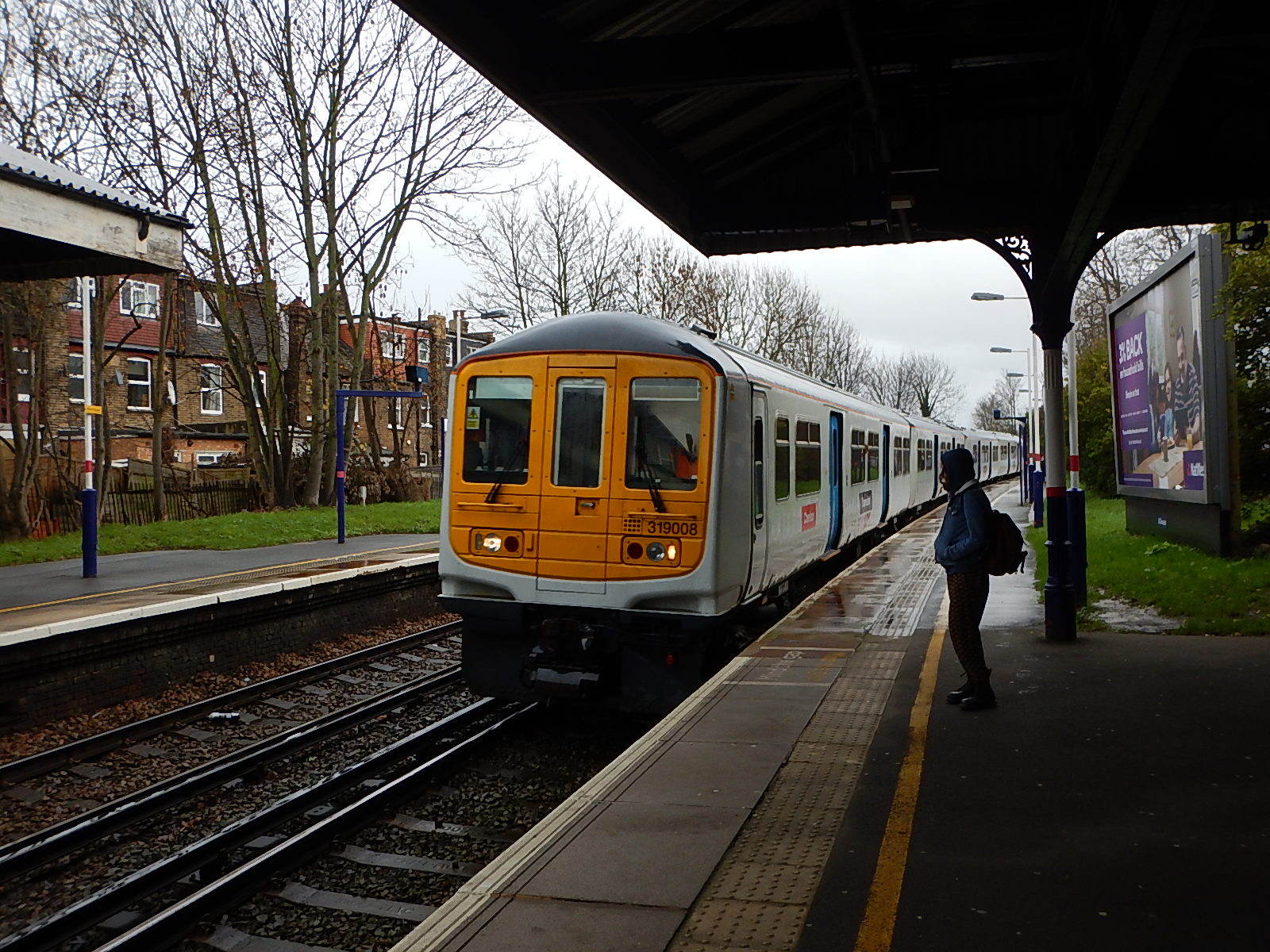
But for some of the electric routes in the North, they’re all we’ve got! And like some elderly actresses, they scrub up well.
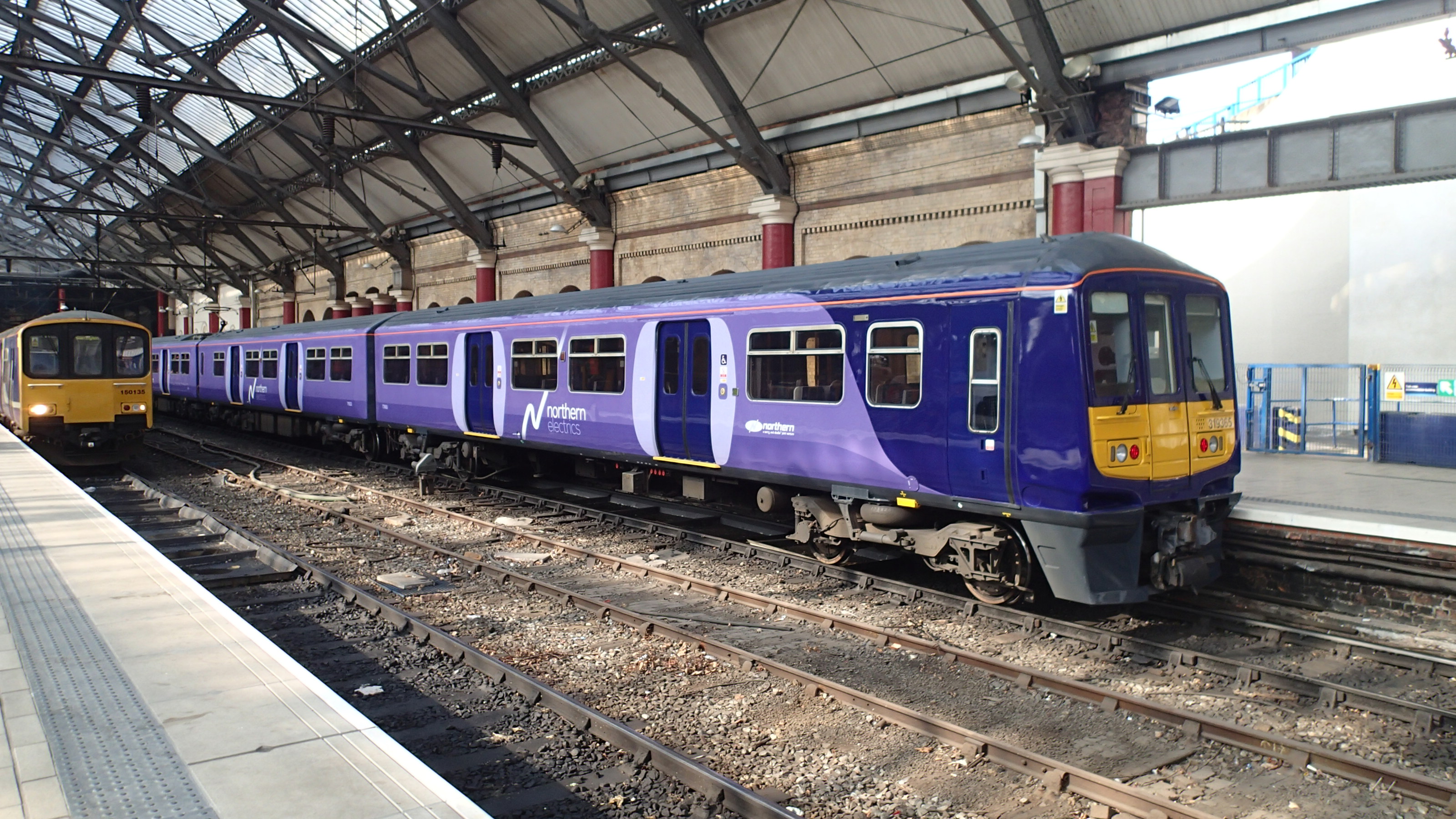
The Modern Railways article says this about Northern’s use of the Class 319.
It is understood that refurbished Class 319s will be used on these services on an interim basis until new build units arrive.
I suspect that these will soldier on for a few years yet!
At least there are eighty-six of these 100 mph four-car trains.
There must be a lot of laughter at reunions of engineers from BREL York, when they see how far their Bedpan Special has gone. after being built especially for the Bedford-Brighton route through the tunnels under London via St. Pancras in the 1980s.
He who laughs last, laughs longest!
Class 442 Trains
This is said in the Modern Railways article about Class 442 trains.
First says it did evaluate the use of Class 442 EMUs displaced from Gatwick Express workings hauled by diesel locomotives.
But they found it was too challenging and have discounted them.
So it looks like the Class 442s won’t be going anywhere in the North and probably have no worthwhile future.
Class 390 Trains And The West Coast Main Line
Virgin Trains have aspirations to run their Class 390 trains that work the West Coast Main Line, at their design speed of 140 mph in as many places on the route as possible. This section in Wikipedia gives more details.
At present because of signalling and regulations, trains are limited to 125 mph, but it is likely that once ERTMS is fully implemented, that pressure will increase to allow 140 mph in places on the West Coast Main Line.
TransPennine’s Scottish Services
TransPennine are increasing their Scottish services and this timetable is given.
- December 2018 – Liverpool-Glasgow service launched
- December 2019 – 12 new electric trains introduced on Anglo-Scottish services.
- December 2019 – Liverpool-Newcastle services extended to Edinburgh
This is said about the Class 350 trains currently running their Scottish services.
The 10 four-car Class 350/4 EMUs currently used on Manchester-Scotland services are expected to be phased out over the first three years and offered to other franchises. First say these trains are too small to run on many diagrams as single units.
So it looks like trains with this specification will be needed.
- Electric power only
- 140 mph top speed, as parts of the West Coast Main Line, will probably get upgraded to this speed, within the service lifetime of the trains.
- Five cars or longer.
- The ability to work in pairs. As all Glasgow trains will probably call at Preston, it might be sensible to join and split Liverpool and Manchester trains there to save train paths on the West Coast Main Line.
- Full on-board customer service.
The specification fits the Hitachi AT300 well, as these trains are available in five car sets and can be upgraded with minor modification for 140 mph running.
But will the timetable of 2019 for twelve new trains, fit the production capabilities?
As delivery into service by December 2019, to give TransPennine their promised service might be exceedingly challenging, could we be seeing something from another manufacturer?
After all, there are several around the world, who could create five-car 140 mph electric express trains?
- Some open-access operators like Alliance Rail are talking about using Pendolinos on Scottish routes, so Class 390 trains or an updated design of Italian-built Pendolino train must be a very real possibility.
- Siemens must also have a suitable train perhaps based on a German ICE design.
- The Chinese, Koreans, Spanish and Swiss shouldn’t be discounted.
If Hitachi can’t deliver, I’d put my money on a five-car Pendolino. After all, it is proven on the West Coast Main Line.
EMUs For Northern
Arriva have said, they will be buying forty-three 100 mph air-conditioned electric multiple units (EMUs), in a mixture of three- and four-car units.
These are probably the easiest trains to source and they might even already have been ordered or even built, in the shape of Class 387 trains. These have the following specification.
- Modern air-conditioned four car electric train.
- 110 mph capability
- Proven performance and certification.
- Bombardier can probably build them alongside all their Aventras at Derby.
But there are few electrified routes in the North, where they can be run.
However on the other hand!
I’ve believed ever since I rode the Class 379 BEMU or IPEMU demonstrator, that battery-powered trains based on this technology, are ideal for some of Northern’s routes.
Partially electrified routes or ones that run between electrified hub stations at Carlisle, Doncaster, Leeds, Liverpool, Manchester, Newcastle and York, could have virtually brand-new four-car electric trains, as soon as Bombardier can add IPEMU systems to Class 387 trains, currently in service or on order and staff can be trained.
A few months ago, I wrote Rumours Of Battery Powered Trains, where I said there were rumours of some of Great Western Railway’s order for Class 387 trains would be delivered as IPEMUs to help solve the shambles of the Great Western Main Line electrification.
Using an IPEMU is an attractive approach for several reasons.
- IPEMUs have a range of around sixty miles on the battery, if it is fully charged.
- IPEMUs have regenerative braking at all times, whether there is an electric supply or not! This improves efficiency and increased on-battery range!
- Bombardier feel that all trains should have energy storage for myriad operational reasons and the upcoming Aventra will be designed to accept an energy storage device as standard.
- Passengers will have the same experience on overhead line or battery power.
- On many routes, IPEMUs need no modifications to be able to run, except perhaps lengthening platforms for four-cars.
- On a scenic line or one in the middle of nowhere, the problems of electrification and its maintenance can be avoided, if services can be run by IPEMUs.
- Electrified hubs can be upgraded or created to charge the trains. In the North, Carlisle is being upgraded and Hull and Middlesbrough could be electrified.
- Some lines are currently run by some of the better diesel multiple units (DMUs) like Class 158 trains. Releasing these would probably eliminate a few of the dreaded Pacers on other lines.
All stakeholders will like these trains.
- Operators know that new four-car trains will attract more fare-paying customers.
- Network Rail will save money on electrification and can skip difficult bits.
- On many routes, opening up bridges and tunnels for the overhead wires is difficult, very disruptive and a time- and money-consuming process.
- Passengers and staff like new trains.
- More places can be served by electric trains.
- New four-car trains replacing ageing diesels will improve the prosperity of an area.
Routes that could be easily converted include.
- Barrow to Manchester Airport
- Chester to Manchester Victoria
- Windermere to Manchester Airport
- Blackpool North to Manchester Airport
- Liverpool to Manchester Airport via Warrington
Add in some electrified hubs and short lengths of tactical electrification to charge the trains and other lines like the scenic Tyne Valley Line between Newcastle and Carlisle could be run using new four-car electric trains.
I believe that these trains have enough energy storage to actually bridge the notorious forty mile gap in the electrification between Manchester Victoria and Leeds, thus creating an electric train service from Liverpool to Edinburgh via Manchester, Leeds, York and Newcastle
Note that news on development of IPEMU trains has been very quiet for several months and the only report is this article in the Derby Telegraph, which is entitled Battery-powered trains win award for Bombardier.
So someone other than I do, think the technology works and deserves its place on the railways of the UK.
Class 323 Trains
Before leaving Northern’s EMUs something must be said about the seventeen three-car Class 323 trains, that run services out of Manchester.
As they are being transferred to London Midland, they will need to be replaced.
Also, according to Wikipedia at times, some of the Class 323s are currently replaced by a pair of Pacers. So perhaps they need a bigger fleet anyway!
So until new units are ordered, will we see Class 319s working these routes? Or could they be a home for some of Porterbrook’s Class 387s?
It’ll all come out in time and in the contracts?
DMUs For Northern
Arriva have said, they will buy fifty-five two- and three-car DMUs.
Two factors could decrease this number.
- If Arriva go down the Class 387 IPEMU route, more routes will be running electric trains.
- The twenty-three Class 185 trains cascaded from TransPennine should they end up with Arriva.
- It seems likely that other companies including Great Western Railway could use the IPEMU route, thus making some high-quality DMUs available.
I won’t speculate on how many new DMUs will be actually ordered and built. If any!
Northern Connect
Northern Connect will be a sub-brand comprising a dozen long distance routes across the North.
Modern Railways publishes a table of the routes and indicates eight routes will be run by new DMUs, two by refurbished trains and two by new EMUs.
Obviously, Northern have a plan to create five of these routes by the end of 2018 and the rest by the end of 2019.
Where will the various classes of train fit?
- Some routes could be run by EMUs, with Class 319s providing an interim service until the new build arrive.
- Some routes could be run by Class 387 IPEMUs, once they are delivered.
- Some of the longer routes around Sheffield and Hull would be ideal for Class 185s.
If the long-rumoured Class 387 IPEMUs do appear, Barrow and Windermere to Manchester Airport, would be ideal routes on which to trial and showcase the technology.
Northern’s Train Philosophy
The Modern Railways article also says this.
Arriva says that it is still in negotiations with the supply chain but expects to sign a contract by April. It also says that the new fleet ‘has the capacity to grow’ with the trains ‘ordered as a family that are expandable’. The first 92 carriages will enter service by the end of 2018, with a further 163 by the end of 2019 to ensure all Pacers are replaced and the final 26 in 2020.
That is a very sound train procurement philosophy, which has a fairly relaxed delivery schedule, given the shortage of train building capacity in the UK and Europe. I suspect the Chinese could build them, but would that be politically acceptable?
I would not be surprised if Arriva went for a purchase of Class 387 trains, of which a proportion were IPEMU variants and some tactical electrification to produce electrified hubs in places like Huddersfield, Hull, Scarborough and Sheffield. It would be an afordable way of getting the benefits of new electric trains at an affordable price.
They would still need a few diesel multiple units, over and above the good ones they replaced with electric trains. But London Overground and hopefully Great Western Railway should be releasing some that are suitable.
Only as a last resort, would any new ones be ordered.
Class 387 Trains
I believe that the Class 387 Trains will play a large part in Northern’s plans.
They are a 110 mph four-car modern unit and currently there are twenty-nine units in service and another twenty-eight on order, if you ignore the separate order of twenty-seven trains for the Gatwick Express.
Thirty seven units are destined for the Great Western Railway and in Rumours Of Battery Powered Trains, I wrote about unconfirmed reports that some of these trains for the GWR would be IPEMU variants. I suspect that this will be confirmed, as it will enable electric services to be started on the shambles that is the Great Western.
The Gatwick Express variant of the Class 387 is going to be a train, worth looking at, as it will be the first Airport train we’ve ordered since the Heathrow Express.
There are to be twenty-seven four car trains replacing twenty-four five-car Class 442 trains.
There may be a few less carriages, but they are designed for the route.
They are also built as dual-voltage trains. Is that just so they can be tested on the West Coast Main Line, as was reported in this article in Rail Magazine, or because they think the type will have other Airport applications, like possibly Manchester, Cardiff, Glasgow, Luton, East Midlands and Stansted.
I can’t wait to ride one in the near future, as I think it might offer, a whole new experience of getting to an airport by train.
A lot of the services in the North West go via Manchester Airport. So would a follow-on order of this variant be ideal to get passengers to the fast growing airport?
Some questions have to be asked.
- As some of these services go all the way to Scotland, could the train be certified to the 125 mph of the West Coast Main Line?
- Could an IPEMU variant be created to bridge the gap between Manchester and Leeds?
- Could an IPEMU variant link Manchester Airport to Barrow, Blackpool North, Liverpool and Windermere?
- Can Class 387 trains be built in five-car formations?
If the answer to all or some of these questions is in the affirmative, Manchester Airport and the Nortrh might receive some interesting trains from Derby to create a 125 mph network of five-car Airport trains all across the North.
I suspect that Bombardier are working hard to see if they can fulfil that dream, as if they can, the rewards to the company, Arriva Northern, First TransPennine, Network Rail and the North in general, could be substantial!
There would be no waiting until 2018 for true bi-mode trains.
Could the silence on the IPEMUs be just because all parties don’t want to show their hands until all of the tiniest details are totally settled?
Political And Commercial Considerations
I mentioned in the section on the Class 387 trains, how important to get any trains, that can improve services in the North is to the companies involved and Bombardier in particular.
Bombardier have been going through a rough patch and were bailed out by the Quebecois. They seem to be sorted with large orders, but creating some more Class 387 trains, must be good cash-flow and profitable.
Network Rail are in a deep mess over electrification everywhere and desperately need some help in creating lines for electric trains. Peter Hendy is trying to sort out the shambles and there is a report in Modern Railways this month with a headline of Hendy Finds £2.5 Billion To Save Enhancements. The article says assets will be sold and there will be more money from the Government.
Arriva and FirstGroup have spent a lot of time and effort to create plans to give the North a modern world-class railway system. It is unlikely, that the train manufacturers will fail to deliver to agreed contracts, as all trains proposed for the North or either in service or at the certification and trial stage. The problem is the tracks. They will not be pleased if Network Rail fail to deliver, the electrification they have promised on time, as pictures of new trains stored in sidings are not good publicity.
Read a lot of the stories about new trains to run on newly electrified lines and dates have a vague air about them.
I suspect all will become a lot clearer, when Peter Hendry fills out his plan for Network Rail in the Spring. All we are getting at the moment are worthwhile aspirations.
And then there is the small matter of the local elections in May!
If the shambles is still persisting before the election, Corbyn and the Labour Party will have a field day, when they say they will nationalise the railways.
This would be a disaster for Arriva, FirstGroup and probably Peter Hendy. The companies would probably lose millions and Peter Hendy would have totally failed.
With my engineering hard-hat on, I’m getting more and more convinced that those clever engineers in Derby will pull the IPEMU rabbit out of the hat.
They have form for this, as in the 1970s, they created the peerless InterCity 125, after the wreckage of the APT.
Conclusion
Wait for April and hopefully before then a lot more will be revealed!
Reaction In The North To Rail Franchise Awards
I have been browsing the local papers in the North, to see the area’s reaction to the award of the new Northern and TransPennine franchises.
This article in the Liverpool Echo is entitled 4,000 more seats in £1.2bn boost for North West trains, which seems a very positive headline. This is the first paragraph.
Nearly 4,000 more seats on Liverpool and Manchester services during the morning peak and a new, direct Liverpool to Glasgow service were among the promised benefits of a trains package announced today.
They use a lot of positive language and only have a slight worry about what it will mean for fares.
This extract from another article, may be a bit parochial, but it is proud of Liverpool’s involvement in formulating the winning bids.
Merseytravel – who were involved in drawing up the specifications for the bidders – said there was a commitment to four fast services an hour between Lime Street and Manchester and two per hour between Liverpool, Leeds and York, as well as more services to Preston.
There will also be an early Northern service from Lime Street to Manchester Airport (arriving no later than 4.45am), and daily services to Manchester Airport via both Newton-le-Willows and Warrington Central.
It is also positive and just as I found in the city, when they introduced the Class 319s electric to Manchester Victoria, Merseysiders seem to be looking forward to better services.
Coverage on the Manchester Evening News, like this article entitled Hundreds of new carriages promised as Arriva and FirstGroup win Greater Manchester rail franchises, seems to be more cynical and snipes at Arriva for other issues. It doesn’t have the practical tone of the Liverpool reporting.
For instance, the Liverpool reporting stresses the much better service to Glasgow, Edinburgh and Newcastle, but despite Manchester will get a doubling of Scottish services, it isn’t given the same prominence.
Across in Leeds, the Yorkshire Post has an article entitled December 10: New age of the train – or not? This said.
Unlike previous deals which did not foresee the untapped potential of this region’s railways, Transport Secretary Patrick McLoughlin has used this opportunity to insist that the new franchise-holders invest in new rolling stock to help ease overcrowding on rush-hour trains. Yet it remains to be seen whether these operators, and their partners, can deliver the “world class rail service” envisaged by Mr McLoughlin and which is so integral to the much-vaunted Northern Powerhouse which aims to improve connectivity between major cities.
It looks to me that the Yorkshire character is shining through.
So on this quick look Liverpool is more positive and Manchester and Leeds are a tad negative.
Could it be that of the three cities, Liverpool is very proud of its locally-managed franchise, Merseyrail and are those in the area bigger train users than people to the East?
I also suspect, that at present, Liverpool with the electric trains to Manchester, has benefited most from rail dvelopment in the last few years.
Has The Government Parked Its Trains On Nicola Sturgeon’s Lawn?
The government has just published a document entitled Government intends to award Northern franchise to Arriva Rail North Ltd, and TransPennine Express franchise to First Trans Pennine Express Ltd.
The document starts like this.
The government promised passengers in the north and Scotland a world class rail service that would make the Northern Powerhouse a reality – today that is being delivered as new contracts for Northern and TransPennine Express franchises are awarded.
In some ways the proposals for Scotland are the most interesting.
Introducing new and additional services for Scotland, including a new, direct Liverpool to Glasgow service from December 2018 with new electric trains and extending existing services beyond Newcastle to Edinburgh from December 2019, and bringing in additional services from Manchester to Glasgow and Edinburgh from December 2017.
These will mean new electric trains and First TransPennine will be ordering forty-four new five-car trains.
I think the announcement will go down well in Scotland, although some politicians and others might be a bit miffed.
 The Anonymous Widower