Has The Possibility Been Created For A Pedestrian Tunnel Between Bank And Moorgate Stations?
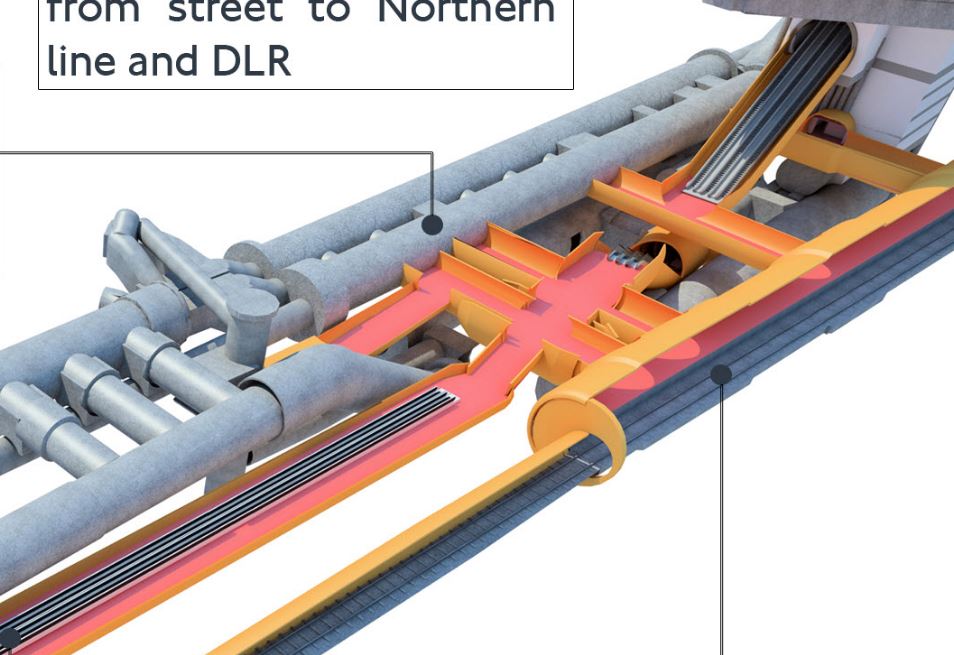
This visualisation shows the Bank Station Upgrade at Bank station, which is now underway to sort out the station’s problems of capacity and poor step-free access.
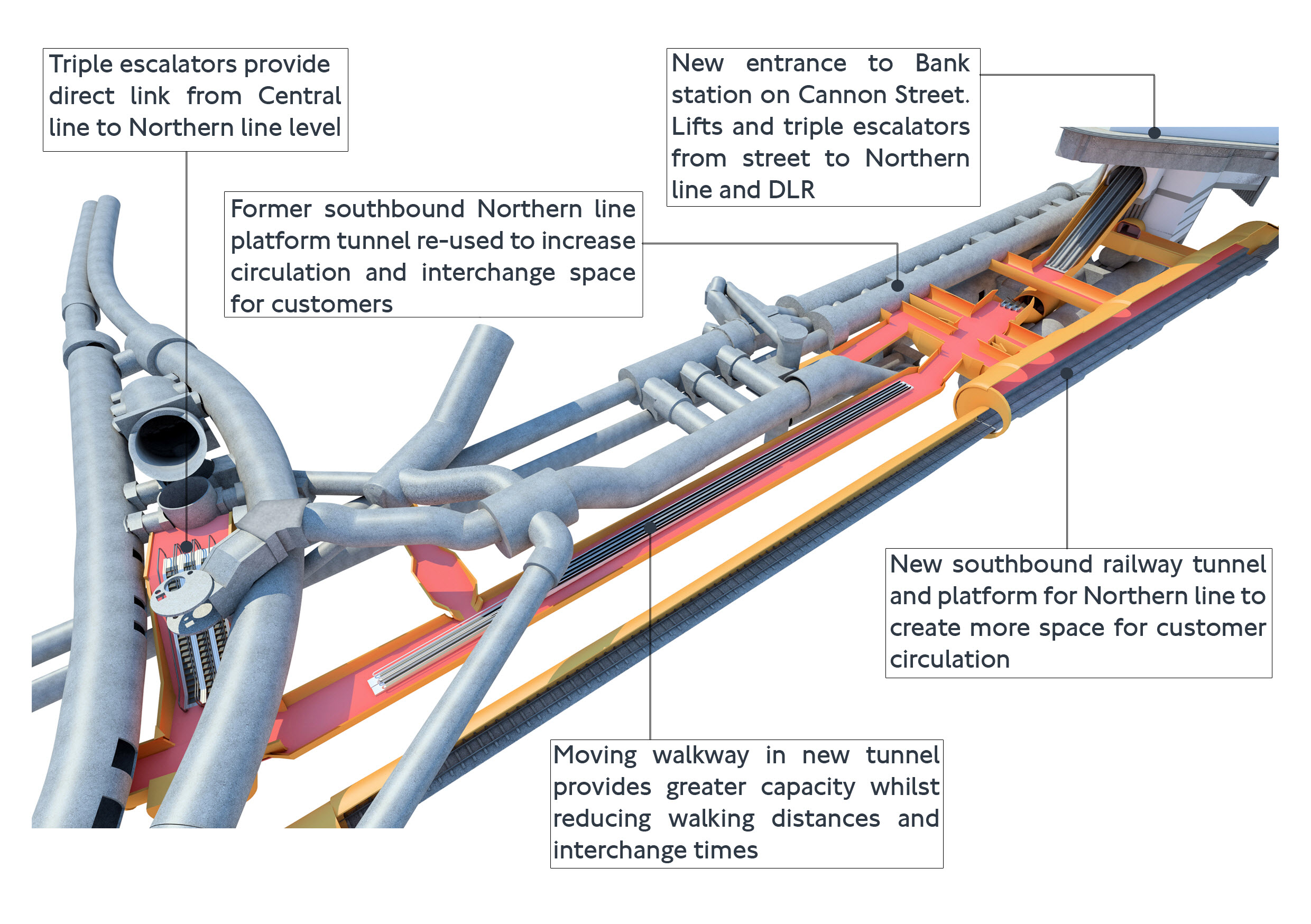
This is the bottom-left corner of the visualisation.
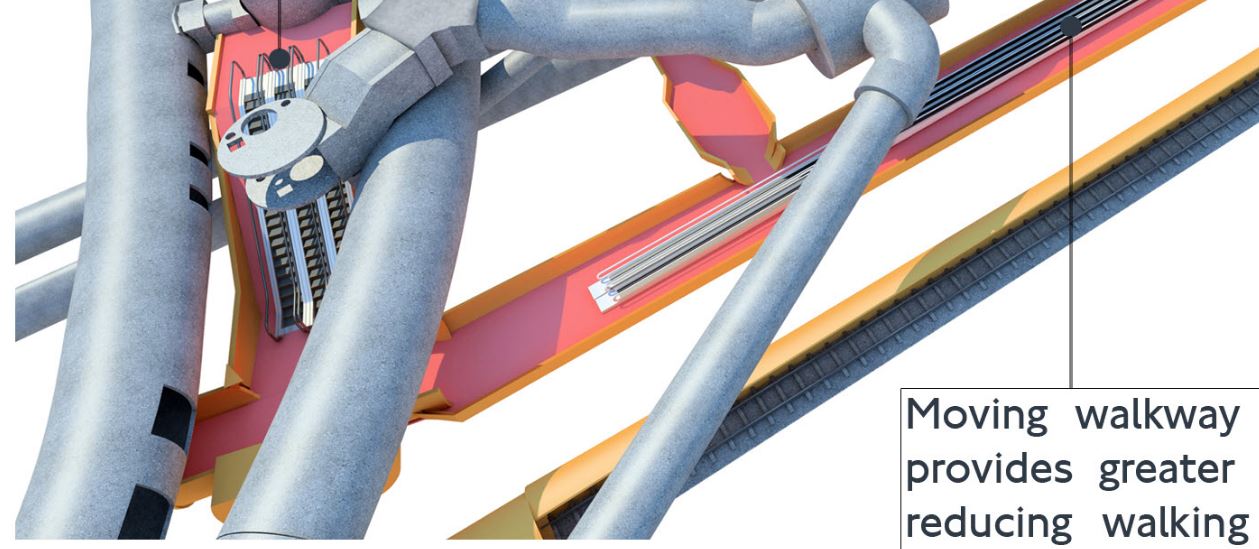
Notice that there are two fat tunnels running top to Bottom across the visualisation, which are the Central Line tunnels, with the Eastbound on the left and the Westbound on the right.
There are also four tunnels running left to right across the visualisation.
The top two, which are sticking out to the left of the Eastbound Central Line tunnel, are the current Northern Line running tunnels
- The top one is the Northbound tunnel going to Moorgate station.
- The other one is the current Southbound tunnel, which under the plans for Bank station will be closed to trains and used to improve passenger access to the Northbound platform. If you go to the Northern Line platforms, there are tell-tale blue hoardings, indicating where better access will be created.
These pictures show the current state of the current Southbound tunnel.
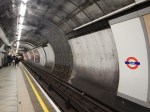
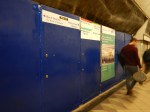
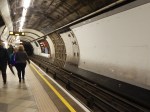

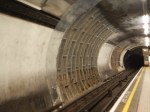
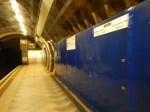
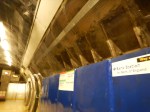
It looks like at least three sections of the wall between the two platforms will be removed.
The third tunnel, which is shown pink in the visualisations is the connecting tunnel between the Central Line and the new entrance to the station on Cannon Street.
Note the following.
- It has a travelator.
- it connects to a lobby, where there are triple escalators to the Central Line.
- It appears to come to a stop under the Eastbound Central Line platform.
What lies at the Northern end of this tunnel?
The fourth tunnel, which is the new Southbound running tunnel for the Northern Line, has been helpfully drawn with a rail track inside.
This is the top-right corner of the visualisation.
Note.
- There are three cross passages between the two running tunnels, just as there appears to be three blue hoardings in the existing Southbound running tunnel.
- The Northbound running tunnel now has a wide platform, which has been built inside the existing Southbound tunnel.
- The new Southbound running tunnel will be built with a wide platform.
- There are three escalators leading to the new Cannon Street entrance.
- There are three escalators leading down to the Docklands Light Railway (DLR) platforms
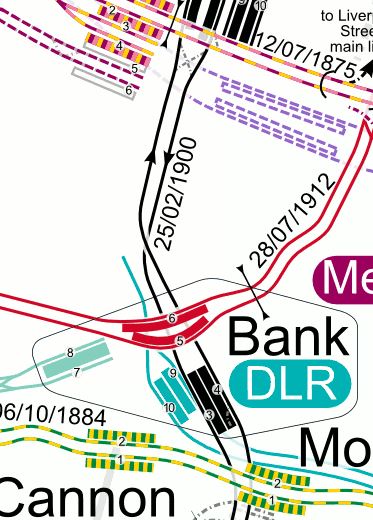
This map from carto.metro.free.fr, shows the layout of lines at Bank station and between Bank and Moorgate stations.
Note.
- The Central Line is shown in red.
- The Northern Line is shown in black.
- The DLR is shown in turquoise.
- The two Northern Line tracks cross to the North of Bank station.
- The lines at Moorgate station are shown at the top of the map.
- Crossrail is shown in violet.
The new Southbound tunnel will be created to the West of the DLR platforms.
This article on IanVisits is entitled Behind The Scenes At London Underground’s Bank Tube Station upgrade.
I suggest you read the article and I feel, you will get the impression the Bank Station Upgrade is a very difficult project, that is being achieved in an innovative manner by the contractors.
In one section, the article describes how they are actually building the new Southbound tunnel, through the piled foundations of existing buildings.
A Travelator Between Bank and Moorgate Stations
I now feel I can answer the question in the title of this post.
The Route
If the route started at the Northern end of the long connection tunnel with the travelator at Bank station, a route could probably be found on the West side of the Northern Line to break-in to the basement of the Crossrail station at Moorgate station.
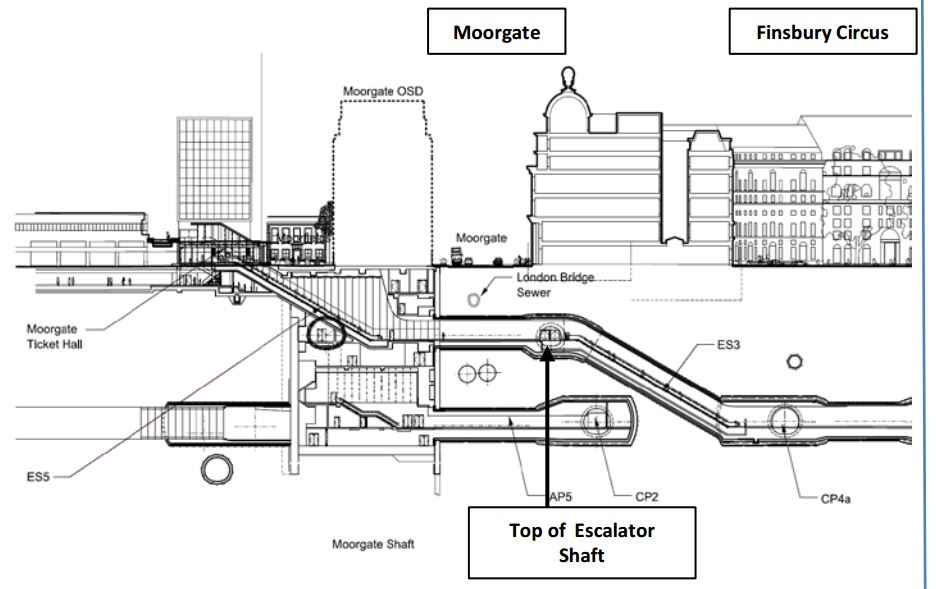
This image shows a cross-section through the Moorgate Crossrail station.
Note that under the escalators leading down from the Moorgate Ticket Hall to Crossrail, are a pair of circles.
- These are the Northern Line running tunnels.
- A travelator tunnel would be at this level but perhaps twenty or more metres to the West (left in the cross-section).
With modern design and construction techniques, I would expect that a connection could be made.
The Length
I estimate that the travelator would be between three and four hundred metres long.
As there are longer travelators either built or in planning in the world, I suspect, the length wouldn’t be a problem.
By comparison, these are example travelators in London.
- Jubilee to Northern/Bakerloo Lines at Waterloo – 140 metres.
- Sloping travelators to Waterloo and City Line at Bank – 76 metres
- Proposed Central to Northern Lines at Bank – 94 metres
A travelator between Bank and Moorgate stations would probably be, the longest in London.
Building The Tunnel
If you read the IanVisits article, it details how the new Northern Line and travelator tunnels at Bank station were excavated.
I suspect similar techniques could be used to build the new tunnel.
The biggest problem would be removing the tunnel spoil and I suspect that if the tunnel were to be built, when a building on the route needed to be replaced, this would make construction a lot easier.
Why The Tunnel Should Be Built
The main argument for building the tunnel is that it would connect Bank station directly to Crossrail.
Why The Tunnel May Not Be Needed
There are various reasons, why the travelator may not be needed.
Pedestrianisation
The City of London is in favour of pedestrianisation and has already disclosed plans to make Bishopsgate, which is one of the most important North-South arteries through the Square Mile, much more pedestrian friendly.
I would expect more initiatives like this to follow.
So many travellers will use their feet on the surface, between Crossrail and Bank, when the two stations are completed.
Improved Northern Line Connections
The connections to the Northern Line will be improved at both Moorgate and Bank stations, when Crossrail and the Bank Station Upgrade are completed.
So those travellers needing or wishing to do a one-stop transfer, will find it easy.
Connectivity between Crossrail And The Central Line
Crossrail and the Central Line have good connectivity.
- Stratford – A cross-platform interchange.
- Liverpool Street – A step-free connection
- Tottenham Court Road – A step-free connection
- Bond Street – A step-free connection
- Ealing Broadway – A step-free connection.
If travellers need Bank and they are coming from either direction on Crossrail, they can change at a convenient station.
Given that Bank station will have a large number of step-free entrances after the Bank Station Upgrade is completed, I suspect many Crossrail passengers will transfer to the Central Line to avoid the walk from Moorgate or Liverpool Street stations.
Conclusion
It may be feasible to build a trevelator between Bank and Moorgate stations, but developments already in hand, may give the project a very bad financial case.
Paddington Bakerloo Line Link Project, London
The title of this post is the same as that of this page on the Institute Of Civil Engineering web site.
The page contains a video presentation of the building of the Paddington Bakerloo Line Link, that will connect the Bakerloo Line to Crossrail sometime next year.
If you think the golden age of British improvised tunnelling finished with the end of World War Two, with the likes of the Wooden Horse and the Great Escape, then think again.
- A redundant Royal Mail building stars as the cookhouse, where the tunnel starts under the floor.
- The old Rail Mail tunnel, doubles for the sewers.
- Sections were dug by hand.
I wouldn’t be surprised to see more pedestrian tunnels dug with all the ingenuity of this one.
Major Overhaul Of One Of Country’s Longest Tunnels Sees Delays Fall By A Fifth
The title of this post is the same as that of this article on Rail Technology Magazine.
This is the first two paragraphs.
A major refurbishment of Sevenoaks tunnel has seen a 20% reduction in delays and halved journey times for passengers, even as the £21m infrastructure renewal nears completion.
One of the longest tunnels in southern England, Sevenoaks has been given a major overhaul which has included replacing thousands of sleepers, laying several miles of news track, and installing new drainage systems.
Sevenoaks tunnel is a single-bore tunnel, double-track tunnel about two miles long.
Obviously, this refurbishment has been worthwhile.
I do wonder how many other schemes, that are stuck in Network Rail’s pipeline would show similar improvements in the quality of the service?
Pedestrian Tunnels In London’s Transport System
I take particular interest in pedestrian tunnels, as I believe properly designed tunnels can be a solution to improving access to stations.
This list will be extended as I photograph more.
Bank – Bank And Monument Escalator Connection
I still think of this tunnel, as an escalator connection, as that was how it was marked on the tube map in the 1950s.



It is two escalators down a walk between the Docklands Light Railway platforms and then two escalators up at the other end.
Verdict – The connection is being upgraded.
Bank- Central To Northern Interchange Tunnel
This is the shortest way from the Central Line to the Northern Line.



It does involve a descent of a circular staircase.
When the Bank station upgrade is complete this route will be replaced by an escalator connection between the two lines.
This visualisation shows the connecting escalators.
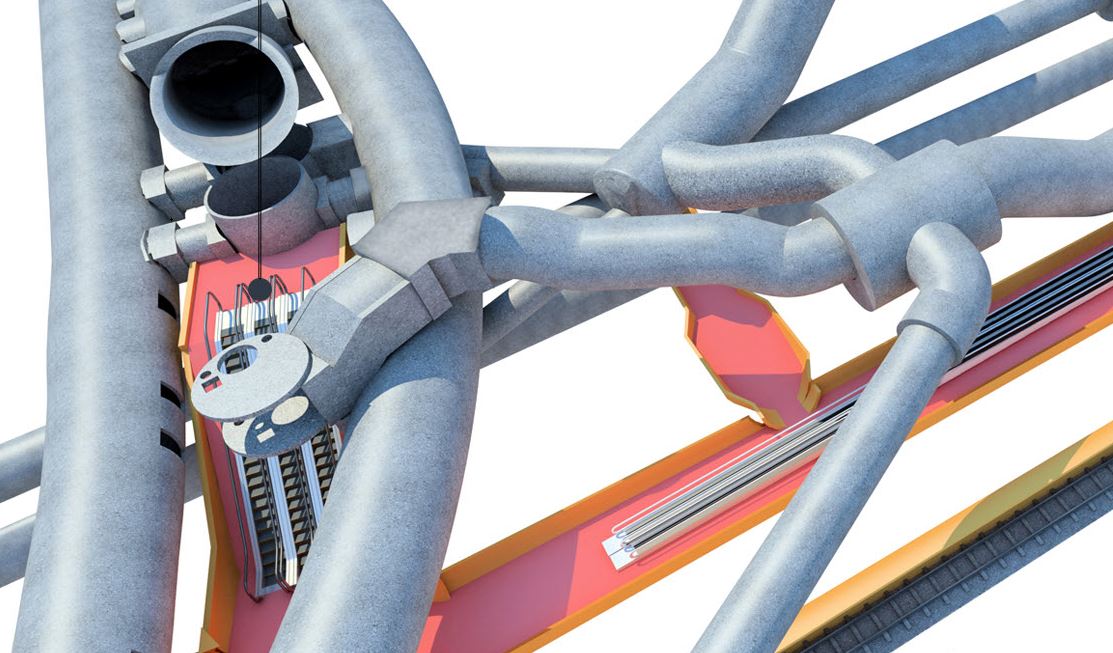
Note.
- The two wide highest level tunnels are the Central Line.
- The infamous curved Central Line platforms,create a large gap to mind.
- The two mid-level crossed tunnels are the existing Bank and Monument Escalator Connection and the Waterloo & City Tunnel.
- The four narrower lowest level tunnels are from bottom to top; the Southbound Northern Line, a new tunnel with a travelator; the old Southbound Northern Line tunnel and the Northbound Northern Line tunnel.
- The old Southbound Northern Line tunnel will become a passenger walkway.
Poking through all this spaghetti are the three escalators connecting the Central Line level with the Northern Line level.
Verdict – This connection will become much better.
Bank – Waterloo & City Inclined Travelator
The inclined travelators that link the Waterloo & City Line platforms and the main station entrances around Bank junction, are unique on the London Underground.
There are other travelators, but no others are inclined.


Verdict – I wonder why there are no others, as this pair seem to work very well.
Bank – Waterloo & City Tunnel
This tunnel connects the Waterloo & City Line platforms at Bank station to the central tunnel at Bank station.



Verdict – It is a linear oasis in an otherwise dingy and cramped station.
Bond Street – Northern Entrance Tunnel
This new tunnel connects the new Northern entrance at Bond Street station to the platforms.


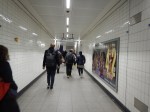
Incidentally, I’d arrived at Bond Street station through the main entrance and it was an awfully overcrowded scrum. The Northern entrance was quiet, as the pictures show.
The entrance is steps or a lift between the street and its own gate line and then a well-lit wide passage to the escalators.
In future, it will link to a wide tunnel to the Western end of the Crossrail platforms at the station.
It is much better way to enter Bond Street station.
Verdict – London and other cities with underground railways, need more new station entrances like this.
Green Park – Interchange Tunnel
This tunnel connects the Jubilee, Piccadilly and Victoria Lines at Green Park station.
The opening dates of the three lines, through the station were.
- Piccadilly Line – 1906 – Modernised in the 1930s with escalators.
- Victoria Line – 1969
- Jubilee Line – 1979
Since 1979 the station has been continually improved and is step-free.
This map from carto.metre.free.fr shows the lines at Green Park station.
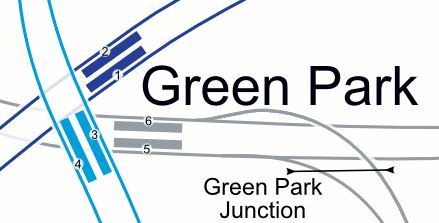
Note that the Jubilee Line is below the other lines and when the extension was built, it was a radical change to what was originally planned. The lines to the right lead to Charing Cross station and those going South to Westminster station.



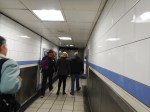

The interchange tunnel is long and usually very crowded. I had an incident recently, where I was walking slowly to the Victoria Line and a group of tourists all with four-wheeled cases, were nudging me to go faster. When we all got to the steps at the end, there was an enforced slow down.
Verdict – I avoid interchanging at Green Park like the plague.
Kings Cross – Eastern Tunnel
This tunnel runs which used to be part of the access to the old Kings Cross Thameslink station, runs from East of Kings Cross station and then has access to the main tunnel connecting the Northern, Piccadilly and Victoria Lines.

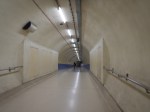

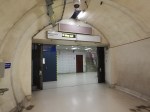

It has partial escalator access at the Eastern end, where the buses from Islington and the East stop outside the old station entrance. Although getting buses to the East mens crossing the busy Pentonville Road.
Verdict – Needs improvement
Kings Cross – Interchange Tunnel
This tunnel connects the Eastern Tunnel at Kings Cross to the escalators and lifts that lead to the Northern ticket hall Kings Cross St. Pancras tube station. On the way is connects to the Victoria, Piccadilly and Northern Lines.


It is a long walk, especially, if you have accessed it, as I often do, from the Eastern Tunnel which is convenient for buses from Islington and Dalston.
Verdict – Too long and boring
Kings Cross – St. Pancras Tunnel
This tunnel connects St. Pancras station to the Northern ticket hall at Kings Cross St. Pancras tube station.
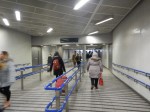


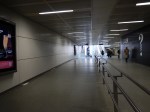

It is a wide, comfortable tunnel with a double handrail down the middle.
Note that the middle picture shows the connection to the next tunnel.
Verdict – Useful and a better walk than the surface alternative in cold or wet weather.
Kings Cross – Pancras Square Tunnel
This tunnel connects St. Pancras Square to the underground tunnel, that links St. Pancras station to the Northern ticket hall of Kings Cross St. Pancras tube station.


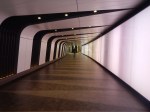

It is a good example of how to create a tunnel.
It has up and down escalators at the St. Pancras Square entrance.
Verdict – Good design and a pleasant walk.
Knightsbridge – Northern Exit Tunnel
This tunnel at Knightsbridge station was built in 2010 to connect the new entrance on the North side of Knightsbridge.


It looks to me that Transport for London had to make do with less space than they needed.
Verdict – Rather narrow and utilitarian.
Paddington – Bakerloo Line Link
This project to create a pedestrian link between the Bakerloo Line and Crossrail at Paddington is currently being built.
- It will be one hundred and thirty metres long.
- It will be twenty-five metres below the Paddington station concourse.
- The design uses a route to avoid existing station facilities.
- The tunnel is being built without major disruption to Bakerloo Line passengers.
- It will have lifts and escalators at both ends.
- The tunnel will handle five thousand passengers per hour in the Peak.
In August 2016, I wrote Paddington Is Operational Again, which describes the tunnel in detail.
Verdict – I have a feeling that this could be one of the most impressive parts of Crossrail.
I can’t wait for this tunnel to open.
South Kensington – Exhibition Road Pedestrian Tunnel
The Exhibition Road Pedestrian Tunnel at South Kensington station is unique in London, as it was built in 1885 and it is Grade II Listed.


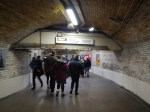

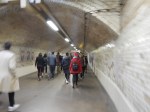
As the pictures show, it can get very busy.
Verdict – A Victorian idea, that hasn’t been copied much.
Tottenham Court Road – Interchange Tunnel
This tunnel connect the Central and Northern Lines at Tottenham Court Road station.



It is a bit lacking in colour to my liking. But at least there is some of Eduardo palotzi’s tiles at one end.
Verdict – Bland and too long.
Victoria – New Tunnels
Victoria station has had a new entrance at Cardinal Place and a lot of new tunnels to sort out the poor connectivity, added in the last couple of years.




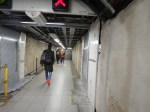
As the pictures show, not all the tunnels are finished.
Verdict – Victoria is no longer a station yo avoid
Waterloo – Interchange Travelator
This map from carto.metro.free.fr shows the Underground lines at Waterloo station.
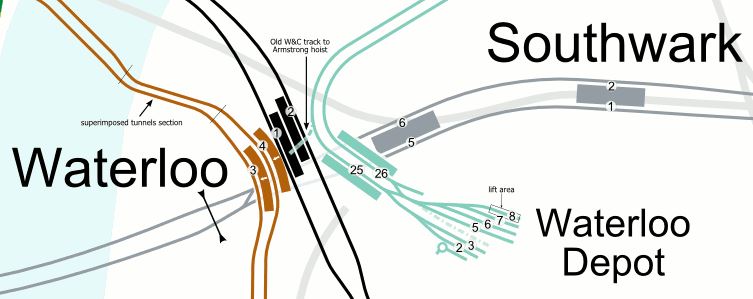
Note the large separation of the platforms of the Jubilee Line and those of the Bakerloo and Northern Lines.
The solution was to install a travelator, when the Jubilee Line Extension was built.


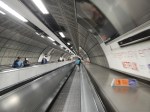
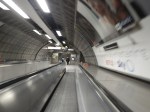
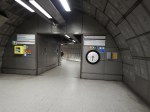


Although expense wasn’t spared on the project, I think we would give it a more decorative lining today.
Verdict – It works.
Whitechapel – Refurbished Overground Staircases
There are two staircases between the District/Hammersmith & City Lines and the East London Line, that are being refurbished for Crossrail.

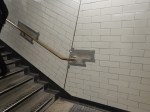
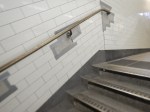

It looks like the work is of a high quality and that the old rails have not been replaced.
Verdict – These were scruffy tunnels a couple of years ago.
Summing Up
Some tunnels are obviously better than others, but what surprised me, was how well the Exhibition Rpad Tunnel to the museums coped with large numbers of passengers.
Perhaps, the Victorians got it right, as some of the best tunnels in my examples are the wider ones.
Comparing the Northern Exit Tunnel at Knightsbridge with the Northern Entrance Tunnel at Bond Street, shows how a wide tunnel and entrance, built with a lift, is a much better solution, than a narrow tunnel and entrance, without a lift.
The only narrow tunnel, that seems to work well is the tunnel connecting the Waterloo & City Line to the main Bank station complex.
But this tunnel is well-lit and I suspect tends to have passengers going the same way most of the time.
It also appears that recent tunnels like those at Bond Street and Victoria, are much better than those built about ten years ago, like the tunnel at Knightsbridge.
The Future
After Crossrail, London has a number of large station projects in the pipeline, some of which will require new connecting tunnels for passengers.
- The upgrading of Bank station is underway, where tunnels are being dug and escalators, travelators and lifts and being installed.
- The upgrading of Knightsbridge station is underway, but this will be simpler and I don’t think the upgrade includes more tunnels.
- The upgrading of Camden Town, Holborn and Walthamstow stations are in the planning stage. All will probably involve creating a new entrance connected to the existing platforms with lifts and escalators, but no long tunnels.
- Oxford Circus station is likely to be the subject of a major upgrade.
- Euston and Euston Square stations are being upgraded for the arrival of High Speed Two and there will be new tunnels to dig, between the two stations.
There are also possible new lines to consider, which may or may not be built.
- Bakerloo Line Extension
- Crossrail 2
- Docklands Light Railway to Thamesmead
- Docklands Light Railway to Euston, St. Pancras and Victoria.
All will be built with lots of entrances and exits, and interchanges with existing lines, so it is likely, there will be quite a few connecting tunnels.
Conclusion
I think that three tunnel projects will define a lot of the thinking about pedestrian access in the future.
- The Northern Entrance Tunnel at Bond Street, which surfaces in a commercial development.
- The Paddington Bakerloo Line Link, which appears to be setting new standards of design and construction.
- The narrow well-lit tunnel at Bank.
Could we see lessons learned with these newly-built tunnels applied to projects like Oxford Circus and Euston stations?
Edinburgh’s Missing Link
In Edinburgh, I’ve walked in an Easterly direction, several times through Princes Street Gardens, with the final intention of taking a train from Edinburgh station.
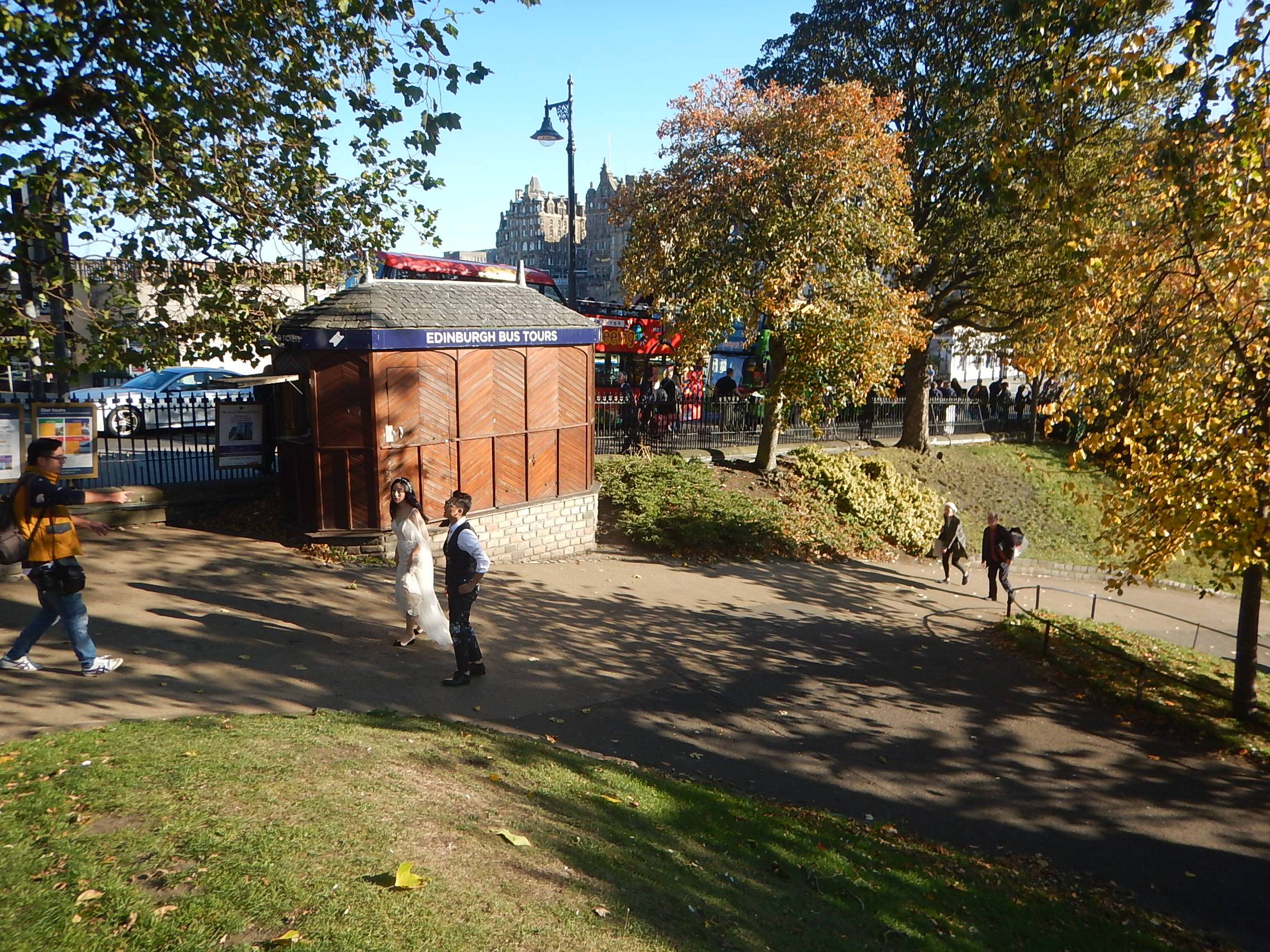
But as the pictures show, there’s no way through.
You have to walk up to the road, fight your way across a pedestrian crossing and then walk down a ramp into the station.
Why isn’t there a pedestrian tunnel?
HS4Air’s Heathrow and Gatwick Tunnels And Stations
One of the details I like about the HS4Air proposal is that the HS4Air tracks cross both Heathrow and Gatwick Airports at right-angles to the existing rail routes through the airports.
In my experience, stations with this layout, make for an easy interchange.
I suspect, the Heathrow and Gatwick Tunnels will be very deep under the airports, which will mean the following.
- They won’t disturb the existing airport.
- All the existing Crossrail design and construction expertise will be useful.
- The station could be as large as needed, with through and terminal platforms.
The stations will have lifts, escalators and travelators all over the place to connect to the existing airport terminals.
Heathrow
The Heathrow HS4Air station could have direct services all over the place.
For many getting to Euston or Paddington to perhaps take a train to Swansea can be a pain, but if Heathrow develops a proper local transport network based on Crossrail and proposals like Heathrow Southern Railway, this will be much easier.
Heathrow Airport could become a massive High Speed Rail Hub buried under the existing Airport.
Gatwick
Gatwick Airport is already an excellent Rail-Hub between London and the South Coast.
HS4Air would mainly add fast connections to Heathrow and HS1.
I suspect that Gatwick would have a smaller number of terminal platforms than Heathrow.
Conclusion
These two stations will be massive building projects, which using the expertise gained from other similar projects, will not disrupt anything on the surface.
Elon Musk Goes Underground With High-Speed Trains
The title of this post is the same as that of an article in the Business section of last Friday’s Times.
This is the first paragraph.
Futuristic electric trains will soon be whizzing under the streets of Chicago at up to 150 mph after Elon Musk’s tunnelling company was chosen by the city to build a new high-speed commuter link.
Currently, the Blue Line train takes about forty-five minutes for the eighteen miles at a cost of five dollars.
Heathrow Airport is eighteen miles from the City of London and Crossrail will do the trip for thirty-three minutes when it opens, next year for a cost of under a tenner.
So what is Musk proposing?
- A journey time of twelve minutes.
- Passengers will ride in skates, which will carry up to sixteen people on concrete tracks.
- Skates will run at a frequency of 120 per hour for 20 hours a day.
- The fare would be twenty-five dollars.
- The system would cost about a billion dollars.
It is a technically ambitious proposal.
There’s more in this section called Chicago in the Wikipedia entry of The Boring Company.
A competition to build a high-speed link from downtown Chicago to the soon-to-be-expanded O’Hare Airport had been reduced to just two bidders by March 2018. The Boring Company was selected in June 2018 and will now negotiate a contract to be presented to the Chicago City Council. Construction is to be entirely financed by The Boring Company, which is subsequently to maintain and operate the link. The system will transport passengers in automated electric cars carrying 16 passengers (and their luggage) through two parallel tunnels running under existing public way alignments, traveling from block 37 to the airport in 12 minutes, at speeds reaching 125 to 150 miles per hour (200 to 240 km/h), with pods departing as often as every 30 seconds
It states it is two parallel tunnels!
Comparison With London’s Crossrail
Crossrail will effectively do the same job in London and a comparison between the two systems may produce some interesting conclusions.
Capacity
Musk’s system will have an hourly capacity of 1920 passengers per hour, based on 120 skates each carrying sixteen people.
Crossrail are talking of six trains per hour, each with a capacity of 1,500 people or 9000 passengers per hour.
I think that Crossrail will need to increase capacity, as Heathrow expands and longer trains and higher frequencies are possible.
But if Musk’s system is a runaway success, can it be expanded easily.
Journey Time
Musk’s system has a journey time of 12 minutes, as against Crossrail’s of 33 minutes
But Crossrail will stop up to ten times!
Intriguingly, the twelve minute is not the headline speed of 125 to 150 mph, but a slower 90 mph.
Routes
Little has been said of the route for Musk’s system, except that it goes between Downtown and O’Hare Airport.
Heathrow to the City of London, also goes direct to London’s major shopping area and the new business area of Canary Wharf.
It is also integrated with London’s existing Underground, Overground and rail lines at several places.
Does Musk’s system have a route structure, that won’t appeal to a lot of possible users?
Musk’s Thinking
This is an extract from the Future Goals section of the Wikipedia entry for The Boring Company.
According to Tesla, Inc. and SpaceX board member Steve Jurvetson, tunnels specifically built for electric vehicles have reduced size and complexity, and thus decreased cost. “The insight I think that’s so powerful is that if you only envision electric vehicles in your tunnels you don’t need to do the air handling for all carbon monoxide, carbon dioxide, you know, basically pollutants for exhaust. You could have scrubbers and a variety of simpler things that make everything collapse to a smaller tunnel size, which dramatically lowers the cost … The whole concept of what you do with tunnels changes.
The philosophy is not unlike that of Crossrail.
- I believe that Crossrail has been designed holistically, using the best tunnel and train technology.
- The tunnel power supply is a simple end-to-end rail.
- The Class 345 trains have batteries to make best use of electricity and provide emergency power.
- The batteries will handle regenerative braking, thus minimising heat-producing electric currents in the tunnel.
- Platform-edge doors and aerodynamic trains reduce mechanical energy losses.
- The electric trains do not emit anything into the tunnel, except perhaps a small amount of hot air.
I suspect that Crossrail’s tunnel section will be a very energy-efficient railway.
Conclusion
Summing up both systems we get.
Musk’s system is.
- A billion dollar cost.
- Twelve minute journey time.
- A vehicle every thirty seconds.
- Only for the few, who want to go from O’Hare to Downtown, who can pay a premium fare.
- Limited capacity.
A Crossrail-like solution would be.
- Perhaps a ten billion dollar cost.
- Twenty minute journey time.
- A train every few minutes.
- For everyone, who wants to travel from O’Hare to most places in Chicago with possibly a change, at a normal fare.
- Expandable capacity.
Musk’s system will appeal to the rich and those who like novelty, but I don’t think it is a long-term solution and just like London, Chicago will eventually have a modern railway linking it to the wider Chicago area.
Where Musk is right, is that he believes that tunnelling methods can be improved and become more affordable.
This will mean that more audacious railway schemes will be built.
Photos From The Disused Tunnels Now Helping The Bank Tube Station Upgrade
The title of this post is the same as that of this informing article on Ian Visits.
The title probably, says it all and Ian describes how London always seem to have a spare tunnel, where it is needed.
Another Ambitious Tunnel
This article on Global Rail News is entitled Study Finds C$1.7bn Undersea Rail Tunnel The Most Attractive Option For Labrador-Newfoundland Link.
The article cites innovations in tunnel technology is one of the reasons, that this tunnel is now possible at an affordable cost.
The study also proposed that the single rail tunnel, uses this operational method.
Travelling at up to 100km/h, the train would take 20 minutes to cross the strait. It would operate 12 hours a day, seven days a week, carrying a maximum of around 130 vehicles.
They indicate because of low traffic levels, this would handle traffic for over forty years.
Tunnel builders will increasingly get more ambitious and we’ll see more plans for tunnels in the future.
Will We See More Slab Track On UK Railways?
I ask this question, as I’ve just read this article on Rail Engineer, which is entitled Slab Track Austria: Now A Serious Contender?
Slab track or ballastless track has a Wikipedia entry.
This is said under Characteristics.
In ballastless tracks, the rails are rigidly fastened to a special type of concrete ties/sleepers that are themselves set in concrete. Ballastless tracks therefore offer a high consistency in track geometry, the adjusting of which is not possible after the concreting of the superstructure. Therefore, ballastless tracks must be concreted within a tolerance of 0.5 millimetres. The elasticity of the ballast in the traditional railway superstructure is replaced by flexibility between either the rails and the concrete ties/sleepers or the ties/sleepers and the concrete or asphalt slab as well inherent elasticity within the conglomerate of the tie/sleeper, whereas the concrete or asphalt slab is usually inelastic.
Applications in the UK recently include.
- Tunnels on Merseyrail, Crossrail and other routes.
- Gospel Oak to Barking Line.
- Borders Railway.
- Edinburgh to Glasgow Line at Glasgow Queen Street station and the Winchburgh Tunnel.
This picture shows some of the slab track on the Gospel Oak to Barking Line.

I suspect, that slab track was used here mainly because of limited clearance. But low maintenance and long life, must have improved the financial case.
Returning to the Rail Engineer article, it would appear that the engineers behind the slab track, have rethought a lot of the process of building a railway.
Slab Track Austria, which used to be called PORR-STA, seems to offer the following.
- Factory-build or one-site fabrication.
- Ease of installation.
- Accurate alignment
- Switches and crossing can be fabricated.
- Transition solutions to ballasted track.
- Low noise and vibration.
- Ease of maintenance
- Sixty year life.
Slab Track Austria would also appear to have worked extensively with Austrian Railways, to get everything as right as possible.
It just shows how much improvement can be squeezed out of some traditional industrial and construction processes.
HS2
TheSlab Track Austria track has also been used extensively on the new Berlin to Munich high speed line, that I wrote about in From Berlin To Munich In Four Hours By Train. This is said about the use of the track on that line, in the Rail Engineer article.
PORR was contracted to design and build three major sections of the railway route. Its patented slab track, STA, was installed over a total length of 320km, in tunnels, on bridges and in open sections. Operations started successfully in December 2015 on the VDE 8.2 section, from Erfurt to Leipzig and Halle. Since December 2017, the sections VDE 8.1.2, from Coburg to Illmenau, and VDE 8.1.3, from Bad Staffelstein to Coburg, have been in operation. Trains have been running on the STA slab track layout at speeds of 300km/h. Prior to commissioning, this slab track was tested at 330 km/h.
So it would appear to be suitable for the 400 kph, that is quoted for HS2, with perhaps a bit of tweaking.
The article also says this about using the track on HS2.
Cost analysis research suggests that the savings made from the reduced maintenance required for STA track will equate to a payback of within 15 to 20 years when compared to ballasted track systems. The opportunity for significant savings, as well as increased network availability due to the reduced maintenance requirement, has to mean that this system is a serious contender for any new railway route, one of which, of course, is HS2.
A dedicated factory producing the slabs would surely increase quality.
But whatever happens, with its numerous, bridges, tunnels and viaducts, I suspect that HS2 will be built using slab track.
In the last quote, a payback time of fifteen to twenty years is suggested, if the track is used on a new railway.
So where else could slab track be used to advantage?
East-West Rail Link
I feel that the East West Rail Link, could be a possibility.
Consider.
- It will not be initially electrified.
- It is through terrain that is not very challenging
- It is fairly close to HS2 and a possible slab track factory.
Building the line with slab track, could help make the East West Rail Link a low-energy and low-noise line for battery or hydrogen trains.
West Anglia Main Line Four-Tracking
Adding two extra tracks to the West Anglia Main Line between Coppermill Junction, which is just South of Tottenham Hale station, and Broxbourne station will be a difficult project.
The line is hemmed in on both sides by housing and slab track might give advantages.
- Ease to squeeze the tracks in the limited space available.
- Reduced noise.
- Speedier construction.
If Crossrail 2 is built, this four-tracking will have to be done.
Calder Valley Line
The Calder Valley Line should be updated to create a quality roue across the Pennines from Preston to Leeds.
Parts of the line would be challenging to improve to say the least, with lots of heritage features around the track.
Using slab track in places, has has been done on the Gospel Oak to Barking Line, might help with the following.
- The construction works needed.
- Increasing line speed.
- Lowering noise.
- Reduced maintenance.
The Wikipedia entry for the Calder Valley Line has a section called Holme Tunnel Engineering Work. This is said.
Holme Tunnel, which lies between Hebden Bridge and Burnley Manchester Road, was closed for 20 weeks from November 2013 until March 2014. This was to allow for major engineering work to fix the distorted shape of the tunnel, caused by movement of the ground through which it passes. The project was budgeted to cost £16.3million. During the works, buses replaced train services. Trains can now pass through at 45 mph.
I don’t think slab track was used in the work in this tunnel, but do we need 45 mph speed limits on Trans Pennine routes? After reading this article on Rail Engineer, it would appear that 75 mph will be possible in the future.
But this project does show some of the major problems on Trans Pennine routes!
It will be interesting to see what happens on this line.
Other Trans Pennine Routes
The other two Trans Pennine routes, the Huddersfield Line and the Hope Valley Line both have similar characteristics.
- Twisting routes.
- Several tunnels.
- Lots of bridges.
They are also busy with passenger and freight traffic.
When the plans for the updating of these lines is published, I suspect that slab track will feature, especially in some of the tunnels.
Across Chat Moss
George Stephenson had difficulty building the Liverpool to Manchester Railway across Chat Moss in 1829. Wikipedia says this about his solution.
Chat Moss threatened the completion of the Liverpool and Manchester Railway, until George Stephenson, with advice from East Anglian marshland specialist Robert Stannard, succeeded in constructing a railway line through it in 1829; his solution was to “float” the line on a bed of bound heather and branches topped with tar and covered with rubble stone. The M62 motorway, completed in 1976, also crosses the bog, to the north of Irlam.
I have talked to drivers, who drive Class 319 trains along the now-electrified line across Chat Moss. They told me, that the soft suspension gives an interesting ride.
Under Timings And Line Speeds in the Wikipedia entry for the Liverpool-Manchester Lines, this is said.
The fastest recorded run was from Manchester Exchange to Liverpool Lime St in 30 minutes 46 seconds by a 1936 built Jubilee 5707 with 7 coaches. An 1882-built compound steam locomotive was timed on the same route in 38 minutes 18 seconds. Until 1968 trains from Liverpool to Manchester by all 3 routes were scheduled to take 40 minutes and often took less. The southern route via Warrington is now restricted to 85 mph and the northern route via Earlestown to 90 mph, with 75 mph over Chat Moss.
It would appear that something needs to be done to get timings between Liverpool and Manchester, back to those of the 1930s.
Would slab track across Chat Moss be part of the solution?
Tunnels
Various tunnel upgrades have shown how using slab track in tunnels is a very helpful technique.
Many tunnels will need to be updated to increase clearance for freight trains and overhead wires and also to solve structural problems caused by anno domini.
I believe we’ll see a lot more slab track in tunnels on the UK rail network.
Noise Reduction
The Rail Engineer article, says this about Slab Track Austria’s slab track.
The elastomeric layer also helps to reduce vibration and structure-borne noise, thus offering protection to supporting structures and reducing the noise created by passing trains – an important feature in built-up areas and tunnels.
So will we see increasing use of slab track in areas, where noise asnd vibration is a problem?
Other Lines
I see the Gospel Oak to Barking Line, as an example use of slab track that will be very much copied.
Slab track has been used successfully in sections, where clearance is limited and noise is a problem.
The use of slab track, might have meant that several bridges didn’t need to be rebuilt.
How many places in the UK have similar needs.
Conclusion
The rethinking of how we build railways by Slab Track Austria, will benefit our rail network and all those who use it.
We’ll be seeing a lot more slab track!
 The Anonymous Widower