Who Will Be First To Order Vivarail D-Trains?
This is pure speculation on my part, but I suspect that before the end of the year, one train company or another will give the Class 230 or Vivarail D-train a serious trial, prior to a possible order.
I shall list some of the reasons why a train company might use Vivarail D-trains.
Pacer Replacement
The main market for the D-train must be to help drive the Pacer trains to the scrapyard.
There are five classes and they all suffer from the same problems, explorerd in detail in this section on Wikipedia.
- They look and feel like thirty year old buses.
- They don’t meet the current access and disability regulations.
- Doubts have been raise about their safety in an accident.
But I do think for the average passenger and train company, their biggest problem is their reputation, which drives passengers away and makes it difficult to attract new ones.
They certainly need replacement, but whether the D-train is the solution in all cases is open to question.
Comparing a D-train with a Pacer can be summarised as follows.
- The ride quality of a D-train on conical rubber springs, proper bogies and a chassis and body designed to be strong enough to accept London’s punishment is what you would want from any train built in the last twenty years, whereas the Pacer with its two axles and bus-style construction, feels like a bus you’d ride in the Third World.
- The D-train will have the sort of interior and passenger facilities in a new train, whereas the Pacer interior is pure 1980s bus design. London’s oldest buses built in the early years of this century, make Pacer design look appalling.
- . Ride a D78 Stock at the Upminster end of the District Line and you can get a feeling how when the trains are carrying a reasonable load of passengers, the trains have a light and airy they feel because of the large areas of glass. Pacers are nothing but claustrophobic.
- The D-train will meet all access and disability regulations, whereas the Pacer does not.
- The D78 Stock on which the D-train is based was designed for quick and easy loading and unloading, whereas for many getting into and out of a Pacer is challenging.
- Will the D-train have an integral ramp for wheelchairs and refreshment trolleys, as is fitted to all buses in London? It would make loading and unloading wheelchair passengers so much faster and thus improve time-keeping and overall train speed.
- The D-train has wi-fi, which everybody expects these days. A Pacer with wi-fi would be a waste, as the trains ride so badly, you can’t really use a mobile device.
- I’ve read that passengers will be able to use the wi-fi to order drinks from a server and that train information will be easily available, but my computer system designing mind, says that these are just a small part of what could be done.
- Many Pacers are overworked on lines that need probably more trains, so I doubt we’ll see many one-to-one replacements.
- The Pacer is faster at 75 mph, than the D-train at sixty, but then the D-train will handle stops faster and have better acceleration.
- The Pacers were designed in an era, where bicycles, wheelchairs and buggies were not so common on trains. The D-train will be designed according to the profile of a typical passenger load.
Class 153 Train Replacement
The Class 153 train is a single coach, diesel train built in the 1980s, with a capacity of 75 passengers and a couple of bikes. There are seventy of them and they have a top speed of 75 mph and typically work rural and branch lines throughout the UK.
A lot of what applies to Pacers applies to the Class 153, although they are better trains.
They are not bad trains, but they do have a few problems.
- Seventy-five passengers is not a large enough capacity on many of the routes they serve.
- Many Class 153s serve seaside resorts or leisure areas, where there is a large need for bike and buggy capacity.
- The toilets and other on-board facilities on some need upgrading.
- Loading and unloading can often be a slow process.
From personal experience, I suspect that some of these trains have reliability problems.
I think that if a lot of these trains, especially those working branch lines like Ipswich to Felixstowe, could be replaced by D-trains. On some routes like Peterborough to Lincoln, the slower speed (60 mph) of the D-train, may mean that replacement is not feasible.
I also think that on some lines with lots of stops, the D-train’s speed of loading and unloading may be an advantage.
One advantage of releasing a few Class 153 trains, would be that the remaining units could be refurbished and coupled together in pairs to increase capacity on some of the routes they serve, where D-trains would not be acceptable.
D-Train Variants
But perhaps the biggest difference between D-trains and Pacers and the later Sprinters like the Class 153 trains, is that the older trains were designed as a one-size-fits-all solution to the problem of providing local trains. D-trains will be a fully-engineered train rebuilt to modern standards, but of a size and capability designed for the route on which it will be intended to run. Vivarail have talked of different versions and looking at where Pacers and other old trains that need replacing are used, you can come up with some ideas.
These will be discussed in the next few sections.
The Commuter Train
Vivarail are promoting the D-train as a commuter train. Many of these routes have frequent stops going into and out of a city, so the stop-at-a-station performance is more important than pure speed. Recent research has shown that more stations may actually be more important for commuting time, than the point-to-point performance of the train.
The Luxury Commuter Train
If you look at some of the latest commuter trains in London like the Class 377 train, much of the seating is at tables, where passengers sit four to a window, giving an experience far removed from any services fifteen years ago.
Also, some cities like Reading and Cambridge now use buses with leather seats and wi-fi on commuter routes into the city.
Over the next few years passengers will demand higher standards on their commute into major centres and train companies will have to provide them to coax commuters out of their cars.
A luxury commuter train could be designed around the D-train with leather seats, space to work, wi-fi, refreshments and a place to store their bicycle.
I would argue that most D-train commuting variants would be furnished internally to a high standard.
The Leisure Train
Quite a few Pacers and Class 153 trains run on scenic lines, often with lots of stations, or a branch to a resort.
They are totally unsuited for this role, as there is not enough provision for large luggage, bicycles and buggies.
The performance of a D-train would be totally adequate for this role and it could be fitted out with perhaps a hundred seats arranged round tables in the windows, so passengers could admire the view, with a large area for the baggage, that these trains attract.
The affordability and availability of the D-train, may mean that a seaside branch would be run by two trains, if the track allowed, so there could be a doubling of services on many lines, at not too great a cost.
The Special Events Train
A couple of years ago, I was travelling in the West Country, at the time of the Glastonbury Festival. It was a nightmare and I’ve never seen rural trains so crowded.
In Is This Rail Project Going Nowhere?, I talked about the problems of getting passengers to and from the new Coventry Arena station on match days.
A special events version of the D-train, could be used to shuttle visitors and spectators to major events like these and the many others that happen around the country.
In its simplest form, it might just be two standard commuter D-trains coupled together to make a four- or six-car train.
I have assumed that D-trains can be run in pairs, as D78 Stock does on the District Line.
If there were a couple of spare D-trains available, they would also be useful to bypass line closures perhaps using non-electrified lines.
Recently, Network Rail have been improving the lines between London and Norwich and regularly, I have endured Rail Replacement Buses to get to and from football at Ipswich. It would have been much easier for passengers, if say a six-coach D-train had been used to ferry everybody between Ipswich and Norwich and Cambridge to catch fast trains to connect to and from London.
The Longer Distance Trundler
There are some important remote lines in the UK, like the Far North Line in Scotland, the Heart of Wales Line in Wales and the Cumbrian Coast Line in England.
Lines like this are very important to the local community, are scenic and often get a rather irregular service with basic trains, that doesn’t encourage use by either locals or visitors.
They must also present problems to train operators, when perhaps a train fails or the line is blocked because of adverse weather or a train hitting stray animals.
The right concept of D-train and operating strategy, either with D-trains working alone or in conjunction with faster trains on these lines, could be the key to providing the first class service that the areas they serve need, at an acceptable cost.
Anything innovative can’t be tried at the moment, as there aren’t any spare trains.
The Creation Of A Spare Train Philosophy
Typically to provide any service or get a job done, you must have adequate resources.
It’s the same, when providing a train service.
As an example, the Victoria Line in London has a fleet of 47 2009 Stock trains. At peak hours there should be 43 trains in service.
So there are a few spare trains either in maintenance or perhaps sitting ready to come into service, should a train fail.
This provision of spare trains is typical of well-managed train networks, as it means that running a full service is a lot easier.
But I suspect most local networks running Pacers and Sprinters have access to very few spare trains. And there just isn’t available to lease!
So could we see the likes of Abellio Greater Anglia, Northern Rail and First Great Western, investing in D-trains, as a sort of insurance, against the sort of problems they face?
A Flexible Train
The beauty of the D-train concept is that the train can be configured to what it will be doing.
We’ve always relied on a standard train and moulded the services and passengers to fit what it offers. That is an outmoded concept.
When you buy a new car, you at least get to choose the colour, whether it is a saloon, estate or hatchback and often the level of luxury you want!
So why can’t train operators buy or lease a train that fits their routes and passengers?
So who might give the D-train a trial?
East Anglia
According to this article on Global Rail News, the Department of Transport has just invited operators to bid for the franchise with the new operator taking over from October 2016, after the winner is announced in the summer.
One of the requirements of the new franchise, would be to introduce 180 new services every week. That is a very demanding requirement, as surely it will need more trains to do this.
So where do they get extra trains?
On the flagship service between Norwich and London via Ipswich, the Class 90 locomotive hauled Mark 3 coaches will be replaced with electric multiple units like Class 801 trains at some time in the future. In the mean-time, the Mark 3 coaches could be updated with automatic doors and retention toilets, just as Chiltern have done. This would meet one condition of the franchise, which is to fix the toilets.
If they needed more trains to run the flagship service, they could always add a few more suitably refurbished Mark 3 coaches, that are currently in store. But there isn’t any suitable electric locomotives in the UK or even on order. One solution would be to use some of the electro-diesel Class 88 locomotives on order from Vossloh for delivery in 2016. These could also be used on new services like.
- Liverpool Street and Great Yarmouth, via Cambridge, the new Cambridge Science Park station and Norwich.
- Liverpool Street and Peterborough via Colchester, Ipswich, Bury St. Edmunds and Ely.
- Liverpool Street to Lowestoft via Colchester and Ipswich.
The first service would also add much-needed extra capacity between Norwich and Cambridge.
Most of the rest of the East Anglian franchise is an intense electric network into Stratford and Liverpool Street.
To improve and increase services, there may be a few electric trains to be scrounged from somewhere, but they would need probably need extensive refurbishment, like many of the trains like Class 321 trains running currently. There might be some Class 319 trains from Thameslink available, but they would need work to be done.
As to new trains, the question has to be asked if any train-maker has the capacity to build them quickly? I can’t see any new trains being delivered before 2020.
There is also the various diesel trains, connecting Cambridge, Ipswich and Norwich and running the branch lines out of Ipswich and Norwich. Most are tired, except for a dozen Class 170 trains running the main routes, and all trains lack capacity and especially space for bicycles.
As the franchising documents mention innovative new trains, surely the branches are places where Vivarail D-trains might be used! They have these advantages.
- They can be appropriately configured for the routes, with plenty of space for bicycles and buggies, that seaside and country services attract.
- More trains could be ordered, so that service frequencies could be increased.
- The trains would be available in the near future.
- They would release some better diesel multiple units to augment services like Ipswich to Cambridge.
East Anglia also has a big problem with irregular but predictable leisure use of trains.
It has two major football clubs and an important racecourse, that are all served by nearby train stations. It also has several seaside resorts, where if the weather is fine, there will be a large increase in traffic. There are also several festivals and other events like the Lowestoft Air Show.
So could two-car D-trains coupled together as a four-or six-car train, be used to shift the extra passengers on busy days? I can’t find anything on the web about whether this is possible, but there must be lots of uses for a four-car or longer event special. Often the solution today, is to bring in a few coaches top and tailed with two diesel locomotives. Surely, two D-trains is a better solution.
The big disadvantage of the D-train, which is its low top speed of 60 mph, would probably not matter on East Anglia’s branch lines, as I doubt trains currently go much faster anyway.
But it would probably preclude using the trains from Cambridge to Ipswich and Norwich, except when there were problems on the main line!
According to this article on the BBC, the new franchisee will have to fulfil certain conditions. I like this.
The establishment of a £9.5m Customer and Communities Improvement Fund to benefit passengers and local residents is required.
Does it mean that the government will expect some new and improved stations?
I think it highly likely, that the three bidders for the new East Anglian franchise, will have a serious look at the prototype D-train.
Possible Requirement – 3 to replace inadequate Class 153s
London Midland
London Midland has a few lack of capacity problems..
The well-publicised one is that between Coventry and Nuneaton, which I talked about in Is This Rail Project Going Nowhere? Coventry councillors have already looked at the D-train for a shuttle from Coventry to the new station at Coventry Arena station.
To serve Coventry Arena, the original plan was to have a six-car shuttle between the station and Coventry.
So could the Coventry to Nuneaton Line and the related Coventry to Leamington Line, via the new Kenilworth station be run using three-car D-trains? Two could be coupled together on match days to provide the six-car shuttle for the stadium.
London Midland has a total of eight Class 153 trains, most of which work local routes, except for Birmingham to Shrewsbury.
Replacing just one Class 153 with a D-train on a short route that needs more capacity, would release a train to work as a pair with another Class 153 elsewhere.
Birmingham is a mass of rail lines, many of which still have freight traffic, some of which the local authorities want to reopen.
Consider the following.
- Walsall to Wolverhampton used to have a direct train service until recently. But the government withdrew funding in 2008. The whole story is documented in Recent History in the Wikipedia entry for the line.
- The Camp Hill Line lost its passenger services in 1941.
- The Sutton Park Line is being considered for reopening.
So if London Midland had a few spare D-trains could they be used to reopen these lines. Especially, if they reduced the cost of reopening.
In some ways using ex-London Underground D78 Stock in Birmingham would be rather ironic. The trains would truly be coming home.
I can’t believe that London Midland are not taking a serious look at the D-train.
Possible Requirement – 4 to replace inadequate Class 153s, 2 for the Coventry Arena shuttle
East Midland Trains
East Midland Trains has seventeen Class 153 trains. As with franchises discussed previously, I suspect that some of the routes might be better served with a two-coach D-train.
Depending on the performance of the D-train some of the other routes may well be very suited to D-trains.
- The Robin Hood Line to Worksop will need some extra trains for its proposed extension to Ollerton and a possible link to the Erewash Valley Line.
- The Derwent Valley Line to Matlock, is a scenic branch, that would probably benefit from more capacity.
- Several of the routes from Nottingham run Class 153 trains, so perhaps these are possibilities. Tram-trains keep being mentioned, but there are new stations like Ilkeston and routes to serve.
As East Midland Trains have just been awarded a franchise extension to March 2018, I suspect they’ll check out if the D-train can make them money.
Possible Requirement – 8 to replace inadequate Class 153s, 2 for Robin Hood
Great Western Railway
In the Wikipedia entry for Class 230 trains, which is the proper name for a D-train, there is a section called Potential Customers. This is said.
Under a recent franchise agreement, FirstGroup (owner of the Great Western Railway franchise) has agreed to carry out a study on the use of overhauled Vivarail D-Trains on branch lines by the end of the year, possibly leading to a trial of the units.
Certainly Great Western Railway has a lot of branch lines, where D-trains could possibly replace Pacers or Class 153 to provide better trains and larger capacity.
Their small fleet of Class 143 Pacer trains are all based in the Exeter area, serving the following lines.
- Avocet Line – 11.25 miles to Exmouth
- Riviera Line – 28.25 miles to Paignton
- Tarka Line – 39 miles to Barnstaple
If Great Western Railway decided to run D-trains here, there shouldn’t be any operational problems as the longest line is only just under forty miles. If they were all stabled together, it must ease servicing and cut the risk of introducing new trains.
Vivarail would certainly be pleased, as they’d get iconic pictures of D-trains running along the sea at Dawlish.
I think we’ll be seeing D-trains on that sea wall by next summer.
Should Great Western Railway go for an all D-train fleet for these three Exeter lines, it would release some Class 150 and Class 153 trains for use elsewhere.
Possible Requirement – 8 to replace Class 143 Pacers
Wales
In the Potential Customers section of the Wikipedia entry for Class 230 trains, this is said.
In May 2015, it was claimed Arriva Trains Wales are to open talks with Vivarail over taking on converted D78s.
I got positive vibes from Vivarail D-trains And The Heart Of Wales Line, but this is not the only place where D-trains could be used.
Wales is developing the Cardiff Valley Lines extensively and when you ride them, you get the impression, that they could do more with a few more decent trains. Especially, as electrification is running late and they need to improve things now.
So could D-Trains be used to extend and improve services in South Wales?
There is also the problem of fifteen Class 142 Pacer trains and fifteen Class 143 Pacer trains that need replacement because of the access and disability legislation by 2019/20, unless the Cardiff Valley Lines are electrified.
Possible Requirement – 30 to replace inadequate Class 142 and Class 143 Pacers, 2 for Heart of Wales Line
Scotland
Scotland doesn’t have any Pacers or Class 153 trains, although I do feel in the absence of anything better, D-Trains would be ideal to improve the service on the Far North Line.
Northern Rail
Northern Rail has the real Pacer problem in that they have 79 Class 142 Pacers and 23 Class 144 Pacers.
I suspect that the company is desperately looking for ways to cut the number of Pacers. But some factors are working in their favour.
- When Manchester to Preston is electrified in December 2016 and this line can be run using Class 319 trains, how many Pacers will this remove and how many Class 150 and Class 156 trains will be released for use elsewhere?
- Preston to Blackpool electrification is supposed to be finished in 2017 and as it is a top priority, this target should be met, so that Class 319 trains can give the Order of the Boot to a few more Pacers and release perhaps a few more Class 150 and Class 156 trains.
- Pacers often run in pairs, so how often would a three-car D-train replace a pair of Pacers.
- There is also a Porterbrook project to create the Class 144e train, which is a Class 144 Pacer, that meets all of the regulations.
If all the Class 144s get upgraded, there’s still probably about sixty Class 142 Pacers to replace. But at least there is probably a dozen or so Class 150 and Class 156 trains to help.
Possible Requirement – 50 to replace inadequate Class 142 Pacers
Conclusions
The possible requirement could be higher than the number of D-Trains available.
So the Vivarail D-Train had better work, as it looks like that if Pacers are going to be eliminated by 2020, UK railways are going to need every one of them.
What is needed is a good source of quality diesel multiple units. But there are possibilities.
- If the electrification of the Great Western can be completed as far as Swindon and Newbury, this might release some of the 36, two- and three-car Class 165 trains or the 21, three-car Class 166 trains. But everybody will want them!
- The eight Class 172 trains on the Gospel Oak to Barking Line will be released when that line is electrified.
- If Bombardier can get their production line for Aventra trains going at full speed and also create some battery packs to enable some trains to run as the IPEMU variant, these might displace a few diesel trains on branch lines off electrified lines.
- Class 144 Pacers are converted to Class 144e.
- All of the Class 150, Class 153 and Class 156 trains must be refurbished to a high standard, as given the pace of electrification, they will be needed for a long time.
As a last resort, it might be necessary to convert the Class 142 Pacers to meet the access and advisability regulations.
Vivarail’s D-Train Now Has A Proper Number
When a train in the UK, is getting near to testing and deployment on the UK rail network it is given a TOPS number.
So the Vivarail D-train is now a Class 230 train.
The concept is coming of age!
Vivarail D-Trains And The Heart Of Wales Line
I’d never really heard of the Heart of Wales Line until it was mentioned in this paragraph in this article on Wales Online about D-Trains running in Wales.
Vivarail spokesman Alice Gillman says the firm’s engineers believe the refurbished rolling stock would be suitable for lines in Wales including the Heart of Wales Line.
It certainly looks like a forgotten line that could certainly use some new rolling stock.
Reading the Wikipedia entry for the line, I come to the following conclusions.
- The line is mainly single track, but has been upgraded with four modern passing loops and can take freight trains that fir a loading guage of W5.
- The line is thought to be scenic.
- The passenger service is only a few trains a day and is mainly run by single coach Class 153 trains.
- It must have some horrendous operating problems, which could be expensive to handle.
It sounds to me, that this line is a very much underused asset, that if it was given a better train service could help to improve the lives of those in some of the most remotest parts of Wales. It might even bring more tourists to the area.
I must take a trip on the line.
In 2010, I took a train ride from Inverness to Kyle of Lochalsh and after that trip, I came to the conclusion, that that very scenic line needed more capacity.
But five years on there is still not enough diesel multiple units to give these lines an upgraded service.
So as reports are suggesting, could one or more D-Trains be used on the Heart of Wales line?
The journey takes just over three hours with a Class 153 Train, which has a top speed of 75 mph.
So a D-Train would unlikely be faster along the route, as it only has a top speed of sixty. Although, as there are 29 stations on the line, the D-train which has been designed for easy loading and unloading in London, may actually not be much slower overall.
Imagine a train service with these characteristics.
- A train with seats arranged in fours around tables by the window.
- Lots of space for bicycles.
- Fully-accessible for everyone!
- Something like Vivarail’s proposed catering system.
- A clock-face hourly service from Craven Arms to Llanelli.
All is possible with the right number of D-trains.
D-trains offer other advantages.
- As the D-trains don’t need the sort of specialist depot that most trains need, this must ease maintenance of the trains.
- More than one train, probably eases the problems of what to do if a train has a serious breakdown or hits a flock of sheep or a snow drift in the middle of nowhere.
- Don’t forget the novelty value of riding a refurbished London Underground train in some of the most rural parts of Wales.
- D-trains will be available by the end of 2016.
D-trains may never run on the Heart of Wales Line, but I can certainly see the reasons why Vivarail have thought seriously about the possibility.
Is Vivarail True Disruptive Innovation?
Disruptive innovation is defined like this in Wikipedia.
A disruptive innovation is an innovation that helps create a new market and value network, and eventually disrupts an existing market and value network (over a few years or decades), displacing an earlier technology.
I’ve always been a great believer in this sort of innovation.
When we started Metier Management Systems and created Artemis, project management was worthy, time-consuming and if a computer was used it was an expensive mainframe. So we took a small but powerful industrial computer put it in a desk, added a VDU and a printer to do the same PERT and financial calculations much faster and often much physically closer to where the answers were needed. I have heard argued that one of our reasons for great success in the early days of North Sea Oil, was that you could find space for an Artemis system in Aberdeen, but not for a mainframe. The city was crawling with dozens of our systems.
After Artemis, project management was never the same again!
If we look at the building of trains, it is supposed to be an expensive business, with large manufacturers like Alstom, Bombardier, Hitachi and Siemens make expensive complicated trains, that are virtually computers on wheels. But at a price and to a time-scale that is such, that say a train company needs perhaps some extra four coach diesel multiple units to support say a Rugby World Cup or Open Golf venue, there is nothing that can be delivered in a short time.
Over the last few years, disruptive innovation has been alive and well in the train building industry. In the 1970s and 1980s, we built a large number of trains and electric and diesel multiple units based on the legendary Mark 3 coach. Wikipedia says this about the coach.
The Mark 3 and its derivatives are widely recognised as a safe and reliable design, and most of the surviving fleet is still in revenue service on the British railway network in 2015.
It is truly one of the great British designs. My personal view is that the ride in a Mark 3 coach, is unsurpassed for quality by any other train, I’ve ever ridden, in the UK or Europe.
A Mark 3-based multiple unit also survived the incident at Oxshott, where a 24-tonne cement mixer lorry fell on top of the train. There were injuries, but no-one was killed.
So what has the Mark 3 coach got to do with disruptive innovation?
They are like a well-built house, that constantly gets remodelled and improved by successive owners.
The structure and running gear of a Mark 3 coach is such that it is often more affordable to rebuild and improve Mark 3-based trains, rather than order new ones.
If Terry Miller and his team in Derby, had not designed the Mark 3 coach and the related InterCity 125 in the 1960s, I suspect that UK railways would be in a truly terrible state today.
These trains still remain the benchmark against which all other trains are judged. Two journeys sum up the class of a Mark 3 coach.
- Travel in First and enjoy Pullman Dining on a First Great Western service between London and Wales or the West. Is there any better rail journey available without a special ticket in the world?
- Travel in Standard on Chiltern to Birmingham and enjoy the ride and the views from the large windows, in the style that the designers envisaged for all passengers.
But the Mark 3 coach has created this industry in the UK, that can take well-built old trains and turn them into modern trains, that are often the equal of shiny new ones from the factory.
So where do Vivarail fit in all this?
London Underground has always specified the best for its railways and expected the trains to last a long time. In some ways it had to, as when it depended on Government favours for new trains, it could not predict if the replacements would ever be forthcoming.
Until the 1980s, most trains were built by Metro-Cammell in Birmingham and regularly fleets have lasted for forty or fifty years, as they were built to handle the heavy use in London, where journeys can be over an hour of full-speed running with frequent stops and often with far more passengers than the trains were designed. Take a Piccadilly Line train from say Kings Cross to Heathrow in the rush hour, if you want to see the sort of punishment that London Underground trains are built to take. The last of these Piccadilly Line trains were built in 1977 and under current plans, they will have to stay in service to 2025.
The oldest London Underground trains still in regularly passenger service, are the Class 483 trains used on the Isle of Wight. Admittedly, they are running a service in a less-stressful environment after fifty years service in London, but the trains were originally delivered to London Underground in 1939 or 1940.
The London Underground D78 Stock, that has been purchased by Vivarail for conversion into the D-train, were first delivered in 1980, so they have only taken about thirty-five years of London’s punishment.
The trains were also extensively refurbished in the mid-2000s.
It also has to be born in mind, that although London works its Underground trains very hard, they also get first class servicing.
Several factors have all come together to create an opportunity for Vivarail.
- There is a desperate shortage of diesel multiple units all over the UK. Partly, this is because of a need to replace the ageing Pacers, but mainly because of the growth in passenger numbers and the reluctant of Government in the 2000s to invest in much-needed new diesel trains.
- Network Rail’s well-publicised problems with electrification, only makes the need for more diesel trains more important.
- A lot of trains will have to be taken out of service as they don’t meet the disability regulations.
- The UK’s world-class train refurbishment business, which has honed its skills on creating new trains from old for forty years, is ready for a new project.
- There is now a supply of well-maintained, corrosion-free D78 Stock, that may not be sexy, but are as tough as teak, that are surplus to requirements.
It should also be said, that train operators and passengers want more flexible and better specified train services on difficult lines that are unlikely to be electrified in the near future and are difficult lines on which to provid a decent reliable train service.
Read any of the serious literature about the D-Train and it shows that the engineers are taking the project very seriously and are thinking very much outside the box.
- Power units are based on Ford Duratorq diesel engines mounted on rafts under the train, with two to each power car.
- These rafts can be changed using a fork lift at a remote location.
- Flexibility of interior layout to suit the route.
- Extensive use of LED lighting, Wi-fi and other modern technology.
- The crash test has been released as a video. How often do you see that?
But perhaps this article from Rail Magazine entitled Catering for VivaRail’s rebuilt D-Stock, illustrates their innovative thinking better than ever.
The more I read about the D-train, the more I think it will surprise everybody.
It is true world class disruptive technology. And British technology too!
Wales Gets Details Of Vivarail’s D-Train
This article on the Walesonline web site is entitled First glimpse at London Underground carriages which could be used on Welsh train lines to ease overcrowding.
It talks about how Arriva Trains Wales have been sent details of Vivarail’s D-Train. This is said.
Vivarail spokesman Alice Gillman says the firm’s engineers believe the refurbished rolling stock would be suitable for lines in Wales including the Heart of Wales Line.
But she said at the moment there had been “no follow up” from the Welsh Government or Arriva Trains Wales.
A Welsh Government spokesman said: “Ministers have made it clear that any rolling stock used on the next Wales and Borders Franchise and Metro should be of a higher standard. It is up to ATW to manage capacity requirements for the current franchise.”
But perhaps the most interesting part of the article is this vote.
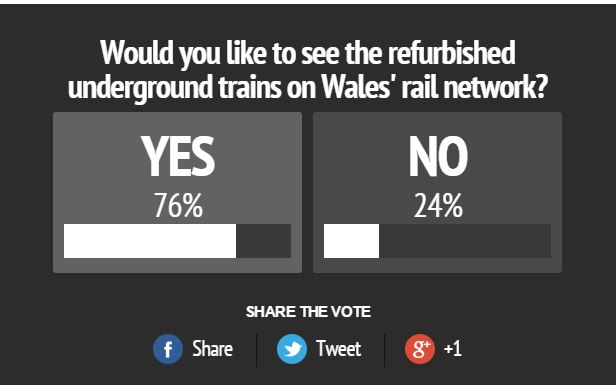
Vivarail Vote In Wales
Now the Welsh are not stupid and so I would suspect this vote is sensible, unless it’s only had a few votes.
So could it be, that those voting have got rather fed up with the trains that are used on the Welsh rail network? Some are not the best trains on the UK’s rail network!
One of the great things about the D-Train, is that once the train is certified and Vivarail have built a few examples, they can be trialled on lines all over the country.
I’ve now read about four or five articles about the D-Train and places where they might be used. None have been hostile, so either Vivarail are doing a good PR job or the concept appeals to serious engineers, train companies, politicians and passengers. At least enough to give the concept a trial with an open mind!
Somebody, asked me when the last truly dreadful train was delivered to the railways of the UK?
I don’t think it’s happened very often since the Pacer trains were delivered in the 1980s. The body shells of the D-Trains may be of a similar vintage, but they are a much better train in the opinions of most commentators.
Is The Vivarail D-Train On A Roll?
I have a Google Alert for Vivarail and over the last few days, it has produced quite a few hits.
This article for the Manchester Evening News is worth reading.
People are sceptical, but some of the reports from possible buyers and passengers, think that the Vivarail D-Train might just be able to step into the gap left by Pacers.
In Raw Material For A New Train, I gave my view and thought they would be a success.
The people who must be really worried, are the manufacturers of new trains. If Vivarail could make this concept work with something as old as the D78 Stock, could they do a job with trains built in the intervening years, that are now thought to be just a bit tired.
New Life For Old Trains
We have a shortage of self-powered multiple units in this country, which means that dreadful Pacers like these are still soldiering on!
In the long term, more lines will be electrified, which will release some modern diesel multiple units, like these Class 172 trains on the London Overground.
There is also the new Aventra IPEMUs that might be used to run branch lines off major electrified lines.would be nice to fill the gap.
But some new diesel multiple units would be very nice to fill the gap.
One possibility to fill the gap is the Vivarail D-Train, which is being developed from second-hand London Underground D78-Stock.
This article on the RailStaff web site entitled New Life For Old Trains, gives more details.
It is an interesting concept and I look forward to my first ride in a new Vivarail D-train.
The D-Train doesn’t have the high quality el-cheapo market to itself, as Porterbrook, which is a ROSCO, has converted a Class 144 train from a dreadful Pacer to a modern Class 144 Evolution.
Ian Walmsley in Modern Railways has said this, with respect to the new Class 144e.
Would I lease this in preference to a new DMU? No.
Would I lease this in preference to D78 stock? Probably, but I’ll let you know.
Would the Pacer Death Warrant have been signed if Pacers looked like this a year ago? No.
At present Vivarail say they can produce seventy-six D-trains and there are twenty-three Class 144 trains that could be upgraded.
May the best train win!
Is This Rail Project Going Nowhere?
There are no good vibes coming from the Coventry Arena station.
This article on the Coventry Telegraph web site is entitled Ricoh Arena station matchday fiasco could see new train operator take over Nuneaton to Coventry line. This is said.
London Midland says it will have to close the station for an hour after games and major events as it can only provide an hourly service for 75 people due to a lack of trains.
But the DfT has invested about £4.75m towards the £13.6m of improvements along the line and is keen to see the route used to its full potential.
I have used three stations regularly to go to see football in the last year; Ipswich, Norwich and Brighton. These three grounds are all about the same size as the Ricoh Arena and have nearby stations that can cope with large crowds. Both Ipswich and Norwich are commuter stations and run half-hourly eight-coach trains amongst others, away from the grounds. Brighton is a new ground and the service relies on four-coach trains going in both directions to clear the spectators. Of the three Brighton is probably the most crowded.
So I would think that it essential that at least four-car trains should be provided at the Ricoh Arena to ferry passengers to Coventry and Nuneaton.
Six car trains would be better, but as many passengers would just be ferried to Coventry, four would probably be enough.
It strikes me that whoever planned this line, never went to see football or rugby at a stadium close to a rail station. Close to Coventry, Aston Villa, Birmingham, Walsall, West Bromwich and Wolverhampton all have stadiums within walking distance of a station.
Another article in the Coventry Telegraph is entitled London Underground tube trains could be used to sort Ricoh Arena station fiasco.
These Vivarail trains may be a solution, if two three-car units can be coupled together.
But are the platforms long enough to accept a six-car train?
I have found a document entitled Coventry Arena Specific Safety Management Plans, which has been produced by Arup.
In an Appendix, the report details how the fans will be transferred between Coventry and Coventry Arena stations.
An additional shuttle service will operate between Coventry and Coventry Arena on certain event days, at 30 minute intervals. This will provide a 15 minute interval service between the two stations. All services will be scheduled to run from the Up platform at Coventry Arena and platforms 1 or 2 at Coventry (though in times of operational disruption these services can use platform 5). All services will be formed by DMU sets of a maximum of 6 cars. Platforms at Coventry Arena and Platform 5 at Coventry are configured for this length; the other platforms at Coventry can accommodate longer trains.
At least the platforms are long enough!
So it looks to me that no-one told London Midland.
Raw Material For A New Train
I wrote a couple of days ago about an innovative use of old London Underground trains, to create the D-Train
So what is the raw material; the D78 Stock like? I took a trip on one from Whitechapel to Kew Gardens, where I took the North London Line home.
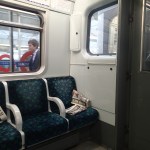

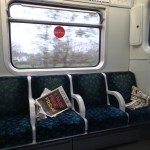
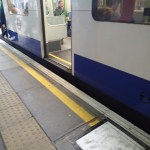
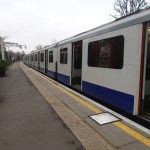
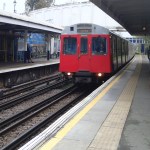
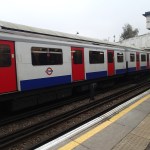
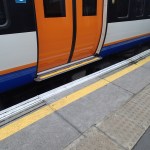
Scrapyard specials they are not! They ride well on rubber coil suspension, with a quality somewhere just short of the S Stock on the Underground. When the train emptied a bit and I got a seat, it made me wonder, why Transport for London are replacing all of them.
Wikpedia says this about their withdrawal.
The stock is scheduled for replacement by S Stock in 2016. It is being replaced about 15 years short of its intended lifespan, as a consistent fleet will allow for frequencies to be increased.
So that’s why. It must also be so much easier for staff on the sections of the line, where it shares tracks with the Metropolitan and Circle lines, that all trains are identical and stop in the same place. Passengers also like the walk-through design of the new S Stock, which eases getting on and off. It also increases capacity by spreading it through the train.
I suppose the main problem is their boxy design, which is not by any means sexy! But you could argue, that they look better than a Class 142. They certainly ride better on those rubber springs.
The more I read about this concept the more I like it.
The designers seem to have taken the approach that a good architect would do, when they’re presented with a Listed building like Kings Cross station and told to make it fit for the next few decades. Every preconception has been thrown out of the window and the designers have just concentrated on a limited set of objectives. These certainly include an affordable, reliable train that meets all the regulations and the expectations of staff, train companies and passeners alike.
But nothing of any substance, can be created without good foundations. The current trains ride well, make the maximum use of the loading gauge and thanks to the refurbishment of the last few years, they have an airy feel, with lots of windows that can be opened for ventilation, if required. I suspect too, that say if you wanted to create some new internal components, a lot of the jigs and mock-ups are still sitting in a shed or are on a computer somewhere.
I particularly like the concept of the power pack. Roger Ford in Modern Railways describes it as being so far off the wall, as to be in next door’s garden. Each driving motor car, will have two fully-enclosed power packs or rafts fitted underneath the train, The engine is a Ford Duratorq, which is built in that centre of railway technology; Dagenham. Vivarail claim that one engine will get the train home, but surely the great thing about having four power packs to a train, means that they can be selectively shut down, when the route allows. The Class 185 trains used across the Pennines, have an Eco-Mode, which selectively adjusts the power to the route, so something similar is surely possible. Computers have been used to control multiple engines according to conditions, fuel economy and power need in aircraft for decades, so I suspect the expertise to create a train that chugs efficiently round the country, is not difficult to find. In the ultimate manifestation, the engine control system would be geared to the ERTMS signalling, when that comes in, so the system would start up and shut down engines in an optimal manner according to traffic.
The power rafts give a tremendous advantage for maintenance. Roger says that taking one out will be a simple ten minute job with a pallet truck, and units will be replaced rather than repaired. Obviously, they’ll be repaired centrally. Vivarail says the concept needs less time in depots
The power raft concept also allows a new raft with perhaps energy storage, like a flywheel to be designed and tested. Given the projected life of the trains, I doubt that a Mark Two power will be developed, but who knows?
The design appears to have an amazing degree of flexibility. Look at this page on the Vivarail web site, which shows some example configurations. Trains can have two or four doors per sides, toilets if required and pictures show the classic four-to-a-table-by-the-window layout is possible.
I also think a seaside or country special would be possible with a large area dedicated for bicycles. Sometimes on Ipswich-Cambridge services, there are bikes everywhere and it is virtually impossible to get in and out.
If I look at the concept from my field of project management it is a dream. Trains arrive from London, as they are replaced by new ones, so for a start there is no storage problem. A separate factory produces the power rafts as required, so materials and cash flow are all as needed.
Even testing and certification is not the extended process it must be with a new train.
There are only a couple of problems that have been flagged up.
Some people think the doors are too narrow. But then, the trains currently run on one of the busiest routes in London and cope well.
Roger worries about the reliability of the power rafts and their Ford engines. I don’t, as if they get the control system right and run the engines efficiently, this will make the task less onerous.
I might flag up another – It’s just a pity, that there aren’t a few more D78 trains to save from the scrapyard.
Innovative Engineering To Recycle Trains
I often refer to Pacers; Class 142 and Class 144 as scrapyard specials. They were built in the late 1980s and some units will be thirty years old next year. They have not worn well and they don’t meet the modern disability regulations.
The London Underground D78 Stock is a few years older and after a major refurbishment a few years ago, the trains are still running on the District Line. I travel on them regularly and although they are not as nice as the new S Stock, they still provide an adequate and reliable service across London.
It wouldn’t seem logical to replace the elderly Pacers with rebuilt D78 Stock that was even older.
On the other hand, a group of very experienced railway personnel who feel that these 75 third rail electric trains can with the addition of a couple of automotive diesel engines be converted into diesel multiple-units.
It sounds crazy, but the realisations on the Vivarail website of what they have called the D-train look good. They also don’t look like a D78 to those who don’t know them well. They will even have wi-fi!
To paraphrase one of my own sayings.
Politicians have a theory and try and prove it, engineers have a problem and solve it.
Roger Ford in Modern Railways for December is reporting that in six months time, there will be a demonstrator. He says this.
If anyone can make D78 stock conversion commercially viable, it is this battle-hardened bunch of veterans.
As Roger also reports they have spent a seven figure sum on buying the trains, I have a feeling that we’ll be seeing at least some of these trains for a long time.
In the article and the Vivarail web site, what I see as a big advantage of the trains is not mentioned.
Some estimates say that we need upwards of fifty replacement trains for the Pacers. And that is about the size of the fleet that could be created.
With George Osborne needing an affordable project that benefits many different areas of the country, it would appear that the D-train has arrived exactly on time.
The biggest problem could be getting the public to believe that re-manufactured nearly forty year old trains are up to the job. But at least, as with the Parry People Mover, it’s a train that can be put into service on a real railway to charm the public.
In the same magazine, there is also an article about rescuing some Class 56 locomotives and returning them to active service.
In the UK, we have a shortage of diesel locomotives for freight. We’ve even used a preserved Class 55 Deltic to haul commercial bauxite trains and you sometimes see pairs of Class 20 locomotives like this doing real work. The article explains how new locomotives get used on the premium high-value trains, but for pulling things like engineering and work trains, they are expensive.
A company called UK Rail Leasing has acquired fifteen and intend to return some to service. There is talk in the article about fitting modern engines. But then they did that with that other relic of the 1970s the InterCity125.
Both of these stories are in some ways a tribute to our rail engineering skills of thirty years and more ago.
 The Anonymous Widower