Memories of Another Welshman Playing for Spurs
Spurs could probably claim that they were robbed against Manchester City today, as Mario Balotelli could have been sent off after kicking Scott Parker in the head. Harry Redknapp thinks he should have been according to this report on the BBC. But he would wouldn’t he! And so do I!
On the other hand Spurs second goal had a bit of familiarity in my mind. Aaron Lennon weaved inside from the left and gave a perfect pass for Welshman Gareth Bale to drill home from outside the box.
I can remember that great Welsh winger, Cliff Jones, doing the same from probably the other wing and teeing the ball up for either John White or even Danny Blanchflower to score. It couldn’t have been Jimmy Greaves, as he usually scored inside the six-yard box and the distance was too great. Also Greaves didn’t join Spurs until the 1961-62 season and I have a feeling this was earlier.
Jones in his prime was as fast if not faster than Bale, although he wasn’t protected as much by the referee. He’s one of those players, who if they played in the modern era would be so much better.
My father also saw another great Welshman, who played on the wing for Tottenham in the 1930s. He was Taffy O’Callaghan, who although not being as fast as either Bale or Jones, was in a team nicknamed the greyhounds, which won promotion in 1932-33. But by repute he could hit the heavy leather ball as hard and accurate as any.
So perhaps Harry’s team will upset the odds and win the Premier League this year or perhaps in the near future. They have the most important brick in place.
The Scottish Independence Referendum
The phone-in on BBC Radio 5 this morning, was about the possible Scottish Independence Referendum, which is being debated by David Cameron’s cabinet today.
I should say, that I don’t care much, whether Scotland is independent from the UK or not. after all, there would be one big advantage to England if Scotland were to be independent.
It would mean that the result of UK General Elections would not be skewed because of the overwhelmingly left-facing vote north of the border. It would also mean that policies for England would not be decided in a Parliament, where many of the members had no electoral connection to England, but still voted on English law. Tam Dalyell posed this as the West Lothian question and summed it up as follows.
For how long will English constituencies and English Honourable members tolerate … at least 119 Honourable Members from Scotland, Wales and Northern Ireland exercising an important, and probably often decisive, effect on English politics while they themselves have no say in the same matters in Scotland, Wales and Northern Ireland?
I agree with this and it is a running sore to many English voters. Interestingly, to sort the West Lothian Question doesn’t need Scottish independence, but just a simple change to UK law, which would say that on matters of English law, only English MPs could vote. But would the Labour Party give up this right?
There might well be other advantages to England and I won’t debate them here, but I think it is in the interest of the whole of the UK, that the problem is settled one way or another before the end of the current UK Parliament.
Some of the biggest problems do not concern either the UK or the Scottish governments.
Suppose you are the CEO of an airline with a service to the London area, that is thinking of serving a second airport in the north of the UK. Obviously, your choice is between Manchester, Edinburgh and Glasgow. But which? Uncertainty about the status of Scotland in the UK doesn’t help your decision. From my experience of the trains between Manchester and Scotland, it would appear that Manchester is getting the business, as opposed to Glasgow or Edinburgh. Note these points too.
- In 2010, Manchester was used by slightly more passengers than Glasgow and Edinburgh combined.
- The Scottish airports are not connected directly to the rail network. Manchester is and is due to get extra connections in the next few years.
- All airports have direct air links to either Gatwick, Heathrow or Stansted.
If Scotland’s status in the UK were to be sorted long-term, it would be a much easier decision.
There are a lot of other business decisions that are suffering from the same uncertaincy.
I actually think that the biggest problem with any Scottish referendum, is that no matter how it is written, it would not give a clear-cut result, that would satisfy everybody.
There could be three possible boxes on the ballot paper for a referendum.
- Complete independence for Scotland.
- More devolution for Scotland.
- Carry on as we are now.
The Scottish Nationalists would be very happy with one and possibly two. But as time progressed, I suspect that if they didn’t get complete independence, they’d come back again and again until they got the result they wanted. The uncertainty would be bad for Scotland and not very good for the UK. So in my view David Cameron is right to insist on an early binding referendum to put the issue to bed, once and for all. It would appear that the Scottish Nationalists want the referendum in 2014, as it’s the seven hundredth anniversary of the Battle of Bannockburn. I actually think that would be a recipe for a lot of trouble, that no-one wants.
The English would also like to bury the argument and most would be happy if Scotland became independent, as it would mean no Scottish interference in matters purely of interest to the English. Remember too, that the last two Scottish Prime Ministers of the UK, are not held in much affection in England. I think too, that the English would also be happy to go along with a very definite vote for the status quo, providing that the West Lothian Question was settled and there was no chance of another referendum for at least fifteen years or so.
I feel a bit sorry for the Welsh here, as they were a bit short-changed on devolution by Tony Blair. I do have this feeling though, that Wales will do well economically in the next few years, especially if they get the infrastructure a lot better.
Northern Ireland is a totally different matter and I’ve always believed that it should be united with the south. But that will probably not happen in my lifetime.
To return to the Scottish Referendum, would any political party get a result they want?
Scotland is a much more divided country than England, although both have a lot of regional pride. Edinburgh and Glasgow rarely agree and I’ve read reports in the past, about the islands not wanting independence at all, except from the rest of Scotland.
So it will be very difficult for any party to marshall the voters.
In fact, I think that in a three choice referendum, the Scots are more likely to vote strongly for maintaining the status quo.
92 Clubs – Day 37 – Swansea
This was one that I thought would be simple. Just a return on a Sunday to one of the furthest clubs from London; Swansea.
But I knew there would be problems because of engineering works on both the Underground and the trains to South Wales. So I decided to start early and just took a Super Off Peak Return to Swansea, having booked a seat on the 08:00 from Paddington. I had elected to take my chances about getting a seat on the return journey. But I thought I’d have a reasonable chance, as the train started its return journey in Swansea and I knew there was an unreserved coach.
So it should have worked out well and mostly it did.
Because there was no Underground trains to Paddington, I had to take a couple of buses. Which wasn’t too much of a hardship, but the journey wasn’t as easy as it would have been on say a Monday.
When I got to Paddington, Marks and Spencer wasn’t yet open, so I couldn’t buy any sandwiches for the trip. As they are the only place to buy any gluten-free food in stations and there is nothing on the trains, I would have to wait until Swansea.
The journey was uneventful except that it took just over four hours instead of just under three. This was because it had to go via Bristol Temple Meads and Bristol Parkway, rather than straight through, because of the engineering works.
On arriving in Swansea, I walked straight to the Liberty stadium in about half-an-hour. There were no signposts for either walkers or drivers until you could see the stadium.
Swansea share the ground with the rugby club; The Ospreys, as you can see from the picture.
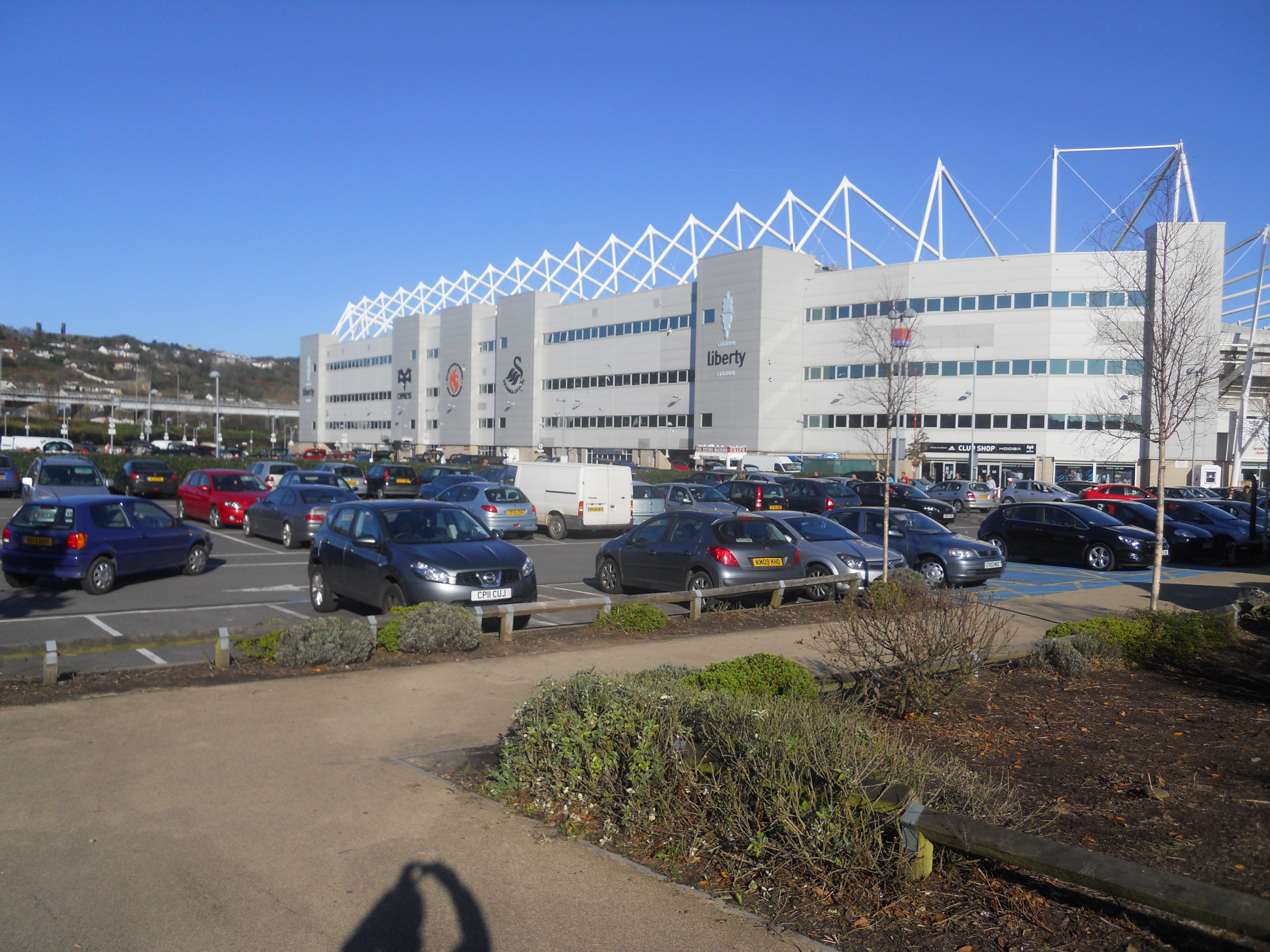
The Liberty Stadium, Swansea
I think I caught the remains of a car boot sale, so I thought I’d get back to the city centre and try and locate some food.
I did get a bus, but of course I had to pay for it, as English bus passes are not valid in Wales. Are we a United Kingdom or not? I don’t mind paying incidentally and feel that a UK wide scheme with perhaps a small charge outside your home are, would be the fairest way to do it.
But I couldn’t find any food. Marks & Spencer told me, that they had no gluten-free sandwiches, although they do stock them. but they are not the best of sellers! In the end I get some EatNakd bars from Holland and Barrett. They may be nice, but coffee and chocolate bars isn’t the best diet, even if it is gluten-free!
So I got back to the station and took the 14:00 train home. Paddington was in chaos because of the Underground engineering works, so it was buses to Oxford Street and then the Central line and another bus to Islington for supper in Carluccio’s.
All I say is roll on CrossRail, as this will make getting to Paddington so much easier; engineering works or not!
As an aside, I took this picture of the stadium from the train from London.
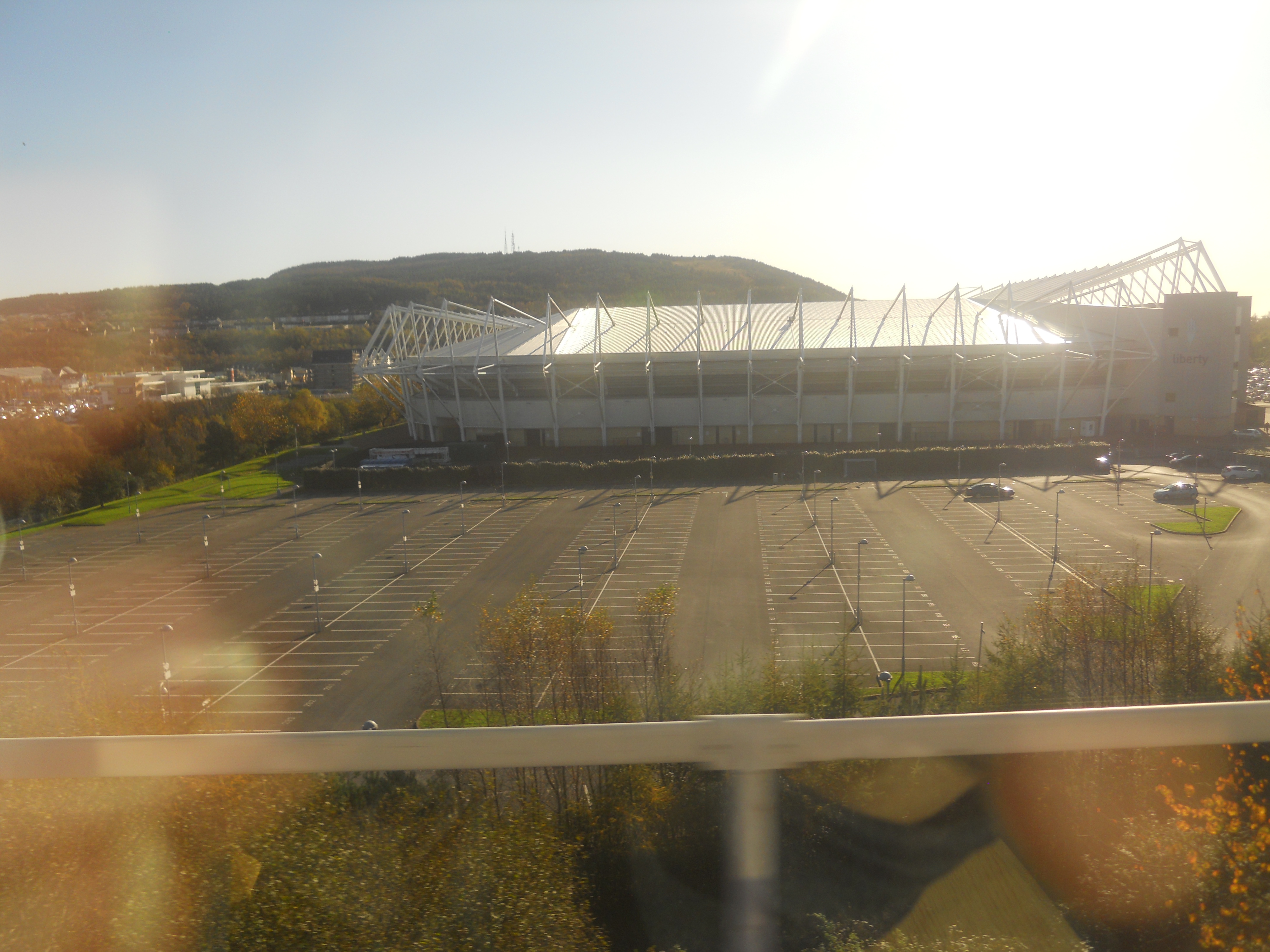
The Liberty Stadium from the London Train
It strikes me that this is a ground that could benefit from its own station.
It was a day though that showed me the problems of travelling as a coeliac unless you plan ahead and take your lunch with you!
A Linguistically Correct Train
This train to Manchester from deepest Wales shows the Welsh form and the English form of Manchester on the destination board.
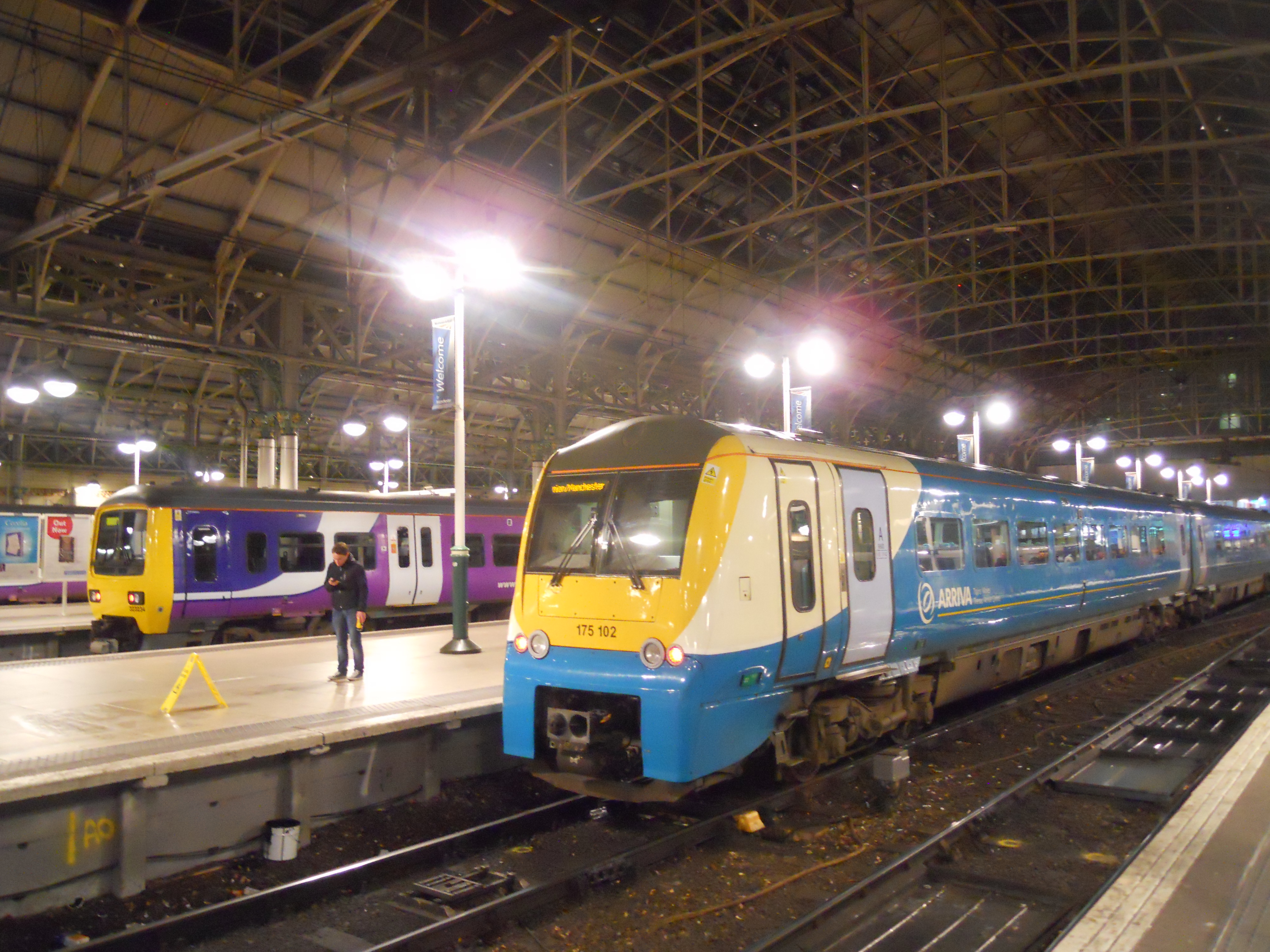
A Bilingual Train at Manchester
I’m not going to say it’s a waste of money to make the train bilingual, but how many people in Wales know the Welsh for Manchester?
I’ve always believed that those who live in a town or city, should chose its name and I’ve posted as such before in this blog.
You have to wonder how far this could go. How about using the Essex dialect form for Southend for trains out of Liverpool Street. Or would Saafend be too confusing?
What’s This Train doing At Norwich Station?
I saw this train at Norwich station, apparently working a service to Sheringham.
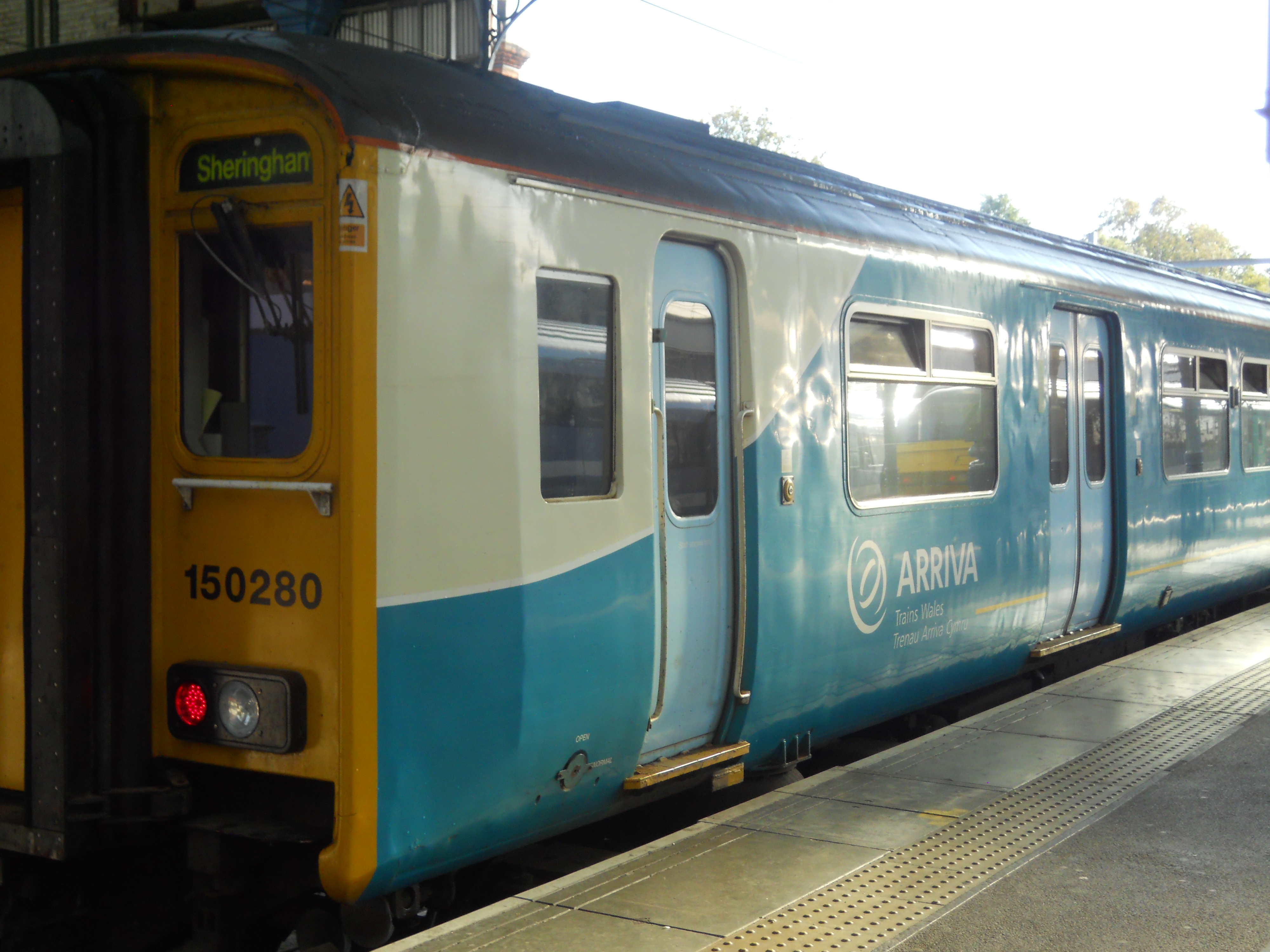
A Lost Welsh Train at Norwich
So have they moved Sheringham to the other side of Offa’s Dyke or have they run out of paint. You’d think as the train is almost in Ipswich colours, they would have repainted it as quick as possible.
Are The Welsh Preparing to Invade?
Dai Greene yesterday won the 400 metres hurdles in Daegu.
With a name like Dai, he has to be Welsh and of course is.
So when the his event takes place at Stratford over the 3rd to the 6th of August next year, will there be a shortage of leeks and daffodils in London?
The big question is where are they going to park the dragon? The problem is that East London and the Olympic Park in particular, has lots of rivers, canals and water in general. So will this put the fire out? Or do dragons have waterproof fire?
The Future of Very Long Distance Trains in the UK
We may be a small island, but it is possible to do some of the longer train journeys in Europe in the UK, where you don’t have to change trains. The longest trip I did in Europe was Nice to Lille.
We have several major long distance routes starting or finishing in London. Some include.
- London (Kings Cross) to Inverness via Edinburgh
- London (Kings Cross) to Aberdeen via Edinburgh
- London (Euston) to Holyhead
- London (Paddington) to Fishguard
- London (Paddington) to Penzance
I should note that the longest route is actually Penzance to Aberdeen.
At present all of the routes use IC125s or other diesel trains, but for a lot of the journey some will be under wires used by high speed electric trains. It is probably for this reason that when civil servants specified the replacement for the incomparable IC125, they came up with the idea of a bi-mode train, that was electric, but hauled a diesel around for where there was no power supply. Just as with people obesity is not to be tolerated as it wastes fuel, causes more carbon dioxide to be emitted and probably causes all sorts of track problems because of the weight. As an engineer, I just don’t like it! But that’s my prejudice and what do I know about trains?
However, Ian Walmsley, a man who does know about trains, has proposed in the August edition of Modern Railways, that the ageing Class 90 electric locomotives and Mark 3 coaches on the London to Norwich line be replaced with Bombasrdier TRAXX electric locomotives, refurbished and modern styled Mark 3 coaches and perhaps a new set of driving van trailers. The article showed some impressive interiors proposed by a company called Dg8.
Would this concept work on say London to Inverness? I’ve travelled the northermost part of this line in the driver’s cab and it is a truly spectacular line, but it is unlikely that it will ever be able to be electrified further than Stirling. But there are diesel versions of TRAXX, so could an engine change be performed before the electricity runs out. If Bombardier has the engineering correct, which I suspect they do, I doubt that an engine change would take more than a few minutes. It would certainly be less hassle for the passengers than a train change.
As you are running engine facing London as trains do on the northern routes out of Kings Cross, there would be no need for any special operating procedures in London, but you would need to provide for perhaps a small amount of track work at the engine changeover. This point would have to be chosen with respect to driver availability, so perhaps on services via Edinburgh, this might be the point. But of course it would be a simple matter for the train company to work out the best place for the changeover.
In his article, Ian proposed new driving van trailers. When I went to Inverness on the IC125, the driver had no access to train services, so he had to disembark to use the toilet. So should the DVTs be provided with various facilities for the driver?
It should also be noted that the current trains on the route have no room for heavy luggage, so could they be used for such items as bicycles, surfboards for Cornwall and large cases.
If these long routes have more than just distance in common; many passengers will want an at-seat meal and many will be leisure passengers who would want to admire the view.
So should in some ways a retrograde step be taken and make sure everyone has a full table and that seats align with windows, just like they originally did when the Mark 3 coaches were built. In some ways all of the routes are premium routes, where many will book well in advance for a holiday or an event, so the extra cost of the trains would probably be affordable.
An idea I thought of was an observation car, but although it might be possible, it might make train operation difficult. But surely someone like Dg8 could come up with a Cafe Bar Car with large windows that sat in the middle of the train.
As the journey length could be up to about nine hours, it would probably need innovative entertainment systems. How about a front and back camera to show views.
I may be talking out of my backside. But as John Lennon said. Imagine!
From London and Crewe to Dublin By Train and Ferry
Ireland has an economic problem, as is well known. Commentators will argue the various reasons, but something that doesn’t help is that getting from Great Britain to Eire is not as easy as to get from Birmingham to Scotland. There are lots of flights, but they are not convenient or acceptable for everyone who wants to travel.
If you go to Dublin by train and ferry there is one train at 9:10 in the morning from Euston, that gets you to Dublin at 17:15, which is a journey time of eight hours and five minutes. I looked for tomorrow and the fare is only £32 one way. But there is only one service during the day, with another overnight.
So how fast could a service be done if the line was electrified all the way to Holyhead? Crewe from Euston can be done in two hours quite easily and it is only 84 miles from Crewe to Holyhead. The fastest services now take just short of four hours. but the trains are not electric or have the smooth ride of an IC125. The fast ferries take two hours for the crossing, but the larger slower ones take three hours fifteen minutes.
If we assume that Crewe to Holyhead can be done at a similar speed as Liverpool Street to Norwich, it would appear that a time of about one hour ten minutes could be obtained on this part of the route. So this would mean a time from London of three hours ten minutes in a smooth modern electric train. If this could be paired with a fast ferry this could mean a time of under five and a half hours if the sea conditions were good enough.
But this is more than about electrifying the North Wales Coast line, which it would appear that the Welsh Assembly would probably like to do. It is about kick starting the Irish economy. And that of North Wales too!
So surely instead of spending billions of euros propping the Irish up, wouldn’t it be better to spend use of that money to connect Eire to Europe more efficiently. After all, railwise, despite what some might believe, the UK is actually part of Europe.
It would be 84 miles of electrification and perhaps a subsidy to the Holyhead to Dublin ferries to make sure that the fast service was every three hours or so. Surely, that would be a more affordable option, as it would also benefit North Wales, which is not one of the more prosperous parts of the EU.
But it is not just about London to North Wales and on to Dublin. Properly built the line would also connect Birmingham, Liverpool and Manchester to North Wales. As an example Liverpool to Holyhead would be under ninety minutes, which is the magic time that makes day trips easy. I also think it would make trips between North and South Wales quicker, but it would probably mean a change at either Chester or Shrewbury.
There are also other issues on the horizon. The major sources of employment on Anglesey, are the nuclear power station at Wylfa and the aluminium smelter. Who knows what will happen in the next few years? But if Holyhead and Anglesey had a first class electrified rail line to the rest of both Wales and the UK, it would help to attract long term jobs. It would of course help tourism and would probably make the University of Bangor even better.
We Can Build Affordable Rail Stations When We Have To!
There are plenty of places on the UK rail network, where it would be advantageous to build new or replace old stations. Around Newmarket and Cambridge there are a lot of places where stations used to be and proposals have been actively pursued at Soham and Cherry Hinton, although the latter is a bit tenuous. Now that the services have been upgraded with newer trains, it would seem logical that improved stations might increase the number of passengers.
The reason these improvements are not carried out is cost.
But have Network Rail created a precedent at Workington North station? Although it had to be built to meet a need created by tragic circumstances, it proved that a working station could be built quickly and affordably. Albeit it only was in use for a year and a supreme example of what could be build with scaffolding.
So should some of the lessons learned be applied elsewhere? Of course they should! Modern Railways are talking this month, about a proposal for a simple rebuilding of Fishguard & Goodwick station to create a transport interchange for the town.
The trains are coming, but there is no station, so they should go for it!
Bilingual Signs
I’ve said before that I don’t like bilingual place names. Mainly with concern to Belgium, where they suddenly change language of the signs to the place you are going. In one case it led to a detour of about fifty kilometres.
Take this sign in Cardiff station.
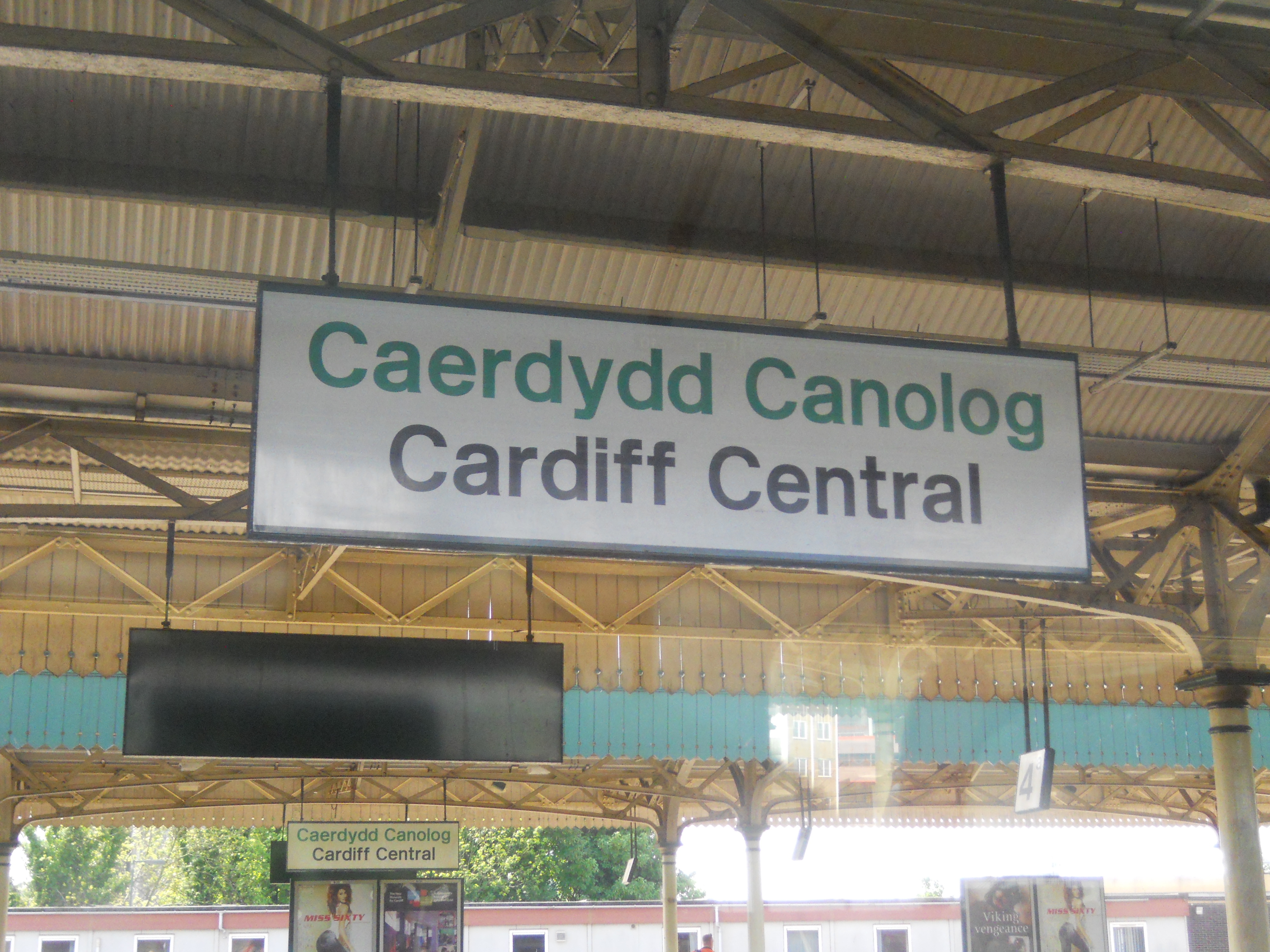
Cardiff or Caerdydd
Surely, it should be in English or Welsh but not both! If the inhabitants of the city want Welsh to be the name, then so be it! An interesting example is London, where although there is a French name for the city, most French of my acquaintance, have used the English form, when speaking to me.
Obviously, where there can be confusion, like this informational sign both common languages are needed.
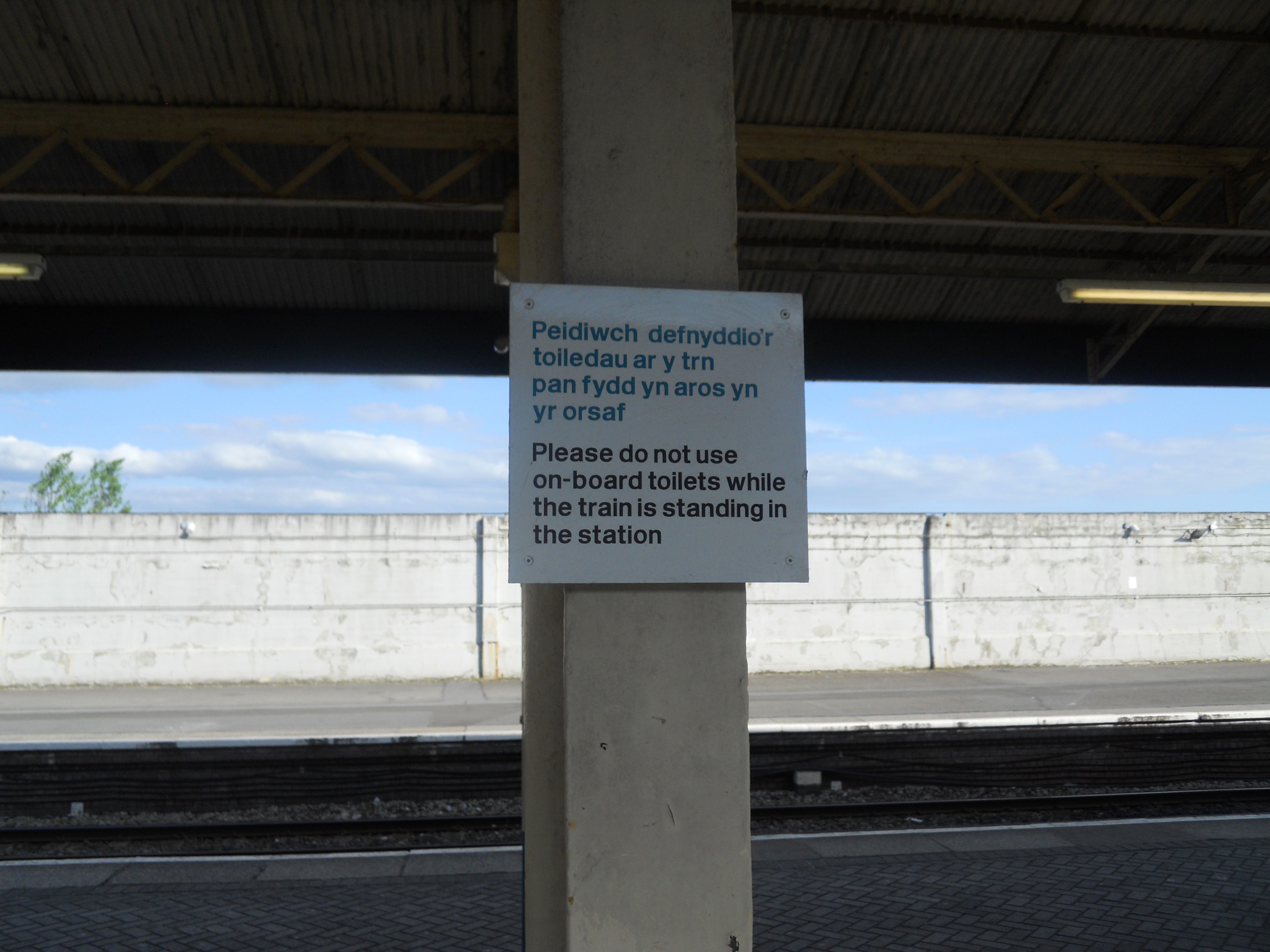
Bilingual Information Sign
In a few years time incidentally, this sign will be unneccessary as new regulations will mean that toilets will not be able to flush directly onto the track.
 The Anonymous Widower