RWE’s Welsh Offshore Wind Project Powers Ahead
The title of this post, is the same as that of this article on offshoreWIND.biz.
This is the sub-heading.
Natural Resources Wales has awarded marine licences for RWE’s Awel y Môr offshore wind project off the North Wales Coast.
These two paragraphs outline the project.
The offshore wind farm, which could power more than half of Wales’ homes, has secured all of its necessary planning approvals with the award of its marine licences from Natural Resources Wales, RWE said.
The marine licences have been awarded on behalf of Welsh Government ministers following the granting of a Development Consent Order in September.
With all the wind action in the East, we tend to forget that the Liverpool Bay area has a lot of wind.
- Awel y Môr – 500 MW – Before 2030
- Barrow – 90 MW – 2006
- Burbo Bank – 90 MW – 2007
- Burbo Bank Extension – 258 MW – 2017
- Gwynt y Môr – 576 MW – 2015
- Mona – 1500 MW – 2029
- Morecambe – 480 MW – 2028
- Morgan – 1500 MW – 2029
- North Hoyle – 60 MW – 2003
- Ormonde – 150 MW – 2012
- Rhyl Flats – 90 MW – 2009
- Walney – 367 MW – 2010
- Walney Extension – 659 MW – 2018
- West Of Duddon Sands – 389 MW – 2014
Note.
- This is a total of 6709 MW to be delivered before 2030.
- All the wind farms have fixed foundations.
- RWE have an interest in three of the Welsh wind farms.
The Times today has this article which is entitled Energy Minnow Sees Pathway To Irish Sea Gasfield Via London IPO, where these are the first three paragraphs.
An energy minnow that is seeking to develop a gasfield in the Irish Sea is planning to list on Aim, the junior London stock exchange, in an attempt to buck the downturn in initial public offerings.
EnergyPathways has announced its intention to float, seeking to raise at least £2 million.
It owns the rights to Marram, a small gasfield discovered in 1993 about 20 miles offshore from Blackpool. It is seeking permission from the government for its plan to develop the field in the Irish Sea quickly by connecting it with existing infrastructure that serves the already-producing gasfields in Morecambe Bay. It aims to be producing gas as soon as 2025.
This gasfield should produce enough gas until the large Liverpool Bay wind farms come on stream at the end of the decade.
Masdar To Invest In Iberdrola’s 1.4 GW East Anglia Offshore Wind Project
The title of this post, is the same as that of this article on offshoreWIND.biz.
This is the sub-heading.
Iberdrola and Masdar have signed a strategic partnership agreement to evaluate the joint development of offshore wind and green hydrogen projects in Germany, the UK, and the US, which also includes an investment in Iberdrola’s 1.4 GW East Anglia 3 offshore wind project in the UK.
These first two paragraphs outline the del.
After the parties’ successful co-investment in the Baltic Eagle offshore wind farm in Germany, the new milestone of this alliance will be to achieve a further co-investment concerning the 1.4 GW East Anglia 3 offshore wind project in the UK, said the companies.
According to the partners, the deal has been under negotiation for the last few months and could be signed by the end of the first quarter of 2024. Masdar’s stake in the wind farm could be 49 per cent.
This deal appears to be very similar to Masdar’s deal with RWE, that I wrote about in RWE Partners With Masdar For 3 GW Dogger Bank South Offshore Wind Projects.
- The Iberdrola deal involves the 1.4 GW East Anglia 3 wind farm, which has a Contract for Difference at £37.35 £/MWh and is scheduled to be completed by 2026.
- The RWE deal involves the 3 GW Dogger Bank South wind farm, which doesn’t have a Contract for Difference and is scheduled to be completed by 2031.
- Both deals are done with wind farm developers, who have a long track record.
- Both wind farms are the latest to be built in mature clusters of wind farms, so there is a lot of production and maintenance data available.
I suspect, that many capable engineers and accountants can give an accurate prediction of the cash flow from these wind farms.
I will expect that we’ll see more deals like this, where high quality wind farms are sold to foreign energy companies with lots of money.
Just over five years ago, I wrote World’s Largest Wind Farm Attracts Huge Backing From Insurance Giant, which described how and why Aviva were investing in the Hornsea 1 wind farm.
Conclusion
It appears that Masdar are doing the same as Aviva and usind wind farms as a safe investment for lots of money.
RWE Partners With Masdar For 3 GW Dogger Bank South Offshore Wind Projects
The title of this post, is the same as that of this article on offshoreWIND.biz.
This is the sub-heading.
RWE has signed an agreement with UAE’s Masdar as a partner for its 3 GW Dogger Bank South (DBS) offshore wind projects in the UK.
These three paragraphs outline the deal.
The partners acknowledged the signing of the new partnership during a ceremony at COP28 in Dubai.
Masdar will acquire a 49 per cent stake in the landmark renewables projects while RWE, with a 51 per cent share, will remain in charge of development, construction, and operation throughout the life cycle of the projects.
RWE’s proposed DBS offshore wind project is made up of two offshore wind farms, Dogger Bank South East and Dogger Bank South West (DBS East and DBS West), each 1.5 GW, which are located over 100 kilometres offshore in the shallow area of the North Sea known as Dogger Bank.
Note.
- Masdar is an energy company headquartered in Abu Dubai.
- The Chairman of Masdar is President of COP28.
Does this deal indicate that wind farms are good investments for those individuals, companies and organisations with money?
Plans for Hydrogen Development At Dogger Bank D Gain Ground
The title of this post, is the same as that of this article on offshoreWIND.biz.
This is the sub-heading.
Dogger Bank D, the potential fourth phase of the world’s largest offshore wind farm under construction, Dogger Bank Wind Farm, has awarded contracts to engineering consultants to support the feasibility and optimization of a large-scale green hydrogen development option on the project
These three paragraphs outline the project.
SSE Renewables and Equinor, the developers of the Dogger Bank wind farm in the UK, awarded contracts for green hydrogen concept and engineering and optimization studies to Genesis, H2GO Power, and Fichtner.
If progressed for delivery, Dogger Bank D would be located in the North Sea around 210 kilometers off the northeast coast of England. Subject to the successful outcome of further technical studies, the project could be capable of generating up to around 2 GW of renewable power.
The 2 GW offshore wind farm is currently planned to comprise 128 wind turbines and up to six offshore platforms.
Note.
According to the article, this would be one of the UK’s largest green hydrogen production facilities.
The partners said, that the project could contribute to the UK Government’s electrolytic hydrogen ambitions for 5 GW by 2030.
This is said about the studies.
Using AI machine learning and robust modeling, these studies will investigate the multitude of interdependent variables required to optimize a potential green hydrogen production facility, such as offshore wind farm sizing, electrolysis capacity, transport and storage capacity, water availability, and offtake optionality.
I was using robust modelling on projects such as these fifty years ago, both with Artemis and bespoke software.
To my mind, SSE Renewables and Equinor are doing the right thing. If anybody has a similar project with lots of variables, I’d love to give my opinion.
I have some thoughts.
How Much Hydrogen Will Be Produced?
Ryze Hydrogen are building the Herne Bay electrolyser.
- It will consume 23 MW of solar and wind power.
- It will produce ten tonnes of hydrogen per day.
The electrolyser will consume 552 MWh to produce ten tonnes of hydrogen, so creating one tonne of hydrogen needs 55.2 MWh of electricity.
This would mean that if the Japanese built one Herne Bay-size electrolyser, then it would produce around three hundred tonnes of hydrogen in an average month.
Consider.
- Dogger Bank D is likely to be a 2 GW wind farm.
- This document on the OFGEM web site, says that the Dogger Bank wind farms will have a capacity factor of 45 %.
- This means that Dogger Bank D wind farm will produce an average of 900 MW over a year.
- This works out at 7,884 GWh of electricity in a year.
As each tonne of hydrogen needs 55.2 MWh to be produced, this means if all the electricity produced by Dogger Bank D, is used to create green hydrogen, then 142,826.1 tonnes will be produced.
How Will The Hydrogen Be Brought Ashore?
142,826.1 tonnes is a lot of green hydrogen and the easiest ways to transfer it to the shore would be by a pipeline or a tanker.
I wouldn’t be surprised to see the use of tankers, as this would give more flexibility and allow the export of hydrogen to countries in need of hydrogen.
Will There Be Hydrogen Storage In The Dogger Bank D Wind Farm?
This would surely be a possibility, but there are security considerations.
Cost would also be a factor!
The Location Of The Dogger Bank D Wind Farm
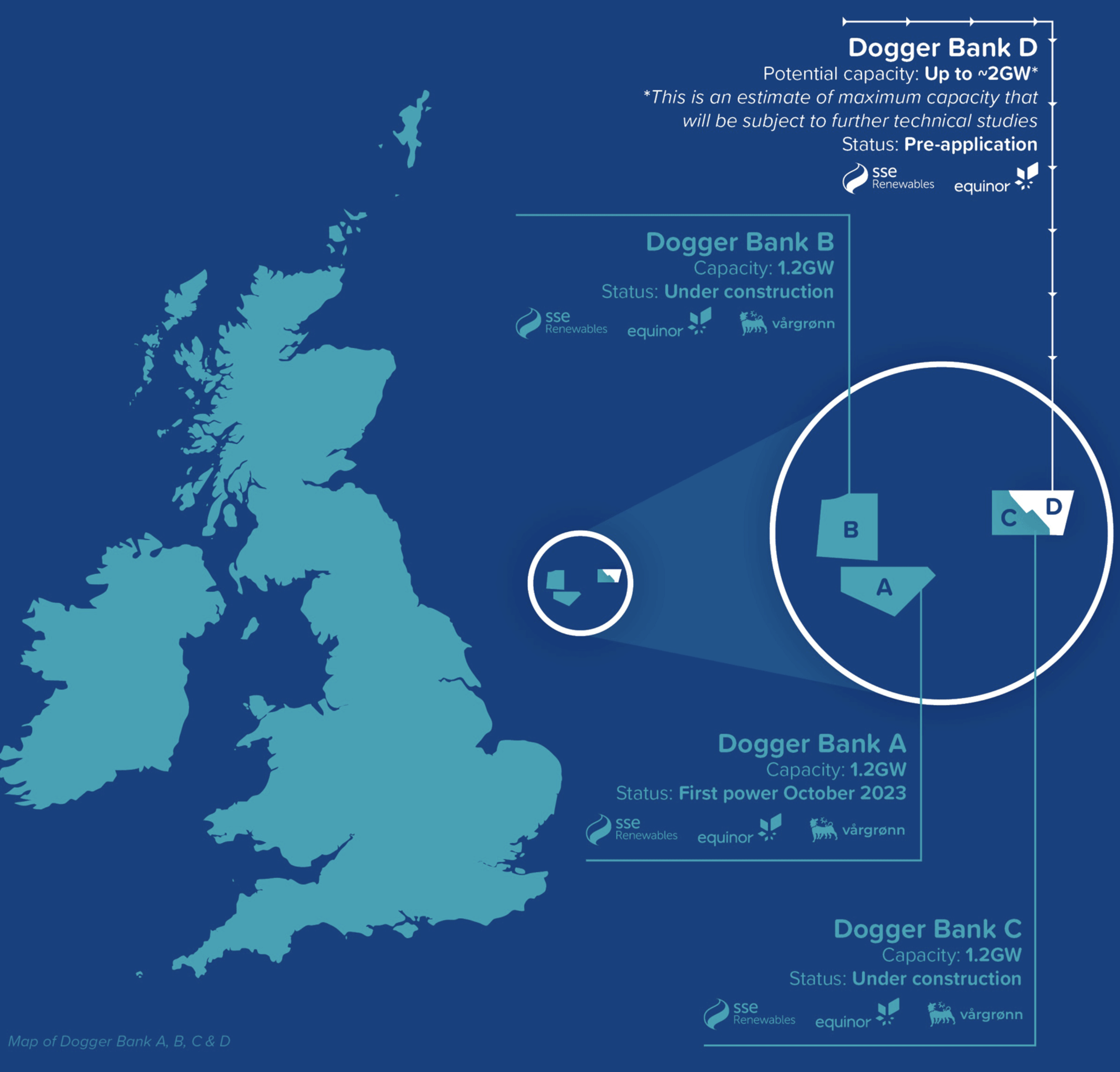
I clipped this map of Dogger Bank A, B, C and D wind farms from this page of the Dogger Bank D web site.
Note.
- RWE’s Dogger Bank South wind farm is not shown on the map.
- Dogger Bank D wind farm is the most Easterly of the four wind farms being developed by SSE Renewables and Equinor.
- Dogger Bank D wind farm must be the closest of the Dogger Bank wind farms to the Eastern border of the UK’s Exclusive Economic Zone or EEZ.
Dogger Bank D wind farm would appear to be ideally placed to supply hydrogen to a number of places, by either pipeline or tanker.
Could Dogger Bank South Wind Farm Also Produce Hydrogen?
In RWE Partners With Masdar For 3 GW Dogger Bank South Offshore Wind Projects, I talked about the change of ownership of the Dogger Bank South wind farm.
I would assume that the Dogger Bank South wind farm will be located to the South of the Dogger Bank A,B, C and D wind farms.
Whether it will produce hydrogen will be a matter for the owners and market conditions.
I do believe though, that it could share some facilities with the those that might be built for Dogger Bank D wind farm.
Conclusion
After this brief look, Dogger Bank D could be an ideal place to build a large hydrogen production facility.
Highview Power, Ørsted Find Value In Integrating Offshore Wind With Liquid Air Energy Storage
The title of this post, is the same as that of this article on offshoreWIND.biz.
This is the sub-heading.
Highview Power and Ørsted have completed their joint investigation into how combining the technologies of Liquid Air Energy Storage (LAES) and offshore wind could unlock greater value for investors and consumers.
These three paragraphs outline the findings.
The results show that there is value in combining offshore wind with LAES to support reducing wind curtailment, increasing productivity, and helping the move to a more flexible, resilient zero-carbon grid, according to Higher Power.
The two companies have carried out analysis of technical performance, route to planning approval, and route to market with a regulatory and economic assessment.
As a result of this study, the companies believe a project can be developed and built aligned with the timeline of an offshore wind farm.
I feel very strongly, that putting the two technologies together is a good idea.
In the simplest cases, the storage could be built into the offshore sub-station.
Could LAES Be Used With Hornsea 4 Wind Farm?
The Wikipedia entry for the Hornsea Wind Farm says this about Hornsea 4.
In July 2023, British government officials gave the final approval for Hornsea Four, the fourth phase of the wind project. Hornsea Four is expected to generate 2.6GW, have 180 giant wind turbines, and has the capability to generate enough renewable energy to power 1 million homes in Britain.
The Wikipedia entry also says this about Hornsea 3.
Project 3 will be to the east of Projects 1 and 2, with an estimated maximum capacity of 2.4 GW over 696 square kilometres (269 sq mi). DONG Energy (which in November 2017 changed its name to Ørsted) began consultation on the project’s development in May 2016. Ørsted submitted a Development consent application in 2018 and consent was granted on 31 December 2020.[69] In early 2023, consent was also given to a battery storage power station at Swardeston. The project is expected to begin construction in 2022, and be completed by 2025.
If Ørsted are adding a battery to the 2.4 GW Hornsea 3 wind farm, I would feel, that Ørsted would think about a battery on the 2.6 GW Hornsea 4 wind farm.
The Energy Storage The UK Needs
This is the last paragraph of the article.
The UK will need up to 100 GWh of energy storage by 2050 according to the estimates from National Grid ESO’s Future Energy Systems Scenario.
SSE Renewables are planning two large pumped-storage hydroelectric power stations in Scotland.
- Coire Glas – 1.5 GW/30 GWh – Possible completion in 2031.
- Loch Sloy – 152.5 MW/25 GWh – See SSE Unveils Redevelopment Plans For Sloy Hydro-Electric Power Station.
A quick calculation, says we’d need seven pumped-storage hydroelectric power stations, which need a lot of space and a handy mountain.
I don’t think pumped-storage hydroelectric would be feasible.
Highview Power say this about their next projects on this page of their web site.
Highview Power’s next projects will be located in Scotland and the North East and each will be 200MW/2.5GWh capacity. These will be located on the national transmission network where the wind is being generated and therefore will enable these regions to unleash their untapped renewable energy potential and store excess wind power at scale.
Note.
- This is more like the size.
- Work is now underway at Carrington – a 50MW / 300MWh plant at Trafford Energy Park near Manchester.
- Highview’s technology uses liquid air to store energy and well-proven turbo-machinery.
They are a definite possibility, as only eighteen 200MW/2.5GWh systems would be needed.
Malaysian Fabrication Company Enters Offshore Wind Market With IJmuiden Ver Alpha Contract
The title of this post, is the same as that of this article on offshoreWIND.biz.
This is the sub-heading.
Malaysia Marine and Heavy Engineering Holdings Berhad (MHB), through its wholly-owned subsidiary Malaysia Marine and Heavy Engineering (MMHE), has secured a subcontract for its first offshore substation high-voltage direct current (HVDC) platform required for TenneT’s 2 GW offshore wind project in the Netherlands
These two paragraphs outline the project.
The Malaysian contractor confirmed the award from Petrofac on 29 November and said the OSS HVDC platform consists of a topside and jacket for the IJmuiden Ver Alpha project.
The subcontract scope consists of construction engineering, fabrication, mechanical completion, load out and sea fastening, and architectual works on engineering, procurement, and construction (EPC) basis.
A third paragraph, indicates, that this contract could be the first of a few.
In addition, the parties will also collaborate towards the possibility of fabrication works for two additional offshore substation units of similar size.
This story illustrates how wind farm developers are looking for more places to build their infrastructure.
In An Elegant Solution, I talked about an idea called a D-Floater. Five are shown being transported in this picture.
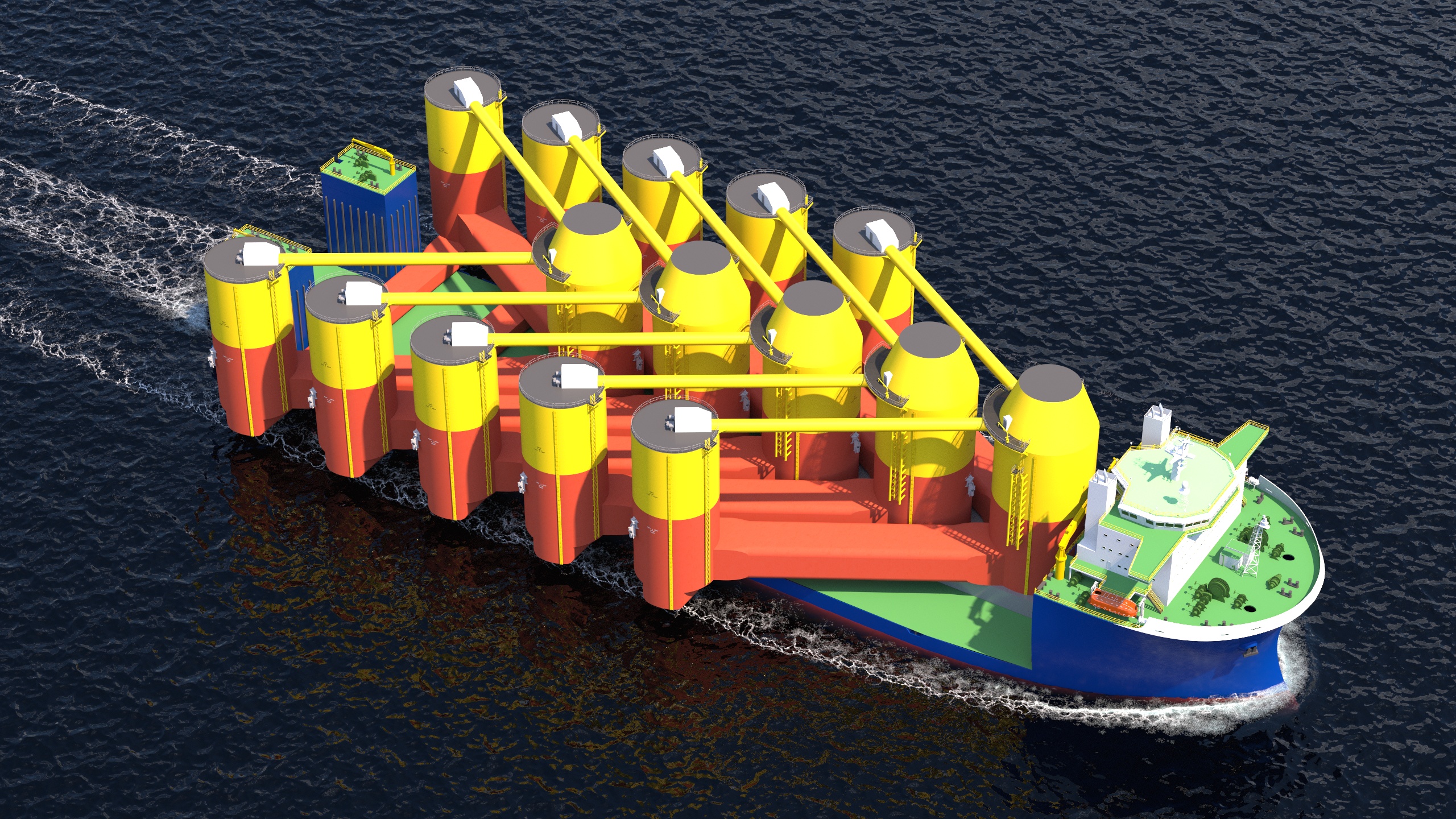
The idea is from a Swedish company; Bassoe Technology.
This would enable transport costs from faraway places to be reduced.
Nearer to Europe, the Black Sea ports of the Ukraine could be an ideal place to build infrastructure, as the country used to have the required skills, ports and steel-making capabilities.
But first Putin must be put back in his box!
UK Offshore Wind And CCS Colocation Projects Kick Off
The title of this post, is the same as that of this article on offshoreWIND.biz.
This is the sub-heading.
The Offshore Wind and Carbon Capture and Storage (CCS) Colocation Forum (the Forum), set up to provide strategic coordination of colocation research and activity on the nation’s seabed, has commissioned two research projects.
These first two paragraphs, which set objectives and possible methods for the two projects.
The projects are designed to inform the best approach to test and demonstrate the colocation of offshore wind and CCS activities in the future.
The research projects – Project Colocate and Project Anemone – build on the Forum’s Spatial Characterisation Report, which identified areas of potential overlap for offshore wind and CCS on the seabed, and NSTA’s Seismic Imaging Report, which explored various options for monitoring carbon storage and offshore wind sites to help resolve possible colocation issues.
These are the two projects.
Project Colocate, which is described in the article like this.
Delivered by the University of Aberdeen with funding from the Crown Estate and Crown Estate Scotland, Project Colocate will investigate the viability of areas on the seabed for colocation of CCS and offshore wind, with bespoke monitoring plans for each area.
Researchers from the University of Aberdeen will focus their investigations on the East Irish Sea and Central North Sea, both of which have been identified as having significant potential for future colocation of CCS and offshore wind, according to the Crown Estate.
Project Anenome, which is described in the article like this.
The complementary Project Anemone will explore mutually beneficial opportunities arising from the colocation of these developing industries.
The project aims to identify and map the routes to realising these opportunities to create practical guidance for how offshore wind and CCS technologies can operate alongside each other – from construction to decommissioning.
It does appear to be a lot of sensible thinking and words, although neither project appears to yet have a website.
This paragraph is a nice tailpiece to the article.
To achieve the UK’s net zero targets, the UK Government is targeting the delivery of 50 GW of offshore wind energy and the capture of 20-30 million tonnes of CO2 per year by 2030.
I’ve mentioned 50 GW of offshore wind before, but 20-30 million tonnes is a lot of CO2.
German Company To Build XXL Monopile Factory in Denmark
The title of this post, is the same as that of this article on offshoreWIND.biz.
This is the sub-heading.
German-based Baltic Structures Company (BSC) has revealed that it will build an XXL monopile production factory in Esbjerg, Denmark
These are the first three paragraphs that outline the project.
BSC will build “Europe’s biggest” foundation fabrication site in the Esbjerg Port where it will be able to offer various foundations structures with a more than 100,000-square-metre production area under the roof and an output of up to 200 XXL monopiles per year.
The German company said that the focus of the plant is on structures with dimensions of up to 15 metres in diameter, up to 130 metres in length, and single unit weights of up to 4,000 tonnes.
In addition to monopiles, transition pieces, pin piles, and components for jackets, floating foundations will also be offered, said BSC.
These last three paragraphs sum up, where we are at the moment with European wind turbine foundation manufacture.
In September 2022, Esbjerg Port (Denmark), Oostende Port (Belgium), Groningen Seaports/Eemshaven (the Netherlands), Niedersachsen Port/Cuxhaven (Germany), Nantes-Saint Nazaire Port (France), and Humber (the UK) signed a partnership agreement with an aim to minimise capacity issues.
At the beginning of this year, the six largest European wind ports also signed a mutual declaration to collaborate on an operational and practical level to help bring the new offshore wind capacities across Europe as smoothly as possible.
In January, the Port of Esbjerg, together with US-based Moffatt & Nichol, deployed digital twin technology which could triple the port’s offshore wind capacity.
I also wrote UK And South Korea Help Secure Millions For World’s Largest Monopile Factory, this morning about a new monopole factory on Teesside.
- The Teesside factory is described as the world’s largest.
- On the other hand the Esbjerg Port facility is described as Europe’s biggest foundation fabrication site.
I suspect the Germans and the Koreans are using different engineering dictionaries.
European Offshore Wind Power Targets
Out of curiosity, I looked up the offshore wind capacity, the UK and neighbouring countries are planning before 2030.
- UK – 50 GW
- Germany – 30 GW
- Norway – 30 GW
- The Netherlands – 21 GW
- France – 18 GW
- Denmark – 13 GW
- Italy – 10 GW
- Portugal – 10 GW
- Belgium – 5.4-5.8 GW
- Republic of Ireland – 5 GW
- Spain – 3 GW
Note.
- Norway’s figure relates to 2040.
- Northern Ireland have a target of 1 GW, which I assume is included in the UK total.
- The total is between 195.4 and 195.8 GW.
Given that we could be producing over a quarter of Western Europe’s offshore wind power, the Gods of the Winds must have been British.
New Plan To Lay Out Path For UK Offshore Wind Growth Expected In Early 2024
The title of this post, is the same as that of this article on offshoreWIND.biz.
This is the sub-heading.
RenewableUK, the Offshore Wind Industry Council (OWIC), the Crown Estate, and Crown Estate Scotland are developing a new Industrial Growth Plan (IGP) to boost the long-term growth of the UK offshore wind sector.
These two paragraphs outline the plan.
The industry players have appointed KPMG to support the development of the IGP which is expected to be published early next year.
The IGP will build on the recent Supply Chain Capability Analysis which outlined a GBP 92 billion opportunity for the country if it can develop its capacity and expertise in a number of key areas, according to RenewableUK.
When plans like this are announced, I wish I was still involved in writing project management software.
UK And South Korea Help Secure Millions For World’s Largest Monopile Factory
The title of this post, is the same as that of this article on offshoreWIND.biz.
This is the sub-heading.
UK Export Finance (UKEF) and South Korea’s export credit agency Korea Trade Insurance Corporation (K-Sure) have helped SeAH Wind to secure GBP 367 million in Standard Chartered Bank and HSBC UK financing to build the world’s largest wind monopile manufacturing facility.
These three paragraphs outline the story.
UKEF and K-Sure have secured support worth GBP 367 million for South Korean manufacturer SeAH Steel Holding’s construction of a wind tech factory near Redcar, in the Tees Valley.
Issuing its first-ever “Invest-to-Export” loan guarantee to secure overseas investment in British industry, UKEF together with K-Sure has ensured that SeAH Wind UK can fund the construction project – worth almost GBP 500 million – with GBP 367 million in financing from Standard Chartered Bank and HSBC UK.
SeAH Wind UK, a subsidiary of South Korean steel company SeAH Steel Holding, announced its decision to invest and broke ground at Teesworks Freeport last summer.
The article also says.
- This is SeAH Wind’s first such investment outside Korea.
- The factory will make between 100 and 150 monopiles a year.
- The factory will create 750 jobs when it opens in 2026.
- The factory is conveniently placed for transport to the North Sea.
Everybody seemed to have worked hard during the state visit of the Korean President and his wife.
 The Anonymous Widower