TRISO-X Completes Vertical Construction Of TX-1 Fuel Fabrication Facility
The title of this post, is the same as that of this news item from X-energy.
These two bullet-points act as sub-headings.
Completion of vertical construction marks major milestone for first-in-the-nation commercial scale advanced nuclear fuel fabrication facility
Project advances into interior buildout, fuel fabrication equipment installation and construction of supporting facilities
These two paragraphs add more detail.
TRISO-X, LLC (“TRISO-X” or the “Company”), a wholly-owned subsidiary of X-Energy, Inc. (Nasdaq: XE) (“X-energy”), today announced the completion of vertical construction at TX-1, its first-in-the-nation advanced nuclear fuel fabrication facility in Oak Ridge, Tennessee. The milestone completes the primary building structure of the 214,000-square-foot facility and enables the project to advance fully into its next phase of construction, including interior buildout, installation of fuel fabrication equipment and continued construction of supporting facilities.
“Completing vertical construction is a major milestone for TX-1 and another tangible demonstration of the progress our team is making in Oak Ridge,” said Joel Duling, President of TRISO-X. “We are moving from constructing the core and shell of the facility to building out the interior utilities, installing manufacturing equipment, and constructing key support capabilities. Every milestone brings us closer to establishing a new domestic source of advanced nuclear fuel and supporting the deployment of the next generation of American nuclear reactors.”
Note.
- Oak Ridge is one of the United States premier nuclear facilities.
- It would be like building a similar facility for specialist nuclear reactor fuel at Harwell in the UK.
This is without doubt a very professional start to the X-energy programme.
I also feel that the fourth paragraph has important information.
Once operational, TX-1 is expected to produce approximately 700,000 TRISO-X fuel pebbles annually, equivalent to 5 metric tons of uranium (“MTU”), with capacity to provide fuel for up to 11 Xe-100 reactors. The U.S. Nuclear Regulatory Commission (“NRC”) granted TRISO-X a 40-year Special Nuclear Material License for the facility earlier this year, the first-ever NRC Category 2 fuel fabrication license issued for the processing of high-assay low-enriched uranium. TX-1 is expected to be the first new commercial-scale advanced U.S. nuclear fuel fabrication facility built in more than 50 years.
Note.
- TX-1 will be able to support eleven Xe-100 reactors.
- Four Xe-100 reactors will be built initially at Dow’s Seadrift site.
- In Hartlepool Nuclear Reactor Moves To UK Regulatory Assessment, I said that Hartlepool will eventually be a 12-pack site.
I can envisage a fuel strategy based on TX-1, which is something like this.
TX-1 will provide the TRISO fuel for the four reactors at Dow’s Seadrift site.
TX-1 will provide the TRISO fuel for the initial reactor or reactors at a new site like Hartlepool, or for other licensees like Amazon or North Western.
TX-1 will be cloned as necessary to create TX-2, TX-3, TX-4 etc. as more Xe-100 reactors are built.
I am sure, that there is relevant expertise to make TRISO-X fuel pebbles safely in Japan, Korea and the UK of the known partners of X-energy.
The Wikipedia entry for the Dragon reactor finishes with these three paragraphs.
The choice of helium coolant was made after a long debate within the UKAEA between proponents of helium and carbon dioxide, with helium ultimately selected. Groundbreaking occurred in 1960. It operated from 1965 to 1976, and is generally considered extremely successful.
Dragon’s construction was followed by similar work in the US, leading ultimately to the much larger Fort Saint Vrain Nuclear Power Plant. This suffered from a number of problems due to corrosion and the customer soured on the design. Contracts for similar models in the US that were being signed were cancelled, and although Dragon suffered none of these issues, no orders were forthcoming in Europe either. By this time the market had largely standardized on the pressurized water reactor (PWR) for the large buildout that occurred during the 1970s and 80s, and the decision was made to shut down Dragon.
As of 2023, Dragon is being decommissioned.
Note.
- It appears only two reactors using TRISO fuel have been constructed.
- The 20 MW Dragon reactor was extremely successful.
- The 330 MW Fort Saint Vrain reactor had corrosion problems.
- Both reactors used helium gas as a coolant.
- The Wikipedia entry for the Fort Saint Vrain reactor details the corrosion problems.
- According to Google AI fuel for Fort Saint Vrain was fabricated at the General Atomic Fuel Fabrication Facility in San Diego, California.
- According to Google AI fuel for the Dragon reactor was fabricated on-site at Winfrith.
After writing these seven points, I have concluded that TRISO-fueled helium-cooled nuclear reactor designs better suited to small reactors?
What does Google AI think?
I asked Google AI “Are TRISO-fueled helium-cooled nuclear reactor designs better suited to small reactors?” and received this reply.
TRISO-fueled, helium-cooled reactor designs are exceptionally well-suited for small and micro-modular reactor applications because their physical properties scale down efficiently to provide inherent safety and high-temperature operation.
Why They Suit Small Reactors
Inherent Safety (Walk-Away Safe): Each TRISO fuel particle acts as its own tiny containment system, capable of withstanding extreme temperatures (well over 1,600°C) without melting or releasing radioactive fission products. In a small reactor design, the high surface-area-to-volume ratio allows residual decay heat to dissipate passively through the reactor vessel walls, meaning the reactor cannot suffer a catastrophic meltdown even if active cooling completely fails.
Simplified Helium Cooling: Helium is chemically inert and does not absorb neutrons or become radioactive. In smaller reactor configurations, helium’s single-phase gas state eliminates the high-pressure water loops and massive containment structures required by traditional large light-water reactors.
High-Temperature Process Heat: Because helium can operate at very high temperatures without boiling off, small TRISO-gas systems can deliver high-grade industrial heat (useful for chemical plants or hydrogen production) alongside electricity.
Compact Footprint: Small modular reactor (SMR) and microreactor developers (such as X-energy and Ultra Safe Nuclear Corporation) leverage these traits to design factory-fabricated units that can be transported and sited near urban or off-grid industrial locations.
Key Challenges
Power Density and Size: Helium has a lower volumetric heat capacity than water, meaning gas-cooled cores can be physically bulkier per megawatt than water-cooled equivalents, placing a premium on optimizing core geometry for micro-scales.
Supply Chain and Cost: High-Assay Low-Enriched Uranium (HALEU) and specialized TRISO manufacturing face immature supply chains and higher first-of-a-kind costs.
The more I read about X-energy’s technology, the more I like it.
Centrica, X-energy Advance Nuclear Plans As UK Regulators To Begin Design Review For Xe-100
The title of this post, is the same as that of this press release from Centrica.
This is the sub-heading.
On the one-year anniversary of the Centrica X-energy partnership being signed, the UK Government has directed regulators to accept the X-energy Xe-100 Advanced Modular reactor into the Generic Design Assessment, marking a significant step toward UK commercial licensing.
Under their partnership, the companies intend to deploy up to 6 GW of new nuclear capacity in the UK (10-20 Xe-100 power stations depending on size of each installation)
These first two paragraphs add some details.
Centrica and X‑Energy, Inc., a leading developer of advanced nuclear reactors and fuel technology, today announced that X‑energy’s Xe‑100 Generation IV advanced Small Modular Reactor (“SMR”) has been accepted into the United Kingdom’s Generic Design Assessment (“GDA”) process.
GDA acceptance formally triggers the process of assessing the design’s acceptability for deployment and operation ahead of the technical and environmental evaluations required for site‑specific licensing and permitting. The assessment is expected to take approximately three years and will be administered by the UK Office for Nuclear Regulation (“ONR”), the Environment Agency (EA), and Natural Resources Wales
To learn more, I asked Google AI for what it knows on the Xe-100 reactor and I received this.
The Xe-100 is an advanced Generation IV high-temperature gas-cooled pebble-bed small modular nuclear reactor developed by the American company X-energy.
Key Specifications & Design
Power Output: Generates about 80 megawatts of electricity (MWe) or 200 MW thermal per unit, and can be scaled up into a four-pack configuration yielding 320 MW.
Cooling System: Uses inert helium gas instead of water to remove heat from the core, reaching operating temperatures above 750°C.
Fuel Type: Runs on proprietary TRISO-X fuel pebbles, where each billiard-ball-sized pebble contains roughly 18,000 microscopic TRISO fuel particles that act as individual containment vessels.
Note.
- 320 MW may seem small, but you have to remember Sizewell A was two 210 MW Magnox reactors and it operated for forty years.
- I like the choice of helium for a coolant. Especially, as the gas is widely used for cooling superconducting magnets, so there must be plenty of expertise.
- Helium is also present in the atmosphere at 5.2 parts per million.
- I also like the concept of the fuel pebbles.
These are some of my questions.
Where Was TRISO Fuel Developed?
The Wikipedia entry for TRISO Fuel has a History section, which starts with this paragraph.
Coated-particle ceramic fuels were initially developed in the United Kingdom as part of the Dragon reactor project. During the development of the Dragon reactor, its designers became concerned by the need to purge gaseous fission products from the reactor core and their potential migration to other parts of the reactor This concern led to the choice of coated-particle fuel, where the fuel would be formed from small particles of uranium then coated with pyrolytic carbon. The inclusion of silicon carbide as a diffusion barrier was first suggested by D. T. Livey in 1961, in order to better retain fission products.
Note.
- The United States and Germany made contributions to the development of TRISO fuel.
- the first commercial reactor to use TRISO, was the 330 MWe Fort Saint Vrain Nuclear Power Plant
- The experimental High Temperature Test Reactor in Japan, constructed in 1998, uses prismatic UO2 TRISO fuel.
- Japan has the only TRISO-fueled reactor in commercial operation.
- Oak Ridge National Laboratory in the United States, developed the process used to make TRISO fuel.
The Wikipedia entry for the Dragon reactor is worth a read.
These are the first two paragraphs of its Wikipedia entry.
Dragon was an experimental high temperature gas-cooled reactor at Winfrith in Dorset, England, operated by the United Kingdom Atomic Energy Authority (UKAEA). Its purpose was to test fuel and materials for the European High Temperature Reactor programme, which was exploring the use of tristructural-isotropic (TRISO) fuel and gas cooling for future high-efficiency reactor designs. The project was built and managed as an Organisation for Economic Co-operation and Development/Nuclear Energy Agency international project. In total, 13 countries were involved in its design and operation during the project lifetime.
Originally conceived as a small research reactor, during the design phase it grew larger. The choice of helium coolant was made after a long debate within the UKAEA between proponents of helium and carbon dioxide, with helium ultimately selected. Groundbreaking occurred in 1960. It operated from 1965 to 1976, and is generally considered extremely successful.
Who Are The Technology Partners Of X-energy?
I had to ask Google AI this question and received this reply.
X-energy works with major technology, industrial, and energy partners to develop and deploy its advanced small modular nuclear reactors (SMRs) and TRISO-based fuel technology.
Key Technology and Strategic Partners
Amazon and AWS: A primary investor (through the Climate Pledge Fund) and customer, Amazon collaborates with X-energy on scaling nuclear energy for data centers and AI infrastructure. X-energy, Amazon Web Services (AWS), NVIDIA, and Idaho National Laboratory are founding members of Project Prometheus to apply AI to advanced nuclear deployment.
NVIDIA: A founding partner in Project Prometheus alongside AWS and Idaho National Laboratory, helping integrate AI accelerators and tools into nuclear design and operations.
Doosan Enerbility & Korea Hydro & Nuclear Power (KHNP): South Korean industrial partners collaborating to support multi-gigawatt deployments of Xe-100 reactors and manufacture key components.
Energy Northwest: A utility partner working on X-energy’s first-of-a-kind project development in Washington state.
Dow Inc.: Partnered with X-energy to deploy an initial four-unit Xe-100 plant at Dow’s Seadrift chemical manufacturing site in Texas.
Centrica: Partnered through a Joint Development Agreement to deploy Advanced Modular Reactors and pursue up to 6 gigawatts of new nuclear capacity in the United Kingdom.
IHI Corporation: Partnered to expand U.S.-Japan supply chain collaboration and commercial-scale manufacturing for reactor components.
Oak Ridge National Laboratory: Collaborates with X-energy’s fuel subsidiary, TRISO-X, on advanced nuclear fuel research.
Note.
- There are companies and organisations here from Korea, Japan, the US and the UK.
- Do Amazon and Centrica see an Xe-100 reactor as a reliable way of powering a data centre without a grid connection?
- The Korean and Japanese companies would be ideal to ensure the quality of reactor and other key compoonents.
- Chemical manufacturing sites use a lot of electricity and Dow’s contribution could define a widespread use of the Xe-100.
- Oak Ridge have been a client of mine in the past and like AWRE in England, I would trust their nuclear technology.
I also believe that if you put these companies in a joint venture, you’ll get out more ideas than you expect.
Who Are The Financial Partners Of X-energy?
I had to ask Google AI this question and received this reply.
Amazon & Climate Pledge Fund: Led major funding rounds (including a $500 million investment in 2024 and ongoing backing) and holds a significant stake in the company.
Jane Street: Led X-energy’s oversubscribed $700 million Series D financing round.
Ares Management: Provided financial backing and funds across multiple investment rounds alongside special purpose acquisition sponsorships.
Emerson Collective: Participated as a key venture capital backer across multiple funding rounds.
NGP Energy Capital Management: Contributed significant capital through multiple financing stages.
Segra Capital Management: Acted as an ongoing financial participant in major capital raises.
Other Investors: Includes ARK Invest, Point72, Galvanize, Ken Griffin (Citadel founder), XTX Ventures, Reaves Asset Management, and the University of Michigan.
Note that like the technology, the finance comes from a wide variety of sources.
This all sounds like a good positive start.
Will Centrica, X-energy Be Going For A Multi-Country Design Review For Xe-100?
There are four major countries with extensive nuclear power experience, with stakes in the Xe-100; Japan, Korea, the US and the UK.
There is also Oak Ridge in the US, which appears to be supplying the concept of the fuel.
If this group can’t convince the regulators in these four countries, that they have a safe and viable project, then they shouldn’t be in business.
Conclusion
It’s now mainly up to the regulators.
Unfortunately, you get stories with titles like this article on the BBC, which have a title of Green Party Leader Criticises Nuclear Reactor Plan.
No Panic At The Pumps … South Koreans Just Stop Driving On Wednesdays
The title of this post, is the same as that of this article on The Times.
This is the sub-heading.
President Lee Jae-myung has urged the public to ‘save every drop of fuel’ and introduced a number-plate rotation to keep drivers off the road
These first three paragraphs deeply illustrate the differences between the energy situation in North and South Korea.
From the lookout point atop Mount Dora, in the heart of the demilitarised zone that has separated the peninsula since 1953, you can clearly see where South Korea ends and North Korea begins.
The trees that proliferate across Korea’s undulating topography come to an abrupt halt. On the land that sits beyond, a farmer can be seen guiding an ox pulling a plough.
Sealed off from the world economy for 73 years, communist North Korea has resorted to cutting down much of its vegetation to burn for fuel. Democratic South Korea, by contrast, has established deep global trading ties that allow the country to import vital natural resources it cannot produce domestically.
North Korean communism certainly can’t be considered green.
I find these two paragraphs extremely significant.
South Korea may have to import almost all of its crude oil, but the country plays a huge role in refining it into petrol, diesel and jet fuel before shipping it around the world. This means that demand from overseas for Korea’s refined products is greater than ever, which has forced the government to step in. The country’s Ministry of Trade, Industry and Energy has implemented mandatory caps on refined petroleum products.
Of all South Korea’s refined products, kerosene, or jet fuel, is the most in demand. The country is one of the biggest exporters of jet fuel in the world. The US, for instance, relies on it for 70 per cent of its total jet fuel imports.
They could also be problematical for the country, as they will surely need to replace these jet fuel exports with exports of sustainable aviation fuel (SAF).
Most viable processes, that I’ve seen need the following ingredients.
- Lots of hydrogen or masses of GWhs of electricity to make it.
- Some carbon atoms, which can even be captured from the air or a gas-fired power station.
- Some form of Fischer-Tropsch process to force the atoms to make sustainable aviation fuel.
There are several companies that can do this, with British ones seeming to often to be connected to Oxford University.
There is also this Anglo-Korean connection over hydrogen.
I asked Google AI, who are investors in innovative hydrogen production company; HiiROC, which is a spin-out of the University of Hull, and received this answer.
HiiROC, a UK-based developer of “turquoise” hydrogen technology, is backed by a consortium of major industrial and financial players, including Centrica, Melrose Industries, HydrogenOne Capital Growth, Hyundai, Kia, Wintershall Dea, VNG, and Cemex Ventures. The company has raised over £40 million to develop its thermal plasma electrolysis technology.
Note the presence of two of the biggest Korean companies ; Hyundai and Kia.
HiiROC is also five times more efficient than traditional electrolysis.
Google AI says this about South Korean offshore wind.
South Korea is aggressively developing its offshore wind sector, targeting 14.3 GW to 15 GW of installed capacity by 2030, with over 116 projects and 44 GW of capacity under development. The country aims for a 2030 renewable energy share of 20-30%, leveraging floating technology for massive projects like the 3.2 GW Jindo project.
It appears to me, that South Korea will replace their market share of the jet fuel market with sustainable aviation fuel (SAF).
I’m also sure, that if the Koreans need to produce more hydrogen to make more SAF to power the world’s aircraft, Centrica will help them to rent some of our empty seas.
I can see the Koreans, with a little help from their friends, including the UK, dominating the SAF market.
Centrica Partners With Ceres Power On Solid Oxide Fuel Cells
The title of this post, is the same as this article on gasworld.
This is the sub-heading.
UK multinational energy and services company Centrica is partnering with clean tech firm Ceres Power to accelerate solid oxide fuel cells [SOFCs] production to meet forecasted ‘multi-gigawatt’ demand from industrial customers across Europe.
These three paragraphs indicate the market opportunity, that Centrica feel, that the partnership will fill.
With electricity grid connection delays impacting new industrial, commercial and digital projects, the UK and Europe are experiencing a widening gap between demand and available capacity.
Centrica aims to offer customers high‑efficiency, low‑carbon, grid independent on‑site power that can be deployed much faster than gas turbines or nuclear.
Group Chief Executive Chris O’Shea said by collaborating with Ceres’ technology it sees an opportunity to support data centres, AI and industry with cleaner power at scale. Ceres claims SOFCs can be manufactured and delivered on site to get power online “in months not years”.
It certainly sounds feasible to drop in an appropriate-sized stack of fuel cells and connect them up to the gas main.
These two paragraphs, indicate how Ceres will support Centrica.
Initially, Ceres will support Centrica in expanding a new differentiated service-led model for clean power, providing access to British technology through its expanding network of global manufacturing partners.
Ceres will assist Centrica with opportunities across project origination, installation and commissioning, remote monitoring, predictive maintenance and end of life recycling.
I have a few questions for Google AI.
Do Ceres Fuel Cells Emit Carbon Dioxide?
Google AI replied this.
Yes, Ceres Power has developed Solid Oxide Fuel Cell (SOFC) technology, known as the SteelCell®, that works on natural gas. This technology is specifically designed to be fuel-flexible, capable of converting grid natural gas into electricity at high efficiency.
Key Details About Ceres Fuel Cells and Natural Gas:
Technology Capability: The Ceres SteelCell runs on natural gas, as well as future-focused fuels like hydrogen and biogas.
Application: These fuel cells are used for distributed power generation in homes, businesses, and industrial settings (such as AI data centres).
Efficiency: When running on natural gas, the SOFC systems can achieve an electrical efficiency of around 62%, with total efficiency exceeding 90% when combined with heat recovery.
Emission Reductions: Compared to conventional combustion engines, the technology offers a 30% reduction in carbon emissions.
Current Strategy: As of early 2026, Ceres is focusing on natural gas-fueled SOFCs for stationary power markets, particularly in collaboration with partners like Centrica to address power shortages in the UK and Europe.
While the systems can be used for hydrogen in the long term, they are currently fully functional with natural gas, making them a “bridge” technology for decarbonisation.
A 30% reduction is surely worthwhile!
In What Size Are Ceres Power Holdings Fuel Cells Manufactured?
Google AI replied this.
Ceres Power Holdings’ solid oxide fuel cell (SOFC) technology is manufactured in modular, scalable sizes, with individual stacks ranging from 10-50 kW and commonly deployed in 1-5 MW power modules. These stacks are produced at manufacturing facilities with capacities like 50MW (e.g., with partner Doosan), with plans for up to 100MW annual capacity.
Key manufacturing and size details include:
Cell Component: 30–150W.
Stack: 10–50 kW.
Stack Array/Module: 100–500 kW, up to 1-5 MW modules.
Manufacturing Capacity: 50MW production facility in South Korea (Doosan), with plans for 100MW+ annual capacity in future plants.
Applications: Primarily stationary, distributed power systems for AI data centres, industrial decarbonisation, and commercial buildings.
Ceres licenses its technology to partners like Bosch and Doosan, with cell technology based on low-cost printed steel substrate
How Much Power Does A Top Of The Range MRi Scanner Use?
I am asking this question, as it is surely something you might power with a Ceres fuel cell powered by natural gas.
Google AI replied this.
A top-of-the-range MRI scanner (such as a 3-Tesla or 7-Tesla system) is highly energy-intensive, consuming substantial power 24/7 to maintain its superconducting magnet. During active scanning, power usage often ranges from 25 kW up to 80 kW or more.
Here is a breakdown of the power consumption for high-end MRI scanners:
Power Consumption Breakdown
Idle/Stand-by Mode (24/7): The machine constantly consumes roughly 6 to 7 kW for background cooling (liquid helium refrigeration).
Standard Scanning: Productive scanning sessions typically demand around 25 kW.
High-Demand Scanning: Demanding examinations (e.g., head examinations with EPI sequences or special angles) can cause power usage to surge to 70 kW to 80 kW.
System Total: A 3T MRI, including cooling systems (chillers) and peripheral electronics, might require a 3-phase, 480V, 200A supply—roughly equivalent to the capacity of six modern houses.
Conclusion
This seems to be a deal with a large number of possibilities.
Speaking from my past experience of banks and financing, where the bill is ultimately paid by a reputable individual or company like Shell or BP, I believe that Centrica will have no difficulty in financing lots of these systemsusing instiutions like Lloyds or Deutsche Bank.
America’s Looming Electricity Crisis Is Trump’s Achilles’ Heel
The title of this post, is the same as that of this article in the Telegraph.
This is the sub-heading.
Culture war banter and point-scoring have left Maga facing a self-inflicted energy shortage
These are the first three paragraphs.
The US is in danger of losing the global AI race for the most banal and careless of reasons: it is critically short of electricity.
The country is sitting on a neglected pre-modern grid that cannot meet surging power demand for data centres, cryptocurrencies, the reshoring of semiconductor plants and the proclaimed revival of the American industrial base.
Nor can it meet the needs for air conditioning through hotter and more humid summers. While we all talk about AI, the chief cause of rising electricity use last year was for cooling. Bitcoin mining took another 2pc of US power, for no productive purpose.
It looks like we can add simple arithmetic to the skills the Trump Administration lacks.
The Telegraph article and myself have some other thoughts.
The Planned Increase In Electricity Is A Fifth Of What’s Needed
This is a paragraph from the Telegraph.
The US Energy Department said in its Resource Adequacy Report in July that the planned increase in firm electricity supply is a fifth of what is needed by 2030.
In Renewable Power By 2030 In The UK, I stated that by 2030, the UK would add nearly 59 GW of offshore wind.
Surely, using the population size difference of four times, 240 GW of offshore wind, would do the USA nicely?
But, Trump doesn’t like wind turbines.
Texas Has A Shortage Of Electricity
These are two paragraphs from the Telegraph.
The Texas grid operator Ercot expects peak power demand in its region to soar from 87 gigawatts (GW) this year to 138 GW by 2030. This is physically impossible.
Texas passed a law in June giving the state emergency authority to cut off power to data centres. Ercot is already having to deploy “mobile generation plants” at exorbitant cost to avert blackouts even today.
It sounds pretty desperate.
Texas needs another 51 GW by 2030, which is less than we intend to delivery from just offshore wind.
If Little Great Britain can do it, then surely Texas can? After all, Texas is three almost times larger than the UK.
I get the idea, that someone isn’t doing any planning.
The United States Needs A Lot Of Transformers
These are three paragraphs from the Telegraph.
The National Infrastructure Advisory Council (Niac) says the average age of America’s 60 million large power transformers is 38 years. Many are beyond their design life.
The US supply chain is not capable of delivering the 12 million new transformers needed each year to keep the show on the road. The backlog has risen to four years. The cost of transformers has jumped 80pc since the pandemic.
There is an acute shortage of electrical steel needed to make them. This comes mostly from China, Japan, Korea or Germany. In his infinite wisdom, Trump has imposed 50pc tariffs on steel, aluminium and copper. That cost shock has yet to feed through.
The Niac says it is a similar tale for “other critical grid components such as conduit, smart meters, switchgear and high-voltage circuit breakers”.
It looks like, there’s another fine mess, you’ve got us in, Donny!
Maga Wants More Coal
These are three paragraphs from the Telegraph.
The quickest way to generate more power is to roll out wind and solar. Trump is actively intervening to obstruct this. Maga wants coal instead.
This week the administration announced $625m of taxpayer subsidy to “expand and reinvigorate” the coal industry. It will open new federal lands, slash the royalty fees for extracting coal, and lift curbs on mercury pollution.
“In addition to drill, baby drill, we need to mine, baby, mine,” said Doug Burgum, the interior secretary.
When it should be spin, baby, spin.
Conclusion
Read the article in full.
We certainly, don’t want anybody, with an energy policy like Trump, influencing the UK’s energy policy.
If Trump carries on like this, he’ll end up in a terrible mess.
One Of The Five Large Buses Sold In Korea This Year Is Hydrogen-Powered
The title of this post, is the same as that of this article in Pulse.
These are the first three paragraphs.
Nearly one in five large buses sold in South Korea in 2025 to date has been a hydrogen fuel cell electric vehicle (FCEV). In response, Hyundai Motor Co. is increasingly focusing on hydrogen-powered commercial transport amid sluggish demand for hydrogen-powered passenger cars.
According to data from the Korea Automobile & Mobility Association (KAMA) and Hyundai Motor, 380 hydrogen-powered buses were sold in the first five months of 2025, out of 1,923 large buses sold overall. The market share stood at 19.8 percent, indicating a significant increase from 6 percent in 2023 and 14.4 percent the previous year.
Analysts say hydrogen power is better suited for commercial vehicles than for passenger cars. While electric vehicles work well for lighter, smaller vehicles, hydrogen-powered systems offer key advantages for larger vehicles, including longer range, shorter refueling times, and greater payload capacity.
Korea and Germany certainly have more hydrogen-powered buses than the UK.
But then we are rather lagging behind other countries in the use of hydrogen. I am certainly writing fewer hydrogen stories since the change of government.
The Hindenberg has done a wonderful job, in convincing politicians that hydrogen is dangerous.
South Korea Aims To Lead The Global Market With Hydrogen Train
The title of this post, is the same as that of this article on Railly News.
These are the first two introductory paragraphs.
South Korea is taking an ambitious step with a vision of becoming a major player in the rapidly growing global hydrogen rail market. To 26,4 billion dollars The country that wants to gain a competitive advantage in this market that is expected to reach A self-developed Hydrogen Train by 2028 announced plans to introduce.
This strategic project is the national railway operator of South Korea korail will be managed by Korail, Building a two-car hydrogen train prototype by 2027 and creating the necessary legal and operational infrastructure for the dissemination of this technology. $23 million will make an investment. South Korean officials also clearly state that they aim to set international standards in the field of hydrogen-based mobility with this project.
I’ve thought for some time, that the Koreans have been serious about hydrogen-powered transport, as Hyundai keeps popping up with hydrogen transport and other ideas.
British company; Centrica owns a big share with Hyundai, Kia and others of a British start-up company from Hull, called HiiROC.
This is the HiiROC web site.
HiiROC can take any hydocarbon gas and split it into green hydrogen and carbon black.
Green hydrogen is obviously useful and the carbon black can be used for making tyres for vehicles, anodes for lithium-ion batteries and in agriculture for soil improvement.
Waste off-gas from a chemical plant can be split into green hydrogen and carbon black.
Biomethane from a sewage plant can be split into hydrogen and carbon black. Could a sewage plant on an estate be used to create biomethane for cooking and feeding to the HiiROC plant? Yes!
Could green hydrogen produced on the estate be used to drive vehicles like cars, vans and ride-on-mowers. Yes! If the manufacturer of the vehicle allows it!
How convenient would it be to have Hydrogen-at-Home?
The Korean investment in HiiROC by Hyundai and Kia clearly fits with the philosophy expressed in the second paragraph of the article of creating the hydrogen infrastructure.
I believe that at some point in the future, you will be able to buy a HiiROC device, that gives you as much hydrogen as you need to power your car, truck, bus, tram or train. The Koreans have a track record of turning ideas like this into reality.
SeAH Steel Holdings’ UK Monopile Factory To Launch With Major Offshore Wind Deals
The title of this post is the same as that of this article on the CHOSUN Daily.
These three paragraphs give more details.
SeAH Wind, the British offshore wind structure subsidiary of SeAH Steel Holdings, is set to begin commercial operations at its local plant next month, bolstering annual revenue growth projected to reach billions of dollars. The facility has received a total investment of £900 million ($1.1 billion or 1.6 trillion won), and the company has already secured orders surpassing the plant’s construction costs, ensuring a solid foundation for stable operations, according to industry sources.
Located in Teesside, northeastern England, the plant is in the final stages of equipment installation and test production ahead of its commercial launch. The facility has an annual production capacity of up to 400,000 metric tons of monopiles—cylindrical steel structures welded from thick steel plates—which serve as seabed foundations for offshore wind turbines.
The £900 million SeAH Wind plant was established with support from various group affiliates. SeAH Steel Holdings founded SeAH Wind in the UK in 2021, initially investing approximately 400 billion won ($274 million or £217 million) in the facility. Additional funding was secured through capital increases, with contributions from SeAH Steel Holdings, its steel pipe subsidiary SeAH Steel, and overseas branches, including U.S.-based SeAH Steel America and South Korea-based SeAH Steel International.
As the UK’s sole offshore wind monopile supplier, SeAH Wind has attracted significant attention. On Feb. 13, King Charles III visited the plant to inspect its production facilities, underscoring its strategic role in the country’s renewable energy sector.
The plant is making monopiles for the Hornsea 3 and Norfolk Vanguard wind farms.
Gatwick’s Hydrogen Advantage Over Heathrow
The Future Of Hydrogen In Aviation
I believe that hydrogen will have a big future in aviation.
Powering Aircraft
It will be some years, but not as many as some people think, before we see hydrogen-powered aircraft in the air.
Airbus have produced this infographic of three possible hydrogen-powered aircraft.

Discover the three zero-emission concept aircraft known as ZEROe in this infographic. These turbofan, turboprop, and blended-wing-body configurations are all hydrogen hybrid aircraft.
I wrote a bit more about these three hydrogen-powered concepts in ZEROe – Towards The World’s First Zero-Emission Commercial Aircraft.
My best estimate is that we’ll see hydrogen-powered aircraft in the air by 2035.
Towing Aircraft Around
Most aircraft are very heavy and towing them around needs a lot of zero-carbon energy.
So I think it is likely, that at some time in the near future,tugs to tow large aircraft around an airport will be hydrogen powered.
If you type “hydrogen-powered aircraft tug” into Google, you get several sensible product developments, including ones from.
- Exeter Airport
- Teesside Airport
- The Royal Air Force.
- The US Air Force
Note.
- The involvement of the military.
- At least two of the tugs are conversions of existing equipment.
- The extra weight of the battery in an electric-powered tug, may make the realisation of a viable electric aircraft-tug difficult.
I suspect we’ll see hydrogen-powered aircraft tugs in use on airports around the world in the near future.
Long-Term Car-Park Buses
I would have thought that using hydrogen-powered or battery-electric buses to serve long-term car-parks at an airport would be an obvious application. But it does appear that airports using zero-carbon buses to serve long-term car-parks are not very common.
- Gatwick uses a large fleet of hydrogen buses to bring passengers and staff to the airport, but these don’t appear to be linked to car parking.
- Incheon Airport in Korea does appear to use hydrogen-powered buses.
Please let me know, if you know of any other uses of hydrogen-powered vehicles at airports.
Hydrogen For Heathrow
This Google Map shows Heathrow Airport.

Note.
- The M4 going across the map.
- The two main runways.
- A new third runway would go between the M4 and the Northern runway.
It is likely if the third runway goes ahead, the village of Harmondsworth will be flattened.
It is likely that supplying hydrogen to Heathrow will mean a hydrogen terminal somewhere South of the M4, which could be supplied by rail tankers.
Hydrogen For Gatwick
This Google Map shows Gatwick Airport.

Note.
- The current main runway with the emergency runway to its North.
- Because the runways are too close together they cannot be used simultaneously.
- To create a second runway, the two runways would be moved further apart and the current emergency runway would be enlarged.
- The Brighton Main Line runs North-South past the Eastern end of the main runway.
Gatwick’s expansion plan doesn’t appear to require any properties outside the airport boundaries to be demolished.
This Google Map shows Sussex between Gatwick Airport and Brighton.
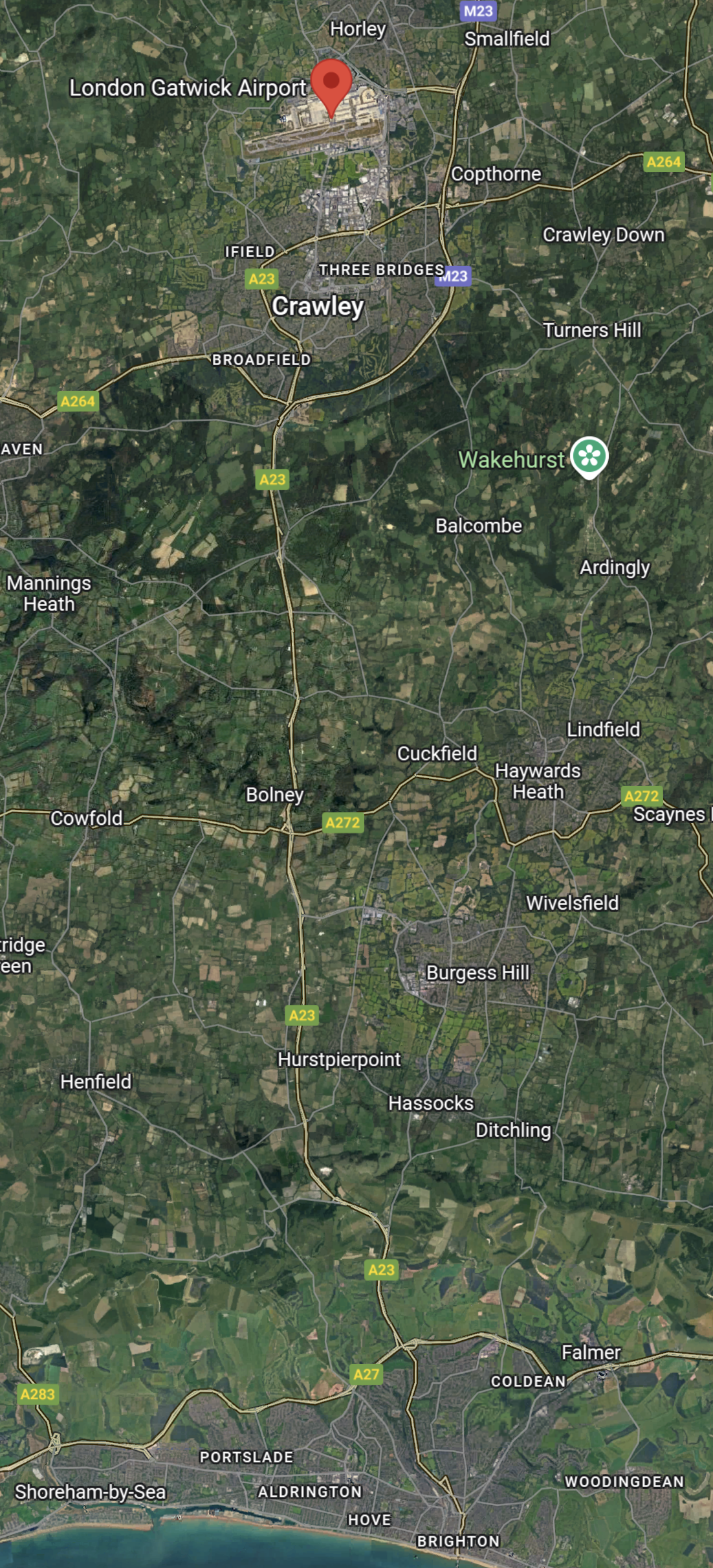
Note.
- Gatwick Airport is indicated by the red arrow at the top of the map.
- Gatwick’s runways can be picked out under the red arrow.
- The South Coast is at the bottom of the map.
- The M23 and the Brighton Main Line connect Gatwick Airport and Brighton.
- Shoreham and Brighton are on the South Coast.
- Click the map to show on a larger scale.
Under current plans, the Ramplion offshore wind farm off the South Coast is going to be increased in size to 1.6 GW.
The simplest plan to provide large amounts of green hydrogen to Gatwick would be to build a large electrolyser in the Port of Shoreham and pipe it along the railway to Gatwick Airport. Hydrogen could also be shipped at night into the Airport using rail tankers.
There’s no doubt in my mind, that it will be much easier to supply large quantities of hydrogen to Gatwick, rather than Heathrow.
In 2023, I wrote Discover How Greater Brighton Is Championing The Transition To Hydrogen, which probably indicates that the locals and their politicians, would welcome the investment in hydrogen in their city.
It should also be noted that world class consultants Ricardo, who are very much involved in the development and promotion of hydrogen technology are based in Shoreham.
Liquid hydrogen could also be imported and distributed from the Port of Shoreham.
Brighton could end up as the South of England’s Hydrogen City.
South Korean Firm To Supply Power Equipment For Ørsted’s Hornsea 4 Offshore Wind Farm
The title of this post, is the same as that of this article on offshoreWIND.biz.
This is the sub-heading.
Denmark’s Ørsted has awarded a contract to Hyosung Heavy Industries for the supply of ultra-high voltage power equipment for the Hornsea 4 offshore wind farm in the UK
These two paragraphs add a bit of detail.
Under the contract, the South Korean company will supply 400 kV ultra-high voltage transformers and reactors, essential components for improving power quality for the 2.4 GW Hornsea 4 offshore wind project.
The most recent contract further strengthens the company’s presence in Europe, where it has accumulated over 1 trillion won (about EUR 667 million) in orders this year, as reported by the company.
Hyosung Heavy Industries seem to be doing rather well at supplying electrical gubbins in Europe.
But then Korean companies seem to be doing well in Europe and especially the UK, after the state visit of the Korean President and his wife in November 2023.
In the last century, we did very well dealing with Korean companies with Artemis; the project management computer system, that I wrote.
In Hyundai Heavy Sets Sights On Scottish Floating Offshore Wind, I describe some of our dealings there.
Conclusion
From other posts, I have written, it looks like the UK and Korea are building a strong partnership with offshore wind, and a secondary one with tidal power might be emerging. We also shouldn’t forget the partnership in North London over football.

