Could HS2 Trains Continue To Wales?
The title of this post is the same as that of this article on New Civil Engineer.
This is the sub-heading.
North Wales business group Growth Track 360 has recently renewed its calls for electrification of the North Wales Main Line to accommodate HS2 trains.
These two paragraphs add some more detail.
The group is pushing for electrification of the North Wales Main Line to Crewe and Warrington, which would allow HS2 trains to run directly from London and Birmingham to Chester and beyond.
It has also commissioned a series of conceptual artworks to help the public visualise the proposed improvements. Produced by Nataliia Marchuk, a Ukrainian Fine Arts undergraduate at the University of Chester, the first shows an HS2 train passing Conwy Castle on an electrified North Wales Main Line.
The article dates from May 2022, so it is a bit old now, but transport in Wales is moving on.
On the Growth Track 360 web site, I found this mission statement.
Growth Track 360 has been launched to secure £1bn of rail improvements, which would transform the North Wales and Cheshire regional economy and deliver 70,000 new jobs over 20 years.
It’s being led by a cross-border alliance of business, political and public sector leaders.
If successful, it would lead to a massive boost to the North Wales, Cheshire and Wirral economies, linking them with the planned HS2 line between London and the North of England.
This OpenRailwayMap shows the railways in the area.
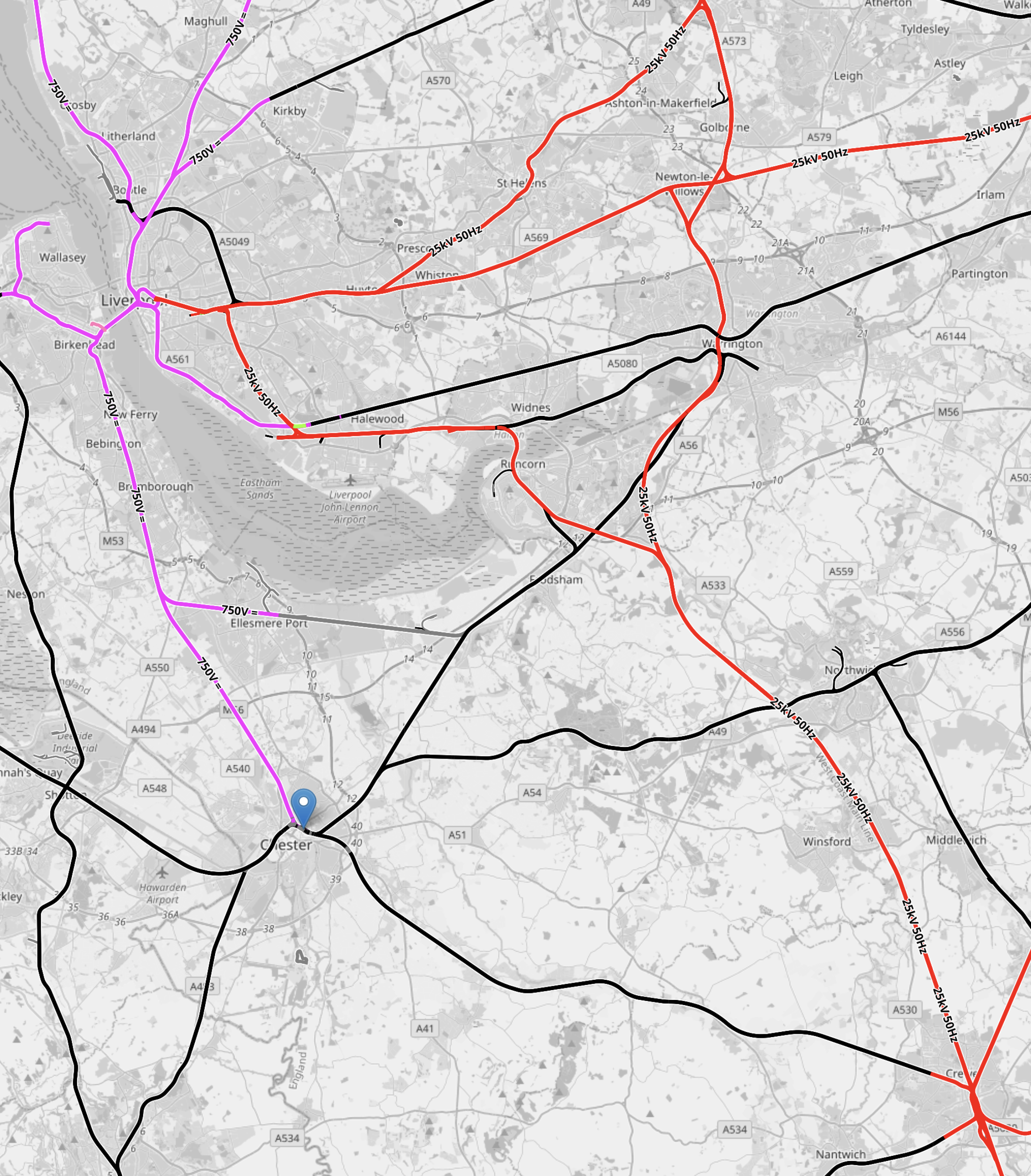
Note.
- The lilac tracks are Merseyrail’s third rail network.
- The lilac knot in the North-West corner of the map is the city of Liverpool.
- The red tracks are electrified with 25 KVAC overhead and connect Liverpool to Manchester in the East and Crewe in the South-East corner of the map.
- The black tracks are not electrified.
- The blue arrow marks the position of Chester.
- The lilac line going North from Chester is the Borderlands Line to Liverpool.
- Chester and Crewe are a distance of just over twenty-one miles.
Looking at the route on Google maps, I don’t think to electrify between Crewe and Chester will be the most difficult of projects.
The Advantage Of Electrifying Between Crewe and Chester
In How Far Will A Class 897 Train Travel Without Using The Electrification?, I showed that that these new tri-mode trains have a range of 120 miles.
In The Data Sheet For Hitachi Battery Electric Trains, I look at the data sheet, that Hitachi published in late 2023.
These were my conclusions about the data sheet.
These are my conclusions about Hitachi’s battery packs for Class 80x trains, which were written in November 2023.
- The battery pack has a capacity of 750 kWh.
- A five-car train needs three battery-packs to travel 100 miles.
- A nine-car train needs five battery-packs to travel 100 miles.
- The maximum range of a five-car train with three batteries is 117 miles.
- The maximum range of a nine-car train with five batteries is 121 miles.
As battery technology gets better, these distances will increase.
Hitachi have seen my figures.
They also told me, that they were in line with their figures, but new and better batteries would increase range.
It looks like Great British Railways will have at least two 125 mph, 120 mile range express trains away from the wires.
These are distances from Chester.
- Holyhead – 84.4 miles
- Bangor – 59.7 miles
- Llandudno Junction – 44.7 miles
It would appear that electrifying between Crewe and Chester will be an insurance policy to make sure, that battery-electric trains can serve Holyhead.
Electrifying between Crewe and Chester, will also ensure, that any battery-electric train leaves Chester with a full battery.
Are There Any Battery-Electric High Speed Trains?
I asked Google AI, this question and received this answer.
Yes, battery-electric high-speed and intercity trains are entering service, primarily in Europe. While many battery trains are designed for regional speeds, Hitachi Rail offers intercity battery trains capable of high speeds and over 70 km ranges. In 2026, the UK’s Great Western Railway (GWR) launched a record-breaking, fast-charging battery train with a 200-mile range.
Key Developments in Battery Trains:
Hitachi Rail Intercity Battery Trains: These trains can operate at intercity speeds, designed for both electrified and non-electrified routes, enhancing sustainability without sacrificing performance.
GWR Class 230 Battery Train: This UK-based, three-car train achieved a world record of over 200 miles on a single charge in 2025.
Rapid Charging Technology: The GWR train uses a 2,000kW fast charger, allowing it to recharge in just over three minutes while stopped at a station, making it suitable for extending electrical service without full, expensive track electrification.
Regional Battery Trains: Beyond the UK, Hitachi’s battery trains (Full battery, Hybrid, Tri-brid) are part of a broader shift in Europe toward lowering emissions. In Argentina, battery-electric units are also used for regional services, designed to operate with solar-powered charging.
These developments show a move towards using battery technology to reduce reliance on diesel trains on partially electrified lines.
How Long Will HS2 Take To Go Between London Euston And Holyhead?
Consider.
- Sources like the House of Commons Library give HS2 times of 56 minutes between London Euston snd Crewe.
- Avanti West Coast’s Class 805 trains take two hours and two minutes between Crewe and Holyhead.
I don’t think that a sub-three hour journey is unreasonable.
Is A Green Route Between London And Dublin Possible?
As we’re more likely to see a zero-carbon ferry, than a zero-carbon airliner. Yes!
Plans Progress To Build World’s Largest Tidal Scheme On The Banks Of The River Mersey
The title of this post, is the same as that of this press release from the Liverpool City Region.
These four bullet points, act as sub-headings.
- Mersey Tidal Power has the potential to become the world’s largest tidal scheme
- Formal planning process for UK’s “first of a kind” Mersey Tidal Power set to begin
- Potential to manage environmental issues associated with climate change
- Scheme would need government backing to complete development stage
These three paragraphs introduce the project.
Advanced proposals to build the world’s largest tidal scheme on the banks of the River Mersey have been unveiled by the Liverpool City Region’s Mayor Steve Rotheram.
Mayor Rotheram has revealed that the city region will pursue a barrage between the Wirral and Liverpool as the preferred option for the city region’s flagship Mersey Tidal Power project.
The barrage scheme – the “first of a kind” in the UK – could generate clean, predictable energy for 120 years and create thousands of jobs in its construction and operation.
Note.
- This page on the Liverpool City Region, has this explanatory video.
- This brochure can also be downloaded.
At a first glance all the documentation is very professional.
These are my thoughts.
How Much Power Will The Mersey Tidal Project Generate?
This graphic from the brochure shows electricity generation in Liverpool Bay.
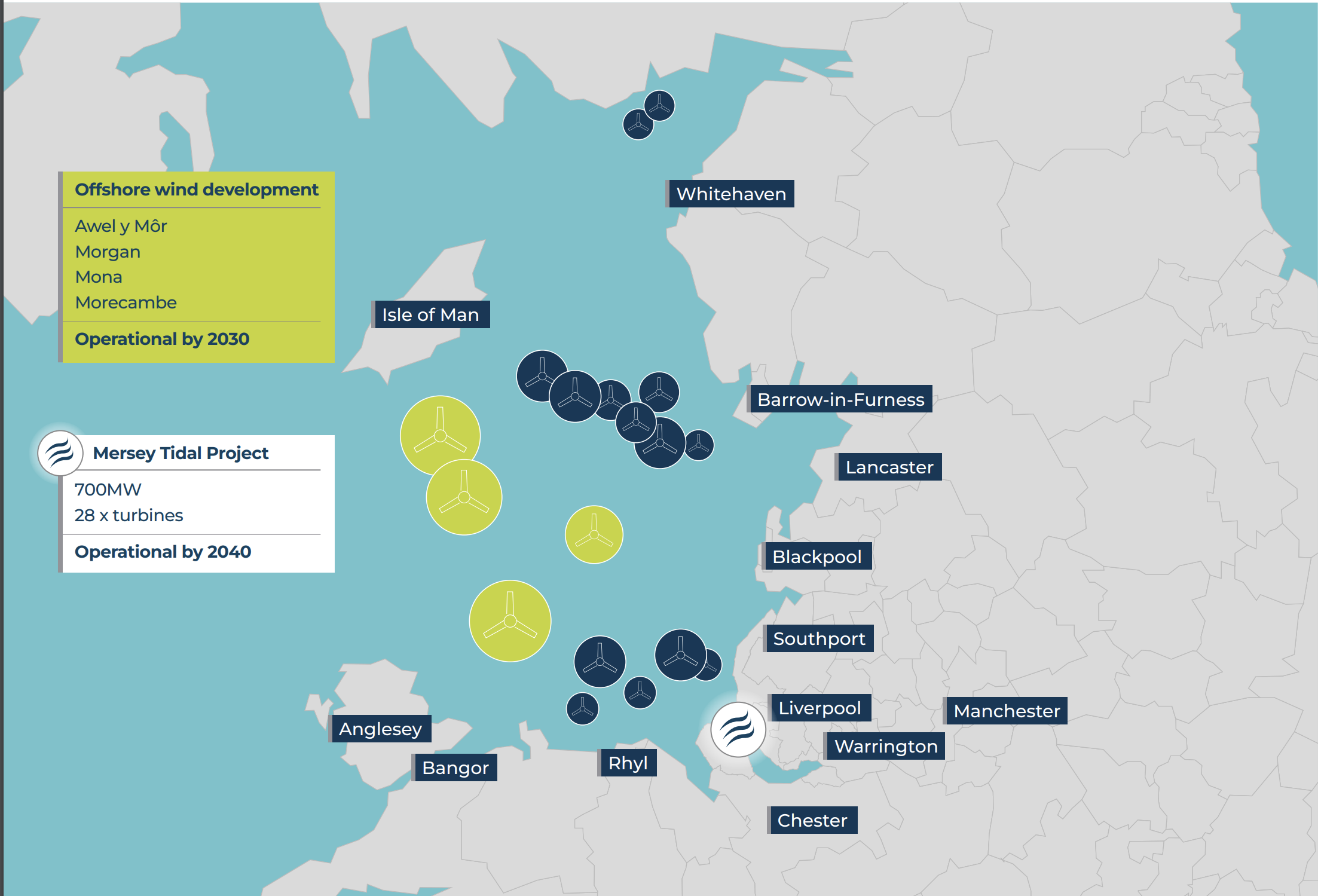
Note.
- The dark blue circles are the thirteen existing wind farms, that have a total capacity of 3 GW.
- The yellow circles are four new wind farms, that will be built by 2030 and will have a total capacity of 4 GW.
- The Mersey Tidal Project will have 28 x 25 MW turbines and generate 700 MW.
I also suspect that the power generation will be supplemented by a large battery, that will smooth out the electricity, when the wind isn’t blowing and the tides are at the wrong cycle.
Access For Ships To The Tranmere Oil Terminal And The Manchester Ship Canal
This article on the Liverpool Business News is entitled £6bn ‘Barrage Across The Mersey’ Takes Step Forward.
This is the introductory paragraph.
Steve Rotheram says his £6bn Mersey Tidal Power project will see a barrage across the river, with locks to allow ships through, but original 2030 switch-on now looks unlikely.
The article has a picture which could show locks on the Wirral side of the Mersey.
This Google Map shows the location of the Tranmere Oil Terminal and the Manchester Ship Canal.

Note.
- Birkenhead is in the North-West corner of the map.
- The line of white squares running parallel to the River Mersey, indicate the stations of the Wirral Line to Chester and Ellesmere Port.
- The Tranmere Oil Terminal is indicated by the red arrow at the top of the map.
This second Google Map expands the area on the West bank of the Mersey, at the bottom of the map.
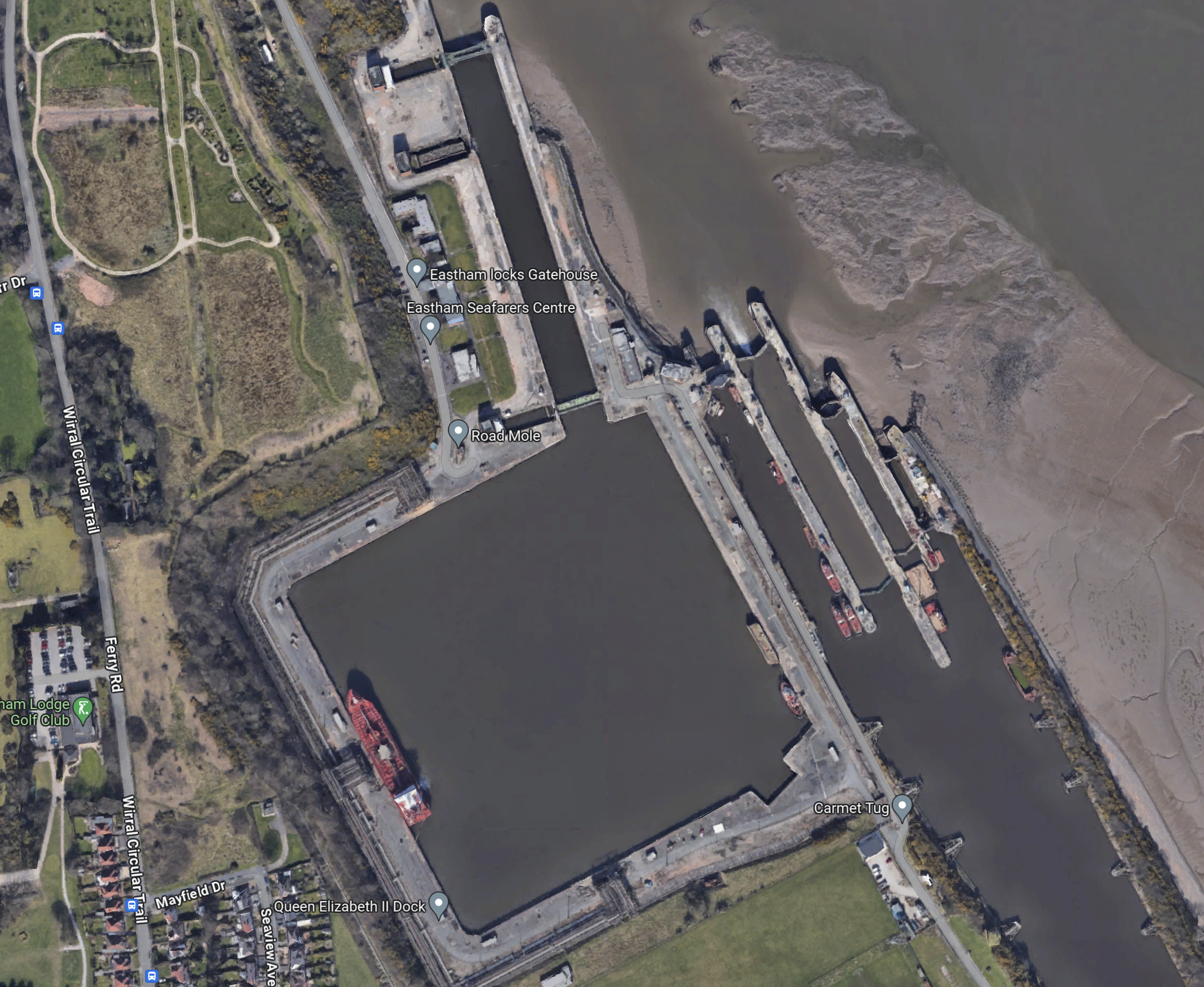
These are Eastham Locks, which allow ships to enter and leave the Manchester Ship Canal.
This third Google Map shows the area around the Tranmere Oil Terminal.
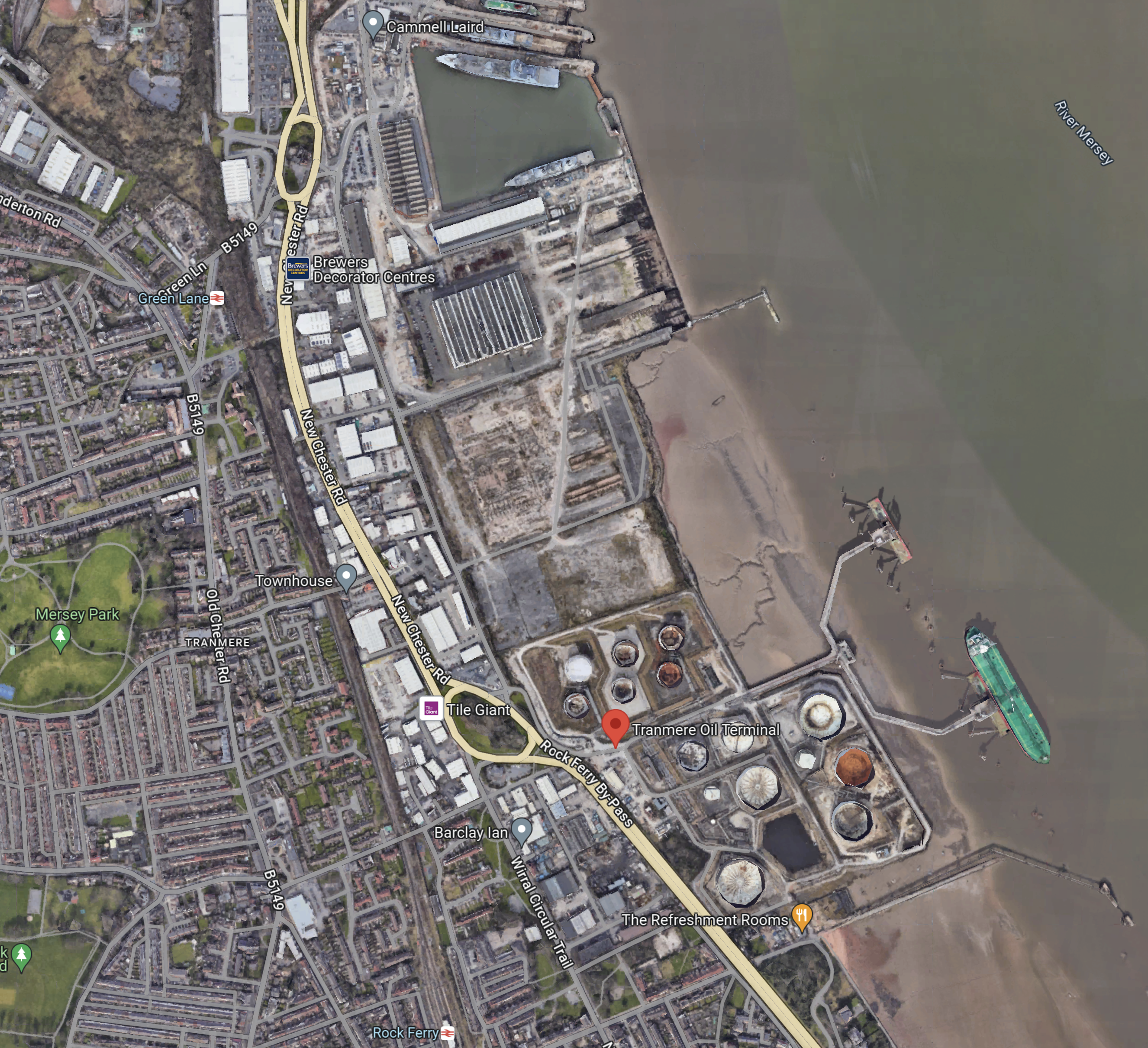
As before the Tranmere Oil Terminal is indicated by the red arrow, with Cammell Laird to the North.
The Liverpool Business News article says this about oil tankers, that use the Mersey.
In terms of oil tankers alone, there are more than 700 vessels coming in and out of the Mersey every year. Supertankers berth at the Tranmere Oil Terminal next to the Cammell Laird shipyard and around 500 smaller vessels berth at Stanlow at Ellesmere Port.
LBN understands that some form of lock system will be incorporated into the barrage to allow ships in and out. That might prove tricky for supertankers which suggests the barrage would be down river from the Tranmere terminal.
This Google Map shows the Manchester Ship Canal as it goes East from Eastham Locks.
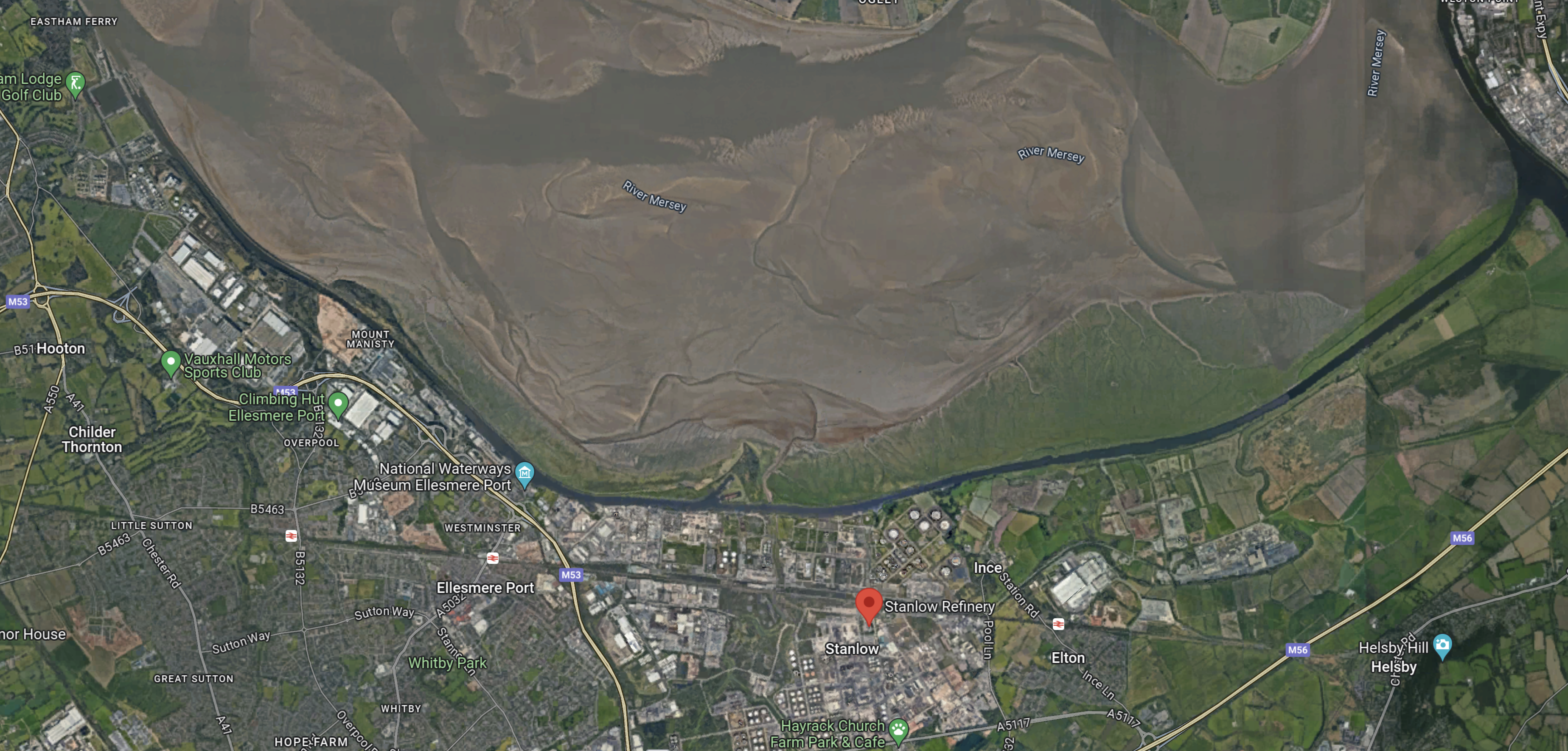
Note.
- The Manchester Ship Canal clings to the South Bank of the Mersey.
- The red arrow indicates Stanlow Refinery,
- There is a lot of industry on the South Bank of the Manchester Ship Canal.
It would appear that access to the Manchester Ship Canal gives access to several important places other than Manchester.
Access To Garston Docks
This Google Map shows the Liverpool Bank of the Mersey.
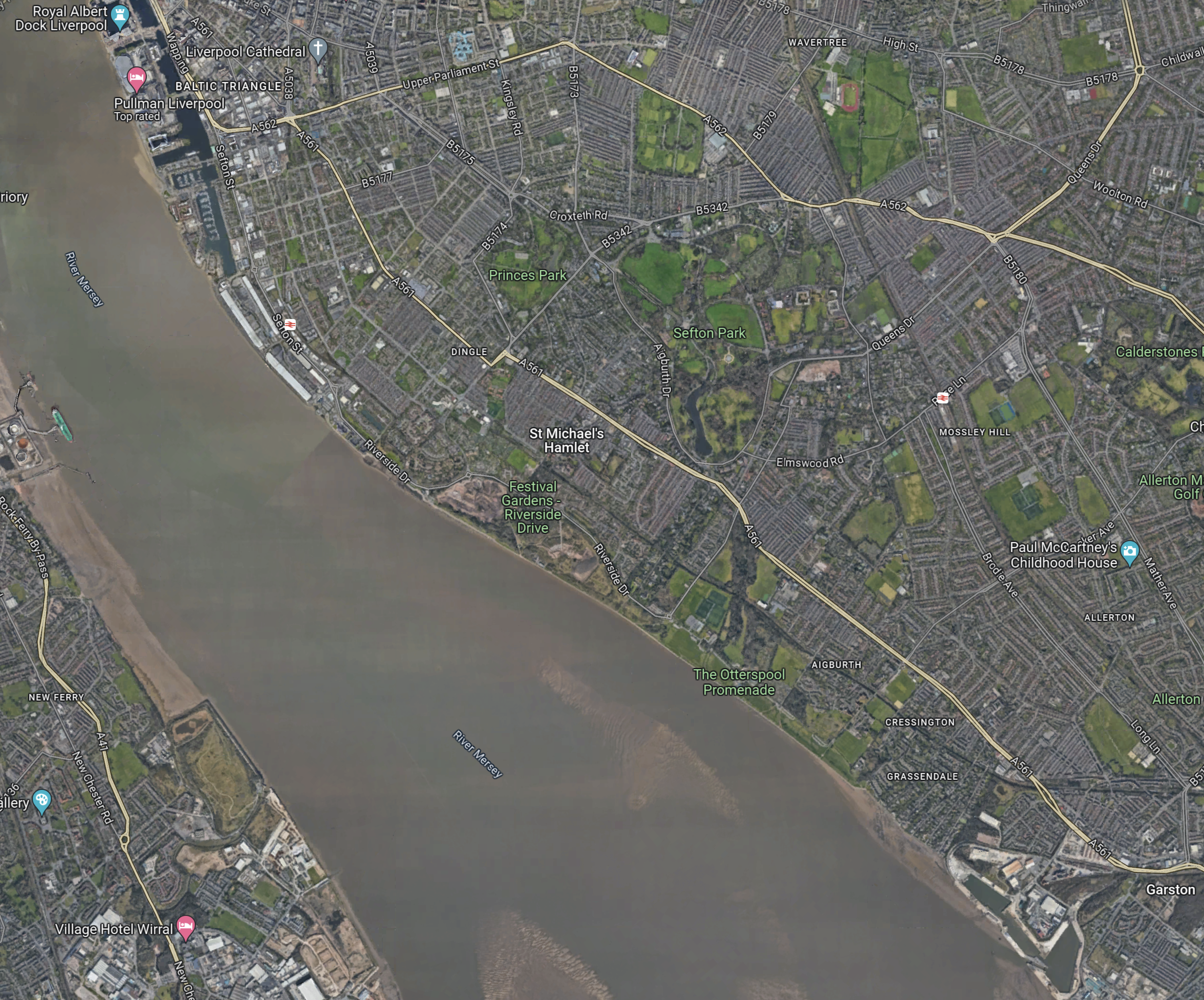
Note.
- The blue marker in the North-West corner of the map indicates the Royal Albert Dock.
- Garston Docks are in the South-East corner of the map
- There are no docks between Liverpool and Garston and much of the route can be walked along the Mersey.
- On the other bank of the Mersey, note the green ship at the Tranmere Oil Terminal, that can be seen in other maps.
This second Google Map shows Garston Docks.
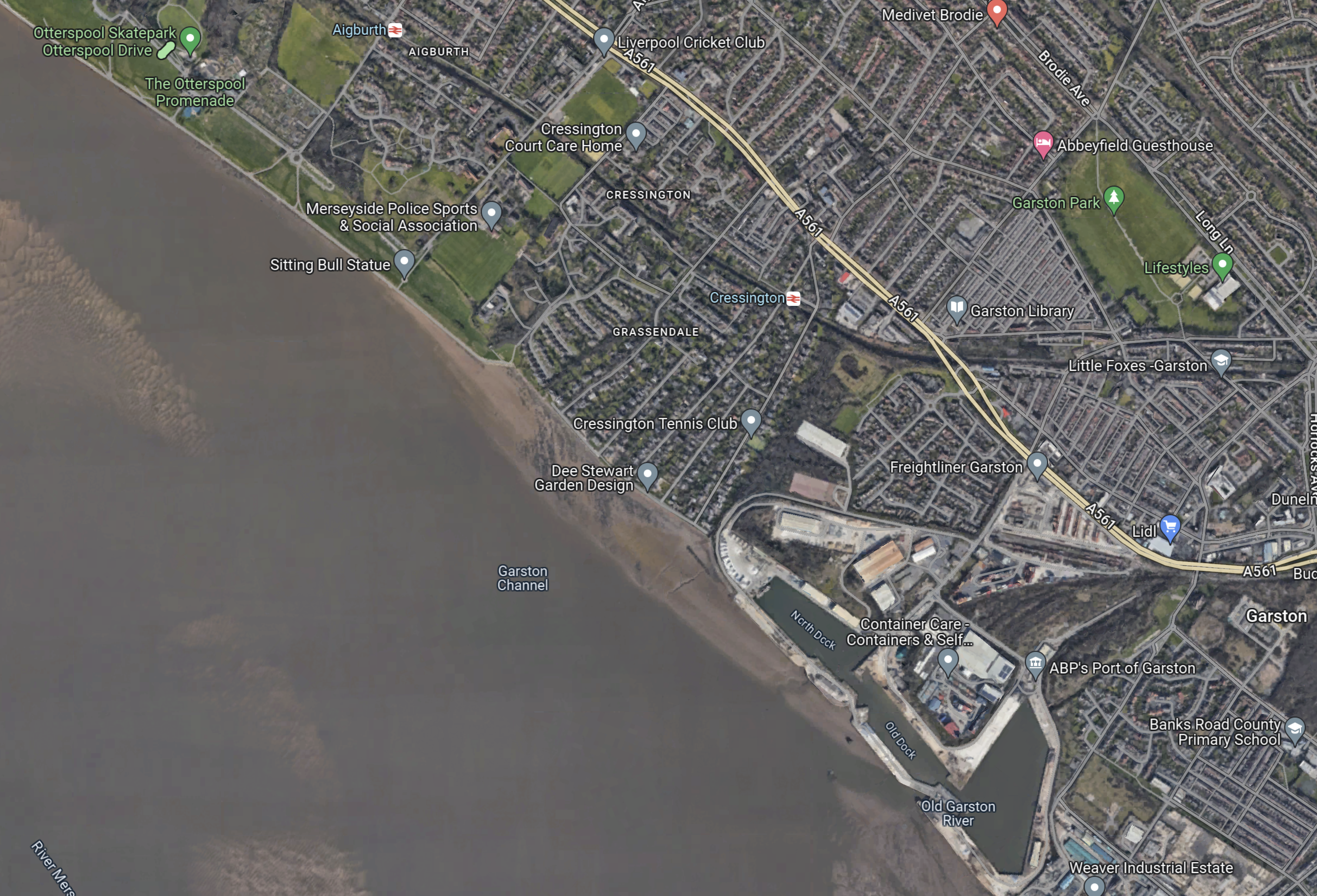
Note.
- There are three docks.
- The Garston Channel and the Old Garston River provide a route for ships to enter or leave the docks.
The Wikipedia entry for the Port of Garston, indicates that the port is rather run-down and a shadow of its former self.
It would appear that ships would have to pass through the locks in the barrier, which would likely be on the Wirral bank, to gain access to the Manchester Ship Canal and then cross the Mersey for Garston.
However, the barrier is built, it must have a route to both the Tranmere Oil Terminal and the Manchester Ship Canal at Eastham Locks.
The barrier could be built either North or South of the Tranmere Oil Terminal.
- If built North of the oil terminal, the locks in the barrier will have to accommodate the largest supertanker that calls at the terminal.
- If built South of the oil terminal, the locks in the barrier would only have to accommodate the largest ship that needed to use the Manchester Ship Canal or visit Garston.
One option would probably be more affordable.
Barrage Cross The Mersey
The very informative Liverpool Business News article, explains why a barrage was chosen, in this paragraph.
After pondering whether to build a barrage across the river from Liverpool to Wirral, or a floating lagoon, the Combined Authority has chosen the former as it would be cheaper and also creates a bridge that could have a pedestrian and cycle link.
The choice of a barrage sounds sensible on grounds of cost and accessibility.

