Liverpool Pier Head On A Sunny Morning
When I was a student at Liverpool University in the 1960s, this area was so different.

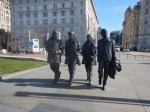

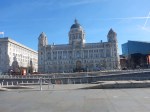
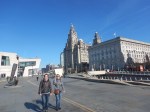

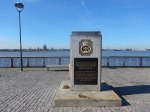




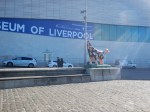
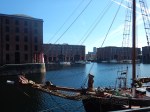



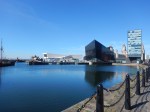
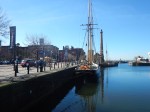
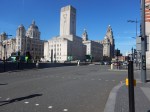
I can only remember, the Three Graces and the Memorial to those with no known grave.
Incidentally, I talked to one of the volunteers in the Tate Liverpool and he says that Friday is often quiet in Liverpool. The gallery certainly was, but they were between exhibitions.
The statue looking out to sea is of Captain Frederick John “Johnnie” Walker, who was the most successful anti-submarine warfare commander during the Battle of the Atlantic.
Drought Caused Brexit
According to Al Gore, drought in Syria was one of the causes of refugees flooding to the EU.
It’s an interesting thought!
Why Aren’t More High Streets Like Liverpool?
These pictures were taken early on a sunny morning in Liverpool’s main shopping street.



No buses, cars and taxis, only a few deliveries and little street clutter.
Imagine Oxford Street like this. Except you can’t as it’s not wide enough!
Both my local High Streets; Angel and Dalston are even main routes for trucks.
Network Rail Go Diving Again
After the Acton Dive-Under and the Bermondsey Dive-Under, in the April 2017 Edition of Modern Railways, there is an article entitled Dive-Under To Radlett SRFI (trategic Rail Freight Interchange).
This Google Map shows the location of the controversial Radlett SRFI.

It is sited on the old Handley-Page aerodrome at Radlett to the East of Park Street station on the Abbey Line and the West of the Midland Main Line.
The dive-under will go under the Midland Main Line to provide access to the slow lines on the East side of the Midland Main Line.
The Train Of The Future
This article in Rail |Engineer is entitled ScotRail’s ‘new’ HSTs, gives full details of the modifications ScotRail wukk make to their HSTs, before they enter service in Summer 2018. This is said.
The iconic HST is now over forty years old. It ensured the success of British Rail’s inter-city service and is still the world’s fastest diesel train, although the ScotRail HSTs will have a maximum speed of 100 mph. With around ten million miles on the clock these trains are approaching retirement for long-distance services as they are about to be replaced by IEPs. However, as ScotRail is about to demonstrate with its reincarnation of these trains, there is still much life left in them.
I wrote Edinburgh to Inverness in the Cab of an HST, after a trip to Inverness and it was the trip of a lifetime.
On the trip, you realise that Scotland has a big problem and an asset with railways and it’s called mountains. So a train is needed with bags of grunt and big windows.
An HST has both, coupled with an iconic style, unmatched since the days of steam.
Scotrail’s plan to run the trains between the seven Scottish cities would appear to be a good one.
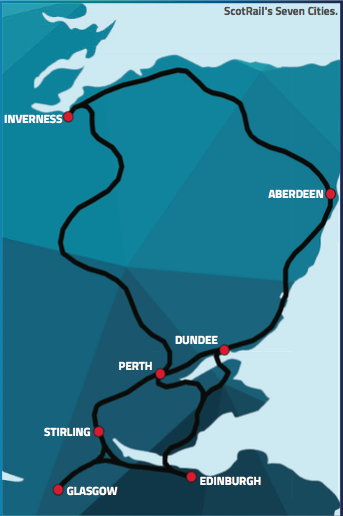
I wonder, if we’ll ever see the trains going to Kyle of Lochalsh, Thurso and Tweedbank.
The article is worth reading, as it details everything that will be done to create a train worthy of the iconic routes.
If I’m still of this life next Summer, I shall be in Scotland.
I’ve never spent a night in Aberdeen, Dundee or Perth for a start!
Every Picture Tells A Story!
The April 2017 Edition of Modern Railways has a picture of a Crossrail Class 345 train on the High Meads Loop.
The main purpose of the High Meads Loop would appear to be to allow trains to go from Lea Bridge station through Platform 11 or 12 at Stratford station and then back to Lea Bridge without the driver changing cabs.
So what was the train doing?
- I doubt it would have been running up the busy West Anglia Main Line, as even in the maddest scenarios, Crossrail will not be running there.
- Could it have just been route proving on a line that other Aventras will use from 2018 or 2019?
- Perhaps it was running to Broxbourne to assess performance for Crossrail 2.
But if it is was running on the High Meads Loop, as the picture caption says, was it testing that Aventras can be turned using the loop?
So could this mean that services from the West Anglia Main Line terminating at Stratford will use the High Meads Loop rather than the Platforms 11 and 12.
Each of Platforms 11 and 12 could probably handle four trains per hour (tph), as is regularly handled by terminal platform on the London Overground.
But terminating in the High Meads loop, which would mean that all services would call at perhaps Platform 11 could give a capacity of upwards of 14 tph, as is the frequency on the Wirral Line on Merseyrail. But the Wirral Line was designed in the 1970s , so surely we can do better than that, as Crossrail and Thameslink will handle 24 tph and even the conventionally signalled East London Line will be handling 20 tph in 2019.
If it was 20 tph, this would mean that Platform 11 at Stratford could see a train every three minutes, possibly going to the following.
- 4 tph to Walthamstow Central and Chingford via the Hall Farm Curve.
- 8 tph to Broxborne
- 2 tph to Hertford East
- 2 tph to Bishops Stortford
- 2 tph to Stansted Airport
- 2 tph to Cambridge
In addition the following services could run from Liverpool Street.
- 2 tph to Hertford East
- 2 tph to Bishops Stortford
- 2 tph to Stansted Airport
- 2 tph to Cambridge
This sort of schedule would be possible given the following improvements and developments.
Signalling
Modern signalling as fitted to Crossrail and Thameslink is installed.
Stadler Flirts
Stadler probably have a good knowledge of the performance of the Flirts.
Current fastest timings are as follows.
- Liverpool Street to Broxbourne – 25 minutes
- Broxbourne to Cambridge – 45 minutes.
The Flirts will be faster than the current trains and will be optimised for a very fast stop at a station. So I do wonder what sort of times could be achieved between Bishops Stortford and Cambridge stopping at all stations.
Fast Lines To Broxbourne
Two separate non-stop fast lines will be built between Tottenham Hale and Broxbourne.
- Cambridge and Stansted services take the fast line to Broxbourne.
- All trains on the fast lines will be Stadler Flirts.
- With fast line trains the first stop is Broxbourne.
The fast lines would also handle extra services from Liverpool Street, which might be 2 tph to each of Stansted Airport and Cambridge.
A summary of traffic on the fast lines between Tottenham Hale and Broxbourne could be.
- 2 tph – Liverpool Street and Cambridge
- 2 tph – Stratford and Cambridge
- 2 tph – Liverpool Street and Stansted Airport
- 2 tph – Stratford and Stansted Airport
There is probably a few paths for other trains.
North Of Broxbourne
North of Broxbourne the service will be very much better than now.
- What helps is that both the Flirts and the Aventras will be masters of the quick stop-start at a station.
- Stansted services will probably go non-stop from Broxbourne..
- Some Cambridge services will go non-stop and others will stop at all stations.
I think it can be arranged that all stations North of Broxbourne get 4 tph in both directions.
A summary of traffic on the lines between Broxbourne and Bishops Stortford could be.
- 2 tph – Liverpool Street and Bishops Stortford
- 2 tph – Stratford and Bishops Stortford
- 2 tph – Liverpool Street and Cambridge
- 2 tph – Stratford and Cambridge
- 2 tph – Liverpool Street and Stansted Airport
- 2 tph – Stratford and Stansted Airport
A summary of traffic on the lines between Bishops Stortford and Cambridge could be.
- 2 tph – Liverpool Street and Cambridge
- 2 tph – Stratford and Cambridge
- 2 tph – Liverpool Street and Stansted Airport
- 2 tph – Stratford and Stansted Airport
There would also be additional Stansted Airport to Cambridge services.
Slow Lines
The slow lines will be upgraded to be able to handle 16 tph stopping at all stations between Tottenham Hale and Broxbourne, which they probably do now at times.
- All trains on the slow lines are Aventras.
- A second platform is built at Ware, as this would enable four tph to Hertford East.
- Cross-platform interchange between slow and fast lines at Broxbourne.
A summary of traffic on the slow lines between Tottenham Hale and Broxbourne could be.
- 8 tph – Stratford to Broxborne
- 2 tph – Straford to Hertford East
- 2 tph – Stratford to Bishops Stortford
- 2 tph – Liverpool Street to Hertford East
- 2 tph – Liverpool Street to Bishops Stortford
Crossrail 2 is proposing a frequency of 12 tph North of Tottenham Hale, so my randomly-chosen frequency gives you that.
Liverpool Street
Liverpool Street station will become the terminus for the following.
- Great Eastern Main Line.
- 2 tph to each of Bishops Stortford,, Cambridge, Hertford East and Stansted Airport.
- London Overground setvices to Cheshunt, Chingford and Enfield Town.
- Perhaps a few c2c services.
Given that Liverpool Street and Stratford are just eight minutes away on Crossrail, is there any reason to keep West Anglia Main Line services at Liverpool Street?
But then, there are others who know more about train scheduling than me and perhaps a good balance can be made between the two termini.
Stratford International Station
If Stratford services used the High Meads Loop, a connection could be built to Stratford International Station.
Crossrail 2
Crossrail 2-like frequencies would have been created between Tottenham Hale and Broxbourne.
All it would need to complete Crossrail 2 after the suburban services out of Waterloo have been upgraded this summer, is to build the Central Tunnel.
Conclusion
Using the High Meads Loop is a good plan.
, Does that mean that Stansted and Cambridge services will be using Stratford as a terminal when Greater Anglia gets Aventras and Flirts?
Were they just seeing if it fits?
The Vehicle Hire Loophole
It is being reported that the car that was used as a murder weapon yesterday was a hire car from Birmingham.
Let’s suppose a country has elected a President, who is against opposition, women, the gay community, Jews, Sikhs, Hindus, Christians and dogs.
Inevitably, a large demonstration will happen in Trafalgar Square.
So the President sends a hitman to hire a suitable vehicle to cause as much death and destruction as he can!
The hitman presents a valid passport and driving licence at Heavy Metal Rent-a-Weapon at Heathrow Airport and he is on his way.
But how many times has the average person hired a car at an airport and driven into the nearest large city?
How do you sort the terrorist from the tourist?
Bolting The Stable Door
After the murder of Airey Neave in the Palace of Westminster by a bomb, many people felt that the car park was a security risk.
The attacker yesterday, who murdered PC Keith Palmer, would have been unable to enter the grounds of the Palace of Westminster if that road entrance and the car park had been closed.
The attacker might have caused more carnage to members of the public and others, but I suspect he would have met the same fate fairly quickly, as there are always armed officers around that area, outside of the Palace.
Nearly two years ago, I wrote What Are We Going To Do With The Palace Of Westminster?
What I said then was probably the rantings of a madman, but after the events of yesterday, we need to act in a very radical manner to preserve our fragile democracy.
Is The Pollution Solution A Part-Solution To Terrorism?
Hong Kongers nickname their tramway the Pollution Solution. ut to be fair to one of my favourite cities, the city also has an extensive public transport network of metro lines and buses. Although, I’ve ever used any of the latter.
London and other cities in the UK have a serous air pollution problem and we should solve it for the health of us all, as pollution probably causes more premature deaths than terrorism. Or for that matter street crime like muggings and robberies!
Suppose in London we did the following to cut pollution.
- Ban polluting vehicles from a wide area of the centre.
- Impose a high Congestion Charge over a wide area.
- All shop deliveries must be at night!
- Cut the number of private hire vehicles.
- All buses, including tourist buses and coaches, private hire vehicles and black cabs must be electric.
- Rigorously impose a twenty mile per hour city-wide speed limit.
- When Crossrail is finished, build the Bakerloo Line Extension and Crossrail 2.
- Pedestrianise large parts of the City Centre.
- Improve the cycle network and make sure cyclists use it and not the pavement.
Other cities could also do similar things to suit their circumstances.
A few of our cities like Birmingham, Cardiff, Glasgow and Liverpool have pedestrianised substantial parts of their city centres. They haven’t done enough, but it’s a start.
I don’t think trams will be a pollution solution in Central London except perhaps on a specific route to overcome congestion on the Underground.
We are going to have to act very strongly to deal with pollution, but will it have collateral effects?
Some years ago, I did some work with the Police on analysing crime and I remember an analyst, who was also a Police Officer, explaining how he saw links between traffic and crime.
I remember him saying that no self-respecting criminal would go burgling on a bus.
One thing that came out of this work, was that if Police checked a car and found that one of car tax, insurance or MOT was not in order, there was a high chance of a non-motoring offence being committed. As he said, if a criminal is dealing in thousands of pounds-worth of drugs, will he bother to renew his tax and insurance?
I’ve wondered for some time, if this car checking in Central London, which must be done by the Congestion Charge cameras has led to the increase in crime in London committed by criminals on motor-bikes, scooters and bikes. London’s congestion could also drive crime this way.
So if we solved the pollution, would this cut the congestion? And how would this effect crime?
I don’t know, but I suspect, we’ll find out in a few years, as the draconian measures we will introduce to cut pollution, will have fundamental effects on the way we live in London.
In the next two or three years, some cross-city and city centre rail lines will will improve drammatically.
- Crossrail will open fully in December 2019 on an East-West axis in London
- The Thameslink Programme will deliver a massive increase in capacity by December 2018 on a North South axis in London
- Waterloo International station will be reopened for suburban services and will give a 30% capacity upgrade by 2019.
- The Northern Line Extension to Battersea could be open by 2020.
- The Ordsall Chord will open in Manchester this year.
- The Manchester Metrolink Line to Trafford Park should be running by 2020.
- The Midland Metro will have been extended in Birmingham and Wolverhampton.
- The Central Belt of Scotland will be receiving a lot of new electric trains.
However, some cities with bad pollution problems will not being seeing any public transport improvements.
It will be interesting to see the effects on pollution, congestion and crime. And terrorism!
Heritage Railways And Class 319 Flex Trains
Heritage Railways In The UK
Wikipedia introduces their Heritage Railway entry by saying this.
A heritage railway is a railway kept to carry living history rail traffic in order to re-create or preserve railway scenes of the past. Often heritage railways are old railway lines preserved in a state which depicts a certain period, or periods, in the history of railway systems.
But that doesn’t mean heritage railways in the UK are not run to the best professional standards.
The Class 319 Flex Train
The Class 319 Flex Train is an electro-diesel version of the Class 319 Train, originally built in the 1980s to serve the Thameslink routes.
These trains are almost as old as the classic Range Rovers., but they have probably been looked after to much higher standards.
Some trains have recently undergone a light refurbishment and are now working electric services for Northern in North-West England.
Northern would run more of the trains, if Network Rail had been able to stick to their electrification timetable.
So Northern and the train rolling stock leasing company; Porterbrook have decided to create the electro-diesel version by installing two rail-proven MAN diesels and an ABB alternator. The train will be able to generate its own electricity and thus work lines without electrification.
I have seen an advance copy of the brochure and the train combines the 100 mph capability of the original trains with the ability to work the very stiff Buxton Line.
Porterbrook describe the train as a Go-Anywhere Solution.
Through Services Onto Heritage Lines
I don’t know how many heritage lines run services that are habitually used by commuters going to school, college or on business, but there have been and might still are be heritage lines where this happens.
The next sections give my thoughts on possible connections and services.
Severn Valley Railway
The Severn Valley Railway runs for a distance of 16 miles between Kidderminster Town and Brignorth stations.
At Kidderminster, there is a connection to the Birmingham to Worcester Line.
This Google Map shows the two adjoining Kidderminster stations.
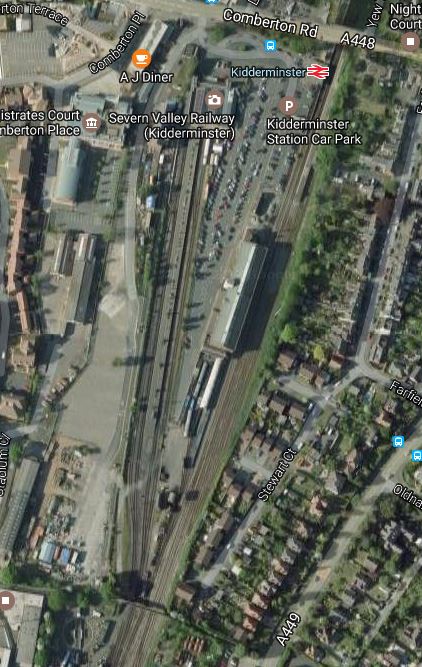
There is a section called Other Operational Extensions in the Wikipedia entry for the Severn Valley Railway, where this is said.
The General Manager, Nick Ralls has confirmed that Chiltern Railways have approached the Severn Valley Railway with a view to extending a number of its peak-time Marylebone to Kidderminster services to Bewdley to alleviate road congestion in the Kidderminster/Stourport/Bewdley area. This has raised questions regarding car parking limitations near Bewdley station. Should this go ahead the distinction between a heritage railway and a contemporary railway operation would be blurred. In conjunction with this there have been suggestions for locating a Park and Ride facility near Foley Park Halt. Investigations are in-hand to construct a station to serve a conference centre and hotel to be located at the West Midlands Safari Park.
Consider.
- According to Wikipedia, it is a future aspiration of Network Rail to electrify the entire Birmingham to Worcester via Kidderminster Line, as well as the Chiltern Main Line to London Marylebone.
- If Chiltern Railways could run to Bewdley station, surely a Class 319 Flex train could run a service to the Severn Valley Railway from anywhere between Kidderminster and Birmingham.
- If the electrification ever happens, a Class 319 Flex train could run under the wires to Kidderminster and then use diesel power to Bewdley or even Brignorth.
When does a heritage and tourist railway become a commuter route?
Swanage Railway
The Swanage Railway are working on a connection to the main line at Wareham station.
This Google Map shows Wareham station in the North East corner, with the South Western Main Line running across the image.
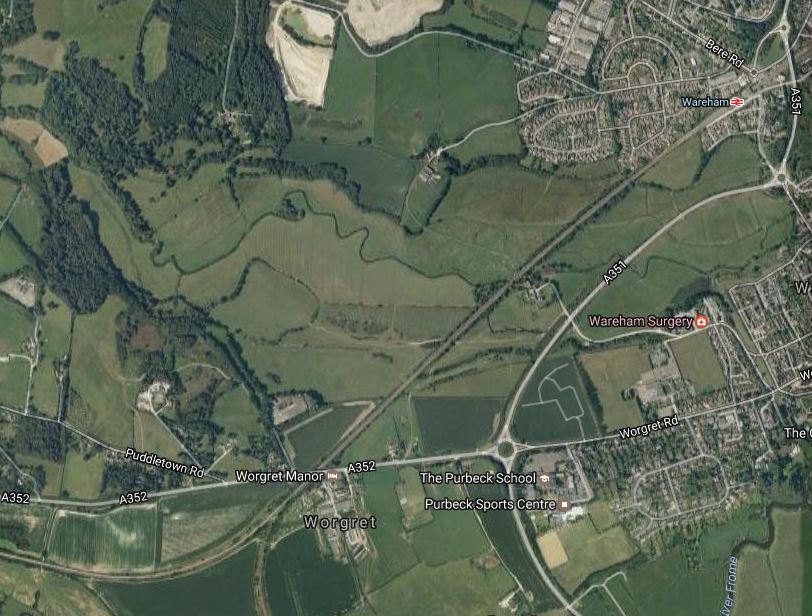
Wareham Station And The Swanage Railway
In the South West corner of the map, a junction can be seen, where the Swanage Railway joins from the South.
As the Class 319 Flex train would probably be a train fully-certified to go on any line, where the Class 319 train can run, it could run from say Poole or Bournemouth stations to the terminus of the Swanage Railway at Swanage via the iconic Corfe Castle.
- I think that Bournemouth station could turnback a local service to Swanage station.
- The Class 319 Flex train would use the third-rail electrification on the main line.
- On the main line, it would be a 100 mph train, just like the Class 444 trains working the line to Waterloo.
- The train would use diesel power to Swanage.
- I don’t think much new infrastructure would be needed, once the connection at Wareham is finished.Is a Class 319 train old enough to count as heritage? I suppose it’s fake with a couple of modern German diesels!
It could work as both a local train service and a tourist attraction.
 The Anonymous Widower