Dutch Stop Offshore Wind Turbines To Protect Migratory Birds In ‘International First’
The title of this post, is the same as that of this article on offshoreWIND.biz.
This is the sub-heading.
The wind turbines at Borssele and Egmond aan Zee offshore wind farms were stopped for four hours on 13 May, to help migrating birds pass by safely.
These three paragraphs outline the measures taken to protect the migrating birds.
According to the Dutch Government, this is the first time such a measure has been applied and is in line with the approach of the government and participating companies to increasingly focus on ecology and biodiversity in offshore wind farms.
The wind turbines’ speed will be reduced to a maximum of two rotations per minute during the predicted night-time peak migration to give the birds a safe passage.
The shutdown was part of a pilot phase, which could become standard this autumn and will also include wind farms that are still being built or will be constructed in the future.
I wonder how this Dutch action fits with research from Vattenfall, that I wrote about in Unique Study: Birds Avoid Wind Turbine Blades.
Plan To Develop New ‘Southern Gateway’ Through Station In City Centre
The title of this post, is the same as that of this article in the Bradford Telgraph and Argus.
This is the sub-heading.
Work to develop a new city centre rail station in Bradford could soon be back on the rails, despite the Government cancelling the local Northern Powerhouse Rail line
These are the first two paragraphs.
It has today been announced that the UK Infrastructure Bank will be working with Bradford Council to plan and develop a proposed “Southern Gateway” station in the city centre.
Although few details have been announced so far, the station is expected to be a through station, and is likely to be on the site off Wakefield Road currently occupied by St James’ Wholesale Market.
This sounds like an updating with finance of a plan I wrote about in Bradford Seeks Support On Rail Project Which Could Deliver £30bn Benefits.
This map from OpenRailwayMap shows the rail lines in the Bradford area.
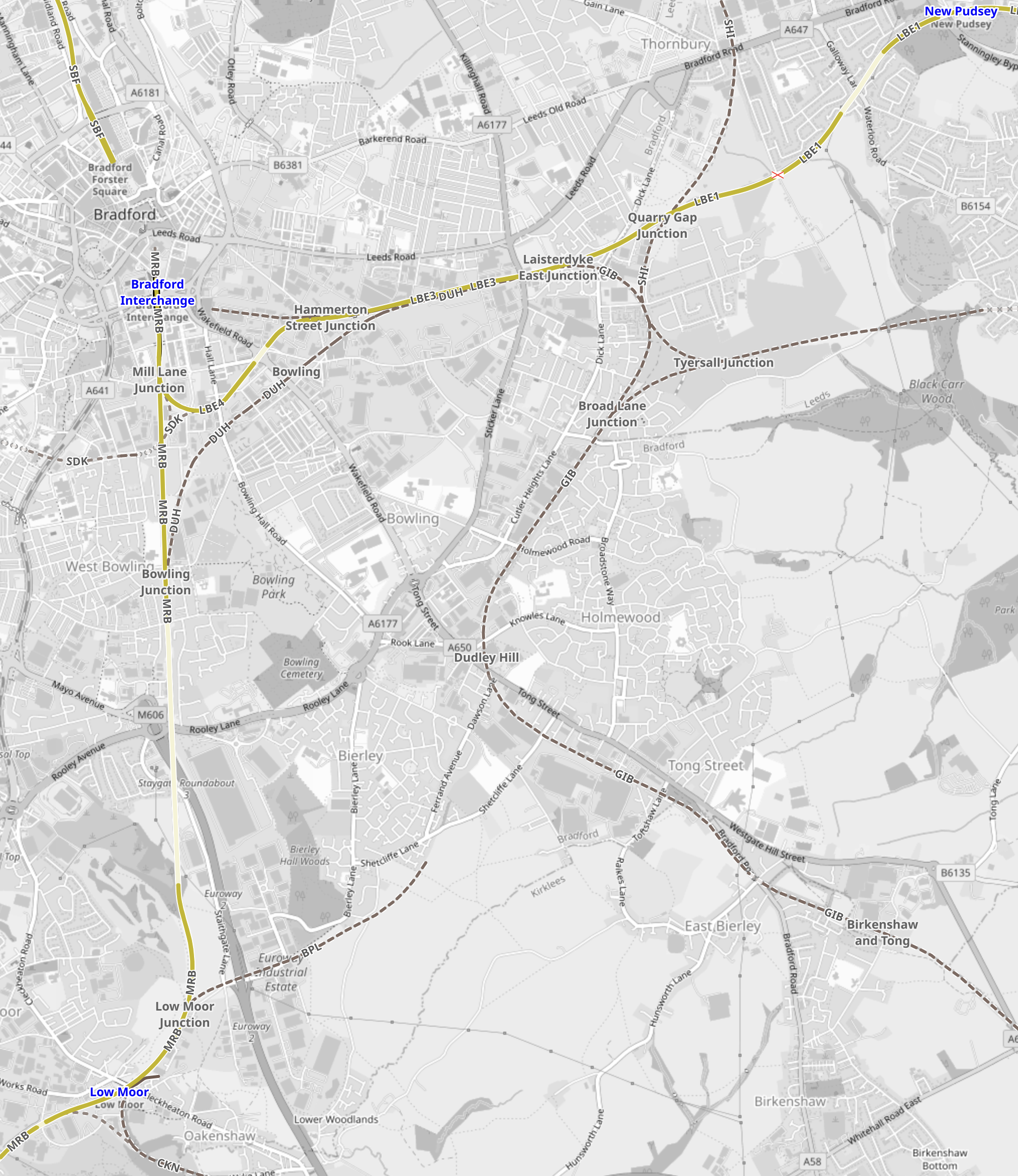
Note.
- New Pudsey station is in the North-East corner of the map.
- Bradford Foster Square and Bradford Interchange stations are in the North-West corner of the map.
- Low Moor station is in the South-West corner of the map.
This second OpenRailwayMap shows an enlargement of the lines across Bradford.
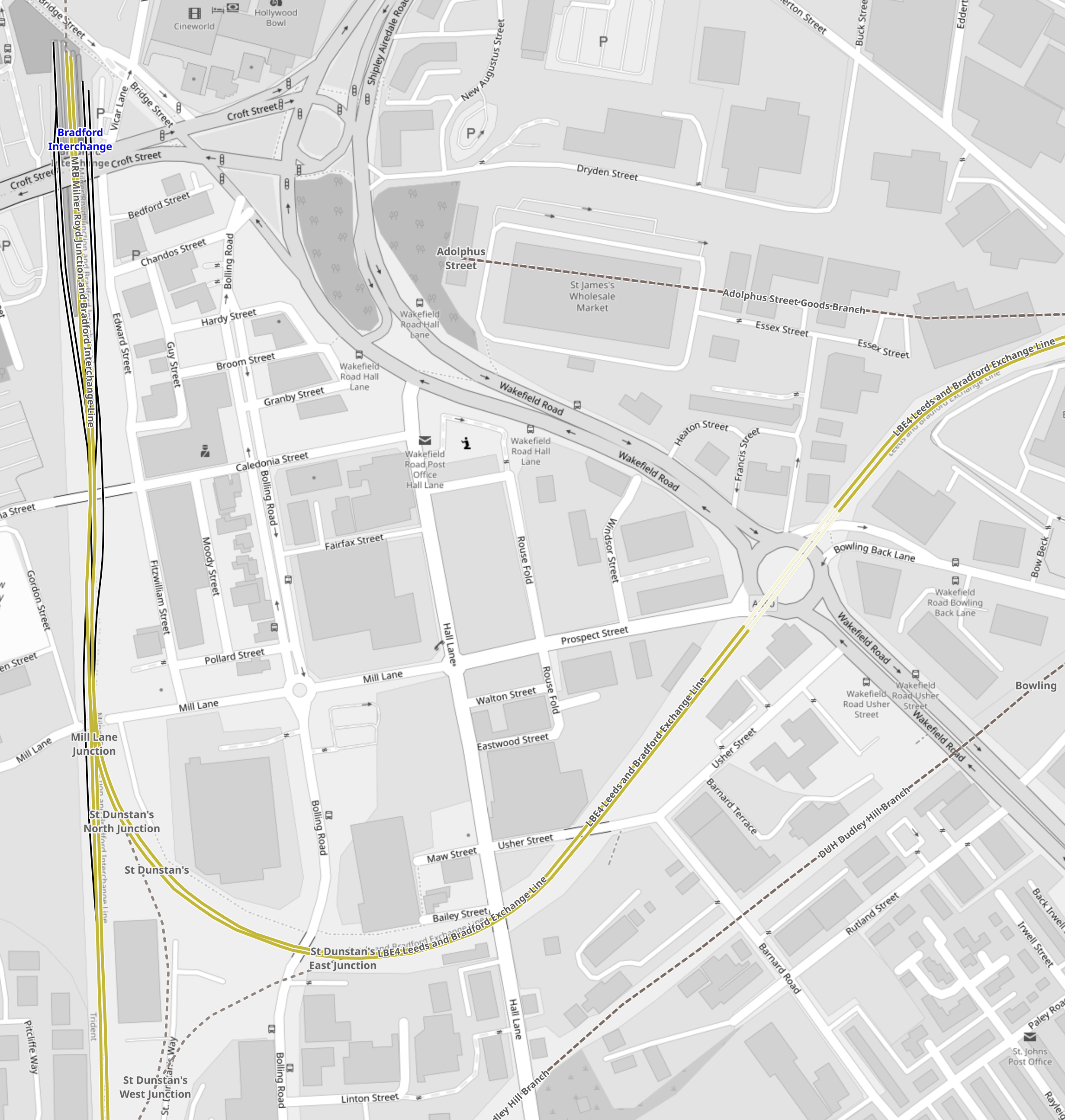
Note.
- Bradford Interchange station is in the North-West corner of the map.
- The railway lines are shown in yellow.
- New Pudsey station is off the map to the East and on the way to Leeds.
- Some trains between Leeds and Bradford are routed via New Pudsey station and the loop in this map.
- The railway between New Pudsey and Bradford Interchange stations goes under a roundabout on the Wakefield Road.
This Google Map shows St. James Wholesale Market and the railway to the North-East of the roundabout.
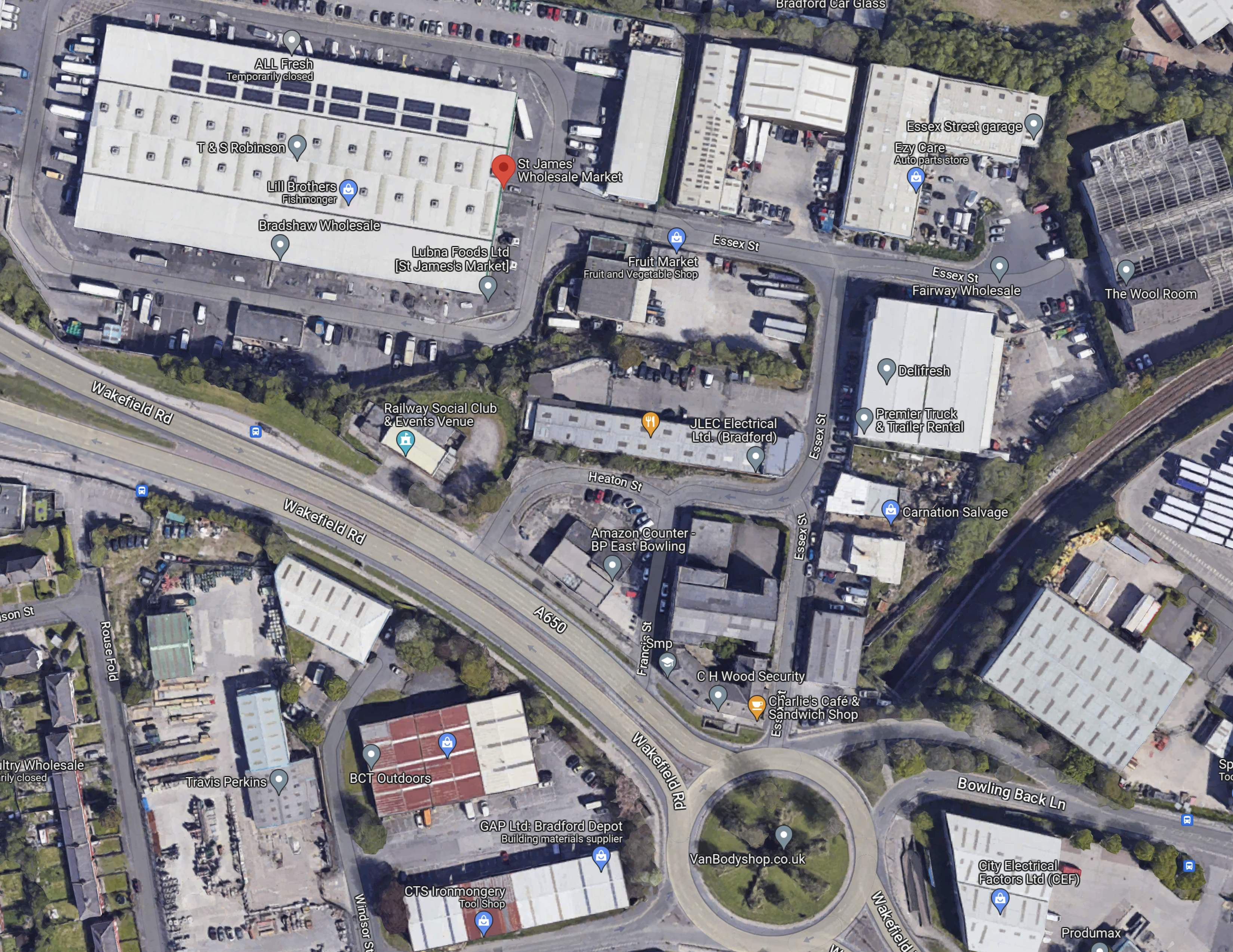
Note.
- St. James Wholesale Market is marked by the red arrow.
- The railway between New Pudsey and Bradford Interchange stations goes under the roundabout at the bottom of the map.
There’s certainly a lot of space to the East of the market. Could the new station be built with a lot of adjacent open space like King’s Cross and Liverpool Lime Street.
These are further thoughts.
Will There Be A New Chord South Of Bradford Interchange Station?
This section is an edited version of a section from Bradford Seeks Support On Rail Project Which Could Deliver £30bn Benefits.
This Google Map, shows Mill Lane Junction, where the lines from New Pudsey and Bradford Low Moor stations join South of Bradford Interchange station.
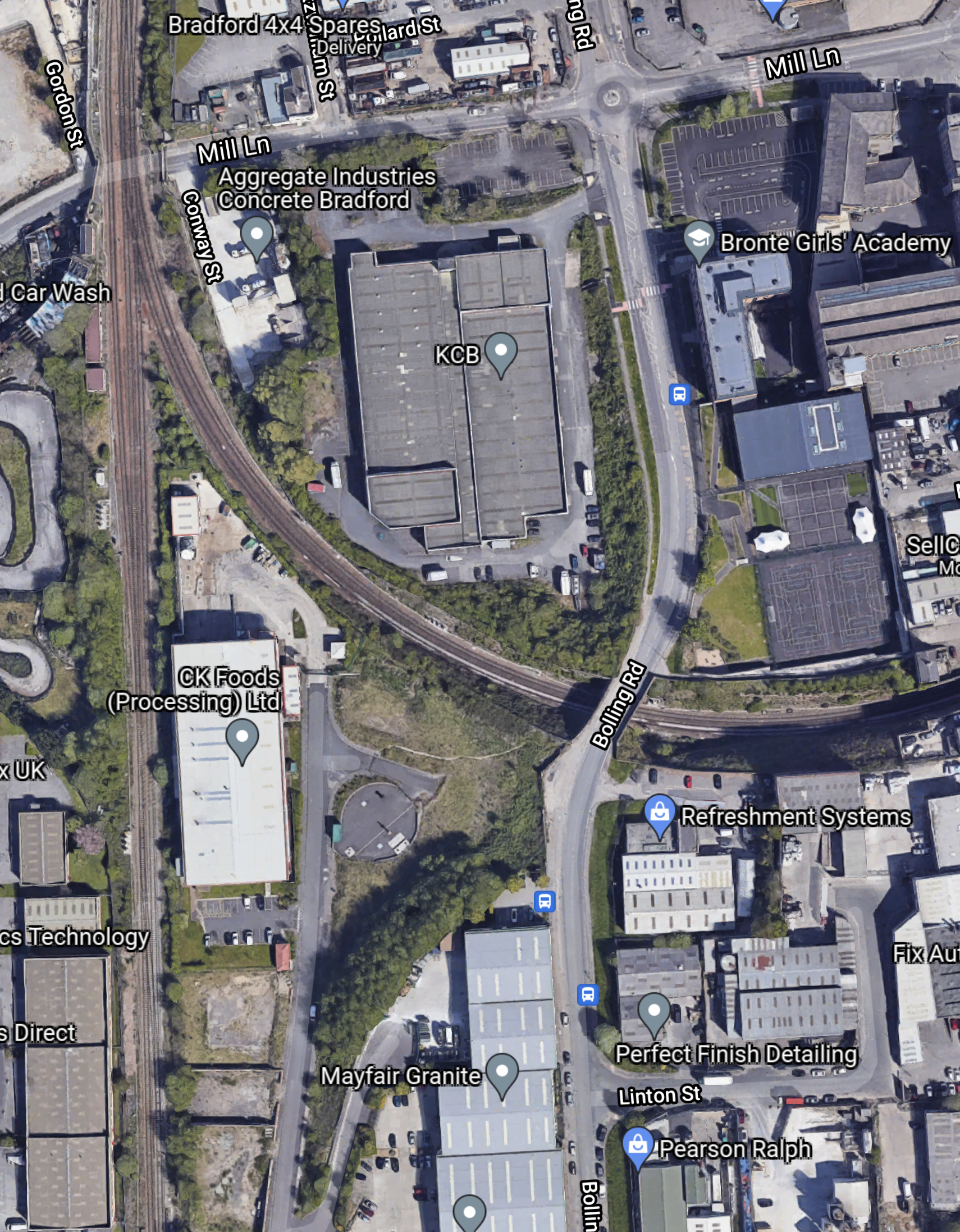
Note.
- Bradford Interchange station is on the rail line to the North.
- The proposed new Bradford station and the existing New Pudsey station are on the rail line to the East.
- Bradford Low Moor station is on the rail line to the South.
It would appear that an extra chord should be added to the junction to allow trains between Manchester Victoria and Leeds running via the Calder Valley Line to call at the new station in Bradford.
Current trains between Manchester Victoria and Leeds using this route have to reverse at Bradford Interchange. The new station and the extra chord would avoid this.
Will Bradford Interchange Station Be Closed?
That is a big question and depends on the overall plan.
I await the full plan with interest.
But building the new chord, closing Interchange station and avoiding the reverse will speed up services.
What Trains Will Call At The New Station?
Currently, only these trains from Northern, go through the station site.
- Hull and Halifax
- Leeds and Chester
- Leeds and Manchester Victoria
- York and Blackpool North
Note.
- All have a frequency of one train per hour (tph)
- All currently reverse at Bradford Interchange.
- All call at Leeds, New Pudsey and Halifax.
- Three tph call at Bramley and Hebden Bridge.
- Two tph call at Manchester Victoria, Rochdale and Todmorden.
- One tph calls at Low Moor.
I suspect these service could be augmented to perhaps give the following.
Four tph to Hebden Bridge, Rochdale and Manchester Victoria.
The only other trains passing though the area are Grand Central’s four trains per day (tpd) between London King’s Cross and Bradford Interchange via Low Moor.
- If these trains terminated in a bay platform at the new station, would this enable their frequency to be increased?
- Or could the services be extended to Leeds?
The new station certainly opens up possibilities.
Vauxhall-Maker Says UK Needs To Change Its Brexit Deal
The title of this post, is the same as that of this article on the BBC.
This is the sub-heading.
One of the world’s biggest carmakers has called on the government to renegotiate part of the Brexit deal or risk losing parts of its car industry
These four paragraphs explain the problem.
Stellantis, which makes Vauxhall, Peugeot, Citroen and Fiat had committed to making electric vehicles in the UK.
But it has now said it is no longer able to meet Brexit trade rules on where parts are sourced.
The government is “determined” that the UK will remain competitive in car manufacturing, a spokesperson said.
Stellantis called on the government to come to an agreement with the EU to keep rules as they are until 2027.
Because, there is not enough battery capacity in the UK and possibly the EU, everything has gone pear-shaped.
I think there are three possible solutions.
- Build more battery factories.
- Change the regulations.
- Develop hydrogen internal combustion engines.
Note.
- Could a battery factory be built fast enough? I doubt it!
- Could the regulations be changed? Possibly!
- Could hydrogen internal combustion engines be developed quickly enough? Ask Cummins, JCB, Ricardo and Toyota.
It is highly likely that there will be much higher demand for batteries, than anybody expects, as innovators develop more applications.
Chiltern Electrification Alternatives Studied
The title of this post, is the same as that of this article on Railway Gazette.
These are the first two paragraphs.
Chiltern Railways is working to present the Department for Transport with options for a fleet renewal programme, with London Marylebone being the only non-electrified London terminal and pressure for the withdrawal of diesel trains continuing to mount, particularly from local residents.
Industry insiders report that this could see at least the 39 two and three-car Class 165 diesel multiple-units replaced.
Note.
- The Class 165 trains were built in 1990-1992 and refurbished around the turn of the century.
- Chiltern Railways have 28 two-car and 11 three-car Class 165 trains.
- Chiltern Railways also have ten similar two-car, nine three-car and nine four-car Class 168 trains.
- In addition, Great Western Railway has 20 two-car and 16 three-car Class 165 trains, and 23 Class 166 trains.
- The Class 165 and Class 166 trains are 90 mph units, whereas the Class 168 trains are 100 mph units.
As Chiltern’s study would appear to rule out electrification, could all of these trains be replaced with an appropriate number of a new class of 100 mph zero-carbon independently-powered multiple units?
In Alstom And Eversholt Rail Sign An Agreement For The UK’s First Ever Brand-New Hydrogen Train Fleet, I talked about a proposed hydrogen train fleet.
These trains are described as three-car in Alstom’s press release.
- Most Aventras are 100 mph trains.
- They could easily be lengthened to four cars by the addition of an extra car.
- It may even be possible, that these trains could be fitted with a pantograph for working on electrified lines.
The only problem, I can envisage, is that a two-car version might not have enough space for the hydrogen and electrical gubbins.
Chiltern’s Locomotive-Hauled Mark III Stock
Greater Anglia have replaced locomotive-hauled Mark III stock with multiple units and it appears to have been successful.
Could Chiltern’s locomotive-hauled Mark III stock be replaced by six-car hydrogen-powered Aventras, with a long-distance interior?
Other Routes
Alstom and Eversholt Rail announced their agreement in November 2021.
Since then, I have written these posts, where the proposed Alstom Hydrogen Aventra could have an application.
- Adding Buxton And Manchester Piccadilly To The Bee Network
- ‘Castle’ HSTs To Be Withdrawn By Great Western Railway
- Proposals Submitted To Create Darlington To Dales Rail Link
- Alstom Hydrogen Aventras And Teesside
- Alstom Hydrogen Aventras And The Reopened Northumberland Line
- Alstom Hydrogen Aventras And Extension Of The Birmingham Cross-City Line
- Alstom Hydrogen Aventras And Great Western Branch Lines Between Paddington And Oxford
- Alstom Hydrogen Aventras And The Uckfield Branch
Note.
- A two-car version would surely increase the number of applications.
- A 110 mph capability would allow the trains to mix it with high speed trains on fast lines.
- Bombardier proposed a 125 mph bi-mode Aventra. Could this be achieved with hydrogen power?
I feel the eight applications, I listed, could be the start of something a lot bigger.
Conclusion
Alstom and Eversholt Rail Group appear to have done their research.
 The Anonymous Widower