World’s First Energy Island Starts Taking Shape – Video
The title of this post, is the same as that of this article on offshoreWIND.biz.
This is the sub-heading.
The first of the 23 caissons being built for Princess Elisabeth Island in Vlissingen, the Netherlands, is almost finished and will be immersed in the North Sea this summer. The artificial Belgian energy island is a world first.
Note.
- This web site is the web site of Belgium’s Princess Elisabeth energy island.
- This YouTube video describes the Princess Elisabeth island.
The video shows the importance of this project, that will have interconnectors to both the UK and Denmark, and connections to a large number of offshore wind farms.
These two paragraphs describe the roll-out of the caissons.
When the caissons are ready, a semi-submersible vessel will transport them further down the harbour, where they will be placed in the water and temporarily stored. They will then be moved to their final location in the North Sea this summer, weather permitting.
The caissons will form the outer walls of the energy island. The island itself will be created using approximately 2.3 million square metres of sand, extracted locally. The island will be finished in late 2026, when the electrical equipment can start to be installed. Contracts for this will be tendered this year.
These pictures show four Pheonix Caissons from Mulberry Harbours that are used as a museum in The Netherlands.








Nothing is new! But at least the Belgians won’t have to tow their caissons across the Channel under enemy fire.
A Video Description Of Princess Elisabeth Island
This web site is the web site of Belgium’s Princess Elisabeth energy island.
This YouTube video describes the Princess Elisabeth island.
From the video the following can be determined.
- The Princess Elisabeth island is 45 km. from the Belgian coast.
- An interconnector to the UK could come ashore at the site of the decommissioned Bradwell nuclear power station.
- An interconnector to Denmark could come ashore in Southern Jutland, just North of where the Viking Link connects to Denmark.
This map clipped from the video shows the location of Princess Elisabeth island.

Note.
- Belgium is shown in red.
- Istend is in the middle of the straight Belgian coast.
- The red dot between Belgium and the UK is Princess Elisabeth island.
- The interconnector to the UK could feasibly go to Bradwell.
- The interconnector to Denmark could go via a wind farm, which would explain the kink.
- Could the kink point be at the Dogger Bank, where there could be 20 GW of wind farms?
Has Belgium made a bid to dominate European energy distribution?
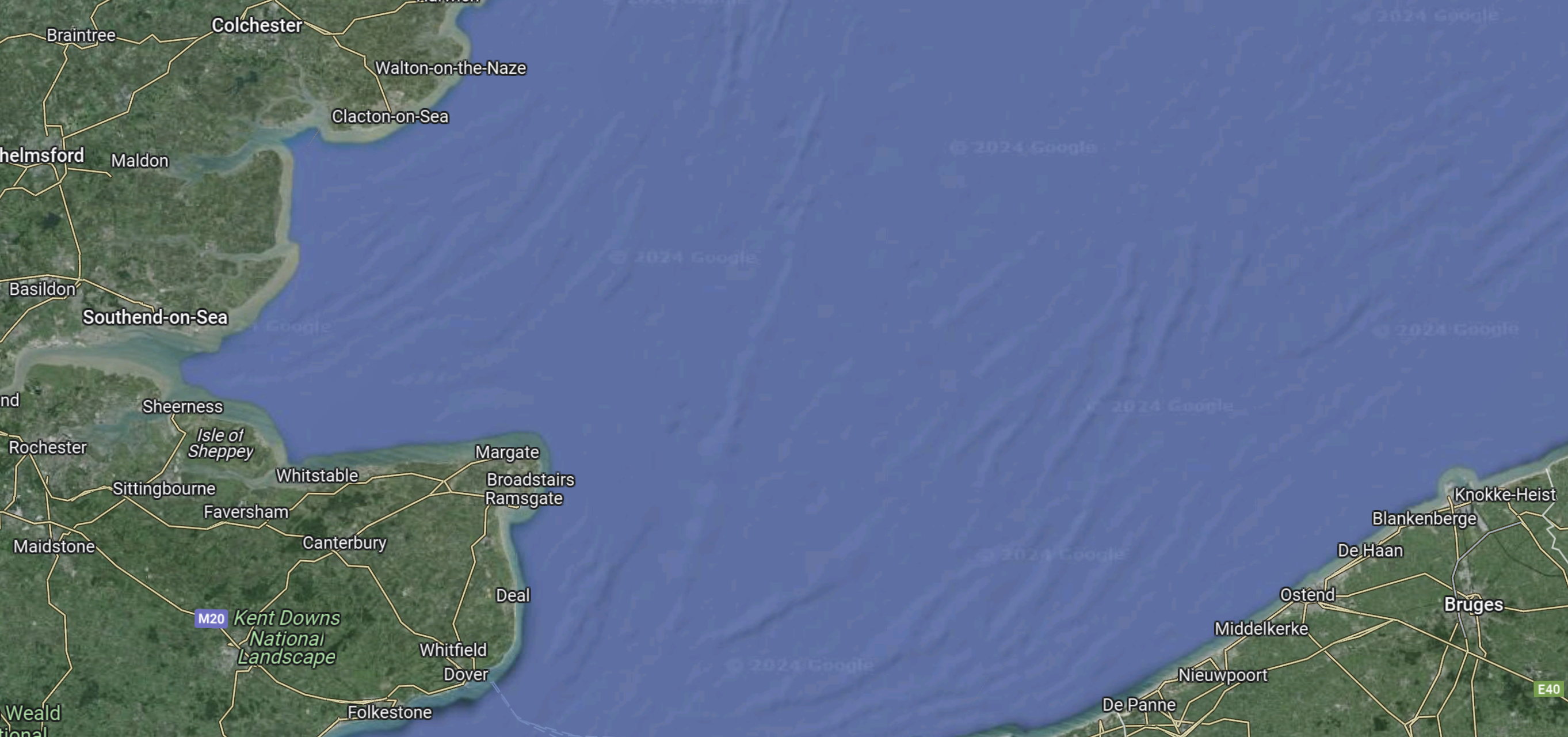
This Google Map shows the Belgian and English coast lines.
Note.
- Bradwell is on the coast to the North-East of Southend-on-Sea.
- As it used to be a nuclear power station site it still has an electricity connection to the grid.
- The Princess Elisabeth island is 45 km. from the Belgian coast at Ostend.
I estimate that a Bradwell and Princess Elisabeth island interconnector would be about 150 miles.
Denmark Launches Massive Offshore Wind Auction
The title of this post, is the same as that of this article on offshoreWIND.biz.
This is the sub-heading.
Denmark has opened a new offshore wind tender, the country’s largest ever, offering a minimum of 6 GW of new capacity spread over six wind farms, with the overplanting option allowing for 10 GW or more of new capacity to be added.
These are two paragraphs from the article.
The offshore wind farms must deliver at least 6 GW, and as a new element, there will be freedom to establish as much offshore wind as possible on the tendered areas, with the exemption of Hesselø with a maximum capacity of 1.2 GW.
If the market utilizes this freedom to optimize the usage of the areas, it could result in the construction of 10 GW offshore wind or more, the agency said.
Recently, some wind farms in the UK have been increased in size after the auction.
In Crown Estate Mulls Adding 4 GW Of Capacity From Existing Offshore Wind Projects, I note how 4 GW of overplanting could be employed to raise the total capacity from 4.6 GW to 8.6 GW.
So have the Danes decided to build expansion into the tender?
One of the wind farms in the auction is called Nordsøen I.
- It will be about 50 km. from the West Coast of Denmark.
- It appears it will have a capacity of at least 1 GW.
- It could connect to the shore, not far from where the Viking Link between Lincolnshire and Denmark connects to the Danish grid.
- There is a 700 MW interconnector between the area and Eemshaven in The Netherlands.
- There is 1.5 GW of overland transmission lines to Germany.
All these connections, increase energy security for Denmark, Germany, the Netherlands and the UK.
Could the Danes be building the Nordsøen I, so it could work with the all the connections in Southern Jutland and improve energy security?
New National Grid Substation Fully Operational, Transmitting Clean Power To 1.5 Million Homes
he title of this post, is the same as that of this press release from National Grid.
These three bullet points act as sub-headings.
- National Grid’s new Littlebrook 400kV substation in Dartford, Kent is now fully energised.
- The facility enables the transmission of 2GW of low carbon and renewable energy from interconnectors and offshore wind farms off the coast of Kent to power around 1.5 million homes.
- New technology deployed to reduce emissions at the site.
This is the first three paragraphs, which outline the project.
National Grid has successfully commissioned a new, state-of-the-art substation, in Dartford, Kent, enabling 2 gigawatts (GW) of low carbon and renewable energy to power around 1.5 million homes.
National Grid and its contractors Balfour Beatty and GE Vernova’s Grid Solutions have been working since June 2019 to build a replacement for Littlebrook 400kV substation.
The new facility will help to reduce the use of sulphur hexafluoride (SF₆), a gas commonly used in the electrical industry to prevent short circuits and to keep the network safe and reliable.
These two paragraphs explain how the new substation fits in with National Grid’s SF₆ policy.
Engineers are using GE Vernova Grid Solutions’ innovative g3 gas-insulated busbar equipment which is SF6- free. A total of 5.6 tonnes of SF₆ gas has been saved, forming part of National Grid’s ambition to reduce its SF₆ emissions by 50% by 2030 and removing all SF₆ gas from electrical assets by 2050.
Teams have also deployed net zero construction methods throughout the project to reduce the environmental impact of the works, including steel manufactured in Britain, solar powered electrics, electric vehicle charging points, biodiversity net gain plan for the local area and an onsite biodigester to manage wastewater, all saving 5229 tonnes of CO₂ emissions during construction.
National Grid have this page on their web site, which is entitled What Is SF6? Sulphur Hexafluoride Explained, where this is the first paragraph.
Sulphur hexafluoride – also known as SF6 – is a ‘greenhouse gas’ that has long played a part in global warming, similar to that of carbon dioxide (CO2).
Hence the need for its removal.
Conclusion
Removal of sulphur hexafluoride from the world’s electricity substations and switchgear will be a very large task.
BW Ideol And Holcim To Explore Use of Low-Carbon Concrete In Floating Offshore Wind
The title of this post, is the same as that of this article on offshoreWIND.biz.
This is the sub-heading.
BW Ideol and Holcim have signed a Memorandum of Understanding (MoU) for a feasibility study on supplying beneficial low-carbon concrete for the floating offshore wind industry, with particular reference to Scotland.
These are the first three paragraphs.
BW Ideol and Holcim aim to collaborate on optimising the supply of the innovative concrete needed for the intended mass production of BW Ideol’s floaters in the Port of Ardersier.
Low-carbon concrete’s advantages as a building material for offshore wind farms include its durability in marine environments, its local availability and its comparatively lower carbon emissions, the companies said.
The collaboration includes developing specific durable maritime low-carbon concrete mixes with enhanced mechanical performance perfectly suited to slipform application.
This is surely a good development.
Europe’s First Commercial-Scale Floating Offshore Wind Farm Secures All Planning Approvals
The title of this post, is the same as that of this article on offshoreWIND.biz.
This is the sub-heading.
Flotation Energy and Vårgrønn, a joint venture between Plenitude (Eni) and HitecVision, have obtained the offshore planning approval for the Green Volt floating wind farm offshore Scotland.
This is the first paragraph.
With onshore consent announced earlier this month, Green Volt has now received all its planning approvals and remains on track to be the first commercial-scale floating offshore wind farm in Europe.
Note.
- This is the Green Volt web site.
- Capacity will be between 300 and 560 MW.
- It should be fully operational by 2029.
- It is an INTOG wind farm designed to decarbonise offshore oil and gas fields.
It will also have the side effect of bringing more gas ashore in the UK, instead of burning it to power the platforms.
Vital Bridge Replacement Means No Trains On Liverpool Street – Chingford line For 16 Consecutive Days This Summer
The title of this post, is the same as that of this press release from Network Rail.
These four paragraphs outline the project to replace the bridge.
Trains will not be able to run for 16 straight days while Network Rail delivers a critical stage of a bridge replacement project between Saturday 20 July and Sunday 4 August.
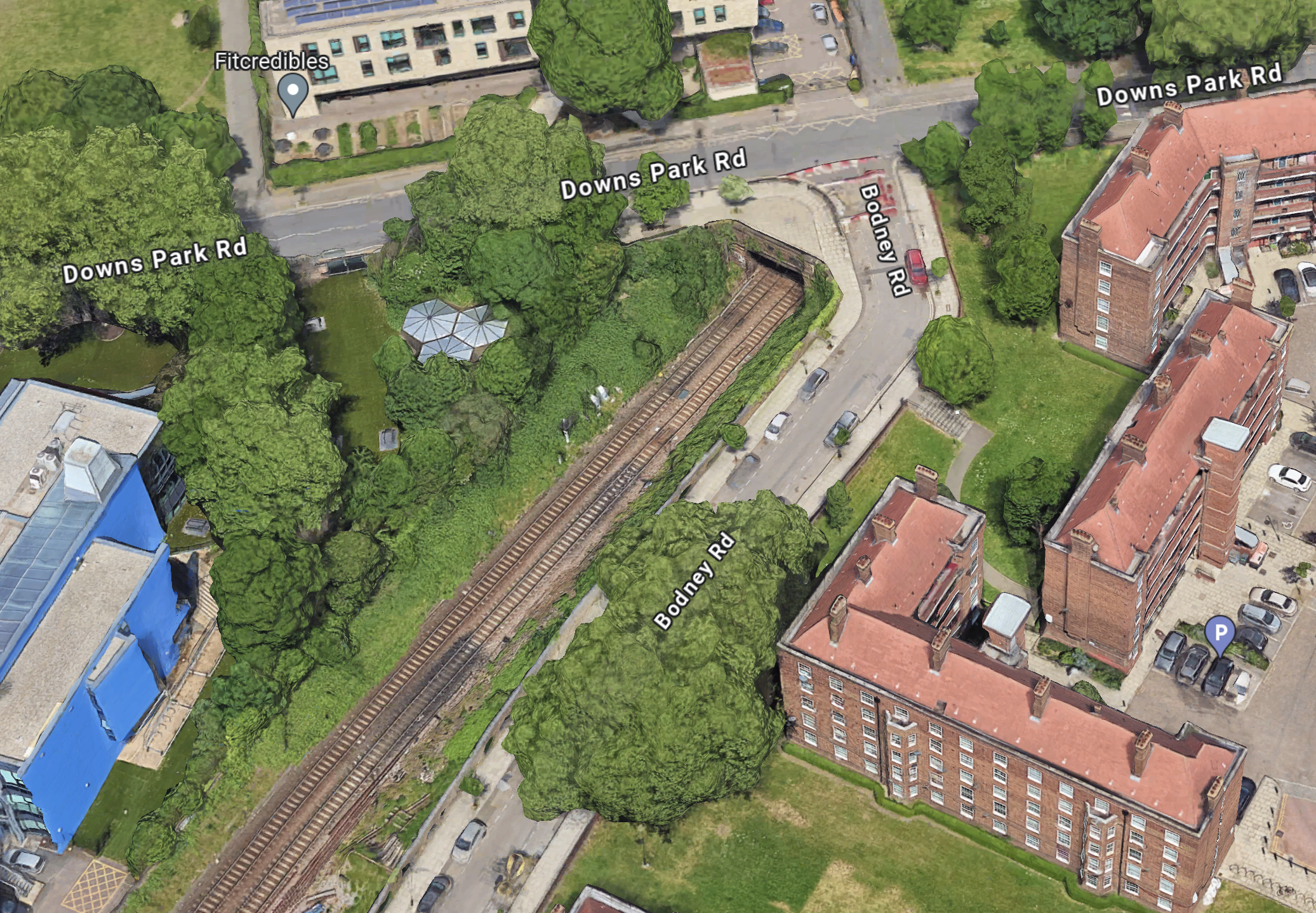
The 150-year-old bridge over the railway is located to the south of Hackney Downs Park and carries the junction of Downs Park Road and Bodney Road. It backs directly onto a tunnel, which emerges further down the line towards Clapton.
The bridge is monitored closely to check it is safe, but its cast iron girders are in poor condition, and they are continuing to deteriorate. A replacement structure is needed to avoid an unplanned closure and keep passengers and road users moving in future.
Over the 16 consecutive days, engineers from Network Rail’s contractor, Murphy, will demolish the old bridge and start building the new one.
This Google Map shows Hackney Downs station and the location of the bridge to be replaced.

Note.
- Hackney Downs station at the bottom of the map.
- The tracks to Enfield Town and Cheshunt stations going to the North-West corner of the map.
- The tracks to Walthamstow and Chingford stations going to the North-East.
- Mossbourne Academy is between the two tracks.
- The bridge to be replaced is where the tacks to Chingford disappear into a tunnel.
This 3D Google Map shows the bridge in more detail.
Note.
Downs Park Road running across the top of the map.
Bodney Road running down the side of the railway.
The blue building is Mossbourne Academy.
This Network Rail image shows the current bridge.

It certainly looks like it’s seen better days.
This Network Rail visualisation shows the how the new bridge will probably look from above.

It looks like the landscaping will be fairly simple.
I have some further thoughts.
The Disruption
Sixteen days is a long closure, but rebuilding the bridge before it possibly falls down, is probably prudent.
So make sure you read the full press release from Network Rail.
Hopefully, it will all go well!
Further Works
Hackney Downs and Clapton stations opened in 1872, so the bridge and the tunnel must be at least 150 years old.
So I wouldn’t be surprised, that when Network Rail do a full underground survey, they find other problems.
Rectification could delay the reopening.
Conclusion
It looks to be a well-prepared project.
But I do have my reservations about Network Rail finding something nasty.
Those naughty Victorians would cut corners and bodge things and then not write it down.
This Hydrogen Engine From Kia And Hyundai Heralds A New Dawn In Automotive – Everything Will Change – Lagrada
The title of this post, is the same as that of this article on Hydrogen Central.
These are the first two paragraphs.
Hyundai and Kia recently unveiled in Korea a zero-emission hydrogen engine that could disrupt the EV market. Both automakers are at the forefront of the development of hydrogen technology, focusing on both fuel cell systems and investigating the possibilities of sophisticated hydrogen engines.
The future of sustainable mobility is being shaped by Hyundai and Kia’s continuous research and dedication to hydrogen as a clean transportation solution. An increasing number of manufacturers are developing hydrogen engines as an alternative to electric cars and vehicles that use polluting combustion engines.
These three paragraphs outline more details of the engine.
What’s more remarkable about this new hydrogen engine presented in Korea is that it solves all the problems of durability and large-scale viability that hydrogen engines have presented until now.
The project team successfully ensured that the Hyundai-Kia hydrogen engine, designed to burn hydrogen, could sustain high thermal efficiency throughout its operation by infusing hydrogen into the combustion chamber at a pressure of 30 bar.
Although the device’s performance was enhanced by the use of a turbocharger, it was found that the enhanced performance and lower pollution emissions of this kind of “direct injection” eliminated the problems that most automakers have with hydrogen engines. As the emissions of carbon dioxide and fine particles were reduced by 99% and 90%, the Hyundai-Kia hydrogen engine would be considered to have zero emissions.
Thirty years ago, I was involved with a company called DMW.
- The company’s first product was an aerosol valve, that instead of using CFCs or HCFCs as a propellent used nitrogen. The patent was sold to Johnson and Johnson, after being shown during the discussions, that led to the Montreal Protocol and the phase out of CFCs.
- This led to a deal with Glaxo to investigate if DMW’s technology could be used in a metred-dose-inhaler for asthma drugs.
- The successful idea was eventual sold to Boehringer Ingelheim and is now marketed as Respimat.
I can compare the Hyundai-Kia hydrogen injector and the Respimat inhaler
- Hyundai-Kia appear to be using a high pressure of 30 bar to sustain high-thermal efficiency.
- I know that the Respimat inhaler uses high pressure to obtain a fine mist of the drug.
It sounds to me, that both companies are using the same properties of applying high pressure to a small hole, to disperse one fluid in another.
 The Anonymous Widower