Gluten Sensitivity And Epilepsy: A Systematic Review
Yesterday, The Times published this article, which was entitled ‘Game-Changing’ NHS Laser Therapy To Prevent Epileptic Seizures.
One reader had made this comment.
Be ace too if they can tweak to help migraine.
I used to suffer from something like migraine about thirty years ago. But after being found to be coeliac and going gluten-free, what ever it was seemed to disappear from my life.
Type “Coeliac Disease and Migraine” into Dr. Google and there are lots of references.
This indicates to me that serious scientists and doctors, must believe there could be a link.
There certainly is with me and going gluten-free eased my migraine-like symptoms.
I then typed “Coeliac Disease and Epilepsy” into Dr. Google and found this paper, which was entitled Gluten Sensitivity And Epilepsy: A Systematic Review.
This information is from the Abstract of the paper
Objective
The aim of this systematic review was to establish the prevalence of epilepsy in patients with coeliac disease (CD) or gluten sensitivity (GS) and vice versa and to characterise the phenomenology of the epileptic syndromes that these patients present with.
Methodology
A systematic computer-based literature search was conducted on the PubMed database. Information regarding prevalence, demographics and epilepsy phenomenology was extracted.
Results
Epilepsy is 1.8 times more prevalent in patients with CD, compared to the general population. CD is over 2 times more prevalent in patients with epilepsy compared to the general population. Further studies are necessary to assess the prevalence of GS in epilepsy. The data indicate that the prevalence of CD or GS is higher amongst particular epileptic presentations including in childhood partial epilepsy with occipital paroxysms, in adult patients with fixation off sensitivity (FOS) and in those with temporal lobe epilepsy (TLE) with hippocampal sclerosis. A particularly interesting presentation of epilepsy in the context of gluten-related disorders is a syndrome of coeliac disease, epilepsy and cerebral calcification (CEC syndrome) which is frequently described in the literature. Gluten-free diet (GFD) is effective in the management of epilepsy in 53% of cases, either reducing seizure frequency, enabling reduced doses of antiepileptic drugs or even stopping antiepileptic drugs.
Conclusion
Patients with epilepsy of unknown aetiology should be investigated for serological markers of gluten sensitivity as such patients may benefit from a GFD.
My Thoughts
These are my thoughts.
Coeliacs Prior To 1960
Consider.
- Even if my excellent GP; Doctor Egerton White, felt I was coeliac, there was no test until 1960 for coeliac disease.
- And the test that was developed using endoscopy wasn’t anywhere near to the endoscopies of the present day.
- My late wife, who was a family barrister, likened the test to child abuse on a young child.
- I have heard some terrible horror stories of doctors looking for coeliac disease in young children in the 1950s.
- But there were some successes. A friend of mine, who is in her eighties, was successfully diagnosed by her parents using food elimination. But they were both GPs.
- Recently, I’ve met two elderly ladies, who only in the last couple of years have been diagnosed as coeliacs.
Luckily, I was never tested until 1997 and I was diagnosed in 48 hours, by gene testing.
Methodology
The methodology was based on a systematic computer-based literature search of the PubMed database.
This has these advantages.
- The rules for the search can be published and peer-reviewed.
- Its Wikipedia entry says PubMed is a free database including primarily the MEDLINE database of references and abstracts on life sciences and biomedical topics.
- The technique can surely be applied repeatedly, to see how results are changing with time.
- The search can be modified to analyse any topic, drug or condition, that appears in the PubMed database.
- The analysis could surely be applied to other databases.
As a writer of data analysis software, developing this sort of software, would be really enjoyable.
Excitement Brewing for Gateshead FC Away At Wembley
The title of this post, is the same as that of this news item on Lumo.
This is the sub-heading.
Lumo, the Open Access rail operator, has teamed up with local Gateshead brewery Black Storm to offer Gateshead FC fans a special commemorative beer onboard its trains.
These first two paragraphs add a few more details.
Hot on the heels of Tyneside based Lumo, the Open Access rail operator, announcing an extra train on Saturday 11th May to get Gateshead FC fans back from London as part of the club’s huge achievement of a second Wembley FA cup final in as many years, they’ve teamed up with local Gateshead brewery Black Storm to offer fans and travellers a special commemorative beer onboard its trains.
The appropriately named’ Whistle Stop’ is a 5% ABV Helles Lager featuring special commemorative Gateshead FC Wembley 2024 and Lumo branding on the can and will be available to purchase on the LumoEats at seat trolley service on all Lumo trains from this week, including on its specially named ‘Heed Army Express’ trains on Saturday 11th (running from Newcastle to London at 07:12 and 10:22, and returning at 20:26).
Surely, rail companies should do more deals like this to support local teams and suppliers.
Feadship Ushers In The Fuel-Cell Era With The Launch Of118.80-metre Project 821
The title of this post, is the same as this press release from Feadship.
This picture from Feadship shows project 821.
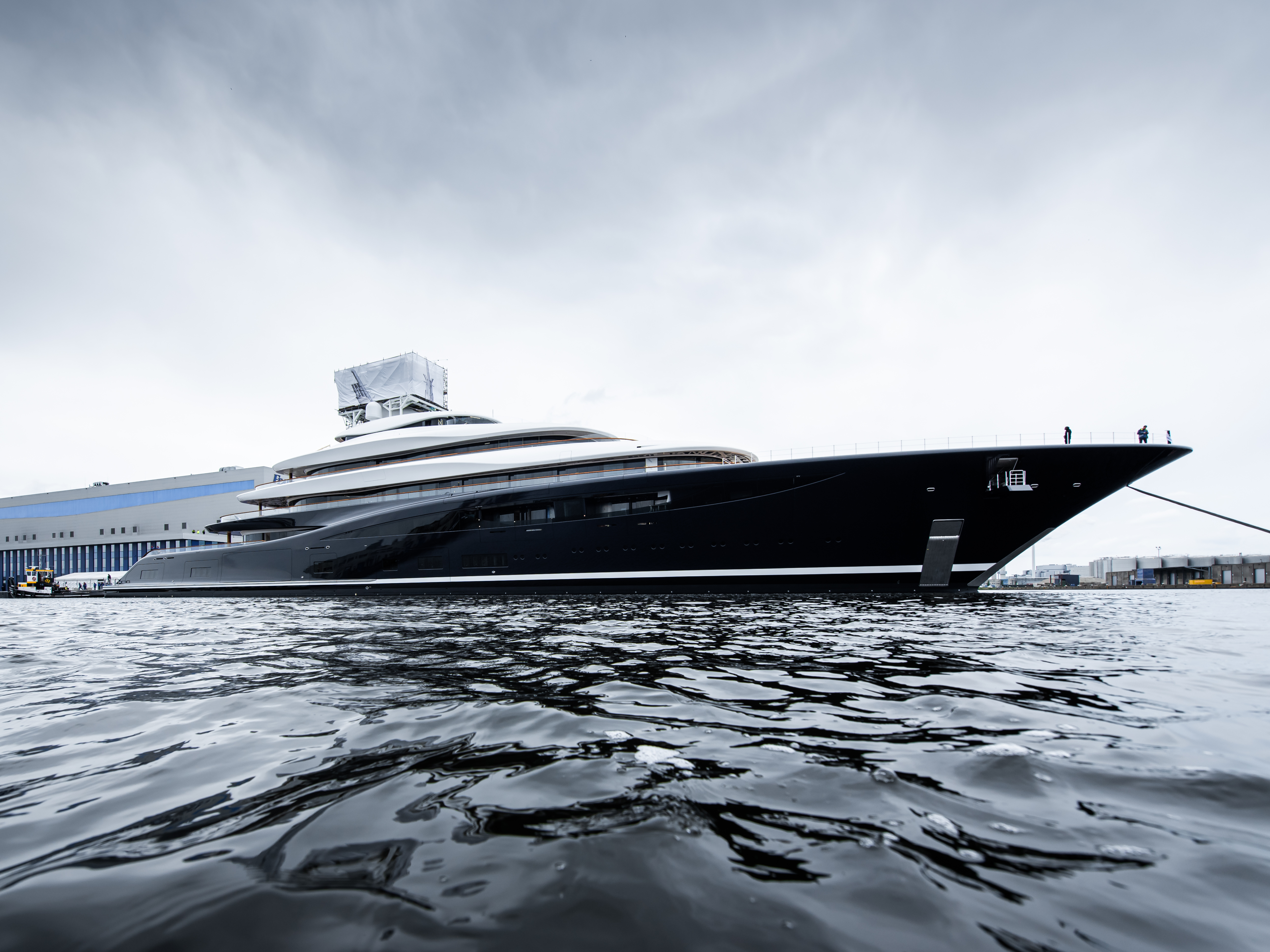
These are the first two paragraphs of the press release.
When the drydock doors slid open on 4 May at Feadship’s Amsterdam shipyard, the yachting
world was forever changed. Say hello to Project 821, the world’s first hydrogen fuel-cell
superyacht. Five years in the making, innovation-packed Feadship Project 821 is the answer to
a fundamental question: “How far can we push green technology on superyachts?”Designed by RWD and with owners representation by Edmiston, Feadship’s bold response was
a multi-faceted, zero-diesel approach designed to cruise between harbours or anchorages and
to operate the yacht’s hotel load and amenities with emission-free power from green hydrogen.
“The aim has been to develop a new, clean technology not just for this project, but for the
world,” said Jan-Bart Verkuyl, Feadship Director / CEO Royal Van Lent Shipyard. The size of
the proposed yacht – 100-metres-plus – made it a good candidate to explore pure green
hydrogen as the fuel-cell source. For those captivated by cutting-edge innovations, this yacht
presents an opportunity for potential acquisition as it showcases the pinnacle of modern
technological advancements.
As the superyacht is 118.8 metres long, I can see a lot of ships of this size being powered by hydrogen.
 The Anonymous Widower