Significant Documents
When I wrote Increased Frequencies On The East London Line, I relied on this document from Transport for London (TfL) entitled London Overground and Docklands Light Railway Growth.
The document was significant because of its openness and the way it laid out how the London Overground and the Docklands Light Railway will cope with growth.
I think the document also shows how a properly planned public transport project attracts users, that are a precursor to the growth.
After all, in the last few months, I’ve seen the extension of the Nottingham Express Transit and the opening of the Borders Railway, neither of which have attracted substantial amounts of negative comment.
So perhaps we’re now getting rather good at planning these types of projects.
Over the last few months, I’ve read some significant documents, that look to the future.
- Transport for London’s London Infrastructure Plan for 2050
- Liverpool City Region Long Term Rail Strategy
- Greater Manchester Rail Policy
All are quality documents and are superb starting points for the development of railways in their area.
Increased Frequencies On The East London Line
This article from the South London Press is entitled More Trains For The London Overground. The article says Transport for London (TfL) wants to make two service improvements are on the East London Line.
- From 2018, there will be an extra two trains per hour (tph) between Dalston Junction and Crystal Palace.
- From 2019, there will be four additional trains between Dalston Junction and Clapham Junction, making the frequency 8 tph.
I found the source of the report on TfL’s web site. This is a handy summary from the Appendix.
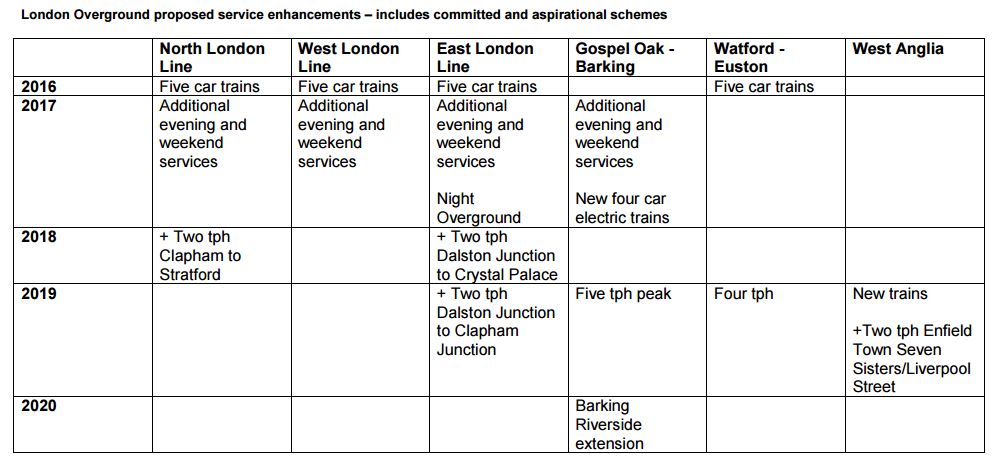
LO Improvements
It looks like the pattern of extra trains is as follows.
- From 2018, there will be an extra two trains per hour (tph) between Dalston Junction and Crystal Palace.
- From 2019, there will be an extra 2 tph between Dalston Junction and Clapham Junction, making the frequency 6 tph.
Currently both these services go to Highbury and Islington.
It’s interesting that these increased services are starting in 2018-2019! This times them to start just as Crossrail and Thameslink are opening, which probably means that TfL are expecting that a lot of Crossrail passengers will change to and from the East London Line at Whitechapel. As I will, no doubt!
Buried in TfL’s Transport Plan for 2050 says are possible plans on improving the service on the East London Line.
- Better late night and overnight services on the Overground.
- Automatic Train Operation on the core of the line from Dalston Junction to Surrey Quays to increase service frequency from 16 tph to possibly as high as 24 tph.
- Six car trains on the Overground.
At the moment the East London Line has 16 four-car trains an hour in the core route, so 24 six-car trains will mean an increase of capacity of 2.25.
The announced service improvements will mean that 20 tph will be passing Whitechapel and Canada Water.
So will we see other services started to bring the line up to the 24 tph capacity?
This would give London three almost-new 24 tph lines crossing the city; Crossrail, Thameslink and the East London Line, in an H-shape.
TfL don’t sem to be planning it yet!
The increase in frequency from Dalston Junction to Clapham Junction station is very welcome to me, as I often take a train to Clapham Junction to go south to Brighton, Gatwick or other places.
Increasing the frequency to Clapham Junction may also be needed, as extra stations and other changes are added to this branch of the East London Line.
- New Bermondsey station will be opened to take advantage of the six services per hour between Dalston Junction and Clapham Junction.
- Clapham Junction might be served by the Northern Line Extension some time in the early 2020s.
- Clapham Junction may well be served with other services to take the pressure off Victoria and Waterloo. It always strikes me as a station, that since its latest improvements could handle more services.
- Camberwell station, which has been promised for some time, could finally be under way, to connect the East London Line to Thameslink at Loughborough Junction station. A design based on the split-level principles of Smethwick Galton Bridge station may solve the connection problem.
The only difficulty of this frequency could be that there might need to be upgrades at Clapham Junction to turnback more trains.
Increasing the frequency to Crystal Palace station will be of less use to me, as I’ve rarely used that service.
If it linked to Tramlink, I might use it more, but that extension to Tramlink was dropped by Boris and there seems to be no enthusiasm on anybody’s part to build it.
I do wonder if Transport for London have other plans for Crystal Palace in their mind.
Look at this Google Map showing Crystal Palace, Penge West and Penge East stations.
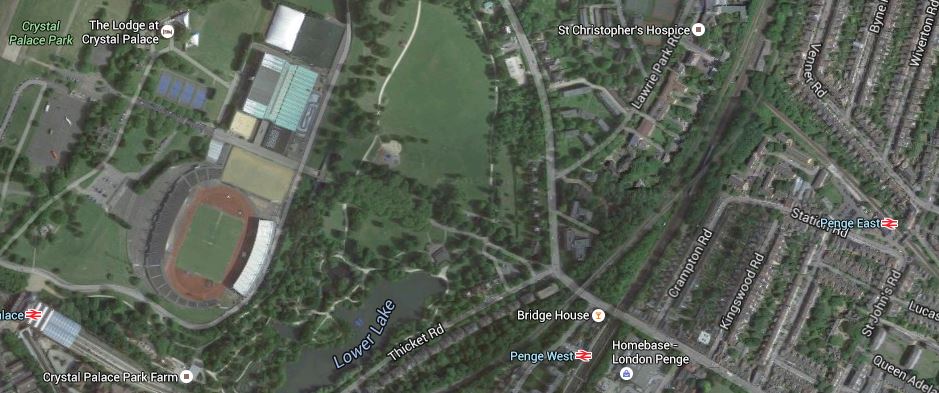
Crystal Palace And Penge
Crystal Palace is a fully modernised and accessible station with lifts, a cafe and lots of platforms, so it makes an ideal terminus for trains on the East London Line.
Penge West is not the best appointed of stations and I suspect if a much better alternative was provided nearby, no-one would miss the station.
Penge East is on the Victoria to Orpington Line and needs upgrading for step-free access. But it has the problem of a Listed footbridge, that should be burnt. I wrote about it in An Exploration At Penge.
Buried in TfL’s Plan for 2050, is the one-word; Penge, as a possible new station. The line through Penge East passes under both the Brighton Main Line and the branch to Crystal Palace, in an area of railway land.
After looking at Smethwick Galton Bridge station or as I called it, Birmingham’s Four-Poster station, I do feel that a good architect could design a station, that solved the challenging problem of the difference in height and created a fully-accessible interchange. This station could have a lot going for it, as services passing through the station would include.
- 4 tph between Victoria and Orpington on the Victoria to Orpington Line
- 6 tph between Dalston Junction and Crystal Palace and 4 tph between Dalston Junction and West Croydon on the East London Line.
- A selection of the East London Line services would go to Highbury and Islington.
- 2 tph between London Bridge and Caterham on the Brighton Main Line.
- Services between Bedford/St. Albans/St. Pancras and Beckenham Junction on the Victoria to Orpington Line
It would increase connectivity greatly all over East London, both North and South of the river.
I suspect too, that the station would open up the brownfield land around the railway for property development.
I think there is a strong case to watch that area of Penge!
Do The English, Scots And Welsh Work Better Together Than The Belgians, Dutch And Germans?
If we take these two groups of three countries, they all have different railway companies, but do they illustrate a problem in the relations between various EU countries.
I know my experience of travelling between these six countries is mainly on the trains, but to travel between England, Scotland and Wales by train, is a lot easier than travelling between Belgium and The Netherlands and the Netherlands and Germany is full of little difficulties.
Strangely if you add France into the mix, that is generally as easy as the three home nations.
Judging by my experience in Europe, there are many ways that the Scots and Welsh could make the English unwelcome. But they don’t, except for the Seniors Bus Pass, although the same Senior Railcard is valid everywhere in the UK.
I know we’re all part of the same country, but I think where something has to be agreed across a border, we generally find a solution that is acceptable enough!
In the important area of rail ticketing, there seems little agreement on common standards between Belgium, The Netherlands and Germany.
Imagine how difficult it would be if ScotRail had different ticketing rules to say Virgin.
Surely, if Europe can’t get its act together in something like rail ticketing, how can it get something important like dealing with migrants working?
Lewes Station
Lewes station has an unusual layout, as this Google Map shows.
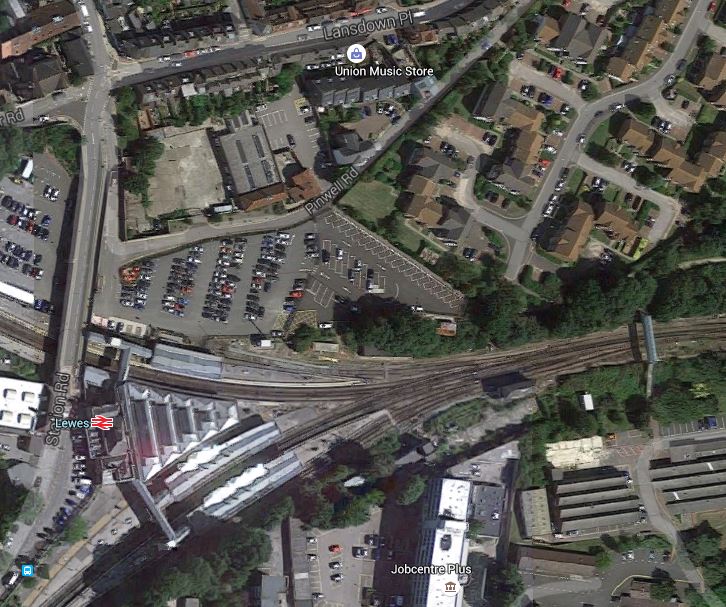
Lewes Station
The line going off to the right is the East Coastway Line to Bexhill, Hastings and eventually via the Marshlink Line toAshford.
The top line at the left goes to Plumpton and eventually to London, whilst the bottom one goes to Brighton.
At the moment a great deal of work is going on, as these pictures of the station show.



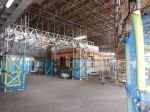


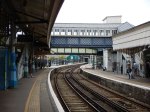
Lewes could end up being a more important station if plans to reopen the Wealden Line to Uckfield come to fruition, to create a second route between London and Brighton. There is a BML2 web site, which is nothing but ambitious, as this map shows.

BML2 Map
I think that the Lewes to Uckfield section might be rebuilt and it would be an ideal place to use IPEMU trains, as they could be used on the whole of the Uckfield Branch of the Oxted Line to replace the current Class 171 diesel trains.
I have a feeling too, that IPEMUs would be ideal to bridge the electrification gap between Ashford and Ore and allow Hastings, Bexhill and Eastbourne to have high-speed services to St. Pamcras. Would these services if they ever start turn back at Eastbourne, Brighton or Lewes?
There is certainly scope for extra services in the area, if only there were more routes to London. In many places along the South Coast, services are hourly, which given the development and other issues in the area, probably isn’t enough.
In my view, half-hourly services are the minimum frequency on any rail-line that is connected to major centres of population, as this effectively, is a turn-up-and-go service. If the Scots feel this is needed on the Borders Railway, then the logic probably applies along the Sussex Coast.
Plumpton Station, Level Crossing And Racecourse
When a friend phoned me from Brighton asking me next time I was in the area to meet him for a coffee, I decided to combine the trip with a visit to the site of the level crossing in I Wonder If This Happens In Europe.
These are pictures I took at Plumpton station.


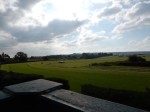



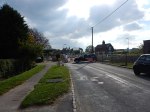




It would not be called grand, but it must be one of the few stations in the UK with an attached racecourse.
The rebuilding of the level crossing is causing problems according to Wikipedia. This is said.
Network Rail closed the level crossing in September 2015 so that the gates on the crossing could be replaced. However, Lewes District Council rejected the plans to replace the gates as it would cause “substantial harm to the significance of the signal box”. Network Rail have said that they cannot open the crossing as the work is not completed. This has effectively split the village in two, with some motorists having to take a six or seven mile detour.
I did chat with a local and her grey whippet and feel that there could be more to this than meets the eye.
If you type “Plumpton suicide” into Google, you find reports, where people have killed themselves at the crossing.
But I also feel that Network Rail haven’t been too clever in this one. My view is that stations like Plumpton need at least a half-hourly service, as this means you have a proper turn-up-and-go service.
One of the pieces of work being done in the area, is to close all the signal boxes and handle all signalling from Three Bridges Operating Centre. This work combined with an automated level crossing, could surely enable all the half-hourly services between Lewes and London to stop at the station.
But it would enrage the militant wing of the heritage lobby!
As to the signal box, they should be looking at a version of the Highams Park solution. Perhaps it would make a cafe and/or business centre.
Starting a half-hourly service might have the effect of increasing traffic at the station.
It’s a difficult one, but with the population of areas like Sussex getting older, more numerous and more and more people cutting use of their cars, who knows?
For the duration of the level crossing closure, Network Rail and Southern had a golden opportunity to experiment with stopping all services. Some of those drivers, who are doing a long detour, might have been persuaded to try the trains to Lewes, Brighton or London.
Keep This Door Closed
I like this witty sign.
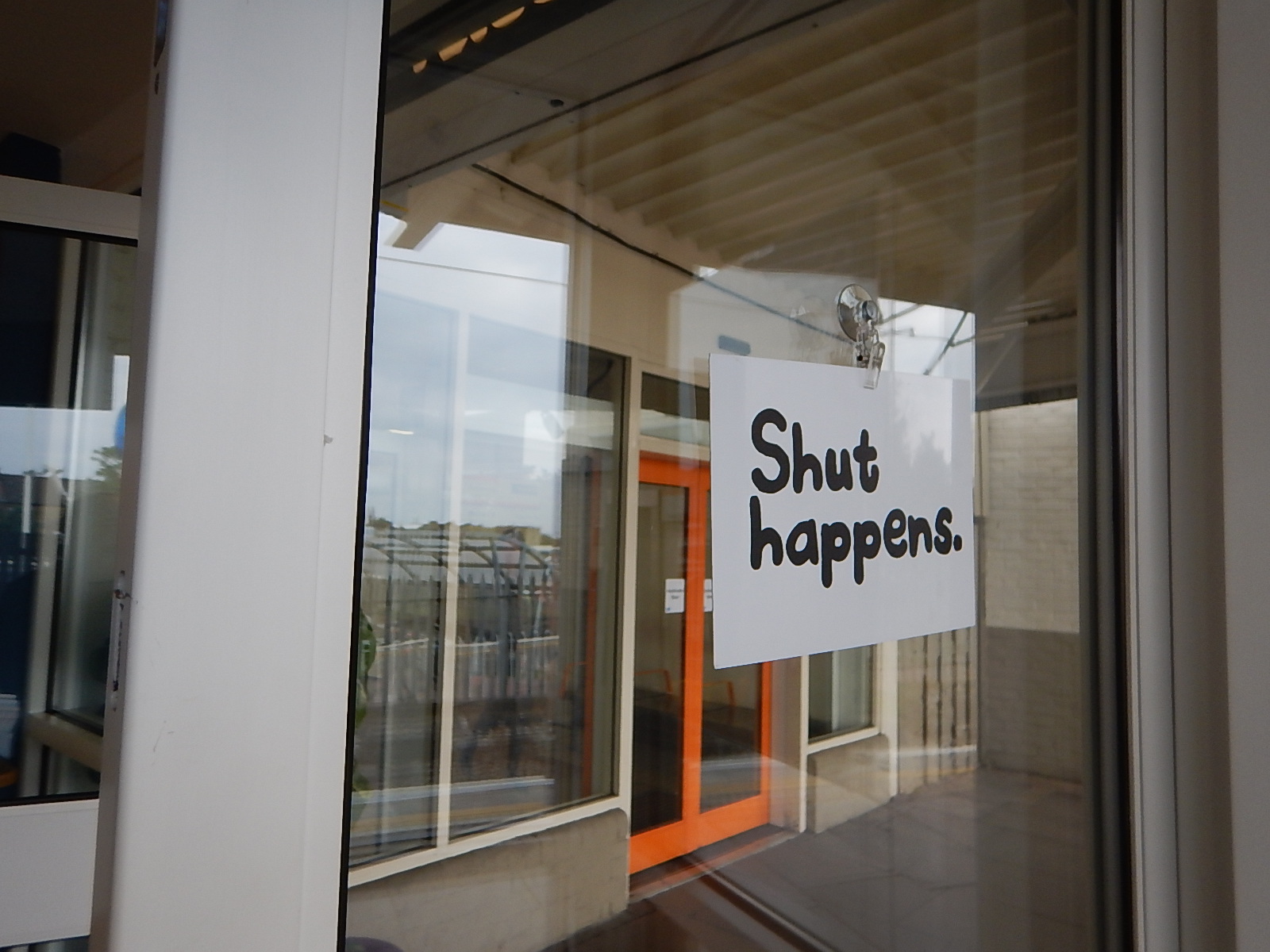
Shut Happens
It was in a cafe at Willesden Junction station.
The Tailor Of Bexley
When I had my family traced, the earliest ancestor of mine that could be found was Robert Miller, who was a tailor in Bexley in 1837.
He was found to have had one son; Edward, who was born about 1816 in Bexley, Kent and died in 1871 at Shoreditch.
Linking backwards from the modern day.
My father was Wilfred Ewart born in 1904
My paternal grandfather was Herbert born in 1878 and died in 1929
My paternal great-grandfather was William born in 1853 and died in 1911.
My paternal great-great-grandfather was Edward born in 1816 and died in 1871.
So the tailor of Bexley was my paternal great-great-great grandfather.
My father once told me, that his grandfather, who must have been William, once told him, of a first hand account of Robert the tailor of Bexley, who was his grandfather.
He said that he was German and that he didn’t speak any English. Because of my coeliac disease, which is quite common in East European Jews and his profession, we can probably assume that Robert; the tailor of Bexley was Jewish. My father also told me that the family name was Müller, which had been Anglicised.
Robert Winder in his excellent book; Bloody Foreigners, talks about how many poor Germans came over to London in the early days of the nineteenth century and lived in terrible conditions in the East End of London.
So was Robert one of those poor Germans?
When you dig into your family history, you find professions that are no longer PC. Some of my ancestors were ivory turners and skin dressers in the fur trade.
I Wonder If This Happens In Europe
This article from Rail News entitled Level crossing upgrade hits deadlock is priceless. This is the first couple of paragraphs.
A bid to upgrade the gates at a ‘high risk’ level crossing in Sussex has fallen foul of planning laws, and Network Rail has written a letter of apology to local residents who have been protesting that the road across the railway has now been closed for several weeks.
The gates at Plumpton between Burgess Hill and Lewes are of the traditional pattern, and controlled from the box alongside. But Network Rail said that “despite its local popularity and heritage, independent risk assessments had identified that the level crossing posed a high safety risk, as well as being increasingly difficult to operate and maintain”.
They now need to be replaced with modern lifting barriers which could in future be controlled by the new Rail Operating Centre at Three Bridges. The upgrade is costing £2 million.
This all sounds straightforward.
But it isn’t as Lewes Council has refused planning permission on heritage grounds.
The lawyers must be loving this one, as it will obviously run and run.
But as it’s a high risk crossing, surely this crossing should be closed before a serious accident happens.
Remember, I used to live in East Anglia and every few months or so, there was a news story about a serious level crossing accident.
Network Rail should be tasked to get rid of them all as soon as possible, so more tragedies like Elsenham and Ufton Nervet never happen again.
I suppose they could always close the East Coastway Line and run Rail Replacement Buses instead.
I wonder if other countries in Europe handle this sort of problem better!
Back From The Hague
Before I left on Thursday, I wrote Off To The Hague Today and started the post like this.
Is there any other train journey between two capitals in the world, that is more difficult now than it was six or seven years ago?
It certainly doesn’t get any better.
Arriving in Brussels, the hourly train to Antwerp and The Hague left in half an hour, so I thought if I could get a ticket to The Hague, I might go direct.
So I tried a machine. But these only sell tickets to Belgium.
Ticket Office?
The queues were horrendous, so I got on the train to Antwerp as my Any Belgium Ticket would get me there!
At Antwerp, I took half an hour to buy a ticket and after a lunch of nuts and the worst coffee, I’ve ever had, I caught the next train to Den Haag HS, where I changed for Den Haag Laan van Nieuwe Oost Indie.
Express train it is not! On this main InterCity route, some of it has a speed limit of just 100 kph. Even London to Ipswich is a 160 kph line.
Coming back, there were a few delays and it took exactly four hours from the time I got on the InterCity train at Den Haag HS before I was on my on-time Eurostar leaving Brussels. Admittedly, forty-five minutes of so was checking-in and waiting for the Eurostar.
Incidentally, Den Haag to Brussels in 172.9 km. and can be driven in two hours.
London to Birmingham is actually slightly further and Virgin does it around 85 minutes.
If that isn’t a disgrace, I’m a Dutchman!
What wasn’t a disgrace was the food on Eurostar!
I’d forgot to ask for a gluten-free meal, but I was assured the main course was gluten-free. I’m pretty certain it was and it was also delicious.
So at least the last part of the journey went well and we arrived in St. Pancras on time!
Passenger services through the Channel Tunnel opened in 1994, with services to and from St. Pancras starting in November 2007.
The new Class 374 trains to start a service to Amsterdam and Cologne are now sitting in sidings, with services supposed to start at the end of 2016.
Judging by the history of the development of services to places other than London, Brussels and Paris, I suspect that date will slip to somewhere about 2026 or even 2036.
The biggest problem seems to be the multiplicity of different electrical systems between France, Germany and The Netherlands. At least we chose our 25kVAC overhead system is the same as the French and has been since at least the 1960s.
I despair, that I’ll ever take a High Speed train direct to Rotterdam and then take a local train to The Hague.
No wonder the EU is such a mess, if the UK, Belgium, France, Germany and The Netherlands can’t agree on something purely technical like a connecting railway.
Den Haag HS Station
This is the station from where I left The Hague
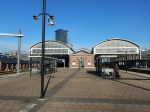
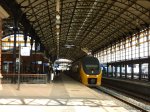
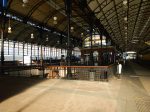
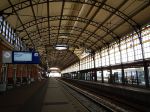

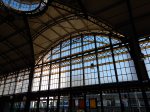

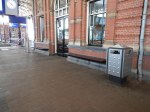
Over the years, I have used it, Den Haag HS station has been cleaned up, but in some ways it is a rather soulless place, except for some of the old details.
I had bought my ticket earlier, but at least there was a machine at the station, where I could get a ticket to Brussels.
Unlike at Brussels, where there were no machines selling tickets to The Netherlands that I could find.
 The Anonymous Widower