Class 710 Trains And Software Problems
There is a lot of chatter in various web sites and publications, and from some London Overground employees, that the late arrival of the Class 710 trains, is down to bugs in the train software.
I have heard or read phrases like “computers-on-wheels” and “thirteenth software upgrade”, which surely doesn’t bode well.
I am reminded of something said, by a Senior Maager of a Computer Company at a conference in the 1960s.
If it takes, one man a year to write a program, then it will take two men, two years and two hundred and fifty-six men, two hundred and fifty-six years.
I have written a lot of software and generally my work was accepted as good. Or at least, no-one ever told me anything I wrote was rubbish!
My guess is that Bombardier have used too many programmers and many are too far from Derby.
A Double Database Cock-Up From The NHS
At three on Sunday morning, I phoned NHS 111 to ask for a bit of help with my terrible cold that was stopping me from even getting to sleep.
I had some advice which helped, but I was also booked in to see a doctor at 09:00 in a surgery a short bus ride away.
So far so good and no complaints.
I duly saw the doctor and he prescribed several drugs, which I took to my local Boots later in the morning.
I should say at this point, that four years ago, I officially changed my name from the one my parents gave me to the one I’ve used continuously since 1968. I was starting to get problems with some airlines, where my passport had a different name to my bank account. My current GP has only ever known me by the latter name and I’m registered with their surgery using it.
When I got to Boots, they initially rejected the prescription, as for some reason it showed by old name, although my address, NHS number and other personal details were correct.
How did the wrong name get on the prescription?
Luckily, Boots were pragmatic and as they recognised me, I got some of thew drugs.
But not all!
The pharmacist recognised that two drugs were incompatible with the Warfarin I take.
So why did the NHS computer system allow the doctor to prescribe the drugs?
As someone who was at the forefront of database technology, I believe, these two problems are inexcusable.
My incorrect name could have led to failure to obtain needed drugs.
The lack of interaction checking, could have led to serious problems for a patient.
I Am A Twenty-Four Hour Person
I rose as usual at around five-thirty this morning and went through my normal routine.
- I measured my weight and blood pressure. Incidentally, I weighed 61.8 Kg.
- I checked my savings in Zopa and my bank account.
- I did two dozen press-ups
Now I am on my first cup of tea of the day. I have also replied to a couple of e-mails.
I’ve been like this in one way or other since the 1970s, when I started programming Artemis.
In those pre-e-mail days, I would be on my computer writing code before six and generally only stopped writing code around ten at night having been writing on and off all day.
C would sometimes drag me off for some shopping or a visit to a pub or restaurant, but I worked very hard and was well rewarded.
Some would say my hours are unusual, but my father was the same. Memorably, he once mowed the lawn at two o’clock in the morning!
Oyster Card Scheme Extension Agreed
The title of this post is the same as that of this article on the BBC,
This paragraph describes the extensions.
Its extension, due in early 2019, will include Hertford North, Welwyn Garden City, Luton Airport Parkway and Epsom.
As the Oyster Card extension will also include intermediate stations, the following stations will be included on the four routes.
- Hertford North – Crews Hill, Cuffley and Bayford.
- Luton Airport Parkway – Radlett, St. Albans City and Harpenden
- Welwyn Garden City – Potters Bar, Brookmans Park,Welham Green and Hatfield
All intermediate stations to Epsom are already in the Oyster Card Scheme.
Fourteen new stations will be added.
These are a few random thoughts.
Contactless And Oyster
Oyster card and most contactless payment methods with a card or mobile device can be used on Oyster Card reader, so in this post, I will use contactless to cover all methods.
I believe that in a few years, Oyster could be phased out, as cards and mobile devices will take over the ticketing.
Luton Airport Parkway
Adding Luton Airport Parkway station to the network, brings Luton Airport in line with Gatwick and Heathrow Airports.
This is very much a logical extension.
Airport Services
This is a list of the current times for airport services from London.
- Gatwick – Express – 29 minutes – Thameslink – 39-60 minutes
- Heathrow – Express – 15 minutes – Crossrail – 28 minutes
- Luton – East Midlands Trains – 21 minutes – Thameslink 30-47 minutes
- Southend – 52-53 minutes
- Stansted – 49-52 minutes
If you look at the passenger statistics for Gatwick Airport station, they have been rising at around a million passengers a year for the past few years. How much of the recent rises have been due to the station going contactless in January 2016?
Certainly, if you’re late for a plane, contactless ticketing might save a couple of minutes.
I always remember an incident at Southend Airport station.
My plane was late and arrived very close to the departure time of the last train to London. There had recently been a lot of arrivals and the queues for tickets were long.
So a Greater Anglia employee took the decision to tell everybody to get on the train and we all went to London without tickets.
If ticketing had been contactless, Greater Anglia might have collected some fares.
But contactless at an airport is not solely about making money, but getting the passengers away from the airport quickly.
Hertford East And Hertford North Stations
Hertford East station accepts contactless cards.
Adding the facility to Hertford North station may open up some journey possibilities and ease ticketing.
The National Rail web site recommends that to go between Ware and Bayford stations on either side of Hertford, that you walk between the East and North stations.
An anytime ticket will cost you £19.50.
But buy two separate tickets between Ware and Hertford East stations and Hertford North and Bayford stations and it’ll cost £6!
Using contactless ticketing and touching in at all stations will save £13.50! Will this cost difference encourage more journeys with a walk in the middle?
When I visited the Hertford East Branch recently in mid-morning, I thought that it was surprisingly busy. Does lower-hassle contactless ticketing encourage more passengers?
Analysis of contactless touches will provide the answers to my two questions.
St. Albans City And St. Albans Abbey Stations
The Abbey Line between Watford Junction and St. Albans Abbey stations is not contactless, although Watford Junction station is so enabled and St. Albans City station will be.
There is surely a case for adding contactless ticketing to this short line of five intermediate stations.
Welwyn Garden City Station
Enabling Oyster on the route to Welwyn Garden City station, will mean that all stations on the Great Northern Route from Moorgate station will be enabled except for Watton-at-Stone and Stevenage.
This would surely be less confusing for passengers, than the current arrangement, where Oyster tickeing is stopped at Hadley Wood and Gordon Hill stations.
Hopefully a suitable announcement would wake-up accidental fare avoiders at Hertford North station.
Epsom Station
The two routes to London from Epsom station are both fully Oyster-enabled, so surely adding one station to the routes shouldn’t be a difficult problem technically.
Further Routes For Oyster
Distances of the new Oyster-enabled stations, with a few existing ones, by rail from Central London are as follows.
- Epsom – 16 miles from Victoria.
- Gatwick Airport – 26 miles from Victoria
- Hertford North – 20 miles from Moorgate
- Luton Airport Parkway – 29 miles from St. Pancras
- Shenfield – 20 miles from Liverpool Street
- Welwyn Garden City – 20 miles from Kings Cross
So what other stations could be added?
Southend And Stansted Airports
Airports seem to like Oyster and as I said earlier, it can help to sort out ticketing problems at certain times.
- Southend Airport station is 39 miles from Liverpool Street and there are five other stations between Southend Airport and Shenfield stations.
- Stansted Airport station is 36 miles from Liverpool Street and there are six other stations between Southend Airport and Broxbourne stations.
This story on ITV is entitled Rail Minister Urged To Roll Out Oyster Card Payments To Stansted, Luton And Southend Airports.
Luton Airport will soon be Oyster-enabled, so hopefully Stansted and Southend Airports will be enabled soon.
Thirty Miles From London
There are a lot of places within thirty miles of London on commuter routes, that I’m sure eventually will be Oyster-enabled.
- High Wycombe and Aylesbury – Chiltern have ambitions for this.
- Rochester – 30 miles from London and on Thameslink.
- Windsor
There will be other suggestions.
Extending Freedom Pass
I’d like to be able to just touch-in and touch-out to go to any station in the Oyster card area.
My Freedom Pass would be connected to a bank or credit card and I would be charged beyond the Freedom Pass area.
If Oyster cards can be linked to a bank or credit card, surely London’s control computer can be programmed to do something very powerful for Freedom Passes.
It could be a nice little earner for cash-strapped Transport for London.
Conclusion
Oyster is extending its reach and after this flurry of extensions in the next few months, lot of places will be wanting to be Oyster-enabled.
I suspect the only objector to this roll-out, will be the RMT, who have made the Luddites look like pussycats!
I Have Just Been Microsofted!
I run Office 365 and today it updated itself.
Now nothing in the suite works.
I don’t like automatic updates, as they have this power to drop you deep in it.
I usually only upate software, when there is a problem!
Google Grabs The Best Site In London For Its Massive Groundscraper
This Google Map the site where the massive groundscraper is being built.

Note.
- Kings Cross station, which is on the right of the map, has extensive connections to the North-East of England and Scotland.
- St. Pancras station, which is on the left of the map, has extensive connections to the Midlands and Belgium, France and the Netherlands, with more services to come including Germany, Switzerland and Western France.
- Thameslink runs North-South beneath St. Pancras station, has extensive connections to Bedfordshire, Herfordshire, Kent, Surrey and Sussex.
- There are also six Underground Lines.
- Gatwick and Luton Airports have direct connections and City, Heathrow and Southend Airports only need a step-free change.
- Improvements in the next few years could mean that HS2 and all of London’s five airports will have a fast direct connection to the area.
In the middle of all these railway lines, sits Google’s groundscraper, which shows as a white structure towards the top of the map.
These pictures show the area between the two stations, the under-construction groundscraper and the new blocks.






And these pictures show the progress on the site.




There is not much that is visible yet!
More Pictures!
But the building will be more visible soon! For those who can’t wait, this article from the Daily Mail has a lot of visualisations.
Is This The Most Important Door In My Life?
In some ways this is the most important door in my life.
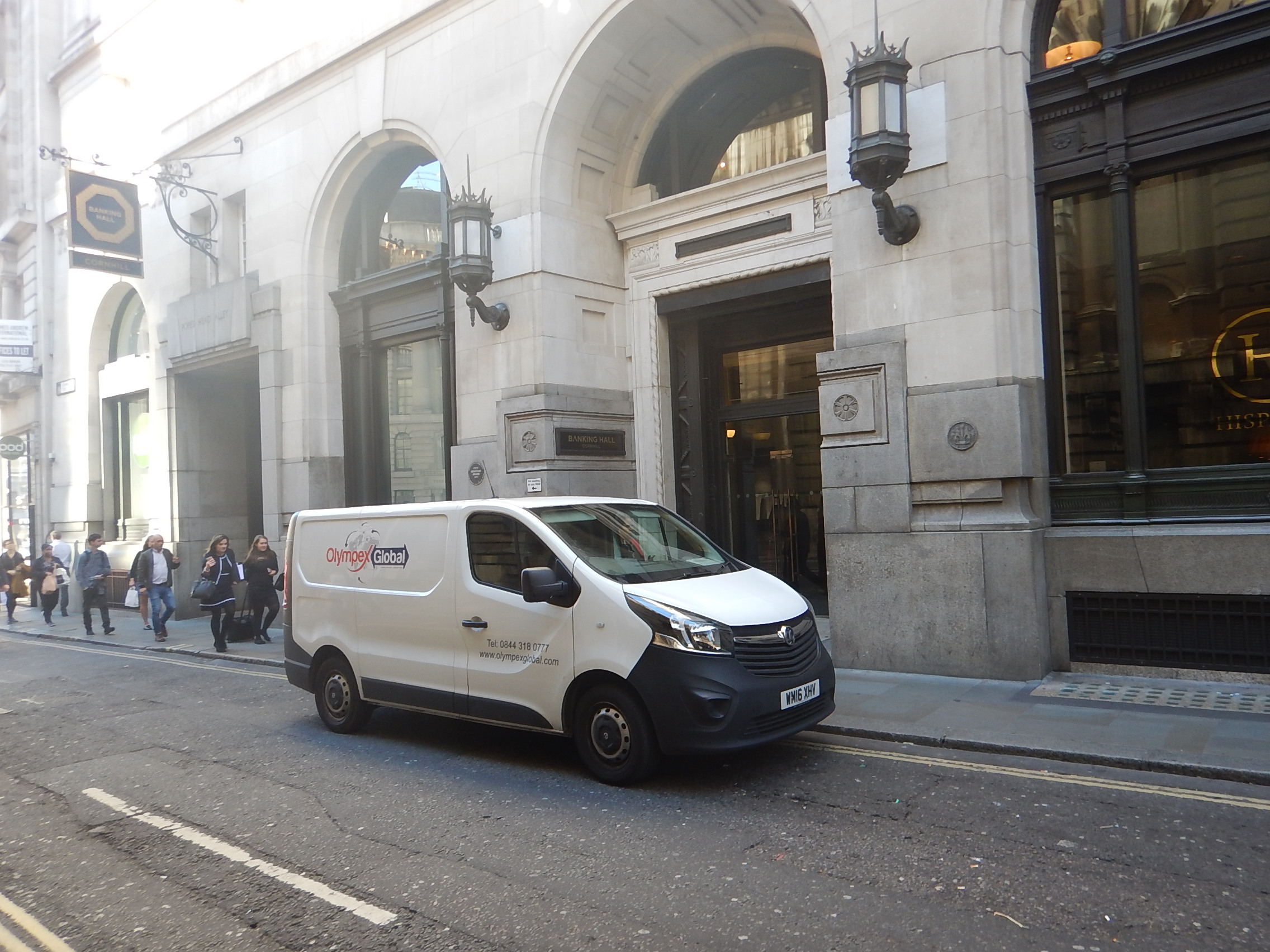
It used to lead through into the superb banking hall of Lloyds Bank.
In the early 1970s, I was doing some programming for the bank as a consultant to a company called Time Sharing Ltd.
The purpose of the software was to take the banks costs and expenses and calculate how much each of the various actions cost the Bank, by branch,area and region.
I was working for one of the Managers; Mike Spicer, who worked under the Chief Management Accountant; C. R. C. Wesson, who I later knew as Bob.
I’d never met Bob and as Mike was away, Bob phoned me up one morning and asked me to run the software, as they’d just uploaded a new batch of data.
I duly did this from home, and checked that it had run successfully after cycling to Time Sharing at Great Portland Street. They then asked, if I could take the results to the Bank on my way home to the Barbican.
I was worried that I was not dressed for visiting the Head Office of one of the UK’s big banks. I was painting our flat and wearing a pair of ice blue jeans and a short-sleeved shirt. . Luckily, I had a carrier on my bike, for the couple of inches of fan-folded green-striped print-out.
I had been told to ring the bell by the side of the door in the photograph and despite the banking hall being closed, I would be let in.
I arrived safely about six and rang the bell.
Perhaps a minute or two later, the ornate and extremely heavy door slid aside and a footman appeared, immaculately dressed in the Lloyds uniform of green tail-coat and top hat. He said. “You must be Mr. Miller!”
When I affirmed, he ushered me through and I offered him the printout. He then said, that Mr. Wesson would like to see me. I protested about my clothes, but he firmly showed me to the lift and pressed the appropriate floor. He added that Mr. Wesson would meet me at the lift.
It was the start of a very firm friendship.
Together we developed the software and produced loads of copious tables and graphs.
I learned a tremendous amount from dealing with the only innovative accountant I have ever met.
A lot of his philosophy found its way into Artemis.
One thing he told is that bankers when given a table of figures, always add them up to make sure there are no mistakes.
So I developed a technique in the Lloyds Bank software, where if money was allocated between various rows in a table, the total was always correct. If you round each row, this isn’t always the case.
I used this technique in the aggregation of resources and costs in Artemis.
Sadly, Bob died of I think cancer, a few years later!
I owe him a great debt!
Pick Your Own Hours With (Really) Flexible Working
The title of this post is the same as that of an article in today’s copy of The Times.
This is the first two paragraphs
More than 2,000 staff at PWC offices in Britain will be allowed to choose their own working hours under a scheme introduced by the accounting network.
PWC’s “flexible talent” initiative will allow people to apply for jobs, stating their skills and availability. It will then match the recruits to relevant projects on which they can work shorter weeks or work for only a few months a year
I think it’s a brilliant idea.
Although, in some ways, it’s a pity, that I’ve retired from programming.
Programming a computer system that could handle this problem, would have been right up my street.
Will PWC make me an offer I can’t refuse?
I doubt it, as they probably believe there are no capable programmers over thirty. And certainly not over seventy.
But then I’ve written four programs to allocate resources.
- A Space Allocation Program for ICI in the early 1970s
- PERT7 for Time Sharing Ltd.
- The original Artemis.
- Artemis for the PC.
All share the same basic algorithm that I first used for the Space Allocation Program.
But I’m certain, that everybody, who has programmed a resource allocation program, uses their own version.
DB Says Innovative Freight Train Project ‘Very Promising’ So Far
The title of this post is the same as that of this article in Global Rail News.
This is the first paragraph.
A project to design innovative freight wagons, which is being financed by Germany’s Federal Ministry of Transport and Digital Infrastructure (BMVI), DB Cargo and VTG, is producing ‘very promising’ results.
The article is worth reading in full and in my mind it could be important in the development of efficient and reliable freight trains.
I remember in the 1960s, British Rail were trying to run faster freight trains and a lot of four-wheel wagons kept derailing.
Research at Derby using computer simulation solved the problem and went on to lead to a greater understanding of the dynamics of steel wheel on steel rail.
I do know that British Rail Research had one of the best tools for this job; a PACE 231-R analogue computer.

This is the one, that I worked on at ICI.
They were a powerful computer, which were capable of solving a hundred simultaneous differential equations.
They were late 1950s technology, based mainly on electronic valves, that responded to tender loving care.
But two of them working together, did the dynamic calculations for the moon landings, when linked to the digital computers of an Apollo capsule and lander.
On Apollo 13, when Jack Swigert said “Houston we have problem”, it was these machines, that were used to find a way to bring everyone home.
And the rest, as they say is history!
In my view, after over fifty years in computing, the rescue of Apollo 13 was the greatest piece of computing ever done with an electronic machine.
I’d love to know, whether the superb dynamics of the Mark 3 coach, are down to the work that was done on British Rail’s PACE 231-R
The second paragraph of the Global Rail News article has this phrase.
feature new digital systems which optimise handling.
Does this mean the Germans are worried about the handling?
I do sometimes wonder, if dynamic systems are best analysed using analogue computers and the demise of the technology means the same problems keep returning in different guises.
There can’t be many of us left, who’ve used an analogue computer seriously.
 The Anonymous Widower