Confessions on the iPope
Well not quite, but there is now an iPhone app to help with confession.
Described as “the perfect aid for every penitent”, it offers users tips and guidelines to help them with the sacrament.
Now senior church officials in both the UK and US have given it their seal of approval, in what is thought to be a first.
The app takes users through the sacrament – in which Catholics admit their wrongdoings – and allows them to keep track of their sins.
It also allows them to examine their conscience based on personalised factors such as age, sex and marital status – but it is not intended to replace traditional confession entirely.
Instead, it encourages users to understand their actions and then visit their priest for absolution.
I have a few questions.
- Does the app search your e-mail to see whether you’ve been hinting of doing things that of which the Catholic Church would not approve? This would probably need a Bayesian filter and the Reverend Bayes wasn’t a Catholic.
- Does it look at all of the pictures you’ve downloaded to your phone and react accordingly?
- Does it check that the app associated with your football club is the right colour?
- Could the app be connected to add-on hardware that gives you a prick or an electric shock if you think naughty thoughts?
The possibilities are endless. And obviously the more serious the religion, the more serious the app!
It would also have added a whole new dimension to Clochemerle.
How to turn a Nokia 6310i Into A Smarter Phone
People laugh at me because I don’t have a smart phone like an iPhone. But then apparently Elton John doesn’t even have any mobile phone.
But then my Nokia 6310i can send and receive text messages, tweet and even send and receive normal phone calls to anybody with a number. That last bit is really cool. Or is it Koool? Who cares anyway? The only thing it doesn’t have is an automatic reject of calls that are trying to cheat me out of money in various ways. But no-one has a phone that does that! Yet! But hopefully, it will come in the next 100 years or so.
I’ve had my 6310i eleven or twelve years now and even now, I find new features that I am starting to use. I’ve known about it for some time, but now I’m using the to-do-list feature to make notes as I ride around London, often at the front on the top deck of a bus. Try doing that in a car!
As the phone stores quite a few text messages, when I have information I might need on the move, I just text it to my phone using LiquidDrop. I’ve just picked up my tickets for Barnsley and I’ve texted the itinerary to the phone for Saturday. No hated piece of paper to take, but I suspect W H Smug, will try and load me up. Perhaps, I’ll buy my Saturday paper in M&S or on the way to St. Pancras.
So the 6310i is getting to be a smarter phone. This is what everyone wants! I once said, “Computers make good slaves, but very bad masters!” That applies to phones as well. And especially mobile ones.
How Do You Banish Virgins?
Virgin Media is an frustrating company in that it designs so many things almost to annoy.
I’m using my Samsung Network at a friend’s house and some of the connection software for my home broadband keeps opening Virgin Broadband windows in Internet Explorer. Delete them and they reappear and often seem to replace something I want.
I do wish I’d installed Sky and used BT for my phone lines.
This is not to forget their rather inferior TV system, which is not up to the standard of Sky Plus and the fact that they still haven’t transferred my number from Suffolk.
I’ve just solved the Virgin windows by deleting the Virgin Media hub from this computer. So don’t install it, is my advice. I haven’t installed it on my laptop and that works fine, so I think it’s one of those unnecessary pieces of software companies like you to install, so they can track what you are doing or lead you to spend more money with them.
Facebook Involved in Divorces
It had to happen, that what you write on Facebook, would start to drop you in the mire over your marriage. One of the reasons, I blog rather than use Facebook seriously, as I have total control over what goes up. Also if someone uses bad spelling or grammar, I can remove the worst of the horrors. C also did some of her training in libel chambers, so I know enough to hopefully make sure, I stay the right side of that line. I also choose my targets with care.
This article in the Telegraph explains the problem of divorce and Facebook.
One lawyer is quoted as saying.
Many of divorces came after partners found “flirty messages” on the Facebook wall of their partner – and also “inappropriate suggestive chats” which spouses can see.
Note that I’ve corrected the punctuation in this extract. Times must be bad when you can’t rely on the Tory Party at Gossip.
As a widow, some would be surprised at some of the messages, I’ve exchanged with other widows. Flirting and the odd suggestion are very much part of life and help everybody to keep a balance in the darkest of times.
So that adds another layer of complexity to the problem and puts more icing on the legal bill.
Was This a Badly Placed Internet Advert?
I usually get notification of newspaper polls on the death penalty from a list I belong to on the Internet. This was the latest request I got.
Please help turn this poll around. Thanks! http://www.ydr.com/local It’s down on the left.
I voted appropriately. The paper incidentally is the York Daily Record.
But imagine my surprise that the placed adverts on the site were for theTrainLine.com, who I’ve recently used to buy a ticket on East Coast to York. And they were trying to sell me a ticket to York! Obviously, there’s an Atlantic Tunnel I don’t know about.
Seriously though, the advertising system was probably looking at my cookies and made an appropriate decision.
I’m not particularly bothered, but I can see that some people will be!
I hope everybody who reads this votes using the link.
–abe
The Minotaur Lives
Imagine my surprise, when a parcel appeared on my doorstep carried by a man who looked like he was doing an impression of Pete Henry, except that he was a few years older than my last recollection.
In the parcel, was about a hundred copies of the infamous Metier Minotaur. This was the edition that had the tall Pete’s picture where he was trying to get into a compromising position with the diminutive Karen, in what looked like the dining room of my old house at Debach with the infamous wallpaper. It was also probably the laste edition as it had Metier’s obituary. On the last page it asked if the hamster really did it.
Pete told me that he had had a vision from God and this had sent him to a dark, satanic print works in Clerkenwell, where in exchange for a fistfull of used notes, he had received these magazines from an atttractive young lady.
So what am I to do with this manna from heaven?
My son died of pancreatic cancer, so these priceless works of great literature will be sold with all proceeds going towards research into the cancer at Liverpool University, where a world-class team has been assembled.
I am not restricting the sales, as the excellent printer, has informed me that if need be he can print enough copies to completely cover every window of the gherkin.
Building Scientific Models with Computers
This was the title of a lecture at University College London, that I attended yesterday lunchtime.
It was an excellent lecture and in some ways it was like going back forty years to when I worked at ICI Plastics in Welwyn Garden City. In fact two topics, that were discussed by Professor Catlow, were similar to problems I tackled all of those years ago.
The first was the problems of turbulent and other flows. We had been interested in what happened inside an extruder as you used it to force plastics, such as polyethylene, polypropylene and PVC into moulds to produce the products needed. It was an intractable problem then and I suspect it might be almost as bad today. Although computers are now bigger and can handle many more nodes than the hundred or so, we could handle on our PACE 231R or with IBM 360/CSMP.
I also found his discussion of the various forms of molecules and how they could be predicted fascinating and if we’d had someone with his knowledge, we’d have got a lot farther with another problem.
When you create polymers, you create long chains of molecules like ethylene and propylene etc. which lock together like a series of odd-shaped Lego bricks. These chains then bind together to form the items we need.
At the time, ICI were trying to create an engineering plastic, which would be stronger and have a greater temperature range. I won’t name it here, as I don’t want to break any confidentiality, but suffice to say that the monomer or polymer building block, needed to be created as a straight molecule for the integrity of the plastic. It was known that several forms of monomer could be created and that there was a rather complicated separation process to extract the straight ones. Just as in Professor Catlow’s example yesterday, water in the reaction, was one of the factors, that affected the proportion of desired monomer.
Now I’m not a chemist but I was asked to look at the physics and dynamics of the reaction, with respect to removing the errant water from the reaction vessel as soon as possible after its creation, to reduce the damage it could do. In the end, I made myself very unpopular, as I often did, by finding a method that removed the water. I can remember searching Chemical Abstracts and finally found the data I wanted in a paper published by a Chinese researcher working in Canada in 1909. We don’t know how lucky we are with Google and the Internet.
I left ICI soon after I completed this work, so I don’t know the final outcome!
But to me, the exercise proved the value of using dynamic computer models based on differential equations, to understand difficult systems.
In some ways, I was able to do this work, because I was properly taught calculus and how to form differential equations at school. Would such an important subject now be taught to sixteen-year-olds as was regularly done in the 1960s at schools similar to the one I attended?
The Virtual Beagle
The headline of “It might look like a dog’s dinner; but this artificial stomach will save (canine) lives” caught my eye as I read The Times this morning.
Apparently, AstraZeneca have virtually replaced dogs with an artificial stomach for drug testing. So not only is it good for drug development, it’s good news for dogs. I’ve always felt that animal testing was wrong from a scientifically correct point of view as keeping animals is expensive and the in vitro and computer alternatives are cheaper and much easier to scale up.
The Times article doesn’t say who is behind this development, but it does quote Troy Seidle of the Humane Society International as saying.
This new use of the intestinal model in drug testing is a fantastic example of how innovative technologies can replace animal experiments and improve medical research at the same time.
I have searched the Internet and it would appear that the company behind this wonderful development could be SimCyp, based in Sheffield.
But why is everybody being so coy about this development? This British company should be on page one of all the newspapers.
On a personal note, I was involved in computer simulation of processes for several years in the 1970s, when I worked at ICI. We always felt that computers had a large part to play in modelling the body, but little seems to have been heard over the last four decades. These are two pictures of the PACE 231R analog computer, I used for simulation of chemical processes.
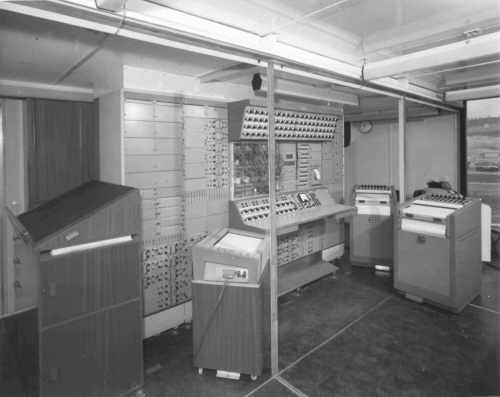

In my view, there are computers, good computers and the PACE 231R.
The 231R was built in the 1960s and it was all valve or vacuum tube, if you are from the United States. It was a formidable beast for solving differential equations and I have a feeling that there isn’t one left even in a museum. These pictures taken by a colleague at ICI seem to be two of the only ones of a 231R in a working environment. Hopefully the Internet will preserve them for ever!
The biggest claim to fame of the 231R was that two of them were used in tandem to solve all of the mathematics and differential equations of getting the Apollo spacecraft to the moon. They were actually linked to virtually a real spacecraft to test everything out.
So when Apollo 13 blew up and they had to use the Lunar Excursion Module to bring the astronauts home, it was these two computers that were reprogrammed to try to find out how to do it. They wouldn’t have stood a chance with a digital machine, but the engineers, programmers and astonauts were able to get the two 231R’s to find a strategy. I’ve never seen the Apollo 13 film, but I suspect that the role of the 231Rs is downplayed or ignored.
So when you ask me, what is the greatest computer ever made, there is only one answer. The amazing PACE 231R.
Laptops in Hospital – 2
I put a post on this earlier and today as I travelled to try to see the eclipse, I got talking to a lady who happened to be a hospital physio working with stroke patients. I asked her whether they allowed patients to have laptops and she said they did to a certain extent. But they were always worried that they’d get stolen.
The latter may be true, but if hospitals have a crime problem, it should not be allowed to get in the way of patients’ care and well-being, Iit should also be properly solved.
I also think that most patients would also accept having the coputer in hospital at their own risk. I certainly would and would make sure it was a rather elderly but reliable machine.
Laptops in Hospital
In a previous post, some of the comments were about smart phones in hospitals.
I’m all for allowing patients to have laptops in hospital. I had my stroke in Hong Kong and I was allowed one there. It allowed me to do things like listen to Radio 5, talk on Skype, do the Sudokus in The Times and send e-mails, that I wouldn’t have been able to do otherwise.
I could also have done things like watch videos, which I never do anyway.
In Addenbrooke’s laptops were effectively banned and I don’t think it helped me.
The reason they are banned is that if they were allowed, it would mean they’d lose all that money they get from that crap Patientline system. The bandwidth wouldn’t be a problem, as they can now get enough Megabits easily.
The laptops could also be integrated into patient care and support. For instance, a physio in Hong Kong told me that typing would help my hands work properly again. She was right!
So let’s have some 21st century, healthcare thinking!
Remember too, that happy patients are less trouble for staff and might even leave earlier.
To me allowing laptops in hospital is a no-brainer. But then what do I know about healthcare? But I have seen good healthcare at work and know what works.
I am also in contact with universities, where they are developing computer games to help stroke patients. Let’s make those free and downloadable!
 The Anonymous Widower