Wrightbus To Supply 20 Electroliner Buses To Hong Kong
The title of this post, is the same as that of this article on bus-news.
These are the first two paragraphs, which give more details.
Wrightbus has received a major order for a set of 20 of its 6×2 StreetDeck Electroliner double-deck buses.
The vehicles have been ordered by Hong Kong’s Citybus, marking the first global order for the new triple-axle vehicles.
I feel very strongly after a very terrible Bank Holiday weekend, that these are the buses we need on the 141 route in London, that I use most days.
Currently, we have BYD’s Chinese Junks and the batteries are too small.
- On Saturday, I had a doctor’s appointment and had to wait 45 minutes for a bus.
- On Sunday, I had to take a taxi.
- On Monday, it was a twenty minute wait and in the end I took a 76, which are Routemasters and walked.
- On Tuesday, I was rescued by an elderly Wrightbus, after twenty minutes wait.
The article on bus-news says this about the three-axle buses.
Measuring 12-metres in length; the StreetDeck Electroliners are capable of carrying up to 82 seated passengers (130 total), and possess an operating range of up to 300km.
That would do us fine in De Beauvoir Town, so we could travel reliably to London Bridge and Palmers Green.
As an engineer, I suspect the longer buses with an extra axle can carry a larger battery. I also suspect that BYD’s batteries don’t perform well in hot weather.
Instead, we get Chinese Junks and Hong Kong will be getting quality British buses built in Malaysia.
What Housing Is Being Built At Cockfosters Station?
I was looking for something to watch on the television and noticed that Cockfosters FC were in the FA Vase final today at Wembley against AFC Stonham.
For the first sixteen years or so of my life, I lived in Cockfosters, and until now, I never knew they had a football team, which is actually based just around the corner from the church, where I got married to C on September 7th 1968.
This Google Map shows the area.
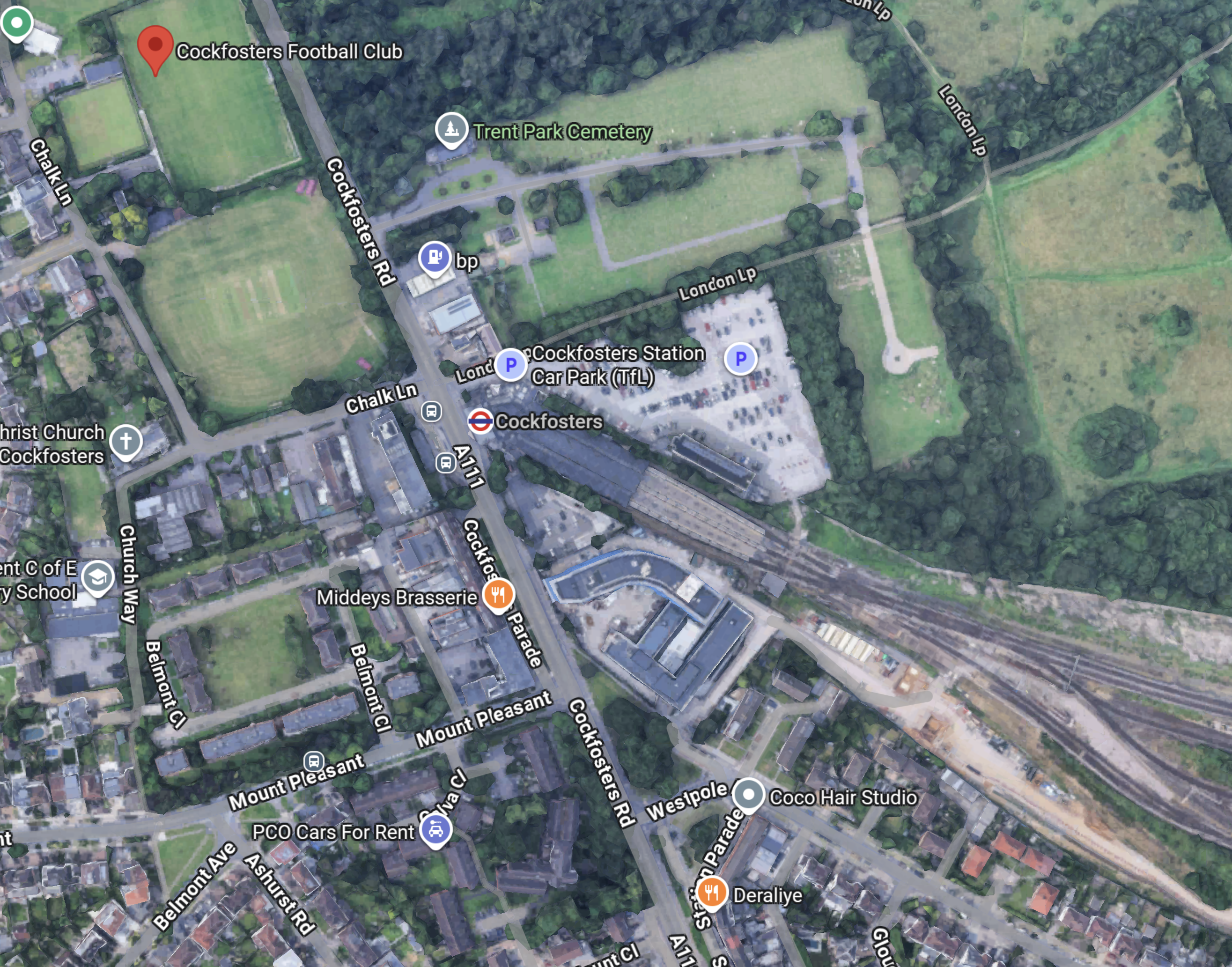
Note.
- The red arrow at the top of the map indicates Cockfosters F.C.
- Christ Church, Cockfosters is to the South of the football club.
- Cockfosters Road runs slightly diagonally down the map.
- Cockfosters station on the Piccadilly Line is indicated by the London Transport roundel.
- Cockfosters station has extensive car parking to the North-East of the station
- Cockfosters Depot is to the South-East of the station.
Our house was just off the Southern edge of the map, by Southgate School.
A 3D Image Of Cockfosters Station
This Google Map shows a 3D image of Cockfosters station and the buildings around it.

Note.
- Cockfosters station is indicated by the roundel.
- The station is a Grade II Listed building.
- The station has an elevation of 97 metres.
- Half of the station car park is going to be turned into housing.
- Trent Park lies to the North of the station.
- The road in front of the station is Cockfosters Road, which to the North joins the M25 at Junction 24.
- The building between Cockfosters Road and the railway used to be offices, but it is now being converted into starter housing.
In Starter Homes At Cockfosters, I write about starter homes being developed on the South side of the station.
Artificial Intelligence On The Housing In The Car Park
I asked Google AI the question in the title of this post and received this answer.
Places for London (Transport for London’s property arm) and Barratt London are building 373 residential apartments across four tower blocks on the former Cockfosters Station car park site. The largely car-free, mixed-use scheme includes 40% affordable housing, new public open spaces, and revamped TfL staff facilities.
Key Project Details
Total Homes: 373 apartments (a mix of 1, 2, and 3-bedroom properties).
Housing Tenure: All flats will be built for rent, with 40% of them allocated as “affordable” (including social rent and intermediate housing).
Building Heights: Four tower blocks ranging between 5 and 15 storeys tall.
Station Parking: The development is largely car-free.
Around 68 parking spaces will be retained at the station, including 12 dedicated Blue Badge spaces.
Public Amenities: The scheme introduces about 4,500 square meters of publicly accessible open space, children’s play areas, cycle storage, and minor commercial floor space.
Development Background
While planning permission for housing on the site was originally granted by Enfield Council in 2022, the project faced years of delays.
In late 2025 and early 2026, revised plans were submitted to add an extra storey to each building to accommodate updated fire safety legislation—adding 22 more homes to the initial 351 proposal.
You can track local planning updates and track progress via the Enfield Council Planning Portal.
I have some thoughts about this development.
Was There Any Opposition To Building Flats On Cockfosters Station Car Park?
From when I lived in the area, I remember that Cockfosters car park was well used in the 1960s and that trains on the Piccadilly Line were exceedingly busy, as I sometimes used to get them to travel to school.
I asked Google AI the question in the title of this section and received this answer.
Yes, there was intense opposition to the proposal to build flats on the Cockfosters Station car park.
The plans to build over 350 homes across blocks reaching up to 14 storeys faced major pushback from local residents, commuters, and Conservative MPs.
The primary points of contention included:
Loss of Parking: Opponents were concerned that wiping out hundreds of park-and-ride parking spaces would reduce the station’s accessibility.
It sparked fears that it would increase traffic on local roads and make journeys impossible for many, particularly blue-badge holders.
Over-development: The proposed height and density were heavily criticized for being out of character for the surrounding outer-suburb.
Heritage and Green Belt Impact: Residents argued that the massive tower blocks would negatively impact the neighboring Trent Park Conservation Area and the Charles Holden-designed Grade 2-listed station building.
Despite the controversy—which generated nearly 3,000 objections and was temporarily halted by the government in 2022—the project was officially given the green light to proceed. You can find full details on the planning outcomes via the Enfield Council Planning Portal or by reviewing the BBC News coverage of the development’s approval.
Do Any Train Depots Have Housing On Top?
I feel that we should maximise housing and in estates like the Barbican, there is extensive housing on top of car parking and even some active railways.
So why not on top of train depots like Cockfosters?
I asked Google AI the question in the title of this section and received this answer.
Yes, train depots and railyards increasingly feature housing built directly on top of them. Because large, open plots are scarce in dense cities, decking over active railway infrastructure has become an innovative engineering solution to generate new residential spaces.
Prominent examples of housing built over railway land include:
Royal Mint Gardens (London, UK): luxury residential and mixed-use development built directly above active train tracks on the approach to London Fenchurch Street.
Hudson Yards (New York, USA): The largest private real estate development in the U.S. features numerous residential skyscrapers built on a massive elevated platform constructed directly over the active John D. Carolan West Side Yard.
North Manhattan Rail Yards (New York, USA): Several multi-family residential projects, such as the Triangle Equities development over the MTA’s East 180th Street depot, utilize air rights to stack housing above active transit operations.
Hong Kong (Global Pioneer): Many of the city’s MTR depots (such as the Tseung Kwan O or Siu Ho Wan depots) and their surrounding stations have extensive private residential estates (known as Rail + Property Developments) built directly onto elevated decks atop the facility.
How is it done?
Building over a depot or railway requires constructing a heavy-duty “crash deck” or podium over the tracks. To prevent the noise, vibrations, and emissions of the trains from disturbing residents, developers use advanced building vibration isolation techniques. The residential buildings are structurally separated from the rail lines using specialized acoustic bearings and shock-absorbing foundations.
As we haven’t got the land in our big cities we should go for it.
Is The New London Museum Built Over Train Tracks?
This link shows all my posts on the new London Museum, as it will be called.
But what does Google AI say in answer to my question?
Yes, the new London Museum at Smithfield Market is built directly over and intertwined with active railway infrastructure.
The multi-billion-pound cultural project is located over or alongside a number of key transport elements:
Thameslink Tunnels: The subterranean galleries and historic brick vaults of the museum sit adjacent to active Thameslink railway lines that pass through a combined basement complex.
Historical Goods Depot: The museum’s underground level occupies what was originally the Great Northern Railway’s Farringdon goods depot.
Train Viewing Area: The museum features a specialized window where visitors can watch passing trains rumble by.
London Museum
To explore the building’s design, you can read more about it on the London Museum Buildings Guide.
Did I Have A Funny Turn Caused By Dehydration This Morning?
I followed my usual Sunday morning routine today
- I took my drugs with a large mug of tea.
- I had a deep bath with emollient in the water.
- I put my head under the water and opened my eyes, to clear the massive amount of sleep, I get overnight in my eyes.
- I then went to Leon in Hanover Square for a good Full English gluten-free breakfast.
Unusually, Leon made a mistake and didn’t put any milk in my tea, so I didn’t drink it. So was I low on fluids?
A Transformer Is Being Moved Tonight
This press release from National Grid is entitled National Grid Prepares For Two Major Supergrid Transformer Deliveries In London.
The first one is to be moved into Redbridge substation tonight, so I went to have a look after breakfast.
- It was easy to get to the site, as it is close to Redbridge station on the Central Line.
- Out of the Underground, it was quite hot.
- By the time, I got to Redbridge station, I was feeling slightly unwell and felt my balance was poor.
- So I immediately turned around and came home using the Central and Lizzie Lines to Moorgate, where I took a bus home.
- I was certainly feeling better in the air-conditioned atmosphere of the Lizzie Line.
Since I’ve been home, I have been continuously drinking Adnams 0.5 % Alcohol Ghost Ship and I feel that I am now back to normal.
I asked Google AI “Can being dehydrated affect your balance?” and got this answer.
Yes, dehydration can definitely affect balance. It can lead to dizziness and a feeling of unsteadiness, which can make it harder to maintain balance. This is because dehydration can disrupt the fluid balance in the inner ear, which plays a vital role in balance.
I can remember an incident in my thirties, when I fell down the escalator at Oxford Circus station and went round to the Middlesex Hospital to be cleaned up.
Did Dehydration Play A Part In My Serious Stroke?
I had my stroke during breakfast in the Mandarin Oriental Hotel in Hong Kong. I’d had two or possibly three very small strokes early in the morning before and I know from measuring my weight, that I can lose up to a kilo overnight.
So I asked Google AI “Can dehydration cause strokes?” and got this answer.
Yes, dehydration can increase the risk of stroke. When the body lacks sufficient fluids, blood volume decreases, potentially leading to thicker blood and reduced blood flow to the brain. This can exacerbate existing blockages in blood vessels or make it more difficult for blood to reach the brain, potentially causing an ischemic stroke.
My late wife drunk a lot more fluids that I do and perhaps, I should have followed her example more, of always having water handy?
UK Among Tri-Axle Zero-Emission Wrightbus StreetDeck Prospects
The title of this post, is the same as that of this article on routeone.
This is the sub-heading.
Orders for new product ‘already lined up’ in Europe and the Far East, the manufacturer has said
These are the first two paragraphs.
Wrightbus sees UK sales opportunity for its new tri-axle zero-emission StreetDeck double-deck bus platform in addition to core Far Eastern markets for that class of vehicle, it says.
That was noted by CEO Jean-Marc Gales (pictured) when debuting prototype examples of the 6×2 bus that it says are “simultaneously” coming off production lines in Northern Ireland and Malaysia. The manufacturer adds that orders are “already lined up” for the product in Europe and the Far East.
I seem to remember that London’s electric trolleybuses used to have three axles.
So I asked Google AI if London’s trolleybuses did have three axles and got this reply.
Yes, London’s trolleybuses were predominantly three-axle vehicles. To accommodate their length and the power of their electric motors, most London trolleybuses, designed to replace trams, were built with three axles. This design allowed them to be larger and carry more passengers, similar to the trams they replaced.
So my memory was correct.
Where I live in De Beauvoir Town, the main North-South bus route is the 141 between London Bridge and Palmers Green.
- They are ten-year-old diesel hybrid buses.
- The route is busy and the buses are far too small.
- During my childhood, the route was the 641 trolleybus, which I used regularly.
- Southgate Road, where the trolleybuses ran is wider than most roads in London.
It would be ironic, if our inadequate 141 buses were to be replaced by new three-axle buses following some of the design rules of trolleybuses.
Is A Three-Axle Bus Better At Climbing Hills Than A Two-Axle?
In the UK, Bradford, Brighton and Sheffield are cities with hills.
If a three-axle bus is better at climbing hills, then this could be a big selling point.
The Chinese Won’t Be Pleased
This is said in the article.
The manufacturer adds that orders are “already lined up” for the product in Europe and the Far East
The Chinese won’t like Wrightbus stealing their markets.
Can You Measure Blood Pressure At The Ankle?
Consider.
- As long, as I can remember my left foot has always been larger than my right.
- Over the last few years increasingly, my left foot has often been a stronger shade of red, than my right.
- I also know, that after my stroke a specialist physiotherapist found that my left leg was stronger than my right.
I also know that I have a strange leaky skin.
- I had my stroke in 2010 in Hong Kong and was looked after in a private Chinese hospital.
- They were very strict and measured all the bodily fluids, that I passed.
- They didn’t collect any urine, so they accused me of throwing all my water away.
- I was not guilty, as I was drinking it all.
So they fitted me with a catheter and guess what? They still didn’t collect anything.
It was evidence that my skin is not good at holding water.
So why do I want to measure the blood pressure at my ankle? Or in fact both ankles.
In my ICI days in the 1960s and 1970s, I was helping chemical engineers to understand chemical plants and reactions, by looking at flows and pressures in the various pipes of the plant or experimental rig.
But I do wonder, if the red nature of my left foot, is due to some sort of irregularity in the blood flow to my left leg.
Surgeon Invents Plastic-Reducing Urine Collection Pot
The title of this post, is the same as that of this article on the BBC.
This is the sub-heading.
A hospital specialist has invented a new product that manages to reduce plastic and simplify the process of testing urine.
These three introductory paragraphs, add more detail.
Consultant urologist Dr Nick Burns-Cox has been working on his own innovation, the Pee-In-Pot (PiP) for 10 years.
Made from bamboo and sugar cane, it removes four items from the current urine collection process, three of them plastic.
Mr Burns-Cox, who works at Musgrove Park Hospital in Taunton, said he hoped it would cut down the use of single-use plastic in the NHS and reduce the chance of errors.
I like the design of this simple device.
But, personally, I hope it becomes universal, as I have trouble giving urine samples.
I had my stroke in Hong Kong and the Chinese nurses, were so aggressive, when it came to taking urine samples, they have given me an aversion to them.
In my view the device could help the patient psychologically, at what could be a difficult time.
Crown Estate To Spend £1.5bn On New Laboratories
The title of this post, is the same as that of this article on The Times.
These three paragraphs introduce the Crown Estate’s plan.
The Crown Estate is to spend £1.5 billion over the next decade building more laboratories nationwide and will start by redeveloping the old Debenhams store in Oxford city centre.
The King’s property company, which looks after the royal family’s £16 billion historic land portfolio, will invest £125 million to buy the former department store and will turn it into laboratory space.
The building has been empty for omore than three years, having closed down in early 2021 after Debenhams collapsed during the pandemic. The Crown has bought a long leasehold of the store from DTZ Investors, the freeholder, which is keeping the street-level retail units. Subject to planning, construction is expected to start at the site next year, with the labs expected to be fully operational in 2027 or 2028.
This looks very much like a smaller version of British Land’s plan for the Euston Tower, which I wrote about in British Land Unveils Plans To Transform London’s Euston Tower Into A Life Sciences And Innovation Hub.
These are my thoughts.
Helping Start-Ups
I have been involved with perhaps half a dozen start-up ventures. Two were very successful and the others generally scraped along or just failed.
One common theme, was the lack of small convenient premises, where perhaps up to a dozen people could work.
- I don’t know Oxford well, but I would assume that the Debenhams site, is good for public transport and cycle parking.
- I also hope there’s a good real ale pub nearby, for some productive group thinking!
If this venture from Crown Estate helps start-ups to get over the first difficult hurdle, then it will be a development to be welcomed.
Location, Location, Location
It has been said, that the three most important things in property development are location, location and location.
This 3D Google Map shows the approximate location of the Debenhams building.

Note.
- The red arrow indicates a pub called the Wig and Pen , which is on the opposite side of George Street to the Debenhams building.
- The railway with its excellent connections runs North-South down the Western edge of the map.
- I estimate that walking distance to the station is about 500-600 metres.
I shall be going to Oxford in the next couple of days to take some pictures of the building and the walk.
We Can’t Have Too Many Laboratories
The British and the sort of people we attract to these isles seem to be born innovators and inventors.
My father’s male line is Jewish and my paternal great-great-great-grandfather had to leave his home city of Königsberg in East Prussia for the sole reasons he was eighteen, male and Jewish. As both Königsberg and London, were on the trading routes of the Hanseatic League, he probably just got on a ship. As he was a trained tailor, he set up in business in Bexley.
My mother’s male line is Huguenot and somewhere in the past, one of her ancestors left France for England. My grandfather was an engraver, which is a common Huguenot craft. Intriguingly, my mother had very French brown eyes.
Why did my ancestors come here?
It was probably a choice between escape to the UK or die!
This Wikipedia entry, which us entitled History of the Jews in Königsberg, gives a lot of detail.
Note.
- My ancestor left Königsberg around 1800.
- He probably brought my coeliac disease with him.
- In 1942, many of the Jews remaining in Königsberg were sent to the Nazi concentration camps.
- About 2,000 Jews remain in Königsberg, which is now Kaliningrad in Russia.
I am an atheist, but some years ago, I did a computing job for a devout Orthodox Jewish oncologist and he felt my personal philosophy was very much similar to his.
This Wikipedia entry, which is entitled Huguenots, gives a brief history of the Huguenots.
Whatever you’re attitude to immigration, you can’t deny these facts.
- Immigration increases the population.
- As the population increases, we’re going to need more innovation to maintain a good standard of living.
- Just as we need more places to house immigrants, we also need more places, where they can work.
- Immigration brings in those with all types of morals, sexualities and intelligences.
- Like the Jews and Huguenots of over two centuries ago, some emigrants will dream of using their skills and intelligence to start a successful business.
- It is likely, that some immigrants, who came here to study, might also want to stay on and seek employment here, using the skills they’ve learned and acquired. Some may even start successful businesses.
I also wonder, if immigration is difficult, does this mean, that the intelligent and resourceful are likely to be successful migrants. I heard this theory from a Chinese lady, who started her immigration to the UK, by swimming from mainland China to Hong Kong.
I feel, that unless we are prepared to ban immigration completely, not allow students to come here and study and be prepared to accept our current standard of living for the future, then we will need more laboratories and suitable places for entrepreneurs to start new businesses.
Conclusion
The Crown Estate appears to be getting more entrepreneurial.
In UK Unveils GBP 50 Million Fund To Boost Offshore Wind Supply Chain, I describe how they6 are using funds to accelerate the building of wind farms in theCetic Sea.
Has the King changed the boss or the rules?
Or have they employed a world-class mathematical modeller?
It is my experience, that modelling financial systems, can bring surprising results.
China’s Biggest Worry Is Pork Not Protests
The title of this post, is the same as that of this article in The Times.
In the year of the Pig, apparently swine flu is rampant in China and half the pig population has gone in the last fifteen months.
It’s a thoughtful article by |Edward Lucas.
Over the years crises like this have brought governments down and with the price of pork rising fast China may see some serious unrest.
This situation is one to watch!
World’s Longest Sea Crossing: Hong Kong-Zhuhai Bridge Opens
The title of this post is the same as this article on the BBC.
It certainly looks to be an impressive bridge.
But I think it shows just how far design and construction of large bridges has moved in the last couple of decades.
In A Solution To The Northern Irish Problem!, I proposed building a fixed link between Northern Ireland and Scotland.
The Chinese bridge has a length of 55 km, whereas a link between Northern Ireland and Scotland would be about 30 km.
Conclusion
I wouldn’t be surprised that the opening of the Chinese bridge will push politicians, engineers and financial institutions to look seriously, at a fixed link across the North Channel.
Opening Date Set For Hong Kong Section Of Guangzhou-Shenzhen-Hong Kong Express Rail Link
The title of this post is the same as that of this article on Global Rail News.
From September 23rd, passengers will be able to take 300 kph trains between Hong Kong and Guangzhou.
The Guangzhou-Shenzhen-Hong Kong Express Rail Link will give access to the Chinese High Speed Rail network for onward travel to places like Beijing and Shanghai.
I can see a whole new tourism market opening up.
- Fly to Hong Kong
- High Speed Rail to Beijing via Guangzhou and other places.
- Fly Home from Beijing.
Only two long distance flights and a wide-ranging itinerary, without the hassle of airports.

