Barclays Capital’s Skyscraper Index
This has been published every year since 1999 and according to this article by the BBC, it forecasts economic downturns.
HMRC Scams
I am very lucky in that I can afford an accountant to do my tax returns, so I know that if I get an e-mail from HMRC, it’s a scam.
I’ve had three in the last few days.
This page on the HMRC web site gives details on how to recognise them.
i forward all mine to phishing@hmrc.gsi.gov.uk. This is indicated on this page.
One of the interesting things about these e-mails, is that they were all to an old e-mail address that I don’t use now. I do monitor it, in case one of my old friends hasn’t got my new one.
For financial transactions, I always use a particular e-mail that is not used elsewhere. That means that if I get an e-mail to that address, I check it thoroughly and if say it’s selling me a holiday, I then know that my bank or other financial institution might have been compromised.
Is The Economy Getting Better?
I’m not sure, but there have been some good stories today.
On the BBC this morning there was a piece about how small exporters were doing well.
I know it’s a Japanese car company, but this article on the BBC about Nissan can’t be seen as anything but positive. It’s also in an area of high unemployment, where they need every job they can get.
John Lewis also reported a 6.2% like-for-like increase in sales during the Christmas period. As the company have branches in most parts of the UK, it can’t be anything other than a good thing. Next too is on target, but other retailers aren’t doing so well. But that isn’t necessarily a bad thing, as customers are picking up a few bargains. I bought a new pair of boots from Blacks at a very silly price.
Over the last few weeks, I’ve been to several places on the trains, like Reading, Blackfriars, Cambridge and others, where the fruits of investment seem to be coming through. You can argue, that these were planned by the previous government, but it does seem that progress has speeded up in the last year or so. I will say that some of the developments in the London area, seem to have benefited from better engineering and project management, with the professionals being given targets by the politicians, who then have not interfered at the micro-management level. We could probably do even better with Network Rail, if they were controlled in the same way as Transport for London.
And lastly today, this piece about the pound has come in, showing it has risen against a failing euro. That may not be a totally good thing for exporters, but it shows that the world thinks our economy is on the mend.
David Would Not Be Amused
My friend, David, finished his career as the Business banking Director of Lloyds Bank.
He was a proper banker, although he was a bit of a rogue. But one on the side of the bank and his clients!
So when I read in the Telegraph, about the dreadful mess Lloyds is now in, after the takeover of HBOS, I wonder what he would have thought of the fiasco.
I know some of the things he did to sort out serious problems and I know he would not have been amused. I suspect that Prudence would not be on his Christmas card list.
The Zopa-Go-Round
The title of this post, nods a little towards Rossminster, which was credited with a rather dubious tax avoidance scheme, that was nicknamed the Money-Go-Round, by the press. The two companies Zopa and Rossminster operate in different fields and I suspect they have really nothing in common. But I like the title.
Now, why do I call it the Zopa-Go-Round?
Usually saving accounts fall into two broad categories.
- The account gives you instance access and an obscenely-low interest rate.
- Your money is locked in for a year or maybe longer, but you get a slightly better rate. But getting your money out early is not only extremely difficult, but it comes at the cost of various financial penalties.
Zopa is something different and very much between the two.
As 2011 has just finished, I now know that I earned just under six percent before tax over the year and that includes all bad debts and charges.
Not a bad rate considering that you have no restrictions on withdrawing money, if it is in your account. So if you have just been paid some interest or some capital has been returned, you can transfer it to your bank account without charge, if that is the place you need it. There is also no charge for putting more money in.
So one of the great things about a Zopa account is that it can be used like a higher interest deposit account without the restrictions and you can move you money in and out freely, as it suits you.
If you take my circumstances, it illustrates how a Zopa account can be used.
When I moved here, I was unable to sell my stud in Suffolk, so I am living on my savings in the Zopa account, plus a small drawdown from my pension. So each month, instead of re-investing all of the money that I earn from Zopa in new lending, I retrieve enough to pay my bills and expenses. If I have any surplus at the end of the month in my current account, I transfer this money back into Zopa.
In my case, much of the capital I have put in, is still lent out to borrowers, but is of course paying regular interest. I could if required sell some of these loans on, but as most are up-to-date, I prefer to keep the borrowers I know, rather than new ones I don’t.
So the money goes around and around and sometimes I choose that it comes out my way.
Hence Zopa-Go-Round!
You can think of many people, who might want this form of flexibility.
I don’t think that my situation is untypical, as often there comes a time in one’s life, where you downsize your house or your possessions.
C and I had always intended to sell up and move to London, although we’d never put a date on it. but we had window shopped for a house in Hampstead. Unfortunately, her premature death put an end to all those dreams. A lot of our possessions would probably have been sold and we wouldn’t have really needed to have three good cars and a horse box.
So just like many, on retirement, we would have a few thousand pounds to either spend or save. Hopefully, the sale of the stud, would have bought a desirable house, where we wanted it.
As I have found, Zopa has been an ideal place to put that money and draw it out as and when I need it.
Zopa though, isn’t the best place to put money, that you might need in a few months, unless you are prepared to use their system to sell good loans to other people. So it wouldn’t be the best place to save your money to pay the taxman, unless of course you save more than you need or do very detailed calculations.
One thing to remember is that if say you put £10,000 into Zopa and lend it for three years at an average rate of five percent, you’ll get just over £300 a month back. I’m assuming that you don’t adjust the interest rates you charge to get the best return and that you don’t reinvest the money returned.
The Money-Go-Round
I must admit that I’ve borrowed this title from the nickname of a rather dubious tax-saving scheme thought up in the 1980s by a company called Rossminster Group. Little is found on the Internet about this company, although there is a bit in the obituary of one of Mrs. Thatcher’s ministers, Peter Rees. I became aware of Rossminster through my bank manager and friend, David, who was also bank manager to the Group. He explained what they did as moving money between large number of onshore and offshore accounts, so that it was difficult to say, where it was for taxation purposes. You have to remember that in those days of the 1970s, tax rates were very high and moving money to say the United States to start a subsidiary there was so impossible it was virtually banned. The latter is one of the main reasons, why so few small, but very profitable private companies were successful before the 1980s and 1990s. Any success, especially in a technological field was to be envied and not nurtured, especially if it was in competition with one of the government’s pet projects. And if it was successful, it had to be taxed to the hilt.
My association with Rossminster was rather limited, but I was asked to quote for a computer system to manage all those accounts. I didn’t do much, as I had bigger fish to fry. But David did a lot of business with Rossminster, as all those transfers meant a lot of bank charges in those days. In the end, as he once said he had a good run with the company, but eventually someone offered Rossminster a better deal.
Cutting Debts
I was listening yesterday to the BBC’s morning phone-in and they were talking about debts and especially how people have got into trouble over Christmas.
If I look at my finances over the last year, they have improved somewhat and I felt that although I’m living on my savings until my house is sold, I’ve probably got almost a year more before my avings run out, than when I moved here in December 2010.
So what major savings have I made.
The first is the the television, phones and broadband. I like Sky Sports, and the big saving is that I can’t have an obvious dish here, as it’s a Conservation Area. Although, I could probably hide one on the roof! I did try Virgin by cable to get Sky Sports 1 and 2. Now I’ve switched to BT Vision with of course Freeview. I now pay about £50 a month to get phone calls, broadband and Sky Sports 1 and 2.
I don’t seem to miss out on watching anything I want to, but the saving is a thousand on Virgin Media and a couple of thousand compared to Sky.
Note that I only rarely watch films on television and generally stick to the four BBC channels, the two Sky Sports channels and radio.
The biggest saving is not having a car. I don’t miss it one bit, although perhaps it would have helped on Christmas Day to get to my son’s. But with the amount of money I save, I can afford the occasional black cab or mini-cab.
Getting rid of the car has other benefits too in addition to the obvious financial and logistical ones.
You walk a lot more, which is obviously good for you. I always walk with my eyes open too and I see things in shop windows that I might like to buy to improve my lifestyle or things that are just interesting in the street.
Walking is a real joy in a city and in no way inferior to walking in the country. In fact, I think it is more thought-provoking.
So how many people with serious debt problems have still got the expensive television, the full Sky and an expensive car?
France in a Fitch
The French have been blaming everybody except themselves for the pickle the Euro is in.
They have used their biggest guns against the UK. But they have also had a go at the rating agencies, saying that they are part of the Anglo-Saxon plot against the euro. This report on the BBC concerns the view of the rating agency Fitch on the euro.
But Fitch is a French-owned company. Even so, they give France a less than perfect rating.
I shall be watching what they say in the future.
This Should Never Happen Again
The case of Dr. Eva Michalak should never happen again. Reading the story in The Times and on the BBC, it seems that the doctor did nothing wrong in her work, except decide to have a baby. That seemed to arouse the ire and vindictiveness of her colleagues and quite rightly, she has got a settlement to compensate for the career they destroyed.
My main problem with this case, is that it would appear that none of her colleagues, have been disciplined in any way. That may not be the case, but as in so many cases like this secrecy may have been used to protect the guilty.
Every person, who runs a large company or organisation, has a duty to all their employees to make sure things like this don’t happen. It could also be argued that they must manage the organisation, so that no employee is pushed into a position, that will cost their company a lot of money. Is the Chief Executive still employed by the Trust? I hope not!
Wonga Moments All Over London
I don’t like Wonga and I don’t think I’m alone judging by the excellent press they are getting.
Now they are advertising on the sides of London buses.




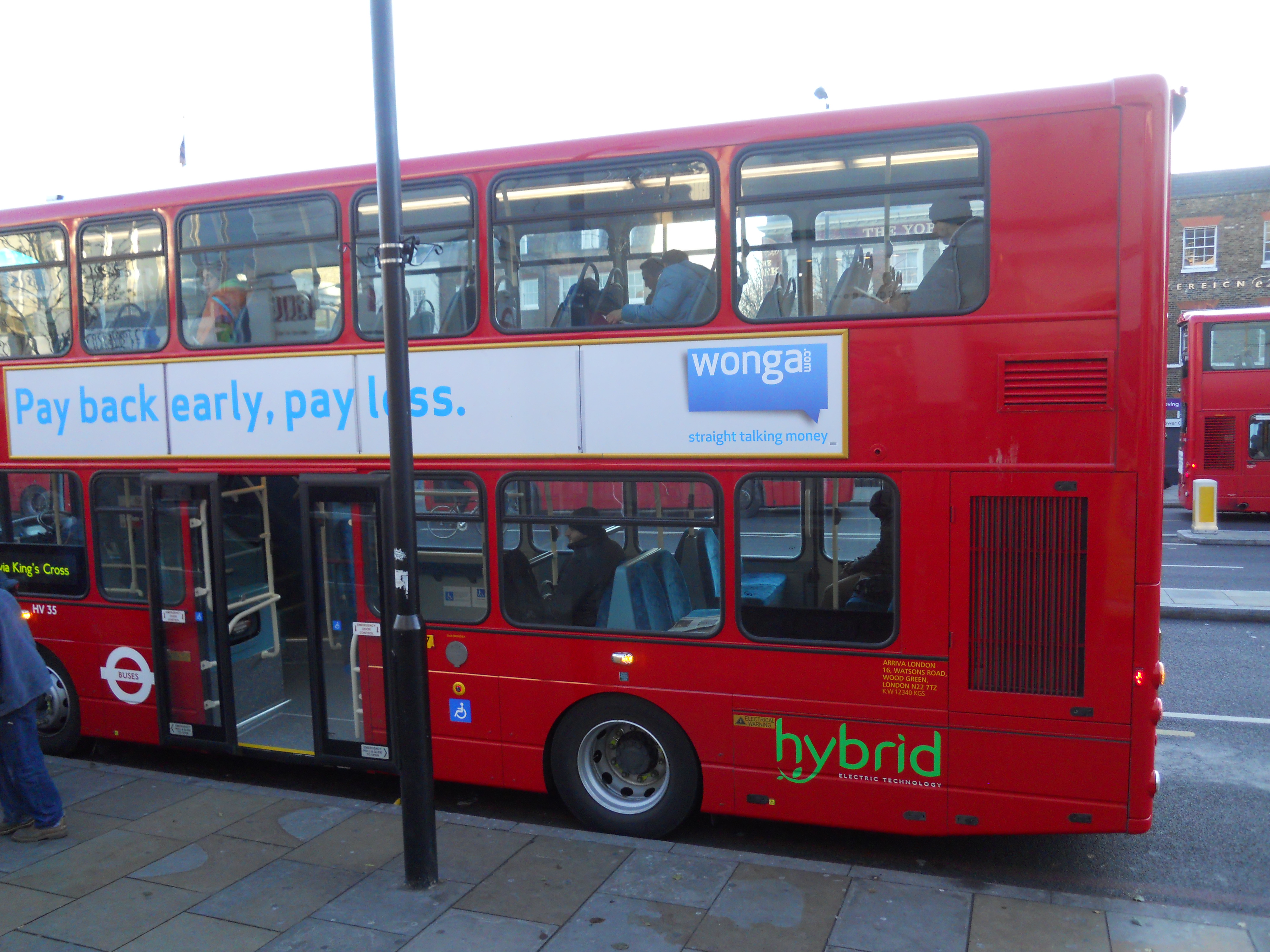
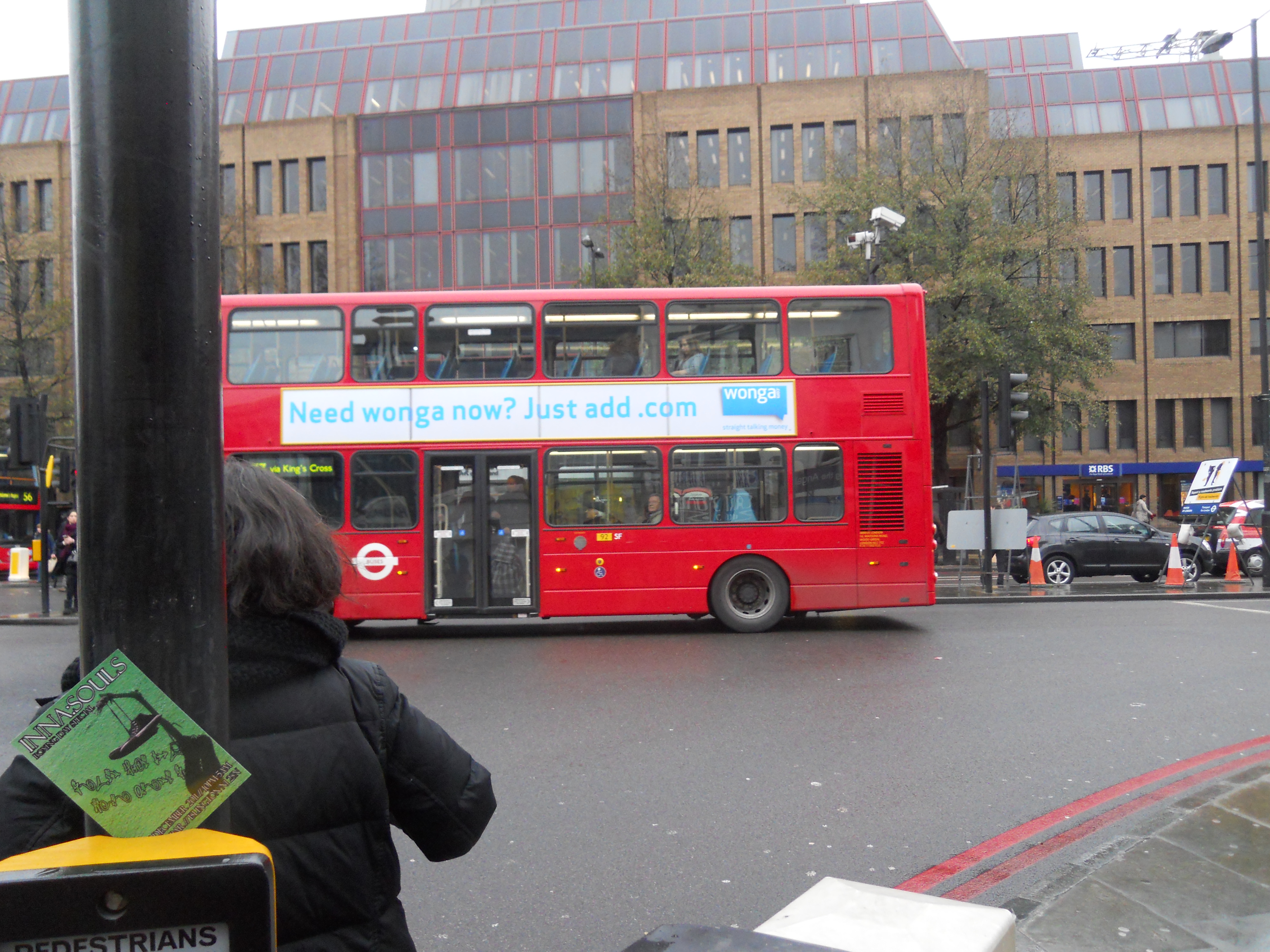
I hope that this advertising has the wrong effect from the company’s point of view. It may put the company’s name in the minds of possible punters, but if they don’t need a loan yet, it will also attract them to articles in the media, which is probably a good thing, as I’ve yet to see one that is the least bit positive towards Wonga!
Slogans I’ve seen so far include :-
THIS IS OUR SMALL PRINT
Pay back early, pay less.
How much? How Long? You decide.
Straight talking money.
Need wonga now? Just add .com
All seem to me to be rather too subtle for their target market.

