Calorie Counts on Menus
The government has agreed with the Food Network, that calorie counts are to be included on menus.
Surely, it would be better to have a special scanner on the entrance to establishments, such as McDonald’s and Pizza Hut, which decide whether you are allowed in or not!
On the other hand, some are so obese that they can’t manage the walk from their obese 4×4 to the door of the establishment.
I’ve Only Got a Gammy Left Hand!
My left hand is getting better, but I still have a degree of pain and lack of control in it, because of the stroke. But then Sarah Storey doesn’t have one at all.
But that didn’t stop her winning gold in the cycling at Manchester last night.
I think it decided what event I want to see in the cycling at the 2012 Olympics.
I’ve now registered for tickets.
If I do get to go, I’ll cycle there along the Regent’s Canal or through the parks. I may take the second option, as I can’t swim.
They Come in Other Colours Too!
The picture shows a friend with a trussed finger after an operation.

A Finger Trussed in Pink
Apparently, if you have a similar need, you can have them in other colours, so macho men could have dark blue or black, Arsenal supporters dould have red, Ian Paisley could have orange and the Pope could have purple.
A Coeliac’s Questions About Warfarin
My cardiologist, reckons that if I can keep to the Warfarin regime, then I won’t have another stroke and his advice is also reflected by other doctors.
I also asked my stroke doctor about the new drugs coming in, more out of curiosity than anything else, and it seemed he was not in favour of them, because we’re still uncertain about the long-term effects of the new drugs.
Of late though, I’ve been feeling wretched a lot of the time, with what is best described as flu-like symptoms and a very itchy skin, a rash and bad dandruff in my beard, just like I used to have before I went gluten-free. My toenails are bad and brittle although my fingernails have improved since Christmas.
I had put it all down to North London’s version of man-flu and the general cold and bad weather. Athough on some trips out of London, like the one to Barnsley, I seemed to feel better.
So I looked up the Mayo Clinic’s web site on Warfarin side effects. I’m not a great one for some health web sites, but this one is generally fairly reliable.
But it did seem that some of my problems could be down to the Warfarin. On the other hand they may not be.
But I think I might make one or two modifications to my lifestyle and go and see my doctor and my dentist, as some of my pain may be down to a tooth, I broke thirty years ago. It hadn’t given me much trouble until the stroke.
One modification I have made is to make the house cooler. This seems to have improved the flu-like symptoms, but my feet are now colder. And I’ve never ever worn slippers and won’t start now!
So it’ll be interesting to see how things work out.
One question though, is what is the best time to take Warfarin? I ask this as I normally take it about six in the evening and the itch seemed to get bad after I took it yesterday.
Larger Child Heart Surgery Centres
There is a debate about whether we should have fewer and larger centres for child heart surgery. The BBC is saying that some centres will be closed.
As someone, whose granddaughter was born with a serious medical problem and underwent serious surgery at a few days old, I can understand some of the emotions involved.
But too much of the arguments about more centres are about local pride and parents wanting to have their child referred to a local hospital.
But as someone, who has lost my wife and son to cancer in the last three years and has suffered a stroke, I would travel hours to get the best.
In my son’s case he was in a local hospital in Manchester, which was just too small to have the expertise to diagnose his pancreatic cancer and the diagnosis was not made until he was in Addenbrooke’s some time later. These smaller hospitals should be closed immediately. But then votes and local pride always override scientific correctness.
Beating IKEA
I ordered two bookcases from IKEA and they came this morning, courtesy of a cheery man from Parcelforce. They are now made up and installed in my living area.
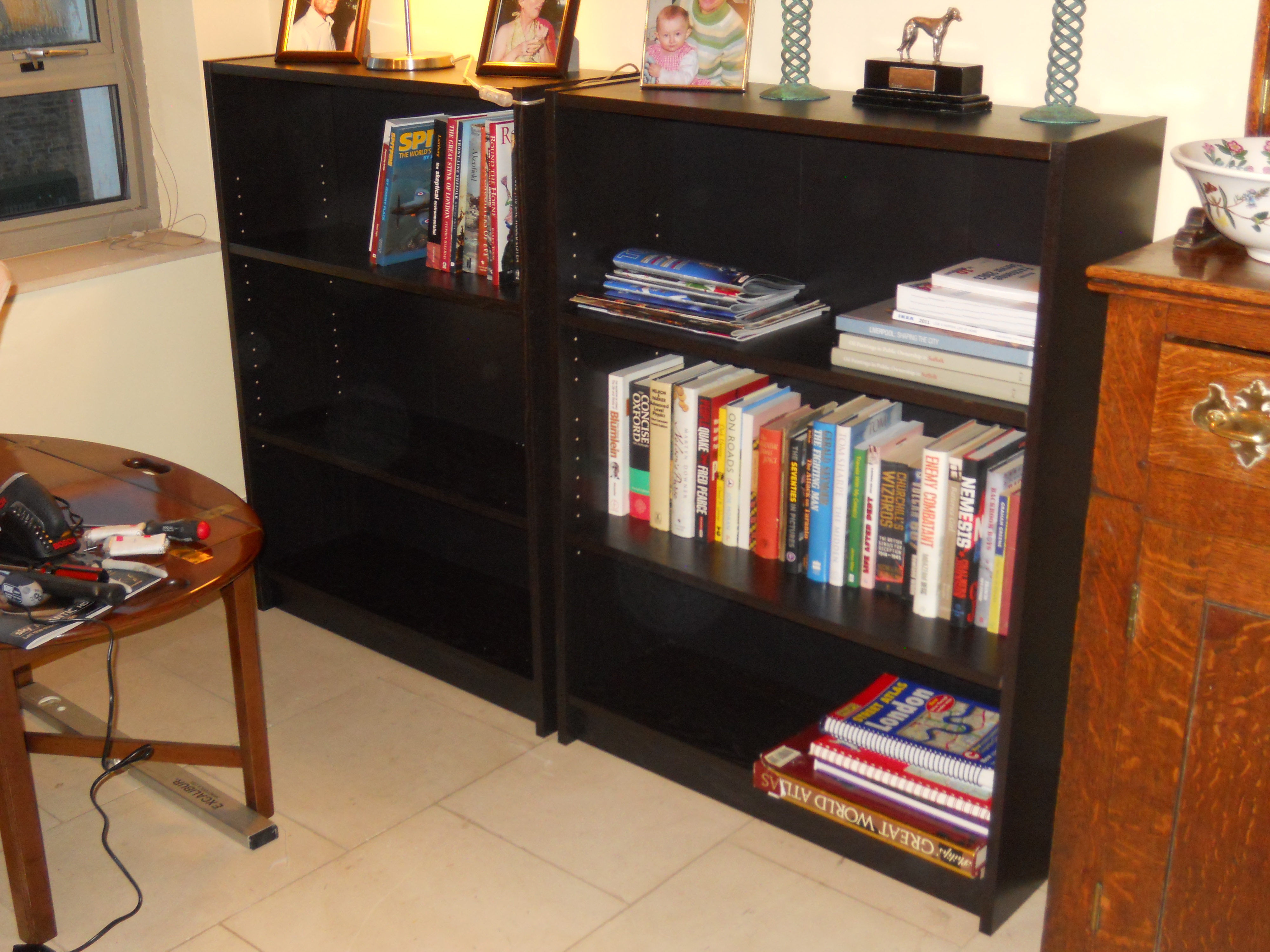
Two IKEA Billy Bookcases
At least they look quite square, even if they don’t match my dresser to their right. But then they were only £80 the pair and they were capable of being put together by a man with only one good hand, dodgy eyesight and not-fully-working brain. It could also be that in the words of the song, I’m getting better all the time.
So perhaps IKEA’s designs are not that bad. I would put in little improvements to the design of these bookcases, but mainly because it is quite easy to confuse which way some of the panels go. I’ve put together quite a lot of flat-pack furniture in my time and compared to the best, this scored about 6 out of 10.
The Link Between Junk Food and IQ
A study from the University of Bristol appears to show that children, who eat a lot of junk food, have lower IQ levels at eight.
Who’d have thought that all those burgers, sandwiches and breaded chicken were not good for you? After all they must be as when you travel around like I do, it is all I can find for lunch. So I take my own gluten-free meals. Perhaps most places are not as bad as Scunthorpe, but there are a few horrors out there.
It will be interesting to see if there is a correlation between children’s IQ and the quality of the special diets on offer in the location.
Death of a Friend
The trip to York yesterday was to visit my old boss from ICI and his wife. He has not been too well lately after a stroke and some complications, but his mind is still all there and just as when I went to Liverpool, we discussed engineering and put the world to rights. He also filled in some of the gaps in some of my stories, like the invention of plastic string.
However, the trip was overshadowed by learning about the death of one of my colleagues in Metier in a phone call on the trip north. Brian was the Finance Director and we couldn’t have wanted for a better one. Or a funnier and witty one for that matter! He had also been a good friend and confidant since the death of my wife and until a few months before his death, he could be relied upon to call regularly.
He will be missed by all who knew him.
Breast Cancer and Obesity
Two items on BBC Breakfast concern the increase in the incidence of breast cancer and also obesity. As the latter is known to be a factor in the first, isn’t it about time people got the message?
C had breast cancer, survived it and the squamous cell carcinoma of the heart that killed her was of a totally different type.
But she got her lump in exactly the same place, where a car airbag going off in an accident, caused quite a severe bruise. Her oncologist didn’t rule out the connection, especially as she was slim, fit, didn’t drink too much and ate healthily.
Gates Takes on Polio
Bill Gates has now turned his big guns on polio. Good!

