Labour Pledges To Cut Rail Fares By A Third
The title of this post is the same as that of this article on the BBC.
This is the first two paragraphs.
Labour has announced plans to slash rail fares by 33% and simplify ticket prices for part-time workers if it wins the election on 12 December.
The party also wants to make train travel free for young people under the age of 16 and build a central online booking portal with no booking fees.~
In other reports on the Internet, the cost is given at £1.5 billion and it would be paid for from existing transport budgets. Really!
Labour’s plan would have two immediate effects.
- More people would be using the trains and there would a need for much more investment to provide the extra capacity
- But the train companies would be unprofitable and would hand the franchises back, as they would effectively be bankrupt.
The government would probably want that, but would Bombardier, CAF, Siemens et al continue to supply the new trains needed to British Rail at prices determined by the government?
This Labour proposal has echoes of Saddiq Khan’s fare freeze to get elected as London Mayor, which has caused investment in London’s transport system to be delayed or cancelled.
The Ultimate Capacity Of The Moorgate Line
The Moorgate Line is an important commuter line to and from its terminus at Moorgate station within easy walking distance of the City of London.
I use the line regularly to travel between my house and Moorgate station for breakfast at Leon, followed by shopping in Marks & Spencer on Finsbury Pavement.
- I catch a 38 or 56 bus from close to my house to Essex Road station.
- I then take the Northern City Line two stops to Moorgate station.
After my breakfast and shopping, I generally get a 141 bus home, as it means less road crossings to get to my house.
A Useful Line That Needs Improvement
It is a useful and well-used line, that needs improvement in various areas, some of which is already being done or is either in planning or fully planned.
The New Class 717 Trains
The new Class 717 trains are now all running up and down without too many problems.
The trains have been designed for the route, so hopefully they have the following features.
- Fast and automatic voltage changeover between 25 KVAC overhead and 750 VDC third-rail at Drayton Park station.
- Ready for ERTMS signalling.
- 100 mph running, so they don’t get in the way of Thameslink trains on the East Coast Main Line (ECML).
- Fast acceleration and regenerative braking to batteries for fast station stops and train recovery, when power fails.
- Optimisation for fast entry and exit to the trains.
I am afraid that they don’t fully meet the last three points, but they should!
It will be interesting to compare these trains, with Stadler’s new Class 777 trains for Merseyrail, which are also replacing similar BR units.
I believe that regenerative braking to batteries is important for trains in tunnels, and as far as I can determine, only Bombardier’s Class 345 trains for Crossrail have it fitted.
- It reduces the power running in the overhead cables or third-rail in the tunnels, which generates less heat.
- Conventional braking can be avoided in tunnels.
- In case of power failure, the train can be moved to the next station for passenger evacuation.
If trains, tunnels and power supply are designed as a complete system, then surely there must be cost savings.
It is also probably true to say about these trains, that if the operator needed some more trains, then Siemens would probably oblige.
Upgrading The Route
The complete route consists of three separate parts.
- The Northern City Line between Moorgate and Finsbury Park stations.
- The slow lines of the East Coast Main Line to the South of Welwyn Garden City station.
- The Hertford Loop Line between Stevenage and Alexandra Palace stations
The big upgrade planned for the East Coast Main Line is to install ERTMS digital signalling between Doncaster and Kings Cross.
Network Rail are doing their first digital signalling design in a darkened room with no communication to the real world, but I believe if the project was designed by experienced engineers, the following will happen.
- Any train that might use the East Coast Main Line will be fitted with ERTMS signalling.
- This ERTMS roll-out must include all Class 717 trains, as these can use the East Coast Main Loop to Welwyn Garden City and at Stevenage station.
- As the Hertford Loop Line is used as a diversion for the East Coast Main Line, it would be logical to install ERTMS signalling on this route.
- Installing ERTMS signalling into Moorgate station would surely be beneficial and would surely be needed to get the best of ERTMS on the East Coast Main Line.
The outcome should be that the whole Moorgate Line will become a fully digitally signalled route.
This should increase train frequency and capacity on all the digitally signalled routes.
- The fast lines of the East Coast Main Line will become a 140 mph race track.
- The slow lines of the East Coast Main Line will allow extra services.
- If coupled with track improvements, extra capacity on the Hertford Loop Line could be used to allow services to by-pass the bottleneck of the Digswell Viaduct with its limited pair of tracks.
- The Northern and City Line could take extra trains to and from Moorgate.
There could be reorganisation of some services.
- Kings Cross and Cambridge/Ely/Kings Lynn services would be run by 140 mph trains, so they could use the fast lines on the East Coast Main Line. I feel these services could be extended to Norwich, but that’s another matter. What would Alan Partridge think of High Speed Norwich?
- Thameslink services serving Peterborough would still use the East Coast Main Line, so they could call at Welwyn North and Knebworth stations, but why not divert the four trains per hour (tph) that serve Cambridge onto the Hertford Loop Line at Stevenage, to ease pressure over the Digswell Viaduct.
Consider.
- An upgraded Hertford Loop Line with full digital signalling could be able to handle as many as the twenty-four tph of Thameslink and Crossrail,
- The grade-separated junction with the East Coast Main Line is being improved.
- There are only infrequent freight trains on the Hertford Loop Line.
- Various platform upgrades at Hertford East and Gordon Hill could allow passing and more turnbacks.
My scheduling experience says that with a well-programmed computer calling the shots, that at least twenty tph along the Hertford Loop Line would be a serious possibility.
Improvements At Stevenage
The Stevenage improvements are very comprehensive and are designed so that however many trains run through the Hertford Loop, they can all stop in the station, if required.
Improvements At Alexandra Palace
If you are travelling North from Moorgate and find yourself on an East Coast Main Line service, when you need a Hertford Loop one, there is a cross-platform interchange at Alexandra Palace station, where the two routes are on either side of the platform.
It is convenient, but the platform needs better facilities, like a decent waiting room, better information screens and possibly a coffee stall and toilets.
Going South, there are two separate platforms, but this doesn’t matter, as there is no need to change.
Although surely, if all trains left from the same island, it would be easier for passengers.
The station would be improved with a properly-designed step-free bridge and information screens.
Passengers needing other than Moorgate as a final destination must change at Finsbury Park for Thameslink or the Piccadilly Line
The Knitting At Finsbury Park
This map from carto.metro.free.fr shows the tangle of lines at Finsbury Park station.
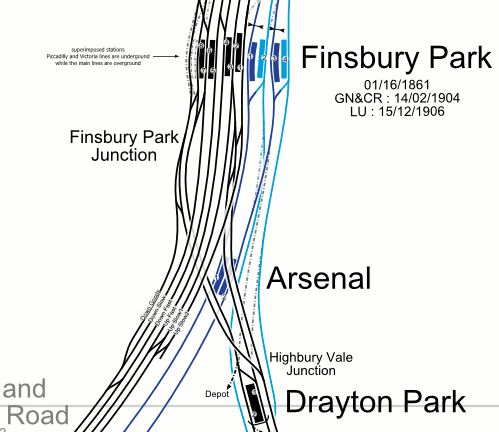
Note that the blue lines are the Victoria and Piccadilly Lines.
Improvements in the last few years have unlocked some of the station’s potential, but there is still plenty of space on the railway land to add extra tracks and possibly reinstate two more platforms.
If there are any train capacity problems, I believe that they can be solved.
The main passenger interchanges at Finsbury Park station are.
- An up-and-down interchange with the Piccadilly Line
- A cross platform interchange with Thameslink
Lifts have been added recently.
Improvements At Drayton Park Station
Drayton Park station is one of those stations, that should be given to developers with a blessing and a very detailed set of objectives and timescales enshrined in a watertight contract.
- The station sits very close to the Emirates Stadium.
- The new trains have increased passenger capacity through the station.
- It could handle much-more match day traffic.
- Large amounts of housing could be built on top.
If done well, it could provide a lot of housing and take the pressures off the other stations in the area on match days.
Improvements At Highbury & Islington Station
This map from carto.metro.free.fr shows the lines at Highbury & Islington station.
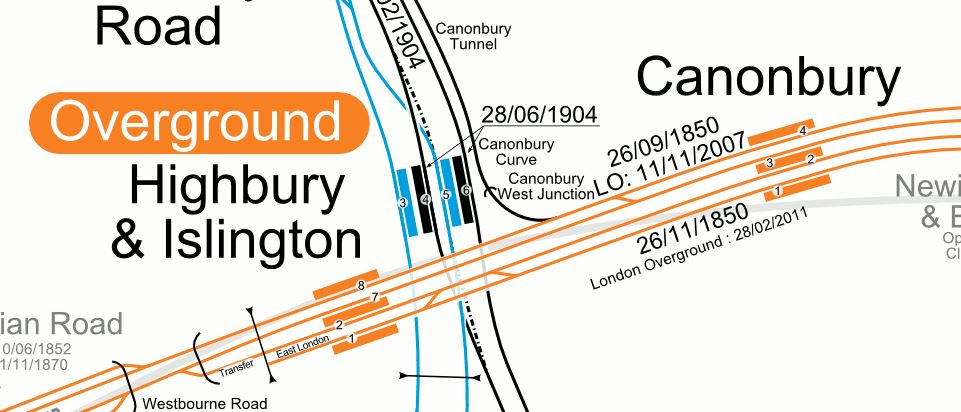
The track layout is basically sound.
The cross-platform interface between the Victoria and Moorgate Line is superb and only needs a good team of builders and lighting specialists to give it a modern finish to make it even better.
The Overground will get better too, as service frequencies increase by up to fifty percent.
The big problem at Highbury & Islington station is that access to the deep level platforms is not fit for purpose.
It is an absolute disgrace that The Mayor and Transport for London have put forward no plan to solve the problem of access to the deep level platforms.
The solution would probably involve opening up the disused station entrance on the on the side of Holloway Road and sinking an escalator and lift shaft to the four platforms. As at Drayton Park station, I believe with the right contract, it could be handed to a developer.
At least Crossrail, when it opens might give a bit of relief in the Peak. Many passengers might avoid Highbury & Islington station altogether by changing between the Overground and Crossrail at Whitechapel.
Like water, passengers tend to flow through the widest channels and find their own level.
Improvements At Essex Road Station
Essex Road station is a disgusting station, with all the charm of a Victorian slum.
As with Drayton Park station, it should be given to developers with a blessing and a very detailed set of objectives and timescales enshrined in a watertight contract.
Improvements At Old Street Station
The access to the existing Old Street station is being improved, but it seems to be taking forever.
I do hope, there is a realistic plan to create a flagship station for Silicon Roundabout.
Improvements At Moorgate Station
This station is being fully upgraded for Crossrail.
Eventually, there will be step-free access between the following lines.
- Central Line
- Circle Line
- Crossrail
- Hammersmith & City Line
- Northern Line
In addition all the National Rail lines out of Liverpool Street will be step and weather-free from all the other lines.
This can only increase the number of passengers using the Moorgate Line.
The Ultimate Frequency
I said earlier that the complete route consists of three separate parts.
- The Northern City Line between Moorgate and Finsbury Park stations.
- The slow lines of the East Coast Main Line to the South of Welwyn Garden City station.
- The Hertford Loop Line between Stevenage and Alexandra Palace stations
These are my thoughts on the capacity of each section.
Frequency Of The Northern City Line
I know Walthamstow Central station on the Victoria Line well and have observed the following.
- Thirty-six tph come and go for most of the day.
- From the time the brakes are applied after a train arrives until the time they are release when the train leaves is about two and a half minutes.
- Drivers use a procedure called stepping-up to speed the turnround. The driver leaves the arrived train and a new driver gets in at the other end, to drive it out.
- There is a lot of passenger congestion in the Peak, due to bad passenger access.
Surely, if Dear Old Vicky can handle thirty-six tph with the following.
- Two platforms,
- Modern trains
- Modern signalling
- Well-trained staff
- Not the best passenger access with just two escalators.
Then the new Class 717 trains at Moorgate with the best passenger access can handle a higher frequency than they do now!
I suspect that around twenty tph can be achieved fairly easily, but that in future , a higher frequency will be achieved.
Frequency Of The Slow Lines Of The East Coast Main Line
London has several commuter lines with frequencies of over 10 tph.
- Foremost, are Crossrail and Thameslink, which are both planned to run at 24 tph
- The East London Line is also planned to increase from 16 tph to 20 tph.
- The North London Line is planned to be increased from its current eight tph
- Waterloo and Wimbledon is upwards of 8 tph.
In addition most London Underground lines have frequencies in excess of 16 tph.
The slow lines of the East Coast Main Line to be a railway, in a few years time with the following characteristics between Finbsbury Park and Welwyn Garden City.
- At least one track in each direction.
- An operating speed of over 60 mph
- ERTMS signalling, which will be fitted to all trains on the lines.
I can’t see any reason, why the lines couldn’t be able to handle up to twenty tph in both directions, based on the experience of other lines in London, that have been operating for over a decade.
But strand on the bridge for an hour at a station like Oakleigh Park, at a busy time of day and you’ll be lucky to see ten trains.
There is a lot more capacity on the slow lines of the East Coast Main Line, to use to add extra services between London and Welwyn Garden City.
Adding services that go further North than Welwyn Garden City will need a solution to the double-track section over the Digswell Viaduct.
Frequency Of The Hertford Loop Line
I said this earlier.
My scheduling experience says that with a well-programmed computer calling the shots, that at least twenty tph along the Hertford Loop Line would be a serious possibility.
I also think that the slow lines of the East Coast Main Line can handle the same frequency, so I very much stand by my original figure.
Is There An ERTMS-based Solution To The Digswell Viaduct?
I answer that question in Is There An ERTMS-based Solution To The Digswell Viaduct?.
Some Questions
Various people over recent months have asked me questions about possible improvements to the Moorgate Line.
Could There Be A Direct Escalator Connection Between Bowes Park Station On The Hertford Loop Line and Bounds Green Station On The Piccadilly Line?
This map from carto.metro.free.fr, shows the two stations.
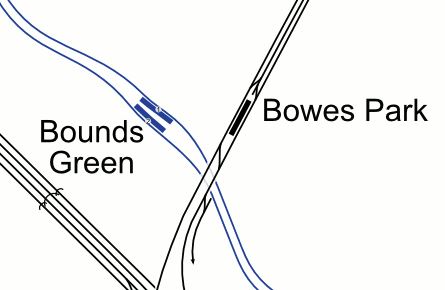
Bounds Green station is one of the Piccadilly Line’s classic stations.
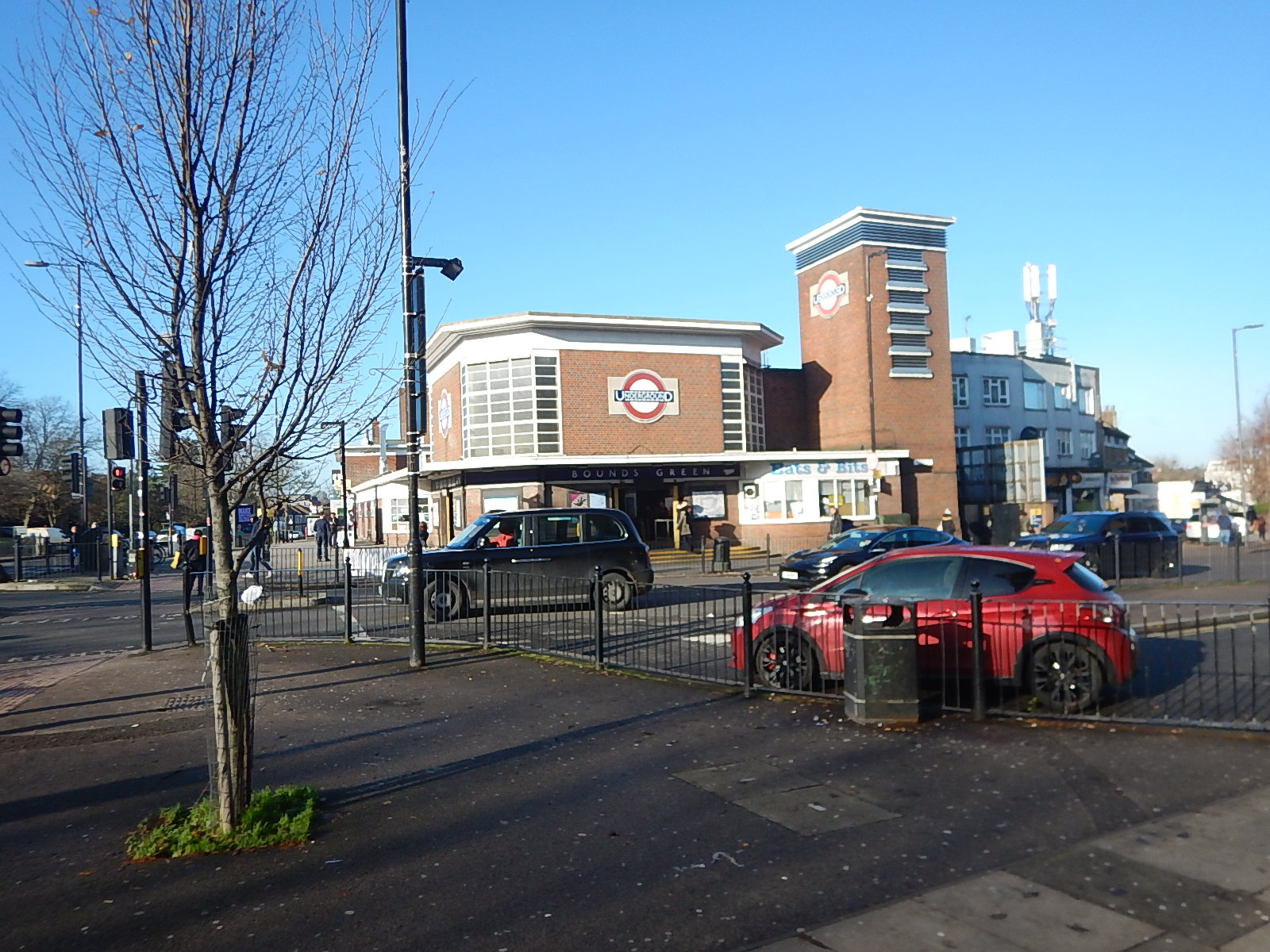
I took the picture, when I walked between the Bowes Park and Bounds Green stations
It is a level walk, that could be better signed and if the two stations were to be made step-free it would be an easier interchange than that at Finsbury Park.
In my view, improving the two stations and the local environment, would be much better value than an expensive escalator connection.
Should There Be A Second London Terminal?
Kings Cross is used as a London terminal at times, but would there be much of a necessity.
Passengers can use the following connections to get to Kings Cross and other stations along Euston Road.
- A cross-platform interchange at Finsbury Park with Thameslink
- A cross-platform interchange at Highbury & Islington with the Victoria Line
- When Crossrail opens, there will be a step-free connection with the Circle, Hammersmith & City and Metropolitan Lines at Moorgate.
Passenger numbers will decide.
Could The Moorgate Line Be Extended South To Bank Station?
The original Victorian plans for the Moorgate Line show the line extended to a station at Lothbury, which is just behind the Bank of England. This Google Map shows the area.
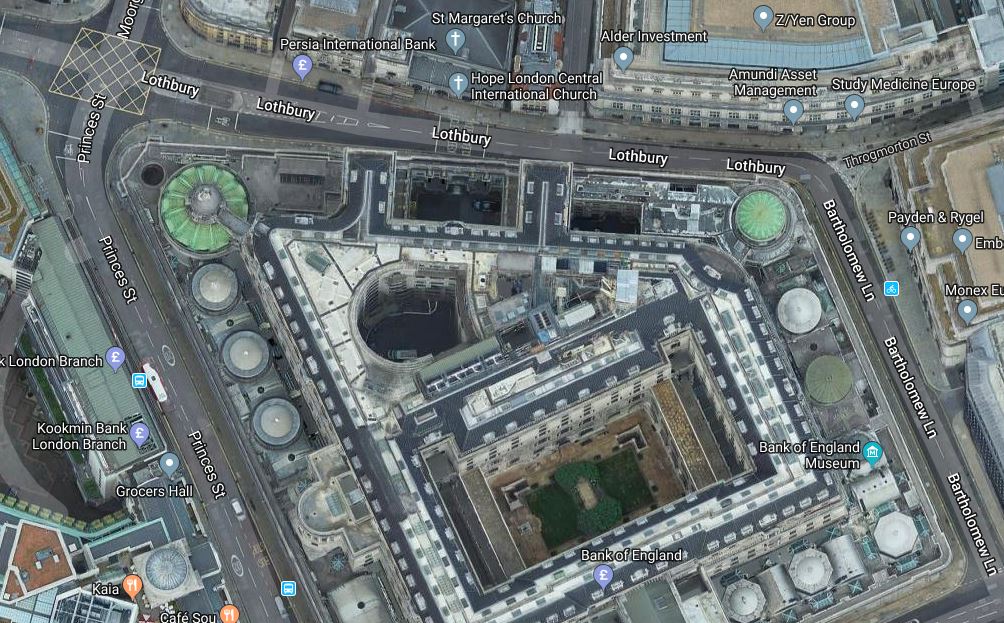
These pictures show the area, where Lothbury and Moorgate meet.


Given the difficulty of handling the logistics of all the tunnelling for the Bank station upgrade, I don’t think the City of London would look too kindly on a rail extension between Moorgate and Bank, especially, as there is already the Northern Line and even I can walk it easily.
It could be argued as Moorgate is served by Crossrail and Bank station isn’t, that there will be a high level of passenger traffic between the two stations.
Consider.
- It is only five hundred metres to walk.
- The Northern Line is jammed solid between London Bridge and Kings Cross in the Peak.
- After the completion of the massive Liverpool Street-Moorgate double-ended Crossrail station and the Bank Station Capacity Upgrade, a one stop on either the Central Line or the Northern Line will be step-free.
- The Liverpool Street-Moorgate Crossrail station will hopefully have a selection of entrances with good connections to walking routes leading South towards Bank.
- The City of London is planning to make the streets of the city more friendly to walking and cycling.
- More and taller towers are increasing employment in the City.
Will the walking routes and the Central and Northern Lines be overwhelmed?
I think they could be, but there could be other solutions.
- Opening up of more walking routes and improving the already pretty good street maps and signage.
- A redesign of the bus network with high capacity electric buses taking over the routes between Old Street and London Bridge stations.
I also wonder, if it would be possible to dig a pedestrian tunnel between the two stations under the existing roads and fit it with travelators.
The ingenuity that has been shown in the Bank Station Capacity Upgrade has probably suggested a few ideas.
But I’m absolutely sure there will be no extension of the railway pass Moorgate.
Is The Interchange With Thameslink At Finsbury Park Frequent Enough?
It seems that Thameslink will run four tph through Finsbury Park station.
- All will have cross-platform interchange with Moorgate Line services.
- All services will serve London Bridge, East Croydon and Gatwick Airport stations.
Are these enough services?
Passenger numbers will decide.
Should Some Thameslink Services Use The Hertford Loop?
I said this earlier.
Thameslink services serving Peterborough would still use the East Coast Main Line, so they could call at Welwyn North and Knebworth stations, but why not divert the four trains per hour (tph) that serve Cambridge onto the Hertford Loop Line at Stevenage, to ease pressure over the Digswell Viaduct.
It possibly is an idea, but I also believe, that ERTMS signalling could offer an elegant solution to the Digswell Viaduct problem.
Could The Moorgate Line Have Some New Park-An-Ride Stations?
There are two possibilities on the Hertford Loop Line.
This Google Map shows where the Hertford Loop Line crosses the M25, to the North of Crews Hill station.
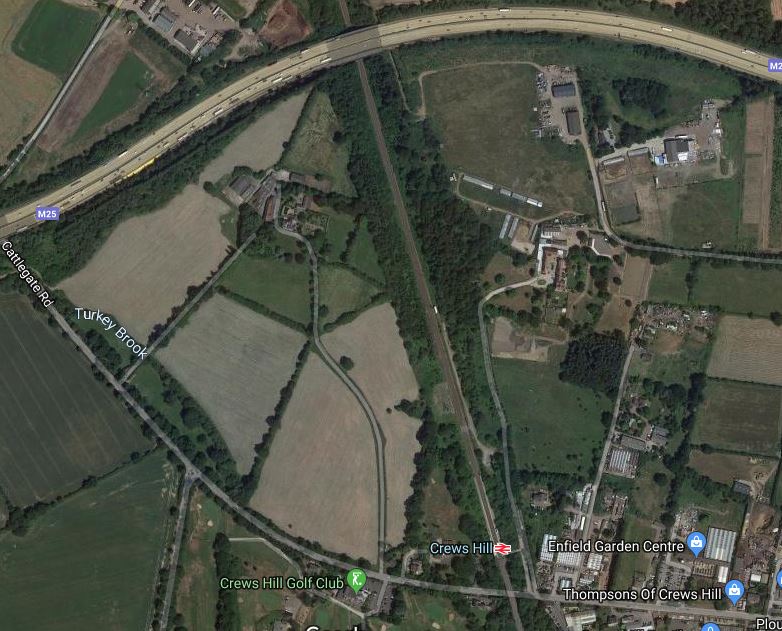
It would probably be impossible to build a Park-and-Ride station in this area now, but if the M25 had been designed in an holistic and environmentally-sympathetic manner, it could have been a place for such a facility.
There must also be the possibility of building a Park-and-Ride or more likely a Cycle-and-Ride station to the South of Stevenage, as the town develops, as it surely will in the next decade.
From my helicopter, it doesn’t look promising to add more parking except possibly at Hadley Wood station. This page from Hansard is a good summary of GNER’s original proposal in about 2000.
Should The Moorgate Line Be Taken Over By Transport for London?
Consider.
- This is certainly a desire of the London Mayor; Saddiq Khan.
- After the farce of the Metropolitan Line Extension at Watford will Greater London and Hertfordshire be able to work together over the route?
- There are twelve stations in Hertfordshire and twenty in Greater London.
- Stations are in four Greater London Boroughs; Barnet, Enfield, Haringey and Islington with Moorgate actually in the City of London.
The line might improve as part of Transport for London, but agreeing the management and development strategy for the line, with all those politicians of different colours, could be a nightmare.
Conclusion
Without doubt all of the parts of the Moorgate Line can handle at least twenty tph and possibly more, once the following conditions are met.
- Full ERTMS signalling on all lines.
- The stations are capable of handling the increased number of passengers.
- There are a few more trains.
Automatic Train Control may need to be used in certain sections, as it will be on Crossrail and Thameslink.
What Would This Mean For Passengers?
The current pattern of train services in the Off Peak is as follows.
- 4 tph – Welwyn Garden City
- 2 tph – Hertford North
- 1 tph – Watton-at-Stone
- 1 tph – Stevenage
Note.
- This is well below the future capacity of the section between Moorgate and Alexandra Palace stations
- It needs eight trains for each branch or a total of sixteen trains.
The simplest pattern would be twenty tph between Moorgate and Alexandra Palace stations, which would serve the following destinations.
- 10 tph – Welwyn Garden City
- 5 tph – Hertford North
- 5 tph – Stevenage
Note.
- Intermediate stations, like New Barnet and Cuffley would get a train every six minutes.
- The service would need forty trains.
- I doubt Great Nortern would want to finance the extra trains.
Cutting the service back to somewhere in between would also work.
- 6 tph – Welwyn Garden City
- 3 tph – Hertford North
- 3 tph – Stevenage
Note.
- Intermediate stations, like New Barnet and Cuffley would get a train every ten minutes.
- The service would need twenty-four trains.
As there are twenty-five Class 717 trains, is this Great Northern’s plan?
It looks to me like a plan designed by Great Northern’s accountants based on the least they can get away with.
An Improved Service For South Hertfordshire
Consider.
- The extra platform and remodelling at Stevenage station are ambitious and the new platform could probably handle six tph.
- Stevenage has an LN|ER service to the North of two tph.
- East Coast Trains intend to start a service linking Stevenage to Newcastle and Edinburgh.
- Healthcare in South Hertfordshire sends patients to hospitals at Barnet and Stevenage, neither of which are easy from a station like Cuffley
- Bus services across are not for the frail, elderly and impatient.
- There is no rail link between Hertford and Hatfield except with a change at Alexandra Palace station, which is not step-free.
Perhaps the Moorgate train service should be as follows.
- 8 tph – Welwyn Garden City
- 4 tph – Hertford North
- 4 tph – Stevenage
Note.
- Importantly, there would be four tph to between Alexandra Palace and Stevenage.
- The Stevenage services would link up to the improved fast services between Stevenage and the North of England and Scotland.
- Intermediate stations, like New Barnet and Cuffley would get a train every seven-eight minutes.
- The service would need thirty-two trains, which is probably another eight trains.
I also think, that Alexandra Palace station should be made step-free to ease journeys from one side of Hertfordshire to the other.
.
Labour Responds To Tories’ Promise Of High Speed Hastings Trains
The title of this post is the same as that of this article on the Hastings Observer.
This is a paragraph.
The Tories would have to spend a vast amount of money, upwards of £20 billion, to create a faster rail service between Hastings and London, Labour said.
This is based on the cast per mile of HS2, but the only work would be some new track and electrification, so that electric trains with batteries could go between Ashford and Hastings.
I doubt it would cost more then fifty to hundred million pounds in total.
RSSB Appoint Arup To Review Hydrogen Trains
The title of this post is the same as that of this article on Rail Technology Magazine.
This is the first two paragraphs.
The Rail Safety and Standards Board (RSSB) has tasked Arup with developing a case for hydrogen-powered trains on the Great Britain (GB) mainline.
The review will move to establish a high-level operational concept, any relevant operational hazards and obligations of regulation.
This must be good forward thinking.
Battery Trains To Be Tested In Denmark
The title of this post is the same as that of this article on Railway Gazette.
This is the introductory paragraph.
Suppliers are to be invited to test battery-powered trains on regional lines in late 2020 and early 2021, ahead of a potential order which could see battery trains enter passenger service from 2025.
This order follows on from three confirmed or possible German battery train orders in Schleswig-Holstein, Baden-Württemberg and Chemnitz.
So far interest in battery trains in the UK, has not been so strong, with only orders in Wales.
Ipswich and Felixstowe In A New Class 755 Train
These pictures show my trip frip from Ipswich to Felixstowe and back in a new Class 755 train.


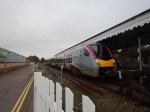
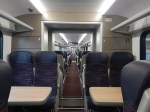
Some points about the journey.
The Class 755 Train Was Fast
Between Derby Road and Trimley stations, the train rattled on at around 70 mph, which is consistent with the current operating speed of 75 mph of the Felixstowe Branch Line.
Looking at Real Time Trains, my train yesterday took four minutes to do the eight miles between Derby Road and Trimley stations and arrived four minutes ahead of schedule.
- The acceleration and deceleration of the new trains is much faster than that assumed for trains on the line.
- The new track is probably capable of handling faster trains.
- The figures on Real Time Trains have a measure of error.
Once the Class 755 train had cleared the junction at the start of the loop, the freight train waiting to come out could leave.
The New Loop
The train I took, illustrated how the new loop allows a passenger train to into into Felixstowe, at the same time as a freight train is coming out.
- The freight train positions itself in the loop.
- The Class 755 train, goes like a rat up a drainpipe down the Northern track and stops into Trimley station.
- As soon as the Class 755 train has passed the freight train, the freight train continues through Derby Road and Westerfield stations to the Great Eastern Main Line..
It looks like the performance of the Class 755 trains, is used to make sure the required timetable is kept.
Could A Second Half-Hourly Service Passenger Service On The Branch?
Consider.
- Felixstowe and the surrounding villages is an area that could be developed with more housing, so there could be a large increase in passenger traffic between Ipswich and Felixstowe.
- The new trains could be very successful in attracting new passengers to the route.
I would be very surprised if Network Rail had designed the new loop at Trimley, without a plan to allow it to be upgrdaed to a half-hourly service.
Are Train Services Around Norfolk And Suffolk Unbalanced?
Consider the following services in trains per hour (tph) after Greater Anglia’s proposed changes in their franchise.
- Cambridge and Bury St. Edmunds- 1 tph
- Cambridge and Ipswich – 1 tph
- Cambridge and Norwich – 1 tph
- Cambridge and Peterborough – 1 tph
- Cambridge and Stansted Airport – 2 tph
- Ipswich and Bury St. Edmund’s – 2 tph
- Ipswich and Colchester – 4 tph
- Ipswich and Lowestoft – 1 tph
- Ipswich and Norwich – 3 tph
- Ipswich and Peterborough – 1 tph
- Lowestoft and Great Yarmouth – 0 tph
- Norwich and Great Yarmouth – 2 tph
- Norwich and Lowestoft – 1 tph
- Norwich and Peterborough – 1 tph
Note.
- Most services are a measly 1 tph. Especially, if you’ve walked or cycled to a bleak station and just missed a train.
- Norwich and Ipswich get 3 tph, whereas Norwich and Cambridge and Ipswich and Cambridge get just 1 tph.
- East West Rail will add an extra 1 train per two hours on the Norwich and Cambridge and Ipswich and Cambridge routes, but improvements are needed now.
I would recommend.
- Two tph between Cambridge and Ipswich, Norwich and Peterborough.
- A direct Norwich service to Kings Cross, via Ely and Cambridge.
- Building Cambridge South station tomorrow!
- Terminate the Ipswich and Cambridge service at Cambridge South.
- All passing services would stop at Cambridge South.
- Add a second Ipswich and Cambridge service that terminated at Stansted Airport.
- Run a high-frequency local shuttle between Ely and Cambridge South stations.
- Improve the frequency on as many of the other routes as possible.
The could also be some new stations.
East-West Eail Link
This report on the East-West Rail web site is entitled Eastern Section Prospectus and gives full details of their proposals for the train services along the East-West Rail Link, to the East of Cambridge.
These are the main proposals as regards passengers.
- A new A14 Parkway station will be built to the North of Newmarket, where the railways and the A14 and A11 cross.
- Passenger services between Ipswich and Felixstowe will be replaced by a four tph tram-train running on the Felixstowe Branch Line and through the streets of Ipswich. Read all about it in Could There Be A Tram-Train Between Ipswich And Felixstowe?.
- The current hourly Ipswich and Cambridge service will be replaced or more likely augmented by an hourly Manningtree and Oxford via A14 Parkway, Cambridge and the East-West Rail Link.
- Combined with the Colchester and Peterborough service, there will be two tph between Ipswich and A14 Parkway via Needham Market, Stowmarket and Bury St. Edmunds.
- The current hourly Norwich and Standsted via Cambridsge service will be replaced or more likely augmented by a Reading and Great Yarmouth service via Cambridge and Norwich.
The two new East-West Rail Link services, which could be run by a train similar in design and performance to one of the new Hitachi expresses would act as both local and long distance trains to and from Cambridge and the West.
A Cambridge Crossrail?
Cambridge dominates the whole of the East of England and has a voracious appetite for more people to work in the high-tech businesses.
- Travel to Cambridge by train in the morning from London and there are large numbers of commuters going North.
- A large quantity of housing is being built at places like Bury St. Edmuds, Cambourne, Haverhill, Huntingdon, Lakenheath, Newmarket, Peterborough, Royston, Soham, Thetford and Wisbech.
Some places, where large developments are happening, have poor or no rail access to the City.
I believe the solution is a high-frequency local shuttle across the City.
- The core stations would be Ely, Waterbeach, Cambridge North, Cambridge and Cambridge South.
- The core frequency would be up to twelve tph between Cambridge South and Ely.
- Cambridge South station would turnback most Cambridge Crossrail services in the South.
- There could be additional Southern terminals at Haverhill, Royston and Stansted Airport
- Ely station would turnback most Cambridge Crossrail services. in the North.
- There could be additional Northern terminals at A14 Parkway, Bury St. Edmunds, Thetford and Wisbech.
Most of the infrastructure is already in place, but the following would be needed.
- Improvement of Ely station.
- Building of a junction, so that trains and passengers could go between Cambridge North and Bury St. Edminds stations without a change of train nor a reverse.
- Reinstate the Wisbech Branch with a new station in the town.
- Build the new Cambridge South station.
- Connect Haverhill to the West Anglia Main Line with a simple single-track branch.
The core section would use the same platforms as other trains on the route, to make interchange between services easier and stations more affordable.
A14 Parkway Station
Rereading this article, I believe that this station should be built as soon as possible.
Conclusion
Services in Cambridgeshire, Notfolk and Suffolk can be improved greatly and they need to be to allow, the UK’s premier Powerhouse to grow.
Are There Seat Reservation Systems On Class 755 Trains?
Greater Anglia’s Class 755 trains may have been ordered mainly for local routes in Norfolk and Suffolk, but they are also going to work some long routes.
- Colchester and Peterborough – 79 milrs
- London Liverpool Street and Lowestoft – 118 miles
- London Liverpool Street and Norwich 114 miles
- Stansted Airport and Norwich – 92 miles
- London Liverpool Street and Norwich via Cambridge 134 miles
These distances are ones, where passengers like to have a reserved seat and you can certainly get reservations on London and Norwich services.
Look at this picture of the window in a Class 755 train.
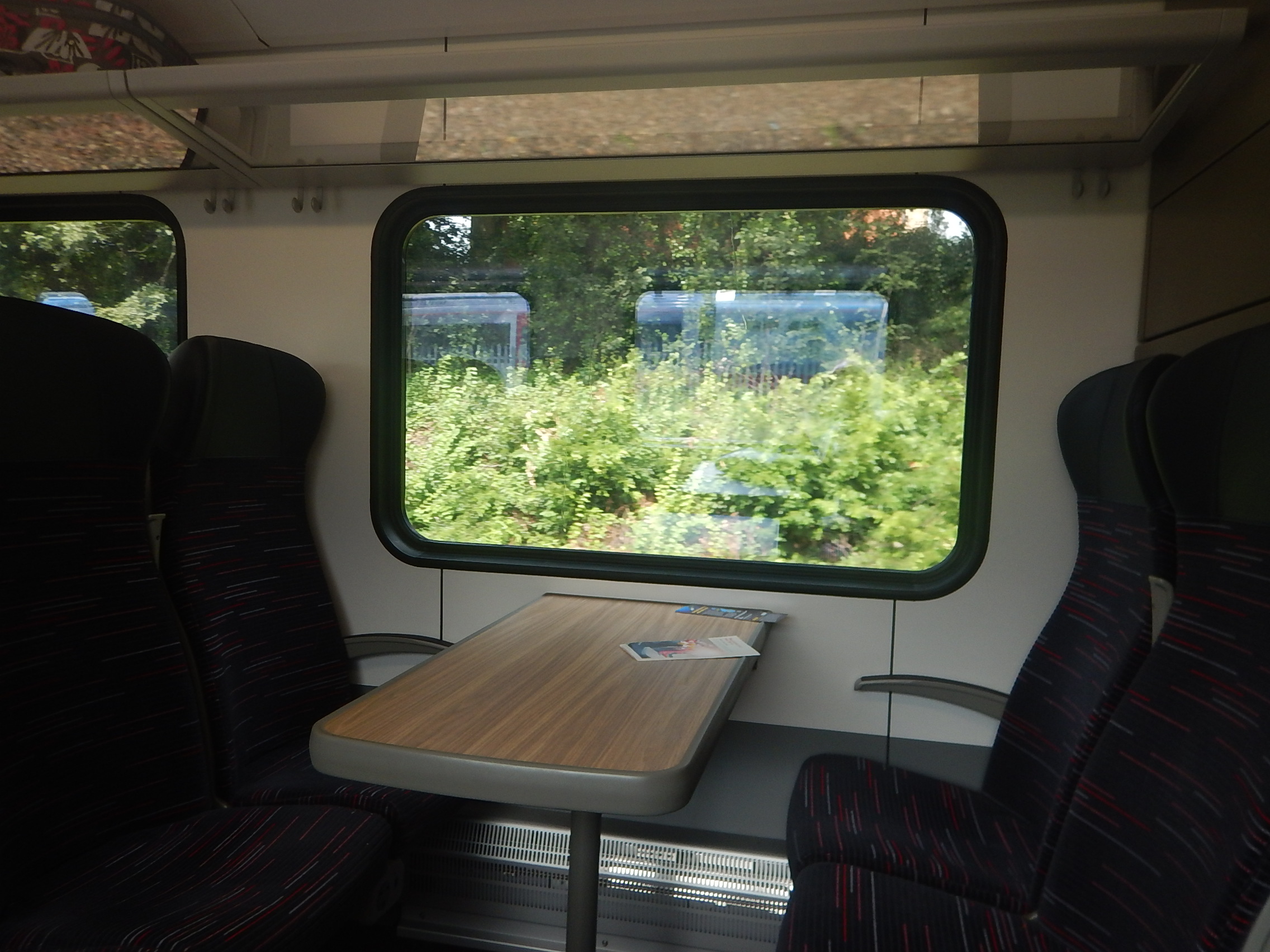
There would appear to be no reservation displays.
Perhaps, they haven’t been fitted yet?
But, it these trains ever run London and Norwich services, via Cambridge because of a weather or power supply emergency, they will need a reservation system.
Can Greater Anglia Run Four-Car Class 755 Trains On Most Services?
Greater Anglia will eventually have the following fleet of Class 755 trains.
- 14 x three-car
- 24 x four-car
Note that only four-car trains are in service.
How Many Trains Are Needed For Each Route?
A rough calculation gives theses trains for various routes.
- Colchester and Peterborough – four trains
- Ipswich and Cambridge – four stains
- Ipswich and Felixstowe – one train
- Ipswich and Lowestoft – three trains
- Norwich and Great Yarmouth/Lowestoft – two trains
- Norwich and Sheringham – two trains
- Norwich and Stansted Airport – four trains
- Sudbury and Colchester Town – two trains
This makes a total of only twenty-two trains. And Greater Anglia have a fleet of twenty-four!
I have seen it written that the Sudbury and Colchester Town service will be run using three-car trains.
Trains North Of Ipswich And Cambridge
Sp it looks like all trains North of Ipswich and Cambridge can be four-car trains, as there are enough trains.
It also gives operational advantages for services to Norwich.
- I took a train from Cambridge to Norwich and noticed, that after unloading passengers at Norwich, it picked up a load more for Cromer and Sheringham and reversed out of the station.
- Norwich services to Great Yarmouth and Lowestoft weave a pattern between the City and the coast all day.
- A spare can be based at Norwich Thorpe Depot, in case a train fails.
- I assume that one Class 755 train can act as a Thunderbird or rescue locomotive for a stalled train.
Ipswich station could see a major sort-out.
- Only three services to and from Cambridge, Felixstowe and Lowestoft, will terminate and go North at the station.
- Will eventually all these services turnback in the bay platform 1?
- Through services going South from Norwich and Lowestoft would use Platfoirm 2
- The new Peterborough and Colchester service will use Platform 2, when going South.
- All Northbound through services would use Platform 3.
- Terminating services from London will use Platform 4.
It looks like Greater Anglia’s proposed timetable simplifies operation at Ipswich and means no new building there.
I suggested that the three services from Cambridge, Felixstowe and Lowestoft all terminate in Platform 1.
- Platform 1 can handle a four-car Class 755 train.
- Three trains per hour (tph) could easily be accommodated in one platform.
- There is space around the platform to improve the passenger experience.
There may be the possibility to use the trains more efficiently.
- Ipswich and Lowestoft currently takes 91 minutes
- Ipswich and Cambridge currently takes 81 minutes
The Class 755 trains will shave a few minutes off these times, but they will still result in a long wait at terminals.
Combining the two services with a reverse at Ipswich might be advantageous.
- Greater Anglia could need less trains for the service.
- Passengers would have extra route choices.
There are some interesting possibilities.
Where Will The Three-Car Trains Be Used?
I believe and I have tried to show the possibilities, that Greater Anglia will use four-car trains efficiently on all their core routes, with the exception of Sudbury and Colchester Town, where three-car trains will be used.
So where will the other three-car trains be used?
New Services
Greater Anglia, Network Rail and politicians have talked about the following new services.
- A direct service between Lowestoft and Great Yarmouth via Reedham.
- Reinstatement of the March and Wisbech service.
- Partial reopening of the Aldeburgh Branch if Sizewell C is built.
In recent years Greater Anglia, Network Rail and others have used the Mid Norfolk Railway, which is a heritage railway for various purposes.
- Storing rail maintenance equipment.
- Moving light tanks for the Army by train.
- Training emergency services.
- Rail enthusiasts tours, including one in an HST,
- Storing trains for Greater Anglia. This was a £3.25million. deal.
I feel that because of the train storage deal, Greater Anglia will explore the possibility of a local Norwich service to Dereham, which is a town of just under 19,000 people with no National Rail connection..
- It could be a joint venture between Greater Anglia and the Mid Norfolk Railway.
- Norwich and Dereham would take under thirty minutes.
- Services could use the Mid-Norkfolk Railway’s stations at Wymondham Abbey, Kimberley Park, Thuxton, Yaxham and Dereham as appropriate.
- Felixstowe, a similar sized town to Dereham attracts 200,000 passengers per year.
The service could be a nice little earner for both companies.
Capacity Increases
With new trains on all Greater Anglia’s services, I suspect that Greater Anglia believe they will see a substantial increase in passengers.
- There will be a large increase in train capacity.
- Services should be faster.
- Services will be more frequent.
But some services will need more capacity.
So will we see pairs of three-car trains working on some services, where a four-car train is not big enough?
Sub-Leasing To Other Companies
It does seem that either Greater Anglia is going to have a large expansion of services or they have acquired too many trains.
Unless of course, they hope to make some of the Class 755 trains available to other companies.
Conclusion
In answer to the title of this post, the answer is yes!
But Greater Anglia must have expansion plans using their three-car Class 755 trains.
Class 755 Trains Are Now Running Between Ipswich And Cambridge
According to this article on the East Anglia Daily Times, the new Stadler Class 755 trains are now running between Ipswich and Cambridge stations.
The article also makes these points.
- The Class 153 trains will be retired at the end of this week.
- More Class 755 trains wll come into service in the coming weeks.
There is a software problem that restricts full operation, which should be fixed in a couple of weeks, which is described like this.
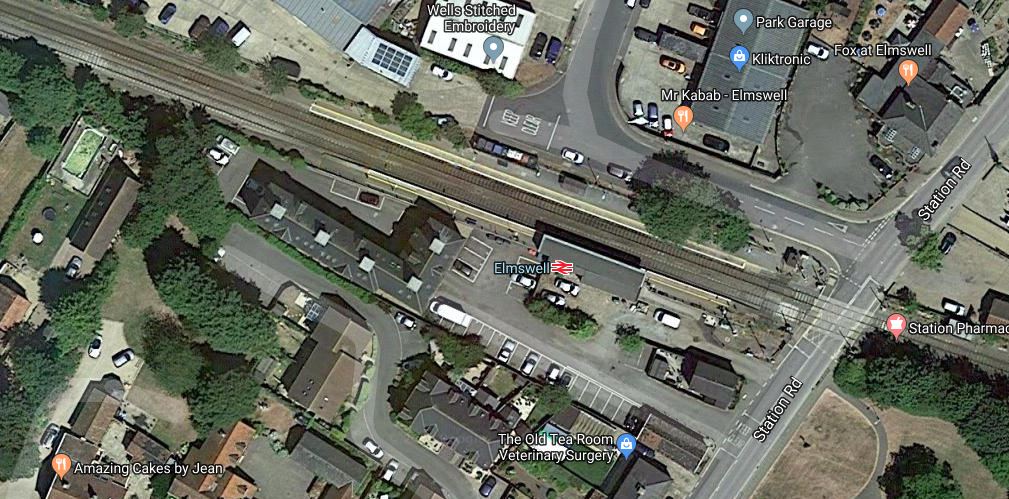
A new piece of software is due to be installed within a few weeks – but until then passengers heading east from Elmswell and west from Kennett are being taken by bus to the next station.
Both Elmswell and Kennett are simpler stations, with short platforms.
This Google Map shows Elmswell station.
And this Google Map shows Kennett station.

I wonder, if with these stations, selective door opening is needed the on one platform and the layout doesn’t fit the original software.
When you write software to work in a large number of situations, it’s difficult to make sure you cover everything.
Greater Anglian’s solution of a bus to get around the problem is not an ideal solution, but it should work, until the software is fixed.
 The Anonymous Widower