New Bank Tube Station Entrance In Final Stages Ahead Of Opening
The title of this post, is the same as that of this article on IanVisits.
Ian suggests that the new entrance under the Bloomberg Building, which will give better access to the Waterloo and City Line, will open in August 2018.
This picture shows the covered Underground roundel on the side of the Bloomberg Building.
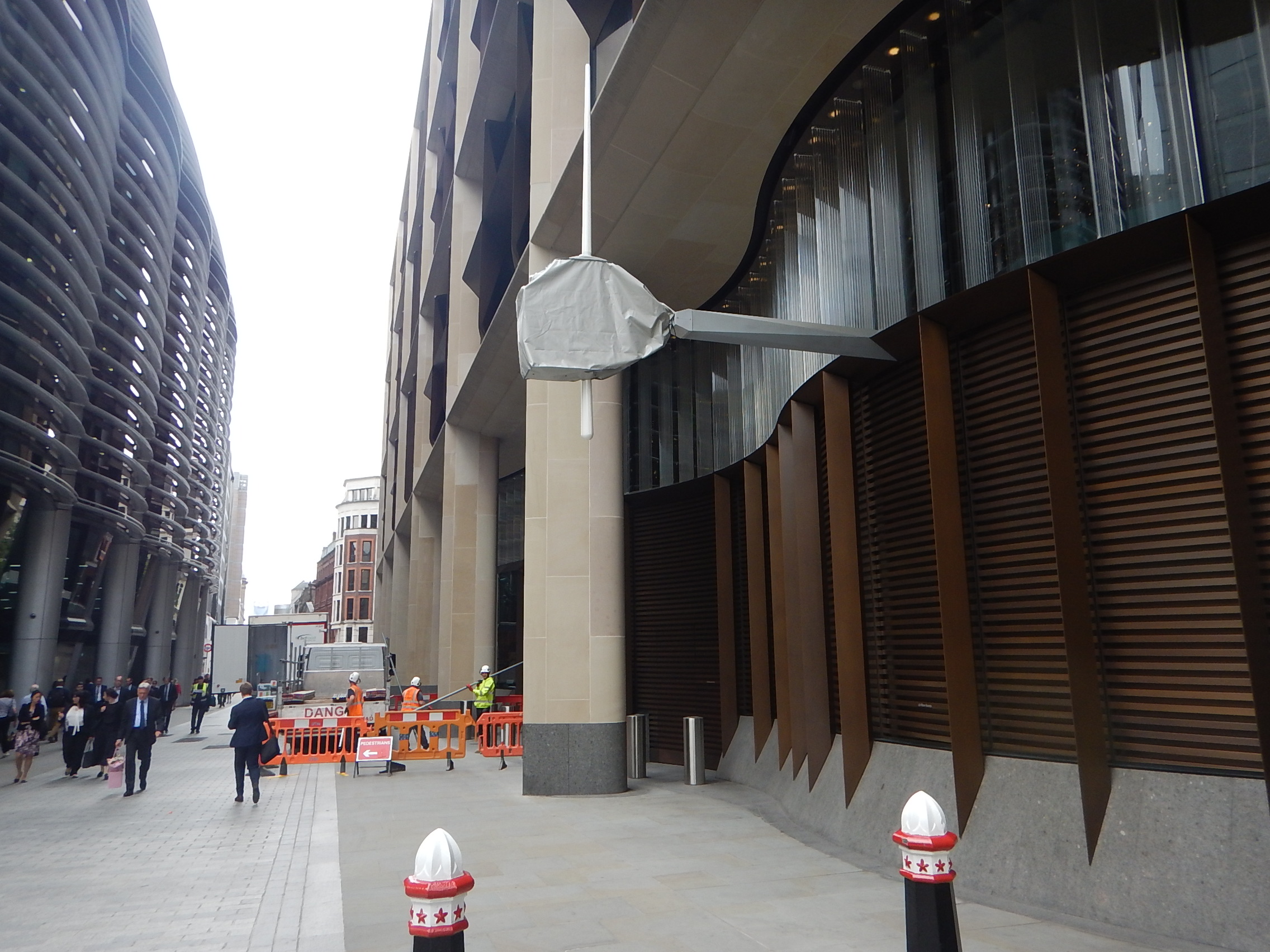
Note the workers putting scaffolding on the truck behind.
Underground, these fire doors, which lead to the new escalators and lifts, look ready to be opened for passengers in the area between the travelator, the connecting tunnel and the Waterloo and City Line platforms.

IWill the area be tiled or just painted?
described the tunnel to the left with the blue entrance rail in The New Tunnel Under Bank Station.
This picture was taken from the tunnel on the left, looking at this area.

The tunnel takes passengers right into the heart of the station.
Other Developments
The new entrance at Bank station is the first of several major transport developments, that will happen in the next few years.
New Trains On The Northern City Line In Autumn 2018
The Northern City Line is London’s forgotten train line, with a history coloured by the tragic accident at Moorgate in 1975.
The first development, a year or so ago, saw the Northern City Line introduce seven days a week working.
Now, the Class 313 trains, which are some of the oldest in the UK, are being replaced with new Class 717 trains, that will offer increased capacity, frequency and passenger comfort.
The Northern City Line terminus at Moorgate station will also be linked directly to Crossrail, when that line opens.
For many travellers in the Northern part of London and Hertfordshire, their route to the City will be much improved.
The final frequency has not been published, but it looks like there will be at least twelve tph on the Northern City Line to and from Moorgate station.
With a step-free cross-platform interchange at Highbury & Islington station, effectively Moorgate station will become a second Southern terminus of the Victoria Line.
Crossrail Between Paddington And Abbey Wood Stations In December 2018
This will be the first phase to be delivered and Crossrail will initially provide a twelve trains per hour (tph) service between Paddington and Abbey Wood stations from December 2018.
This will mean that the double-ended Jumbo Crossrail station, which will serve Moorgate station at its Western end and Liverpool Street station at its Eastern end, will open a short walking distance to the North of Bank station.
For those not wanting to walk, the link will also be one stop on the Central or Northern Lines.
Crossrail Between Paddington And Abbey Wood Stations In May 2019
This will be the second phase to be delivered and Crossrail will initially be provided a twelve tph service between Paddington and Shenfield stations from May 2019.
Crossrail To Heathrow And Reading In December 2019
The full Crossrail service will open in December 2019 and will provide the following services from Moorgate-Liverpool Street.
- Six tph to Heathrow
- Two tph to Reading
- Two tph to Maindenhead
- Twelve tph to Abbey Wood
- Twelve tph to Shenfield
In the Central section, there will be twenty-four tph between Padsdington and Whitechapel stations.
Bank Station Upgrade In 2022
Bank station is being upgraded and this is said in Wikipedia.
TfL is also retunnelling and widening the Northern line platforms, and adding lifts and new entrances on King William Street and Cannon Street. The work, agreed in 2015, will be carried out from 2016 to 2022 and will boost capacity by 40%, with 12 new escalators, 3 new lifts and a new travelator (or moving walkway) to connect the Northern Line and DLR to the Central Line.
It is a massive upgrade, as this visualisation shows.
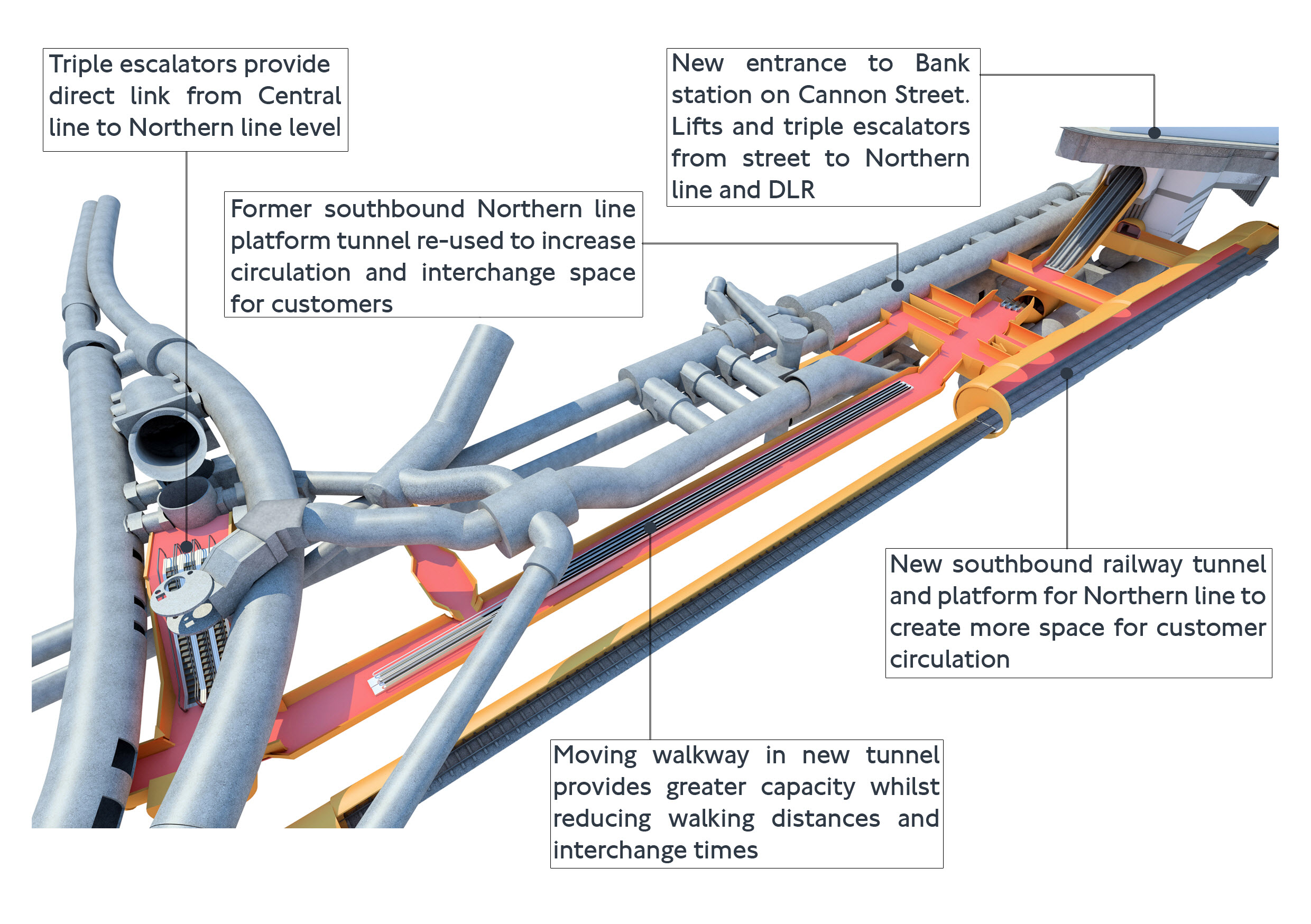
Note that the two larger diameter tunnels at the left of this visualisation are the tunnels and platforms for the Central Line. The third tunnel is the pedestrian tunnel that links the Waterloo and City Line to the main station.
The capacity upgrade at Bank station, will surely mean more people will be drawn to the area.
Bank Junction Improvements
The City of London has a project called All Change At Bank, which aims to improve the roads and pedestrian routes at Bank Junction.
Their web site gives these objectives.
- Reduce casualties by simplifying the junction
- Reduce pedestrian crowding levels
- Improve air quality
- Improve the perception of place, as a place to spend time in rather than pass through.
At present Bank Junction is restricted to buses and cyclists on Monday to Friday, between 0700 and 1900.
I wouldn’t be surprised to see this restriction increased, especially as more pedestrians are drawn to the City at weekends and in the evening.
The Future Of The City As A Leisure And Tourist Destination
When I lived in the City in the early seventies, nothing happened in the City in the evenings or at the weekends.
Over the years, the City has started to use these freer times for other activities.
- The Barbican Arts Centre and Tate Modern have opened.
- Quality shopping has greatly increased and improved.
- Pubs, bars and restaurants have often increased their hours.
- Better walking routs along and over the Thames have opened.
With its superb transport links, I can see the City of London becomes a much more important leisure and tourist destination.
Conclusion
The City of London is becoming a 24/7 area of London and the Waterloo and City Line must go with the flow.
It should run seven days a week, as do all other Underground lines.
Eventually, there will be a need for a Night Drain!
Elon Musk Goes Underground With High-Speed Trains
The title of this post is the same as that of an article in the Business section of last Friday’s Times.
This is the first paragraph.
Futuristic electric trains will soon be whizzing under the streets of Chicago at up to 150 mph after Elon Musk’s tunnelling company was chosen by the city to build a new high-speed commuter link.
Currently, the Blue Line train takes about forty-five minutes for the eighteen miles at a cost of five dollars.
Heathrow Airport is eighteen miles from the City of London and Crossrail will do the trip for thirty-three minutes when it opens, next year for a cost of under a tenner.
So what is Musk proposing?
- A journey time of twelve minutes.
- Passengers will ride in skates, which will carry up to sixteen people on concrete tracks.
- Skates will run at a frequency of 120 per hour for 20 hours a day.
- The fare would be twenty-five dollars.
- The system would cost about a billion dollars.
It is a technically ambitious proposal.
There’s more in this section called Chicago in the Wikipedia entry of The Boring Company.
A competition to build a high-speed link from downtown Chicago to the soon-to-be-expanded O’Hare Airport had been reduced to just two bidders by March 2018. The Boring Company was selected in June 2018 and will now negotiate a contract to be presented to the Chicago City Council. Construction is to be entirely financed by The Boring Company, which is subsequently to maintain and operate the link. The system will transport passengers in automated electric cars carrying 16 passengers (and their luggage) through two parallel tunnels running under existing public way alignments, traveling from block 37 to the airport in 12 minutes, at speeds reaching 125 to 150 miles per hour (200 to 240 km/h), with pods departing as often as every 30 seconds
It states it is two parallel tunnels!
Comparison With London’s Crossrail
Crossrail will effectively do the same job in London and a comparison between the two systems may produce some interesting conclusions.
Capacity
Musk’s system will have an hourly capacity of 1920 passengers per hour, based on 120 skates each carrying sixteen people.
Crossrail are talking of six trains per hour, each with a capacity of 1,500 people or 9000 passengers per hour.
I think that Crossrail will need to increase capacity, as Heathrow expands and longer trains and higher frequencies are possible.
But if Musk’s system is a runaway success, can it be expanded easily.
Journey Time
Musk’s system has a journey time of 12 minutes, as against Crossrail’s of 33 minutes
But Crossrail will stop up to ten times!
Intriguingly, the twelve minute is not the headline speed of 125 to 150 mph, but a slower 90 mph.
Routes
Little has been said of the route for Musk’s system, except that it goes between Downtown and O’Hare Airport.
Heathrow to the City of London, also goes direct to London’s major shopping area and the new business area of Canary Wharf.
It is also integrated with London’s existing Underground, Overground and rail lines at several places.
Does Musk’s system have a route structure, that won’t appeal to a lot of possible users?
Musk’s Thinking
This is an extract from the Future Goals section of the Wikipedia entry for The Boring Company.
According to Tesla, Inc. and SpaceX board member Steve Jurvetson, tunnels specifically built for electric vehicles have reduced size and complexity, and thus decreased cost. “The insight I think that’s so powerful is that if you only envision electric vehicles in your tunnels you don’t need to do the air handling for all carbon monoxide, carbon dioxide, you know, basically pollutants for exhaust. You could have scrubbers and a variety of simpler things that make everything collapse to a smaller tunnel size, which dramatically lowers the cost … The whole concept of what you do with tunnels changes.
The philosophy is not unlike that of Crossrail.
- I believe that Crossrail has been designed holistically, using the best tunnel and train technology.
- The tunnel power supply is a simple end-to-end rail.
- The Class 345 trains have batteries to make best use of electricity and provide emergency power.
- The batteries will handle regenerative braking, thus minimising heat-producing electric currents in the tunnel.
- Platform-edge doors and aerodynamic trains reduce mechanical energy losses.
- The electric trains do not emit anything into the tunnel, except perhaps a small amount of hot air.
I suspect that Crossrail’s tunnel section will be a very energy-efficient railway.
Conclusion
Summing up both systems we get.
Musk’s system is.
- A billion dollar cost.
- Twelve minute journey time.
- A vehicle every thirty seconds.
- Only for the few, who want to go from O’Hare to Downtown, who can pay a premium fare.
- Limited capacity.
A Crossrail-like solution would be.
- Perhaps a ten billion dollar cost.
- Twenty minute journey time.
- A train every few minutes.
- For everyone, who wants to travel from O’Hare to most places in Chicago with possibly a change, at a normal fare.
- Expandable capacity.
Musk’s system will appeal to the rich and those who like novelty, but I don’t think it is a long-term solution and just like London, Chicago will eventually have a modern railway linking it to the wider Chicago area.
Where Musk is right, is that he believes that tunnelling methods can be improved and become more affordable.
This will mean that more audacious railway schemes will be built.
Exploring Metrovalencia
Metrovalencia is a Metro, that uses both trains and trams with a proportion of the network in tunnels.
I took these pictures.




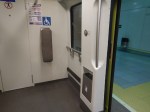

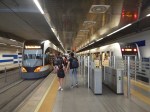


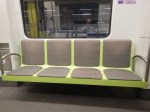





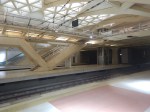



It is in many ways, a typical modern Metro with good and sometimes spectacular architecture, spacious, clear trains and a ticketing system, that relies on a plastic card.
To my mind there are two major problems.
It Doesn’t Go To The City Of Arts And Sciences
The City of Arts and Sciences, is a place that many tourists want to see.
But the Metrovalencia doesn’t go there and I couldn’t find how to get there from the information at various stations.
It would be as if the London Underground didn’t go to Stratford or the Manchester Metrolink didn’t go to Salford Quays.
Finding Stations Is Difficult
Valencia doesn’t have a way-finding system and finding the stations of the Metro can be difficult. Unlike say Berlin, Bilbao, London, Stockholm and many other cities, where stations have a big logo or feature, you can see from a couple of hundred metres, you can walk past stations without seeing them.
I walked a lot farther than I intended to.
The map I had was one that came with my good value 48-hour travel card, which cost eighteen euros.
It wasn’t the easiest to understand, as there was no symbols for Metro stations on the map.
The Citylink Trains Of The Metrovalencia
The Citylink trains of the Metrovalencia were built in Valencia in 2007 and are very different to their cousins; the tram-trains of Karlsruhe and Sheffield.
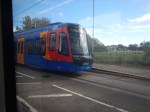
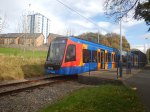
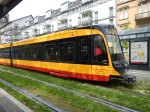
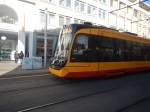
Sheffield is in blue, Karlsruhe in yellow and Valencia in white.
They are metre gauge, have larger bodies, are four or five cars long and I didn’t find one working as a tram-train.
Dalston To Gatwick And Back For £6.15
This could be one of the best travel bargains for those like me, who have the privilege of a Freedom Pass.
I can use my pass, as far as East Croydon or West Croydon stations, but I must buy a ticket or use contactless to get to Gatwick Airport.
So I use the following route.
- London Overground to West Croydon station using my Freedom Pass.
- London Tramlink to East Croydon station using my Freedom Pass.
- Thameslink or Southern to Gatwick using a contactless credit card.
I paid £3.10 for the last leg.
These pictures show my journey to Gatwick.

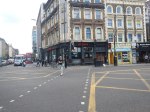
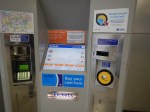
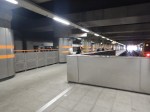
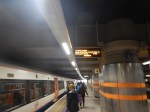

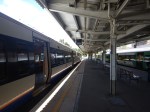
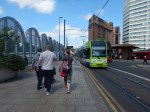




Note that as my flight on Friday was early, I was staying the the Premier Inn, where I watched the World Cup 2018, before taking an early bath and an early bed.
The only problem was finding how to get from the shuttle to the Premier Inn at the Gatwick North Terminal.
Coming back, was just a two-legged journey.
- Thameslink to London Bridge station using the ticket I bought on the way out and my Freedom Pass.
- A 141 bus to just outside my house from the forecourt of London Bridge to just outside my house using my Freedom Pass.
I paid £3.05 for the ticket between Gatwick and East Croydon.
The Journey Could Be Improved
I do this journey a lot of times, especially as it is an easy way to the South Coast.
- Getting to Victoria will continue to be difficult, until there is a comprehensive rebuild of Highbury and Islington station.
- I could go to St. Pancras and get Thameslink, but there are time restrictions on using a Freedom Pass early in the morning.
- I could get a 141 bus to London Bridge, but going South seems a lot longer than coming North due to traffic, road works and bus frequency.
So what would I do to improve things?
The Overground Should Go To East Croydon Not West Croydon Station
Often, when I do the journey to West Croydon, the train is almost empty from perhaps Penge West station.
So do passengers from the East London Line wanting to go to Croydon choose a train to East Croydon?
- East Croydon has a cornucopia of services going all over the South.
- West Croydon has only a few services and no long distance ones.
- There are no intermediate stations between either station and Norwood Junction station.
- East Croydon is the hub station of London Tramlink.
- There is only a tram service going East at West Croydon.
- To get a tram to Wimbledon at West Croydon, it is a long walk, which is badly signposted.
What is needed is a dedicated Overground platform at East Croydon station.
- One platform could handle six trains per hour (tph)
- It would create a simple one-change link between Gatwick Airport, Brighton and other South Coast destinations to East London and especially Whitechapel station, for the Eastern branches of Crossrail.
I know space is difficult, but I suspect that there is a solution somewhere.
Refurbish The Class 700 Trains
The Class 700 trains have only been in service for about two years, but when you travel on one after using another train, you realise their inadequacies.
- The seats are worse than most and certainly not up to the standard of those on Electrostars, like the Class 377 train, I took to Gatwick.
- There is no wi-fi.
- There are no power sockets to charge a mobile phone or laptop.
- Tables don’t exist in most of Standard Class.
- There’s nowhere to put a drink.
- Some drivers, who worked for East Midlands Trains told me, that they are not fast enough for the Midland Main Line.
They are crap design of the highest class. They certainly don’t say “Welcome to the UK”, to arriving passengers at Gatwick.
But I do believe the trains can be sorted, as the Class 707 trains are better.
Extend The Freedom Pass Area
A Freedom Pass works to any station in Fare Zone 6, with a few extensions like Shenfield station using TfL Rail and Watford Junction station using the Overground.
I don’t think that the area, where the Freedom Pass can be used for free, should be extended, but the technology must exist to link a Freedom Pass with a credit or debit card, so that all journeys within the Oyster contactless area are charged appropriately.
I’m surprised that this or something like it hasn’t been implemented yet, as surely it could be an encouragement for Freedom Pass holders to vote for a Mayoral candidate.
Conclusion
Travelling to Gatwick will get easier and more comfortable.
Meridian Water Station – 14th June 2018
Since my last post on Meridian Water station, that was called The Site Of The New Meridian Water Station – 25th April 2018, things have moved on at a good speed.

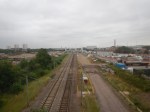



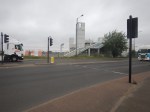

Note.
- It will be a four-platform station.
- It will have fullstep-free access, with five lifts.
- It will be ready for Crossrail 2, if that line ever arrives.
- It will also be a step-free bridge over the railway., for those not using the trains.
- It will be very handy for Tesco and IKEA.
It also looks like it could be ready for use in May 2019, which is the planned opening date.
More Innovation From CAF
CAF are noted for innovation in the design of their trains and particularly trams. I have read somewhere, that they spend a lot of money on Research and Development and it seems to show in their products.
- In Seville’s Elegant Trams, I wrote about the MetroCentro in Seville, which is catenary-free and charges the batteries of the trams at stops, through an overhead rail.
- Zaragoza trams use a similar system.
- The Midland Metro is fitting batteries to its CAF Urbos 3 trams, to extend the system in Birmingham and Wolverhampton.
- A second line for the Midland Metro could use tram-trains, so it can share the South Staffordshire Line with freight trains.
- My engineering instinct tells me that the Midland Metro system is more advanced, than that installed in Spain.
This article on Global Rail News is entitled CAF Secures New Orders In Luxembourg, Germany and Sweden.
This is an extract from the article.
Luxtram has selected CAF to supply 12 trams for the second phase of Luxembourg City’s tram network, a catenary-free line which is currently under construction.
These Urbos 3 trams will cost €40 million and be powered through a ground-level charging system at stops.
So it looks like CAF have now added a new way of charging battery trams.
Will we be seeing this technology in the extension to the Edinburgh Tram and later extensions to the Midland Metro?
Is The United States Catching Railway Mania?
This article on Global Rail News is entitled Brightline Looks To Replicate Model In Other US Regions.
This is the first two paragraphs.
Brightline, the United States’ only privately-owned, operated and maintained intercity passenger railway, has revealed it is looking to replicate its model in other areas of the country.
The announcement comes less than six months after Brightline’s first service was launched between Fort Lauderdale and West Palm Beach, Florida, and weeks after the service was extended to Miami.
Brightline must be doing alright!
Especially, as they are going to start construction of their extension from West Palm Beach to Orlando.
Talking to an American friend today, she said that Orlando to Miami is a long drive. I wouldn’t know, as I’ve only been to Florida twice and that was to Key West with C and a conference near a couple of theme parks. On the latter trip, I got to see the Space Shuttle take off!
Brightline’s concept seems sensible.
- Higher-speed diesel-electric train.
- Trains consist of two SCB-40 locomotives and four coaches initially.
- Speeds up to 125 mph.
- Level disabled access
- Wi-fi
- Orlando to Miami is planned in three hours.
- 7-12 services per day.
The concept has echoes of an InterCity 125, built to modern standards.
If we can find several routes to run InterCity 125 trains, surely Brightline’s plan to duplicate the Florida service can find many places in the wide expanses of the United States.
But this is not the only rail project, that I’ve covered on this blog lately.
The Texas Bullet Train
I covered the Texas Bullet Train in August 2017.
- This will run between Dallas and Houston.
- A speed of 205 mph
- A journey time of 90 minutes.
- Based on Japanese Shinkansen technology.
- Could start in 2020.
See Texas Central Railway on Wikipedia for more details.
Vivarail D-Train To Be Tested In US Cities
On the face of it to use a Vivarsil Class 230 train in the United States seems a crazy idea.
Wikipedia says this about the concept.
During March 2018, it was announced that plans were being developed to take a Class 230 to the United States, in order to demonstrate how they could provide a low-cost rolling stock option for new passenger services.
The idea would be to run them on freight lines with temporal separation from freight trains.
The Rise Of Metro, Light Rail And Trams In The United States
I haven’t been to the United States this century and in those days, Metro, light rail and tram systems were fairly thin on the ground.
In those days, I drove and I think I’ve only ridden on systems in Boston and New York.
What surprised me, was that Wikipedia now lists about over a hundred rail transit systems around the United States, several of which are expanding.
Even cities built for the car, like Dallas, Houston and Los Angeles have systems.
Temporal Separation In Salt Lake City
The TRAX light rail system in Salt Lake City, is a system with three lines, forty-five miles of track and fifty stations.
This is a paragraph from Wikipedia.
TRAX uses former Denver and Rio Grande tracks as well as street trackage to service Salt Lake City. Between the hours of midnight and six in the morning, Union Pacific freight trains use much of the trackage, up to just past 2500 S to service a number of industries along the line.
How many other areas in the United States can use techniques like this?
Conclusion
Perhaps the United States is going through a Modern equivalent of Railway Mania.
This time though, it is not driven by a frenzy of get rich quick investors, but more by the following.
- Serious investors like Pension Funds looking for places to put money to get a return for thirty to forty years.
- Brightline talks of city-pairs, where it is too-far to drive and too close to fly, like Orlando-Miami and Dallas-Houston.
- Dallas-Houston will link two cities with light rail networks. Others will follow this model, if it’s successful.
- Increasing highway and airport congestion must help rail.
But the biggest driver could be the new technology coming on stream from the rail industry, which makes setting up systems easier, less disruptive and more affordable.
Ryanair To Open New Base at London Southend Airport
The title of this post, is the same as that of this article in the Guardian.
The title gives most of the story, although the article says that flights won’t start until April 2019.
The article also contains this classic example of Ryanair-speak from their airline’s chief commercial officer, David O’Brien.
O’Brien said disruption from European air traffic control strikes, primarily in France, could be the “worst ever” for airlines, which cancelled 1,100 flights in May. “Your tourist going from Britain down to Spain is screwed by a couple of hundred French air traffic controllers,” he said.
The Wikipedia entry for Southend Airport gives these places as Ryanair’s destinations.
Alicante, Bergamo, Bilbao, Brest, Corfu, Cluj-Napoca, Dublin, Faro , Košice, Málaga, Palma de Mallorca, Reus and Venice.
This is a paragraph from the article.
Southend’s deal with Ryanair will double passenger numbers at an airport that only reopened six years ago. Its rapid expansion is set to continue, according to the chief executive of its owners, the Stobart Group. “We have a clear and focused strategy to grow our airport to welcome over 5 million passengers a year by 2022,” he said.
That number of passengers would put Southend Airport in the top dozen airports in the UK.
It’s a bit different to when I learned to fly at the Airport in the 1970s.
In those days, the only commercial traffic was the odd Carvair ferrying five cars and a score of passengers across the Channel.
I think Southend Airport will continue to grow for the following reasons.
- Planes to and from the Airport can avoid the busy airspace over London.
- The location and the prevailing Westerly winds, allows pilots on some routes to bring the planes straight in, saving a lot of time.
- Being early encourages passengers to use the Airport again and tell their friends.
- Southend Airport station is less than a hundred metres away.
- The City pf London is about an hour away.
- Currently, the train service is three trains per hour (tph) between Liverpool Street and Southend Victoria stations.
- Greater Anglia is getting new Class 720 trains and trains to the Airport may be increased in frequency.
- Crossrail and Greater Anglia will bring increasing numbers of passengers to Shenfield station for trains to the Airport.
I think it ls inevitable, that as the traffic at the airport grows, that Crossrail will be extended to Southend Airport and Southend Victoria stations.
 The Anonymous Widower