London To Get The Night Orange
This article on the BBC is entitled Night Tube: East London route joins 24-hour services.
This is said.
The Overground service will start operating from December on Fridays and Saturdays between New Cross Gate and Dalston Junction.
It is also expected to extend to Highbury and Islington next year, Mayor of London Sadiq Khan said.
I am a bit surprised that the Southern terminal is New Cross Gate station, as this is not normally a terminus for Overground services, wheras New Cross station does have a four trains per hour (tph) service to Dalston Junction station all day.
On the other hand New Cross Gate station has the following advantages.
- Services could be extended Southwards to other stations in the future.
- New Cross Gate will be a Bakerloo Line station, when that line is extended.
- Thameslink and other services into London Bridge might call.
- It might offer an easy link to Gatwick Airport for an early flight.
I think that as Thameslink will be important with all its connections, I wouldn’t be surprised to see a Night service on this line, which would make a link to the East London Line useful.
The Class 345 Train Has An Updated Information Display
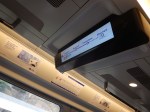
Bombardier have updated the information display on the Class 345 train, that I rode on the The 10:35 From Liverpool Street To Shenfield.
In that post I said this about the Information.
The current on-train information is simple, but then as I suspect the screens are software driven, any degree of required complication can be added.
I don’t know whether it is deliberate but everything is large and easy to read. There is also no maps or exhortations about security.
Long may it stay that way!
Simple is efficient!
So it looks like a new version of the software has been installed.
These pictures show the new display.


I wonder what the final version will be like.
I hope it’s not to fussy or full of advertising.
France Opens Two New High Speed Lines
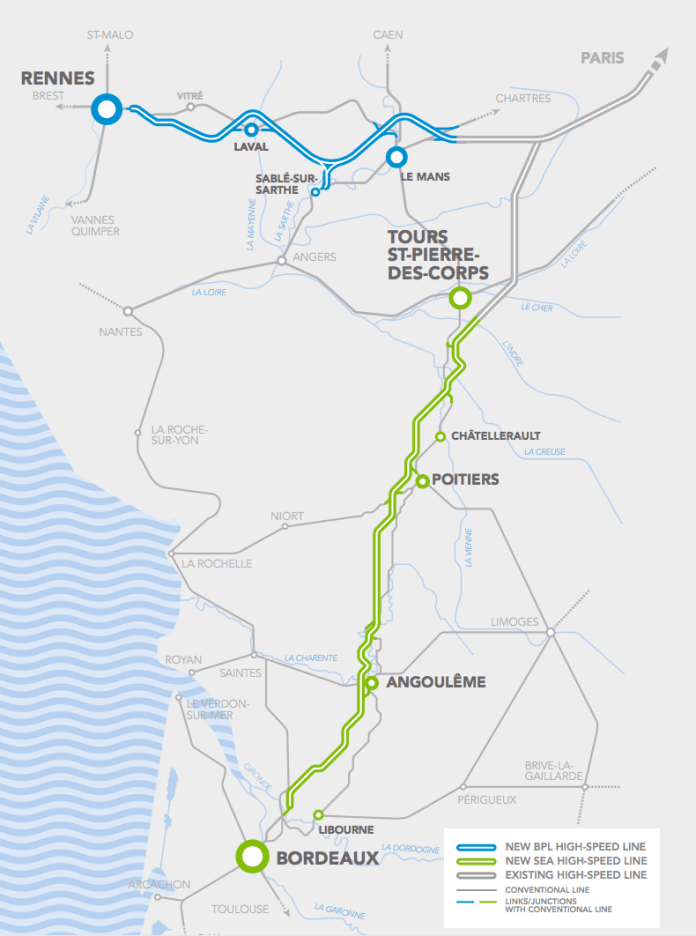
This article on Global Rail News is entitled.SNCF launches two new high-speed lines.
This map shows the two lines to Rennes and Bordeaux.
I doubt well ever lauch two high speed lines in one weekend.
It would appear that the two journies are timed as follows.
- Paris to Rennes takes about an hour and three-quarts and costs ariund £72.
- Psris to Bordeaux is a few minutes over two hours and costs around £88.
Prices are for a fully flexible ticket.
Kent On The Cusp Of Change – Track Improvements
The Kent On The Cusp Of Change article in the July 2017 Edition of Modern Railways talks mentions a few track improvements.
Ashford Spurs
This enables more Continental trains to call at Ashford International station. I discussed it in Ashford Spurs.
The Link Between High Speed One And The Marshlink Line
This is needed to get the Highspeed trains from St. Pancras to Hastings, I I discussed in Highspeed to Hastings.
The Modern Railways article says this about the creation of the link.
It will be an uphill struggle to fund necessary layout changes at Ashford International during Control Period 6 (2019-2024). A realignment of the track would be needed to join the track serving the London end of platform 2 (which is accessible from the Marshlink route) to the Ashford spurs that link through to High Speed 1.
This diagram from Wikipedia shows the lines through Ashford International station.

Note how the two main tracks of High Speed One use a flyover to get out of the way of Ashford International station. The Ashford Spurs connect the lines through the two platforms to High Speed One.
This Google Map shows the London end of Ashford International stations.
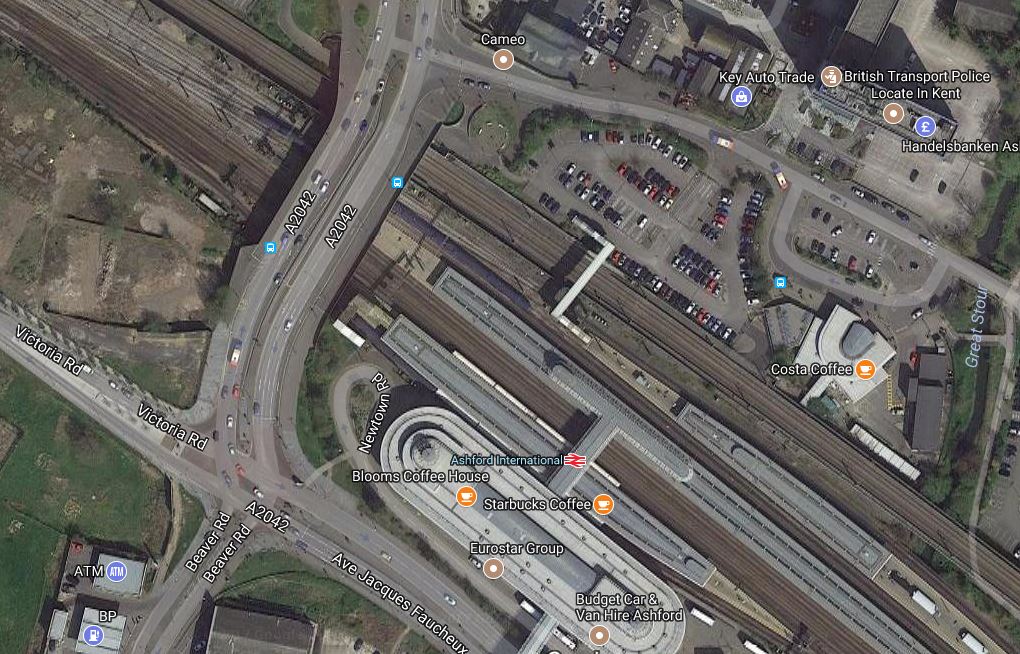
There are three island platforms, which are as follows from the bottom.
- Platform 1 and 2 for third-rail domestic services and the Marshlink Line
- Platform 3 and 4 for Continental services
- Platform 5 asnd 6 for Highspeed domestic services.
The two lines visible beyond platforms 5 and 6 are High Speed One on the flyover.
At the London end of the station, there is already the following links to High Speed One from the station.
- Platform 3 to London for Continental services
- Platform 4 from London for Continental services
- Platform 5 to London for Highspeed services
- Platform 6 from London for Highspeed services
It could be quite complicated connecting even one of Platform 1 and 2 to High Speed One.
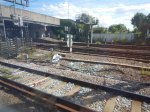
But at least as these pictures show, there is plenty of space.
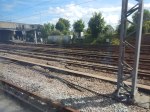
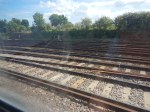
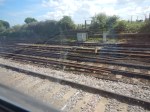

Note.
- The pictures were taken from a Highspeed train leaving Platform 5 for London.
- The first picture was taken just to the London side of the bridge shown in the Google Map.
- The domestic Platforms 1 and 2 are on the far side, in this first picture.
- The
I do feel that after some of the engineering on Crossrail and Thameslink, that an affordable solution is possible.
In addition to the space, I don’t think any trains thunder through here at high speed, as they use the flyover for that.
I also feel that Hitachi might be the key here.
As I said in Highspeed to Hastings, I believe that batteries not diesel will be used to power the trains on the Marshlink Line.
So if necessary, battery power could be used to power the trains between High Speed One and Platforms 1 and 2.
Hitachi could probably do the change between power sources under the wires of High Speed One, so this would mean that there would be no extra overhead electrification at Ashford International station.
As most of the train frequencies between High Speed One and Ashford International station are not by any means high, I wonder if there is a simple solution in there somewhere.
The most difficult connection would be to get trains from London across three tracks.
- The Highspeed line from Platform 5 to London
- The Continental line from London to Platform 4.
- The Continental line from Platform 3 to London
A single track unelectrified dive-under or even a flat junction might be possible to connect High Speed One to Platforms 1 and/or 2.
Connecting Platforms 1 and/or 2 to High Speed One to London is much easier, as no other lines need to be crossed.
I also wonder if the funding problem and probable subsequent delay of building a link could lead to an interim solution to give Hasting the service it needs.
Network Rail’s Options For The Link Between High Speed One And The Marshlink Line
This document from Network Rail gives their options for the link.
- High Speed One To Platform 2
- High Speed One To Marshlink via Platform 3
As the second option would leave Continental services with just one bi-directional platform, I think it is unlikely to be used, as what happens if a train fails in the platform?
This diagram from the Network Rail document shows the traqck layout for the first option.
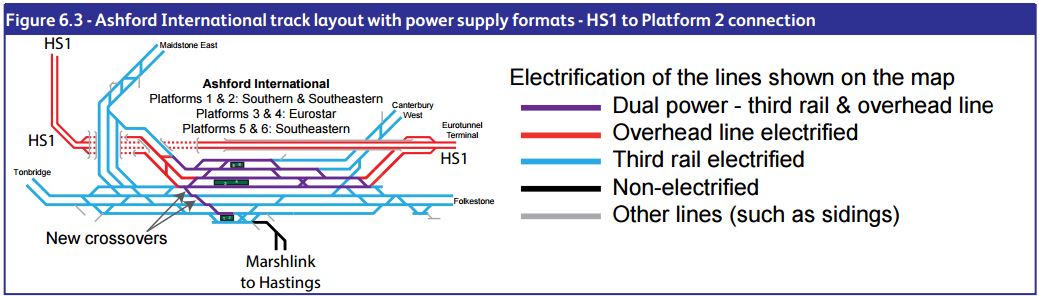
Note the only track work would appear to be two or three new cross-overs, which are shown as being electrified with both third-rail and overhead line.
Note the following.
- The trains that will be working the Marshlink Line and High Speed One will have either diesel or battery power for the Marshlink Line.
- Modern trains like Hitachi’s Class 800 trains can change from one mode to the other at linespeed, raising and lowering the pantograph as necessary.
- Automation can aid the driver in selecting the best power source.
So could we see the cross-overs built without electrification to save money and probably time as well?
I suspect this could be possible, although there may be operational reasons to add third-rail electrification.
Network Rail say this about their scheme with dual-power cross-overs.
Although this seems a fairly simple proposal, the technicalities of installing the crossovers, power supplies and signalling enhancements add significantly to the challenges of the scheme, which would cost in the region of £15-35M.
Surely, as the trains will have a dual-power capability for the Marshlink Line, this would reduce the challenges and cost of the scheme.
, The Fawkham Junction Link
The Fawkham Junction link will enable Highspeed services to use another terminal in London, which will probably be Victoria.
I discussed this link in Fawkham Junction Link.
General Track Improvements
This document from Network Rail is the Route Specification for the South East and it details two projects, that will improve times on the lines between Victoria and shford International station.
- Journey Time Improvement – Reduce impact of Permanent Speed Restrictions
- Maidstone signalling interlocking renewal – Renewal of interlocking and external equipment
The document indicates they could be completed in 2019.
The document also uses this phrase in several places.
Increase speed to rolling stock and signalling capability
As the East Kent Re-Signalling Project seems to be improving the signalling, it does appear that one of the keys to better services in Kent may well be faster trains.
It should be noted, Network Rail have been particularly successful in upgrading the speed of the Midland Main Line in recent years, so with a faster third-rail train available, they might be able to speed up services on the East Kent Lines.
An Interim Solution For A Highspeed Service To Hastings
As I said earlier connecting the Marshlink Line to High Speed One might be delayed because of funding.
Network Rail’s planned improvements will deliver journey time improvements between Victoria and Ashford International stations and along the lines in East Kent, provided some faster trains are procured.
There is not much point in having tracks with a capability in excess of 110 mph, if the trains can’t make use of it.
But these trains, be they Ultimate Class 395 trains or a product from another manufacturer, will be needed to bridge the electrification gap of the marshlink line.
Once the modifications at Ashford are complete, these trains will be able to use High Speed One.
Conclusion
Track improvements are a key to making the new Southeastern franchise a lot better.
See Also
These are related posts.
- Abbey Wood Station
- Ashford Spurs
- Crossrail
- Elimination Of Slow Trains
- Fawkham Junction Link
- Highspeed Routes
- High Speed To Hastings
- Historic Routes
- Longfield Station
- Maidstone
- Reading To Tonbridge
- Thameslink
- Thanet Parkway Station
- Ultimate Class 395 Train
- Victoria As A Highspeed Terminal
To know more read Kent On The Cusp Of Change in the July 2017 Edition of Modern Railways.
Kent On The Cusp Of Change – Ultimate Class 395 Train
The Kent On The Cusp Of Change article in the July 2017 Edition of Modern Railways talks about the need for more Class 395 trains.
The Class 395 train has the following features.
- 140 mph capability on 25 KVAC overhead electrification
- 100 mph capability on 750 VDC third-rail electrification
- Six-cars
- The ability for trains to couple and uncouple automatically in a couple of minutes.
- Modern interiors.
Upgrades, that I can see in a new batch of trains are discussed in the next three sections.
Batteries To Enable Working To Hastings For The New Southeastern Franchise
The Modern Railways article says this about the Highspeed service to Hastings.
What form the new trains would take is asnother question; Kent County Council is keen on Class 800s, to give bi-mode capsability over the Romney mashes so that Hastings and Bexhill could be given a high-speed service to London via Ashford.
However, question marks continue to hang over any such service: there is some doubt as to whether diesel tanks would be allowed in the London tunnels of HS1 (so battery electric could be an option)
It should be noted that, Hitachi have experience in the field of battery electric trains and I think that their engineers will find a solution to bridge the twenty-six miles of the Marshlink Line, between Ashford International and Ore stations, that is not electrified.
The key could be that a passing loop is needed at Rye station for efficient operation of the trains. As Rye is under sixteen miles from Ashford and under eleven miles from Ore, it might be feasible to electrify the passing loop, so that trains could have a quick battery top-up, whilst stopping at Rye station.
Electrification around the station in a town like Rye would mean safety would be easier to ensure, than in some of the remoter parts of Romney Marsh.
Wi-Fi And 4G Capability
These facilities will probably be required of the bidders for the new franchise.
Up To 125 mph Capability On 750 VDC Third-Rail Electrification
The Class 395 trains can obviously go safely at a lot higher speed and Network Rail have the knowledge and engineering to turn 100 mph lines into ones with an operating speed of 125 mph, if the topography of the line is suitable.
125 mph wouldn’t probably be needed but the ability to run at 110 mph might be particularly useful on various of the lines in Kent.
In a Network Rail document about the East Kent lines, Network rail says this.
Increase speed to rolling stock and signalling capability.
As the East Kent Re-Signalling Project seems to be improving the signalling, the faster Class 395 trains would set the desired operating speed.
Network Rail have been particularly successful in upgrading the speed of the Midland Main Line in recent years, so with a faster third-rail train available, they might be able to speed up services on the East Kent Lines.
I doubt all of this has not occurred to Hitachi and the other train manufacturers.
It should also be born in mind that High Speed One is not unique amongst dedicated high speed lines in the world and other countries and operators must want to mix high speed long distance and commuter services on the high speed lines.
So if Hitachi can demonstrate their skills between London and Kent on the way to the iconic Channel Tunnel, it can’t be at all bad for the company.
It also probably means, that the companies bidding to take over the Southeastern franchise will get a good deal for extra Class 395 trains.
Or would Bombardier come up with an Aventra with a 140 mph capability on High Speed One?
Other Applications Of Class 395 Trains
Most of the third-rail electric trains south of the Thames like the Class 377 trains are 100 mph trains.
But as there is a need for more and faster services South of the Thames, there will probably be a need for a faster train.
This probably explains why South Western Railway are bringing the Class 442 trains back into service on the Portsmouth Direct Line, as these trains are capable of more than 100 mph.
An alternative might have been to buy some Class 395 trains with a 110 mph or higher capability on third-rail lines.
Conclusion
The next versions of Class 395 trains and trains of similar performance from other manufacturers will not be limited to High Speed One and Kent.
Hitachi can easily create a third-rail train with a capability of running at over 110 mph and if Network Rail upgrade the tracks and signalling to accommodate higher speeds, we could see improved services all across the South of England.
Routes where they would bring improvement include.
- Waterloo to Portsmouth
- Waterloo to Southampton, Bournemouth, Poole and Weymouth
- Ashford to Southampton via Brighton and Portsmouth.
As energy storage gets better will we be seeing Waterloo to Salisbury run by electric trains, using battery power to and from Basingstoke?
See Also
These are related posts.
- Abbey Wood Station
- Ashford Spurs
- Crossrail
- Elimination Of Slow Trains
- Fawkham Junction Link
- Highspeed Routes
- High Speed To Hastings
- Historic Routes
- Longfield Station
- Maidstone
- Reading To Tonbridge
- Thameslink
- Thanet Parkway Station
- Track Improvements
- Victoria As A Highspeed Terminal
To know more read Kent On The Cusp Of Change in the July 2017 Edition of Modern Railways.
Kent On The Cusp Of Change – Victoria As A Highspeed Terminal
The Kent On The Cusp Of Change article in the July 2017 Edition of Modern Railways has made me ask questions about services into St. Pancras International station.
Is There Enough Capacity For Continental Services At St. Pancras International Station?
Platforms 5-10 at the station are allocated to Continental services.
Under Eurostar (High Speed 1) in the Wikipedia entry for the station this is said.
Seventeen pairs of trains to and from Paris Gare du Nord every day, ten pairs of trains to and from Bruxelles-Midi/Brussel-Zuid for Brussels and the European Union de facto capital, and one train to and from Marne-la-Vallée for Disneyland Resort Paris. Extra services run to Paris on Fridays and Sundays, with a reduced service to Brussels at weekends. Additional weekend leisure-oriented trains run to the French Alps during the skiing season, and to Marseille via Lyon and Avignon in the summer.
So it looks like on a typical day, there are just under thirty pairs of trains between St. Pancras International station and the Continent. So on a typical operational day from 0700 to 2200, that means it’s approximately two trains per hour (tph).
I feel that with perhaps some changes to the operation of the passenger and train cleaning and victualling systems, that six platforms could easily handle up to six tph.
So I doubt, that there is too much of a problem increasing the number of Continental services from St. Pancras International station.
Is There Enough Capacity For Highspeed Services At St. Pancras International Station?
Platforms 11-13 at the station are allocated to Southeastern‘s Highspeed services, which are run by Class 395 trains.
Is There Enough Capacity On High Speed 1 Between Ebbsfleet International And St. Pancras International Stations?
Under Services in the Wikipedia entry for High Speed 1, this is said.
High Speed 1 was built to allow eight trains per hour through to the Channel Tunnel. As of May 2014, Eurostar runs two to three trains per hour in each direction between London and the Channel Tunnel. Southeastern runs in the high peak eight trains per hour between London and Ebbsfleet, two of these continuing to Ashford. During the 2012 Olympic Games, Southeastern provided the Olympic Javelin service with up to twelve trains per hour from Stratford into London.
I think the key figures here are the ability to handle eight tph for the Channel Tunnel and the twelve tph that was achieved during the Olympics.
Let’s fast forward to 2024 when Paris could be hosting the Olympic Games.
Given too, that by then, Continental services to Germany, the Netherlands and other parts of France could have expanded and there must be a strong possibility, that the full eight Channel Tunnel paths will be needed.
So that would leave just four train paths for the Highspeed services.
I suspect that whoever is running the Highspeed services will want to develop them with services to other destinations like Hastings and Eastbourne and more frequent services to the existing destinations in Thanet.
This leads me to the conclusion, that more capacity is needed for Highspeed services into London.
Some extra capacity can probably be created by improving the signalling and operational methods, but will that be enough.
The Problems With The Highspeed Services
Every time, I use the Highspeed services, they work well, but they do have problems.
- The only London terminal is St. Pancras International station.
- The interchanges at Stratford International station to the Underground is a long walk.
- The interchange at Stratford International station to Crossrail will be equally poor.
- The frequency of services are not what passengers demand these days.
- The services need to connect to Hastings and Eastbourne.
- Passengers complain about the cost.
Expanding the Highspeed services would solve some of these problems, but if the Continental services of Eurostar and other operators expand, there could be a capacity problem before the mid-2020s.
The Two London Terminal Solution
Network Rail and the train operating companies (TOCs) seem to have come up with a cunning plan.
In the Kent on the Cusp of Change article and in one in the May 2017 Edition, Modern Railways, the magazine reports that consideration is being given to reopening the Fawkham Junction link, that used to be used by Eurostar trains to access Waterloo station from the Channel Tunnel.
Trains would not now go to Waterloo, as there are other plans for the expansion of the station.
But it would be fairly simple for trains to go via Swanley and Bromley South stations into Victoria station.
In the next few sections, I will outline why I think this station could and probably will be used as a second London terminal for Highspeed services.
Extra Highspeed Terminal Capacity In London
As I indicated earlier, I think that within the next few years, there may be a capacity problem between London and Ebbsfleet and opening a second terminal at Victoria would add extra train paths on the surface through South L:ondon.
A Second Highspeed Terminal In London
Services to Victoria with its Underground connections, that are currently being improved dramatically, would be welcomed by many travellers, who want to go to places like Kensington and Westminster or perhaps avoid the long walks at Stratford International station to the Underground or Crossrail.
Crossrail 2 will also call at Victoria, if it’s ever built.
Services Between Victoria And Thanet Could Go Highspeed
All or some of the services between Victoria and the Thanet area would be able to go Highspeed and use the Class 395 trains.
The Highspeed services would use the reinstated Fawkham Junction link and High Speed One between stops at Ebbsfleet International and Ashford International stations.
Suppose All Services Between Victoria And Thanet Used Class 395 Trains
Surely, this would have tremendous advantages for Network Rail and the operator in that, all of the stations and tracks, to the East of Ashford International station, could be updated, so that they efficiently handled twelve-car Class 395 trains.
In a Network Rail document about the East Kent lines, Network rail says this.
Increase speed to rolling stock and signalling capability.
As the East Kent Re-Signalling Project seems to be improving the signalling, the faster Class 395 trains would set the desired operating speed.
As I indicated earlier, if the new batch of Class 395 trains could have a faster capability on third-rail routes.
What Times Could Class 395 Trains Achieve On Classic Routes?
As an illustration of the operating speed on the East Kent lines, Ashford International to Ramsgate stations takes thirty-six minutes for a journey of about thirty-five miles with only one stop.
Network Rail probably know how to reduce this important journey by at least ten minutes, which would benefit Highspeed and Classic services.
Currently, London Victoria to Ashford International stations takes just under an hour and a half via Maidstone East and another ten stops.
This document from Network Rail has two projects, that will improve times on the Chislehurt to Ashford section of this route.
- Journey Time Improvement – Reduce impact of Permanent Speed Restrictions
- Maidstone signalling interlocking renewal – Renewal of interlocking and external equipment
The document indicates they could be completed in 2019.
The Class 395 trains are a modern train with bags of grunt and probably the ability to execute a station stop in double-quick time.
So with the track improvements to allow higher speeds between London Victoria and Ashford International station, I suspect that it might be possible to trim perhaps twenty minutes from the journey time.
Could Network Rail be aiming for an hour between Victoria and Ashford International stations on the Classic route, via Bromley South, Swanley and Maidstone East stations?
If they could manage the magic hour, then Hastings could be within perhaps 95 minutes of Victoria in a Class 395 train with either diesel or battery power.
This would be a few minutes faster than the current faster times to Cannon Street on the Hastings Line.
It would certainly be a good interim alternative, until trains can go between High Speed One and the Marshlink Line.
What Times Could Class 395 Trains Achieve Using High Speed One Between Victoria and Ashford International Stations?
I estimate that Victoria to Ebbsfleet International using the Fawkham Junction link and Class 395 trains could be in the order of thirty minutes.
As Class 395 trains take nineteen minutes between Ebbswfleet International and Ashford International stations, I believe it would be reasonable to assume between Victoria to Ashford International stations will take forty-nine minutes or just twelve minutes longer than the current time between St. Pancras and Ashford International stations.
Victoria To Fawkham Junction
If the Fawkham Junction link were to be reinstated, a number of the trains between Victoria and Thanet would take the Chatham Main Line after passing Swanley station and then take the Fawkham Junction link to Ebbsfleet International station.
Other than the Fawkham Junction link, no substantial new infrastructure would be required, but if line improvements increased the speed between Victoria and Fawkham Junction, the Class 395 trains could certainly take advantage.
I suspect that each Class 395 train, would just take over the path of the Classic service it replaced.
There might even be a bonus, in that all fast trains through Bromley South and Swanley became Class 395 trains, which might aid the timetabling.
Class 395 Trains At Victoria Station
There are various reports on the Internet of Class 395 trains running into Victoria station, sometimes as a twelve-car train.
Class 377 trains also appear to run as twelve-car trains to Ramsgate.
So I think we can assume that Class 395 trains can run into Victoria.
Conclusion
I think that it is possible that Victoria can be used as a second terminal for Highspeed services from Thanet into London.
See Also
These are related posts.
- Abbey Wood Station
- Ashford Spurs
- Crossrail
- Elimination Of Slow Trains
- Fawkham Junction Link
- Highspeed Routes
- High Speed To Hastings
- Historic Routes
- Longfield Station
- Maidstone
- Reading To Tonbridge
- Thameslink
- Track Improvements
- Ultimate Class 395 Train
- Thanet Parkway Station
To know more read Kent On The Cusp Of Change in the July 2017 Edition of Modern Railways.
All Change At South Kensington Station
The title of this post is the same as that of this article in Rail Engineer, which describes the plan for developing South Kensington station.
The article gives a lot of insight into the expanding of the station and how it will be funded.
It is a busy station that in 2016 handled nearly thirty-four million passengers.
It was certainly busy today with visitors today, when I passed through as I went to and from the Victoria and Albert Museum, which has now been expanded.









Expanding the station will certainly test the skills of those managing the project. Especially, now that the V & A will be drawing more people to the area.
Funding Station Expansion
I said earlier that South Kensington station has a yearly traffic of just under 34 miilion.
These are figures for 2015/2016 for some important provincial stations in England.
- Bank – 94 million
- Birmingham New Street – 39 million
- Blackpool North – 2 million
- Brighton – 17 million
- Bristol Temple Meads – 11 million
- Camden Town – 23 million
- Dalston Junction – 5 million
- Dalston Kingsland – 6 million
- Euston – 42 million
- Liverpool Lime Street – 15 million
- Manchester Piccadilly – 26 million
- Newcastle – 8 million
- Nottingham – 7 million
- Peterbirough – 5 million
- Sheffield – 9 million
- Waterloo – 39 million
These stations were chosen pretty much at random, but I do think they show that London Underground stations seem to attract a lot of traffic near tourist attractions.
So perhaps we should built more stations near to major tourist attractions.
Are these the sort of projects that can be funded privately by property development?
It is proposed to use this model at South Kensington station.
I deliberately put in my two local stations of Dalston Junction and Dalston Kingsland.
Dalston Junction, is the bigger station, with twice as many platforms as Dalston ingsland.
It is also step-free with blocks of flats on top.
So is it surprising that it is not the busier station of the two?
I think it just goes to show, that predicting passenger numbers, is not an easy task.
Kent On The Cusp Of Change – Fawkham Junction Link
The Kent On The Cusp Of Change article in the July 2017 Edition of Modern Railways discusses the Fawkham Junction Link, which was originally used to allow Eurostar trains to get to Waterloo station. It is now used as a siding for old Eurostar trains, that are waiting for the scrapyard.
I wrote about this link in Connecting Ebbsfleet International To South London, which connects the Chatham Main Line to Ebbsfleet International station and High Speed One.
A quick look on Google Maps appears to show, that the third-rail electrification is still in place, which must make the link easier to reinstate.
Obviously, Network Rail and the TOCs (train operating companies) have a cunning plan to create extra services using the reinstated link and High Speed One.
Ebbsfleet International Station
Bear in mind, that Ebbsfleet Internation station is an important transport hub.
- Services to and from the Continent call.
- Highspeed services between St. Pancras and Thanet call.
- There is masses of car parking.
If Ebbsfleet Interbational has a problem, it is badly connected to the local area and only serves St. Pancras in London.
London Victoria To Thanet Services
At present, services between Victoria and Thanet services that go through Bromley South and Swanley stations are as follows.
- 1 tph – Victoria to Ramsgate via Longfield and Chatham.
- 2 tph – Victoria to Dover Priory via Longfield and Chatham
- 1 tph – Victoria to Canterbury West via Swanley and Maidstone East
- 1 tph – Victoria to Ashford International via Swanley and Maidstone East
Note that in all these services the first stop is Bromley South station.
Could the plan be as simple as this?
- Some services between Victoria and Broadstairs, Canterbury, Dover Priory, Ramsgate and Thanet Parkway stations would be run by Class 395 trains or similar trains with a 140 mph capability on High Speed One.
- Trains would go to from Victoria to Swanley, with just the single stop at Bromley South station, as they do now, and then join High Speed One via the Fawkham Junction Link.
- Once at Ashford, they take the routes to Thanet as used by the current Highspeed services.
I suspect this would give times from Victoria as follows.
- Broadstairs in ninety-seven minutes as against 111 minutes now.
- Canterbury West in seventy-two minutes as against 125 minutes now.
- Dover Priory in seventy-six minutes as against to 122 minutes now.
- Ramsgate in ninety minutes minutes as against to 124 minutes now.
Times could probably be improved further with a bit of work in Thanet and between Swnley and Victoria.
This could mean.
- Nearly all trains in Thanet are Class 395 trains., so tracks and stations could be designed accordingly.
- The Class 395 trains use the Thanet paths into Victoria from Swanley.
- Provision would have to be made for stations losing their services to High Speed One.
It could all be very efficient and a simple way to improve timings to Thanet.
Thameslink Services
Thameslink services serve Swanley station and could easily be extended to Ebbsfleet International, if that was desired via the Fawkham Junction link.
Bromley South Metro Services
The Southeastern Metro service on the Bromley South Line could use Ebbsfleet as an alternative terminal to Petts Wood station, by using the Fawkham Junction link.
Conclusion
There are lots of possibilities, with perhaps the most important being to create a second Highspeed terminus in London, to relieve the inadequate capacity at St. Pancras.
See Also
These are related posts.
- Abbey Wood Station
- Ashford Spurs
- Crossrail
- Elimination Of Slow Trains
- Highspeed Routes
- High Speed To Hastings
- Historic Routes
- Longfield Station
- Maidstone
- Reading To Tonbridge
- Thameslink
- Thanet Parkway Station
- Track Improvements
- Ultimate Class 395 Train
- Victoria As A Highspeed Terminal
To know more read Kent On The Cusp Of Change in the July 2017 Edition of Modern Railways.
Kent On The Cusp Of Change – Elimination Of Slow Trains
The Kent On The Cusp Of Change article in the July 2017 Edition of Modern Railways discusses the improvements that may be made by the new franchisee of the Southeastern franchise.
Southeastern‘s current fleet includes.
- 112 x Class 375 trains – 100 mph capable
- 36 x Class 376 trains – 75 mph capable.
- 8 x Class 377 trains – 100 mph capable.
- 29 x Class 395 trains – 140 mph capable.
- 147 x Class 465 trains – 75 mph capable.
- 43 x Class 466 trains – 75 mph capable.
The slower 75 mph trains are generally older and lack customer-friendly features like wi-fi and good information screens.
The article says that Class 465 trains are still used on the Maidstone East Line and possibly on Tunbridge Wells stoppers.
I can confirm in my trip to Longfield Station, that they are still used on that route.
Running these slow trains in with the faster 100 mph units like the Class 375/377 trains, is like allowing milk-floats on motorways.
It could be that the reason, stations on the Maidstone East Line only get two trains per hour (tph), is because some services are or could be run by the slow Class 465 trains.
Implications For The Maidstone East Line
Currently, Maidstone East to Ashford International station takes about thirty minutes.
Given that modern trains like Southeastern’s Class 375 and Class 377 trains and Thameslink’s Class 700 trains are also very much better and faster at carrying out a station stop, could it be that even if the train stopped everywhere on the Maidstone East Line, that substantial savings in time could be made?
Could this mean, that Thameslink’s future Cambridge to Maidstone East service could be extended to the much better connected Ashford International?
I think it could be mathematically possible and it would mean that all the intermediate stations on the Maidstone East Line would have a doubling of service frequency to 4 tph.
This is a simple example in the Southeastern area, but in how many other places on their network, do the 75 mph trains cause timetabling problems.
It is my belief, that all trains incapable of operating at 100 mph, should either be modified so they can operate at 100 mph or be scrapped.
The Minimum Train Specification
A minimum electric train specification should probably be something like this, to satisfy passengers and train operating companies.
- 100 mph capability
- Designed for a fast station stop with minimum dwell-time
- Regenerative braking
- Efficient traction motors
- Wi-fi in all classes
- The capability to fit boosters for 4G signals.
Southeastern’s Class 465 trains fail on all points.
Metro Operations
But surely, they are OK when running a Metro service like Victoria to Dartford?
Currently, this service takes 49 minutes with eleven stops.
This means that a train takes two hours to go from Victoria and Dartford and back, so to achieve the required service frequency of 2 tph, four trains will be needed.
But supposing a modern train is used on this route. Train manufacturers will claim that a modern train saves about two to three minutes a stop.
So if two minutes a stop is saved, modern signalling is used to advantage and the driver uses the extra speed and acceleration with alacrity, I feel that the forty-nine minute journey could be brought down sufficiently, so that the round trip would be under an hour.
Not only would passengers see a faster service of under thirty minutes in a much better equipped train, but the operator could run the 2 tph service with just two trains instead of four and a big saving in electricity.
The operator may have to alter staff practices because of the faster journey, but I doubt it would be anything controversial.
Could Class 707 Trains Be Used On The Southeastern Franchise?
The Class 707 trains, which are unwanted by South Western Railway are 100 mph units and are probably up-to-scratch for the train operator.
But they may need to be retrofitted with wi-fi.
I suspect, that one of the conditions of the new Southeastern franchise, is that free wi-fi is offered. Now that Crossrail is throwing in 4G access, I suspect all bidders will offer this too!
Conclusion
All trains incapable of running a service at 100 mph should be eliminated, just as the two operators;Greater Anglia and South Western Railway, are planning to do.
There’s going to a lot of slow trains going cheap!
See Also
These are related posts.
- Abbey Wood Station
- Ashford Spurs
- Crossrail
- Fawkham Junction Link
- Highspeed Routes
- High Speed To Hastings
- Historic Routes
- Longfield Station
- Maidstone
- Reading To Tonbridge
- Thameslink
- Thanet Parkway Station
- Track Improvements
- Ultimate Class 395 Train
- Victoria As A Highspeed Terminal
To know more read Kent On The Cusp Of Change in the July 2017 Edition of Modern Railways.
Kent On The Cusp Of Change – Highspeed Routes
The Kent On The Cusp Of Change article in the July 2017 Edition of Modern Railways talks about the Southeastern Highspeed routes through Kent.
Some principles are laid down.
- All six-car services would be extended to twelve-car services.
- Trains could be divided at Ashford International station to serve multiple destinations.
- Maidstone West station would get an hourly Off Peak service.
The article gives an estimate that at least another twenty Class 395 trains are needed of which perhaps three would have batteries for operation along the Marshlink Line between Ashford International and Ore stations.
The new timetable proposed in the article is similar to that now, with the following changes in each hour.
- All Day – A St. Pancras – Ashford – Dover Priory service runs once per hour and splits at Ashford with one six-car train going to and from Hastings and the other six-car train going to and from Dover Priory.
- Off Peak – A new St. Pancras – Ashford – Canterbury West service runs once per hour.
- All Day – A new St. Pancras – Ebbsfleet service runs twice per hour.
- Off Peak – A new St. Pancras – Gravesend – Strood – Maidstone West service runs once per hour.
In addition all trains passing Thanet Parkway station will stop after it opens.
The Fawkham Junction Link
The article talks about reinstating this link , which connects the Chatham Main Line to Ebbsfleet International station and High Speed One.
I wrote about this link in a related post called Fawkham Junction Link, which shows how it can be used to create additional Highspeed services between London and Thanet.
- Victoria becomes a second terminal for Highspeed services.
- Victoria gets a Highspeed connection to Ebbsfleet International and Ashford International stations for Eurostar.
- Most if not all of the Thanet services become Highspeed services.
- Thanet services are faster with more capacity.
Obviously, Network Rail and the TOCs (train operating companies) have some cunning plan to use the Fawkham Junction Link.
Should All Victoria To Thanet Services Be Run By Highspeed Trains?
In my trip to Longfield Station, I came back iat a leisurely pace in a Class 465 train, that had started at Dover or Ramsgate.
As the routes to Thanet from Victoria can all be run by twelve-car trains and the platforms in East Kent are accessible to twelve-car Class 377, Class 395 and Class 465 trains, I wonder if Class 395 trains or a train with a similar performance, should run all these routes in an identical manner to the slower trains.
Consider.
- Calls at many stations would only be made by twelve-car Highspeed trains, which must make station design simpler and station stops easier and faster.
- Highspeed trains would be able to take advantage of any line speed improvements on the route.
- Highspeed trains are fitted with modern signalling systems including ERTMS, which would allow more capacity on busy sections of the routes. Between Victoria and Swanley could benefit.
- Crossrail and Thameslink trains already have ERTMS, so this must give advantages, on shared routes.
- A single unified fleet to Thanet must ease servicing and maintenance, which is done currently at Ashford and Ramsgate.
- High Speed One could be used as a diversion route if required.
- Victoria could be used as a diversion for Highspeed services, if there were problems on High Speed One to the West of Ebbsfleet station.
The outcome would surely be that even the Victoria to Thanet stoppers would be several minutes faster.
What would faster services be worth to the new train operating company?
Conclusion
Highspeed services could be increased in frequency and developed to a second terminal at Voctoria.
I wouldn’t be surprised to see all services to Thanet run by a single uinified fleet of Highspeed trains.
See Also
These are related posts.
- Abbey Wood Station
- Ashford Spurs
- Crossrail
- Elimination Of Slow Trains
- Fawkham Junction Link
- High Speed To Hastings
- Historic Routes
- Longfield Station
- Maidstone
- Reading To Tonbridge
- Thameslink
- Thanet Parkway Station
- Track Improvements
- Ultimate Class 395 Train
- Victoria As A Highspeed Terminal
To know more read Kent On The Cusp Of Change in the July 2017 Edition of Modern Railways.
 The Anonymous Widower