Uncovering The Past On Thameslink
The definition of archaeology according to the Oxford English Dictionary is.
The study of human history and prehistory through the excavation of sites and the analysis of artefacts and other physical remains.
So perhaps calling digging up an old nineteenth century station is stretching the definition a bit far.
But this report on the BBC web site about the uncovering of the disused Southwark Park station is fascinating none-the-less. This is an extract from the report.
The station was discovered as engineers constructed the Bermondsey Dive Under, which will see two Victorian viaducts partially-demolished and rebuilt to allow trains from south east London and Kent to dive down, under a new route carrying Thameslink services from Croydon.
There’s more here on the Ian Visits site and here on the Thameslink web site. This is a Google Earth image of the area.
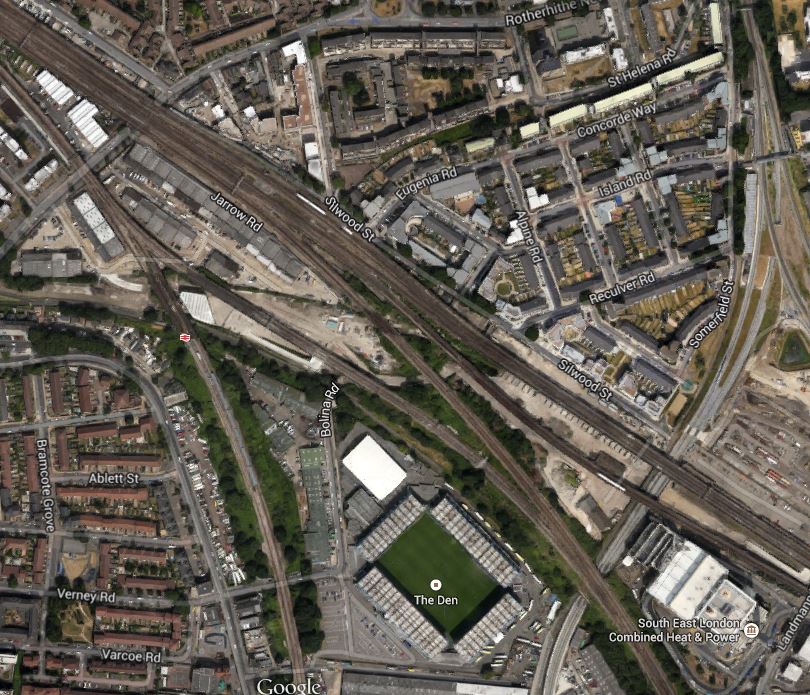
Bermondsey Dive-Under
Note The New Den, which is Millwall’s ground and SELCHP incinerator to its right. The image highlights the complicated nature of the lines into London Bridge station. The line that runs between the football ground and the incinerator in a south-easterly direction is the Thameslink line between London Bridge and New Cross Gate. The smaller line that crosses this line at right angles is the Overground line between Surrey Quays and Clapham Junction.
Where this Overground line crosses Surrey Canal Road just off the bottom of this image, construction should start on the new New Bermondsey station later this year.
Southwark Park station was under the tracks , where Rotherhithe New Road crosses underneath.
Similar But Different!
London and Paris are rival cities and their two transport networks share some of the same characteristics.
But there are differences. The Paris metro was designed as a whole and was deliberately built with close stations, in a grid that covered the centre of the city. For political reasons, it was also built mainly in the city centre. This gives it various strengths and weaknesses that are different to London’s.
As a regular visitor to Paris, I’ve only ever used a bus once, whereas in the centre of London, I use them all the time. Is this because the Metro covers the centre in a denser manner than the London Underground does or is it because London’s buses have an unequalled bus information and mapping system.
In recent years, London has been building Crossrail and Thameslink, which are its version of the Paris RER and London has also developed a collection of run-down railways into the vaguely-circular London Overground. One of the aims of this railway, was to avoid going into the centre and out again, when you needed to go around the city.
So now Paris is developing the similarly laid-out Grand Paris Express, with similar aims. The layout is shown in this map.

Grand Paris Express
But there are differences. Whereas London has used full-size trains on existing railways with stations about two minutes apart, Paris is using smaller Metro sized trains calling at frequent stations and new tunnels and tracks will be constructed.
It’s a case of you pays your money and you makes your choice!
I think the only certainty, is that Paris’s ring Metro, will cost a lot more to build than it did to build London’s ring Overground. This article on Property Investor Europe says that the Grand Paris Express will cost ten billion more than the original estimate of twenty billion euro. That’s twice as much as London’s Crossrail!
The construction will also be a lot more disruptive, as new tunnels, stations and lines are built.
The Two Big Election Issues The Politicians Aren’t Addressing
The tragedy unfolding off the Libya coast, where hundreds are dying every day as they try to get to Europe is impossible to solve.
We can’t say it’s an Italian problem and put our heads in the sand, as most politicians seem to be doing. Especially, as it seems most of the migrants want to get to Northern Europe and often the UK, where the jobs are.
Suppose we just said that none of these migrants would be let into the UK, as probably the Ukippers would say. How long would it be before the rest of Europe applied policies to get us to accept our fair share?
If on the other hand, we took a selective number, then this would signal to those organising the trade, that there was a good chance you may get residence in the UK.
I haven’t a clue what you do! And neither have the politicians!
I do have some sympathy though for the migrants as three hundred years ago, my two closest male lines; one Jewish and one Huguenot, were welcomed in this country, after escaping from persecution. One was probably a tailor and the other was an engraver, so all they brought was their brains and skills. I don’t know about the Huguenot, but the Jew was probably single and converted to Christianity within a few years, so he could find a lady and get married. My two close female lines are both internal migrants from Devon and Northants. London has always been a magnet for migrants, so nothing has changed.
There is also the problem of Greece going bust, which could happen before our General Election.
It could be argued that it is nothing to do with us, as we’re outside the Euro zone!
But then we have a strong economy and a country where there are a lot of Greeks.
Certainly, if I was a Greek engineer living in Athens with a cousin in London, my savings would have been long gone.
I do wonder how much of the Greek bailout money ended up safely invested outside of Greece.
So we may not lose money, but we are probably going to suffer some collateral damage. Especially, if the various financial institutions want their money back!
It will not be as serious a problem as the Libyan migrants, but where are the politicians heads on this one?
Deep in the sand!
The West Midland’s Transport Map
I snipped this off the Network West Midlands web site.
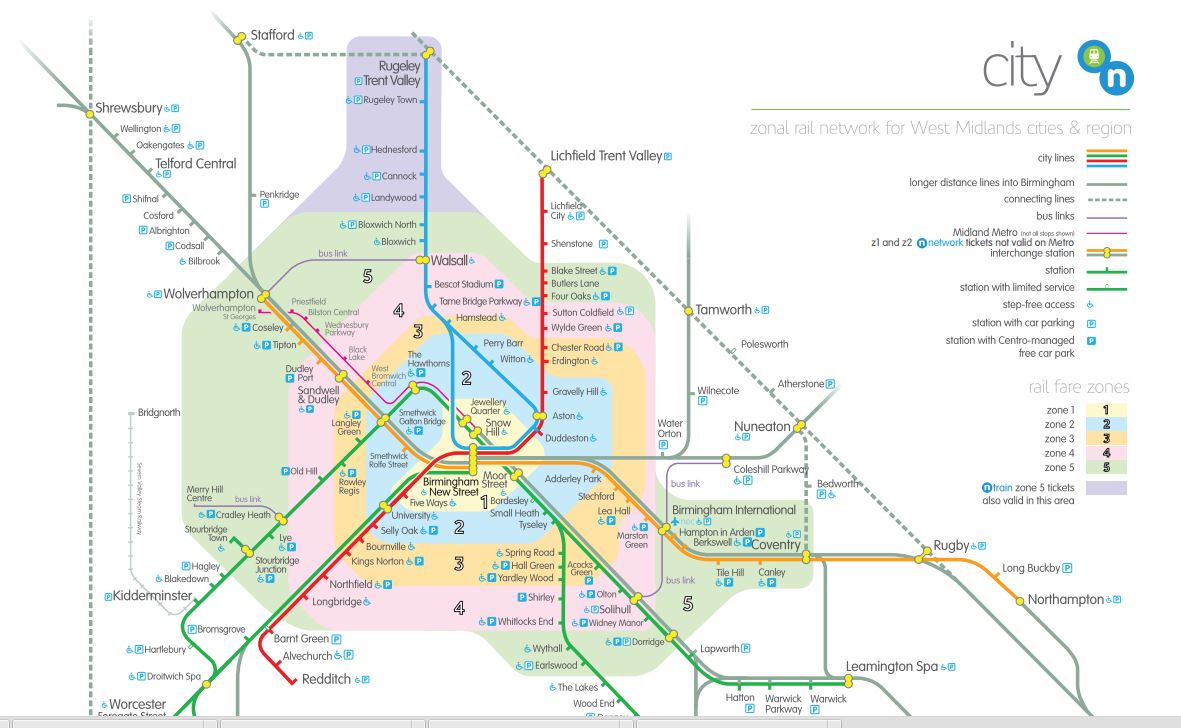
West Midlands Transport Map
Will it ever be as recognisable as the London map?
Up And Down The Lickey Incline
When I was growing up in the 1950s, books for boys, used to have pictures of massive steam or diesel locomotives working in twos and even threes to bring heavy freight and passenger trains up inclines in places like the Rocky Mountains and the Alps.
In the 1950s and 1960s, it was quite common to see two engines double-heading a freight train, but it is a practice you rarely see now, except in special circumstances. This video shows a single nuclear flask double-headed by two Class 57 locomotives.
Occasionally, in places in the world, where there are steep gradients, an extra banking engine will be added at the rear to help push the train up the incline. You can imagine it, whilst crossing serious mountains or possibly even on the the Highland Main Line, where I rode in the cab of an InterCity 125 from Edinburgh to Inverness.
But you wouldn’t think you’d see this technique on the south-west approach to Birmingham from Bromsgrove!
You would be wrong, as this video shows. It was uploaded in 2007.
It shows a Class 66 locomotive taking a coal train up the Lickey Incline, assisted by a similar locomotive at the rear. If you search YouTube for Lickey Incline, you’ll find some real engineering pornography, like massive steam locomotives being assisted by four smaller tank engines.
But in a few years time, the pictures will all be different, as the Cross-City Line from Lichfield via Birmingham is being electrified to Bromsgrove and Redditch. Bromsgrove will also be getting a new four-platform station, which should open in November according to this article in the Bromsgrove Advertiser. Three new Class 350 trains have been ordered to provide a much-improved service, of three trains an hour to each of the two southern termini.
It looks like the improvements to the southern end of the Cross-City line with come out at around £65 million and the new Bromsgrove station at £17.4 million according to various reports on the Internet.
I would think this investment is money well-spent, as the line is the busiest commuter railway outside London.
I think that if the next government devolves transport to local areas, then other projects like this will be undertaken in the West Midlands.
For example, the reinstatement of passenger services on the Camp Hill Line is a long term aspiration of the city.
To Dive Or Fly At Werrington
Network Rail are doing their bit to speed up trains on the East Coast Main Line. Over the last few years they have upgraded the Great Northern Great Eastern Joint Line from Werrington Junction, just north of Peterborough, to Doncaster via Spalding, Sleaford and Lincoln, so that the number of freight trains on the East Coast Main Line can be reduced and the passenger services can be speeded up. This page on Network Rail’s website describes the work.
But all these freight trains have started to get up the locals noses. This article in the Peterborough Telegraph is entitled Werrington And Peakirk Residents’ Plea On Rail Plans. It starts like this.
Two petitions signed by 752 people in Peterborough opposed to plans to increase freight services on the railway have been presented to Parliament.
Householders in Werrington and Peakirk have signed the petitions calling on the Government to start talks with rail operator Network Rail about the proposals.
The line is also noted for its numerous level crossings and proposals to shut them and according to this article in the Lincolnshire Echo, there is opposition to the closure of at least one crossing.
So now Network Rail want to create a flyover or a dive-under at Werrington Junction to speed northbound freight trains turning on to the line through Lincoln. This map from Network Rail, shows the two options.

Werrington Junction
The dive-under is shown in red and the flyover in blue.
I have a feeling that the decision for this much-needed junction and its construction will be a long-time coming.
I also think that it is complicated, by the fact that Peterborough is very much a city, where most people don’t use public transport, as they have their own cars, so any local vote would not be in favour of improving public transport or the railway, unless perhaps it improved commuting to London.
Perhaps the solution to these problems, could be a bit of bribery in the form of some strategically-located new stations and a very much improved rail service between Peterborough and Doncaster via Lincoln.
Removing One Hundred And Seventy Years Of Inadequate Design
The Manchester to Preston railway is san important line in the North-West of England, that was completed in 1841.
To say that is not fit for purpose is a total understatement, as it is not electrified and has a speed limit of just seventy-five miles per hour.
Finally, the line is being electrified and the speed limit will be raised to a hundred. From December 2016, hopefully refurbished Class 319 trains will be speeding from Manchester via Bolton and Preston to Blackpool and possibly Windermere.
The major problem on the line are the twin tunnels at Farnworth. They have a history of make-do-and-mend and are too small to take the overhead wires and Network Rail have come up with a practical solution, that should last several hundred years at least. This Google Earth image shows the ends of the tunnels with respect to the location of Farnworth station and the A666.
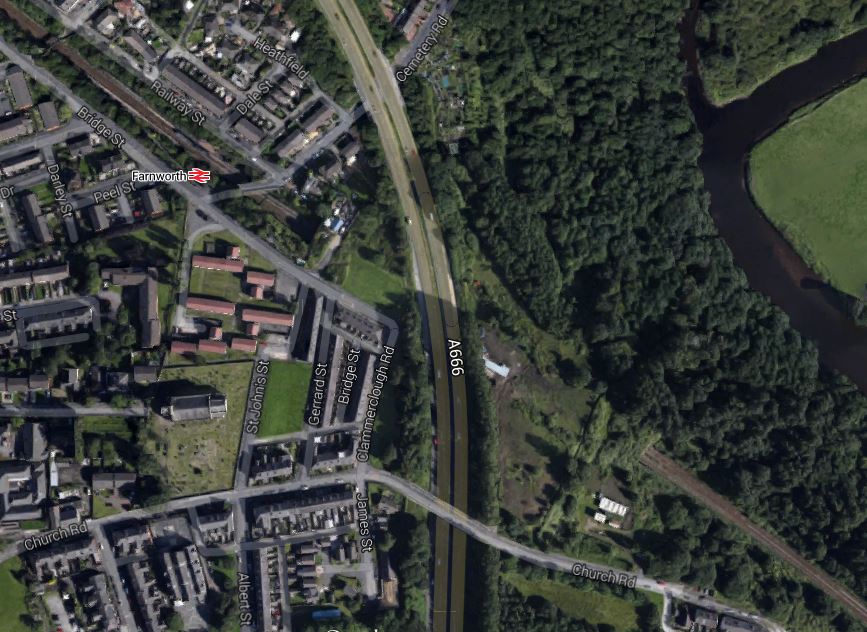
Farnworth Station And Tunnels
The smaller of the two tunnels will be refurbished and given a concrete lining, so that during the works, there will always be one track for trains. They will then bore out the larger tunnel, so that it is big enough to take two tracks and the overhead lines.
This will require that between May and October this year, there will be significant disruption to rail passengers. The whole project is described in this article in the Bolton News. It may cause a lot of disruption, but the passengers seem philosophical, as these paragraphs from the article show..
Jeff Davies, part of the newly formed Bolton Rail Users Group, said: “The station closures are the bad news, but there is good news here actually.
“It is the beginning of big investment which could take us out of the present problems and the companies have been at great pains to minimise inconvenience and ensure that Bolton people who work in Manchester will still be able to get there.
Perhaps this is because Network Rail have done their public relations well, if this YouTube video entitled Rebuilding the Farnworth Tunnel is anything to go by.
It all goes to prove that politicians should have sorted out the mess that are the railways of the North many years ago.
Euston Is Getting A Balcony
At Euston station today, it was obvious that Network Rail are creating a balcony in a similar way to how they did at Manchester Piccadilly and Waterloo stations. They describe the project on this page on their web site and these are some pictures I took today of the construction work.

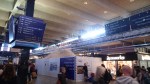
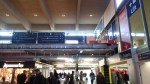
Hamish Kiernan, Network Rail’s Commercial Retail Director is quoted as saying this.
Our award-winning developments at King’s Cross and Waterloo showcase what can be achieved at our major stations and now as we move our focus to Euston, we are confident we can create a bigger, brighter station for everyone.
Any improvement to Euston is to be welcomed.
I wonder how many other stations could be balconied to create more space.
Match Forty-Four – Wolverhampton 1 – Ipswich 1
It was an early start to catch the 08:43 Virgin to get me to Wolverhampton for this match’s 12:15 kick-off I travelled in First and got water, a banana and tea to sustain me on the journey. At least the trains now seem to carry a lot of fruit, which is surely acceptable to all.
Molineux stadium is not that far to walk from Wolverhampton station, as the Google Earth image shows.
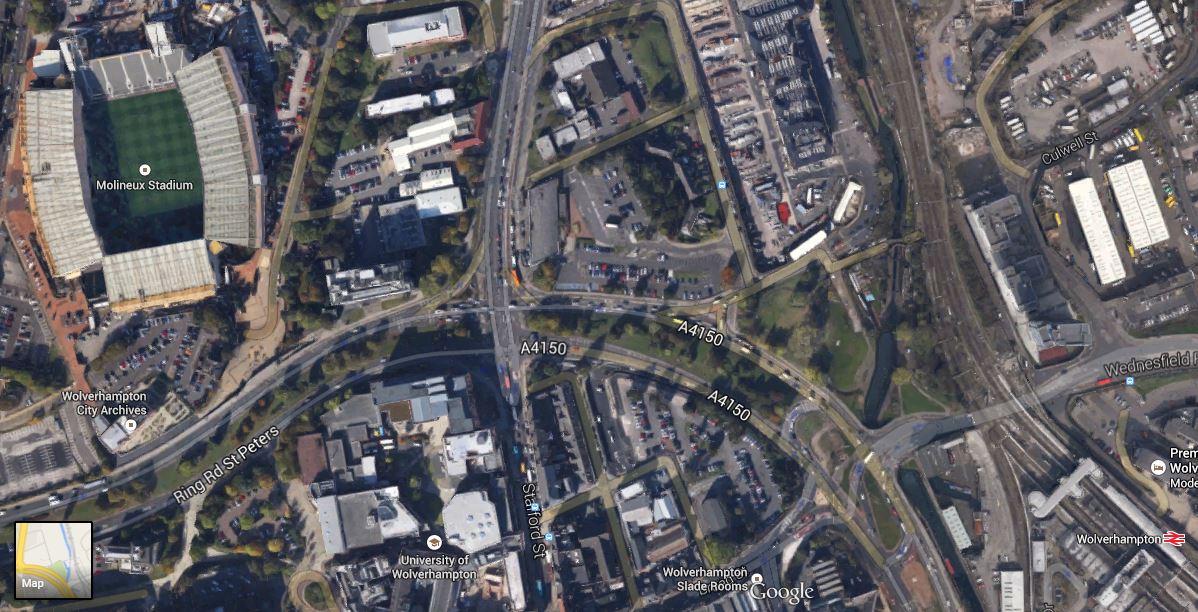
Molineux And Wolverhampton Station
I’m sure there must be a quicker way that is known to regular visitors, especially for Away supporters, who are in the top-right or north-east corner of the stadium.
When I went to the ground today, I felt it would be prudent to have an early lunchtime snack, so I walked up into the city centre to the Marks and Spencer, to see if they had any sandwiches. Just as at Middlesbrough, there were none available. I then walked down from the city centre to the ground.
Coming back, I asked the stewards and they said the best way was to walk through the buildings of the University and then climb up to the Inner Ring Road, which leads to the station.
It wasn’t that difficult a walk, but I do wonder if a better direct route could be signposted that possibly ran along the canal in the area. Wolverhampton does have signposts and liths, but like this one in the city centre, the football ground isn’t always indicated.
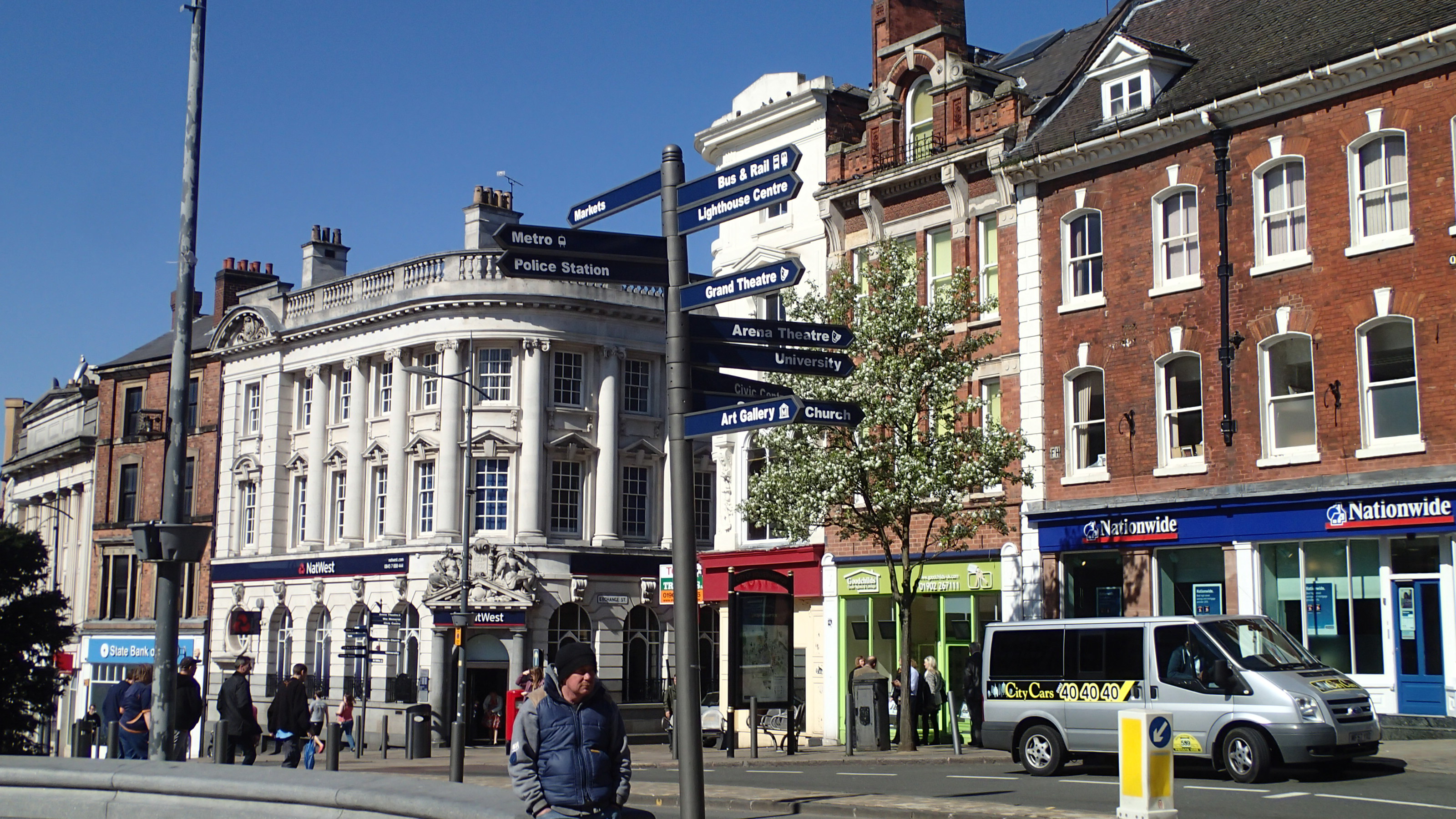
Where’s The Football Ground?
Hopefully next time, I go, the Midland Metro will be connected to Birmingham New Street station, so it may be easier to go to Molineux by Birmingham and the Metro, as this will mean only a downhill walk in Wolverhampton and I could et in the larger city first. Coming back, it would probably be easier to use today’s route, until they extend the Metro with a loop in Wolverhampton. The Wikipedia section contains this statement.
In July 2010, Centro Director General Geoff Inskip hinted that the scheme would be reworked by taking it to “places people need to go, such as the University”, and not taking passengers to the railway station and back “if they don’t actually need to go there”
Surely as the football ground is next to the University, Wolverhampton probably needs a full city centre loop, that serves the shops, railway and bus stations, the University and the football ground. This Google Earth image shows the Inner Ring Road, the northern part of the city centre, the football ground and the train station.
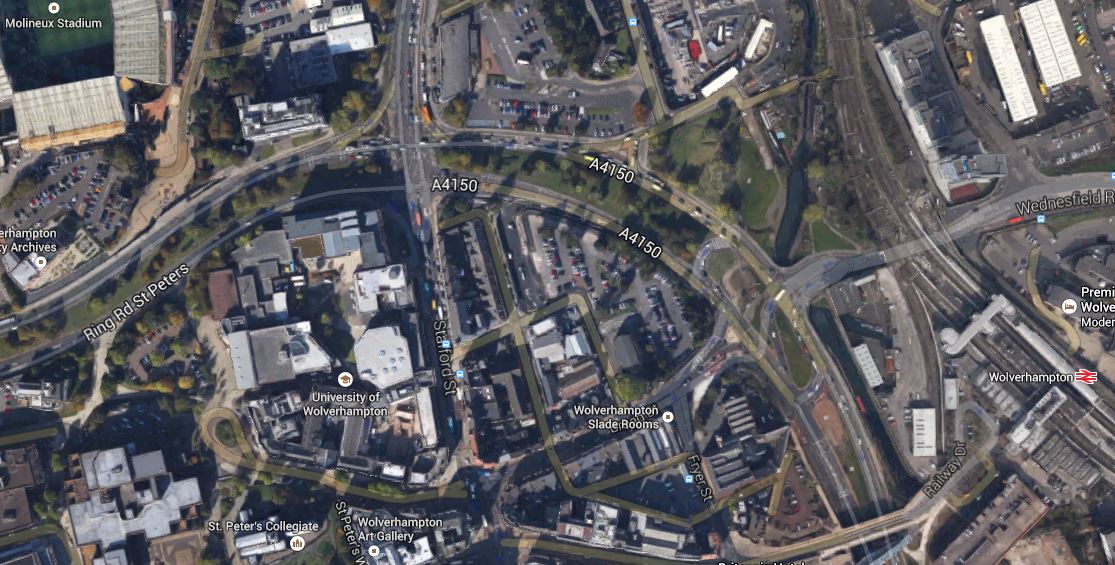
Wolverhampton Inner Ring Road
Note that the Inner Ring Road has a very wide central reservation, which must offer possibilities for running the Metro along the middle, serving the various stops by subway or footbridge. At the football ground there is already a subway and there is a bridge at the railway station, that could be upgraded to tram stops. This Google Earh image shows the bridges that connect the bus and railway stations.
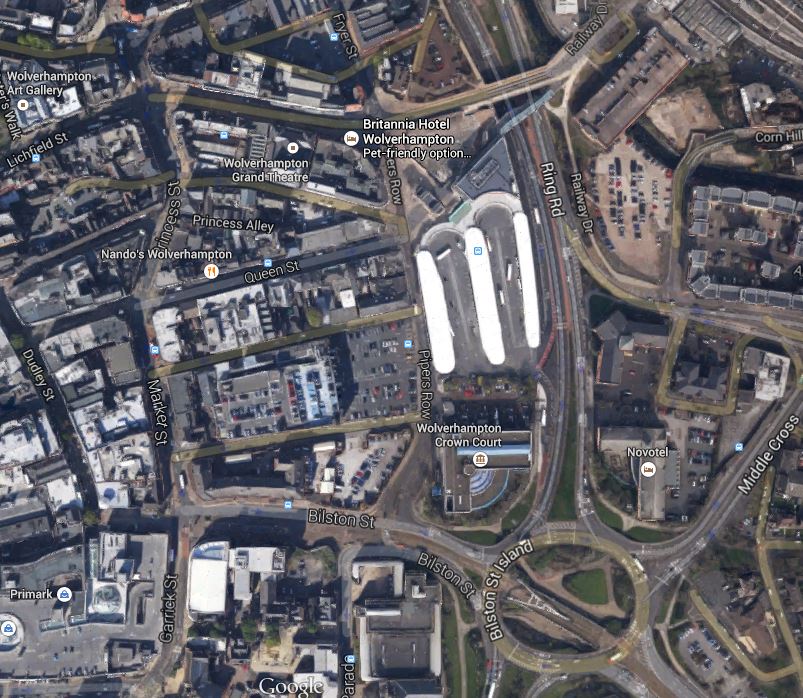
Wolverhampton And Midland Metro
The big roundabout south of the bridges and the three limbs of the bus station is where the Metro enters Wolverhampton City Centre to terminate at Wolverhampton tram stop. Could not a branch turn north to serve the bus and train stations, Wolverhampton University and Molineux? In an ideal world, it would continue past the football ground to perhaps a Park and Ride site on the other side of the city. Or it could even go further round the Inner Ring Road and loop back into the City Centre to the existing terminus.
There is also talk as in this article in the Wolverhampton Express and Star, of using tram-trains to extend the Midland Metro from Wolverhampton to Walsall on an old rail line. But then the West Midlands has used and disused rail lines everywhere and if tram-trains work well connecting Sheffield and Rotherham, I would think it is likely that proposals could be put forward to extend the Metro.
The possibilities are endless and by 2020, engineers and civic planners will have come up with a scheme that is much better than any so far proposed.
The football today was a hard-fought draw and a that was probably a fair result.






The pictures show the ground, the match and the half-time entertainment.According to the report on the BBC web site, Mick McCarthy was forthright after the match.
We are always hard to beat and hard to play against. The first thing I said to the players in the dressing room after the game was what a belligerent, stubborn, hard working, tough, horrible bunch you have turned out to be and I love you and I am proud of you because you need all those qualities to be a good team. It is lovely to have.
I wouldn’t disagree with Mick’s superb motivational speech. You can imagine various military commanders saying something very similar.
Pudding Mill Lane Portal – 17th April 2015
Crossrail’s Stratford Portal is where the surface section of the line to Shenfield enters the tunnel to go to Whitechapel and all the stations to the west. This is a Google Earth image of the works at the tunnel portal.
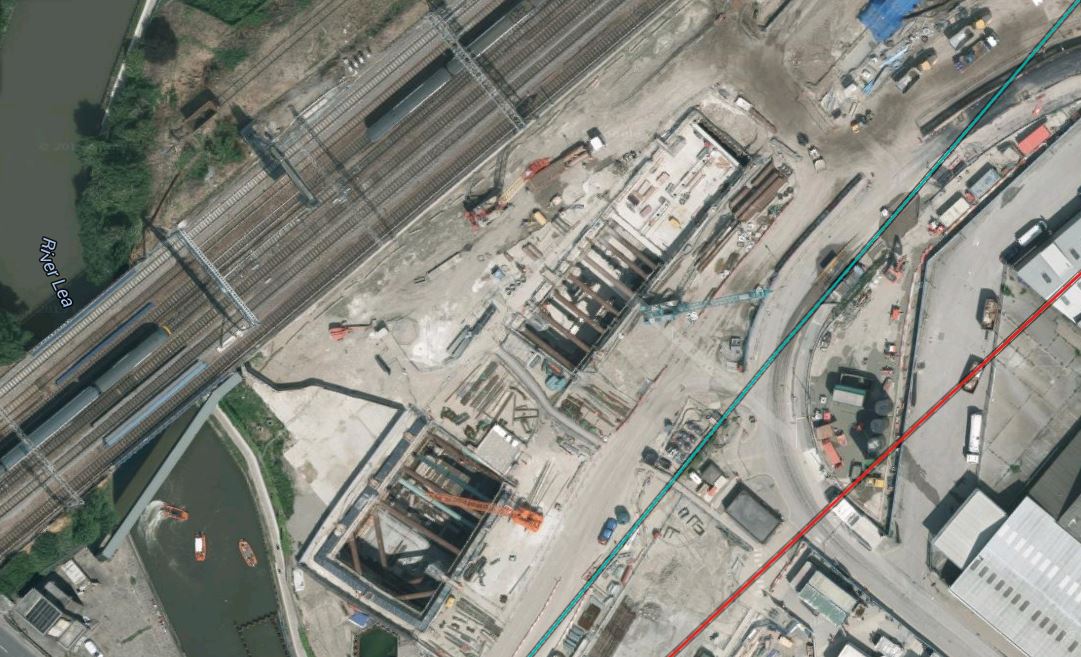
Crossrail’s Stratford Portal
A ramp is being built to and from the Great Eastern Main Line to connect the Crossrail tracks to those of the main line. This picture shows how Pudding Mill Lane station will look, when everything is complete.
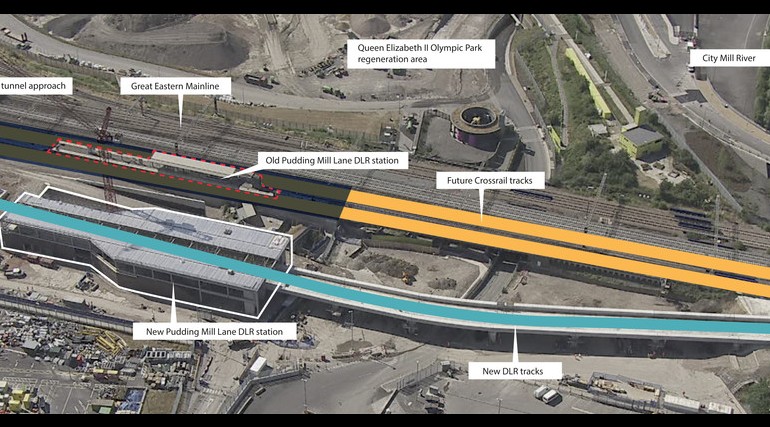
Pudding Mill Lane Station
The Crossrail tracks are shown in yellow and the DLR ones in blue.
These pictures of the area were taken from Pudding Mill Lane station or a DLR train.
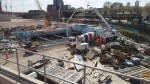
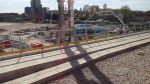
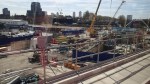
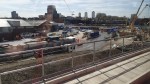
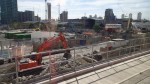
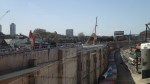
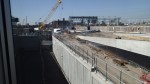
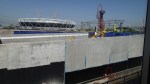
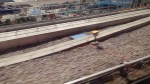
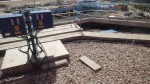
The station is certainly a good place to go to see the works going on here.
 The Anonymous Widower