Serial Cooking – Cinty’s French Fish Pie
This fish pie is another Lindsey Bareham recipe, that is an ideal two portion dish.
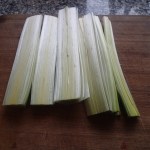
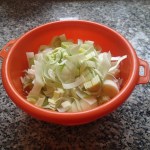
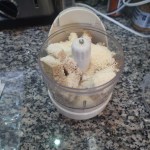
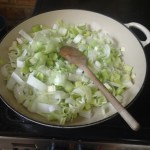
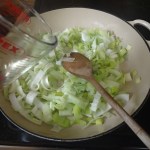
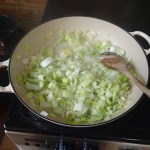
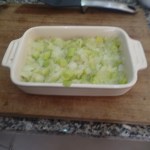
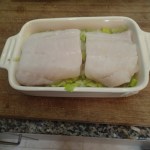
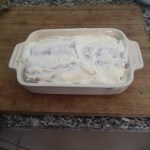
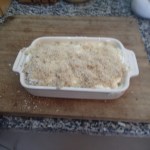
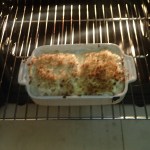
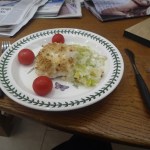
It is easy to do and I suspect that the completed dish could be prepared earlier and left in the fridge for most of the day.
The one here, gives me two portions for two suppers or a meal with a friend.
A friend of mine does this recipe a lot. She says it is easy to modify for however many are turning up for supper. She also says she doesn’t get complaints.
Could Parry People Movers Replace The Class 153s?
On the Stourbridge Town Branch Line, Parry People Movers or Class 139 trains, have replaced a Class 153 train on the short route.
As there are seventy of the Class 153s, how many of these could be replaced by the smaller Class 139s.
I feel that a line like the Felixstowe branch could probably just be covered adequately, by two Class 139s working together. They would start simultaneously at Ipswich and Felixstowe, every thirty minutes. The current Class 153 is scheduled to take twenty-six minutes, which means it would be tight and would probably need a train with a bit higher performance than the current Class 139.
But if you look at this line in a few years, it is likely that it will be electrified for freight reasons and I suspect that passenger trains on the branch will be reorganised and run by a suitable electric train. I do wonder if the Ipswich Cambridge line were to be electrified and given an increased service frequency, that some of these trains should be extended to Felixstowe or Harwich. Extra stations might also be added on the Felixstowe line to both serve the port and new housing developments. The area has lived on scraps and hand-me-down trains for years, but now that the Beccles Loop and the Bacon Factory Curve have been built, the trains are at last generating traffic and running more frequently and reliably.
Looking at where the seventy single coach Class 153 trains are used, quite a few are used on lines a lot longer than the Felixstowe branch. When I took a trip around Wiltshire, a lot of the journey was in a Class 153, but probably the route is too long, fast and busy for the smaller Class 139.
So I would think that some Class 153s and possibly some Class 150s or 156s might be able to be replaced on services by Class 139s or a bigger version, but not many. A specialist version with lots of space for bicycles, wheelchairs and luggage might also have applications in tourist areas like the St. Ives branch.
Another likely source of replacement is some new Class 172s. This has been hinted at by a rail minister and we do have a General Election coming up. If money was no object, all of those rural lines that will probably never be electrified like those in the North of Scotland, Lincolnshire, East Anglia, Wales and the West Country, would be equipped with a new standard train like a Class 172, built to last for the next forty years. Class 172s also have the advantage that they can be lengthened by adding extra coaches in the middle and coupled together to make longer sets. I suspect too, they could also be updated in a decade or so, with an energy-efficient, quieter hybrid power train.
In my view an order for some Class 172s would solve a lot of problems for a long time.
A start has also been made on refurbishing some of the Class 156s and these will probably all be retained for many years. As some of these Class 156s are used on lines that will be electrified, they could be a replacement for Class 153s and 150s, where something better and/or bigger is needed.
The Class 15x trains may all be getting on for thirty years old, but many could linger a good few years. Especially, if engineers keep finding ways of updating them, like these new toilets.
So to answer my original question. Parry People Movers or their larger successors might have a place in some places in the UK, but I can’t see too many running in say ten years time, except under special circumstances like Stourbridge, where a high frequency service is needed over a short distance.
Perhaps some might be used on new services, where a small town or attraction needs to be connected to a main line. One place for example might be to link Yeovil Junction to Yeovil Pen Mill and then possibly to the town centre. The track exists between the two stations, which don’t have any connections and are served by totally different companies and services
Projects Are On The Way – W/E 22nd November
This week there have been several projects or investment in UK railways announced.
21st November – Crossrail Work At Shenfield Starts Early – Are they wanting to build Crossrail faster?
21st November – Welsh Valley Lines Go-Ahead Given – This is very much needed.
20th November – Wisbech Reopening Proposed – Nothing concrete yet, but needed if Wisbech is going to develop as a satellite of Silicon Fen
19th November – Electrostars For Gatwick Express – Something like this was expected and Derby will be pleased.
18th November – Crossrail Accessibility Boost – Probably best done before opening
It will be interesting to see how many get announced each week, as we build up to the General Election.
Using The Strange Property Of Water To Advantage
Most people, except perhaps those, who live in hot climates, know from their personal experience that ice floats on water. But most people don’t know that water is at its densest at 4°C. So water at this temperature sinks, but it rises at all others.
I once heard somebody use the existence of this property as a reason why God exists. He argued that if it didn’t, then life would have been impossible in water. It was all a bit contrived, but it is still as a strange property.
This morning, I was listening to Wake Up To Money, when a company called SureChill was mentioned. So I looked them up and found that they are using this property to create a new type of refrigerator. This page explains it all. This section describes the solution.
Sure Chill is a brand new kind of cooling system. It doesn’t need a constant power source. In an on-grid situation with intermittent power, it works perfectly well. In an off-grid situation, where a solar panel may be used, a Sure Chill powered refrigerator doesn’t even need a rechargeable battery. It shouldn’t work but it does. And it works beautifully.
Water surrounds a Sure Chill refrigeration compartment. When it has power, the water cools and forms ice above the compartment leaving only water at four degrees cooling the contents. When the power is switched off, the water warms and rises while the ice begins to melt, keeping only four-degree water cooling the contents of the compartment. So it has its own internal and entirely natural energy store that maintains a completely steady temperature. The system can operate like this, without power, for days and weeks.
People think physics is boring. Outside of Metier, I’ve done well in my career and made quite a bit of money by understanding the laws of physics that govern our lives.
My surprise at this idea, is that the technique could have been implemented in a refrigeration system decades ago. Artificial refrigeration was first performed by William Cullen in 1755. My bible; Nelkon amd Parker says that the maximum density of water was first measured by Thomas Charles Hope in 1804.
That is a long time from experimental proof to reality!
Dalston Junction To Marylebone In The Rush Hour
Yesterday, I needed to get to Marylebone to go to Birmingham. Some time ago, I wrote about the reverse journey and it wasn’t easy in the rush hour.
So just out of interest, I decided to go by getting the Overground to Whitechapel and then using the District line to get to Embankment for the Bakerloo line to Marylebone.
I left home at 08:44 and arrived at Dalston Junction at 08:52. I left the station five minutes later, after a bit of trouble with the machine buying my return ticket from Marylebone to Stourbridge Town.
I made Whitechapel at 09:10 and at 09:30, I was at Embankment, after a trip on a not-to-busy train.
I’ve avoided Embankment station for some time, as it has been in a state of chaos due to refurbishment, but now look at it.

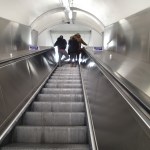

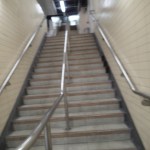
It was clean and bright and a virtually empty Bakerloo line train got me to Marylebone in a couple of minutes under the hour since I left Dalston Junction. This post on TfL’s web site explains what was done. It says this.
The decision to replace the escalators simultaneously rather than phasing the work meant that it took 43 weeks to complete as opposed to at least 75 weeks. While this work was taking place, LU also took the opportunity to refurbish other parts of the station including retiling corridors and platforms, installing new lighting and replacing station Help Points and CCTV systems.
It certainly looks to be a job well planned and executed.
I think this could become my preferred route to Marylebone and Paddington, until Crossrail goes to Paddington.
Unfortunately, there was a bit of a signalling problem on the Chiltern line and staff got confused about the 09:45 Birmingham train’s departure platform. So I caught the 10:15.
To Stourbridge And Back
I went to Stourbridge today essentially to see the town and the Parry People Mover, but I took these pictures on my way up by Chiltern from Marylebone and back on Virgin to Euston.
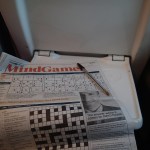
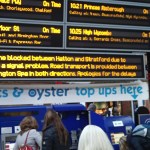
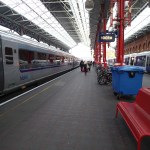
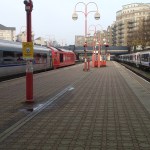
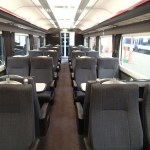
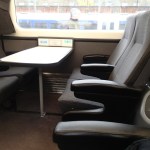
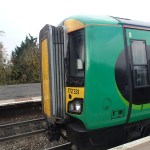
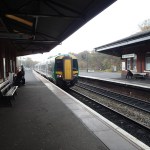
The trips illustrated the best and worst points of the two companies and their trains.
Chiltern has the more comfortable trains, with big windows and free wi-fi, but the journey takes longer.
One small thing that surprised me was the quality of both the Class 172 trains and the stations it passed through, on the way from Birmingham Moor Street to Stourbridge Junction. In some ways though it is a reasonably modern line, as it was only reopened in 1995 as the Jewellery Line Project, which created Birmingham’s cross-city passenger route between Moor Street and Snow Hill. Wikipedia says this about the Birmingham to Worcester via Kiderminster Line, on which Stourbridge Junction is located.
It is a future aspiration of Chiltern Railways and Network Rail to electrify the entire line, including the Chiltern Main Line to London Marylebone.
I’ve always thought that electrification of the Chiltern Line should be done before HS2, so that there is adequate capacity between London and Birmingham, whilst Euston is rebuilt.
Another reason to electrify the Snow Hill Lines sooner rather than later would be so that some of these Class 172 trains could be released for other routes.
Birmingham New Street Has Silver Cladding
The new mirror cladding on Birmingham New Street station, just asked to be photographed.
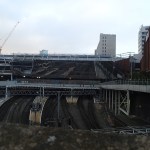
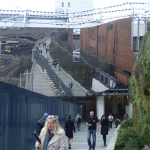
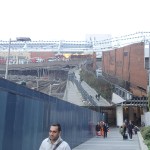
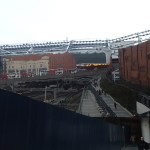
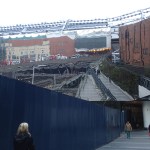
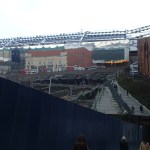
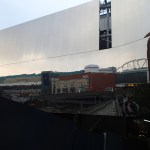
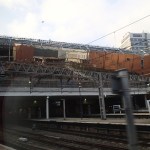
These attempts are only pretty crude, but when it’s finished, professional photographers will be drawn to the station, to get that ultimate picture.
Stourbridge And The Parry People Mover
I went to Stourbridge to see the Parry People Mover that is used on the branch line between Stourbridge Junction and Stourbridge Town.
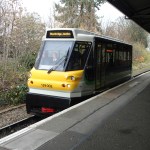
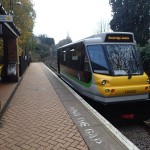
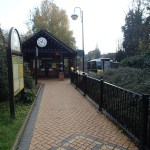
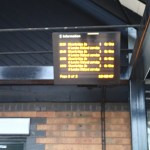
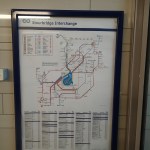
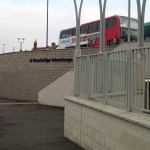

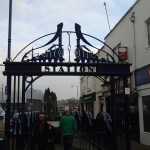
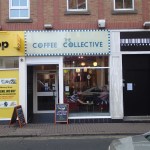

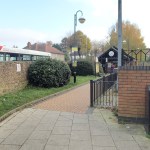
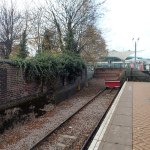

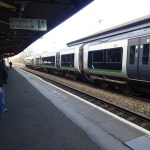
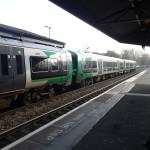
But as the pictures show, I also found a well-thought-out solution to the problem of how do you create an integrated transport hub in a town.
It was one of the first bus interchanges I’ve found outside London, where if you’d been dropped to get to X, you could have found the way without asking anybody.
One thing the pictures don’t show, is that on both trips the number of people on the train was more than you generally see on the Class 153 between Ipswich and Felixstowe.
I would also recommend the Coffee Collective. It is a short walk from the bus station and is obvious, when you exit the subway.
But having ridden in the Parry People Mover or Class 139, what do I think of it?
The first thing I would say, is that if you look at the pictures, you’ll see it is a genuine step-free entrance and exit. A lady pushed a baby in a buggy into the people mover, when I travelled, and it was as easy as any train I’ve ever seen.
You could say, wouldn’t it be cheaper to use a quality bus at Stourbridge to link Stourbridge Junction with the bus station in the town. Obviously, London Midland hasn’t done this. But, when they did this in the past, they brought back the Class 153, so perhaps this connecting train is a great traffic generator for services to Birmingham.
Other than that, it just did what you would expect a train would do and transported the around twenty passengers to the other station without fuss. The vehicle had a feel somewhat like the Docklands Light Railway, although it was a lot smaller.
As it is powered by a flywheel driven by a small internal combustion engine, this type of vehicles could have a range issue, but it won’t be as severe as that of a battery-powered one. In this section on the future of the Class 139 in Wikipedia, this is said.
This will entail an articulated unit, with a pair of PPM60 variants at either end of a fixed passenger unit—the whole unit will be capable of accommodating up to 220 passengers and travelling at up to 60 miles per hour (100 km/h) on railways or 50 miles per hour (80 km/h) on tramways.
If a double vehicle could move even 100 passengers over a distance of fifteen miles, then the branch line I know best; Ipswich to Felixstowe, could be run by such a people mover. It probably isn’t much slower than the Class 153, so it shouldn’t give too many problems with scheduling amongst the freight trains.
Two vehicles would probably be needed for the line, but it would seem likely that the frequency of passenger trains could be increased.
A special version of the vehicle could be designed for tourist branch lines such as the one at St. Ives, with space for bicycles.
How much extra traffic would shiny new trains, running more often, generate?
Having seen this first use of a simple energy-efficient people mover, I think that in a few years time, vehicles based on similar principles will become commonplace. Just as London’s new Routemaster, has shown that buses should be hybrid with flat floors and lots of entrances/exits, we will see a series of rail vehicles, where flywheels or batteries are used to create efficient hybrid drive systems and stylish modern vehicles sized to the traffic.
Eventually, I think we’ll see this type of train on a branch like Romford to Upminster, which is only about six kilometres long and has a speed limit of only 30 mph. If they are the only traffic on such a branch, this would remove the need for electrification. You probably wouldn’t take it down, but you’d switch it off. On the other hand this would make it easier to nick!
But because this type of vehicle doesn’t need electrification or other expensive infrastructure, it also opens up the possibility of adding new services and even lines. Go back to Felixstowe. The town used to have a station at Felixstowe Beach, which is close to the port and still served by the Felixstowe branch. It might at some point be thought to be a good idea to restart this service. It would be so much easier to do this with a vehicle like a Class 139 or a successor.
There are also quite a few heritage and freight-only branch lines connected to the main UK rail network. Could vehicles like this be used to run commercial services to connect passengers to the network? It would all depend on the branch line, but some companies are looking at possibilities.
Once one scheme is successfully up and running, I feel others will quickly follow.
Serial Cooking – Ham And Leek Gratin With Emmental Mash
Ham And Leek Gratin With Emmental Mash is another of Lindsey Bareham’s recipes from The Times

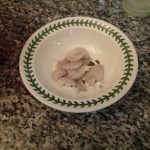

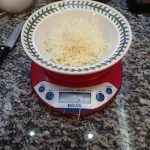




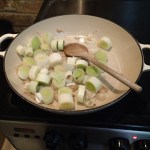

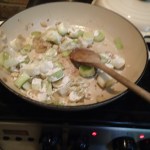
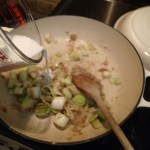


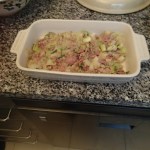
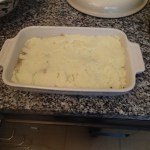

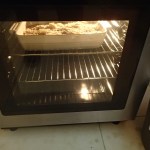
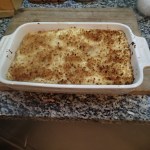
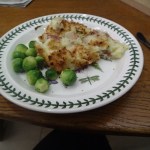
Again I chose it becauses there could be a break before putting it in the oven. I also made a half quantity for myself. Lindsey’s sizes were double mine for three.
I had one portion cold and it was delicious.
Latimer Road – A Gem Of A Station
The platforms at Latimer Road station had to be rebuilt for the new S Stock trains.
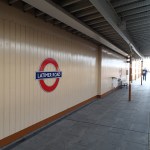
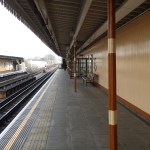
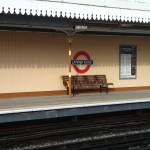
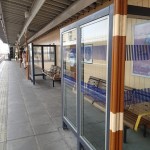
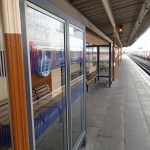
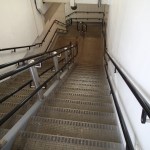
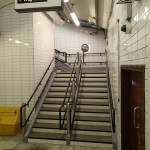
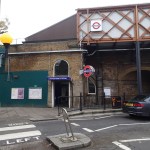
It would be wonderful if all stations had the look and feel of this one. Wikipedia gives a full history of the refurbishment, which contains this gem.
When the wall for the westbound platform was removed, contractors discovered an old bricked-up entrance to the station public house, currently known as The Garden. They also found underneath the platform a very old and possibly Mahogany staircase leading up to the pub entrance. Apart from all the years of dust and grime they also found, amongst other things, a bath, old gun parts and even a vat of acid.
How many other stations have secrets like that?
 The Anonymous Widower