What Do You Do With Six Million Tonnes Of Earth?
Crossrail will produce six million tonnes of earth and spoil, from where they are digging the tunnels, shafts and stations in London. Three-quarters of this are being used to create a new wetland habitat for the RSPB at Wallasea Island, north of Southend in Essex. Read all about it here.
Crossrail’s Tunneling Machines
The BBC has been showing a story with video about Crossrail‘s giant tunneling machines which will start work in the near future.
Crossrail has more on the boring of 42 km. of tunnels under London using eight tunnel boring machines here.
They also have more on the Tunneling and Underground Construction Academy, which will be a unique legacy of Crossrail and will continue to provide trained staff for tunnel projects all over the world.
We really are entering the Golden Age of Tunneling.
How To Recycle A Tunnel
Crossrail is Europe’s largest construction project and they are really upping their publicity this year, as the work begins in earnest.
I found this story with a video about the reusing of the Connaught Tunnel on the BBC’s web site. I wrote about this earlier.
It’s a fine piece of engineering and the associated project management.
Eating Healthily On The Cheap
The Government has got together with Ainsley Harriott to promote healthy eating on the cheap.
Where I live in Hackney my letter box is stuffed full of money off vouchers for kebab and burger houses.
This campaign will fail, unless the problem of junk food is addressed.
Perhaps the rates on all unhealthy eating places should be increased.
David Would Not Be Amused
My friend, David, finished his career as the Business banking Director of Lloyds Bank.
He was a proper banker, although he was a bit of a rogue. But one on the side of the bank and his clients!
So when I read in the Telegraph, about the dreadful mess Lloyds is now in, after the takeover of HBOS, I wonder what he would have thought of the fiasco.
I know some of the things he did to sort out serious problems and I know he would not have been amused. I suspect that Prudence would not be on his Christmas card list.
The Boxer, The Philosopher and The Model
It sounds like the title of one of those jokes, but it is a story I picked up in Wikipedia.
Years ago, C used to know the late Dee Wells and her sister. Dee was a respected journalist and was married at the time to the rather famous philosopher Professor A. J. Ayer. I was browsing through his entry and found this story.
He taught or lectured several times in the United States, including serving as a visiting professor at Bard College in the fall of 1987. At a party that same year held by fashion designer Fernando Sanchez, Ayer, then 77, confronted Mike Tyson who was forcing himself upon the (then) little-known model Naomi Campbell. When Ayer demanded that Tyson stop, the boxer said: “Do you know who the fuck I am? I’m the heavyweight champion of the world,” to which Ayer replied: “And I am the former Wykeham Professor of Logic. We are both pre-eminent in our field. I suggest that we talk about this like rational men”. Ayer and Tyson then began to talk, while Naomi Campbell slipped out.
Does this illustrate that words are stronger than fists?
The Zopa-Go-Round
The title of this post, nods a little towards Rossminster, which was credited with a rather dubious tax avoidance scheme, that was nicknamed the Money-Go-Round, by the press. The two companies Zopa and Rossminster operate in different fields and I suspect they have really nothing in common. But I like the title.
Now, why do I call it the Zopa-Go-Round?
Usually saving accounts fall into two broad categories.
- The account gives you instance access and an obscenely-low interest rate.
- Your money is locked in for a year or maybe longer, but you get a slightly better rate. But getting your money out early is not only extremely difficult, but it comes at the cost of various financial penalties.
Zopa is something different and very much between the two.
As 2011 has just finished, I now know that I earned just under six percent before tax over the year and that includes all bad debts and charges.
Not a bad rate considering that you have no restrictions on withdrawing money, if it is in your account. So if you have just been paid some interest or some capital has been returned, you can transfer it to your bank account without charge, if that is the place you need it. There is also no charge for putting more money in.
So one of the great things about a Zopa account is that it can be used like a higher interest deposit account without the restrictions and you can move you money in and out freely, as it suits you.
If you take my circumstances, it illustrates how a Zopa account can be used.
When I moved here, I was unable to sell my stud in Suffolk, so I am living on my savings in the Zopa account, plus a small drawdown from my pension. So each month, instead of re-investing all of the money that I earn from Zopa in new lending, I retrieve enough to pay my bills and expenses. If I have any surplus at the end of the month in my current account, I transfer this money back into Zopa.
In my case, much of the capital I have put in, is still lent out to borrowers, but is of course paying regular interest. I could if required sell some of these loans on, but as most are up-to-date, I prefer to keep the borrowers I know, rather than new ones I don’t.
So the money goes around and around and sometimes I choose that it comes out my way.
Hence Zopa-Go-Round!
You can think of many people, who might want this form of flexibility.
I don’t think that my situation is untypical, as often there comes a time in one’s life, where you downsize your house or your possessions.
C and I had always intended to sell up and move to London, although we’d never put a date on it. but we had window shopped for a house in Hampstead. Unfortunately, her premature death put an end to all those dreams. A lot of our possessions would probably have been sold and we wouldn’t have really needed to have three good cars and a horse box.
So just like many, on retirement, we would have a few thousand pounds to either spend or save. Hopefully, the sale of the stud, would have bought a desirable house, where we wanted it.
As I have found, Zopa has been an ideal place to put that money and draw it out as and when I need it.
Zopa though, isn’t the best place to put money, that you might need in a few months, unless you are prepared to use their system to sell good loans to other people. So it wouldn’t be the best place to save your money to pay the taxman, unless of course you save more than you need or do very detailed calculations.
One thing to remember is that if say you put £10,000 into Zopa and lend it for three years at an average rate of five percent, you’ll get just over £300 a month back. I’m assuming that you don’t adjust the interest rates you charge to get the best return and that you don’t reinvest the money returned.
The Money-Go-Round
I must admit that I’ve borrowed this title from the nickname of a rather dubious tax-saving scheme thought up in the 1980s by a company called Rossminster Group. Little is found on the Internet about this company, although there is a bit in the obituary of one of Mrs. Thatcher’s ministers, Peter Rees. I became aware of Rossminster through my bank manager and friend, David, who was also bank manager to the Group. He explained what they did as moving money between large number of onshore and offshore accounts, so that it was difficult to say, where it was for taxation purposes. You have to remember that in those days of the 1970s, tax rates were very high and moving money to say the United States to start a subsidiary there was so impossible it was virtually banned. The latter is one of the main reasons, why so few small, but very profitable private companies were successful before the 1980s and 1990s. Any success, especially in a technological field was to be envied and not nurtured, especially if it was in competition with one of the government’s pet projects. And if it was successful, it had to be taxed to the hilt.
My association with Rossminster was rather limited, but I was asked to quote for a computer system to manage all those accounts. I didn’t do much, as I had bigger fish to fry. But David did a lot of business with Rossminster, as all those transfers meant a lot of bank charges in those days. In the end, as he once said he had a good run with the company, but eventually someone offered Rossminster a better deal.
Good Riddance To That Tooth
I broke the tooth many years ago and a couple of dentists had tried to fill it, but it always caused me a certain amount of pain. I don’t remember how I broke it, but I think it might have been on a bread roll in a Michelin-starred restaurant in Italy. The only person, who could know is C, and she has been gone for over four years now.
After the stroke it got painful and no matter what I did, it was giving me pain. Since the stroke it seemed to have got worse and I often thought it smelt of something like rotten fish. It will be three weeks tomorrow, since I had the tooth finally removed in the Royal London.
Since then, I’ve been to dentists twice to have a look at it and one gave me some antibiotics. A few days or so a small piece of tooth came through the gum.
Yeserday though, another piece came out and it was about the size of a child’s front tooth. The gum bled a bit, but by the time I got to bed and after a whisky, it was OK.
I also slept very well and long and woke without any tooth pain. And that means also none in the left hand side of my face for the first time in a year.
Strangely, my left hand seems to be working better in the typing.
It’ll be interesting to see what my dentist says, when he reviews it all on Wednesday.
My only regret is that I’d had it out a year ago. Or even earlier.
Building The Revolution
I went to the Royal Academy to see the exhibition on Soviet Art and Architecture entitled Building the Revolution – Soviet Art and Architecture 1915-1935.
It was fascinating and sad in equal measure.
The former because some of the buildings were spectacular and ground-breaking. It was all rather sad to see the state of decay that some of them are now reduced to.
But then some of our best buildings from the era have suffered a similar fate. Although, it is from just after World War II, I once went over Cliff Key Power Station in Ipswich. That was a real pleasure and it was a pity that it couldn’t have been transformed for a modern purpose. But then those power stations, were built to last thirty years and often the foundations weren’t of the best. Just look at the state of the iconic Battersea Power Station today.
In the Courtyard of te Royal Academy, there was this tower.
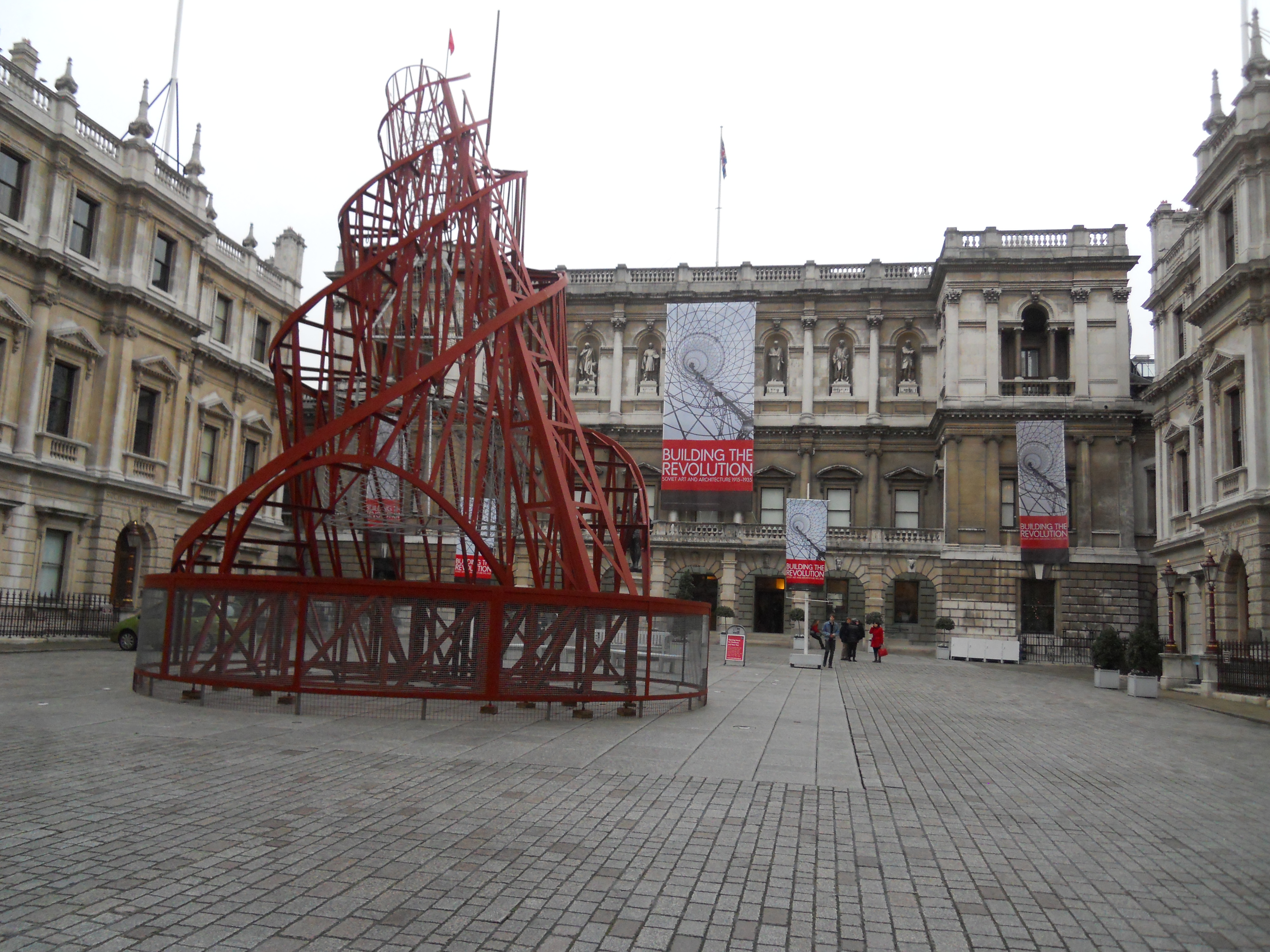
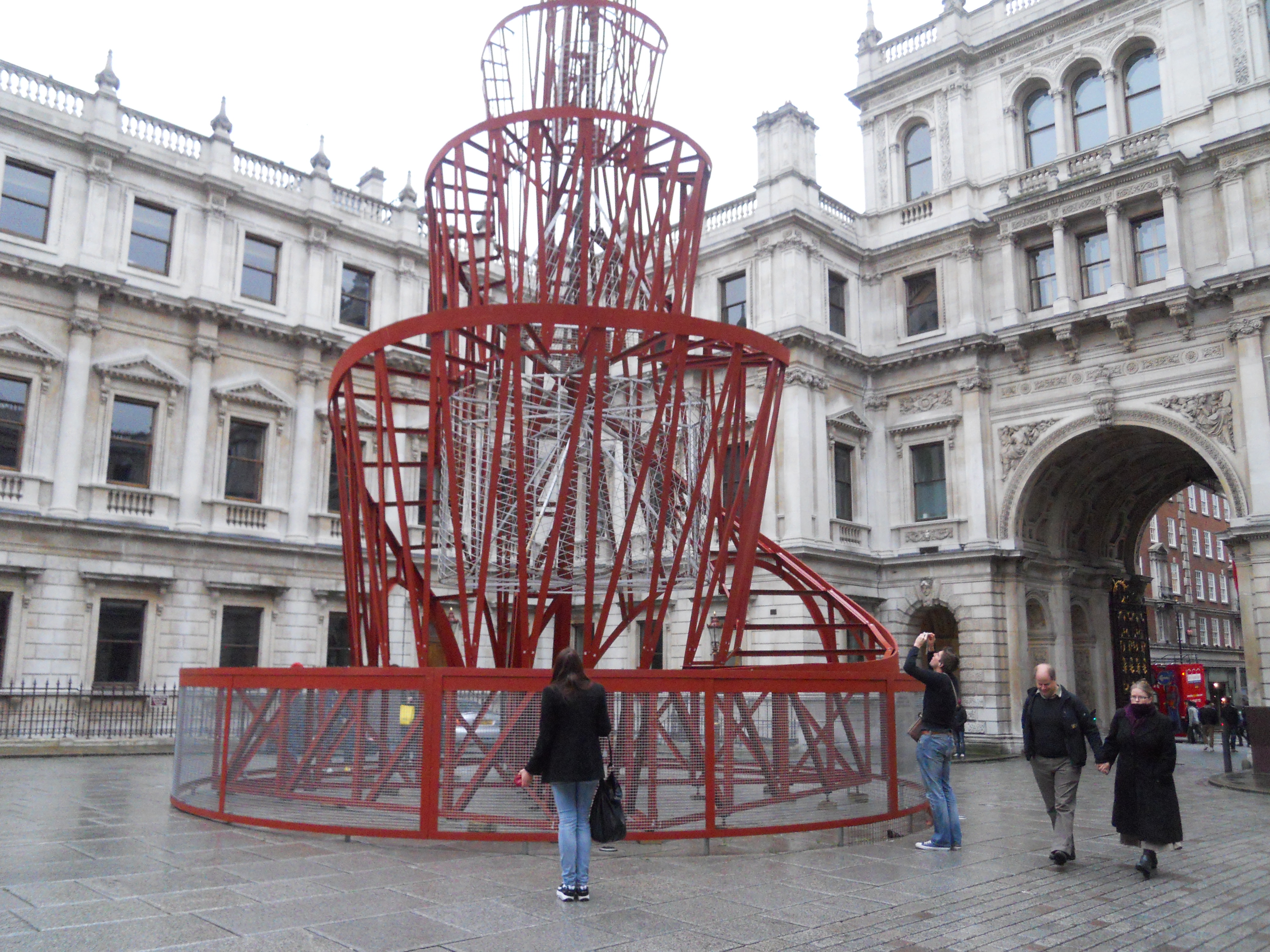
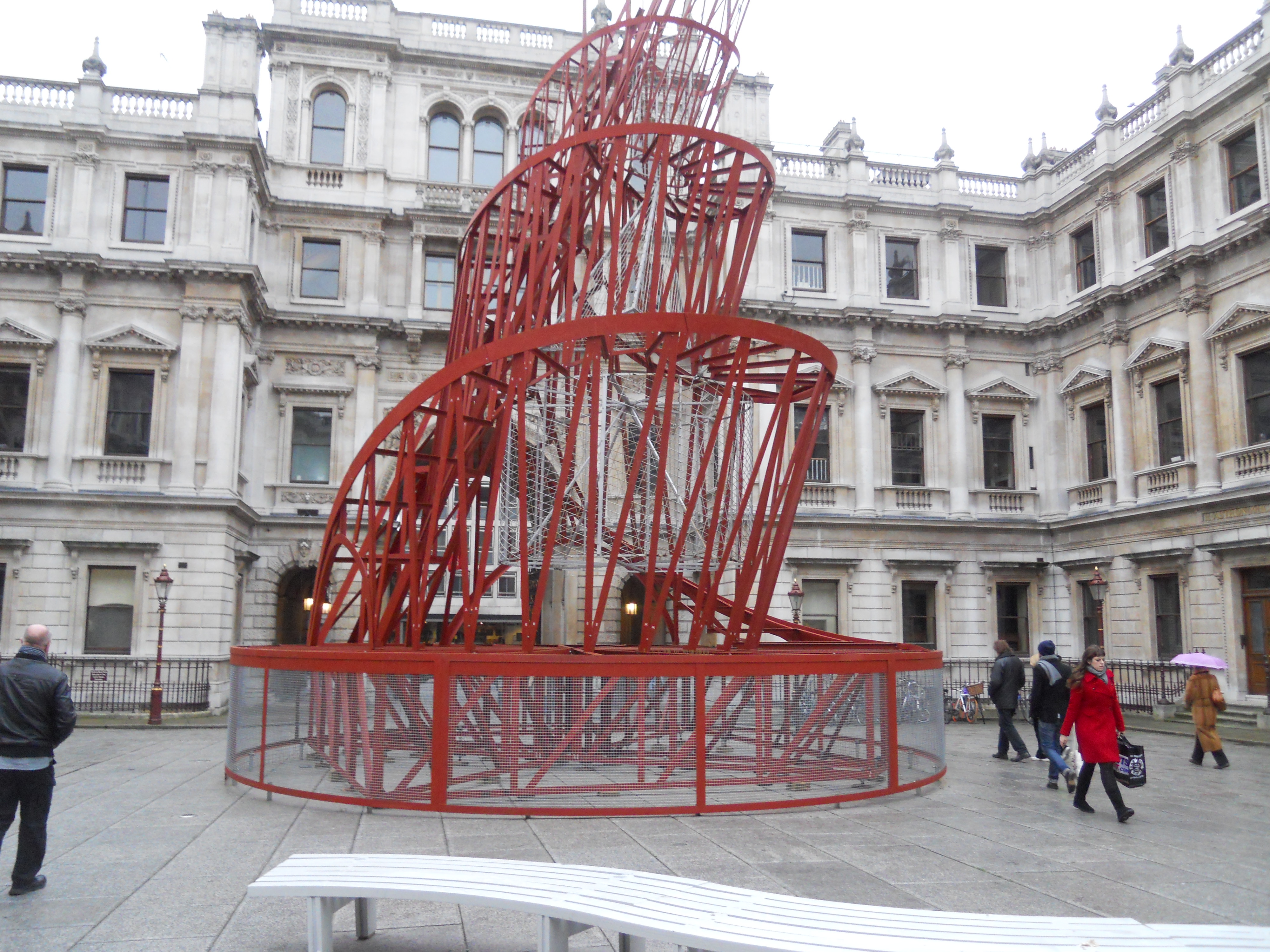
It is a modern reconstruction of Tatlin’s Tower; a giant tower that was never built.
 The Anonymous Widower