Access To Multiple Units
I have been taking some pictures of the grab handles in the doorways of a selection of electric and diesel multiple units.
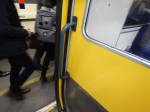
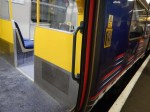
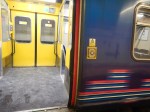
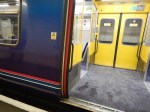
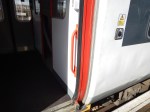
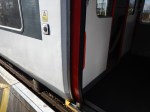
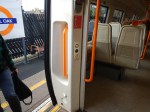
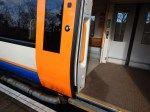
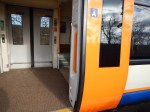
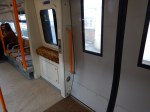
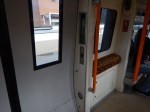
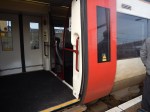
On most stations, the access between platform and train is a simple step across, but on lots of others, I have to grab the handle to make certain I am safe in the step-up or step-down.
Note
- The British Rail-era trains have similar designs.
- On some trains, you can’t see the grab handle from the platform, as it is hidden by the door.
- The Class 172 and Class 378 Trains are both Bombardier trains of a similar date, but the handles are very different.
- The Class 378 train has an asymmetric layout.
I will add more examples.
My Entry And Exit With A Large Step
When I get into a train, where there is a large step, I often poke my head around the door to get a good look at the handle on the right hand side, which I grip with my right hand to balance myself as I step up.
When I get out from a train, where there is a large step, I go to the right, grab the handle and then step out sideways onto my left leg.
I should say that I have the following problems.
- My left hand and arm isn’t the best, as my humerus was broken by the school bully.
- I tend to avoid using my left hand.
- My stroke a few years ago damaged my eyesight low down on the left, so when descending I like to have something to grab.
- I have a touch of arthritis.
- I am only one metre seventy tall.
On the other hand, my right hand and arm are strong. I also have no vision problem on the right hand side.
Could Grab Handles Be Designed Better?
They could certainly be designed better for me!
But I am one of millions, who are less than one hundred percent!
I wonder if a University or Design Consultancy has ever looked at the problem of designing a perfect grab handle for a train.
My ideas could include.
- A grab handle that is longer and goes lower, so it is better for short people and lder children.
- A grab handle that protrudes slightly from behind the open door, so that entering passengers can see it.
- A grab handle with a textured surface.
- Should the grab handle layout be symmetrical.
I would suspect, that if a better design of grab handle could be found, this would speed up entry and exit from the train. Surely train operating companies would like that?
This is not the finished post. Any suggestions and comments will be welcomed.
The Electrification Between Lea Bridge And Meridian Water Stations Is Almost Complete
I took these pictures from a train going North from Lea Bridge station to the new Meridian Water station.
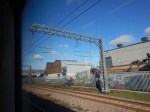

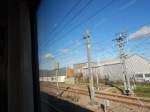
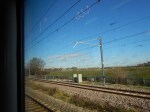
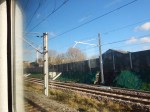
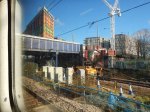
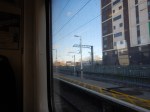
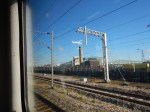
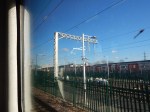
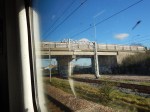

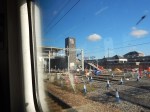
It appears that most of the electrification is almost complete, except for perhaps a hundred metres at the Southern end.
Conclusion
This electrification seems to have gone reasonably well so far.
On the other hand, the electrification of the Gospel Oak to Barking Line was troublesome with various components being wrongly made and the discovery of an unknown sewer.
But the electrification of the new single track was effectively working on a new track, where what was underneath the track was very well known.
I’m drawn to the conclusion, that if we want to electrify a railway, the quality of the knowledge of the tracks to be electrified has a strong influence on the outcome of the project.
If there are thought to be too many unknowns and it is felt necessary to relay the track, then so be it!
We may have the paradox that to electrify a 125 mph fast line like the Midland Main Line, which has had top class care and constant speed upgrades, may be easier and more affordable, than to electrify a slower commuter line like Manchester to Preston, which has probably not had as much attention, due to the slower speeds.
I know it’s totally different, but decorating a new house is easier than doing the same to an old one!
Electrification of a railway track seems to have a similar relationship.
Annoying Advertising Pop-Ups In The Bottom Right Corner Of The Screen
These started a couple of months ago!
Many are from a site called Your Money, but one was selling me cannabis.
How do I stop them?
I use Chrome as a browser and don’t use Facebook or other social media of that type.
Thanks in advance!
A Class 313 Train In Not Bad Condition
On Friday, I took a train between Moorgate and Essex Road stations.
It was not in bad condition.
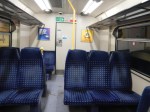
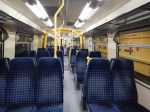
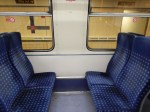
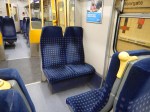
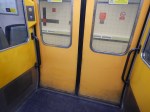
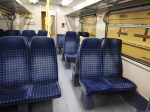
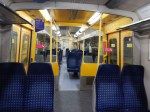
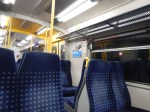
These trains are three-car trains and run in pairs as six-cars.
These trains used to run on the Watford DC Line, so I wonder if when they get to be released by the new Class 717 trains, some could be put back on that line to release some more Class 378 trains for the Gospel Oak to Barking Line.
Anybody like a game of Musical Trains?
Energy Price Cap Rise Will Cost Homeowners Extra £100 A Year
The title of this post is the same as that of an article in yesterday’s copy of The Times.
This is the first two paragraphs.
Ministers were forced to defend one of the biggest energy bill increases in a decade yesterday after the regulator raised caps on prices for 15 million households by more than £100 a year.
Ofgem blamed higher wholesale gas and electricity costs as it authorised suppliers to raise prices for 11 million households on standard tariffs by 10 per cent or £117 a year from April and for four million households with pre-payment meters by £106 a year.
The well-trumpeted energy price cap doesn’t seem such a good idea now!
As a time-expired Control Engineer, I’m against putting hard limits on anything, as it distorts the equilibrium of the system.
It is much better to do the following.
- Let prices find their own level.
- Make certain that those who should swap, get the best advice possible.
The regulator should always ensure that the price is right for both consumers and energy companies.
Battery-Poweed Trams To Beat Congestion
The title of this post is the same as that of an article in today’s copy of The Times.
This is the first two paragraphs.
New tram networks could be rolled out in towns and cities across England under government plans to cut congestion and pollution.
The Department for Transport said that so-called light rail systems could help “reduce dependence on private cars”. A report published yesterday said that trams could carry 20,000 passengers an hour in each direction – about four times more than buses.
It goes on to discuss battery-powered trams and their advantages.
It then discusses the future and says that funding for new tram networks could come from the £2.5billion Transforming Cities Fund.
I’ve been trying to find the report, but it doesn’t appear to be on the Department for Transport web site.
Thanks to Peter, the report is called Light Rail And Other Rapid Transit Solutions In Cities And Towns: Call For Evidence and it is on this page of the Government web site.
Has The Canonbury Cross-Over Become More Difficult?
In The Canonbury Cross-Over, I described how it was possible at Canonbury station to change easily from a Westbound train on the North London Line to a Southbound-train on the East London Line.
Services through Canonbury station on the East London Line in trains per hour (tph) are.
- Four tph between Highbury & Islington and Crystal Palace stations.
- Four tph between Highbury & Islington and West Croydon stations.
This means that eight tph call in Platform 2 at Canonbury station.
Services through Canonbury station on the North London Line used to be.
- Four tph between Richmond and Stratford stations.
- Two tph between Clapham Junction and Stratford stations.
This means that six tph call in Platform 3 at Canonbury station.
Since the December 2018 Timetable Change, two tph have been added to the Clapham Junction service.
So now both services calling at Platform 2/3 have the same frequency of eight tph.
So Why Does The Canonbury Cross-Over Appear To Be More Difficult?
Today, I was coming from Stratford on a Richmond train and was changing to the East London Line to Dalston Junction station, from where I can get a bus from outside the station to my house.
It takes a bit longer, but I was carrying my weekend shopping and as Dalston Junction station has lifts, if you need them and Dalston Kingsland station doesn’t, A lot of passengers, seem to use the Canonbury Cross-Over, when they are going from Stratford to stations on the East London Line.
As my train arrived at Canonbury station, in Platform 3, a Southbound-train was leaving Platform 2. So I had a wait of seven minutes in the rain for the next train to Dalston Junction station.
Since the Timetable Change, it appears that I am having to wait for several minutes a lot more.
Look at these times from the 6th of February. The time is when a train on the North London Line calls in Platform 3 and the integer is the number of minutes before the train calls on the East London Line in Platform 2.
- 1150 – 7
- 1157 – 0
- 1205 – 7
- 1212 – 0
- 1220 – 7
- 1227 – 0
- 1235 – 7
- 1242 – 2
- 1250 – 7
- 1257 – 0
- 1305 – 7
- 1312 – 0
- 1320 – 7
- 1327 – 0
- 1335 – 7
- 1342 – 0
- 1353 – 4
- 1357 – 0
- 1405 – 7
- 1312 – 0
In some cases two Southbound trains call between two Westbound ones.
Quite frankly, it’s crap!
Why?
I am no expert on railway timetabling, but if I look at the timetable, it appears that the two trains often seem to be timetabled to arrive at the same time.
As Southbound trains on the East London Line have only come one stop from Highbury & Islington station, are they more likely to be on time, than North London Line trains that have come all the way from Stratford station.
So like today, do North London Line trains arrive after the East London Line train has departed?
Conclusion
The timetable needs to be improved.
Would it be possible to timetable the East London Line trains a couple of minutes after those on the North London Line?
The Surprising Reason For London Underground’s New Heritage Signs
The title of this post is the same as that of this article on IanVisits.
This post will be finished, when I get a few pictures.
But in the meantime read Ian’s article.
 The Anonymous Widower