UK Objects To Description Of Gibraltar As ‘British Colony’ In EU Law
The title of this post is the same as that of this article on the BBC.
This is the first three paragraphs.
The UK has objected to Gibraltar being described as a “colony” in European Union legislation allowing UK nationals to travel to the EU after Brexit.
The EU proposed allowing visa-free travel for Britons in November.
The Spanish government has since insisted a footnote be added describing Gibraltar as a “colony” and referring to “controversy” over its status.
The UK’s Ambassador to the EU objected.
The Case For Okehampton Reopening
The title of this post in the same as that of an article by Jim Steer, in Issue 871 of Rail Magazine.
The article talks about the need to safeguard the rail route to the far South West of England and describes in detail, the problems of the current route, how it can be improved, so it is less likely to disruption and the problems of reopening the old London and South Western Railway route through Okehampton and Tavistock to Plymouth.
This is a quote, shown in bold in the article.
Politicians are coming round to the idea that more needs to be done to ensure the resilience of the South West’s rail services.
Reasons given for creating the Okehampton route include.
- Creation of a second route between the Far South West and Exeter.
- Housing in Okehampton and Tavistock.
- Creation of a route for freight trains to the Far South West.
- The route would serve one of the least accessible parts of England.
- Create better access to Exeter and Plymouth for both educational and job opportunities.
But improving the rail links to the Far South West won’t come cheap and costs in the order of a billion pounds are mentioned.
The biggest problem if the Okehampton route is to be reopened, is probably the Meldon Viaduct, which is between Okehampton and Tavistock stations.
Conclusion
Costs may be high, but if climate change or the weather should make the Dawlish route unuseable, can we really cut Plymouth and Cornwall off from the rest of England?
Network Rail are stated to have developed a plan to improve the Dawlish route, but surely, as that could be destroyed as it was in 2014, now is the time to get some of our finest engineers to create a workable plan for the Okehampton route.
Perhaps Lord Foster or another architect or structural engineer, has an idea that could create a replacement Meldon Viaduct. This could be key to an affordable Okehampton route.
Vivarail Spearheads Development Of Green Fuel Technologies
The title of this post is the same as that of this press release from Vivarail.
The press release describes and shows visuals of their new hydrogen-powered Class 230 train.
These are a few points from the press release.
A Four-Car Train
This is said about the basic philosophy of the design.
Vivarail’s on-going success in launching new technologies to the UK market means it is the only train manufacturer with a fully approved base train to work from. The hydrogen train will follow the design of the Transport for Wales fleet with two driving motor cars powered by Hoppecke batteries, the only difference being that instead of a diesel genset beneath the intermediate car the hydrogen train will have two carriages housing the fuel cells and hydrogen tanks.
Building on an approved base train must be the way to go.
Underfloor Power
This is said about the position of the hydrogen tanks and the fuel cells.
Unlike other trains the Vivarail Class 230s will store all the equipment beneath the floor making a much more stream-lined and efficient vehicle able to carry more passengers and deliver faster journey times.
I would suspect that Vivarail have designed tanks and fuel cells, that take up less space.
Modular Design
The design appears to be modular from this extract.
Vivarail’s standard modular power pack designs allow easy transition from one power source to another – in this case simply adapting a genset to a fuel cell. Both sit in the same space envelope beneath the train and indeed a train built as a diesel unit could be converted to run with hydrogen if required.
Would you design it, any other way?
Range Of 650 Miles
This is a thousand kilometres and seems to be the design range of most hydrogen trains.
Class-Leading Acceleration
It is a good idea to look at the ratio of weight to length of a basic trains, that will be converted to hydrogen power.
- Alstom – The Class 321 train has a figure of 1.72 tonnes/metre.
- Vivarail – The D78 Stock train has a figure of s 1.32 tonnes/metre.
The difference is probably because the D78 Stock is built from aluminium.
Keeping the weight down is a good way to increase the rate of acceleration.
Regenerative Braking
Why would you design a train without it?
Conclusion
The only supplier mentioned in the press release is Hoppecke, who will be making the batteries.
It looks to me that Vivarail have looked at every component for a hydrogen train and chosen the best ones with respect to performance, size and weight.
I shall be looking forward to taking a ride!
Spark Energy Supply Switch To Ovo Energy Going ‘Smoothly’
The title of this post is the same as that of this article on the BBC.
If the article is true, which as it is on the BBC, I feel there is a high chance that it is, I think that this means, that OFGEM has now got a backstop for those customers, who choose an energy company that fails.
It probably means that there is less risk in changing to an energy company, that you don’t know, but was recommended by a trusted friend or a reputable consumer affairs program or magazine.
As to OVO, I have used them for several years now, as have several of my friends.
Pan Up And Pan Down At Drayton Park Station
The years and decades go by and the new Class 717 trains, just like their predecessors; the Class 313 trains, continue to change between 25 KVAC overhead and 750 VDC third rail electrification at Drayton Park station.


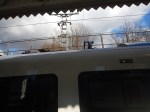


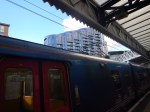

There appears to have been little noticeable development in the forty years since the Class 313 reains were introduced. But the operation of the Class 717 trains appears smoother and quieter.
I would have thought, that for safety reasons, the new trains would have used battery power between Drayton Park and Moorgate stations.
After all it’s only two and a half miles, that is run using third-rail electrification.
I’d be very interested to see how much power is used by the new Class 717 trains South of Drayton Park.
In Weight And Configuration Of A Class 717 Train, I showed that the kinetic energy of a jam-packed Class 717 train at 85 mph is 56.15 kWh.
- I doubt that this sort of speed is achieved in the tunnels.
- At 60 mph, the energy would be 28 kWh
- At 40 mph, the energy would be just 12 kWh.
Obviously, hotel power for air-conditioning and lights will be needed for the train, but even at 5 kWh per car per mile, that would only be 150 kWh.
To carry 200 kWh of batteries on a six-car train is a very practical proposition.
- Vivarail have done it in a three-car train.
- There could be a short length of third-rail electrification to top up the batteries at Moorgate station, if required.
- Battery power could be used in depots to move trains, which would mean depots could have less electrification.
- Trains could be moved to the next station, if the electrification should fail.
The route between Moorgate and Drayton Park stations, is probably one of the best and easiest in the UK for battery operation.
Wi-Fi And Power Sockets On A Class 717 Train
In A First Ride In A Class 717 Train, I didn’t take any pictures of the power sockets, as I didn’t see them.
This picture from a second trip, rectified the error.

There is one 13 amp socket under a pair of seats and you will need a plug.
It is my belief that a USB socket is better, as this armrest installation on a Class 230 train shows.
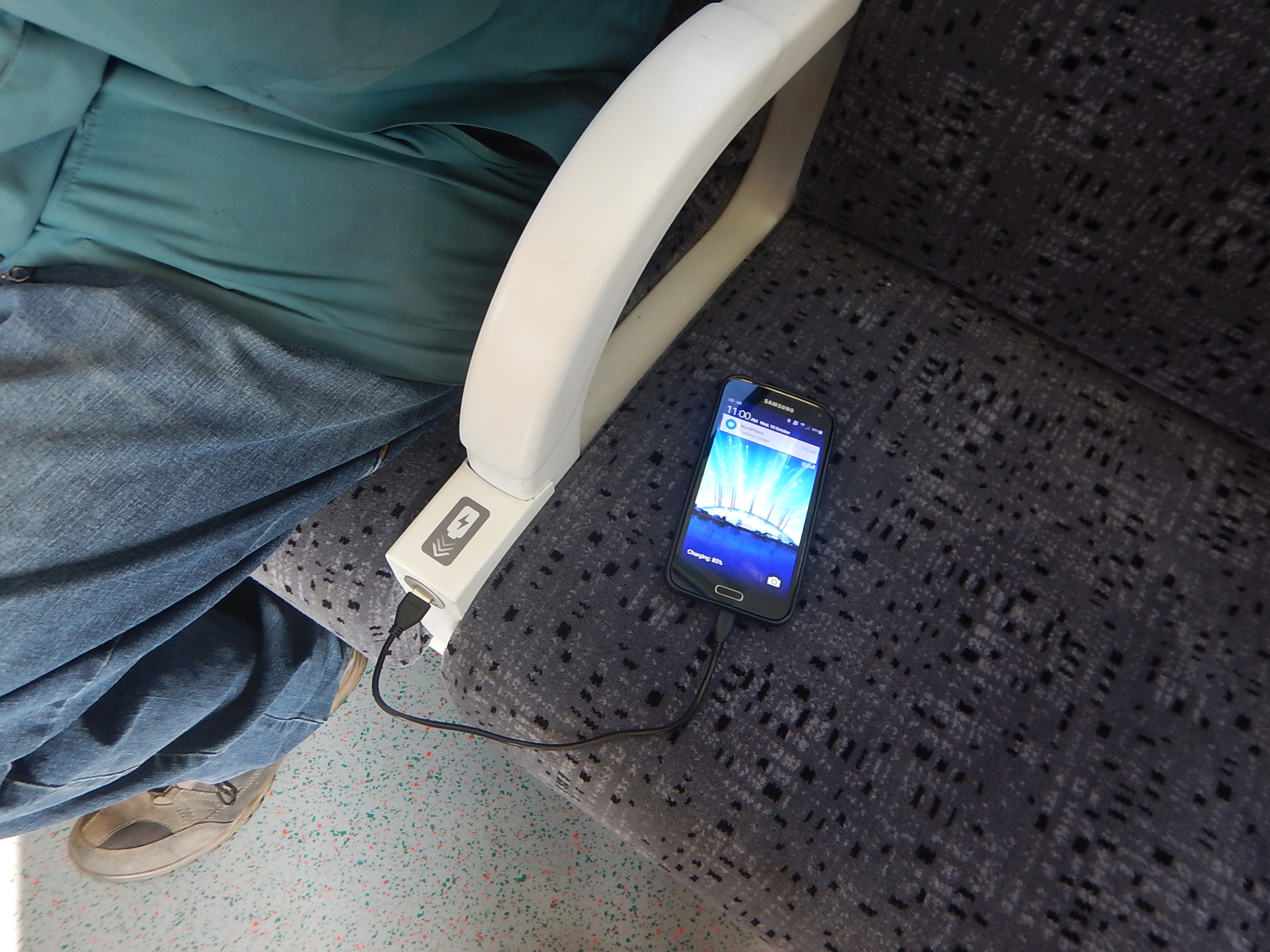
It is certainly a better place, as the wires can be short and can be kept out of the way.
The wi-fi performed well, but Great Northern seemed to want me to register. I never do, as it just gives them an excuse to send you junk mail.
Conclusion
The wi-fi installation can be improved.
It has to, as according to this article on Rail Magazine, Class 710 trains have USB sockets.
My ideal train would have.
- Free wi-fi with no registration.
- USB sockets in the armrests.
- 4G booster, so if the train has a signal, you do.
The current systems can be greatly improved.
Weight And Configuration Of A Class 717 Train
I walked the length of a Class 717 train and noted the various plates.
The formation was as follows.
- DMOSB – Weight – 38.8 tonnes – Seats – 52
- TOS – Weight – 28.8 tonnes – Seats – 68
- TOS(L)W – Weight – 28.7 tonnes – Seats – 61
- MOS – Weight – 35.5 tonnes – Seats – 68
- PTOSB – Weight – 33.9 tonnes – Seats – 61
- DMOSB – Weight – 38.8 tonnes – Seats – 52
Totalling these up and adding other details gives.
- Length – 121.674 metres
- Width 2.80 metres
- Speed – 85 mph
- Seats – 362
- Weight – 204.5 tonnes
This article on Rail Magazine has this paragraph.
Each ‘717’ has capacity for 943 passengers, for which there are 362 seats (including 64 priority seats and 15 tip-ups).
Assuming that each passenger weight 80 Kg with bags and buggies, this gives the following.
- A passenger weight of 75.4 tonnes.
- A train weight of 280 tonnes.
- At a speed of 85 mph the kinetic energy of the train will be 56.15 kWh
This figure would probably mean that batteries could be fitted to these trains to handle regenerative braking.
Germany Agrees To End Reliance On Coal Stations By 2038
The title of this post, is the same as this article on the Guardian.
This is the first two paragraphs.
Germany has agreed to end its reliance on polluting coal power stations by 2038, in a long-awaited decision that will have major ramifications for Europe’s attempts to meet its Paris climate change targets.
The country is the last major bastion of coal-burning in north-western Europe and the dirtiest of fossil fuels still provides nearly 40% of Germany’s power, compared with 5% in the UK, which plans to phase the fuel out entirely by 2025.
Travel across Germany on a train and you see the high chimneys of coal-fired power stations everywhere.
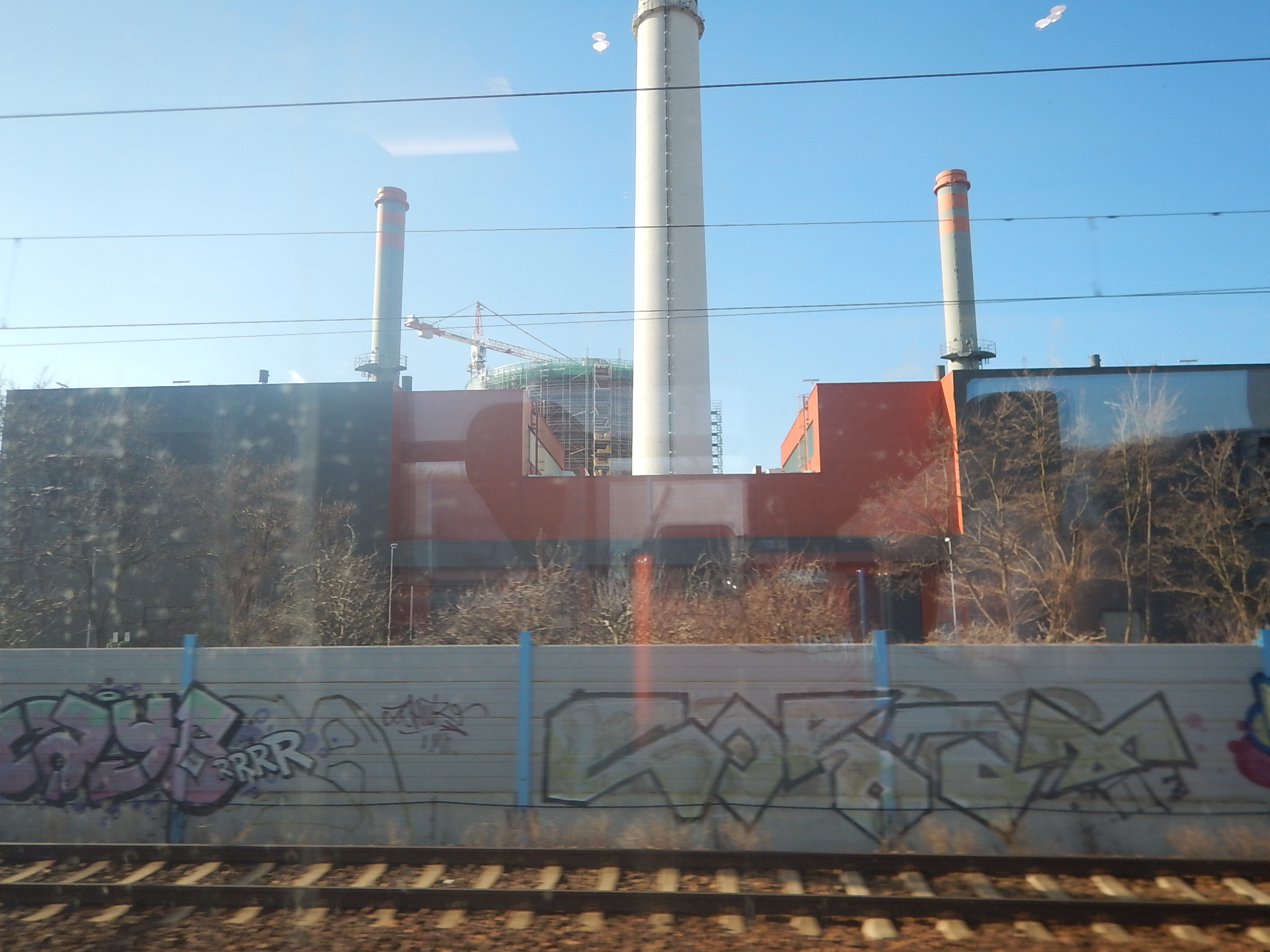
When we can get rid of coal by 2025 and France by 2022, you do wonder why Germany is taking so long.
The Guardian article provides a partial answer in that both the power company; RWE and the trade unions are very much for the continued use of coal.
The Germans are phasing out nuclear power, in response to the Green Party. Surely, unregulated coal-burning is far worse than well-regulated nuclear power?
But then the prevailing winds mean that most of the carbon-dioxide and pollution goes to Poland, who are big coal-burners themselves.
I wonder what would have happened to coal-fired power stations in the UK, if Margaret Thatcher hadn’t taken on the miners and started the run down of the use of coal!
The can would probably have been kicked down the road and we’d probably have coal power stations at German levels.
 The Anonymous Widower