Coeliac Journey Through Covid-19 – Medical Research
Medical Research
I first got involved as a lab-rat in medical research, when I had my second endoscopy to check for coeliac disease at Addenbrooke’s Hospital in 1997. Rebecca Fitzgerald took a sample of fluid from my gut for her Barrett’s oesophagus research.
After my wife died, I asked my contact in Alumni Relations at Liverpool University, if they did widowhood research.
They are one of the few universities that do and I did several interviews for PhD students in the unit, which is in the Psychology Department. It was very much a positive experience and certainly helped with my grieving.
In some ways the most enjoyable piece of research I have been involved in, was at the University of East London, where they were using computers to measure the balance of those recovering from strokes.
My GP also suggested that I get involved in drug tests at Queen Mary University. The tests were abandoned as the drug didn’t have any good or bad effects, but now I’m one of the William Harvey Centre’s lab-rats.
I also help to sponsor pancreatic cancer research at Liverpool University in memory of my son.
In There’s More To Liverpool Than Football And The Beatles!, I detail some research, that I sponsored in a small way.
I may be tempted to do the fund-raising trip again.
I always advise people to get involved in medical or psychological research, as I have found it such a beneficial experience.
One thing that is needed, is an on-line database of all research projects that are looking for volunteers.
Remember, that much medical and psychological research is about as dangerous as meeting someone in a GP’s surgery for a chat or perhaps in a cafe and having a coffee.
Coeliac Journey Through Covid-19 – Coeliac Diagnosis
Coeliac Diagnosis
My health was very variable as a child.
I would often have months off school and my health only really improved, when my parents bought a second home in Felixstowe, where we spent most of our holidays.
Perhaps it was the sea air, as going to Liverpool University didn’t seem to adversely affect my health.
I had been having gut problems for years and then in Autumn 1997, I didn’t see my GP, but a very elderly locum, who as I had recently had my fiftieth birthday, gave me a present of my first blood test.
It turned out that I was very low on B12 and a course of B12 injections was arranged.
As the injections didn’t raise my levels, an appointment was made to see a consultant at Addenbrooke’s Hospital in Cambridge.
It was a Monday, when I went to the appointment and after a quick chat and no examination, the consultant said that they would take some blood. Which they did!
Within forty-eight hours a letter arrived on my door-mat saying that I was probably coeliac and it would be confirmed by endoscopy.
Two endoscopies without sedative or anaesthetic were performed and I was confirmed as coeliac.
The first was performed by Dr. Richard Hardwick and the second by Dr. Rebecca Fitzgerald.
My gut health has been better since, I’ve been on a gluten-free diet, backed up by three-monthly B12 injections.
A few years later, I was talking to a gastroenterologist in Cambridge and he told me that he thought he had more coeliac patients than any other in England.
The manager of Carluccio’s in the city, also told me that they sold a very high percentage of gluten-free food.
Were Cambridge testing a genetic test for coeliac disease or was it just a Whack-A-Coeliac policy?
They certainly had everything geared up for high-speed diagnosis. They even did the endoscopies without a sedative, so they didn’t need any recovery beds.
High Risk Of Coeliac Disease In Punjabis. Epidemiological Study In The South Asian And European Populations Of Leicestershire
The title of this post, is the same as that of this peer-reviewed paper on PubMed.gov.
This is the abstract of the paper.
The purpose of this study was to measure the incidence of coeliac disease in different ethnic communities and investigate the hypothesis that the incidence is decreasing in most European countries and the role incomplete retrieval of data may play. In a retrospective study of histologically confirmed cases of coeliac disease between 1975 and 1989 in the City of Leicester, 106 patients with coeliac disease were identified. Of these 86 were European and 20 Asian. The overall incidence of coeliac disease in Europeans was 2.5/10(5)/year (95% CI 2-3.2), in Gujaratis 0.9/10(5)/year (95% CI 0.4-1.8), and in Punjabis 6.9 (95% CI 3.2-12.3). These differences were independent of religious belief. The relative risk to Punjabis compared with Europeans is 2.9 (95% CI 1.5-5.3; chi 2 = 12.5, p < 0.01) and to Gujaratis 8.1 (95% CI 3-22.4; chi 2 = 25; p < 0.001). Gujaratis were at 0.4 risk of Europeans (90% CI 0.2-0.8; chi 2 = 6.7; p < 0.01). The incidence in the urban populations of Leicester was 6/10(5)/year (95% CI 1.3-1.9) which was significantly lower than the 3.2/10(5)/year (95% CI 2.7-3.8; chi 2 = 5.6; p < 0.001) in surrounding rural areas. This study shows that the incidence of coeliac disease in Punjabis (Sikhs, Hindus and Muslims) is 8 times higher than in Gujaratis (Hindus and Muslims) and 4 times higher than in Europeans in Leicester.
I find the last sentence in particular very significant.
I’m no medic, but I think it is reasonable to assume, that in a particular community for every diagnosed coeliac, there will be several undiagnosed coeliacs out there.
In this overview of coeliac disease on the NHS web site, this is said about the incidence of coeliac disease.
Coeliac disease is a condition that affects at least 1 in every 100 people in the UK.
But some experts think this may be underestimated because milder cases may go undiagnosed or be misdiagnosed as other digestive conditions, such as irritable bowel syndrome (IBS).
Reported cases of coeliac disease are around 3 times higher in women than men.
The one-in-100 figure is often used in web pages in European countries or Australia, Canada and the United States, so I’ll go along with that.
So does that mean that Punjabis living in Leicester, have a one-in-twenty-five likelihood of being coeliac?
Whether you have been diagnosed though, is a matter of pure luck.
I had been having gut problems for years and then one Autumn, I didn’t see my GP, but a very elderly locum, who as I had recently had my fiftieth birthday, gave me a present of my first blood test.
It turned out my B12 levels were very low and after several months of B12 injections, which made little difference to my B12, my GP decided to send me to a consultant at Addenbrooke’s Hospital in Cambridge.
My appointment was on a Monday morning and consultant took about ten minutes to ask a few questions, after which he said they would take a few bloods.
On the Wednesday morning, I received a letter that said, that I was probably suffering from coeliac disease and this would be confirmed by endoscopy.
Was I diagnosed solely by analysis of my blood? This was in 1997, which is after the date of the Leicester study.
Two endoscopies without sedative or anaesthetic were performed and I was confirmed as coeliac.
The first was performed by Dr. Richard Hardwick and the second by Dr. Rebecca Fitzgerald.
Both doctors feature in this story on the Cambridge University Hospitals web site, which is entitled Familial Gastric Cancer – Case Study.
My problems have been minor compared to the two sisters in the story.
My luck had been good and I recommend that everyone who feels they could be coeliac should get themselves tested.
Cases Of Covid-19 In Leicestershire
This article on the Leicester Mercury is entitled 11 Areas Of Leicestershire Have Among Worst Infection Rates in the UK.
In Coeliac Disease: Can We Avert The Impending Epidemic In India?, I started like this.
The title of this post, is the same as that of this article on the Indian Journal Of Research Medicine.
With the high levels of COVID-19 in Leicester and an Indian population who make up 28.3 % of the population of the city, I was searching the internet to see if there was any connection between those of Indian heritage and coeliac disease.
I know you should not try to prove a theory. But as a coeliac, I’m very interested to see how the millions of diagnosed coeliacs on a gluten-free diet like me, are faring in this pandemic.
I then talk about some extracts from the Indian research.
In a section entitled, which is entitled All Wheats Are Not Equal, I say this.
The other dimension to this problem is that not all wheat is alike when it comes to inducing celiac disease. The ancient or diploid wheats (e.g. Triticum monococcum) are poorly antigenic, while the modern hexaploid wheats e.g. Triticum aestivum) have highly antigenic glutens, more capable of inducing celiac disease in India, for centuries, grew diploid and later tetraploid wheat which is less antigenic, while hexaploid wheat used in making bread is recently introduced. Thus a change back to older varieties of wheat may have public health consequences.
So did all these factors come together to create the high levels of Covid-19 in Leicestershire?
Conclusion
I am getting bored with saying this. More research needs to be done!
Why Do More Elderly Men Die Of The Covids Than Women?
I asked this question of the Internet and found this article from The Times, which is entitled Why Are Men More Likely To Die From Covid Than Women?.
These are the first two paragraphs.
On Valentine’s Day last year, researchers at China’s Centre for Disease Control and Prevention submitted one of the first studies into who was dying of the new coronavirus that was spreading through Wuhan.
Two clear findings jumped out. Firstly, the virus appeared to hit the elderly hardest. Secondly, if you were a man, you were much more likely to die.
The article goes on to say, that men are 24 percent more likely to die.
I am coeliac and here are some facts about coeliac disease.
This page on the NHS web site is an overview of coeliac disease.
There is a sub-section called Who’s Affected?, where this is said.
Coeliac disease is a condition that affects at least 1 in every 100 people in the UK.
But some experts think this may be underestimated because milder cases may go undiagnosed or be misdiagnosed as other digestive conditions, such as irritable bowel syndrome (IBS).
Reported cases of coeliac disease are around 3 times higher in women than men.
It can develop at any age, although symptoms are most likely to develop:
during early childhood – between 8 and 12 months old, although it may take several years before a correct diagnosis is made
in later adulthood – between 40 and 60 years of age
People with certain conditions, including type 1 diabetes, autoimmune thyroid disease, Down’s syndrome and Turner syndrome, have an increased risk of getting coeliac disease.First-degree relatives (parents, brothers, sisters and children) of people with coeliac disease are also at increased risk of developing the condition.
The three most important facts in this are.
- The condition affects 1 in every 100 people in the UK.
- Reported cases are three times higher in women than men.
- First degree relatives of coeliacs are at increased risk of developing the condition.
I am sure my father was an undiagnosed coeliac.
When I was born in 1947, there was no test for coeliac disease in children, as one wasn’t developed until 1960.
Testing for many years was by the Gold Standard of endoscopy, which for a child is not an easy procedure.
I’m certain, that in 1997, I was one of the first to be diagnosed in a General Hospital by genetic testing.
At fifty, a locum had given me a blood test and I had been found to be very low on B12. Despite a course of injections, it refused to rise so I was sent to Addenbrooke’s Hospital, where I saw a consultant, who gave me a short chat and then got a nurse to take some blood samples.
Two days later, I received a letter, saying I was probably coeliac and it would be confirmed by endoscopy.
I can’t think how else it was done so quickly, unless they were using a genetic test.
I went gluten-free and the rest as they say is history.
In some ways there’s been two of me.
- BC – Before Coeliac – Frequently unwell, lots of aches and pains and weak mentally.
- AD – After Diagnosis – Healthier, few aches and pains and much stronger mentally.
My immune system appears to be much stronger now!
I believe my son was also coeliac.
Undiagnosed coeliacs tend to have poor immune systems and he died of pancreatic cancer at just 37, because he refused to get himself tested.
As there was no test for coeliac disease in children until 1960, anybody over sixty has a higher chance of being coeliac with a poor immune system and be at higher risks from both the covids and cancer.
It should be noted that according to the NHS, there are three times more female coeliacs than male.
Could this be explained by the fact that undiagnosed coeliac disease can be a cause of female infertility? So when a lady has difficulty conceiving, doctors test for it. So perhaps, by the time they get to 70 a higher proportion of female coeliacs have been diagnosed, compared to male ones, which may explain why more elderly men than women die of the covids.
More research needs to be done.
Goodbye To My Gallstones
It is now some weeks since I said goodbye to my gallstones.
They were in my bile duct and were discovered by using an ultrasound probe on an endoscopy at Homerton Hospital. I didn’t even put on a hospital gown.
I had that endoscopy, as I did my two previous ones at Addenbrooke’s Hospital in Cambridge to check for coeliac disease without a sedative, as Addenbrooke’s likes to be efficient and cutting out sedatives reduces the manpower required, cuts the need for recovery beds and allows patients to drive home.
After this endoscopy, I came home the way I arrived – on the bus!
I would say that a good endoscopy operator should be able to do the procedure without a sedative. Although in this case, the nurse holding the oxygen tubes up my nose, was stroking my beard to calm me down. Not that I needed it! But it was a nice action!
I had the removal of the gallstones with a sedative, but I only remember the anaesthetist saying something like “Lovely” as he threaded the camera and attachments down my throat.
They broke into my bile duct from the duodenum and then inserted a balloon, which was then inflated to flush the stones back into my duodenum.
I must have dropped off and I woke without any pain or even discomfort.
One complication for me, was that I am on Warfarin, but I dropped my INR to one before the operation, so that there wasn’t blood everywhere.
I have had some after effects.
Where Has My Constipation Gone?
Since I was about sixty, I have suffered from constipation and my GP has prescribed a laxative.
I felt it was a family trait as my father was also a sufferer.
But since the operation, I have only taken one pill, that may not have been necessary.
My Appetite Has Returned
I am certainly eating better and I have not put on any weight.
Conclusion
If you have gallstones and removal is suggested, go for it!
Inner Eye AI Identifies Tumours To Speed Up Treatment Of Cancer
The title of this post is the same as that of this article on The Times.
This is the introductory paragraph.
A hospital in Cambridge is the first to use artificial intelligence technology developed by Microsoft to treat cancer patients faster, helping to cut the treatment backlog and save lives.
There is only one NHS hospital in Cambridge and that is Addenbrooke’s, who probably saved my life, by diagnosing me as coeliac in 1997.
This paragraph explains the development of the software and how it will be deployed across the NHS.
Inner Eye is the result of an eight-year project with Microsoft and Addenbrooke’s and is being introduced in other NHS trusts. It is easy to access and free to use. When the AI tool is in place, hospitals will be able to use their own data to improve accuracy.
This paragraph sums up the usefulness of the system.
Pat Price, a professor at Imperial College London and chairwoman of Action Radiotherapy, a charity, said: “This is just one brilliant example of the quiet but amazing technological revolution that has unfolded in radiotherapy in recent years and could dramatically improve cancer survival rates.”
It really is amazing how since my wife died of a squamous cell carcinoma of the heart, treatment of cancer has improved.
I can envisage a time, when a rare cancer like that, which killed her in three months, will be survivable!
Thoughts On COVID-19 On Merseyside
Merseyside is in trouble with the covids.
These are the number of lab confirmed cases per 100,000 population for local authorities in the area, as of the 1st October 2020.
- Halton – 1108.1
- Knowsley – 1388
- Liverpool – 1244.5
- Sefton – 1037.6
- St. Helens – 1230.4
- Wirral – 1185.5
My London Borough of Hackney, which is demographically, a bit like poorer parts of Liverpool, has a rate of 524.3.
But the gold standard to my mind is Cambridge, which has a rate of only 380.6.
Oxford, which is a very similar city to Cambridge has a much higher rate of 799.5,
Why Is Cambridge Doing So Well?
I was diagnosed as a coeliac at Addenbrooke’s Hospital in Cambridge, twenty-three years ago.
According to my consultant in the City at the time, Cambridge has a VERY high level of diagnosed coeliacs.
He told me, that he had more coeliac patients, than any other gastroenterologist in the UK.
So why is the number of coeliacs so high in Cambridge?
I feel it is because Cambridge had a Whack-a-Coeliac policy in the 1990s, where they attempted to diagnose as many coeliacs as they could find.
I was certainly diagnosed at that time and judging by the speed they did the initial diagnosis, I suspect, they were using one of the first genetic tests. They were also doing endoscopies without anaesthetic to increase throughput!
Coeliacs, Cancer And The Covids
Diagnosed coeliacs on a gluten-free diet have a strong immune system, which helps protect them from cancer, as has been shown by Joe West at Nottingham University.
I should also add, that none of my coeliac acquaintances have had a severe dose of the covids.
So does our stronger immune systems give us protection from the covids?
This could explain, why an area like Cambridge has a lower level of the covids than Oxford.
Why Is Merseyside In Trouble?
The Irish, because of historic famine, have higher levels of coeliac disease.
Comedians from the City have joked about Liverpool being the capital of Ireland for decades.
Could it be that there is a high percentage of undiagnosed coeliacs on Merseyside?
If this is true, could these undiagnosed coeliacs, with poorer immune systems, be easy pickings for the covids?
Conclusion
These actions should be taken.
- Merseyside needs a Whack-a-Coeliac policy, if it doesn’t have one! It would certainly, improve cancer rates!
- Every in-patient with the covids, should be given a quick blood test for coeliac disease.
- Other research needs to be done to find out the any link between coeliac disease and the covids!
Not for nothing is coeliac disease regularly called the Many-Headed Hydra by some doctors and researchers.
Should The NHS Adopt A Whack-A-Coeliac Policy?
The Wikipedia entry for Whac-a-Mole, says this about the colloquial use of the name of an arcade game.
In late June 2020, Boris Johnson based the UK’s COVID-19 strategy on the game.
Because of the high number of diagnosed coeliacs in the Cambridge area, I believe that I was diagnosed to be coeliac, by possible use of a Whack-a-Coeliac policy at Addenbrookes Hospital in Cambridge, in the last years of the Twentieth Century.
- I was suffering from low B12 levels and my GP sent me to the hospital to see a consultant.
- It was only a quick visit and all I remember, is the speed with which the nurse took my blood.
- A couple of days later, I received a letter from the hospital, saying it was likely I was a coeliac and it would be confirmed by an endoscopy.
- A point to note, is that I had my endoscopy with just a throat spray and this must have increased the efficiency and throughput and reduced the cost of the procedure.
The only way, I could have been diagnosed so quickly would have been through an analysis of my genes and blood. But I was never told, what method was used.
I have a few further thoughts.
My Health Since Diagnosis
It has undoubtedly improved.
Cancer And Diagnosed Coeliacs On A Gluten-Free Diet
Joe West of Nottingham University has shown, that diagnosed coeliacs on a gluten-free diet have a 25% lower risk of cancer compared to the general population.
That is certainly a collateral benefit of being a coeliac. But is it being a coeliac or the diet?
I’m no medic, but could the reason be, that diagnosed coeliacs on a gluten-free diet have a strong immune system?
Coeliac Disease Is A Many-Headed Hydra
I have heard a doctor describe coeliac disease or gluten-sensitivity as a many-headed hydra, as it can turn up in so many other illnesses.
Type “coeliac disease many-headed hydra” into Google and this article on the NCBI , which is entitled Gluten Sensitivity: A Many Headed Hydra, is the first of many.
This is the sub-title of the article.
Heightened responsiveness to gluten is not confined to the gut
My son; George was an undiagnosed coeliac, who had a poor diet consisting mostly of Subways, cigarettes and high-strength cannabis. He died at just thirty-seven of pancreatic cancer.
Did George have a poor immune system, which was useless at fighting the cancer?
Undiagnosed Coeliac Disease In The Over-Sixty-Fives
In A Thought On Deaths Of The Elderly From Covid-19, I used data from Age UK and Coeliac UK to estimate the number of coeliacs in the UK over the age of sixty-five. I said this.
Age UK has a figure of twelve million who are over 65 in the UK. If 1-in-100 in the UK are coeliac, that is 120,000 coeliacs over 65.
But some research shows that the number of coeliacs can be as high as 1-in-50.
If that 120,000 were all diagnosed, I would have several coeliacs amongst my over-65 friends. I have just one and she is self-diagnosed.
Are all these undiagnosed coeliacs out there, easy targets for diseases like cancer and COVID-19?
The Ease Of Testing For Coeliac Disease
I was worried that my granddaughter was coeliac and I asked my GP, how difficult a test is to perform.
He said, that a genetic test is usually quick and correct and only a few borderline cases need to be referred to a consultant.
Diagnosis has moved on a lot in twenty years.
Cambridge, Oxford and Covid-19
Six weeks ago I wrote Oxford And Cambridge Compared On COVID-19, to try to find out why the number of Covid-19 cases are so much lower in Cambridge than Oxford.
Checking today, the rate of lab-confirmed cases of COVID-19 per 100,000 residents is as follows.
- Cambridge 336.6
- Oxford 449
So why the difference?
In the related post, this was my explanation.
Is the large number of diagnosed coeliacs around Cambridge, the reason the area has a lower COVID-19 rate than Oxford?
It sounds a long shot, but it could be a vindication of a possible Whack-a-Coeliac policy at Addenbrooke’s in the last years of the Twentieth Century.
Or were the hospital testing the genetic test for coeliac disease? Perhaps, in conjunction with Cambridge University and/or the Sanger Centre.
Conclusion
I believe the NHS should seriously look at a Whack-a-Coeliac policy!
- The health of a large number of people would improve.
- There would be less cancer in the UK.
- A better combined National Immune System might help in our fight against the next virus to follow COVID-19.
It would be a very simple testing program, that would be mainly in the hands of the GPs, their nurses and the testing laboratories.
Potential Site For New Cambridge South Station Named
The title of this post, is the same as that of this article on Rail News.
The article says this about the site of the proposed Cambridge South station.
There had been three options for the station site and the preferred choice, which is the furthest north and nearest the guided busway, will offer improved connections with other railway routes as well as the busway. Although the detailed plans for East West Rail between Bedford and Cambridge have not yet been confirmed, it is possible that EWR trains will call at Cambridge South.
This Google Map shows the area.
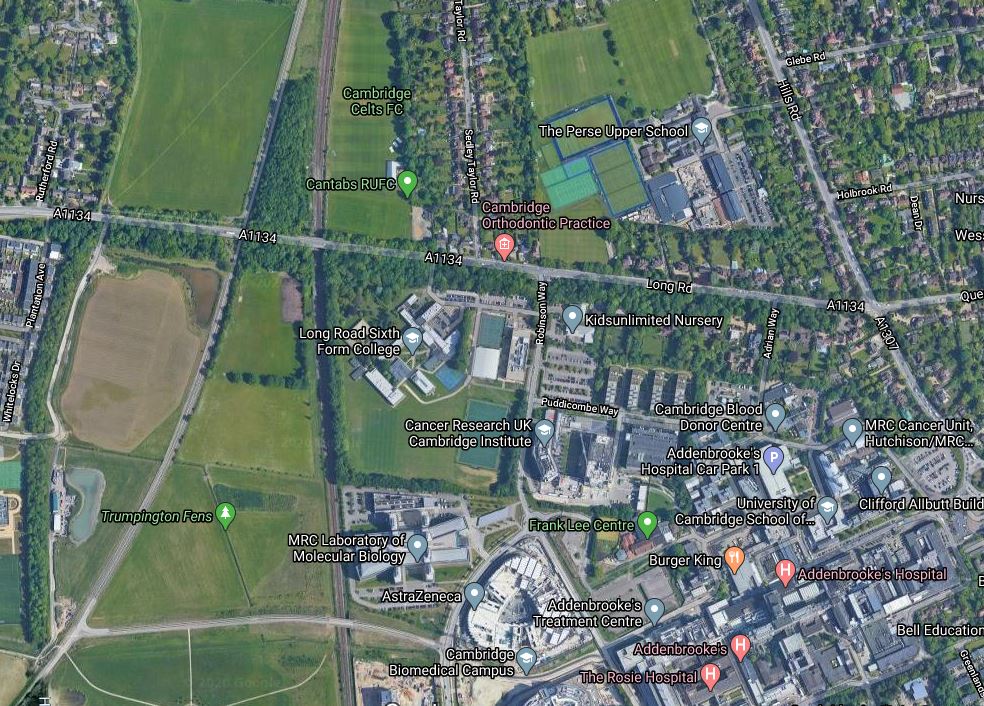
Note.
- Addenbrooke’s and Papworth Hospitals and the Cambridge Biomedical Campus in the South-East corner of the map.
- Long Road going East-West across the map.
- The West Anglia Main Line going North-South, at the Western edge of the Cambridge Biomedical Campus. Cambridge station is to the North and Shelford station is to the South.
- Running diagonally away from the railway towards the South-West corner of the map, is the Cambridge Busway. which connects the Trumpington Park and Ride to Cambridge station and the City Centre.
It would appear there would be plenty of space to put a station with enough capacity for this important medical complex.
Train Services
Trains passing through that area include in trains per hour (tph)
- CrossCountry – 1 tph – Birmingham New Street and Stansted Airport via Cambridge
- Freater Anglia – 2 tph – London Liverpool Street and Cambridge North via Cambridge
- Greater Anglia – 1 tph – Norwich and Stansted Airport via Cambridge and Cambridge North
- Great Northern – 1 tph – London King’s Cross and Ely via Cambridge and Cambridge North
- Great Northern – 1 tph – London King’s Cross and Kings Lynn via Cambridge and Cambridge North
- Thameslink – 2 tph – Brighton and Cambridge
- Thameslink – 2 tph – London King’s Cross and Cambridge
That all adds up to 10 tph to Cambridge and 5 to Cambridge North.
When you add in future services on East West Rail, and do a bit of reorganisation, there could be twelve tph through the three Cambridge stations.
Thoughts On Coeliacs And Covid-19 In Cambridgeshire
I was diagnosed as a coeliac by Addenbrooke’s Hospital in Cambridge.
- One of the consultants there told me, that they had a very high number of coeliacs on the books and the number was one of the highest in the country.
- I also used to eat in Carluccios in the centre of Cambridge and the manager once told me that they did an Annual Dinner for the local branch of Coeliac UK.
- He also told me, that they had the highest gluten-free sales in the group.
I think it is fairly likely that Cambridge has a lot of diagnosed coeliacs.
But it is not a place with health problems, that jump out of the pages of the tabloids.
My theory is that because Cambridge does a lot of gastroenterology research, they have a good rate in finding coeliacs.
So how is Cambridgeshire doing in the COVID-19 pandemic?
In Five Eastern Counties, I said this about COVID-19 in Cambridgeshire and Suffolk, where a lot of patients go to Addenbrooke’s.
- Cambridgeshire – 673 of 852,523 or 0.08%
- Suffolk – 936 of 768,556 or 0.12%
Both seem to be low. How do they compare to Oxfordshire?
- Oxfordshire – 1515 of 887, 564 or 0.17%
I wouldn’t have thought that Oxfordshire would have a rate twice that of Cambridgeshire!
- The counties are similar in population.
- Both have proportions of industry, farming and academia
- The cities of Oxford and Cambridge are similar in character
Could it be that Addenbrooke’s has diagnosed most of the coeliacs in Cambridgeshire?
I’m no medical expert, but someone should look at it!
 The Anonymous Widower