Electrified Regional Air Mobility Will Be Disruptive & Mature Rapidly In Coming Years
The title of this post, is the same as that of this article on Clean Technica.
It is very much a must-read article, where the author analyses technology and how it will affect regional aviation.
He comes to the conclusion, that electric aircraft will develop much quicker than autonomous systems and full digital air traffic control.
He feels that we’ll see rapid development of electric aircraft flying traditionally with a pilot in charge, who talks to air traffic controllers.
Effectively, this is the system that was in operation, when I used to fly my Cessna 340 all round the UK and Western Europe thirty years ago.
Adding in electric aircraft to this system, is very similar to adding a car with a certified alternative power source to the traffic of the UK.
I think this means, that electric aircraft need to have a pilot on board to be certified, as any certification involving passenger will have to be as risk-free as possible.
The article mentions Electron Aviation. The author describes their operational model like this.
Electron Aviation, for example, sees that a 4-seater, one-pilot plane can become the workhorse of a regional short-haul leisure and business travel on-demand flight service in the second half of this decade, with planes coming to a small airport near customers, who are delivered by electric Ubers at either end. The economics work out with electric airplanes where they don’t with current internal combustion planes.
As Electron’s UK address is in Mildenhall in Suffolk, which is close to the UK horseracing centre of Newmarket, I know from my past experience that their model of four-seat air-taxis certainly works in the racing industry.
The specification for their aircraft looks impressive.
- Very aerodynamic with a high aspect ratio wing.
- Tricycle retractable undercarriage.
- Twin-pusher propellers.
- 186 mph cruise at 10,000 feet.
- 466 mile range.
- Low noise.
- Zero emissions.
Looking at the visualisation on the home page of their web site, I suspect that the battery is at the centre of lift in the middle of the plane to give excellent flying characteristics.
I also think, that their concept is scalable and that a larger aircraft could be built to a similar layout.
Conclusion
I am happy to agree with the author’s conclusion, that electric aircraft will revolutionise regional aviation in a short space of time.
Alice, The First All-Electric Passenger Airplane, Prepares To Fly
The title of this post, is the same as this article on CNN.
It looks like the first flight is just weeks away.
This paragraph describes the aircraft and compares it to a Boeing 737.
With battery technology similar to that of an electric car or a cell phone and 30 minutes of charging, the nine-passenger Alice will be able to fly for one hour, and about 440 nautical miles. The plane has a max cruise speed of 250 kts, or 287 miles per hour. For reference, a Boeing 737 has a max cruise speed of 588 miles per hour. The company, focused exclusively on electric air travel, hopes that electric planes that can fit 20 to 40 passengers will be a reality in seven to 10 years.
Fully electric flight on short routes is a lot closer than we think.
Note, that 440 nautical miles will give sufficient range from London to Amsterdam, Belfast, Cork, Frankfurt, Inverness and Paris.
Up, Up And Away: Flying AirCar Earns Its Wings
The title of this post, is the same as that of this article on The Times.
This is the first paragraph.
A supercar that comes with wings attached has been given the green light to take to the skies.
It has been given European certification.
I will be very surprised if the Klein Vision AirCar is a success!
CEO: Alice Electric Commuter Airplane’s First Flight Days Away
The title of this post, is the same as that of this article on Flying Magazine.
The Eviation Alice prototype has certainly been spotted taxiing on the runway and the CEO has said it won’t be long before the first flight.
I have a feeling that this aircraft is going to be a winner.
- It’s got a lightweight structure.
- The aerodynamics look to be right.
- It has received firm orders from quality companies, like Cape Air, DHL and United Airlines.
- It would be the ideal corporate aircraft for the green billionaire who wants a toy!
- It looks sexy like Concorde.
I also think that the range, performance and capacity could fit travel patterns well in the UK and Ireland.
Conclusion
I’m looking forward to my first flight.
The Time I Said No To Joan Collins
I’m watching Joan Collins In her programme On BBC 2.
It reminds me of the time I met her.
It must have been between 1985 and 1987, as she was with her fourth husband; Peter Holm, who is exactly two months younger than I am.
We had all travelled from Los Angeles to London on British Airways and we were queuing for passport checks. Joan was to my right and Peter was looking very disinterested.
Then out of the blue, she asked me, if I had a light for her cigarette.
I replied that I was sorry, but I didn’t smoke.
She just smiled and put the cigarette away!
More ICE Sprinters Offer Alternative To Flying
The title of this post, is the same as that of this article on Railway Gazette.
The first two paragraphs, give an overview of the changes being made.
Deutsche Bahn introduced more limited-stop Sprinter ICE services on long-distance inter-city routes with the timetable change on December 12.
Sprinter-branded ICE services now operate on eight domestic routes, while a daily Frankfurt am Main – Paris service calling at Mannheim and Karlsruhe also carries the branding. Intended to appeal to business travellers, many of the Sprinter services are timed to depart early in the morning with return trips in the evening. This ensures a full day at the destination and offers a viable alternative to domestic flights.
It would appears that these services now have trains that are under the acceptable four hours.
- Cologne and Berlin
- Cologne and Munich
- Hamburg and Frankfurt Airport
If Deutsche Bahn are serious about competing with the airlines, they must surely increase the frequency.
In 2018, I travelled between Berlin and Munich in under four hours and wrote about it in From Berlin To Munich In Four Hours By Train.
This is how I started that post.
The length of the East Coast Main Line between London Kings Cross and Edinburgh is 632 kilometres.
Deutsche Bahn have recently completed an upgraded High Speed Line between Berlin and Munich, which has a length of 623 kilometres.
Both lines are not the very fastest of High Speed Lines, but lines where a consistent two hundred kilometres per hour is possible.
The East Coast Main Line was built in Victorian times and services typically take around twenty minutes over four hours, with nine -car InterCity 225 trains running twice an hour.
The Berlin-Munich route was originally built over two centuries ago, but the Germans have spent twenty-five years and many billions of euros punching a new route between Berlin and Nuremberg, through the difficult countryside of Thuringen Forest.
The route may allow the Germans to travel from Berlin to Munich in three hours fifty-five minutes, but at present you can only do it three times a day in a six-car train.
I took the lunchtime train and sat in First Class for a hundred and fourteen euros.
Deutsche Bahn have increased the trains on this route to five trains per day, but compared to London and Edinburgh on LNER, it is too infrequent, expensive with questionable customer service and not enough seats to give the airlines a run for their money.
A quick look on Rail Europe indicates that these routes have fast services at an hourly frequency or better.
- Madrid and Barcelona
- Milan and Rome
- Paris and Bordeaux
- Paris and Cologne
- Paris and Marseilles
- Venice and Naples
German rail services might be getting better, but not fast enough to take on the airlines.
Plane Surveying Cornwall For Minerals
The title of this post, is the same as that of this article on the BBC.
These are the first two paragraphs.
A low-flying 1940s plane doing survey work will be a common sight over mid and west Cornwall during the next two to three weeks.
The geological mapping plane is hoping to identify where lithium and other minerals may be located underground.
But the most interesting thing about the project is the aircraft that does the surveying, which is a 1943 Douglas DC3.

It is being flown by Bell Geospace and the aircraft has been upgraded into a Basler BT-67, with turboprop engines, an improved airframe and modern avionics.
Having flown aircraft at the sort of height mentioned by the BBC, I’d love to get a lift on one of their survey flights.
ZeroAvia Raises $35 Million From United And Alaska Air Group to Provide Hydrogen-Electric Engines For Large Aircraft
The title of this post, is the same as that of this article on Aviation Today.
This is the first paragraph.
United Airlines announced an investment this week in ZeroAvia’s hydrogen-electric engines. ZeroAvia has secured $35 million in this latest round of investments from both United and Alaska Air Group. The total amount of investments in ZeroAvia is now $115 million and includes previous investors AP Ventures, Horizons Ventures, Shell Ventures, Breakthrough Energy Ventures, Summa Equity, and Amazon’s Climate Pledge Fund.
ZeroAvia certainly seem to be bringing in the investment.
After, yesterday’s trip in a dual-fuel train, lower- and zero-carbon fuels seem to be on the way.
Zero-Carbon Emission Flights To Anywhere In The World Possible With Just One Stop
The title of this post, is the same as that of this press release from the Aerospace Technology Institute.
This is the first sentence of the press release.
Passengers could one day fly anywhere in the world with no carbon emissions and just one stop on board a concept aircraft unveiled by the Aerospace Technology Institute (ATI) today.
These three paragraphs describe the concept.
Up to 279 passengers could fly between London and San Francisco, USA direct or Auckland, New Zealand with just one stop with the same speed and comfort as today’s aircraft, revolutionising the future of air travel.
Developed by a team of aerospace and aviation experts from across the UK collaborating on the government backed FlyZero project, the concept demonstrates the huge potential of green liquid hydrogen for air travel not just regionally or in short haul flight but for global connectivity. Liquid hydrogen is a lightweight fuel, which has three times the energy of kerosene and sixty times the energy of batteries per kilogramme and emits no CO2 when burned.
Realising a larger, longer range aircraft also allows the concentration of new infrastructure to fewer international airports accelerating the rollout of a global network of zero-carbon emission flights and tackling emissions from long haul flights.
These are my thoughts.
The Airframe
This picture downloaded from the Aerospace Technology Institute web site is a visualisation of their Fly Anywhere Aircraft.
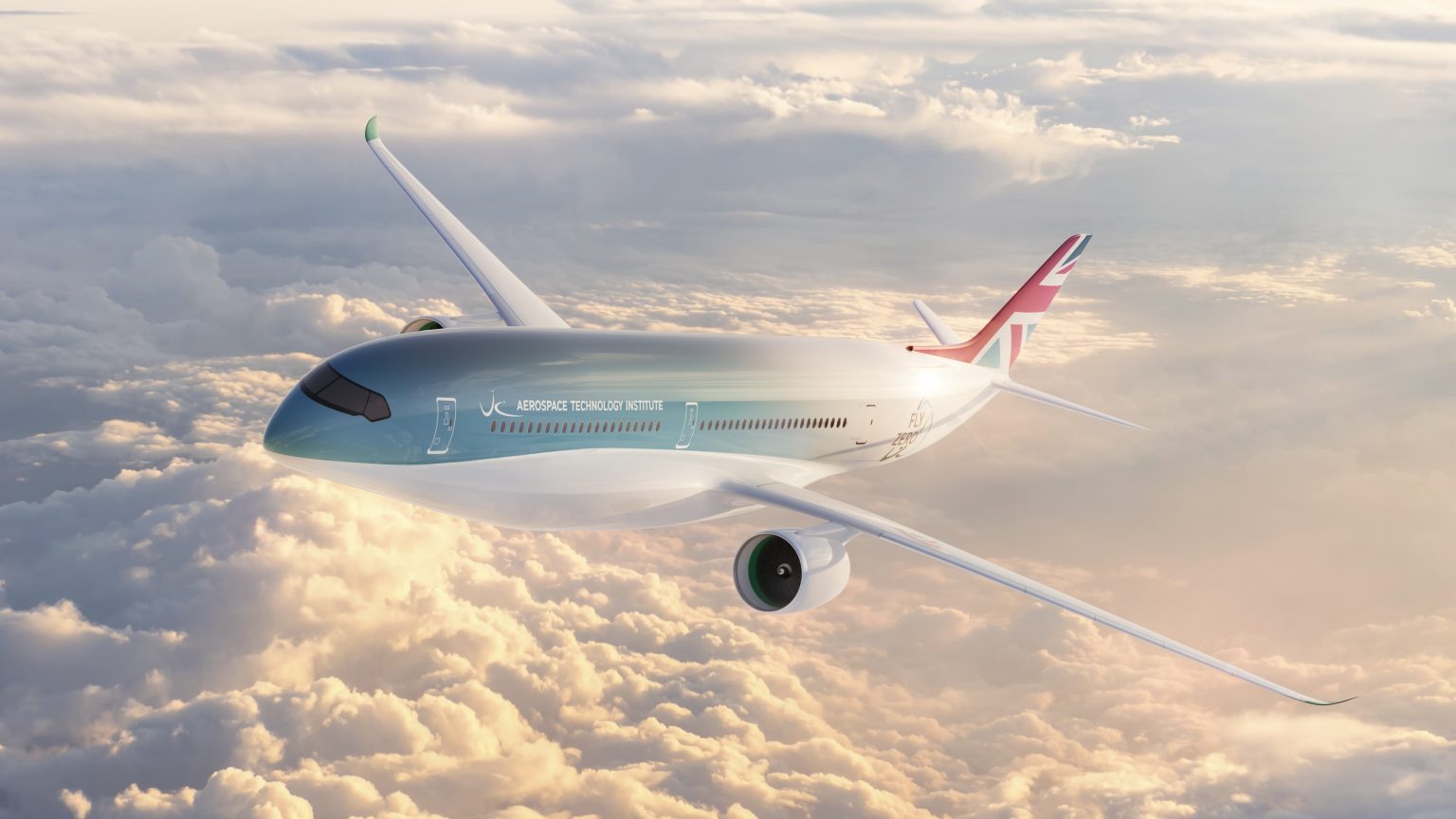
Some features stand out.
The wings are long, narrow and thin, almost like those of a sailplane. High aspect ratio wings like these offer more lift and stability at high altitude, so will the plane fly higher than the 41,000-43,000 feet of an Airbus A350?
I wouldn’t be surprised if it does, as the higher you go, the thinner the air and the less fuel you will burn to maintain speed and altitude.
The horizontal stabiliser is also small as this will reduce drag and better balance with the wing.
The tailfin also appears small for drag reduction.
The body is bloated compared to say an Airbus A 350 or a Boeing 777. Could this be to provide space for the liquid hydrogen, which can’t be stored in the thin wings?
The fuselage also appears to be a lifting body, with the wings blended into the fat body. I suspect that the hydrogen is carried in this part of the fuselage, which would be about the centre of lift of the aeroplane.
The design of the airframe appears to be all about the following.
- Low drag.
- high lift and stability.
- Large internal capacity to hold the liquid hydrogen.
It may just look fat, but it could be as radical as the first Boeing 747 was in 1969.
The Engines
I suspect the engines will be developments of current engines like the Rolls-Royce Trent XWB, which will be modified to run on hydrogen.
If they are modified Trent engines, it will be astonishing to think, that these engines can be traced in an unbroken line to the RB211, which was first run in 1969.
The Flight Controls
Most airliners these days and certainly all those built by Airbus have sophisticated computer control systems and this plane will take them to another level.
The Flight Profile
If you want to fly any aircraft a long distance, you generally climb to a high level fairly quickly and then fly straight and level, before timing the descent so you land at the destination with as small amount of fuel as is safe, to allow a diversion to another airport.
I once flew from Southend to Naples in a Cessna 340.
- I made sure that the tanks were filled to the brim with fuel.
- I climbed to a high altitude as I left Southend Airport.
- For the journey across France I asked for and was given a transit at Flight Level 195 (19,500 feet), which was all legal in France under visual flight rules.
- When the French handed me over to the Italians, legally I should have descended, but the Italians thought I’d been happy across France at FL195, so they didn’t bother to ask me to descend.
- I flew down the West Coast of Italy at the same height, with an airspeed of 185 knots (213 mph)
- I was then vectored into Naples Airport by radar.
I remember the flight of 981 miles took around six hours. That is an average of 163.5 mph.
I would expect the proposed aircraft would fly a similar profile, but the high level cruise would be somewhere above the 41,000-43,000 feet of an Airbus A 350. We must have a lot of data about flying higher as Concorde flew at 60,000 feet and some military aircraft fly at over 80,000 feet.
The press release talks about London to San Francisco, which is a distance of 5368 miles.
This aircraft wouldn’t sell unless it was able to beat current flight time of eleven hours and five minutes on that route.
Ground Handling
When the Boeing 747 started flying in the 1970s, size was a big problem and this aircraft with its long wing may need modifications to runways, taxiways and terminals.
Passenger Capacity
The press release states that the capacity of the aircraft will be 279 passengers, as against the 315 and 369 passengers of the two versions of the A 350.
So will there be more flights carrying less passengers?
Liquid Hydrogen Refuelling
NASA were doing this successfully in the 1960s for Saturn rockets and the Space Shuttle.
Conclusion
This aircraft is feasible.
Could Universal Hydrogen’s Concept Create A Hydrogen-Powered Single-Aisle Airliner?
Universal Hydrogen are making some of what I would consider the right moves.
Hydrogen Supply
Universal Hydrogen have signed a supply contract with Fortescue Future Industries for the supply of green hydrogen.
The deal is described in this press release on the FFI web site, which is entitled FFI And Universal Hydrogen Join Forces To Decarbonise Aviation.
Collaboration With Airbus
There is an article on BusinessWire, which is entitled Universal Hydrogen Announces New Engineering Development Center Located In Toulouse, France, The Heart of European Aviation.
Toulouse is the home of Airbus.
The Capsule Concept
The capsule concept could be universal.
These are widths of various planes and trains.
- De Havilland Canada Dash 8-400 – 2.52 metres – Internal
- Airbus ATR 72 – 2.57 metres- Internal
- Airbus A320neo – 3.7 metres – Internal
- Boeing 737 – 3.53 metres – Internal
- Class 800 train – 2.7 metres – External
- Class 66 locomotive – 2.65 metres – External
I suspect that if the design is correct, then one size of capsule can be made to fit a variety of applications.
Application To Regional Aviation
I discussed this in Flybe Appears To Be On The Way Back.
I believe that De Havilland Canada Dash 8s and Airbus ATR 72s could be converted to hydrogen.
Road Transport
Surely, the capsules would be too big for road transport in the UK and many other countries.
But they would probably be ideal to deliver hydrogen to bus and truck depots and filling stations for hydrogen vehicles. They would just be plugged in and then could start dispensing the fuel.
Decarbonation Of Diesel Locomotives
Consider.
- The cross-section of a diesel locomotive even in the UK, is larger than that of a regional airliner.
- Most of the space in the body of a diesel locomotive is taken up by a large diesel engine.
- Fuel ells or a small gas turbine could be small compared to the diesel engine.
- Most existing diesel locomotives have electric transmissions.
I believe that many diesel-electric locomotives could be converted to hydrogen power and some could use Universal Hydrogen’s capsules.
Zero-Carbon Backup Generators
Many pieces of important infrastructure, like data centres, hospitals and large railway stations have backup generators.
Universal Hydrogen’s capsules could provide hydrogen for zero-carbon backup generators.
Universal Hydrogen’s Ideas For Single-Aisle Airliners
In the Product page on the Universal Hydrogen web site, there is a section, which is entitled Single Aisle / Narrowbody, where this is the first two sentences.
The majority of aviation emissions are produced by the single aisle (also known as narrowbody) fleet, dominated by the Boeing 737 and Airbus A320 families of aircraft. Both Boeing and Airbus are likely to develop a replacement for these venerable models for entry into service in the mid 2030s.
Alongside the text is this graphic, which compares various airliners.
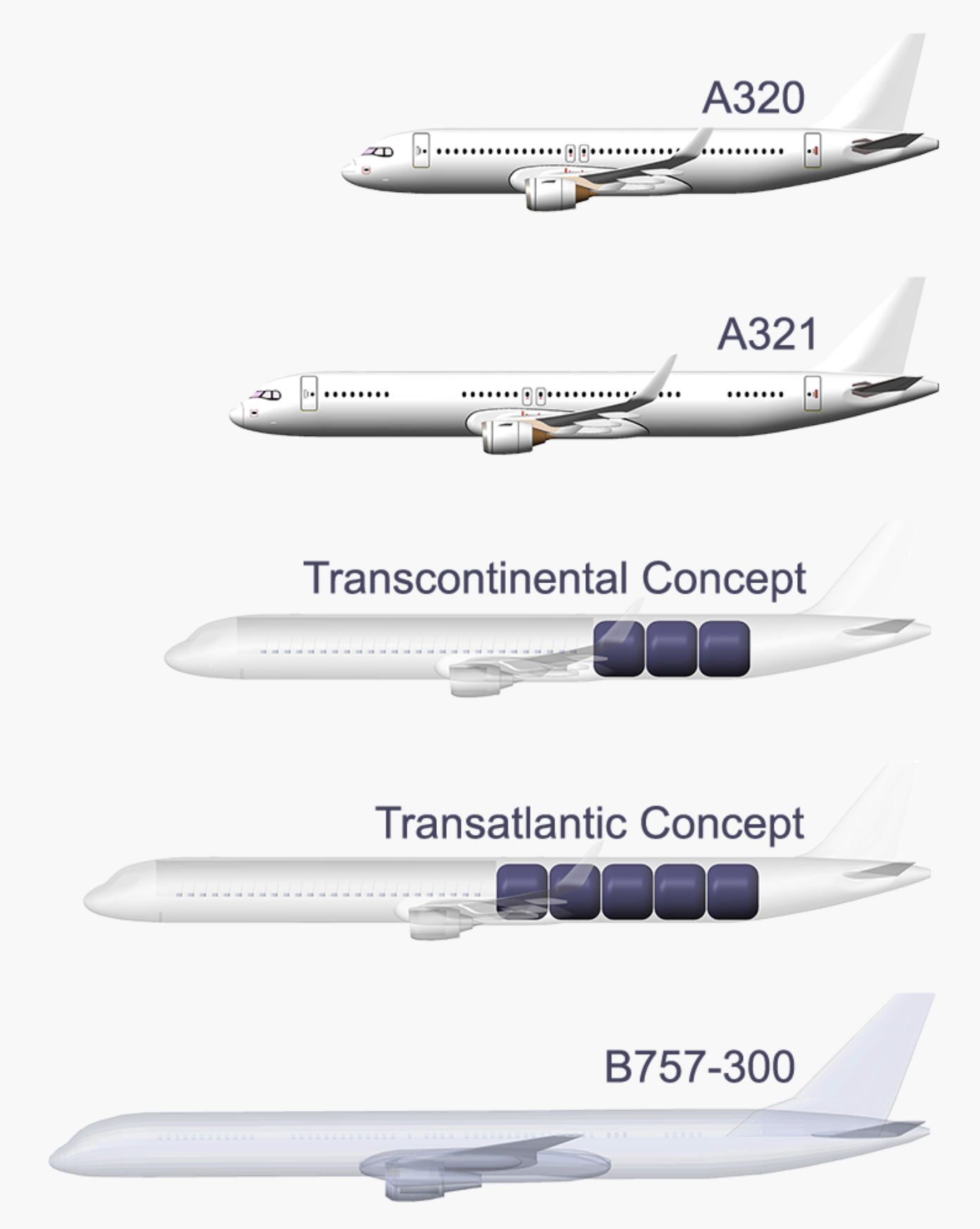
Universal Hydrogen are proposing that Airbus stretch the A321, so that hydrogen capsules can be fitted in the rear of the fuselage, so that the aircraft has similar proportions to the Boeing 757.
Read the full text on the Product page of the Universal Hydrogen web site.
I can see that if they could prove the concept with the Regional Airliner, they could develop the two concepts shown in the graphic.
Conclusion
This is a simple, but very exciting project.

