Monte To Purchase 100 FC Aircraft Drives From ZeroAvia
The title of this post, is the same as that of this article on electrive.com.
This is the first paragraph.
ZeroAvia and Monte Aircraft Leasing will jointly market hydrogen-powered aircraft to regional operators. Under an agreement now signed between the companies, Monte will purchase up to 100 ZA600 hydrogen-electric powertrains from ZeroAvia to be installed on existing and new 5- to 20-seat aircraft.
Monte look to be an interesting company from their web site, which has this title.
Supporting The Transition Of The Regional Aviation Industry To Net Zero Carbon Emissions
The business model appears to be a well-proven and it is not that far removed from the one, colleagues and myself used to sell the project management system; Artemis.
In our case we took proven Hewlett-Packard computers and and other hardware, added our Artemis software and a custom-made desk and leased the systems to those who wanted to do project management, with as much support as our clients required. Customers just had to supply operators, printer paper and a thirteen amp socket.
Finance was obtained by various innovative methods, often through a bank manager, who was a bit of a rogue. But he was a rogue, who was on the side of the angels.
Later he became a firm friend of mine, before he sadly died within a few days of my wife.
Monte Aircraft Leasing’s model would appear to take a proven aircraft like a Cessna Caravan, Dornier 228 or Dash 8, replace the turboprop engines with a zero-carbon powerplant and then lease the aircraft. Often this will just be an additional lease to the existing operator.
The great advantage of this approach, is that the reengined aircraft does not need to be fully re-certified. It can fly under a Supplemental Type Certificate, which is described like this in Wikipedia.
A supplemental type certificate (STC) is a civil aviation authority-approved major modification or repair to an existing type certified aircraft, engine or propeller. As it adds to the existing type certificate, it is deemed “supplemental”. In the United States issuance of such certificates is under the purview of the Federal Aviation Administration (FAA).
Monte seem to have found a good way to make money from going net-zero.
2.7M Tonnes Of Co2 Could Be Saved Per Year If UK Domestic Flights Went Electric
The title of this post is the same as that of this article on Simple Flying.
This is the introductory paragraph.
Analysing over 100 domestic routes within the UK, researchers have uncovered some significant Co2 reductions upon the inevitable switch to electric.
It is an excellent summary of the state and potential of electric airliners in the UK.
The article gives this example of the sort of carbon savings, that can be achieved.
One of the shortest domestic flights in the United Kingdom, a 38-minute hop between Belfast International and the Isle of Man, uses around 36kg of carbon dioxide per passenger. In 2019, the route served approximately 20,000 passengers – with a switch to electric aviation, 752 tonnes of carbon dioxide could be cut on the 76-mile flight.
The article says this about one of the more developed electric aircraft; the ES-19 from Heart Aerospace.
One manufacturer, in particular, is seeing a significant surge in interest; Swedish electric aircraft startup, Heart Aviation. Currently holding letters of interest from United Airlines and Finnair, Heart’s 19-seat ES-19 is set to be the first all-electric regional aircraft, boasting a 400km range with a full-charge time of just 40 minutes. The first flight is planned for 2024, with an anticipated 2026 start date.
Airports within a 400 km range from London would include.
- Anglesey
- Blackpool
- Exeter
- Guernsey
- Jersey
- Leeds/Bradford
- Liverpool
- Manchester
- Newquay
- Norwich
- Paris
- Schipol
Dublin, Isle of Man and Newcastle are just over 400 km.
Note.
I also suspect that Dublin, Edinburgh, Leeds and Liverpool would make excellent hubs for electric aircraft.
I used Free Map Tools to get the distances.
HyPoint And GTL Ultra-Light Liquid Hydrogen Tanks Could Be A Jet Fuel Game Changer
The title of this post, is the same as that of this article on Hydrogen Fuel News.
This is a sentence from the article.
HyPoint and GTL have been developing a groundbreaking liquid hydrogen cryotank design that could turn the entire aircraft industry on its head.
It is claimed that these ultra-light tanks could give a four times increase in range for jet-fuelled aircraft.
The article also claims that HyPoint has developed a new ctype of fuel-cell that could make conventional jet fuel obsolete.
Occasionally, ideas come along, that are literally too good to be true! Usually, they are!
But this one could be the one in a hundred, that isn’t!
Visit the HyPoint web site and see what you think!
I also think, that the technology may have other applications, in addition to aviation.
Eviation Says Cape Air Will Take 75 Alice Aircraft
The title of this post, is the same as that of this article on Flight Global.
Orders in the Wikipedia entry for the Eviation Alice says this.
The first buyer for the Alice was Cape Air, a regional airline serving the Northeastern United States as well as the Caribbean. In August 2021, Deutsche Post announced that it had ordered 12 aircraft for use by DHL to transport cargo, with delivery planned from 2024. In April 2022, Eviation stated that Cape Air ordered 75 planes.
It does look like this innovative aircraft could be ready for more than just a first flight.
Applicability To The UK
I have a feeling, that we’ll see a lot of five-to-nine electric aircraft in the UK, as we have lots of islands and quite a lot of small airports.
The Alice has a range of around 500 miles, which is useful, but the take-off run of 800 metres could be a limitation on some islands.
Conclusion
I can’t wait to fly in an Alice.
The ZEROe Demonstrator Has Arrived
The title of this post, is the same as that of this press release from Airbus.
This is the introductory paragraph.
2022 marks a new and exciting phase for ZEROe – Airbus’ ambition to develop the world’s first zero-emission commercial aircraft by 2035. The multi-year demonstrator programme has officially been launched with the objective to test a variety of hydrogen technologies both on the ground and in the air.
The ZEROe demonstrator will be the first Airbus A 380 aircraft and it is shown in this Airbus visualisation.
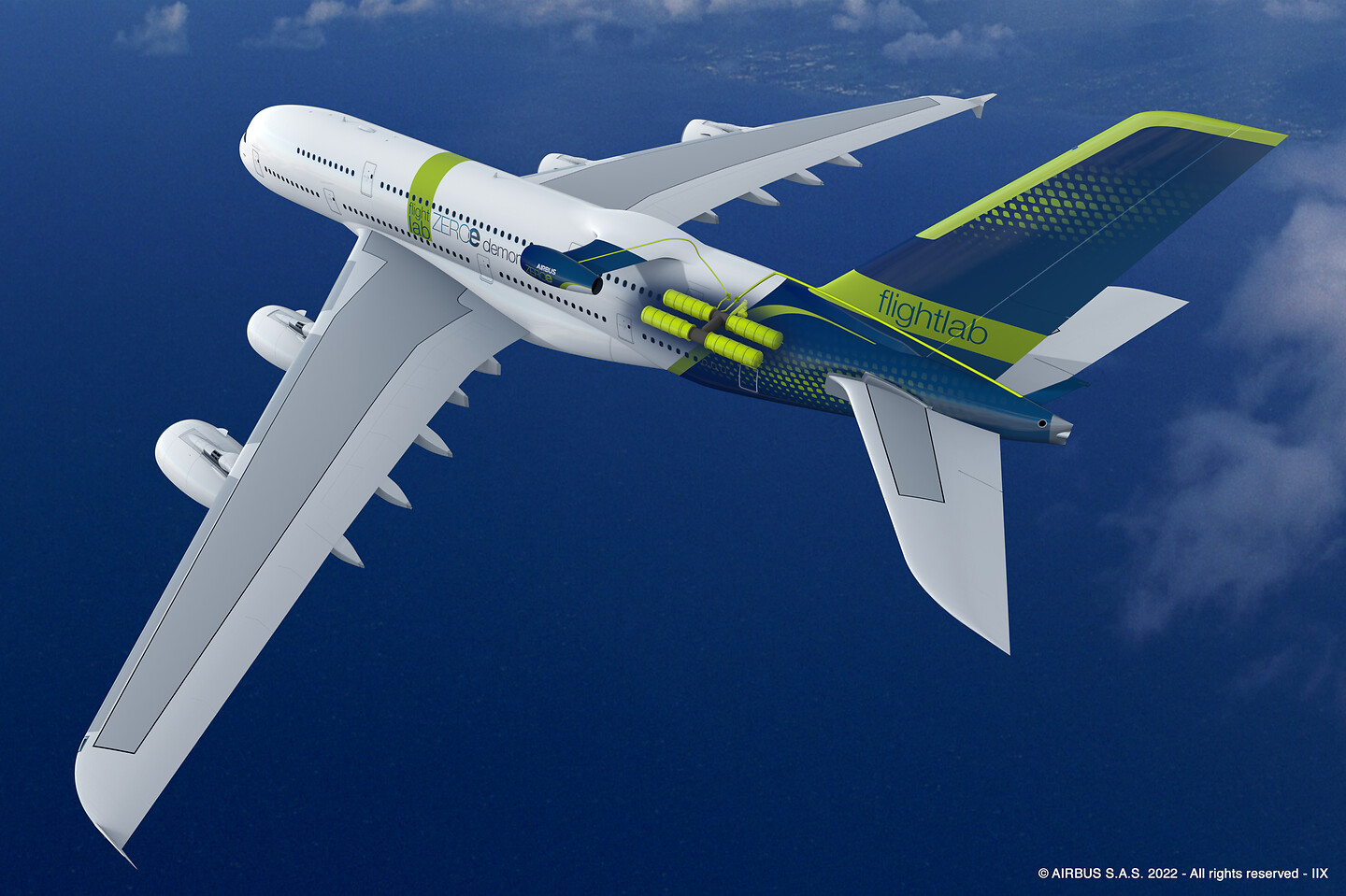
Note.
- The four hydrogen tanks in the fuselage.
- The fifth engine mounted in a pod on the fuselage.
- There’s certainly lots of space inside the fuselage for more hydrogen tanks and test and monitoring equipment.
I have a few thoughts.
This Aircraft Will Be A Superb Demonstrator
The press release says this about the use of an A 380 as a demonstrator.
The A380 is the world’s largest and most spacious passenger jet ever built – a size that makes it ideally suited to the role of test platform.
Today, the A380 MSN1 test aircraft is earmarked for a new role: to take the lead on testing the technologies that will be vital to bringing the world’s first zero-emission aircraft to market by 2035.
“The A380 MSN1 is an excellent flight laboratory platform for new hydrogen technologies,” says Mathias Andriamisaina, Airbus ZEROe Demonstrator Leader. “It’s a safe and reliable platform that is highly versatile to test a wide range of zero-emission technologies. In addition, the platform can comfortably accommodate the large flight test instrumentation that will be needed to analyse the performance of the hydrogen in the hydrogen-propulsion system.”
Initially, I suspect the aircraft will fly as a four-engined turbofan aircraft running on standard or sustainable aviation fuel.
The performance of the hydrogen engine will be tested in all phases of operation and at different altitudes.
What Size Is The Fifth Engine?
This layout is clever.
If Airbus want to test a smaller hydrogen engine for say an Airbus A 320-sized hydrogen aircraft like the ZEROe Turbofan shown in this Airbus visualisation, they fit it to the fifth pylon.
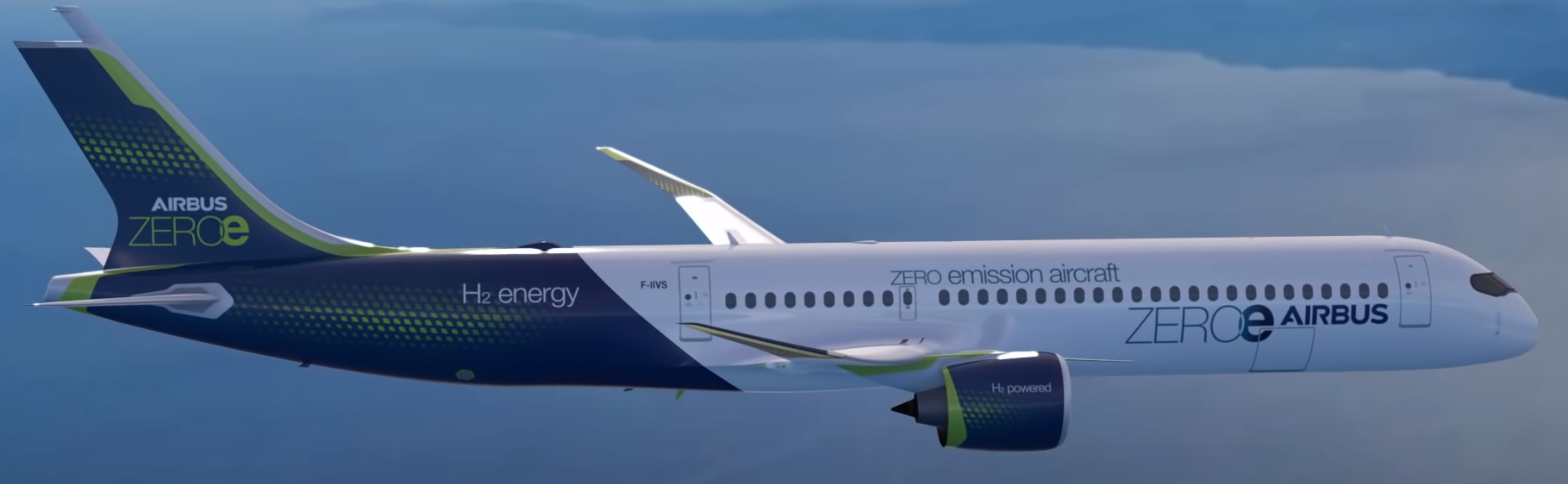
Note.
- The fifth pylon on the ZEROe Demonstrator could be the proposed pylon for the ZEROe Turbofan.
- The ZEROe Demonstrator could probably carry a lot of hydrogen to test out the hydrogen engine over a long duration.
- The hydrogen engine could be tested out over the full flight envelop of an Airbus A 380.
I would suspect that the tests on the hydrogen engine would be some of the most comprehensive ever carried out on a new engine.
If Airbus want to test a larger hydrogen engine for say an Airbus A 350-sized hydrogen aircraft, they would probably replace one of the four main engines with the hydrogen engine.
It looks like Airbus will be able to test hydrogen engines for all sizes of plane in their current range.
What Will Happen To Current A 380s?
Consider.
- The production of the A 380 has been stopped.
- There are 251 aircraft in service.
- They appear to be a reliable and safe aircraft.
- The aircraft can run on sustainable aviation fuel.
- The oldest aircraft are only thirteen years old.
- They are still reasonably modern aircraft, that if they needed to be updated to the latest standards could probably be easily done so.
- The aircraft have a lot of volume, which can hold over 500 passengers in a typical configuration.
- The flying characteristics and structure of the aircraft is well known.
I suspect there are a lot of aircraft leasing companies, who feel these aircraft are too good to scrap, just because they are not zero-carbon.
Could Hydrogen Be Stored In The Wing Of An A 380?
Hydrogen storage will get more capable in the next few years and we will see hydrogen stored in strange places in vehicles and aircraft using the gas as a fuel.
The A 380 may well have an advantage in that its wing is relatively thick compared to that of other airliners.
- The A 380 has a wing aspect ratio of 7.53.
- The Boeing 787 has a wing aspect ratio of 11.
- Gliders have wing aspect ratios as upwards of 30.
High aspect ratios are generally more economical on fuel.
But this relatively thick wing, may make it possible to store hydrogen in the wing of an A 380.
Could There Be A Hydrogen-Powered A 380?
I suspect part of the Airbus ZEROe progam will be to investigate the possibility of converting existing A 380 aircraft into a capable hydrogen-powered aircraft.
In Could An A320 neo Be Rebuilt As A ZEROe Turbofan?, I looked at the possibility of turning an existing Airbus A 320 neo into a ZEROe Turbofan running on hydrogen.
This was my conclusion.
I very much feel that there will be a route to convert some or all of the A 320 neo aircraft to hydrogen power.
So what will a ZEROe A 380 look like if it follows the same design route as an A 320 neo to a ZEROe Turbofan?
- There would be a large hydrogen tank in the rear fuselage.
- As I explained earlier, there may be a possibility for some hydrogen to be stored in the wing.
- Both passenger decks would be shortened and perhaps be able to hold the 350-410 passengers of the Airbus A350-1000.
- The cockpit, front part of the fuselage, wings, tailplane and landing gear would be unchanged.
- The aircraft would fit existing jetways at any airport, that can handle an existing A 380.
I believe that converting an existing Airbus A380 to a hydrogen-powered aircraft is possible and the conversion falls within Barnes Wallis‘s rule of problem solving.
There is no greater thrill in life, that proving something is impossible and then showing how it can be done.
The quote comes from a BBC program, where he was interviewed by Chris Brasher, who was another for whom impossible was just a minor hurdle in the way of meeting objectives.
Could There Be A Hydrogen-Powered A 380 Freighter?
Consider.
- I think it is likely, that companies like Amazon will come under pressure over their carbon footprint, as they transport increasing numbers of packages around the world.
- In DHL Express Shapes Future For Sustainable Aviation With First Order Of All-Electric Cargo Planes From Eviation, I talk about how DHL Express have ordered twelve Eviation Alice aircraft to create a zero-carbon service. DHL must feel this would be good for their image. So would they like an intercontinental zero-carbon freighter?
- Some people worry about the air-miles on their food!
There could be a worthwhile niche market for a high capacity intercontinental zero-carbon freighter.
Because it has such a large internal volume, an Airbus A 380 might make an ideal aircraft to convert.
Conclusion
Airbus will learn a lot from the ZEROe Demonstrator.
They may even learn how to develop, a long-range hydrogen-powered zero-carbon A 380 variant that could carry four hundred passengers between Europe and Australia.
Velocys’s Waste-To-Fuel Project Moves Forward
The title of this post, is the same as that of this article on Let’s Recycle.
This is the first paragraph.
Velocys says it has completed works at its Altalto plant in Immingham, North East Lincolnshire, in preparation for a future connection to the East Coast Carbon Capture and Storage (CCS) cluster.
In partnership with British Airways, Velocys is developing a facility that could convert up to 500,000 tonnes of municipal solid waste into fuel for planes and cars each year.
At last, this very interesting and important project is underway.
I believe that plants like this could be the way we keep flying until hydrogen-powered planes are developed.
Russia Destroys Ukraine’s Dream
The Antonov An-225 Mriya was a unique aircraft.
It was the biggest aircraft in the world and was regularly used to move heavy or awkward cargoes around the world, as a reading of its Wikipedia entry will disclose.
Mriya is Ukrainian for dream.
But all that useful work has come to an end.
This article on CNN is entitled World’s Largest Plane Destroyed In Ukraine.
These are the first two paragraphs.
The world’s largest plane, the Antonov AN-225, has been destroyed during the Russian invasion of Ukraine, according to Ukrainian officials, generating alarm and sadness among the aviation world in which it occupies almost cult status.
The enormous aircraft, named “Mriya,” or “dream” in Ukrainian, was parked at an airfield near Kyiv when it was attacked by “Russian occupants,” Ukrainian authorities said, adding that they would rebuild the plane.
I know it’s only a plane and in the current scheme of things, that is a minor loss, but the Mriya has proved itself to be so uniquely useful in moving awkward cargoes, that the plane would surely have played a major part in the humanitarian relief and the rebuilding of Ukraine.
Given, that the plane would have surely been of use to the Russians, it just shows how utterly stupid, they have been in this war.
Fortescue Future Industries And Airbus Join Forces To Help Decarbonise Aviation
The title of this post, is the same as that of this press release from Fortescue Future Industries.
These are the first two paragraphs.
Global green hydrogen company Fortescue Future Industries (FFI) and Airbus, a world leader in aeronautics, have joined forces to create a working alliance to help enable the aviation industry to decarbonise through zero-emissions green hydrogen.
Today’s announcement reflects FFI’s and Airbus’ shared ambition to leverage their respective expertise to support the entry-into-service of a green hydrogen-based aircraft by 2035. Green hydrogen, unlike other forms of hydrogen, is made from water using 100 per cent renewable electricity.
I think this is a smart move by Airbus.
It could be argued that hydrogen trucks, buses, cars, vans and other road vehicles have not taken off at a great rate due to the lack of hydrogen filling stations.
Hydrogen airliners travelling on typical routes will probably need refuelling at both ends of the route and possibly several times per day, so hydrogen refuelling would be an important part of any deal Airbus signs with an airline.
Fortescue Future Industries seem to be in prime position to be the first global hydrogen company, so they must be the ideal hydrogen fuelling partner.
I don’t think anybody predicted, when Airbus published the possible designs of their concepts for hydrogen-powered aircraft in September 2020, that I wrote about in ZEROe – Towards The World’s First Zero-Emission Commercial Aircraft, that an Australian company would be likely to provide the hydrogen fuel for these aircraft.
‘Game-Changing’ Drones Helping Ukraine In Battle For The Skies
The title of this post, is the same as that of this article in The Times.
This is the introductory paragraph.
The Ukrainian military has been using “Punisher” stealth drones that can target fuel storage, ammunition supplies and electronic warfare stations up to 30 miles behind enemy lines.
Some other points from the article.
- They are a Ukrainian-built drone with a 7.5 foot wingspan an electric propulsion.
- They are from a company called UA-Dynamics.
- They have completed sixty successful mission.
- They can fly for hours at 1,300ft
This paragraph describes a mission.
He said the drone, which can carry 3kg of explosives, needs the co-ordinates of its target and then carries out its mission automatically. Onboard cameras record the impact of the blast to check the accuracy of the mission.
It can also work in combination with a reconnaissance drone.
Could this be the reason the Russians have held back the convoy?
It may not be a big enough warhead to knock out a tank, but it would do a lot of damage to a supply truck or a tanker full of diesel.
There is also this paragraph, which describes a dog-fight between Russian and Ukranian fighters.
The Ukrainian military said today that a “fierce air battle” took place overnight in the Kyiv region between a pair of MiG-29 fighters and a pair of Russian Su-35s. Both Russian jets were destroyed and one MiG-29 survived.
Note.
- The Mig-29 first flew in 1977.
- Mig-29s are a very common fighter aircraft.
- Ukraine inherited hundreds of Mig-29s after the collapse of the Soviet Union.
- The USAF has a few Mig-29s
The Su-35 first flew in 1988.
In addition to the Russians, they are flown by China and Egypt.
This is a paragraph from the Wikipedia entry for the Mig-29.
On 29 May 2020, Ukrainian MiG-29s took part in the Bomber Task Force in Europe with American B-1B bombers for the first time in the Black Sea region. In September 2020, B-52 bombers from the 5th Bomb Wing conducted vital integration training with Ukrainian MiG-29s and Su-27s inside Ukraine’s airspace.
Have the Ukrainian pilots been doing some combat training?
Embraer, Widerøe And Rolls-Royce Announce Partnership To Research Innovative Technologies For Sustainable Regional Aircraft
The title of this post, is the same as that of this press release from Rolls-Royce.
This is the body of the press release.
Embraer, Widerøe and Rolls-Royce have today announced plans to study a conceptual zero-emission regional aircraft.
The 12-month cooperation study – in the context of pre-competitive research and development – will address passenger requirements to stay connected in a post Covid-19 world, but do so sustainably, and seeks to accelerate the knowledge of the technologies necessary for this transition. Such technologies will allow national governments to continue to support passenger mobility while reusing most of the existing infrastructure in a more sustainable way.
Advances in scientific research can make clean and renewable energy a major enabler of a new era of regional aviation and the three companies will share their combined in-depth knowledge of aircraft design, market demand, operations and propulsion solutions to further develop their understanding of zero-emission technologies and how they can be matured and applied to future regional aircraft.
Among other topics, the study will cover a wide range of applications for new propulsion technologies to examine a range of potential solutions – including all-electric, hydrogen fuel cell or hydrogen fueled gas turbine powered aircraft.
These are my thoughts.
An Aircraft For Existing Infrastructure
This is an extract from the press release.
Such technologies will allow national governments to continue to support passenger mobility while reusing most of the existing infrastructure in a more sustainable way.
If I was the CEO of an airline, I’d want an aircraft that fitted the airports and their facilities, where I wanted to fly.
No Propulsion System Is Ruled Out
This is an extract from the press release.
Among other topics, the study will cover a wide range of applications for new propulsion technologies to examine a range of potential solutions – including all-electric, hydrogen fuel cell or hydrogen fueled gas turbine powered aircraft.
It would appear no propulsion system is ruled out.
In LNER Seeks 10 More Bi-Modes, where I talked about LNER ordering ten new trains, they also said they would accept any type of power, that was suitable.
Embraer
Embraer are a successful Brazilian aerospace company, who according to Wikipedia, are the third largest producer of civil aircraft, after Boeing and Airbus.
I first flew in one of their EMB 110 Bandeirantes in the 1970s from Norwich to Stavanger and I’ve flown on several of their aircraft since.
Embraer’s current jet aircraft line-up includes.
- Embraer E-Jet – Twin-jet regional airliner – 66-124 passengers – 1596 produced
- Embraer E-Jet E2 – Twin-jet regional airliner – 88-146 passengers – 50 produced
Note.
- The E-Jet E2 is the successor to the E-Jet with new engines, new avionic, fly-by-wire controls and other improvements.
- Production numbers are as of 31st March 2021.
- Embraer don’t seem to produce turboprop aircraft any more, although a lot of their former products are still flying.
I certainly wouldn’t avoid flying in Embraer products, as I would in other aircraft and on some airlines.
Have Embraer identified a market for a smaller sustainable or even zero-carbon aircraft that could extend their product range below the jets?
Widerøe
Widerøe are a long-established and well-respected Norwegian airline.
Their fleet consists of forty De Havilland Canada Dash 8 turboprop aircraft of various variants and three Embraer E-Jet E2 jet airliners.
Wikipedia says this about their fleet.
Widerøe plans to replace most of its Dash-8 by 2030.
Given that the Dash 8 seats between 40 and 80 passengers, I wonder if a sustainable or even zero-carbon aircraft with an appropriate number of seats and the STOL performance of the Dash 8, would suit Widerøe’s route network, which includes many small airfields.
Rolls-Royce
In What Does 2.5 MW Look Like?, I talked about Rolls-Royce’s development of a 2.5 MW Generator.
I am inserting the start of the linked post.
This press release on the Rolls-Royce web site is entitled Rolls-Royce Generator Delivered For Most Powerful Hybrid-Electric Propulsion System In Aerospace.
This Rolls-Royce picture shows the generator installed on a test bed.
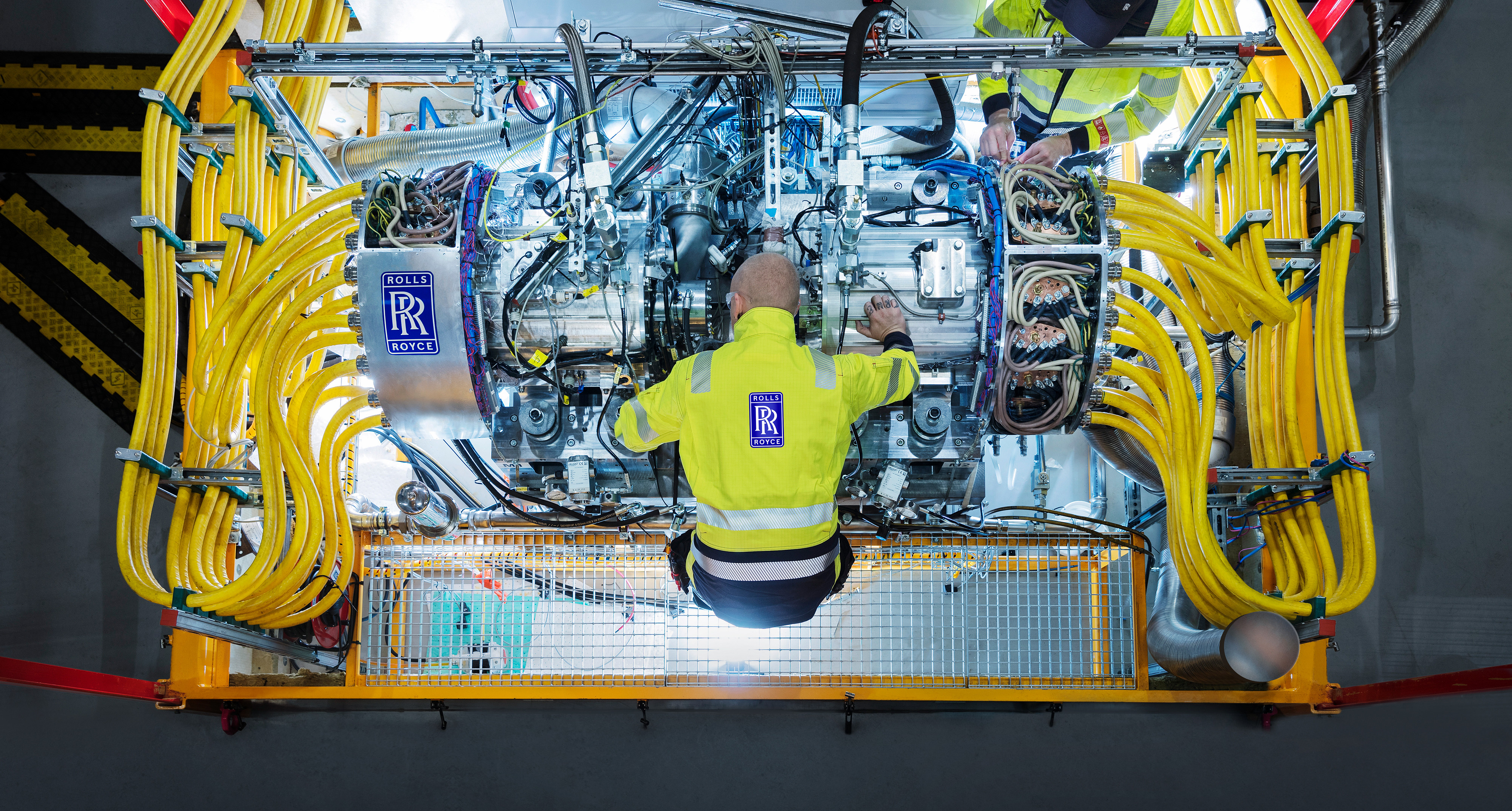
These are the first three paragraphs of the press release.
The generator that will be at the heart of the most powerful hybrid-electric aero power and propulsion system in aerospace has arrived for installation at our specialist testbed.
The generator, and related power electronics, was delivered to the newly-renovated Testbed 108 in Bristol, UK, from the Rolls-Royce facility in Trondheim, Norway, having completed an extensive development test programme. It will form part of the 2.5 megawatt (MW) Power Generation System 1 (PGS1) demonstrator programme, for future regional aircraft. In addition to hybrid-electric propulsion, the generator could also be used as part of a “more-electric” system for larger aircraft or within future ground or marine applications.
PGS1 forms an important element of our sustainability strategy, which includes developing innovative electrical power and propulsion systems.
I must say that as an engineer this 2.5 MW generator really excites me, as I see so many possibilities.
Could this engine become the power unit of a hydrogen-powered regional airliner?
Rolls-Royce, Tecnam And Widerøe
In Rolls-Royce And Tecnam Join Forces With Widerøe To Deliver An All-Electric Passenger Aircraft Ready For Service In 2026, a similar deal to the Embraer, Widerøe and Rolls-Royce deal is discussed.
I am inserting the start of the linked post.
The title of this post, is the same as that of this press release from Rolls-Royce.
This is the first paragraph.
Rolls-Royce and airframer Tecnam are joining forces with Widerøe – the largest regional airline in Scandinavia, to deliver an all-electric passenger aircraft for the commuter market, ready for revenue service in 2026. The project expands on the successful research programme between Rolls-Royce and Widerøe on sustainable aviation and the existing partnership between Rolls-Royce and Tecnam on powering the all-electric P-Volt aircraft.
This picture from Rolls-Royce shows the proposed aircraft.

The P-Volt aircraft is based on the Tecnam P2012 Traveller.
Conclusion
Perhaps, the first deal is progressing so well, Rolls-Royce and Widerøe decided to repeat the exercise.

