Birmingham Plays The Green Card
This article in The Times today is entitled Birmingham Airport Set For Hydrogen Take-Off.
These two paragraphs introduce the article.
Birmingham Airport aims to become the first in Britain to operate commercial zero-emission hydrogen-fuelled flights — and by as early as 2025.
The ambitious goal follows the signing of a partnership with the British start-up ZeroAvia whose first trial flight of a 19-seater passenger aircraft powered by hydrogen fuel cells took place last month.
Other points from the article include.
- ZeroAvia is also working with Rotterdam Airport.
- Initially, it is likely that the hydrogen-powered aircraft will be used for cargo.
- The government wants all UK domestic flights to be zero-carbon by 2040.
- Birmingham wants to be zero-carbon by 2033.
- ZeroAvia has received upwards of £20 million of matched-taxpayer funding.
- It has some big backers and well-known airlines, who have placed orders.
These are my thoughts.
ZeroAvia’s Airliners
This paragraph from The Times article describes their first two aircraft.
ZeroAvia is retrofitting turboprops, 19-seater Dornier and in future 80-seater De Havilland Canada Dash 8-400s, with tanks of hydrogen which is converted by fuel cell stacks to energy taken to electric motors that power the propellers. The only emission is water. It is talking to potential new-entrant airframe makers to build all-new hydrogen aircraft of the future.
Note.
- The Dornier 228 is a 19-seater airliner of which over three hundred have been built.
- The de Havilland Canada Dash 8-400 is an 80-seater airliner of which over six hundred have been ordered and over 1200 of all marques of Dash 8s have been built.
Both are workhorses of the smaller airlines all over the world.
As the paragraph from The Times indicates the power system is not conventional, but then most of this new breed of small electric/hydrogen/hybrid airliners have electric propulsion. I suspect that there’s been a marked improvement in the design and efficiency of electric motors.
Electric propulsion should have a substantial noise advantage over turboprops.
ZeroAvia are also retrofitting their two chosen airliners.
This offers advantages in the certifying of the airliners. Providing the changes made to the airframe are not significant, the various certifying authorities in the UK, US and EU will allow previous certification to be carried over.
This means that ZeroAvia only have to thoroughly test and certify the powerplant and its integration into the aircraft.
One of their competitors, the Eviation Alice is a completely new airframe with battery-electric power, so I suspect this aircraft will take longer to certify.
I think ZeroAvia have used this shorter certification time to aim to get their airliners in service first.
Those that don’t win, don’t get the same fame.
Hydrogen At Birmingham Airport
Hydrogen will be needed at Birmingham Airport to refuel ZeroAvia’s airliners.
But will hydrogen also be used on the airside to power some of the heavy vehicles you see on airports.
Look at this page on the Hawaii Technology Development Corporation, which shows a Hydrogen Fuel Cell U-30 Aircraft Tow Tractor. The specification indicates, that it can tow a C-17 or a Boeing 747.
I wouldn’t be surprised to see Birmingham Airport build their own electrolyser nearby both to supply hydrogen-powered aircraft and decarbonise the airside.
To And From Birmingham Airport
Consider.
- Birmingham Airport is connected to Birmingham International station by a free AirRail Link.
- Birmingham International station has an impressive number of services, many of which are electric.
- There will be a people mover to connect to Birmingham Interchange for High Speed Two.
- Birmingham Interchange will have five trains per hour (tph) to and from London, taking under forty minutes.
- There are plans to extend the West Midlands Metro to the airport, with journeys taking thirty minutes from the City Centre.
- Birmingham Airport is at the centre of the UK’s motorway network.
Most public transport to Birmingham Airport will be zero-carbon and the percentage that is will increase.
A Green Air Bridge To Ireland
Currently the fastest services between London and Birmingham International station take a few minutes over the hour.
But after High Speed Two opens, the service will improve.
- High Speed Two will take under forty minutes.
- There will be five tph.
- High Speed Two will connect to the Elizabeth Line and the London Overground at Old Oak Common station.
- Euston station will have better connectivity to the Underground.
This diagram shows High Speed Two services.
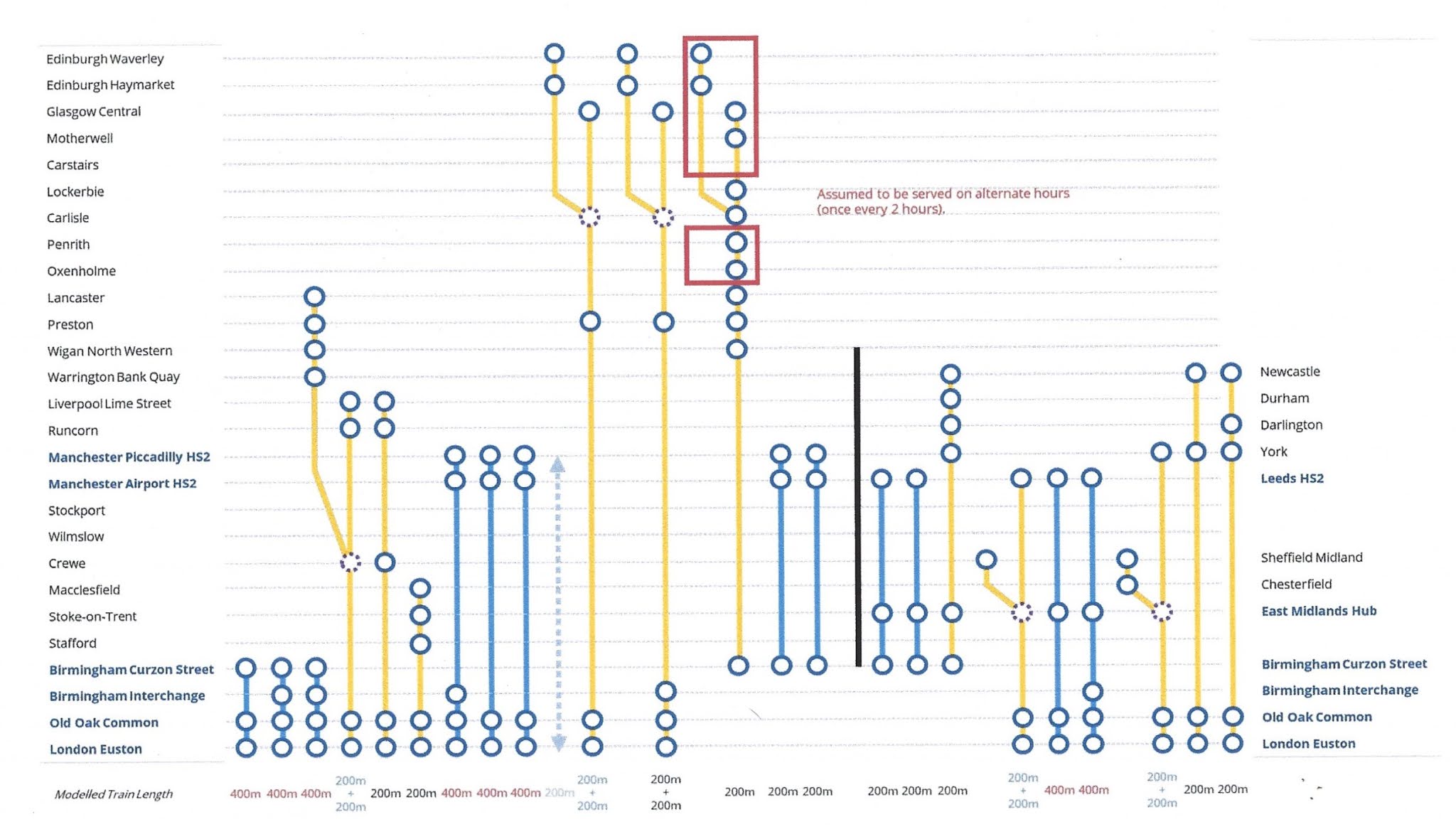
Consider.
- Birmingham Interchange has good connections in the North.
- I can see that Birmingham Airport could start to attract lots of passengers going between the islands of Great Britain and Ireland.
- And don’t forget Cardiff, Swansea, Exeter, Isle of Man and New Quay.
- Could Birmingham-Dublin and Birmingham-Belfast be run as frequent shuttles?
- Will there be AirRail tickets between Euston and Belfast and Dublin?
I also wonder if zero-carbon travel will attract passengers?
Zero-Carbon Air Cargo At Birmingham Airport
This article on Railway Gazette is entitled Varamis Rail Launches Regular Express Light Freight Service.
These three paragraphs outline the service from Varamis Rail.
Varamis Rail has launched a 160 km/h express freight service between Glasgow and Birmingham International using a converted electric multiple-unit.
The service is targeted at express parcels and third-party delivery companies seeking next day delivery of consumer goods.
Consignments arriving at the Glasgow hub by 17.30 from Monday to Friday can reach Birmingham at 23.00, with northbound freight arriving at the Birmingham site by 23.00 reaching Glasgow at 05.30 the next morning.
I think this service would interface well with cargo planes operating overnight from Birmingham Airport.
It seems to me, that Spokes at Speke could be reborn at Birmingham.
Conclusion
Birmingham Airport seems to be positioning itself to take advantage of aviation’s new breed of planes.
Swedish Battery-Electric Aircraft Selected By A Major Airline
The title of this post, is the same as that of this article on autoevolution.
This is the sub-heading.
You know that saying, “New year, new me”? In the case of this major airline, it’s more like “New decade, new me.” Air New Zealand wants to flaunt a brand-new regional fleet starting 2030. And it looks like that will include an all-electric model developed by the Sweden-based Heart Aerospace.
The article then gives a description of their plan called Mission Next Gen Aircraft to go zero-carbon on their short haul routes.
This paragraph describes the aircraft that will be used.
ATR will bring its upgraded aircraft concept, called the ATR EVO, designed to be 100% compatible with SAF (sustainable aviation fuel). Embraer will showcase the innovations of an entire new family of aircraft named Energia, based on various types of clean propulsion. Universal Hydrogen will retrofit the existing regional airliners with its efficient hydrogen solution. Last but not least, Heart Aerospace will focus on the niche segment of battery-electric aircraft.
It will be fascinating to see how all this works out.
We’re still waiting in the UK for an airline to announce the purchase of a zero-carbon aircraft.
Especially, as we have some routes, like those around Scottish islands, where there are many short routes, that have less than a dozen passengers on a flight.
An American View Of The Harrier
In The Times today there is the obituary of Ralph Hooper.
This is the sub-heading.
Aeronautical engineer who designed the revolutionary Harrier jump jet and the versatile Hawk used by the Red Arrows.
I have two tales that must be told.
An Artemis Users Conference In Denver
The project management software I wrote; Artemis, was used by both British Aerospace and McDonnell Douglas to build Harriers.
One day, soon after the end of the Falklands War, I was at an Artemis Users Conference in Denver and got chatting to three users.
- The Project Manager for the US Harrier.
- A Senior Project Manager for Long Beach Naval Shipyard.
- A banker from a famous New York Bank.
Because of the times and two project managers working on military projects, the conversation naturally turned to the recent war.
The banker, then said something like. “What you need is a big flat-top with a squadron of Tomcats, to blow the Argies out of the sky.”
Tomcats were top-of-the-range US naval fighter jets.
Whereupon, the McDonnell Douglas guy said. “We’re getting the weather reports! There’s no other aircraft, that can take-off and land in the terrible conditions!”
An A-10 Pilot’s View Of The Harrier
In the 1970s, I used to drink in the Clopton Crown pub. Sometimes, I got drinking with one of the USAF A10 Thunderbolt II pilots from Bentwaters.
As I was a pilot myself at the time, we had quite a few chats about flying.
One night he told how two A10s would fly as a pair, at a fairly low altitude.
To protect themselves from MiGs, one would break away and do a steep turn through a complete circle, scanning the horizon for any threat.
Then the other would do the movement the other way.
He felt that in hostile combat, that they would give any opposition fighter a real kicking, as the attacker would have to keep out of the way of two GAU-8 Avenger 30 mm Gatling-style autocannons, firing large numbers of heavy shells.
He also told me, that he had flown A-10s up against other aircraft on a simulator. He just said, he found AV-8As, as the US called Harriers, very difficult to beat.
The Southern Entrance To London City Airport
I entered London City Airport by a different route today, taking these pictures as I walked.








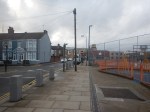
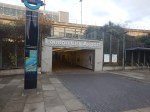





Note.
- The route is level.
- It is on the Southern side of Hartmann Road, which is the main entrance road for the airport.
- There is a pedestrian tunnel under Hartmann Road into the airport.
- There are stairs and lifts into the Docklands Light Railway station at the airport.
- The lifts so all the way to the platforms of the DLR.
- The route is level from the lifts to the airport.
This Google Map shows the walk.
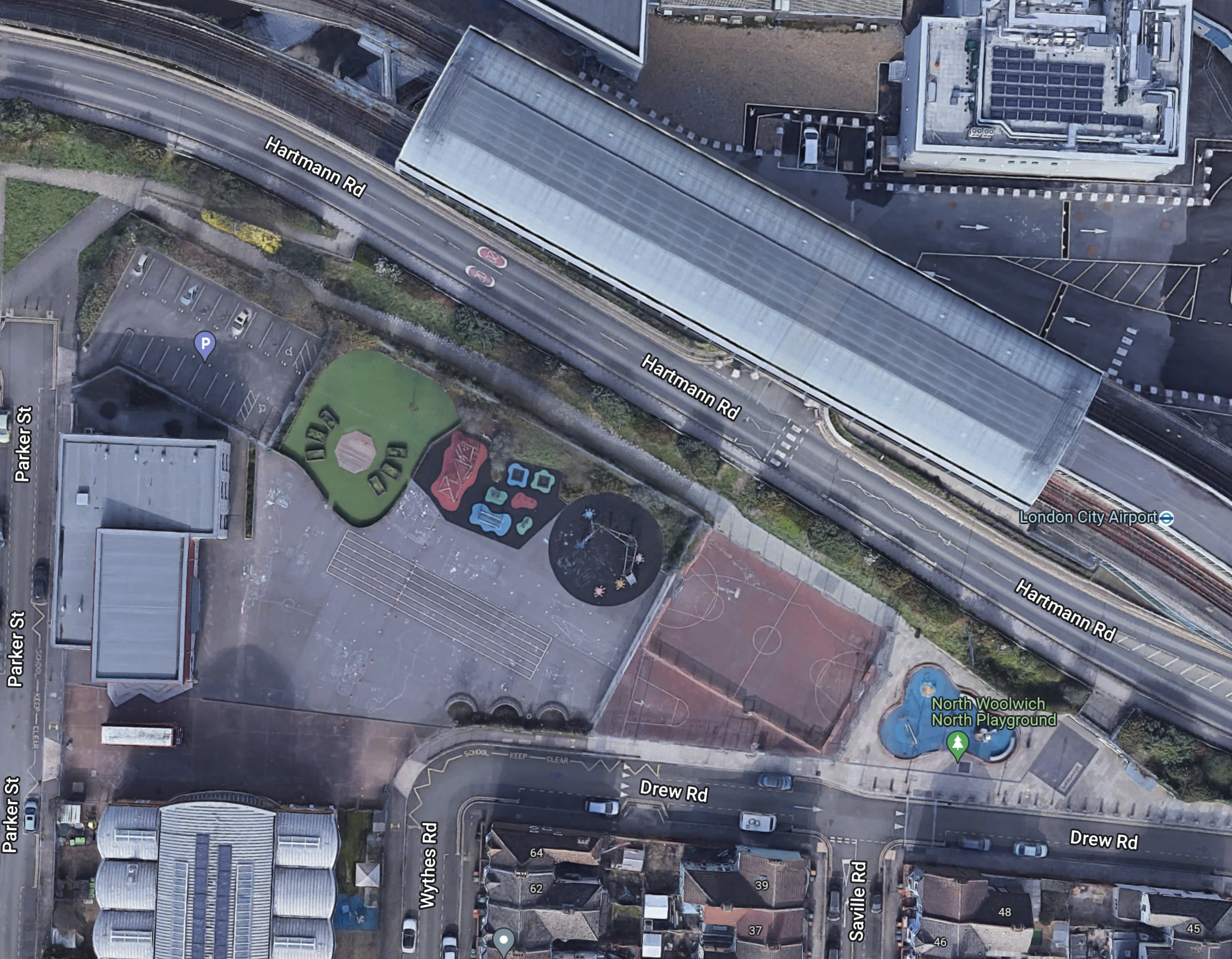
Note.
I walked along the path, that runs NW-SE on the Northern side of the various courts and playgrounds.
The entrance to the DLR station is at the South-East end of the path at the junction of Drew and Saville Roads.
This Google Map shows a 3D visualisation of the entrance.
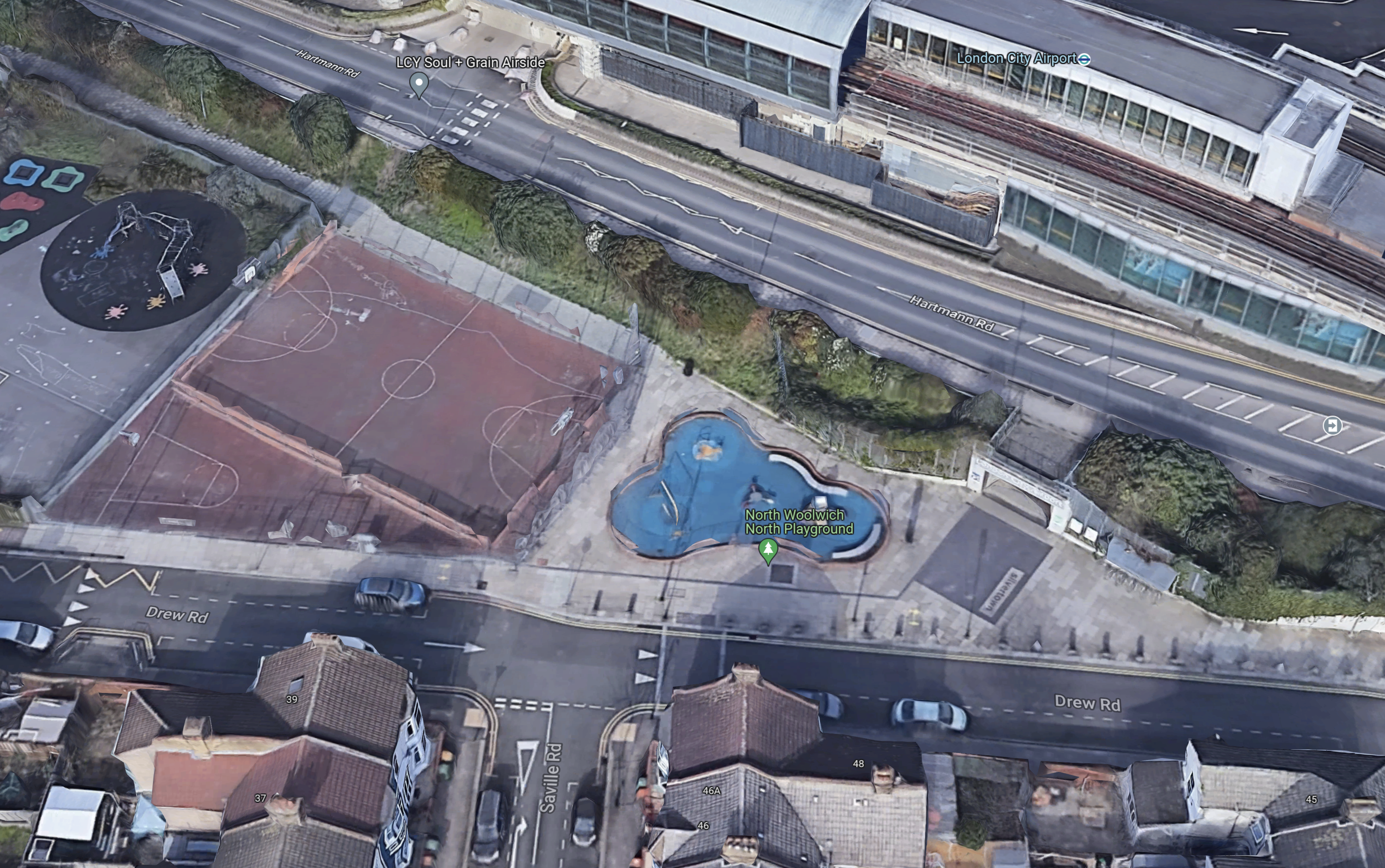
Note.
- The path runs on the North side of the football pitch.
- The Southern entrance is to the right of blue play area.
- Drew Road runs across the entrance.
- It looks like there is a drop-off point for passengers, where the car is parked by the football pitch.
Would it be possible to create a waking route from this Southern entrance to a rebuilt Silvertown station on the Elizabeth Line?
This Google Map shows the area between the Southern entrance to the airport and the footbridge over the Elizabeth Line.
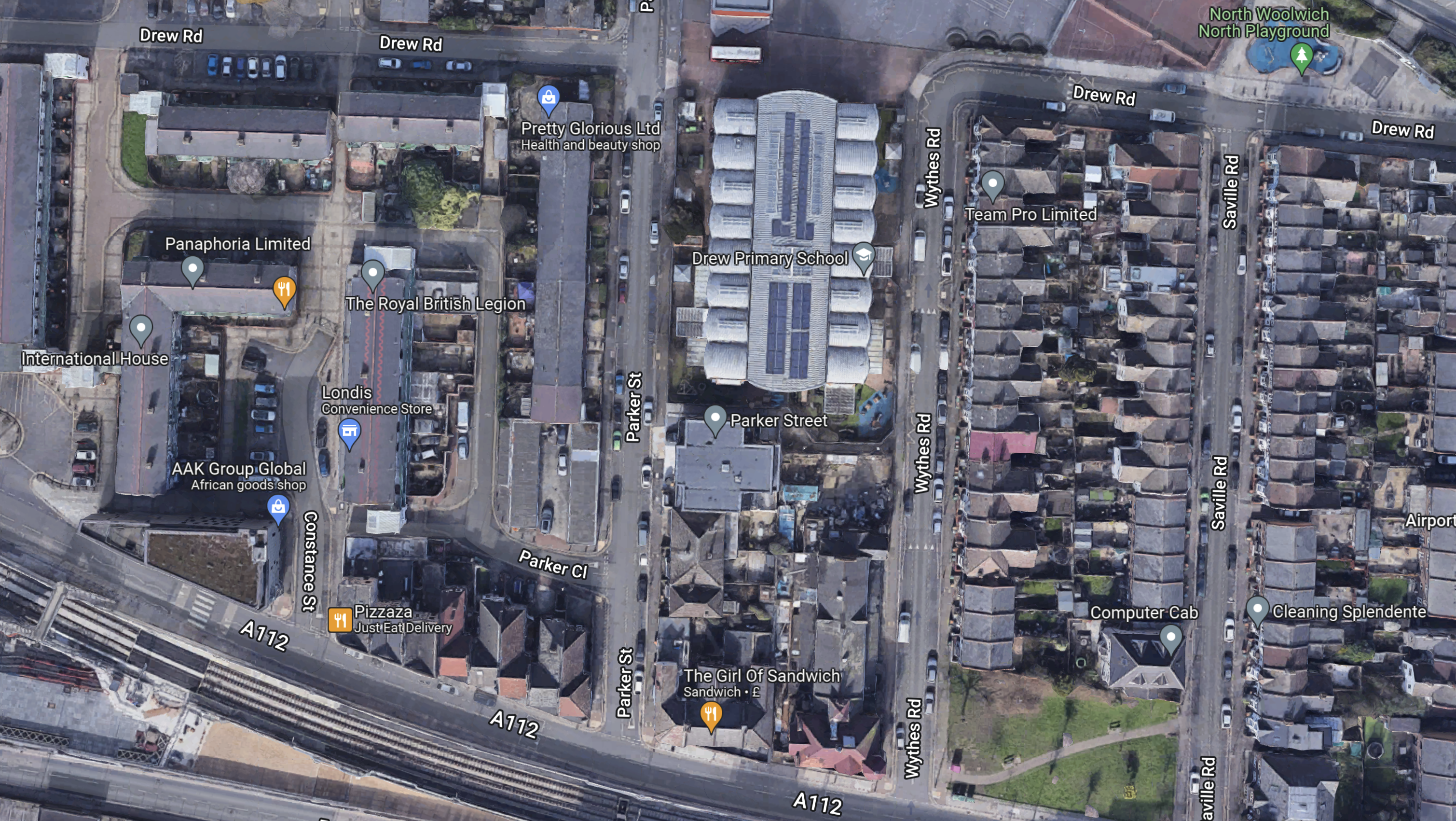
Note.
- The Southern entrance to the airport is in the North-East corner of the map.
- The footbridge over the Elizabeth Line is in the South-West corner of the map.
- The large building in the middle is Drew Primary School.
- Whytes Road, Saville Road and Leonard Street lead between the Southern entrance to the airport and the A112.
I took these pictures of the A112 and the footbridge a few days ago.
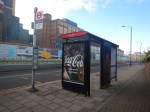

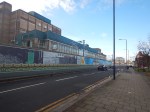









I think it would be possible to run a fleet of small electric shuttle buses on the route.
Elizabeth Line Trains From Silvertown Station
Currently, the following trains pass through the site of the original Silvertown station.
- Reading and Abbey Wood stopping at Twyford, Maidenhead, Taplow, Burnham, Slough, Langley, West Drayton, Hayes & Harlington, Southall, Ealing Broadway, Paddington, Bond Street, Tottenham Court Road, Farringdon, Liverpool Street, Whitechapel, Canary Wharf, Custom House and Woolwich.
- Maidenhead and Abbey Wood stopping at Taplow, Burnham, Slough, Langley, Iver, West Drayton, Hayes & Harlington, Southall, Ealing Broadway, Paddington, Bond Street, Tottenham Court Road, Farringdon, Liverpool Street, Whitechapel, Canary Wharf, Custom House and Woolwich.
- Heathrow Terminal 4 and Abbey Wood stopping at Heathrow Terminals 2 & 3, Hayes & Harlington, Southall, Hanwell, West Ealing, Ealing Broadway, Acton Main Line, Paddington. Bond Street, Tottenham Court Road, Farringdon, Liverpool Street, Whitechapel, Canary Wharf, Custom House and Woolwich.
- Heathrow Terminal 5 and Abbey Wood stopping at Heathrow Terminals 2 & 3, Hayes & Harlington, Southall, Hanwell, West Ealing, Ealing Broadway, Acton Main Line, Paddington, Bond Street, Tottenham Court Road, Farringdon, Liverpool Street, Whitechapel, Canary Wharf, Custom House and Woolwich.
Note.
- All four services have a frequency of two trains per hour (tph).
- Paddington, Bond Street, Tottenham Court Road, Farringdon, Liverpool Street, Whitechapel, Canary Wharf, Custom House and Woolwich have a frequency of eight tph.
- Heathrow Terminals 2 & 3 has a frequency of two tph and it has extra connections to Heathrow Terminal 4 and Heathrow Terminal 5.
The number of services will increase in May 2023.
World’s First Net Zero Transatlantic Flight To Fly From London in 2023, Powered By The Rolls-Royce Trent 1000
The title of this post, is the same as that of this press release from Rolls-Royce.
These are the three main bullet points.
- World first as Virgin Atlantic wins UK government funding to operate historic London – New York flight
- Rolls-Royce, Boeing, Imperial College London, University of Sheffield, Rocky Mountain Institute (RMI) and ICF also form part of an iconic British-led consortium
- Heralds future of low carbon aviation, with the wider sustainable aviation fuel (SAF) industry potentially creating thousands of UK jobs while supporting delivery of net zero aviation emissions by 2050
Note.
- The flight will take place next year.
- The aircraft will be one of Virgin Atlantic’s flagship Boeing 787s, which are powered by a pair of Rolls-Royce Trent 1000 engines.
- When fully replacing kerosene, SAF can slash lifecycle carbon emissions by more than 70% compared to conventional fossil jet fuel.
- This flight is expected to be fuelled by SAF made primarily from waste oils and fats, such as used cooking oil.
- SAF could create a UK industry with an annual turnover of £2.4bn by 2040, and which supports up to 5,200 UK jobs by 2035.
The flight could be made net zero, if it used 100 % SAF and offset any carbon dioxide produced.
What Is Sustainable Aviation Fuel?
It is also known as Aviation biofuel, which has a comprehensive Wikipedia entry, which has this first paragraph.
An aviation biofuel or bio-jet fuel or bio-aviation fuel (BAF) is a biofuel used to power aircraft and is said to be a sustainable aviation fuel (SAF). The International Air Transport Association (IATA) considers it a key element to reducing the carbon footprint within the environmental impact of aviation. Aviation biofuel could help decarbonize medium- and long-haul air travel generating most emissions, and could extend the life of older aircraft types by lowering their carbon footprint.
Sustainable Aviation Fuel (SAF) can be made in a variety of ways, which are described in the Wikipedia entry.
Could A Plane Run On Kerosene One Flight And SAF The Next?
I suspect that the practicalities of airline operation and schedules and the production and distribution of aviation fuel, will mean that if an airliner can run on both kerosene and SAF would be a great advantage.
This is a paragraph from the press release.
It comes hot off the heels of the world’s first sustainable fuel military transporter flight using 100% SAF, completed by the RAF last month using the iconic Voyager aircraft.
Note.
- The Voyager is an RAF military transport/tanker aircraft based on the Airbus 330 and fitted with Rolls-Royce Trent 772B-B-60 engines.
- Rolls-Royce Trent engines power both the Dreamliner and the Voyager.
- I’m sure that for operational reasons, the RAF would mandate a dual fuel capability.
This press release on the RAF web site, which is entitled Royal Air Force Completes World-First Sustainable Fuel Military Transporter Flight, gives more details of the RAF flight.
Rolls-Royce And Gulfstream Give Wings To Sustainable Business Aviation
The title of this post, is the same as that of this press release from Rolls-Royce.
These are the first two paragraphs of the press release.
Rolls-Royce and Gulfstream Aerospace Corp. are leading the way towards sustainable business aviation by conducting the first original equipment manufacturer test flight of an ultralong-range business jet powered by 100% Sustainable Aviation Fuel (SAF). The test took place on the BR725-powered Gulfstream G650 twin-jet over Gulfstream’s headquarters in Savannah, Georgia.
Demonstrating that current Rolls-Royce engines for business jet and large civil applications can operate with 100% SAF as a full “drop-in” option, this test lays the groundwork for moving this type of fuel towards certification. At present, SAF is only certified for blends of up to 50% with conventional jet fuel and can be used on all current Rolls-Royce engines.
Note.
- The BR725 is described in this Wikipedia entry.
- The Gulfstream G650 is described in this Wikipedia entry.
- All current Rolls-Royce engines can run with blends of up to 50 % SAF and conventional jet fuel.
The BR725 or other engines in the family have other applications.
- It is used in the Bombardier Global Express.
- It was used in the Boeing 717 airliner.
- The military version of the BR725 will be used to re-engine the USAF’s Boeing B52-H Stratofortresses.
- The Dassault Falcon 10X will be powered by a development of the BR725.
I can certainly see, the owners of business jets being very interested in operating a sustainable business jet.
But would the USAF be interested in running a seventy-year-old bomber on 100% Sustainable Aviation Fuel?
The Fuel Used In The Test
This paragraph of the press release describes the fuel.
The SAF that was used in the test consists of two components: HEFA (Hydroprocessed Esters and Fatty Acids), produced from waste fat and waste plant oils by low-carbon fuel specialist World Energy in Paramount, California, and (SAK) Synthesised Aromatic Kerosene made from waste plant-based sugars by Wisconsin-based Virent Inc. This innovative and fully sustainable fuel in development eliminates the need for the addition of further petroleum-based components and enables a 100% drop-in SAF that can be used in existing jet engines and infrastructure without any modifications. This sustainable fuel has the potential to reduce net CO2 lifecycle emissions by about 80% compared to conventional jet fuel, with the possibility of further reductions in future.
That sounds impressive.
A Sustainable Airliner
The Boeing 717 is a hundred seat airliner, with about a hundred still in service. They appear to have a good safety record.
One of the operators is Hawaiian Airlines and might be the sort of airline, that would like to decarbonise their flights.
So might we see some airlines using the Boeing 717 on SAF to attract passengers?
I wouldn’t rule it out and after certifying the engine on the Gulfstream, certification on another type wouldn’t be the most demanding of certifications.
I also think, it is quite likely, that an aircraft manufacturer could use engines in the BR 725 family to create a hundred seat sustainable airliner.
Rolls-Royce And easyJet Set New World First
The title of this post, is the same as that of this press release from Rolls-Royce.
These three paragraphs explain what the two companies have done and are planning to do.
Rolls-Royce and easyJet today confirmed they have set a new aviation milestone with the world’s first run of a modern aero engine on hydrogen.
The ground test was conducted on an early concept demonstrator using green hydrogen created by wind and tidal power. It marks a major step towards proving that hydrogen could be a zero carbon aviation fuel of the future and is a key proof point in the decarbonisation strategies of both Rolls-Royce and easyJet.
Both companies have set out to prove that hydrogen can safely and efficiently deliver power for civil aero engines and are already planning a second set of tests, with a longer-term ambition to carry out flight tests.
The test today was carried out at Boscombe Down and are shown in this picture from Rolls-Royce.
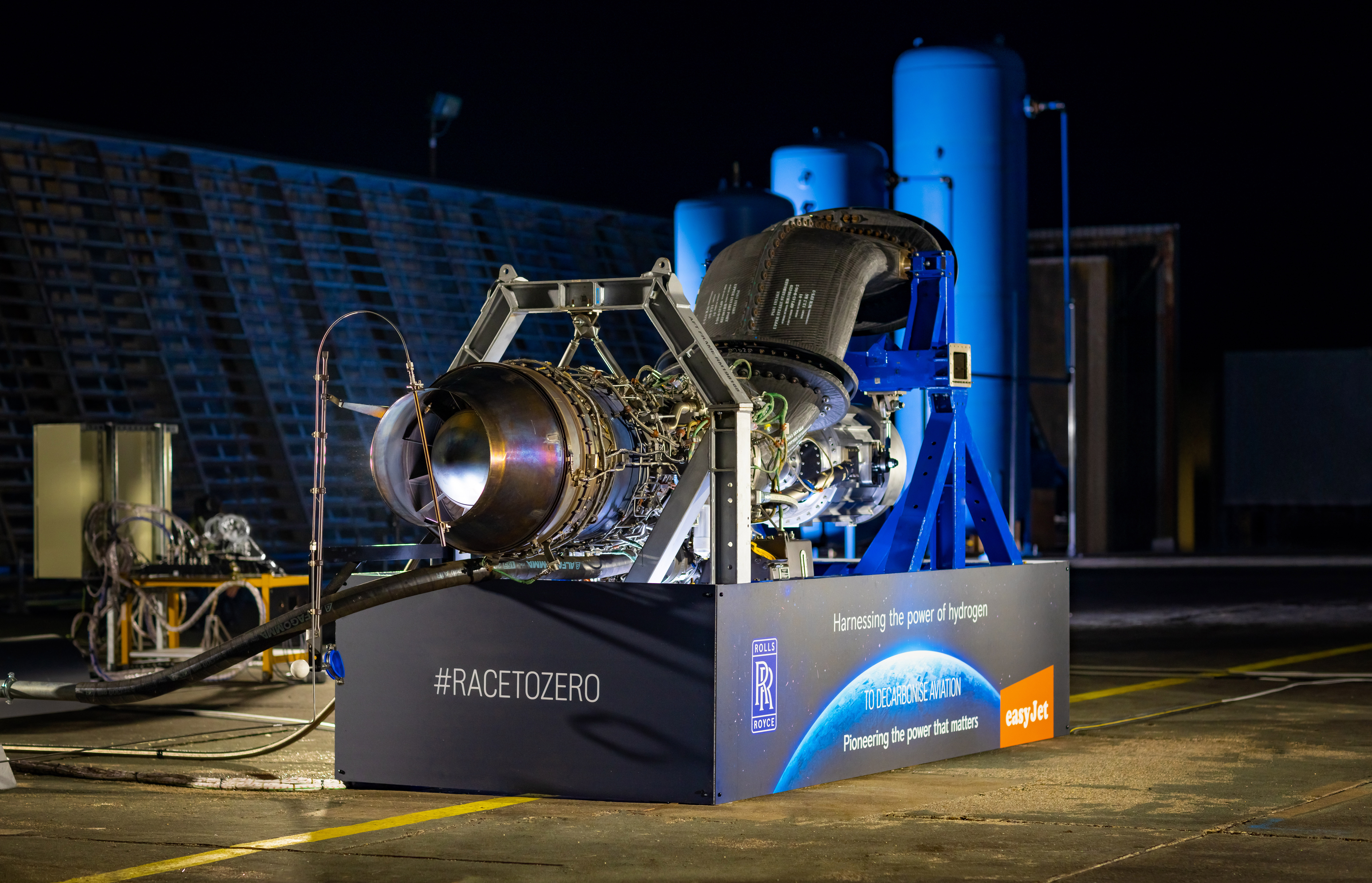
Rolls-Royce AE2100 Hydrogen Demonstrator engine preparing for test at RAF Boscombe Down
Note that the green hydrogen produced using Orcadian winds and tides.
We live in desperate times and I predict that a hydrogen-fuelled and Rolls-Royce-powered easyJet plane, will fly sooner than anybody thinks.
As with athletes, engineers love to be first!
German Startup EVIA AERO Commits To Hydrogen-Powered Britten-Norman Islanders
The title of this post, is the same as that of this article on Simple Flying.
These two paragraphs outline the deal.
EVIA AERO has signed a letter of intent with Cranfield Aerospace Solutions (CAeS) to increase its order for hydrogen modification kits and aircraft. As part of the agreement, the startup airline expects to receive five additional hydrogen modification kits and ten 19-seat aircraft.
The hydrogen modification kits are designed to power the nine-seat Britten-Norman Islander aircraft and come in addition to a previous order with CAeS for 10 kits.
I can remember seeing the Islander prototype at a Farnborough Air Show in the mid-1960s on the BBC with commentary from the iconic Raymond Baxter.
Is Hydrogen The Fuel Of The Future?
The title of this post, is the same as that as this article on Engineering and Technology Magazine.
The article is a must read about hydrogen.
Orders For The Eviation Alice Pass US$ 2 Billion
The title of this post, is the same as that of this press release from Eviation.
This is the first paragraph.
Eviation Aircraft, a manufacturer of all-electric aircraft, today announced that the order book for its world-leading nine-seater all-electric Alice airplane has passed a total value of US$ 2 billion.
$2 billion is a tidy sum and I suspect it ensures that they can now concentrate on its certification program on the way to completing Entry into Service (EIS).
It looks like the day, I will fly in an electric aircraft has come closer.
 The Anonymous Widower