The title of this post, is the same as that of this article in The Times.
These two paragraphs describe this extraordinary flight.
A transatlantic flight propelled by jet-stream winds whipping up Storm Éowyn came close to the subsonic speed record on Wednesday.
British Airways flight 274, an Airbus A350, reached a ground speed of 814mph and shaved 45 minutes off its journey from Las Vegas to Heathrow, according to flight radar records. The record for subsonic speed is 835 mph and the typical cruise speed is about 600 mph.
I feel, we’ll have more and more flights like this, if these air conditions get more common, as the years roll by.
Ignoring the two flights, I had on Concorde, I’ve had several exhilarating flights on commercial airlines.
- At least twice in the last few years, I’ve come over from Schipol to Southend on easyJet and the crew has taken a flight profile that saves fuel. Why not? It’s one way to cut carbon emissions.
- I was also on a British Airways Jumbo into Dulles, where the pilot showed how a 747 could do an economical landing like a small Cessna and get everybody to the terminal in double-quick time.
- There was also the case, when, with the family, I got stuck in St. Lucia and we had an extra night in an excellent hotel, after an engine failure on the flight, that would have taken us back to the UK. The next day’s flight was one of the last 747 400s, with a fifth engine bolted under its armpit and enough crew and equipment to get the stricken plane airworthy again. Twenty-four hours later with two planes on St. Lucia, the decision was made to fly to London, omitting the stop at Barbados, with all seats taken. Our plane was loaded, backed down the runway, so that the captain had maximum length, with its tail hanging out over the ocean. He then cheekily topped up the fuel, so that used in taxiing had been replaced. After, a very noisy full-power take-off, Heathrow was made in one and the the captain made the point of apologizing for the bumpy landing, as the autoland system needed adjusting.
As I indicated in the text good airmanship will be the first action that airlines use to cut emissions.
I have used that myself to save fuel, when I was taking my Cessna 340 to faraway places.
One holiday, C had booked that we’d go to the Almalfi Coast. We would fly to Naples in the Cessna and then hire a car.
- I decided to leave the UK from Southend and because it was a long flight, I would take on the maximum amount of fuel possible. As with British Airways in St. Lucia, I was fully-fueled at the end of the runway.
- As I had a unique British instrument rating called an IMC Rating, I knew that French Air Traffic Control would let me fly at 19,5000 feet( FL 195) through France, which meant I could be at around 180 knots.
- The French should have dropped me down for Italy, but I continued past Corsica, Sardinia and Rome, until I did an instrument approach into Naples.
- That was a distance of 980 miles as a crow would fly.
But by planning it properly and with a little bit of help from French ATC, we managed it safely, fast and very easily.
January 24, 2025
Posted by AnonW |
Transport/Travel | Airbus A350, Amalfi Coast, Aviation, Barbados, Boeing 747, British Airways, Cessna 340, Decarbonisation, EasyJet, Heathrow Airport, Italy, Las Vegas, Schipol Airport, Southend Airport, St. Lucia, Storm Éowyn |
Leave a comment
This press release from Airbus is entitled The ZEROe Demonstrator Has Arrived.
This is the introductory paragraph.
2022 marks a new and exciting phase for ZEROe – Airbus’ ambition to develop the world’s first zero-emission commercial aircraft by 2035. The multi-year demonstrator programme has officially been launched with the objective to test a variety of hydrogen technologies both on the ground and in the air.
The ZEROe demonstrator will be the first Airbus A 380 aircraft and it is shown in this Airbus visualisation.
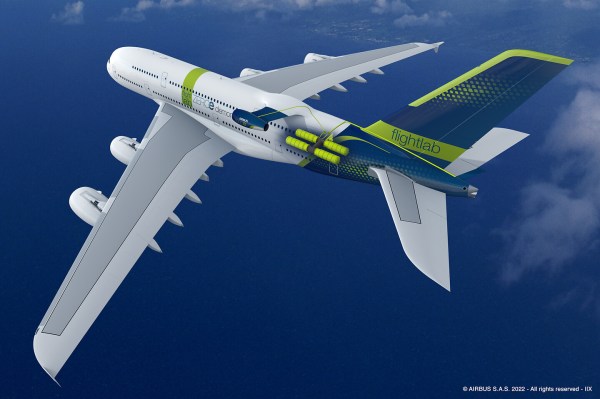
Note.
- The four hydrogen tanks in the fuselage.
- The fifth engine mounted in a pod on the fuselage.
- There’s certainly lots of space inside the fuselage for more hydrogen tanks and test and monitoring equipment.
Take away the fifth engine and the test equipment and this aircraft becomes an A380 with two fuel systems; hydrogen and aviation fuel.
Consider.
- Suppose two engines were hydrogen-capable and two were normal engines running on aviation fuel or Sustainable Aviation Fuel (SAF).
- I don’t think it is impossible to build engines that could run on both hydrogen and Sustainable Aviation Fuel.
- All aircraft use fuel at a higher rate, during take-off and climbing.
- Do long non-stop flights use less fuel, than ones with stops?
- As altitude increases, air resistance decreases.
- Aircraft could fly slower to reduce the fuel needed, as they did in the oil crises in the last century.
- Generally, the most economical way to fly a route, is to climb to maximum altitude, fly level until descending into the destination.
- The aircraft would not carry cargo in the belly-hold.
- There could be a hydrogen-powered APU, as I wrote about in Airbus To Trial In-flight Auxiliary Power Entirely Generated By Hydrogen.
- This document from IATA says that in its liquid form, contains about 2.5 times more energy per kilogram than kerosene.
- The Boeing 747 first flew in 1969 and the Airbus A 380 in 2005, so these aircraft are well known.
I just wonder, if it is possible to work out a flight profile, that would enable these aircraft to fly very long non-stop routes?
- All four engines would be used for take-off.
- An appropriate power setting would be used for the cruise and the descent.
- There would be large numbers of 747s and A 380s in good condition to convert.
- The plane would land with little or no hydrogen left.
The hydrogen used would cut the carbon footprint of the flight.
July 15, 2023
Posted by AnonW |
Hydrogen, Transport/Travel | Airbus A380, Boeing 747, Hydrogen-Powered Aircraft, Sustainable Aviation Fuel |
Leave a comment
The title of this post, is the same as that of this press release from the Aerospace Technology Institute.
This is the first sentence of the press release.
Passengers could one day fly anywhere in the world with no carbon emissions and just one stop on board a concept aircraft unveiled by the Aerospace Technology Institute (ATI) today.
These three paragraphs describe the concept.
Up to 279 passengers could fly between London and San Francisco, USA direct or Auckland, New Zealand with just one stop with the same speed and comfort as today’s aircraft, revolutionising the future of air travel.
Developed by a team of aerospace and aviation experts from across the UK collaborating on the government backed FlyZero project, the concept demonstrates the huge potential of green liquid hydrogen for air travel not just regionally or in short haul flight but for global connectivity. Liquid hydrogen is a lightweight fuel, which has three times the energy of kerosene and sixty times the energy of batteries per kilogramme and emits no CO2 when burned.
Realising a larger, longer range aircraft also allows the concentration of new infrastructure to fewer international airports accelerating the rollout of a global network of zero-carbon emission flights and tackling emissions from long haul flights.
These are my thoughts.
The Airframe
This picture downloaded from the Aerospace Technology Institute web site is a visualisation of their Fly Anywhere Aircraft.
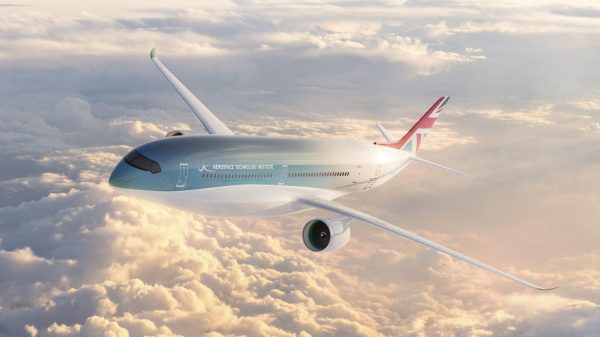
Some features stand out.
The wings are long, narrow and thin, almost like those of a sailplane. High aspect ratio wings like these offer more lift and stability at high altitude, so will the plane fly higher than the 41,000-43,000 feet of an Airbus A350?
I wouldn’t be surprised if it does, as the higher you go, the thinner the air and the less fuel you will burn to maintain speed and altitude.
The horizontal stabiliser is also small as this will reduce drag and better balance with the wing.
The tailfin also appears small for drag reduction.
The body is bloated compared to say an Airbus A 350 or a Boeing 777. Could this be to provide space for the liquid hydrogen, which can’t be stored in the thin wings?
The fuselage also appears to be a lifting body, with the wings blended into the fat body. I suspect that the hydrogen is carried in this part of the fuselage, which would be about the centre of lift of the aeroplane.
The design of the airframe appears to be all about the following.
- Low drag.
- high lift and stability.
- Large internal capacity to hold the liquid hydrogen.
It may just look fat, but it could be as radical as the first Boeing 747 was in 1969.
The Engines
I suspect the engines will be developments of current engines like the Rolls-Royce Trent XWB, which will be modified to run on hydrogen.
If they are modified Trent engines, it will be astonishing to think, that these engines can be traced in an unbroken line to the RB211, which was first run in 1969.
The Flight Controls
Most airliners these days and certainly all those built by Airbus have sophisticated computer control systems and this plane will take them to another level.
The Flight Profile
If you want to fly any aircraft a long distance, you generally climb to a high level fairly quickly and then fly straight and level, before timing the descent so you land at the destination with as small amount of fuel as is safe, to allow a diversion to another airport.
I once flew from Southend to Naples in a Cessna 340.
- I made sure that the tanks were filled to the brim with fuel.
- I climbed to a high altitude as I left Southend Airport.
- For the journey across France I asked for and was given a transit at Flight Level 195 (19,500 feet), which was all legal in France under visual flight rules.
- When the French handed me over to the Italians, legally I should have descended, but the Italians thought I’d been happy across France at FL195, so they didn’t bother to ask me to descend.
- I flew down the West Coast of Italy at the same height, with an airspeed of 185 knots (213 mph)
- I was then vectored into Naples Airport by radar.
I remember the flight of 981 miles took around six hours. That is an average of 163.5 mph.
I would expect the proposed aircraft would fly a similar profile, but the high level cruise would be somewhere above the 41,000-43,000 feet of an Airbus A 350. We must have a lot of data about flying higher as Concorde flew at 60,000 feet and some military aircraft fly at over 80,000 feet.
The press release talks about London to San Francisco, which is a distance of 5368 miles.
This aircraft wouldn’t sell unless it was able to beat current flight time of eleven hours and five minutes on that route.
Ground Handling
When the Boeing 747 started flying in the 1970s, size was a big problem and this aircraft with its long wing may need modifications to runways, taxiways and terminals.
Passenger Capacity
The press release states that the capacity of the aircraft will be 279 passengers, as against the 315 and 369 passengers of the two versions of the A 350.
So will there be more flights carrying less passengers?
Liquid Hydrogen Refuelling
NASA were doing this successfully in the 1960s for Saturn rockets and the Space Shuttle.
Conclusion
This aircraft is feasible.
December 7, 2021
Posted by AnonW |
Hydrogen | Aerodynamics, Aerospace Technology Institute, Airbus A350, Aviation, Boeing 747, Boeing 777, Cessna 340, FlyZero Project, Hydrogen-Powered Aircraft, Liquid Hydrogen |
2 Comments
I ask this question as I have just written a post, which is entitled Grant Shapps Announcement On Friday, where I detail a project called Altalto, which its developers hope will convert waste into aviation biofuel.
But there are other factors at work, that will have effects on passenger flying.
Electric Aircraft
Despite the technological problems electric aircraft, I can see that in a couple of years, an electric plane will be available with the following specification.
- 9-15 passenger capacity
- 100-200 mile range
- Half-hour recharge time
These will improve as technology improves. But then everybody who uses a battery in their product says this.
Lightweight Structures
If you’ve ever looked at a high-performance glider, you’ll see that they are the featherweights of the aviation world and are built mainly from ultra lightweight composites.
Boeing have gone this route with the 787 Dreamliner and the aircraft has been a success.
Unfortunately, Boeing’s accountants have trashed the company, by trying to prolong the life of the obsolete 737 too far, instead of developing a composite replacement.
By the end of this decade all aircraft will be made from lightweight composite structures.
Interstingly, the only all new electric passenger aircraft; the Eviation Alice has a fully-composite airframe.
Lightweight structures will help create lower carbon emissions on traditional aircraft, by reducing fuel burn, but will really help in creating new aircraft types. Some of which will look very unusual.
Better Aerodynamics
Aerodynamics are getting more efficient and this will reduce fuel burn and have two effects on aircraft design.
- They will make existing designs more efficient.
- They will improve the design of electric aircraft designed on a clean sheet of paper.
Expect to see some very weird looking aircraft. Look at Eviation Alice, which could evolve into a twenty seat aircraft with a range exceeding six hundred miles.
Hybrid-Powered Aircraft
I can’t with current technology, see an all-electric aircraft powered by batteries having a range greater than perhaps six hundred miles and a capacity of greater than perhaps 20 passengers. The mathematics and the physics say no!
Some aero engine manufacturers are talking about hybrid power, where a small turbofan engine is paired with a battery and electric motors.
I think it could be a way to extend the range of electric aircraft, without creating significant emissions. Aviation biofuel would fit well with a hybrid aviation powerplant, as it would further remove emissions.
Completely Automatic Flight
The pilot of a modern airliner does very little flying and there is no reason, pilots couldn’t do as little to fly the plane, as a driver on a Victoria Line tube has done since 1967 to drive the train.
When a train is ready to depart, the driver presses a button and the train moves automatically to the next station.
If anything unusual happens, the driver takes control.
Why not with airliners?
Point-To-Point Air Services
In MagniX Electric Aircraft Engines Take To The Skies, I put this quote from magniX, who make the electric motors for electric aircraft.
magniX says 45% of all airline flights cover less than 800 km, while 5% of flights are sub-160 km.
These flights will be the first to go electric.
But they are not really suited for an airport like Heathrow or Gatwick, as each plane needs a separate take-off and landing slot to fit in with conventional flights.
Heathrow want a third runway to increase capacity.
Perhaps it should be for electric flights only!
- Electric aircraft will be low-noise and create no pollution.
- It would have its own terminal.
- Charging facilities would be built into the terminal.
- Taxi distances would be short.
- The runway would only need to be short.
- Passengers would have to arrive and leave by zero-carbon transport.
- There might even be space for two runways; one for landing and one of take-off.
I can see a network of both smaller airports and satellites at major airports developing, that are designed for electric aircraft.
- Some airports, like possibly London City, might convert to all-electric, due to their sensitive locations.
- Other important towns and cities without an airport, might develop new all-electric airports.
- Hubs might develop at convenient locations in the UK, for short trips to the Continent and Ireland. Perhaps a high speed rail-connected Manston Airport would be ideal for electric flights to Belgium, The Netherlands and Northern France.
Frequent point-to-point electric flights could create a zero-carbon short-haul network for flights of up to about six hundred miles.
Rail Journeys Less Than Four Hours
It is accepted by many analysts and rail companies, that if a train takes less than four hours, then it is a viable alternative to flying.
- Could the success of Eurostar’s London and Amsterdam route, be partly down to the that it’s four hours?
- First Group subsidiary; East Coast Trains have stated they will target air passengers, with a sub four-hour, one-class £25 train journey between London and Edinburgh.
- High Speed Two is currently promising three hours and forty minute journeys between London and Edinburgh/Glasgow, when their service starts.
I believe that rail companies all over the world will see tempting air passengers to use rail, as a market to develop.
Zoom And Other Internet Techniques
During the COVID-19 pandemic, businesses, families and others have started using Internet conferencing in a big way.
But will other software develop, that will have the effect of both cutting flying or making it more zero-carbon.
Suppose, I wanted to visit several cities in the United States. Is there an Internet site that tells me how to do it to create the least amount of CO2?
Biofuel For Short Flights
When I laid out the factors, I only mentioned aviation biofuels once.
That was in conjunction with hybrid aircraft, that use both jet and electric power.
If the hybrid technology succeeds, it may mean that flights up to about a thousand miles are possible and this would include a lot of short haul flights around the world. With biofuels and hybrid powerplants, carbon dioxide emissions will be greatly reduced and could probably be managed by carbon offset measures like tree-planting.
Biofuel For Long Flights
As aircraft get more efficient using biofuel will help to reduce the amount of emissions, to a level that could be balanced by carbon offset.
This will be an expensive process for airlines, as probably most fleets will need to be replaced with more fuel efficient planes.
But this is happening, as 757s and A380 are being replaced by Dreamliners and other more fuel efficient types.
Conclusion
By 2035, most short haul flights will be electric or some form of hybrid power, although a lot will be replaced by high speed rail.
Biofuel won’t save long-haul flights, but it will make them economic for the airlines.
I suspect that there will be a lot of aluminium aircraft going for scrap.
June 16, 2020
Posted by AnonW |
Transport/Travel | Altalto, Boeing 747, Boeing 787, Flying, Global Warming/Zero-Carbon, Heathrow Airport, High Speed Rail, Sustainable Aviation Fuel |
2 Comments
The title of this post is the same as that of this article on the BBC.
This is the first two paragraphs.
Australian carrier Qantas has completed a test of the longest non-stop commercial passenger flight as part of research on how the journey could affect pilots, crew and passengers.
The Boeing 787-9 with 49 people on board took 19 hours and 16 minutes to fly from New York to Sydney, a 16,200-km (10,066-mile) route.
The article also says that they will be running a test flight between London and Sydney next month.
I can’t help thinking about a joke I first heard in the 1980s.
The United States Secret Service had got hold of a very long range Boeing 747SP and used to put the suspect in the plane and fly them around the world.
As they fed them standard airline food all the way, the suspect always cracked and they got the information they wanted.
October 20, 2019
Posted by AnonW |
Transport/Travel | Boeing 747, Boeing 787, Flying, New York, Sydney |
3 Comments
 The Anonymous Widower