Innotrans 2024: Rolls-Royce Shows mtu Solutions For On-Track Energy Transition And Celebrates 100 years Of Rail Engine Business
The title of this post, is the same as that of this press release from Rolls-Royce.
These four bullet points, act as sub-headings.
- All mtu engine series for locomotives and railcars approved for sustainable fuels
- DB, RDC Autozug Sylt, Trenitalia and České dráhy use or test HVO
- Rolls-Royce celebrates 100 years of success with mtu rail drives
- More than 250 rail customers worldwide value the performance, compact design and low exhaust emissions of mtu systems
These are the first two paragraphs.
Rolls-Royce will be presenting its mtu-brand propulsion and service solutions at the international rail exhibition Innotrans in Berlin from September 24 to 27, 2024 in Hall 18, Booth 500. The company will be celebrating an anniversary at the same time: for 100 years, mtu products have been powering trains, including mainline and multi-purpose locomotives, high-speed trains and local transport railcars. On display will be sustainable propulsion solutions such as the mtu Series 4000 and 1600 engines for locomotives and the underfloor drive systems mtu PowerPacks for railcars, all of which are now released for sustainable fuels such as HVO. Rolls-Royce will also be presenting its repower and reman solutions.
100 years ago, Karl Maybach laid the foundation for the rail drive systems of today’s mtu brand with the world’s first high-speed diesel engine for railcars, the Maybach G 4a. Maybach also developed the GO 5 engine for the “Fliegender Hamburger” express train.
These are my thoughts.
Chiltern Railways Could Go Carbon-Neutral By Using HVO
In Vegetable Oil Fuelling Chiltern Railways Trains In UK First, I described how Chiltern Railways are running their Class 68 locomotives on HVO.
This move by Rolls-Royce mtu will allow all Chiltern’s Class 168 trains to be run on sustainable HVO, as they have Rolls-Royce mtu diesel engines.
Chiltern Railways Class 168 train fleet is as follows.
- 10 x 4-car
- 9 x 3-car
- 9 x 2-car
This will still leave Chiltern Railways Class 165 train fleet to be converted to sustainable fuel.
- 28 x 2-car
- 11 x 3-car
Note.
- There are 75 of these trains in service with Chiltern Railways and Great Western Railway.
- They are fitted with Perkins engines.
- Perkins engines are now owned by Caterpillar, who built the engines for the Class 68 locomotives.
As Caterpillar have the sustainable diesel technology, could they convert the Class 165 trains to HVO?
Cummins And HVO
Although this post is mainly about Rolls-Royce mtu, it would be convenient to put in this section about Cummins and how their diesel engines run on HVO.
The UK train fleet contains the following trains with Cummins engines.
- 10 x Class 175 train x 2-car
- 16 x Class 175 trains x 3-car
- 14 x Class 180 trains x 5-car
- 34 x Class 220 trains x 4-car
- 23 x Class 221 trains x 5-car
- 4 x Class 221 trains x 4-car
- 4 x Class 222 trains x 7-car
- 23 x Class 222 trains x 5-car
Cummins says this about their engines and HVO.
Cummins approves use of HVO fuel in all high-horsepower engines
(19L-95L), including the QSK19, K19, QSK23, QST30, QSK38, K38, QSK45,
QSK50, K50, QSK60, QSK78, QSK95, V903 and ACE for all industrial
markets. No engine modifications are required; engines currently in the
field can be used with HVO at any percentage.
It would appear that all trains with Cummins engines can be converted to run on HVO.
CAF And HVO
Class 195, 196 and 197 trains all have Rolls-Royce mtu diesel engines, so they will be able to run on HVO.
Hitachi And HVO
Class 800, 1801, 802, 805 and 810 trains all have Rolls-Royce mtu diesel engines, so they will be able to run on HVO.
Conclusion
If all diesel engines are to be converted to HVO, there is going to be a lot of HVO needed in the UK.
But many train fleets will be carbon-neutral.
A Chiltern Class 68 Locomotive At Marylebone Station
As I was passing through Marylebone station, I took these pictures of a very clean Class 68 locomotive.

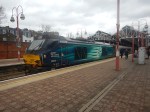
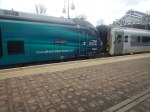

If I’m going to Birmingham, I generally use Chiltern, as often you get to travel in one of these well-restored Mark 3 coaches hauled by a Class 68 locomotive.
With the Mark 3 coach, you get a full size table and a large window to enjoy the countryside.
- The Class 68 locomotives were all built by Stadler in Spain, within the last ten years.
- The UK has a fleet of 34 Class 68 locomotives.
- They are powered by a Caterpillar diesel engine.
- The only problem with the trains is that the Class 68 locomotives are diesel.
But is Caterpillar working on a simple solution?
Search the Internet for “Caterpillar Hydrogen” and you find press releases and other items, like this press release, which is entitled Caterpillar to Expand Hydrogen-Powered Solutions to Customers.
I wouldn’t be surprised to find out, that Stadler and Caterpillar were working on a program to provide a solution to convert Class 68 locomotives to hydrogen.
Caterpillar To Launch Demonstration Project Using Hydrogen Fuel Cell Technology For Backup Power At Microsoft Data Center
The title of this post, is the same as that of this press release on the Caterpillar web site.
This is the first two paragraphs.
Caterpillar Inc. today announced a three-year project through a collaboration with Microsoft and Ballard Power Systems to demonstrate a power system incorporating large-format hydrogen fuel cells to produce reliable and sustainable backup power for Microsoft data centers. The project is supported and partially funded by the U.S. Department of Energy (DOE) under the H2@Scale initiative and backed by the National Renewable Energy Lab (NREL).
“At Caterpillar, we focus on supporting our customers with reliable, resilient and economical power solutions while achieving their climate-related goals,” said Jason Kaiser, vice president for Caterpillar’s Electric Power Division. “This hydrogen fuel cell demonstration project enables us to collaborate with industry leaders to take a large step toward commercially viable power solutions that also support our customers in making their operations more sustainable.”
It certainly looks like Caterpillar are turning to the use of hydrogen to keep their existing markets.
This press release explains the cooperation in a paragraph.
Caterpillar experts in advanced power technologies, controls and system integration are working alongside Microsoft experts in data center design and Ballard experts in fuel cell design to demonstrate a 1.5 MW backup power delivery and control system that would meet or exceed the expectations set by current diesel engine systems.
Elsewhere the press release says that Caterpillar aims to be carbon negative by 2030.
Conclusion
We will see lots of systems like this providing reliable and sustainable power systems for entities like airports, city centres, data centres, hospitals, ports, shopping malls and other large users of electricity.
Caterpillar To Offer Power Solutions Generator Operating On 100% Hydrogen To Customers In 2021
The title of this post is the same as that, of this article on Hydrogen Central.
The title says most of it, although engines will soon be offered that can run on natural gas with up to ten percent of hydrogen added.
The last part of the article described various projects being undertaken by Caterpillar with hydrogen.
It looks like Caterpillar are taking the route chosen by Cummins and JCB to embrace hydrogen, rather than fight it.
Caterpillar, Cummins Move On Hydrogen For Trains
The title of this post, is the same as that of this article on Construction Equipment.
This is the first paragraph.
Caterpillar and Cummins are working separately to put hydrogen to work in locomotives.
They have a lot to lose with the extinction of their diesel businesses, so why not join the party.
This Company May Have Solved One Of The Hardest Problems In Clean Energy
The title of this post is the same as that of this article on Vox.
I found the article about an American company called Hytech Power, very interesting.
The company has developed technology called Internal Combustion Assistance (ICA), that improves the fuel consumption and emissions performance of diesel engines, by injecting small amounts of hydrogen and oxygen into the cylinders at the right time.
This is a paragraph from the article, which gives the performance improvements.
HyTech’s offer to that market is pretty remarkable: it claims that its ICA can improve the fuel efficiency of a diesel engine between 20 and 30 percent, reduce particulate matter by 85 percent, and reduce NOx by between 50 and 90 percent. In concert with a DPF and some SCR, it can yield a diesel engine that meets official California standards for an “ultra-low emissions” vehicle.
Note.
- A DPF is a diesel particulate filter.
- SCR is selective catalytic reduction fluids.
Both are expensive!
This paragraph from the article gives some customer feedback.
The ICA has been listed by the EPA as a candidate for emissions-reduction technology; respected testing firm SGS found that the ICA boosted the fuel efficiency of a FedEx delivery truck by 27.4 percent; FedEx is currently road testing the ICA on a fleet of trucks and finding 20 to 30 percent better fuel economy and substantially reduced DPF maintenance costs. In third-party testing, and in limited local sales around Redmond, the ICA has performed as promised.
It never hurt a company to have FedEx on their side! Later on, the article says that Caterpillar are on board and their engines, generators and equipment features heavily on the Hytech Power web site.
If you look at the Wikipedia entry for Hydrogen Fuel Enhancement, you read a lot of sceptical words about this technology.
I would suggest that you read the Vox article, Hytech Power’s web site and the Wikipedia entry in detail before making your mind up.
My decision has been to file Hytech Power in a box, called Must Watch and set up a Google Alert.
For three of the last ten companies, I did that for, I made an investment in the shares. None are trading badly!
Trains Are The New Age Planes
The title of this post, is the same as that of this article on Seeking Alpha.
It is an article well worth a read about the future development of railways in the United States.
 The Anonymous Widower