The Four-Car Bi-Mode Train
The Class 319 Flex train is an affordable four-car bi-mode or electro-diesel train, promoted by Porterbrook and to be used by Northern.
- The train is affordable, as it is based on a refurbished Class 319 train, which was built thirty years ago.
- The train is a dual-voltage unit and can be powered by either 25 KVAC overhead or 750 VDC third-rail electrification.
- Each unit also has two rail-proven MAN diesel engines, for powering the train on lines without electrification.
If there is a drawback, it is that with their interiors so far, Northern have opted for a no-frills interior with no wi-fi.
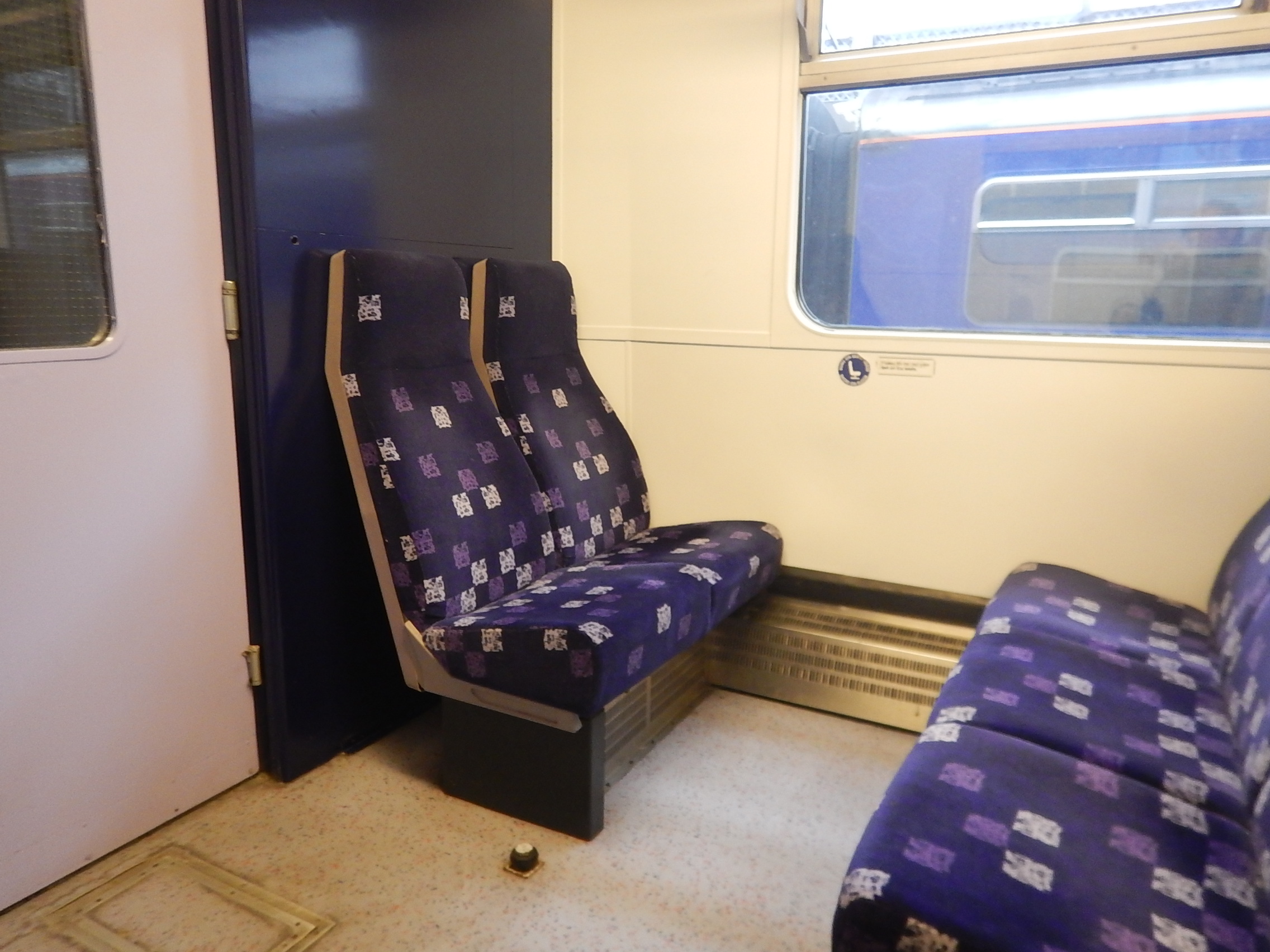
Compare this with the interior of a Class 455 train.
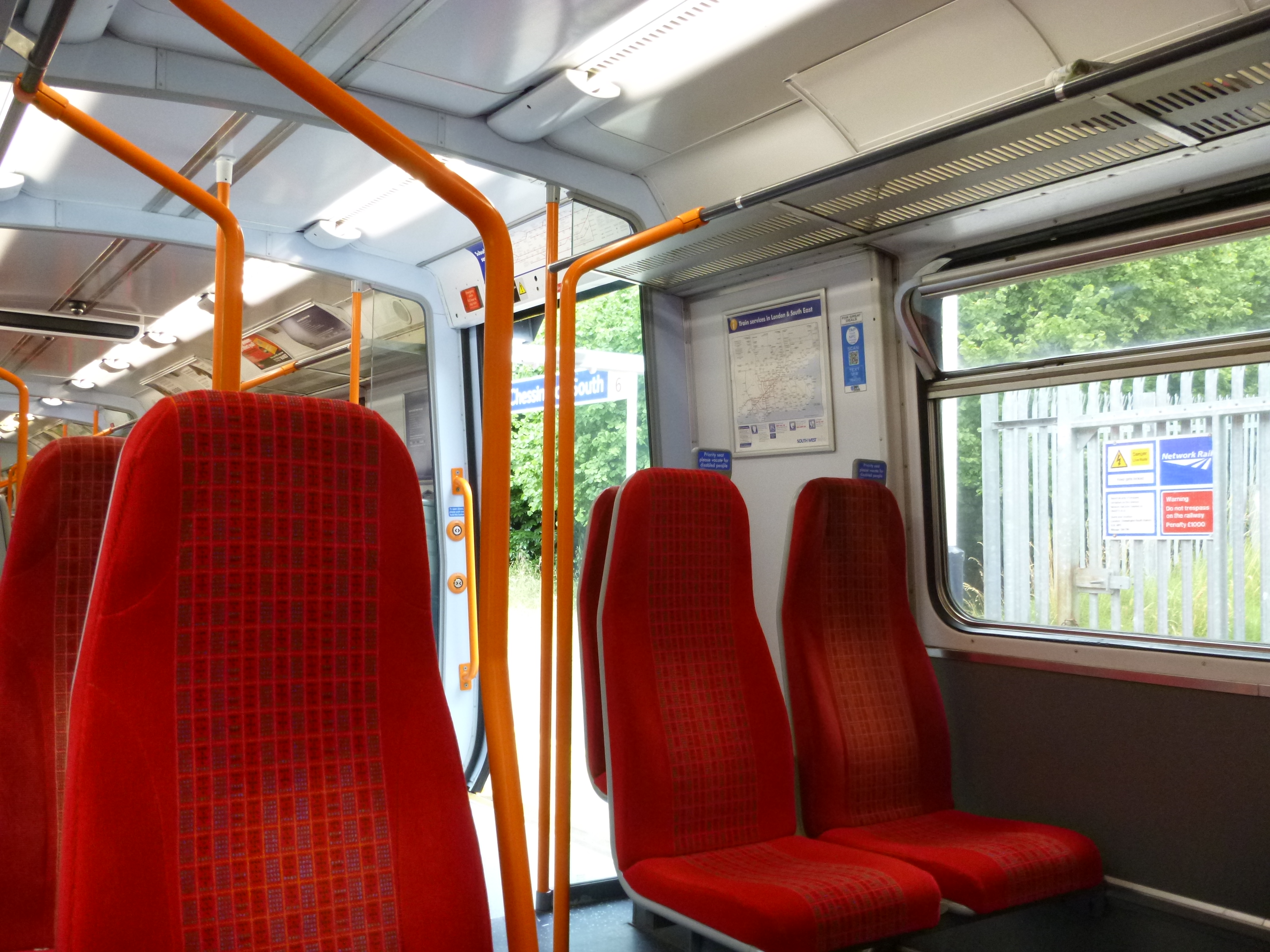
The trains were originally built within a couple of years, but the updated interior specified by South West Trains is much more impressive and passenger-friendly than that used by Northern.
Both trains are four-car units and are based on the Mark 3 coach, so underneath the skin, they probably have a lot in common.
There are a large number of four-car trains on UK railways so it must be a train length that is convenient for operators.
But strangely until now there has not been a four-car bi-mode train.
But then bi-mode trains are not that common, with the only UK train of that type; the Class 800 train, yet to enter service.
But the Class 800 train is for the long distance market and is a five-car or nine-car 125 mph train.
I do wonder, if the reason we have no four-car bi-mode trains, is that no-one has bothered to design one so no-one has wanted one.
But Porterbrook own 86 of these Class 319 trains, which are reliable 100 mph trains, that drivers tell me they like, because of their performance and excellent brakes.
Because of their age, they’re probably not worth a great deal more than scrap value, but because of the depth of knowledge of what can be done with Mark 3 coaches, they can be turned into a useful train by quality engineering.
Porterbrook have seen a gap in the market with Northern for a train specifically designed to be able to handle their toughest route, which is Manchester Piccadilly to Buxtonup the very steep Buxton Line. But the train is no one-trick pony and can run on virtually any of Northern’s routes, whether they are electrified or not.
So Northern can use the train for a variety of purposes.
- Running services on routes, that are not fully electrified.
- New route development.
- Extension of existing electrified routes.
- Replacement of a failed unit, which could be electric or diesel
Northern will have two versions of the Class 319 train; electric and bi-mode, just like other train operating companies will have electric and bi-mode versions of the Class 800 train.
I suspect that to passengers and all train staff except the driver, there will not be many obvious differences between the two versions.
Some routes will probably be able to be served by both versions.
The Bombardier Aventra
I feel very much that the Aventra will have one or more independently-powered versions.
The Aventra has a slightly unusual and innovative electrical layout.
This article in Global Rail News from 2011, which is entitled Bombardier’s AVENTRA – A new era in train performance, gives some details of the Aventra’s electrical systems. This is said.
AVENTRA can run on both 25kV AC and 750V DC power – the high-efficiency transformers being another area where a heavier component was chosen because, in the long term, it’s cheaper to run. Pairs of cars will run off a common power bus with a converter on one car powering both. The other car can be fitted with power storage devices such as super-capacitors or Lithium-Iron batteries if required.
This was published six years ago, so I suspect Bombardier have improved the concept.
Perhaps instead of a power storage device, they could squeeze in a small diesel engine and an alternator.
I’ve believed for a long time, that the Class 710 train being built by Bombardier for the London Overground, has onboard energy storage and that I wouldn’t be surprised if it used the storage to capture energy from regenerative braking, just as a lot of hybrid vehicles, like a London Routemaster and a Toyota Prius.
It won’t be a high-power bi-mode like the Class 319 Flex train, but it could have a useful range on the stored energy.
But it will be an all-electric train and probably more energy-efficient.
Other Four-Car Bi-Modes
I can’t believe that other train manufacturers are not looking at various forms of bi-mode trains.
Hitachi make the Class 800 trains at Newton Aycliffe, where they also make the four-car Class 385 train for ScotRail.
And what about Alstom, CAF, Siemens and Stadler?
What About Five Cars?
Four-car trains mean that operators can run eight and twelve car trains, when they are convenient. But other companies prefer five-car and ten-car trains.
We have the Class 800 trains, which are a 125 mph bi-mode, but we don’t have a five-car bi-mode suburban trundler. A few would surely be useful for Southern to handle Uckfield and the Marshlink Line.
I also believe that Greater Anglia’s five-car Aventras could have the limited independent capacity given by onboard energy storage.
I suspect that what the train operators need, the train operators will get!
Conclusion
We will see a complete spectrum of bi-mode four-car trains. And a few fuve-cars too!
, o
Bi-Mode Ate My Electrification
The title of this post, is the headline on an article by Roger Ford in the January 2017 Edition of Modern Railways.
The article describes how electrification of the rail line between Selby and Hull has been dropped and quotes Chris Grayling as implying that it’s all because the train companies have bought Class 802 trains, which are bi-mode, and won’t need electrification between Selby and Hull.
Both train companies; Hull Trains and TransPennine Express need to run high-class services with modern fast trains to Hull.
I will look at Hull Trains need in more detail.
Much of the route used by Hull Trains is along the electrified East Coast Main Line, so a 140 mph capability could be needed in the next few years, as speeds increase on that line.
If the Selby-Hull line were to be electrified, Hull Trains could run electric trains like Class 801 trains, InterCity 225s, or perhaps a version of the Stadler Flirt, that Greater Anglia will be running.
Hull Trains obviously need to increase quality and capacity on the route and it appears that the only train available is the bi-mode Class 802 train.
The only certain way Hull Trains could get new trains in a reasonable time, given that electrification is continually being kicked into the long grass, is the bi-mode route.
Purists might not like the bi-mode train, but at least it will enable Hull to have a quality high-speed train service.
The Problems With Electrification
Electrification is needed, so that trains can run fast and efficiently, without the noise, pollution and carbon-emissions of diesel power.
But.
- Electrification in the UK, is like trying to make a Victorian house fit for a modern lifestyle and it is even more expensive.
- Electrification gantries and wires, ruin landscapes.
- Much of our railway infrastructure,like stations, bridges and viaducts are beautiful structures in their own right and perhaps electrification will not be for some of them.
As we get further into the future, I think that there will be more reasons why existing lines will not be electrified.
We’re All In It Together
Several countries have a substantial proportion of lines without electrification, of which Germany, India and, the UK and the US are the most notable examples.
So ideas will be developed in these and other countries, that could be replicated in other countries with a pressing need for electrification.
The Problem Is An Opportunity For The Train Builders
Consider.
- Hitachi have developed their Class 800 family of trains to include bi-modes.
- Bombardier are developing trains with onboard electric storage and have a philosophy for all markets that I wrote iabout in Parallel Thinking From Bombardier.
- Stadler have a Pandora’s box for of ideas and technologies.
- CAF are supplying trams with onboard energy storage.
I can’t believe that Alstom, Siemens and other fFar Eastern manufacturers are not looking at using self-powered trains to cut down on electrification.
It is also worth noting that others are developing technologies, that will assist train builders in providing the trains that train companies and their passengers desire.
- Tessla and other companies are developing batteries with a higher storage density.
- Automatic pantograph up and down is being developed, so trains can use overhead power, where it exists.
- Automatic coupling and uncoupling will be developed.
- Trains will be driven automatically, so minimum power is used.
The train of the future will be powered and braked by electricity, and highly automated. It could be driven automatically, but I suspect like the Victoria Line or your average commercial airliner, the driver will be in overall control and monitoring everything.
Why Trains Need An Energy Storage Capability?
If an electric train has an onboard energy storage capability, it has various advantages.
- It can store the energy generated from regenerative braking and release it to help get the train back up to speed.
- On board energy storage can be used with both electric and diesel-electric trains.
- Depots can be designed with less electrification for safety and to save money.
- Trains can be given a remote wake-up capability as I discussed in Do Bombardier Aventras Have Remote Wake-Up?, so a train parked in a siding can be warmed up ready for the driver at the start of the day.
- Trains can recover to the next station using stored power, if electrification power fails.
- Trains can take diversions without electrification if needed.
- Depending on the size of the storage, trains could provide a service over a limited distance on stored power alone.
Hybrid cars and buses, which have onboard energy storage, might suggest even more reasons.
Energy Storage Can Only Get Better
Over the last few decades the energy capable of being stored in a device of a fixed physical size and weight has increased dramatically.
This process can only increase, so onboard energy storage will become more and more viable.
What Is The Kinetic Energy Of A Train?
I ask this question to show the energy values involved.
If I take a nine-car Class 345 train, which will be used on Crossrail, this has a mass of less than 350 tonnes and a maximum speed of 145 kph.
1500 passengers at 80 kg each works out at another 120 tonnes.
So for this crude estimate I’ll use 450 tonnes for the mass of a loaded train.
This gives the train an energy of 365 megajoules or 101 kilowatt-hours.
This amount of energy is only a couple of kWh larger than the largest battery size of a Tessla Model S car.
Can Regenerative Braking Be Handled By Onboard Energy Storage On A Train?
As an example, look at the Stadler Flirts and Bombardier Aventras, that will be running between London Liverpool Street and Cambridge, Colchester, Ipswich, Norwich, Southend and Stansted Airport.
- These are fully-electrified lines.
- The ability to stop and restart quickly is needed as these are very busy lines, with another 110 mph train along in a couple of minutes.
- All the passenger trains on the lines will have regenerative braking.
The electricity generated by braking can either be returned to the overhead wires using an inverter to get the voltages right or stored on the train in an onboard energy storage device.
Both methods are possible with good electrical engineering and there is probably no weight or installation advantage with either technology.
I don’t know what Stadler are doing, but this article in Global Rail News from 2011, which is entitled Bombardier’s AVENTRA – A new era in train performance, gives some details of the Aventra’s electrical systems. This is said.
AVENTRA can run on both 25kV AC and 750V DC power – the high-efficiency transformers being another area where a heavier component was chosen because, in the long term, it’s cheaper to run. Pairs of cars will run off a common power bus with a converter on one car powering both. The other car can be fitted with power storage devices such as super-capacitors or Lithium-Iron batteries if required.
As this was published five years ago, I can’t believe that an innovative company like Stadler have not been thinking about onboard electrical storage.
As I showed in the previous section, the kinetic energy of a Crossrail Class 345 train is around 101 kiowatt-hours.
So it is not beyond the bounds of possibility that a couple of Tessla batteries could handle the regenerative braking for a fully-loaded Crossrail train!
The same would apply to all of the trains in East Anglia, which would probably have a bit more kinetic energy.
It can obviously be done on an Aventra, so I feel that the Flirts will do it as well.
If all the trains on the routes handled their own regenerative braking, this could mean that there would be no need for the power supply to the overhead wires to be able to handle it. Whether that would save money, I don’t know!
Can the same technology be applied to a locomotive-hauled train, like a Class 68 locomotive pulling a rake of five Mark 3 coaches at 160 kph?
The kinetic energy is slightly less than that of the Crossrail train, so it might be feasible to put onboard energy storage in the diesel-electric locomotive to reuse braking energy.
Onboard energy storage for regenerative braking will become universal on all electric or diesel-electric trains.
In March 2016, I wrote Will London Overground Fit On-board Energy Storage To Class 378 Trains?, which was based on this article in Rail Technology Magazine entitled Bombardier enters key analysis phase of IPEMU. In the article, Marc Phillips of Bombardier is quoted as saying this.
All Electrostars to some degree can be retrofitted with batteries. We are talking the newer generation EMU as well as the older generation. So, the 387s and 378s are the ones where we have re-gen braking where we can top-up the batteries and use the braking energy to charge the batteries. That gives us the best cost-benefit over operational life.
So it would seem that the Class 378 trains of the London Overground are candidates for fitting with batteries. This would give the following advantages.
- Electricity savings.
- Recovery to the next station if the electricity supply fails.
- Simplified depot layouts with less electrification.
As nearly all lines are electrified in London, the ability to travel on short routes without electrification wouldn’t be needed.
On the other hand, new services might need a new branch line or a chord between two electrified lines, which if worked with trains with onboard energy storage, would not need to be electrified.
In Don’t Mention Electrification!, I noted that in all the documents for the extension of the Gospel Oak to Barking Line to Barking Riverside, there is no mention of electrification, although electric trains are stated to be working the route.
So could this be the first newly-built line in the UK to be worked by electric trains powered by onboard energy storage?
How Far Will Trains Go On Onboard Energy Storage?
This is very much a case of answering these and other questions.
- How much range do you want?
- Does the route have lots of stops?
- Is the route hilly?
- How much space there is on the train?
In the end, the most important question is can you afford it?
Could We See A Tri-Mode Train?
A tri-mode train would be one that could use the following power sources.
- Electric power from either 25 KVAC overhead or 750 VDC third-rail.
- Diesel power.
- Onboard energy storage.
It could even pick up 750 VDC from a tramway, if it was running as a train-tram.
Consider.
- If you look at an Hitachi Class 800 train, I suspect that the engineers could find space somewhere for onboard energy storage.
- The Aventra double-power-car concept, has probably been designed with a diesel version in mind.
- A hydrogen fuel-cell would be an alternative to diesel.
- The power control system would just switch between power sources automatically.
It’s all down to good engineering design and innovation.
I suspect, that a tri-mode train will be launched in the next few years.
Conclusions
I believe there is a lot of scope to cut the amount of electrification that is done, by using alternative technologies.
The bi-mode is in pole position, but with the advance of battery and other technologies, the current lead will not last long.
What Next For Class 385 Trains?
Scotrail have ordered a fleet of Class 385 trains, which will be built by Hitachi at Newton Aycliffe in the North-East of England.
If you look at Scotrail’s network, there are a lot of lines, where new trains will be needed in the next decade.
Most of these lines are not electrified, so will the Class 385 train, be available in a version say, that would handle lines like the Borders Railway?
Electrifying all lines will be costly and the Heritage Taliban, may object to overhead gantries marching all over Scotland.
Class 800 And Class 801 Trains
The Class 800 trains are electro-diesel trains with a range depending on the size of the fuel tanks, whereas the Class 801 trains are the pure electric version.
Like the Class 385 trains, they are members of Hitachi’s A-Train family, so I suspect that if asked to supply a bi-mode Class 385 train, that Hitachi know the route to create such a train.
Trains With Batteries
I have written two posts about the Japanese using batteries in electric trains.
- Japanese Trains With Batteries describes how some Tokyo Metro trains have batteries to get them to the next station, in an emergency situation.
- Battery Trains In Japan describes how battery trains are to be used on the OGA Line.
The Japanese technology, doesn’t seem as comprehensive as that I wrote about in Bombardier’s Plug-and-Play Train, but I’m sure that Hitachi must be thinking about trains with batteries,
Conclusion
I am inevitably drawn to the conclusion, that Hitachi will come up with a train, that can run say between Edinburgh and Aberdeen, substantially under its own power, aided by overhead electrification where it exists.
Seamless Interchangeability
At several places on the UK rail network, two trains running as a pair will split, with one train going to one destination and another going to another.
I wrote about trains splitting and joining in Trains Uncoupling and Coupling at Cambridge.
In the past, UK railways used to use the concept of slip coaches, so that coaches could be dropped from an express without stopping. But the last time it was used in the UK was in September 1960 at Bicester North station.
I have just read this article on the Rail Engineer web site, which is entitled Seamless Interchangeability.
The article talks about a concept of dynamic coupling, where trains are automatically coupled and uncoupled at line speed.
It also talks about the issues this would raise.
As a Control Engineer, I’m fairly certain, that it would be very easy to create a system, where say an eight-car Kings Lynn train could split just before Cambridge station, with the front four-car train going to Kings Lynn and the other four-car train stopping in Cambridge station.
It could either be done using two drivers or by driver-less trains. Although the unions would have a lot to say about the latter.
I also believe that if the trains could uncouple, then coupling at line speed would also be possible.
So what is the point?
An Example From The Brighton Main Line
To make full use of the capacity available, Southern serve Littlehampton and Ore, with a train that divides at Haywards Heath. It is a well-proven technique that has been used for decades.
Automatically splitting the two trains at line-speed, can give journey time advantages.
Take the 19:47 from Victoria, which arrives at Haywards Heath at 20:30 as an example.
The following is taken from the timetable.
- The front portion to Ore leaves at 20:34.
- The rear portion to Littlehampton leaves at 20:36.
- Stops at East Croydon and Gatwick Airport take about a minute.
This leads to the following, if the two trains split immediately after stopping at Haywards Heath and before the trains take different directions after Keymer Junction where the East Coastway Line divides from the Brighton Main Line, a few miles South.
- The Ore train performs a one-minute stop instead of one of four minutes, thus saving three minutes.
- The Littlehampton train performs a one-minute stop instead of one of six minutes, thus saving five minutes.
- The platform at Haywards Heath is only occupied for a minute, as opposed to six.
- The Littlehampton and Ore portions must be capable of providing enough capacity for their route.
For those worried about driver-less trains, the driver of the second train for Littlehampton, would probably step up at the previous stop at Gatwick Airport or at Haywards Heath.
But the outcome would be a small increase in capacity on the line, due to the platform at Haywards Heath being occupied for five minutes less.
Coming North, take the 09:47 from Littlehampton as an example.
The following is taken from the timetable.
- The first train arrives at Haywards Heath at 10:35 and leaves at 10:45.
- The second train arrives at Haywards Heath at 10:41.
The pattern of the trains would be different.
- Whatever was the front portion of the train would go through Keymer Junction first
- The train forming the rear portion would be the next train through the junction.
- The rear portion could catch the front portion and the two trains would be automatically coupled together before Haywards Heath.
- The joined train would stop at Haywards Heath for a minute.
- The driver of the second train could step-down at Gatwick Airport or Haywards Heath.
In some ways the mathematics involved in the coupling, are not unlike those for a fighter jet connecting with a tanker aircraft. Except that speeds are a lot lower and there is no need to control direction only closing speed.
Haywards Heath station would be occupied for up to nine minutes less, thus creating capacity.
This simplistic analysis, shows how automatically coupling and uncoupling trains at line speed can create capacity and decrease journey times.
- Journey time from Victoria to Ore would be reduced by three minutes.
- Journey time from Victoria to Littlehampton would be reduced by five minutes.
- In the Down direction the platform at Haywards Heath station would be occupied for just one minute instead of six.
- Journey time from Littlehampton to Victoria would be reduced by nine minutes.
- Journey time from Ore to Victoria would be reduced by three minutes.
- In the Up direction the platform at Haywards Heath station would be occupied for just one minute instead of ten.
Obviously strategies would have to be developed for various eventualities including.
- Unsuccessful coupling or uncoupling.
- Late trains.
- Signalling and train failures.
- Leaves on the line.
- Extreme weather.
But as during all coupling and uncoupling operations, both trains would have a driver in the cab, keeping an expert eye over the procedure and each train could be driven independently, I think all safety issues could be overcome, to the satisfaction of all parties.
If you read the full article, you’ll see that there are some much more exciting possibilities, than the simple ones I have outlined here.
But I do believe that line speed uncoupling and coupling of trains with a driver in the cab of both trains involved, can be a very powerful tool in creating capacity on the UK’s railways.
The Great Eastern Main Line
I know the Great Eastern Main Line well and several trains are coupled and uncoupled regularly on this line.
As Greater Anglia has ordered new five-car Aventra trains and nearly all platforms can take 12 -car trains, running these trains in pairs and coupling and uncoupling appropriately, is probably in their plans for the line.
As on the Brighton Main Line, could coupling and uncoupling at line speed, unlock capacity on the line?
A few weeks ago, I caught a train from Chelmsford to Manningtree, that divided at Colchester, with the front four-car train going to Clacton and the rear four-car train going to Harwich.
The 16:44 from Liverpool street is a train that divides at Colchester, when it arrives at 17:40. These timinings are from the timetable.
- The Clacton portion of the train leaves at 16:44.
- The Harwich portion of the train leaves at 16:47.
As the Sunshine Coast Line for Clacton leaves the Great Eastern Main Line immediately after Colchester station, it would appear that the two trains must uncouple during the stop at Colchester.
Surely, an improved and well-designed automatic uncoupling system could separate the trains faster, saving minutes on both services.
Towards London, two trains leave Harwich and Clacton at 07:16. The timetable shows.
- The Harwich train arrives at Colchester at 07:47 and leaves at 07:54.
- The Clacton train arrives at Colchester at 07:50 and leaves at 07:54.
Surely, an improved coupling system, could join the trains faster, saving minutes on both services.
The time savings will not be as great as those at Haywards Heath, but automatic coupling and uncoupling must be a worthwhile feature of the new trains.
|As Bombardier are adding automation to the Aventra, could they be adding the ability to automatically couple and uncouple trains, both in the station and at line speed?
The West Coast Main Line
I have seen Class 221 Trains, join at Crewe, but I don’t think this is done any more.
However, with the need for direct services from London to places like Blackpool, Burnley and Huddersfield, the ability to be to couple and uncouple trains quickly must be something that would be useful to make optimal use of the valuable train paths on the line.
The East Coast Main Line, Midland Main Line, Great Western Main Line And South West Main Line
If the West Coast Main Line could benefit, then surely these lines could as well.
Class 800/801 Trains
The Class 395 train is very much related to the Class 800 and Class 801 trains, that are being built by Hitachi for the East Coast Main Line, Great Western Railway and other routes.
In The Impressive Coupling And Uncoupling Of Class 395 Trains, I talked about the design of the coupling system for the Class 395 trains.
I would be very surprised if this feature was not incorporated in the Class 800 and Class 801 trains.
So will we be seeing two five-car Class 800/801 trains dividing and joining at a convenient station and then running as a ten-car train to and from London?
Class 385 Trains
What about the Class 385 trains for Scotland?
- These are another version of Hitachi’s A-Train, like 395s, 800s and 801s.
- These will come in two lengths; three-car and four-car.
- Edinburgh-Glasgow services will need at least two units to be coupled together.
- The trains are being introduced from Autumn next year.
It seems to me, that Scotrail are acquiring a very flexible fleet that can run in various lengths.
Will they have the ability of the 395s to couple and uncouple in under a minute?
And if they do, will Scotrail use this ability to adjust train formation to the traffic?
Aventras
There are three definite orders for Bombardier’s new Aventra train at the present time.
- Class 345 trains for Crossrail.
- Class 710 trains for London Overground.
- Five and ten car units for Greater Anglia.
All trains are fixed formations in a mixture of lengths.
Will Aventras have similar coupling and uncoupling performance to Hitachi’s Class 395 trains?
I suspect normally, the Crossrail trains will never be coupled together, as where are platforms for a four-hundred metre long train?
But suppose a train fails in the central tunnel, will the quickest way to remove it, be to attach it to another train and drag it out?
The routes where the London Overground trains will run, are currently served by a mixture of four-car and eight-car trains. So will London Overground, adjust train length to the known traffic patterns?
Greater Anglia do couple and uncouple trains at present to serve Harwich. So I suspect, we’ll see use of an automatic and fast coupling and uncoupling feature to create a more efficient timetable.
Cross City Lines
There are several cross-city lines in the UK.
- Cross-City Line – Birmingham
- Crossrail
- North Berwick Line – Edinburgh
- Northern Line – Merseyrail
- Snow Hill Lines – Birmingham
- Thameslink
One of the characteristics of cross-city lines, is they are busiest in the centre of the city, where passengers tend to use the trains for short hops , as well as longer distances. Then in the suburbs, outside of Peak hours the trains could run almost empty.
Crossrail’s trains are designed so that hopefully they could cope with the variable traffic, but would it be possible to have half trains, which join and split at outer stations.
Thameslink
I think that Thameslink could be the line that might benefit most, as it would probably want to serve more places.
In All Change On Thameslink, I detailed the current proposed schedule of trains.
- 4 trains per hour (tph) – Sutton to St. Albans (2 tph via Wimbledon, 2tph via Mitcham)
- 2tph – Brighton to Bedford
- 2 tph – Three Bridges/Gatwick Airport to Bedford
- 2 tph – Brighton to Cambridge North
- 2 tph – Horsham to Peterborough
- 2 tph – Maidstone East to Cambridge
- 2 tph – Sevenoaks to Blackfriars
- 2 tph -Orpington to Kentish Town/West Hampstead
- 2 tph – Rainham to Luton (via Dartford and Greenwich)
- 2 tph – East Grinstead to Bedford
- 2 tph – Littlehampton to Bedford
This makes a total of twenty-four tph, which is the design limit for the central tunnel.
In this schedule 4 tph go to Cambridge and 2 tph go to Peterborough. Suppose, it was decided that Peterborough needed 4 tph.
The path limit of 24 tph through the central tunnel makes this impossible, but if Peterborough and Cambridge services joined and split at perhaps Stevenage, then both Cambridge and Peterborough would get 6 tph through the core tunnel.
It would need new six-car trains, that could couple and uncouple quickly.
Conclusion
I believe that improving the coupling and uncoupling of all modern trains to the standard of that of the Class 395 trains could be very beneficial, to train operators, staff and customers.
If coupling and uncoupling could be done at line speed, this might bring extra benefits.
Is It Bi-Modes And Battery Trains To The Rescue?
This article in Rail Technology Magazine is entitled Further delays to GWML electrification as schemes deferred indefinitely.
The delayed schemes include.
- Bristol Parkway to Bristol Temple Meads
- Bath Spa to Bristol Temple Meads
- Oxford to Didcot Parkway
- Henley Branch
- Windsor Branch
There is no mention of the Marlow Branch or the Greenford Branch.
The article also quotes the Rail Minister; Paul Maynard, as saying.
Introducing newer trains with more capacity in these areas could be done without costly and disruptive electrification,
Is this a meaningless platitude or is there substance behind it?
A mix of Class 801 electric trains and Class 800 bi-mode electro-diesel trains were originally ordered for GWR.
But this is said in the Wikipedia entry for the Class 800 train.
In July 2016, it was announced that GWR’s intended fleet of Class 801s were to be converted from pure EMUs to bi-mode units. Subsequently these were reclassified as Class 800s.
So will we see bi-mode trains working the Bristol Temple Meads routes, which are numbered 1 and 2 above?
That would certainly allow the Minister to bathe in the glory of a run to Bristol via Bath and back via Bristol Parkway.
Five-car Class 800 trains could also work route 3, thus giving Oxford trains, that would increase capacity and run on electric power between Didcot and Paddington.
But what about the four branch lines; Greenford, Henley, Marlow and Windsor?
Note.
- The Minister used the word newer not new.
- He also said capacity would be greater.
- When I passed the Marlow branch a few weeks ago, it appeared electrification had started.
- All branches are short, with the Marlow Branch the longest at 7.25 miles.
- The Henley Branch has a 50 mph speed limit.
It should also be noted that the Mayflower Line, where the battery train trial was conducted in 2015 is just over eleven miles long.
So would it be possible to fit batteries to the Class 387 trains to fulfil the Minister’s statement?
- The Class 387 trains are very similar to the Class 379 trains used in the trial on the Mayflower Line.
- They are newer with greater capacity, than the current trains on the branch lines.
The answer could be yes! I reported on Rumours Of Battery-Powered Trains in August 2015. At that time Network Rail were calling the trains Independently Powered Electric Multiple Units or IPEMUs.
The possibility also exists that Class 387 trains with batteries could also work the lines between Didcot Parkway and Oxford, Reading and Basingstoke and Reading and Bedwyn.
Network Rail needs to convert a serious loss of face into at least a score-draw!
If the Great Western does use this approach, they’ll only be taking a similar route to the Germans, as I wrote about in German Trains With Batteries.
The New Depot For Class 800 Trains At Swansea
The electrification to Swansea station may not be ready until 2024, but it looks like they have a depot for thew new Class 800 trains.


This illustrates how badly Network Rail got their planning for electrifying the Great Western Main Line.
Sorting Out The Late Great Western Electrification
I could have added something like And Other Issues to the title of this post.
An article in the June 2016 Edition of Modern Railways entitled GWR To Order More ‘387s’ starts with the statement.
Govia Thameslink Railway’s fleet of 29 Class 387/1 EMUs is to be retained by the operator and will not be transferred to Great Western Railway, according to industry sources.
It seems that not only do GTR have trouble with their staff and the new Class 700 trains, but also with other train operators too.
So GWR have snapped up the other fourteen ordered by Porterbrook and supplemented this with an order for fifteen new build units.
This means they have got their required 29 trains to go with the eight they ordered some time ago.
Unfortunately, building more Class 387 trains, which would probably help the rolling stock shortage caused by the non-working Class 700 trains, especially as it appears Bombardier has spare capacity, is not on, as changes to crashworthiness regulations mean that these trains can’t be produced after September 2016.
So it’s probably very lucky, that the Great Western doesn’t have much working electrification.
One paragraph in the article gives some news about the progress of Bombardier’s IPEMU technology. Thios is said.
Industry sources confirm that options for some of the GWR order to be produced as independently powered EMU (IPEMU) variants fitted with batteries for operation away from electrified routes are still being explored. This would enable GWR services to Gatwick Airport and on some of the Thames Valley branches to be worked by ‘387s’ prior to electrification. Any decision to look seriously at this proposal will depend on final electrification timescales being confirmed by Network Rail.
Using IPEMUs on the routes mentioned would be a sensible move.
It would also appear from the article that GWR is going to order more Class 800 bi-mode trains from Hitachi.
There is also this article in Rail Technology Magazine entitled Perry Confirms New GWR Class 801 Will Be Bi-Mode.
As the Class 801 electric train and the Class 800 bi-mode train are more of less identical except for the diesel engines, conversion between the two types is possible.
TransPennine Express Buys Spanish Trains
After Arriva Rail North bought 98 Civity trains from CAF, which I wroye about in Arriva Rail North’s New Trains, it probably wasn’t much of a surprise that TransPennine Express have gone to the same source for twenty-five new trains, as is detailed in this article in Global Rail News. This is said.
The new fleet, which will be maintained by Alstom at Longsight depot, will consist of 12 five-car Civity EMUs from CAF – financed by Eversholt Rail – and 13 five-car loco-hauled intercity trains.
The announcement follows an order placed earlier this year with Hitachi for 19 bi-mode train sets. Both fleets of new trains are due to be delivered between 2018 and 2019.
If there is a surprise, it is that they are going for locomotive-hauled sets or rakes of coaches.
The 12 five-car Civity EMUs will be running between Liverpool/Manchester and Edinburgh/Glasgow. According to the CAF data sheet, there will be a 200 kph version available, so these could mix it with other operators’ Class 800 trains.
The article also says this about the locomotive-hauled rake of Mark 5 coaches.
In addition to the new CAF trains and carriages, Beacon Rail-owned Class 68 locomotives will be leased from Direct Rail Services to operate intercity services between Liverpool and Newcastle.
So it would appear that the Class 68 locomotives could work Liverpool to Newcastle before the line is fully electrified. They would also be ideal for routes to Hull and Scarborough.
I would also suspect, that as the Class 88 electro-diesel locomotive is very similar to a Class 68, that these locomotives could also work some of the services, once the route is partially electrified.
The Mark 5 coaches, are probably similar to those being built for the Caledonian Sleeper. One question that has to be asked, is why haven’t TPE opted to bring some of the legendary Mark 3 coaches up to a modern standard.
- The concept of a quality set of coaches with a locomotive at one end has been proven to work in East Anglia, on Chiltern and on Deutsche Bahn.
- The conversion of doors, toilets and other issues, might mean that new coaches are better value for money.
- New coaches are probably good for at least thirty years.
- All the basic design has been paid for in the Caledonian Sleeper order.
- One of the five coaches in each set, could have a driving cab integrated into one end, so there would be no need for a separate driving van trailer.
- Have CAF applied all their designs for the modular Civity train to build a train, where you just plug a suitable locomotive into one end?
- New coaches sell seats, especially if they are designed for a good passenger experience.
- If you want six, seven or more coaches, you could probably just slot them into the rake.
I suspect that CAF have seen a gap in the market and have produced a design for a rake of coaches, that will appeal to the UK. I think we could be seeing these coaches appearing elsewhere.
At the end of the day, it all comes down to cost, reliability, flexibility and the quality of the passenger experience.
It does look to me, that by virtue of good design and manufacturing capacity, that CAF seem to have nicked a nice order from under the noses of the big companies.
- CAF could probably deliver coaches in 2018.
- Suitable locomotives are already in the UK and Stadler/Vossloh would probably oblige with a few more.
- The Class 68 locomotive doesn’t seem to generate bad reports in the media.
- The three previous points, might mean that TPE could be running new reliable trains earlier than anybody thinks.
- The Civity family is proven and is being built for Arriva Rail North.
- Hitachi haven’t probably got the capacity to build more Class 800 trains early enough.
- Bombardier haven’t built a high-speed Aventra, although they might have the capacity, but not a diesel variant.
I certainly think that TPE have got a good replacement at an affordable price for the overcrowded Class 185 trains.
Virgin’s New Train On Test
I took this picture near to Stevenage.
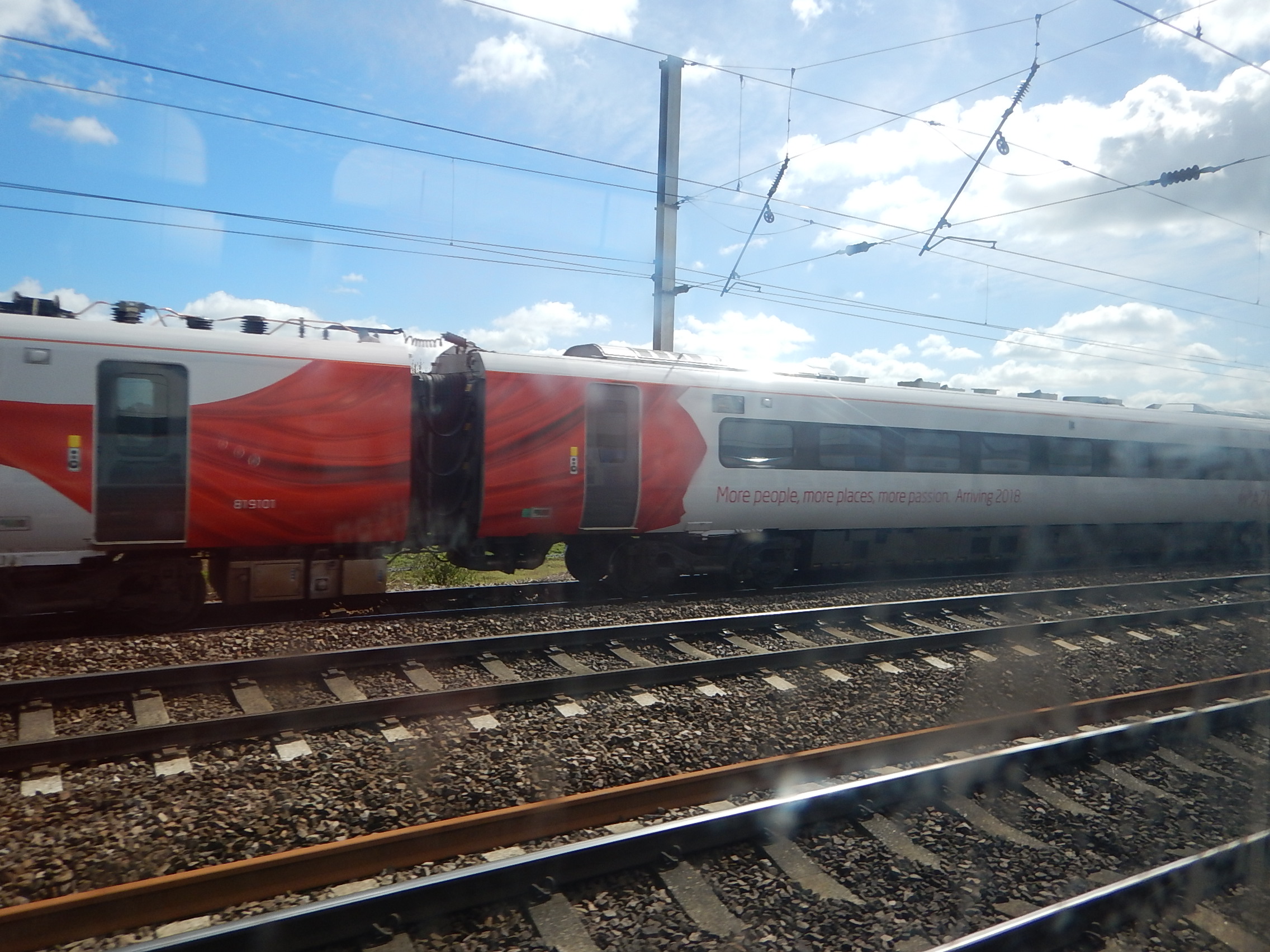
Virgin’s New Train On Test
Virgin’s new Class 800 train is under test.
Cardiff To Southampton By Electric Train
When I was waiting on Bath Spa station to return to London, a Class 158 train from Cardiff stopped at the station, on its way to Brighton via Southampton.
The train travels the full length of the Wessex Main Line from Bristol Temple Meads to Southampton, using the soon-to-be-electrified South Wales Main Line and the electrified West Coastway Line to complete the full route.
I wondered how much of the route will be electrified, once Cardiff to Bristol is hopefully electrified in the next few years. The current date for wires to Cardiff is December 2018.
I would estimate the length of the non-electrified section between Southampton and Bath is about sixty to sixty-five miles.
So it would appear that, the line could be within range for a Class 387 train or a new Aventra, with an IPEMU capability.
Obviously, Great Western Railway could also run a five-car Class 800 train on the route, using the on-board diesels to bridge the gap.
One way or other by 2020, Cardiff to Southampton will be run by electric trains, with a much increased capacity.

