Coal’s Economic Victims
Coal still claims victims, but these days, the biggest ones are economic and corporate.
In the United States, this article has been published on Bloomberg, with a title of Coal Slump Sends Mining Giant Peabody Energy Into Bankruptcy.
The article makes these points.
-
Biggest U.S. producer felled by cheap gas, China slowdown
-
Environmental costs could complicate miner’s reorganisation
How many US pensions have lost value because Peabody was considered a safe investment?
As fracked cheap gas is given as the reason for Peabody’s fall, don’t think that the US is swapping one dirty fuel for another!
- When you burn coal, which is virtually pure carbon with impurities, you create a lot of carbon dioxide and spread the impurities, which are sometimes quite noxious over a wide area.
- But natural gas is mainly methane, which is one carbon atom and four of hydrogen. So burning gas creates a lot of water, as well as less carbon.
I seem to remember that to get the same amount of heat energy from natural gas, as from a given quantity of coal, you only create about forty percent of the carbon dioxide.
This page on the US Energy Information Administration probably can lead you to the answer.
In the UK, there are two recent stories on Global Rail News.
Rail freight is going through a bit of a crisis in the UK, because we are burning much less coal in power stations.
As coal is moved to power stations by diesel-hauled trains in the UK, from open-cast sites and the ports, the burning of less coal in power stations is having a serious effect on rail freight companies.
At least, if any train drivers are made redundant, there are plenty of vacancies for drivers of passenger trains and I’ve yet to meet a freight train driver, you likes the dreaded Class 66 locomotives, with all their noise, vibration and smell, that generally pull coal trains.
But it’s not all bad news, as this article from the Railway Gazette, which is entitled Freightliner wagons use recycled coal hopper components, shows. This is said.
Freightliner has taken delivery of the first of 64 open wagons which are being built by Greenbrier Europe using bogies and brake components recovered from coal hoppers made redundant as a result of the decline in coal traffic.
Freightliner Heavy Haul needed a fleet of high capacity box wagons for a new contract to haul construction materials for Tarmac, and decided to investigate the possibility of using recycled parts from redundant Type HHA 102 tonne coal hoppers. With assistance from engineering consultancy SNC Lavalin, Freightliner and Greenbrier Europe identified that with some modifications the bogies and some of the braking equipment would be compatible with an existing design of Greenbrier box wagon.
To a small extent, the movement of aggregates around the country by rail instead of truck, is replacing the coal trains on the the railways.
Did Aberfan Change My Thinking About Coal?
I have just watched a moving piece by John Humphrys on the BBC, which describes Aberfan now and compares it to what he remembers from fifty years ago.
Growing up in London, I remember the awful smogs of the 1950s caused by domestic coal smoke, so that might have had an affect on my thinking.
But I have been strongly anti-coal for as long as I can remember and I suspect that the tragedy of Aberfan, finally sealed its fate in my mind.
Coal mining tragedies used to happen regularly at that time all over the world and I probably felt it was just too high a price to pay for energy.
I must be one of the few people, who felt, through all of this country’s coal mining troubles of the latter twentieth-century, that the mines should be shut immediately.
I always remember an article in the Guardian, that stated that miners should be retrained into teams, that went round and insulated our pathetic housing stock. If you’ve ever put insulation into a roof, in some cases, it’s very much akin to Victorian coal-mining in reverse.
After all the greenest form of energy, is not to have to generate it in the first place.
I have solar panels on the flat roof of my three-bedroomed house, and even in the Autumn, I only use 50 KwH of electricity and 20 units of gas every week.
Coal Is On The Way Out!
In my view, the only sensible use for coal, is using it to create products for uses like medicines.
The Army also found a use for coal, when they got National Service recruits to [paint it white to give them a job to do.
But two stories tell the world that the Western World has decided that coal is like the lady and not for burning.
This story in the Guardian is entitled Peabody Energy, world’s largest private coalminer, may file for bankruptcy. This is said.
The world’s largest private coal mining company is teetering on the edge of bankruptcy, driven to the brink of collapse by plummeting energy prices around the world, cheaper and less polluting rivals such as natural gas, and widespread economic uncertainty.
When you consider that to get the same energy out of natural gas compared to coal, you generate a lot less carbon dioxide and a lot less of other pollutants, is it surprising? Especially, as the whole process is probably cheaper!
This story in Rail Magazine is entitled FLHH axes 145 jobs as coal cuts bite. This is said.
Freightliner Heavy Haul (FLHH) is to cut 145 ground staff, shunting and driving jobs as the closure of coal-fired power stations accelerates.
Economic forces are seeing that King Coal is killed.
I won’t be shedding any tears.
Good Riddance To Coal-Fired Power Stations
This article on the BBC is entitled UK’s coal plants to be phased out within 10 years. This is said.
The UK’s remaining coal-fired power stations will be shut by 2025 with their use restricted by 2023, Energy Secretary Amber Rudd has proposed.
Ms Rudd wants more gas-fired stations to be built since relying on “polluting” coal is “perverse”.
Because coal is pure carbon, when it burns, if produces carbon dioxide.
On the other hand, natural gas, is a mixture of hydrogen and methane, which is a compound of one carbon atom and four hydrogen atons. So when it burns, it produces a lot of the combustion product of hydrogen, which is water.
I think to get the same amount of heat or produce a given amount of electricity, natural gas creates about half the amount of carbon dioxide, than coal does.
There is another advantage of using gas to generate electricity. You can have small power stations generating electricity, where it is needed.
An interesting small gas-powered power station is the Bunhill Energy Centre in Islington, which is used to generate electricity and heat for some of the Council’s buildings. Phase 2 of this project will capture waste heat from the London Underground and a large electricity sub-station, that will be used to heat more buildings.
These cogeneration systems will become more numerous. For instance, if you had say a large detached house in the country, you might use solar panels or a wind turbine, backed by a microCHP system for dark or still days.
We shouldn’t underestimate, the skill of engineers to design electricity combined heat and power systems matched to all the different markets.
There will come a time, where many of us will generate the electricity we need, either by ourselves or perhaps in a local co-operative. We could even sell the surplus back to the grid.
I will not predict what a system will look like, but it will heat your house and provide you with the electricity you need.
The one thing, I will predict that coal will not have any use for the generation of electricity.
My Kind Of Energy Company
I found this article on edie.net entitled Ovo Shuns Coal And Nuclear.
I am very much against using coal as a fuel for various reasons, but as I get older and hopefully wiser, I feel that nuclear energy is non-viable economically.
The cost of the new station at Hinkley Point doesn’t look good value for money, when compared to some of the new developments in the pipeline.
Tidal, such as the Swansea Bay Tidal Lagoon, personal solar and linking the UK to Iceland with an undersea cable, might well prove to be better long term investments.
So I applaud OVO for their stance and will continue to use them as my energy supplier.
Is Coal In Terminal Decline?
I’m no lover of coal, because of all the pollution and carbon dioxide it creates. I’ve also never met anyone from a coal mining family, who would ever want to work in a mine.
So when I look at the latest freight statistics from the Office of Rial and Road, I am rather pleased to see that in the last year coal traffic on UK railways has fallen over the last twelve months, from 1.66 billion net tonne km to 0.64 billion net tonne km (a drop of 61.2%).
As this is mainly imported coal to be burned in coal-fired power stations, I don’t think it is bad for employment. Power stations may be closing, but new ones must be opening to fill the gap in electricity generation.
Expanding The Robin Hood Line
The Robin Hood Line, runs between Nottingham and Worksop. It had been closed to passenger trains in the 1960s and reopened to passengers in the 1990s. I used to use it regularly to see a client in Mansfield in the years soon after it opened.
In my investigations into Ilkeston station, the Robin Hood Line kept cropping up and especially talk of a branch from the line to Ollerton.
Search Google News for Robin Hood Line and articles with titles like Chancellor backs Robin Hood line passenger plans are found in the Mansfield and Ashfield Chad. This is the start to the article.
The Chancellor George Osborne, has confirmed his backing for plans to open a passenger service on the Robin Hood line, from Shirebrook to Ollerton, including passenger stations at Ollerton and Edwinstowe.
Other Government figures like David Cameron and Patrick McLoughlin and important local councillors are also quoted saying similar things.
What is not said is that the line will serve the CentreParcs Sherwood Forest and that the rail line needed is currently fully maintained for driver training. This Google Map shows the area.
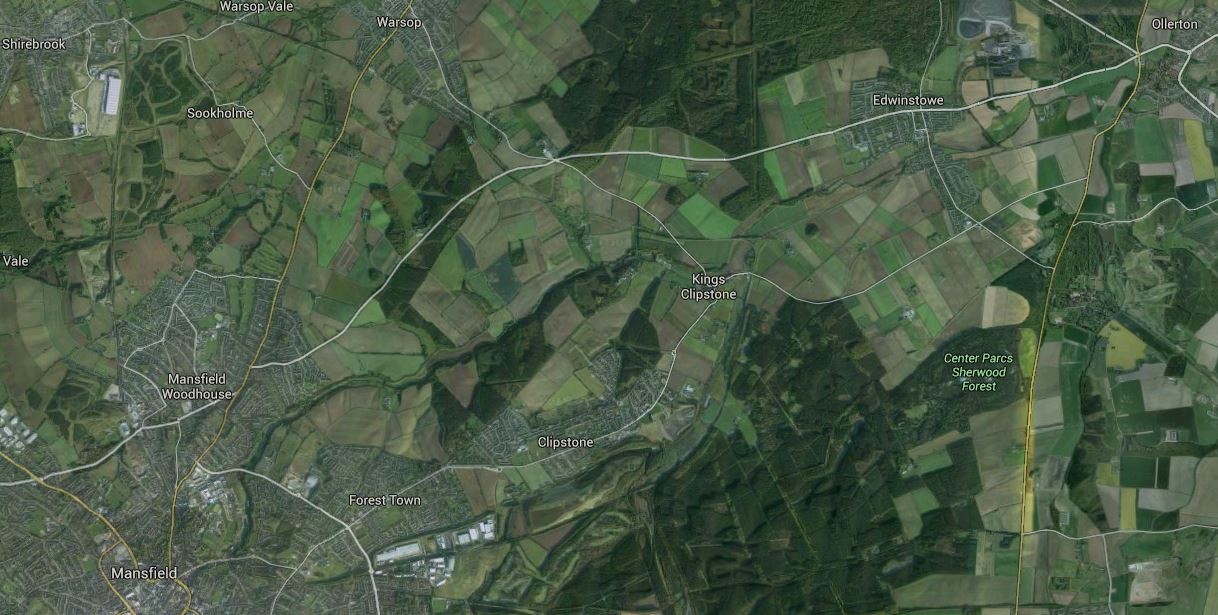
Proposed Ollerton Branch
The branch turns off from the Robin Hood Line just North of Shirebrook station in the top left hand corner of the map and then makes it way to Ollerton by way of the South of Warsop and Edwinstowe and North of the CentreParcs Sherwood Forest .
The line probably illustrates the only environmentally-friendly use for coal, which is to keep rail lines open and in good condition, until we can find a better use for them.
There is an interesting section called Branch Lines in the Wikipedia entry for Shirebrook station. This is said.
Two branch lines are plainly visible veering off north of the bridge at the north end of Shirebrook station.
The double tracks branching off eastwards (i.e. to the right as viewed from the station) to the side of the signalbox joined the LD&ECR’s one-time main line to Lincoln, next stop Warsop. The branch only ever carried a regular passenger service for a few years in Edwardian times. It did, however, carry Summer holiday trains such as the Summer Saturdays Radford to Skegness in at least 1963. The branch’s main purpose was always freight traffic, with coal being overwhelmingly dominant.
In 2013 the line gives access to Thoresby Colliery and to the High Marnham Test Track.
There is some hope of reopening the line as a branch off the Robin Hood Line and reopening Warsop, Edwinstowe and Ollerton stations, providing an hourly service to Mansfield and Nottingham.
This Google Map shows Shirebrook station and the railway lines around it.
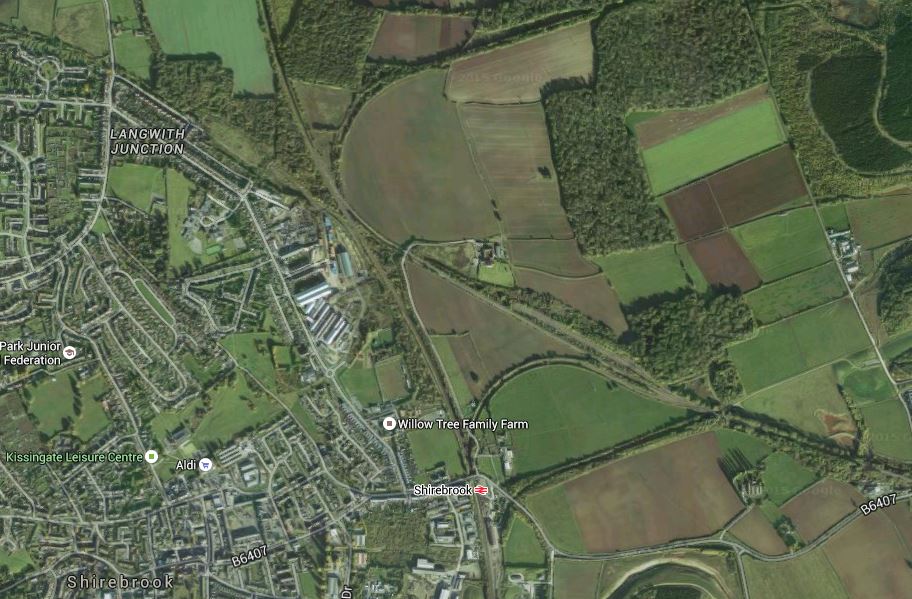
Shirebrook Station
The junction of the Ollerton branch would appear to allow access to trains from or to either Nottingham and Mansfield in the South and Worksop in the North
So there could be three stations; Warsop, Edwinstowe and Ollerton on a double-track branch.
From Ollerton To Lincoln
Interestingly, after Ollerton the line goes all the way to Lincoln. But I doubt that it would ever be part of the plans for passenger trains in the area.
But who knows?
The area between Chesterfield, Mansfield and Nottingham is not very well connected to Derby.
If you want to go from Mansfield or Kirkby-in-Ashfield on the Robin Hood Line to Derby, you always have to change at Nottingham, with sometimes an extra change at East Midlands Parkway.
The Erewash Valley Line runs North-South a few miles to the West of the Robin Hood Line.
Despite being partially in Derbyshire, getting from stations like Alfreton, Langley Mill and the soon-to-be-opened Ilkeston stations to Derby, you have to change at either Nottingham or Chesterfield.
Look at this Google Map of the area
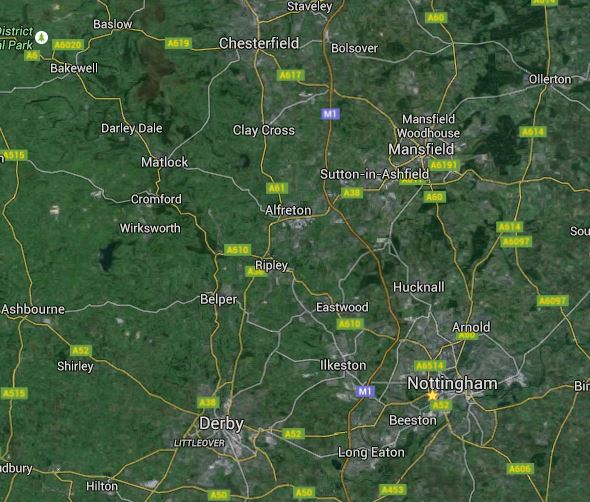
Between Derby, Nottingham, Mansfield And Chesterfield
There must be a better way of getting to Derby, than by changing trains in Nottingham or Chesterfield.
But what?
There are four main North-South routes in the area.
- The Robin Hood Line between Nottingham and Worksop
- The Erewash Valley Line between Long Eaton and Chesterfield
- The Midland Main Line between Derby and Chesterfield
- The M1 Motorway
What seems to be missing is high-capacity East-West routes for both rail and road.
The Erewash Valley Line goes South to Long Eaton, which has several trains per hour direct to Derby, so this could be the key to getting to Derby.
In a Notes on Current Station section on the Wikipedia entry for Long Eaton station, this is said.
It is planned that both platforms will be extended by up to 10 metres by no later than 2012.
It is anticipated that developments along the Erewash line will result in changes for Long Eaton station. A plan drawn up in 2011 recommended a new Derby to Mansfield service via new stations at Breaston & Draycott, Long Eaton West (renamed from Long Eaton), Long Eaton Central, Stapleford & Sandiacre, Ilkeston, Eastwood & Langley Mill (renamed from Langley Mill), Selston & Somercotes and then to Pinxton via new trackbed connecting with the Mansfield line from Nottingham at Kirkby in Ashfield.
It strikes me that work at Long Eaton, the several new stations and improvements north of Langley Mill would enable direct services from Alfreton, Ilkeston and Langley Mill to both Derby and Mansfield. This service would also improve services from stations stations North of Mansfield to Derby.
A trackbed from Langley Mill to Kirkby in Ashfield is shown on Google Maps.

Langley Mill to Kirkby-in-Ashfield
Alfreton is the station at the top left and Kirkby-in-Ashfield is at the top right. The Erewash Valley Line from Langley Mill, enters at the bottom and splits with one branch going to Alfreton and the other going East to cross the M1 and join the Robin Hood Line south of Kirkby-in-Ashfield.
On an Ordnance Survey map, dated 2009, the railway is shown as a multiple track line, probably serving collieries and open cast coalfields.
It all sounds very feasible too! Especially, as the Erewash Valley is an area of high unemployment, low car ownership and a dependence on public transport.
The Future Of Railways In North Nottingham And South Yorkshire
Look at any map of the area between Nottingham and Derby in the South to Sheffield, Doncaster and Barnsley in the North and you will see rail lines criss-crossing everywhere. Many are now disused and show up as green scars on the landscape.
Also on the maps, you will see quite a few large power stations. Most were originally coal-fired and merry-go-round trains transported the coal from the mines to the power stations.
So most of the rail lines in the area, were built to take the coal away from the mines to where it was needed. Passengers were almost an afterthought. The railway companies even built the Great Northern Great Eastern Joint Line from Doncaster to East Anglia to take coal to where it could profitably be used.
After the Second World War, the railways contracted and cut passenger services. As an example, the Robin Hood Line closed in the 1960s.
The passenger services were suffering because of car ownership, so most were withdrawn, except on the main routes. Mansfield before the Robin Hood Line reopened, was one of the largest towns in England without a rail station, an honour now held by Ilkeston a few miles away.
In recent years, coal use has in my view rightly declined. Everybody knows the poor environmental record of coal, with its creation of CO2 and other pollutants. On the other hand, I have met people whose fathers worked in the mines and the general advice they received is don’t go underground!
So as the need to move coal by rail has declined, many of these railway lines have ceased to carry much freight traffic and have fallen into disuse.
But some are coal’s last legacy, in that until comparatively recently, they were still used to get coal to the power stations. Like the line from Shirebrook to Ollerton, they are in good condition and only need stations to bring them back into use as passenger lines. Just as the Robin Hood Line was reused twenty years ago!
Because these lines serves the coalfields and the mines, they also serve the mining communities and the small towns, that need improved public transport links.
Network Rail’s plans seem to be going some way to be addressing some of the problems in the area.
I don’t think that the reopening of the Ollerton Branch and the connection between the vErewash Valley and Robin Hood Lines, will be the last lines to reopen in the area.
Why We Shouldn’t Mine Coal
I’m sixty-seven this year and all my life, every year or so, I’ve heard reports of the deaths of coal miners.
Now today, there are reports of a serious mine disaster in Turkey.
When I was in Poland, I shared a train compartment with a lady going to Katowice. I remember the city for a mining disaster in the 1950s, which was nearby.
Isn’t it about time, we stopped mining the filthy stuff, as it just creates grief for the miners and their families? And of course there’s always the issue of global warming.
Trade Unions Living In The Past
I was listening to Radio 5 this morning and a couple of Trade Union leaders said that we should open up the mines again and burn coal using carbon capture technology.
Who do they think they’re kidding?
I have serious doubts about this technology and don’t think I’ll ever see it working in my lifetime on a large scale. I put a few thoughts here. But don’t listen to me. In these two posts, Wikipedia details the limitations and cost. So it looks like an exopensive dead end, if you believe Wikipedia. I definitely agree!
One thing though, if we started deep mining coal, I doubt there would be queues of people wanting to work in the mines. But then we can always get a few thousand willing immigrants to do the work!
A Bail-Out Too Far
The Sunday Times is reporting that because of the big fire at Daw Mill, UK Coal is close to collapse. The story is also here in the Newcastle Journal.
For many decades now, I’ve been against the mining of coal and its use as a fuel. My objection probably stems more from the dangers of mining, the bad disasters of my childhood years and recollections of a few former miners, that I’ve met, and not from any political reasons. When global warming became known, it just reinforced my views that we should get rid of this dangerous and polluting fuel.
If we don’t put UK Coal out of its misery this time, we’ll only be delaying the inevitable for a few years, as some other problem will come along.
 The Anonymous Widower