Phyllis And Ada To Be Buried Alive
This headline from a magazine, seems like something consistent with Halloween.
But it’s not!
The headline actually is from the Crossrail update on the back page of this month’s Modern Railways. It tells how, the two tunnelling machines; Ada and Phyllis, will be left in the ground rather than recovered. The two machines are named after Ada Lovelace and Phyllis Pearsall respectively.
This does seem to be a pity, especially, as they cost ten million pounds each, but getting some of them out will be a very difficult, dangerous and expensive job. I also suspect that there isn’t much of a second-hand market for specialist tunnelling machines, which generally seem to be built for a particular set of conditions and sizes. Crossrail are actually using two different types of machine for their project. There’s more about the tunnelling here.
Kings Cross Square Is Nearly There
Kings Cross Square opens tomorrow and it’s nearly there.
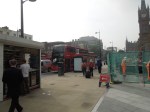
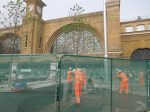

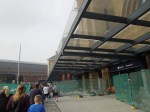
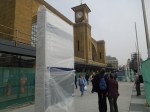


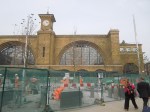
The buses though are back and I came home on a 476 towards Islington, from in front of the station. The driver seemed pleased too, judging by the smile on his face, when I said it was good to have the stop back.
The Fake House Is Coming On
I walked past the new house they’re building round the corner today.
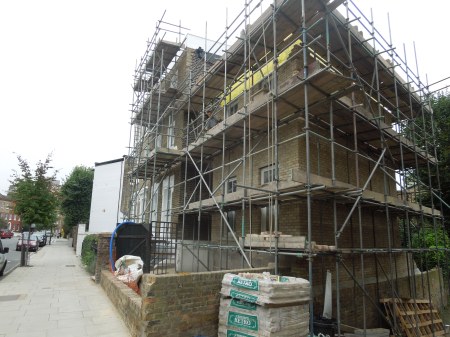
The Fake House Is Coming On
It’s all looking good.
Inside Canary Wharf Crossrail Station
This was one of the must-see events in Open House.




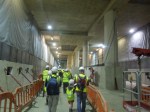

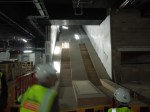


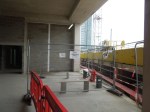
The areas we saw were the bottom levels of Canary Wharf station where trains and passengers go. On the top of these floors is a large retail mall.
This is the future, where stations are more than just means to access the trains. The new Birmingham New Street station has another large retail mall on top and the new Crossrail station at Woolwich, is underneath masses of flats, as is my local station of Dalston Junction. Land is expensive, but digging down or building in the sky only increases its value and hopefully gives benefits to all of us.
Does Good Rail Infrastructure Attract Investment?
I ask this question after reading this article in Global Rail News about the opening of the new Kings Cross Square in a few days time.
This paragraph in the article also caught my eye.
It’s not only the station that is undergoing a makeover. The area around King’s Cross is also undergoing a major regeneration – a project that will soon see Google build its new European headquarters beside one of the capital’s most famous stations.
So if we had left Kings Cross as it was or just cleaned it up, would Google and others be hastening to the area?
I doubt it!
Will Birmingham New Street, Leeds, Derby and Reading stations, which have all been or are being substantially rebuilt have the same effect?
We need a lot more kingscrossification!
The Walkie-Scorchie
This is one of the nicknames of London’s newest skyscraper, usually called the Walkie-Talkie.

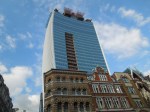




The building focussed the sun and melted parts of a car parked in the street. Note the cones to stop it happening again. There’s a report of the incident here in the Independent.
More Demolition At London Bridge Station
As I came back, I passed through London Bridge station.

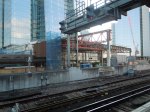


Very little is now left of the old station.
Note the pristine refurbished Class 465 in one picture.
Some may decry our trains, but we have one of the newest fleets in the world and even ones like these, which are wenty years old, look almost fresh out of the factory.
Pudding Mill Lane Station – 20th August 2013
This set of pictures shows how fast Crossrail and the new Pudding Mill Lane station are progressing, when it is compared with pictures of just over a month ago.


The two tunnelling machines; Jessica and Ellie are soon to be on their way, or might have even left yet on their journey to Stepney Green.
The new station is looking like it will be one of the grandest on the Docklands Light Railway. According to this piece in Wikipedia, it will be completed this year.
As it will be one of the major stations for the Olympic Park and probably the closest to the stadium, I think we’ll start to see pressure to change the name or at least add a tag to Pudding Mill Lane like for West Ham United Stadium. After all there is a precedent at Gillespie Road station.
The Tallest Timber Residential Structure In The World
You’d have thought that this would be somewhere like Japan, Scandinavia or perhaps Canada, but despite it’s name, the Stadthaus is in Murray Grove in the London Borough of Hackney.
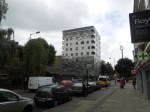


Wikipedia says this about the building.
It is thought to be the tallest timber residential structure in the world.It was designed in collaboration between architects Waugh Thistleton, structural engineers Techniker, and timber panel manufacturer KLH.
Stadthaus is the first high-density housing building to be built from pre-fabricated cross-laminated timber panels. It is the first building in the world of this height to construct not only load-bearing walls and floor slabs but also stair and lift cores entirely from timber.
I like it and it shows how modern buildings don’t have to be constructed using traditional methods. It was also constructed in just 49 weeks and residents moved in ahead of schedule.
So as we need more housing and we need it quickly, perhaps we should build more houses and flats using these methods.
Do We Need A Rolling HS2?
The report today by the think tank, the Institute of Economic Affairs, which says that HS2 will cost a lot more than is currently budgetted for. It’s all reported here on the BBC.
They make a lot of good points in the report.
Extra infrastructure such as trams and trains, will be needed to link other areas to the route.
Extra tunnels and other infrastructure will be needed to buy off the opposition.
The BBC summarises it like this.
The report said HS2 “and the add-on transport schemes will be heavily loss-making in commercial terms – hence the requirement for massive taxpayer support”.
As someone, who is very familiar with project management, I’ve always felt that the logic of HS2 and the way it is being implemented could and will be improved.
If we look at the current rail network, it has problems that will eventually be solved or helped by HS2.
Euston station is not fit for purpose and should be redeveloped and/or relieved. I favour a second terminus of the West Coast Main Line at Old Oak Common, as I mused here.
There are very severe capacity problems on the northern part of the West Coast Min Line between Wigan and Glasgow. This is not part of the current HS2, so perhaps it should be done to make sure the Scots get their connections to the South improved.
The East Coast Main Line to Leeds and Newcastle, has a notorious bottleneck at the Digswell Viaduct and according to this report on the BBC web site, it could be removed for under half a billion.
One problem that HS2 doesn’t solve is the bad connections across the north of England from Liverpool to Leeds and Hull. This BBC report includes an estimate of a billion plus.
So should we just define the route for HS2 and then break it into a series of manageable projects, that are implemented over the years.
We might design large stretches for say 300 kph, but most of the upgraded network would have limits of around 200 to 250 kph. Effectively large sections of the East and West Coast Main Lines can now handle 225 kph and just need resignalling.
The new Class 800 and Class 801 trains will be built to a design speed of 225 kph.
In some ways these trains may be the key to the whole of the expansion of high-speed services. I suspect, we’ll see them on London to Sheffield and Norwich for a start.
 The Anonymous Widower