Behind London’s Contactless Ticketing
I have just read this article on London Reconnections, which is entitled Don’t Fear the Beeper: Bus Hopper Tickets and the Future of Oyster.
It is fascinating stuff and a lot consists of an interview with Shashi Verma, TfL’s Director of Technology and Customer Experience.
One thing that surprised me is that Oyster and Contactless have separate back-ends, but the two will be combined in 2018.
So I think we’ll see lots of new features coming in after 2018.
As many of these will improve the customer experience, isn’t Sadiq a lucky Mayor, as he’ll get the credit rather than the geek who had the idea and did the coding.
This is said in the article about the Bus Hopper
This isn’t to say, of course, that the Hopper was an entirely new idea.
“[It] is something we have wanted to do for years and years.” Verma confirms. “But we haven’t wanted to do in the way that some politicians have wanted it to be done.”
So it was there all along.
How many other things will be possible, when the back offices are combined?
Use With Railcards
According to this page on the TfL web site, railcards don’t work with contactless cards.
I would suspect that one feature after 2018, would be that if you create an account for contactless or Oyster and add a railcard to the account, your fares will be adjusted accordingly.
The system could also handle the very popular Two Together Railcard. You’d just register two accounts for each traveller with the same railcard, then if they’re both used within say five minutes for the same journey, the back office applies the discount.
Use With Freedom Pass
Once the back offices are combined, the Freedom Pass could be made to work in two ways.
As now!
Or it is registered in your TfL account along with your contactless card and the back office would charge you an appropriate fare.
So if say I wanted to go to Gatwick Airport or anywhere in the Oystercard area, I just tap in and out with my contactless bank card and the back office charges be the £3, I would be charged if I went to East Croydon using my Freedom Pass and left the station before coming back in using contactless to get a train to the Airport.
If such a method was possible, I would certainly use it, as quite a few of the journeys I do are just outside the Freedom Pass area, but still within the Oystercard area.
It would then mean that I would only have to carry one card in my pocket.
The Outer London Freedom Pass
Say you live in one of the administrative districts that ring London. I’ll use Epping Forest as an example.
Because of your age or circumstances, you are entitled to a bus pass, but you get no free travel on trains or the Underground.
If your local authority decided to have a Freedom Pass scheme for all travel in the district, you would get any train or tube travel between stations in the local authority or to the boundary of the area, free.
In the case of Epping Forest, you’d get the outer reaches of the Central Line.
So if you were travelling from Theydon Bois to Liverpool Street, you’d only get charged for the tube between Woodford or Grange Hill and Liverpool Street.
You would create a contactless/Oyster account on TfL and add your bus pass and/or railcard to the account.
The back office would do the rest and you’d travel all over the Oystercard area using your contactless card.
I think that some local authorities could look at this concept seriously to encourage card holders to shop locally.
Stations Could Allow Freedom Passes Outside Zone 6
I’ll take Greenhithe for Bluewater station as an example.
The clue is in the station name.
Suppose that the Shopping Centre felt it would get a lot more business from Freedom Pass holders if it were to be in Zone 6, would it pay for the cost of tickets for Freedom Pass holders to attract them to their relaxed shopping experience.
It should be noted that there are already stations outside Zone 6, like Watford High Street and Shenfield stations, that allow Freedom Passes provided you use the London Overground or TfL Rail.
Other possibilities include.
- Gravesend by an extended Crossrail.
- Gatwick Airport
- Watford Vicarage Road
- Windsor
Who knows, which local authorities, events and attractions would find subsidising travel worthwhile.
Imagine for instance Winter-only Off Peak use of a Freedom Pass to say Brighton or Southend.
Conclusion
Travel in London is going to get even more interesting.
I look forward to the day, when I have a single card in my pocket!
Along The North Kent Line
The North Kent Line has seen some changes in the last few years and could see some more in the next few.
Starting from the terminal in London Bridge, which itself is going through a massive upgrade, these improvements have been done or will happen.
Woolwich Arsenal
Woolwich Arsenal station has from 2009 provided a direct link to the Docklands Light Railway, giving a direct connection to London City Airport and Bank.
In 2019, Woolwich station on Crossrail will open, which will be two hundred metres away from Woolwich Arsenal station. This will probably not have a direct effect on Woolwich Arsenal station, but two stations will certainly stimulate development in the area.
I doubt many will use this station to interchange between the North Kent Line and Crossrail, as it looks like the connection at Abbey Wood station could be easier.
Abbey Wood
Abbey Wood station is being rebuilt and in December 2018, Crossrail will start services at the station to Paddington via Canary Wharf and the central tunnel.
Wikipedia says this about Crossrail services at Abbey Wood station.
Abbey Wood is the terminus of one of two eastern branches of Crossrail and will offer cross-platform interchange between terminating Crossrail services (at 12 trains per hour on new line) and existing Southeastern services (along existing tracks)
Plans are always being talked about to link Abbey Wood station to the North Bank of the Thames at either Gallions Reach or Barking Riverside.
I doubt it will happen in the next ten years.
Dartford
Dartford station has from the beginning of this year been one of London’s contactless ticketing stations, as is reported in Oyster and Contactless Bank Cards, under the station’s Wikipedia entry.
Don’t be surprised if this creeps outwards from London.
Greenhithe
Greenhithe station was rebuilt in 2008 and is the station for Bluewater.
Because of the Shopping Centre, Greenhithe will probably be a station that could benefit from contactless ticketing.
Northfleet
Northfleet station is the closest to Ebbsfleet International and we could see an improved link between the two stations.
As Northfleet could have upwards of four trains per hour (tph) stopping in both directions, a frequent shuttle bus, could be an affordable option.
Smaller Stations
There are several smaller stations between London Bridge and Gravesend.
I’m obviously not sure, but on a quick look all of them seem ready to accept the long trains, that will be used by both Thameslink and Crossrail.
Gravesend
Gravesend station was remodelled in 2013 and now has two long through platforms and a bay platform.
Crossrail to Gravesend
Under Future in the Wikipedia for Gravesend station, this is said.
In December 2008, the local authority for Gravesend (Gravesham Council), was formally requested by Crossrail and the Department for Transport, to sanction the revised Crossrail Safeguarding. This safeguarding provides for a potential service extension, from the current south of Thames terminus at Abbey Wood, to continue via the North Kent Line to Gravesend station. The Crossrail route extension from Abbey Wood to Gravesend and Hoo Junction, remains on statute. With current services from Gravesend to London Bridge, Waterloo East and London Charing Cross being supplemented by highspeed trains from the end of 2009 to St Pancras, the potential in having Crossrail services from central London, London Heathrow, Maidenhead and/or Reading, terminating at Gravesend, would not only raise the station to hub status but greatly contribute towards the town’s regeneration.
At present, Gravesend station has the following services.
Typical off-peak services are:
- 2 tph Highspeed services in each direction between London St. Pancras, Ebbsfleet intewrnation and Faversham and the East.
- 2 tph Southeastern services between London Charing Cross and Gillingham.
- 4 tph Southeastern services between London Charing Cross and Gravesend.
From 2019, Thameslink are saying that they will be running two tph between Rainham and Luton via Dartford and Greenwich.
This will mean that eight tph in each direction will go between Gravesend and Dartford, with another two tph going between Gravesend and Ebbsfleet International.
Because of the new Thameslink service, the train frequency between Gravesend and Gillingham will increase from the current four tph to six tph.
I think that although Gravesend will be the nominated terninal for Crossrail, the trains will actually reverse direction at Hoo Junction, so there will no need to use any platform space at Gravesend to prepare the train for its return journey.
At present, Wikipedia is saying this will be the Morning Peak service from Abbey Wood station.
- 4 tph to Heathrow Terminal 4
- 6 tph to Paddington
- 2 tph to West Drayton
With this Off Peak service.
- 4 tph to Heathrow Terminal 4
- 4 tph to Paddington
What the current North Kent Line can handle would probably determine how many Croosrail trains went to Gravesend and Hoo Junction.
But Crossrail won’t be short of seats to really provide a superb service to and from the Medway Towns.
I have a feeling that once Crossrail is running successfully, the traffic will define, if, when and how any extension to Gravesend is built.
But the creation of the extension to Gravesend and Hoo Junction will not be a massive undertaking.
- The depot and other facilities at Hoo Junction will have to be built.
- Could the depot at Hoo Junction be without electrification? If the Class 345 trains have sufficient onboard energy storage, which I believe could be the case and I wrote about in Bombardier’s Plug-and-Play Train, then this is a serious possibility, which would save money and time in building the depot.
- All platforms are probably long enough for the Class 345 trains.
- The Crossrail train specification says that trains must have the potential to be converted for third rail operation. The similar Class 710 trains will have this capability.
- Judging by my observations in Between Abbey Wood And Belvedere Stations, I feel that Abbey Wood station is probably capable of handling the same number of trains going further down the line.
- The signalling would have to be adjusted for the new service pattern.
But there would be no tunnelling and no major electrification on the North Kent Line.
Perhaps, the only major expenses would be.
- Building the depot/reversing sidings and facilities at Hoo Junction.
- Any extra trains needed.
- The cost of any rail link into Ebbsfleet International station.
So I doubt, we’ll be talking large numbers of billions.
Class 395 Trains
The Class 395 trains are normally six-car trains, but they can work in pairs as twelve-cars.
This probably means that any station, where the Highspeed service calls can handle a twelve-car train.
Strood
Strood station was updated in 2009 for the Highspeed service. Ready for Crossrail/Thameslink.
Rochester
Rochester station was rebuilt in 2016. Ready for Crossrail/Thameslink.
Chatham
Chatham station accepts twelve-car trains. Ready for Crossrail/Thameslink.
Gillingham
Ready for Crossrail/Thameslink.
Gillingham station is an interchange with two long platforms and a bay platform.
Five tph including two Highspeed services pass through the station and two tph go to and from London Charing Cross.
From 2019, there will be another two Thameslink tph between Luton and Rainham stopping at the station.
All this adds up to comprehensive service which stretches out to several London termini and the Kent Coast.
London Bridge, Abbey Wood and Gravesend all have at least four tph from Gillingham.
Rainham
Ready for Crossrail/Thameslink.
Rainham station has been updated in the last couple of years. An Update section in the Wikipedia entry, says this.
As part of the rebuild of Rochester Station, a new Up Bay Platform has been added.
Trains are now able to use this new platform as the East Kent Resignalling Project has been completed. At present, only a couple of trains use it in the evening rush hour.
The East Kent Resignalling Project is described on this page of the Southeastern web site.
These improvements are noted.
- New £26 million station at Rochester
- 250 new signals to replace old signalling equipment
- Disabled access at Strood station
- New bay platform at Rainham
- Safer level crossings fitted with obstacle detection technology at Aylesford, Yalding, Beltring, Wateringbury, East Farleigh, Cuxton and Snodland
- Centralisation of signalling control to Gillingham and the decommissioning of several signal boxes.
It would appear that a updated railway and a short series of good stations through the Medway Towns has been created, that can handle the increased frequencies.
Thameslink To Rainham
Modern Railways in August 2016, said that Thameslink would be running a two tph service between Luton and Rainham via Greenwich and Dartford.
The new bay platform at Rainham would be ideal for this service.
Onward From Rainham
There doesn’t seem to be many changes to what services are run now.
Conclusions
Everything seems to fit together rather well.
- Twelve-car platforms seem universal or at least where needed.
- The signalling is up to scratch.
- The new bay platform at Rainham makes the new two tph Thameslink service to Luton deliverable.
- To extend Crossrail to Gravesend probably just needs the new depot at Hoo Junction.
- Dartford to Rainham gets at least a four tph service with six car or longer trains.
The only area, where nothing has been published, is how to incorporate Ebbsfleet International station into the network.
I think it could suffer from London Overground Syndrome. This is my definition of the disease.
This disease, which is probably a modern version of the Victorian railway mania, was first identified in East London in 2011, when it was found that the newly-refurbished East London Line and North London Line were inadequate due to high passenger satisfaction and much increased usage. It has now spread across other parts of the capital and across the UK, despite various eradication programs.
It is usually solved by adding more capacity.
Related Posts
A Design Crime – Ebbsfleet International Station
Between Abbey Wood And Belvedere Stations
Connecting North Kent And The Medway Towns To Ebbsfleet International Station
Extending Crossrail To Gravesend
What Do You Do With A Problem Like Sheppey?
A Contactless Card Explosion
According to Becky Barrow in the Sunday Times, it not yet ten years since contactless cards were introduced.
She says that during the first six months of this year, we spent £9.3billion using the cards.
In the same period of 2009, we spent just £315,953 and half of that was Patsy and Edina in Harvey Nicks.
That is some increase.
When contactless cards were introduced on London’s buses, after listening to quite a few idiot techophobe politicians, I set up a very tight Internet trawl about ticketing problems on London’s transport.
I have not found a single problem reported in a newspaper or web-site.
My problem with contactless cards, is that I can’t use them for small train or tram trips outside London. Every train company and local authority seems to be reinventing London’s wheel.
No wonder London gets all the tourists!
I also had a small problem where a branch of a well-known store set up their tills incorrectly and AMEX thought it was fraud and refunded my purchases.
Is This The Most Significant Public Transport Development Of This Century So Far?
This article on Rail News is entitled Contactless export deal will help London fares freeze.
Whether the deal does keep fares down is irrelevant to me in London, as I get London’s extensive transport network for nothing! The only benefit, I’ll see is new services paid for by licencing revenue.
But how long will it be, before, when I go to say Birmingham, Berlin or Bucharest, that the only thing I will need to use public transport will be a contactless bank card?
Everything is now in place for all cities to use a similar system to London!
The only reason, it won’t get used in a city or public transport area, is that mistakenly because of NIH syndrome, politicians have gone their own route, which are incompatible with contactless bank cards and mobile devices impersonating them.
Say for instance Paris, Venice or New York didn’t allow the use of cards and devices, how would their visitor revenue drop?
I trawl the Internet extensively for reports of contactless cards used on public transport in London.
- I have not found one adverse report on the media, although I have found a couple of travel sites recommending using a bank card as a ticket in London.
- Remember that you get the same price as Oyster, which is less than cash, without having to use a special card.
- Oyster use is dropping in London.
- Carrying umpteen cards is so twentieth century.
- How much money do people have lying dead on Oyster cards, they’ve mislasid in old jackets etc.?
- There was a big worry from the left, that cashless and contactless ticketing would hurt the less well off. This Luddite-view has been shown to be totally wrong, with some of the highest non-Oyster use in London’s poorest boroughs.
- There has been a reduction of attacks on staff, as the only money they carry is now their own.
- I have been unable to find a report of someone using a stolen contactless card as a ticket.
The world will embrace London’s model and now, that Cubic has the licence, there is nothing to stop the march of contactless bank card ticketing.
Except of course stupid politicians!
An Announcement From TfL
This article in Rail Technology Magazine is entitled Battersea Power Station to be extensively redesigned for Northern Line extension.
I think that they’ve found that putting together the new Battersea station, is not as simple as the developers thought.
In fact, they could have discounted it, as how many of the developers, architects or owners of the new properties will actually use the line?
But Londoners, visitors and others are looking forward to the Northern Line Extension, as it gives access to an area, that is not the easiest place to visit, unless you use several buses or a long walk.
However, the most significant news in the article is the last paragraph.
At the same meeting, the committee were also asked to authorise TfL to submit a proposal for a final fixed licencing price in order to commercially exploit the software used in its contactless payment systems.
Does this mean, that London’s contactless payment system will be seen all over the world?
I certainly hope so, as I’ve never found a system that comes within a hundred miles of London’s proven go-anywhere ticketing on either an Oyster-like card or a contactless bank-card.
If I ruled the world, I’d make this compulsory for all public transport!
It would create the biggest economic stimulus to tourism and trade, since coins were first used in the Iron Age.
Gatwick Express Embrace Contactless Ticketing
I took this screen capture this page on from the Gatwick Express web site.
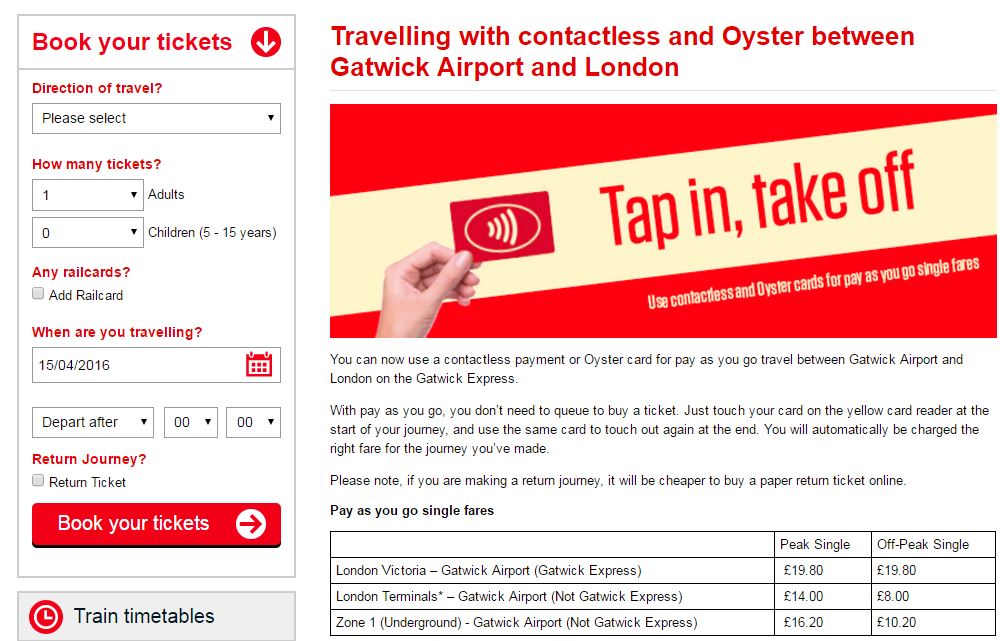
It does seem they are embracing contactless ticketing to Gatwick. They do add this caveat.
Please note, if you are making a return journey, it will be cheaper to buy a paper return ticket online.
From here in the wilds of Dalston, I shall probably never use Gatwick Express, except to catch an early flight, when I would take one of two night buses; N38 and N73 or a mini-cab to Victoria.
I will probably use Thameslink from London Bridge or use the East London Line to get to Croydon.
I will certainly use a contactless bank card for the last leg to Gatwick, as it is not in Freedom Pass territory. As contactless costs just three pounds between East Croydon and Gatwick, I wouldn’t put it past the Airport to allow Freedom Passes to Gatwick, if Heathrow don’t allow them on Crossrail to the there.
There’s a war out there and the two main protagonists; Helpful Gatwick and Greedy Heathrow are laying out their policies.
Riding The Cable Car
I hadn’t ridden the Emirates Air-Line for some time, so I thought it would be a good idea on Sunday.













As you can see, I got a car to myself.
I think the trouble with the line, is that it is pushed at tourists, who don’t realise that the cheapest way to cross it, is by the use of an Oyster card.
But it doesn’t appear to accept cashless payment, which as this is most of London’s preferred payment method, probably doesn’t help ridership.
Let’s face it, who in their right mind would use Oyster? I have a Freedom Pass, so I don’t need Oyster, but I do get peeved that I have to carry one with perhaps twenty pounds on it, just so I can use the cable-car.
Small Annoyances In Travel
I have some big things, that annoy me, but in my travels, I constantly come across small things that can be improved.
1. Beggars Selling Tissues
A complete pain and an annoyance to train companies too!
One day, an annoyed drunk, will tell one to get lost very forcibly!
2. Bi-Lingual Signs
If the Welsh want to have station signs in Welsh that’s for them to decide, but having everything in Welsh and English just clutters the station and makes doing simple things like finding toilets difficult.
3. Bus Information Outside London Is Mainly Useless
London’s bus maps and text Countdown system, sets a very high standard for bus information.
But why is it, that no area of the UK, or few in Europe for that matter, has a system that works as well for visitors?
4. Bus Pass Restriction In Other Countries Of The UK
Today, I was in Cardiff and had to buy a ticket. I had no small change, so I held everybody up and in the end a kind Welshman paid.
I believe that if all bus passes worked all over the UK, it would be a self-financing scheme, as more of us would travel to the other three countries and probably spend money which would generate VAT and other taxes.
Supposing too, we also allowed those from other countries over sixty-five or disabled to use buses for free. Would this encourage tourism and create revenue?
It certainly would be an experiment that would be worth trying.
5. Buses With Only One Door
All of London’s buses, except for the very smallest have two or more doors. It speeds loading and unloading, especially for those in wheelchairs or pushing buggies, so the buses go faster.
6. Cities And Towns With Two Disconnected Main Stations
Some cities and large towns have two main stations. Birmingham, Blackpool, Glasgow and Manchester come to mind.
If they can’t be connected by a proper rail connection, then at least there should be a ticketless way of getting between the stations.
Several times a year, I do journeys, where I have to go across Manchester between Victoria and Piccadilly stations. I have to buy a ticket on the tram, but if say I have a ticket from Euston to Burnley or Blackburn, the tram should be included.
It is not a system designed for the real needs of travellers.
7. East Croydon Station
East Croydon Station is the ideal changing point for journeys to Surrey and Sussex.
But despite the rail lines being in place, it is not easy to get there from East London. You use one of these routes.
- Bus or Bus/Tube to London Bridge station and then use Thameslink.
- Bus or Bus/Tube to Victoria station and then use a direct train.
- East London Line to West Croydon station and then a tram
The last method can’t be used coming north, as the trams don’t serve West Croydon when going west.
At present, you can take the East London Line to New Cross Gate or Norwood Junction stations and change, but this will be stopped, when the full Thameslink opens.
8. Ordsall Chord
I fear that due to the persistent opposition of one misguided and obstinate individual, that the Ordsall Chord will never be built.
9. Paddington Station
For those of us in East London, Paddington station is a very difficult station to get to. Unless you’re happy to crawl along the Hammersmith and City Line and walk a long way to your train.
10. Stations With No Information On How To Use Local Buses
Manchester Piccadilly station is particularly bad and in many cases you have to walk to Piccadilly Gardens to get the bus you need.
Some towns and cities like Sheffield have the main bus station by the train station.
If this is not possible, then at least have comprehensive information.
11, Stations Without A Marks & Spencer Simply Food
Paddington and Nottingham stations annoy me, as these two important stations don’t have a Marks & Spencer Simply Food store, which is the only one I trust for gluten-free sandwiches, snacks and ready meals.
12. Stations Without Ticket Machines
Most stations have them these days, but I’ve come across a couple recently which don’t.
They should also be as close to the platforms as possible, under a shelter from the weather.
13. Taxi Drivers That Are Incompetent
In London we’re spoilt as our black cab drivers know where they’re going and everything is on a meter.
I think because of this, all the mini-cabs seem to work to a very good standard of knowledge.
But I’ve had some very incompetent taxi drivers in parts of the UK! One was even a black cab!
14. Toilets That Need Money
I know that providing toilets is expensive and that there are other reasons to charge, but why can’t someone develop a toilet that can be entered using a contactless bank card.
15. Urban Area Ticketing
If I wasn’t old or infirm enough for my Freedom Pass, I could use any contactless bank card to pay my fare on all of London’s transport.
But why can’t I do this in places like Birmingham, Edinburgh, Glasgow, Leeds, Liverpool, Manchester and Newcastle?
Are these transport authorities worried that if passenger numbers rise like they have in London with contactless ticketing, that they couldn’t afford the extra buses, trains and trams?
Manchester’s Nineteenth Century Ticketing
On Wednesday from my hotel by the Reebok Stadium at Horwich Parkway I had to get three tickets to get to Manchester Piccadilly station.
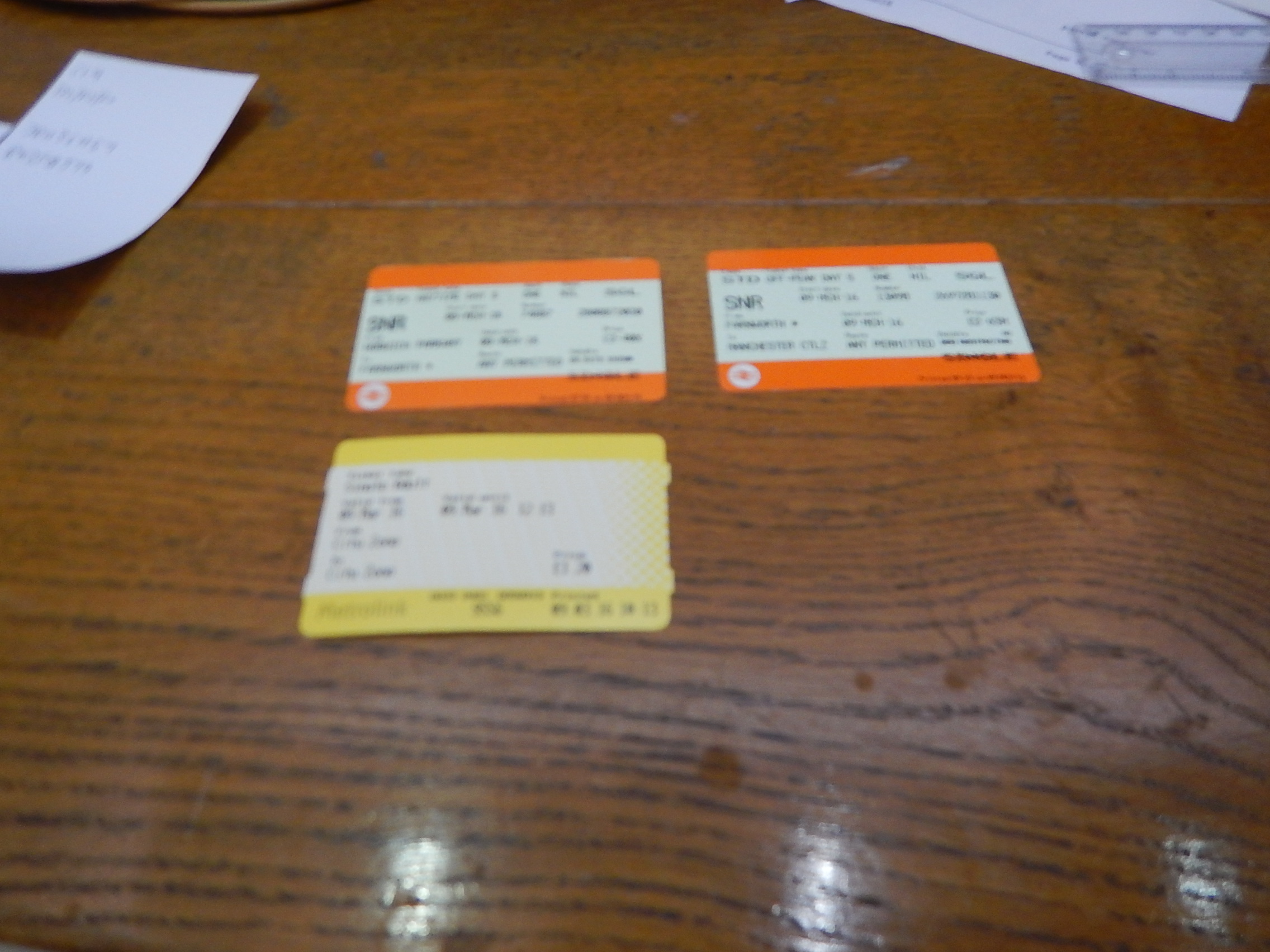
Three Tickets To Ride
The first took me from Horwich Parkway to Farnworth with a change at Bolton.
The second then took me from Farnworth to Manchester Victoria
The third was the tram ticket across the city.
As there were not even any ticket machines at Horwich Parkway and Farnworth, I had to use the Ticket Office.
It’s all so very nineteen-century!
At Farnworth, I got talking to a couple of fellow passengers, who were local and probably over ten years older than I am.
One had just visited his granddaughter in Bromley and said he’d been impressed with using his bank card as a ticket in London.
Mancunians seem to understand London’s simple ticketing concept, so why haven’t the transport authorities embraced contactless ticketing?
It might encourage a few more visitors and commercial activity, if all the great cities of the North allowed contactless ticketing with bank cards.
It will happen, if only because American Express, AndroidPay, ApplePay, Mastercard and Visa will insist it does for their own commercial interests.
Contactless Between East Croydon and Gatwick Airport
I recently travelled to Gatwick Airport and went via East Croydon station, which is a Zone 6 station and thus Freedom Pass territory for lucky Londoners like me!
I used my Freedom Pass to get to East Croydon, by changing at New Cross Gate from the East London Line.
At East Croydon, I found myself on the well-appointed Platform 5, with its coffee stall, waiting room, information booth and toilets.
The only thing that the platform lacks is an Oyster reader, so that those like me, who need to touch-out and touch-in again, as they are changing from a Zone 6 ticket to contactless for Gatwick Airport, don’t have to walk up and through the barrier.
Incidentally, for those like me who have a Freedom Pass, there is an interesting anomaly. After going through the barrier, I then re-entered the station using my AMEX card, before catching a Bognor Regis/Southampton Central service to Gatwick Airport.
At Gatwick I entered the Airport using my AMEX card and when I checked the statement I found that I’d been charged three pounds for the journey.
Coming back, I bought a ticket in a machine from Gatwick Airport to East Croydon and I was charged three pounds and forty-five pence.
So contactless cards may be cheaper! And the return ticket used my Senior Railcard!
I shall have to travel between East Croydon and Gatwick Airport on a Gatwick Express and see how much I’m charged.
It would seem to me that for Freedom Pass holders, the cheapest way to get to Gatwick, is to use the pass to get to East Croydon, exit the station and then re-enter the station using an Oyster or contactless bank card.
It’s just a pity, there isn’t an Oyster reader on the platform at East Croydon, so that those changing for Gatwick at the station can touch out and touch in again.
But this simple exercise showed that for those wanting to go to Gatwick, using contactless ticketing is the way to go.
 The Anonymous Widower