Norfolk Boreas Offshore Windfarm Contract Awarded
The title of this post, is he same as that of this article on the BBC.
These are the introductory paragraphs.
A government contract has been awarded for the first phase one of the biggest offshore wind zones in the world.
The Norfolk Boreas is expected to secure renewable electricity to meet the needs of around 1.5 million homes, Swedish firm Vattenfall said.
Alongside the Norfolk Vanguard project, it is part of the Norfolk Offshore Wind Zone, which was approved in February.
Together, Norfolk Boreas and Norfolk Vanguard will probably produce over 3 GW of electricity.
Ørsted Awarded Contract For World’s Single Biggest Offshore Wind Farm
The title of this post, is the same as that of this press release from Ørsted.
This is the sub-title.
The UK Department for Business, Energy and Industrial Strategy (BEIS) has awarded Ørsted a contract for difference for its Hornsea 3 offshore wind farm. The project was awarded at an inflation-indexed strike price of GBP 37.35 per MWh in 2012 prices.
And this is the first paragraph, which describes the size of the farm.
With a capacity of 2,852 MW, Hornsea 3 will produce enough low-cost, clean, renewable electricity to power 3.2 million UK homes, making a significant contribution to the UK Government’s ambition of having 50 GW offshore wind in operation by 2030 as part of the British Energy Security Strategy.
This map from Ørsted shows the location of the Hornsea wind farm and its three sections.
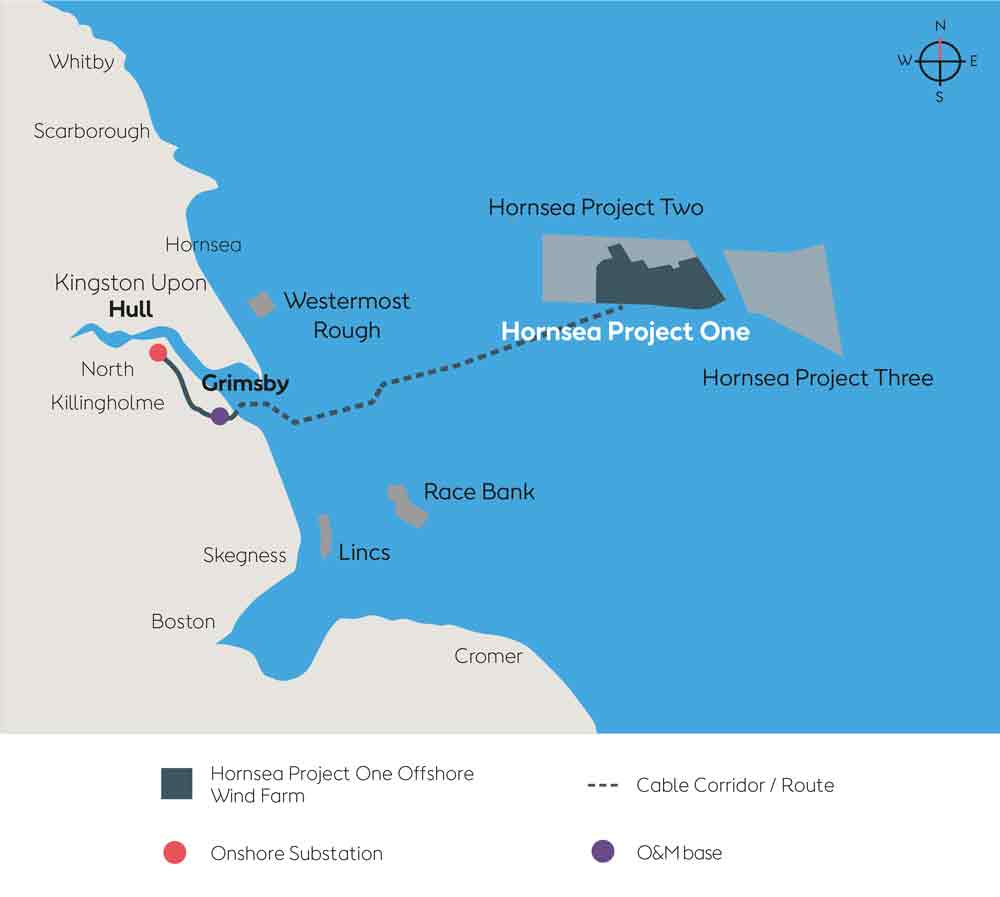
Note.
- The Hornsea Wind Farm, when fully developed, with a fourth section, is likely to have a capacity of around six GW.
- The Lincs, Race Bank and the Westernmost Rough wind farms are about another GW.
Looking at the map, I can see Humberside hosting the world’s largest hydrogen electrolyser to feed into the Humber Zero hydrogen network.
The Concept Of Remote Island Wind
This document from the Department of Business, Industry and Industrial Strategy lists all the Contracts for Difference Allocation Round 4 results for the supply of zero-carbon electricity that were announced yesterday.
The contracts have also introduced a concept that is new to me, called Remote Island Wind. All have got the same strike price of £46.39 per MWh.
Two of the projects on Orkney are community projects of around 30 MW, run by local trusts. This is surely, a model that will work in many places.
There is more on Orkney’s Community Wind Farm Project on this page of the Orkney Islands Council web site.
It could even have an electrolyser to provide hydrogen for zero-carbon fuel, when there is more electricity than is needed. Companies like ITM Power and others already build filling stations with an electrolyser, that can be powered by wind-generated electricity.
The other Remote Island Wind projects are larger with two wind farms of over 200 MW.
It does look to me, that the Department of BEIS is nudging wind farm developers in remote places to a model, that all stakeholders will embrace.
The Viking Wind Farm
I wrote about this wind farm in Shetland’s Viking Wind Farm.
There are more details in this press release from SSE enewables, which is entitled CfD Contract Secured For Viking Energy Wind Farm.
These introductory paragraphs, give a good explanation of the finances of this farm.
SSE Renewables has been successful in the UK’s fourth Contract for Difference (CfD) Allocation Round, announced today, and has secured a low-carbon power contract for 220MW for its wholly-owned Viking Energy Wind Farm (Viking) project, currently being constructed in Shetland.
Viking’s success in securing a contract follows a competitive auction process in Allocation Round 4 (AR4) where it competed within Pot 2 of the allocation round set aside for ‘less established’ technologies including Remote Island Wind.
The 443MW Viking project, which SSE Renewables is currently building in the Shetland Islands, has secured a CfD for 220MW (50% of its total capacity) at a strike price of £46.39/MWh for the 2026/27 delivery year.
The successful project will receive its guaranteed strike price, set on 2012 prices but annually indexed for CPI inflation, for the contracted low carbon electricity it will generate for a 15-year period. Securing a CfD for Viking stabilises the revenue from the project whilst also delivering price security for bill payers.
It’s very professional and open to explain the capacity, the contract and the finances in detail.
The press release also has this paragraph, which details progress.
Viking is progressing through construction with over 50 per cent of turbine foundation bases poured. When complete in 2024, Viking Energy Wind Farm will be the UK’s most productive onshore wind farm in terms of annual electricity output, with the project also contributing to Shetland’s security of supply by underpinning the HVDC transmission link that will connect the islands to the mainland for the first time.
SSE also released this press release, which is entitled Major Milestone Reached As First Subsea Cable Installation Begins On Shetland HVDC Link, where this is the first paragraph.
The first phase of cable laying as part of the SSEN Transmission Shetland High-Voltage Direct Current (HVDC) Link began this week off the coast of Caithness, marking a major milestone in the £660M project.
SSE seem to be advancing on all fronts on the two projects!
The Stornoway Wind Farm
This press release from EDF Renewables is entitled EDF Renewables UK Welcomes Contract for Difference Success, where these are the first two paragraphs.
Two EDF Renewables UK projects bid into the Contract for Difference (CfD) auction round held by the UK Government’s BEIS department have been successful.
The projects are the Stornoway wind farm on the Isle of Lewis and Stranoch wind farm in Dumfries and Galloway. Together these onshore wind farms will provide 300 MW of low carbon electricity which is an important contribution to reaching net zero.
The press release also gives this information about the contract and completion of the Stornoway wind farm.
Stornoway Wind Farm on the Isle of Lewis is a joint venture with Wood. The project has won a CfD for 200 MW capacity, the strike price was £46.39, the target commissioning date is 31 March 2027.
This page on the Lewis Wind Power web site, gives these details of the Stornoway Wind Farm.
The Stornoway Wind Farm would be located to the west of the town of Stornoway in an area close to the three existing wind farm sites.
The project has planning consent for up to 36 turbines and is sited on land owned by the Stornoway Trust, a publicly elected body which manages the Stornoway Trust Estate on behalf of the local community.
The local community stands to benefit as follows:
- Community benefit payments currently estimated at £900,000 per annum, which would go to an independent trust to distribute to local projects and organisations
- Annual rental payments to local crofters and the Stornoway Trust – which we estimate could total more than £1.3m, depending on the CfD Strike Price secured and the wind farm’s energy output
- Stornoway Wind Farm is the largest of the three consented wind farm projects with a grid connection in place and is therefore key to the needs case for a new grid connection with the mainland. Indeed, the UK energy regulator Ofgem has stated that it will support the delivery of a new 450MW cable if the Stornoway and Uisenis projects are successful in this year’s Contract for Difference allocation round.
Note the last point, where only the Stornoway wind farm was successful.
The Uisenis Wind Farm
This press release from EDF Energy is entitled Lewis Wind Power Buys Uisenis Wind Farm, gives these details of the sale.
Lewis Wind Power (LWP), a joint venture between Amec Foster Wheeler and EDF Energy Renewables has bought the Uisenis Wind Farm project on the Isle of Lewis. The wind farm has planning consent for the development of 45 turbines with a maximum capacity of 162 MW. This would be enough to power 124,000 homes and would be the biggest renewable energy development on the Western Isles.
LWP owns the Stornoway Wind Farm project located around 20km to the north of Uisenis which has planning consent to develop 36 turbines to a maximum capacity of 180 MW – enough to power 135,000 homes.
This would bring Stornoway and Uisenis wind farms under the similar ownership structures.
This is a significant paragraph in the press release.
On behalf of Eishken Limited, the owner of the site where the Uisenis Wind Farm will be located, Nick Oppenheim said: “I am delighted that LWP are taking forward the wind farm. The resources available on the Eishken estate, and the Western Isles in general, means that it is an excellent location for renewable energy projects and, as such, the company is also developing a 300MW pumped storage hydro project immediately adjacent to the Uisenis wind farm. With such potential for renewables and the positive effect they will have on the local community, economy, and the UK as a whole I am are looking forward to positive news on both support for remote island projects and the interconnector.”
Note the mention of pumped storage.
This article on the BBC is entitled Pumped Storage Hydro Scheme Planned For Lewis, where this paragraph introduces the scheme.
A pumped storage hydro scheme using sea water rather than the usual method of drawing on freshwater from inland lochs has been proposed for Lewis.
The only other information is that it will provide 300 MW of power, but nothing is said about the storage capacity.
It looks like Lewis will have a world-class power system.
Mossy Hill And Beaw Field Wind Farms
Mossy Hill near Lerwick and Beaw Field in Yell are two Shetland wind farms being developed by Peel L & P.
This press release from Peel L & P is entitled Government Support For Two Shetland Wind Farms, where these are the first two paragraphs.
Plans for two onshore wind farms on the Shetland Islands which would help meet Scotland’s targets for renewable energy production are a step closer to being delivered after receiving long-term Government support.
Clean energy specialists Peel NRE has been successful in two bids in the Department for Business, Energy and Industrial Strategy’s (BEIS) Contracts for Difference (CfD) scheme; one for its Mossy Hill wind farm near Lerwick and the other for Beaw Field wind farm in Yell.
It looks like the two wind farms will power 130,000 houses and are planned to be operational in 2027.
Conclusion
I must admit that I like the concept. Especially, when like some of the schemes, it is linked to community involvement and improvement.
Only time will tell, if the concept of Remote Island Wind works well.
 The Anonymous Widower