Could High Speed Two Trains Serve Chester And North Wales?
This may seem a slightly outrageous proposal to run High Speed Two trains to Chester.
- The city is a major tourist destination.
- Despite its closeness to Crewe it is a major rail hub, with services across Wales to Cardiff, Holyhead and Llandudno and along the border between England and Wales to Shrewsbury and Newport.
- Merseyrail serves the city and the station can be considered to be part of Liverpool’s extensive commuting area. This service is likely to be more reliable and faster with the delivery of new Class 777 trains.
- For parts of Merseyside, travelling to London or Manchester Airport, is easier via Chester than Liverpool Lime Street or Liverpool South Parkway.
If the promoters of High Speed Two are serious about creating a railway for the whole country, then I feel that running trains direct to and from Chester could be very beneficial for the towns and cities, that can be served by the current network at Chester.
Current And Possible Timings
Currently, trains take two minutes over two hours between Euston and Chester.
When Avanti West Coast introduces the new Hitachi AT-300 trains on the route, the following times will be possible.
- Euston and Crewe via West Coast Main Line – 90 minutes – Fastest Pendelino
- Crewe and Chester – 24 minutes – Current timing
This would give a time of one hour and 54 minutes, which is a saving of 8 minutes. But a lot of carbon would not be emitted between Euston and Crewe.
I estimate, that with High Speed Two Phase 2a completed, the following timings will be possible.
- Euston to Crewe via HS2 – 55 minutes – HS2 website
- Crewe and Chester – 24 minutes – Current timing
This would give a time of one hour and 19 minutes, which is a saving of 43 minutes.
Infrastructure Needed
There will need to be some infrastructure changes.
Platform Lengthening At Chester Station
The station would probably be served by two-hundred metre long High Speed Two Classic-Compatible trains, which might need some platform lengthening.
This Google Map shows the station.
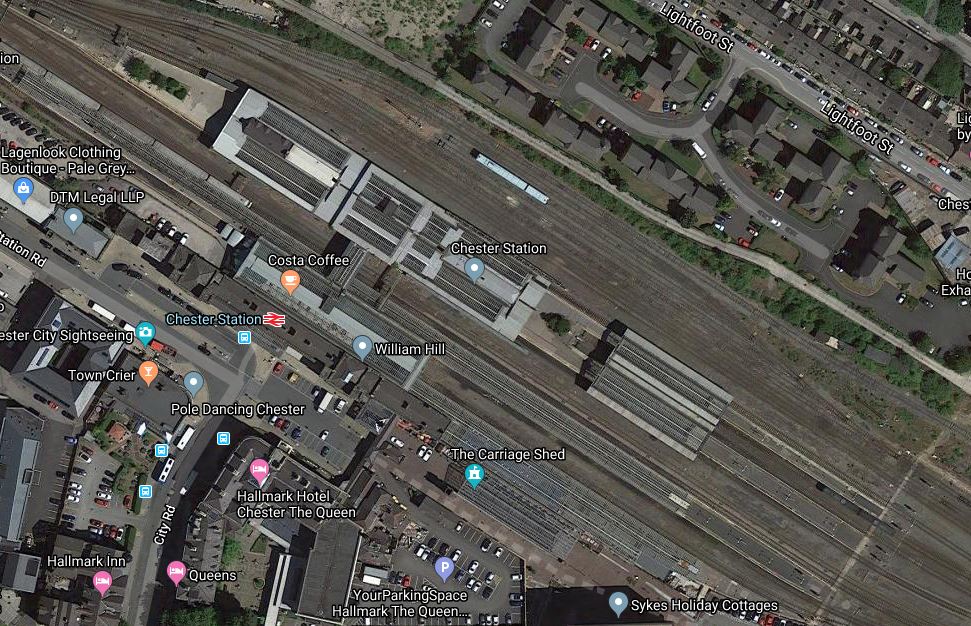
It looks to me, that there is plenty of space.
Will Chester And Crewe Be Electrified?
We know little about the capabilities of the trains proposed by the various manufacturers.
But, I wouldn’t be surprised that one or more of the proposals use batteries for one of the following purposes.
- Regenerate braking.
- Emergency power.
- Range extension for up to perhaps sixty miles.
As Chester and Crewe stations are only twenty-one miles apart with no intermediate stations, which will be run at an average speed of only 52 mph I don’t think it will be impossible to extend the service to Chester on battery power.
If electrification is required I wrote about it in Hitachi Trains For Avanti.
As it is only just over twenty miles, I don’t think it will be the most challenging of projects, although there does seem to be a lot of bridges.
Electrification would also allow Avanti West Coast’s Hitachi trains to run on electricity to Chester.
What About Holyhead?
Holyhead could become a more important destination in the next few years.
It is probably the best alternative to avoid flying and driving between Great Britain and the Island of Ireland.
And who can accurately predict, what effect Brexit and thinking about global warming will have?
I have a feeling that after electrification to Chester, using on-board energy storage could be used West of Chester.
It is very difficult to predict battery ranges in the future, but I can see a two hundred metre long High Speed Two Classic-Compatible train being able to reach Holyhead on battery power, with or without some limited extra electrification.
Alternatively, the UK and Welsh governments, might bite the bullet and just electrify the whole route between Crewe and Holyhead.
I have found a train on Real Time Trains, that covered the 105.5 miles between Holyhead and Crewe in two hours and 11 minutes at an average speed of 48 mph. The train took then a total of three hours and forty-five minutes to get to Euston
I estimate that with electrification and some track improvements, that it will be possible to travel between Euston and Holyhead in under three hours before High Speed Two.
Conclusion
It looks to me, that when High Speed Two, think about adding extra destinations, Chester and Holyhead could be on the list.
I also suspect that even without electrification and High Speed Two services, but with the new Class 805 trains, the route could be a valuable one for Avanti West Coast.
Should Phase One Of High Speed Two Go To Birmingham Or Crewe?
The important Crewe station is currently planned to be reached from London in Phase 2a of High Speed Two, with the first train scheduled for 2027, according to Wikipedia.
There have been changes over the years and the delivery of the line at Crewe was brought forward by a few years, so that now it is just twelve months after the line opened to Birmingham.
So is it better that Phase 1 of High Speed Two goes to Birmingham or Crewe?
The Route Of High Speed Two Between Birmingham And Crewe
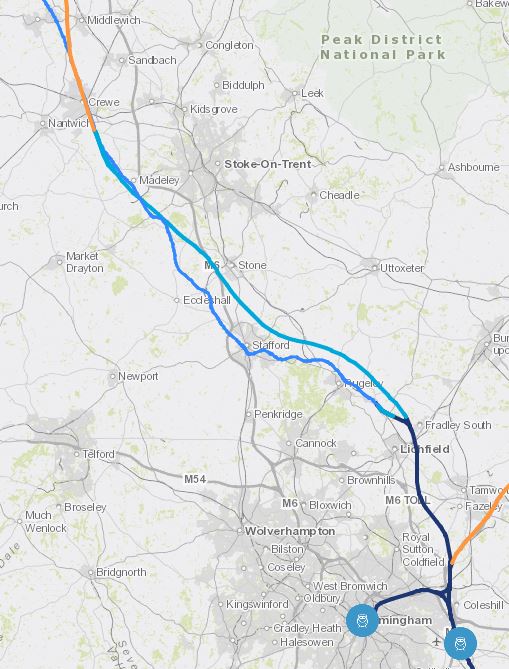
This map clipped from the High Speed Two web site, shows the route between Birmingham and Crewe.
Note.
- Phase 1 is shown in dark blue
- Phase 2a is shown in a lighter blue.
- Phase 2b is shown in orange.
- Crewe is in the North-West corner of the map.
- Of the two routes in the middle Phase 2a is to the East with the West Coast Main Line to the West.
- Birmingham is in the South-East Corner of the map, where two stations are shown; Birmingham Curzon Street in the West and Birmingham Interchange slightly to the South.
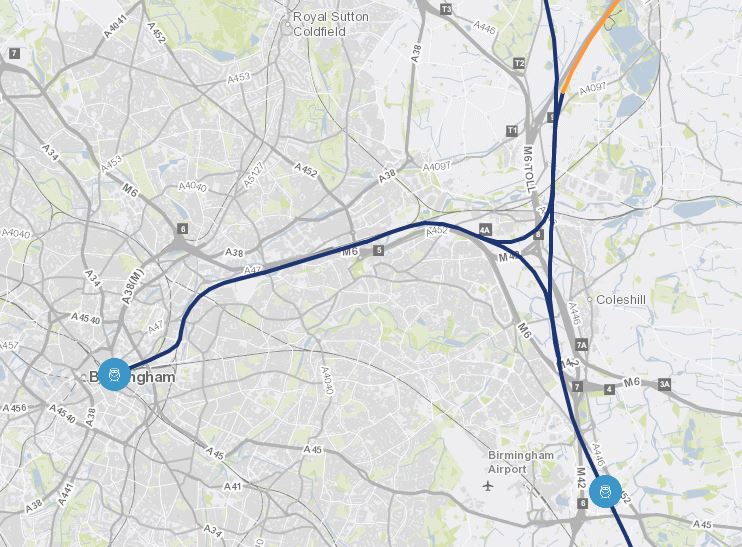
This second map, shows High Speed Two to the East of Birmingham.
Note.
- The colours are the same.
- The Eastern leg to Nottingham and Leeds, which is shown in orange, goes off to the North-East.
This third map shows the route around Lichfield.

Note.
- Phase 1 is shown in dark blue
- Phase 2a to Crewe is the branch going North and is shown in a lighter blue.
- The other branch going to the North West is the existing West Coast Main Line.
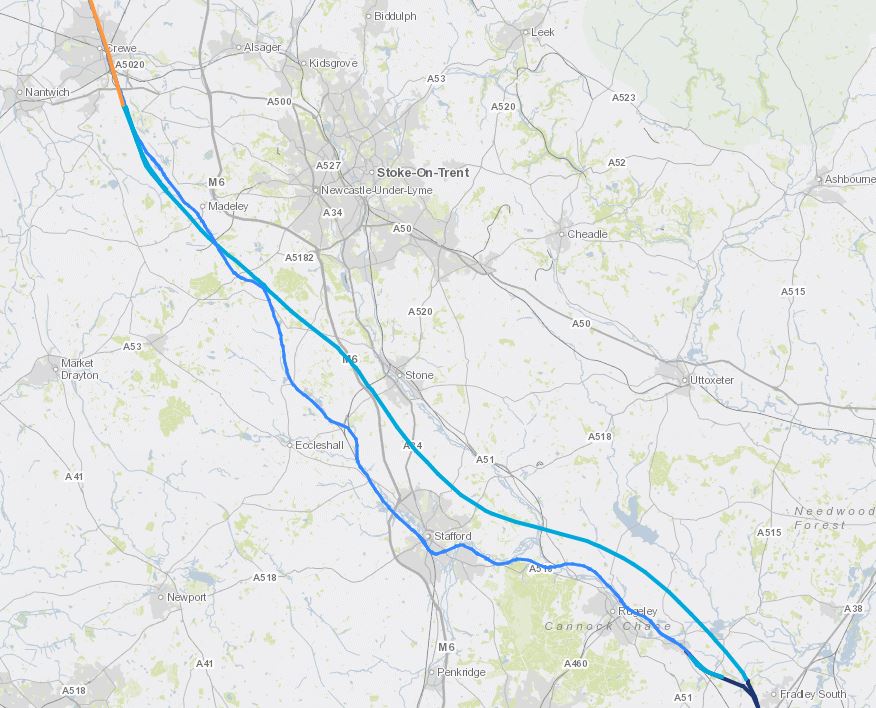
This fourth map shows the routes between Lichfield and Crewe
Note
- The colours are the same.
- Phase 2a of High Speed Two is the straighter route to the East.
- The more curvy route is the existing West Coast Main Line.
This fifth map shows the section of the route through Crewe.

Note.
- At the North of the map, the blue line is the West Coast Main Line and the orange line is the High Speed Two route to Manchester.
- Through Crewe the two lines share a route and may even share tracks.
- At the South of the map the High Speed Two route is on the East, with the West Coast Main Line to the West.
Click here to access High Speed Two’s interactive map, that I used to obtain these maps.
Phase One Services
Currently the following services are planned for Phase One of High Speed Two.
- Three trains per hour (tph) – Birmingham Curzon Street, via Old Oak Common (OOC) and Birmingham Interchange.
- Three tph – Birmingham Interchange via OOC.
- Two tph – Liverpool Lime Street via OOC, Stafford (1tph), Crewe (1tph) and Runcorn
- Three tph – Manchester Piccadilly via OOC, Wilmslow (1tph) and Stockport
- One tph – Preston via OOC, Crewe, Warrington Bank Quay and Wigan North Western
- One tph – Glasgow Central via OOC and Preston
Summing these up, the following totals are calculated.
- 6 tph – Birmingham Interchange
- 2 tph – Crewe
- 2 tph – Preston
Most other stations get two tph or less.
Birmingham Or Crewe?
In the following sections I will discuss various points.
Service Between Euston And Stafford
There is an interesting point shown up by the maps and the proposed services for Phase One.
Trains using High Speed Two won’t be able to call at Stafford unless they take a diversion along the West Coast Main Line. So after Phase 2a has been built between Lichfield and Crewe, Stafford could lose its High Speed Two service, unless they use the classic route.
Birmingham Interchange Station
Birmingham Interchange station will be unaffected by the decision of the terminus of Phase 1 of High Speed Two.
- It will be a Parkway station, with probably lots of parking.
- It will be connected to the National Exhibition Centre, Birmingham International station and Birmingham Airport by means of a people mover.
- All High Speed Two services go through the station and six tph are proposed to stop in Phase 1.
- The West Midlands Metro could serve the station.
- It will be thirty-eight minutes from London. Stansted Airport is fifty and Gatwick is around thirty!
I suspect that the time to and from London and a four-hundred metre long train every ten minutes, will mean that this will be a very busy station.
- Will Londoners treat Birmingham Airport, as a London Airport?
- Motorways to the East of Birmingham could mean the West Midlands treats the station as a Park-and-Ride station for London.
- Birmingham International station is a well-connected station with five platforms.
This station could become the busiest in the UK.
Birmingham Curzon Street Station
Birmingham Curzon Street station will be an unusual station for the UK, in that will be a city-centre terminal station running East-West, with services going both North and South, using a junction with the main High Speed Two.
- It will have seven platforms.
- It will be a short walk to Birmingham Moor Street station.
- It will have a stop on the West Midlands Metro line between Digbeth and Grand Central
Birmingham are hoping the station will be a catalyst for redevelopment of the area around the station.
After Phase 2 of High Speed Two services to the South are planned to include.
- Three tph – Euston via Birmingham Interchange and OOC.
- One tph – Birmingham Interchange direct
The hourly shuttle between the two stations makes up the service between them to a Turn-Up-And-Go frequency of four tph.
After Phase 2 of High Speed Two services to the North are planned to include.
- One tph – Stafford or Crewe direct
- One tph – Manchester Piccadilly via Crewe and Manchester Interchange
- Two trains per day – Preston via Crewe, Manchester Interchange and Wigan North Western
- Two trains per day – Carlisle via Manchester Interchange, Wigan North Western and Preston.
- One tph – Glasgow via Warrington Bank Quay, Wigan North Western, Preston and Carlisle.
- One tph – Edinburgh via Crewe, Warrington Bank Quay, Wigan North Western, Preston and Carlisle.
- One tph – Leeds via East Midlands Hub
- One tph – York via East Midlands Hub and Sheffield
- One tph – Newcastle via York
Summing up four tph go via the Western leg and Crewe to the North and three tph go via the Eastern leg and East Midlands Hub.
I suspect it is all about balancing the services between the three legs of High Speed Two.
- London and Birmingham
- Birmingham and North West England and Scotland
- Birmingham and North East England.
High Speed Two has been designed for fifteen tph running into Euston, so if all parts of the route can handle that number of trains, there must be a lot of scope to add extra services.
Birmingham Curzon Street with its seven platforms would balance all the services and probably help to sort things out in times of disruption.
Between Birmingham International Station And Lichfield
The maps show that this section must be built to connect High Speed Two to the West Coast Main Line just to the North of Lichfield Trent Valley station on the Trent Valley Line, as there is no other possible connection between the two routes.
This map clipped from the High Speed Two map, shows where the two lines join.
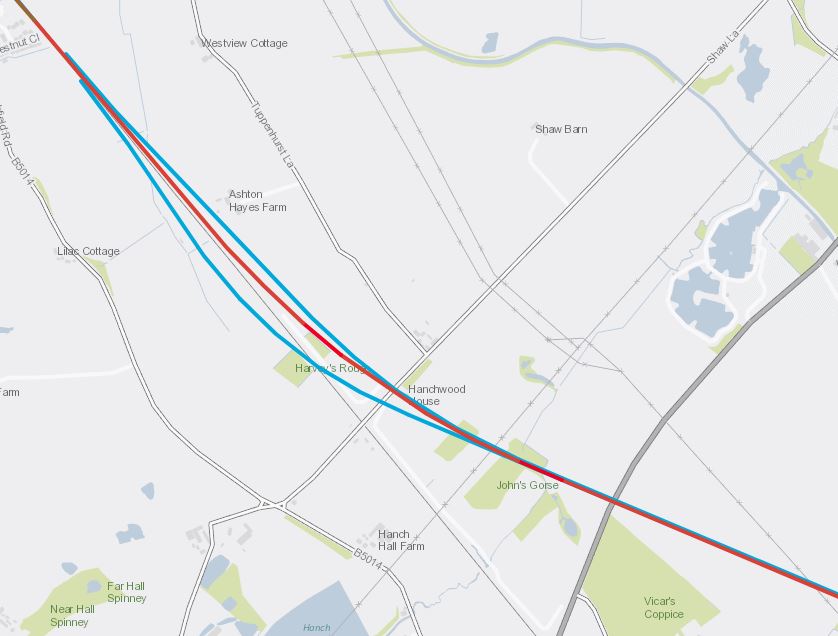
It is obviously designed for speed.
I estimate that the distance between Birmingham Interchange and this junction is not far short of twenty miles.
Between Lichfield And Crewe Station
Along the West Coast Main Line, the distance is around forty-two miles, but the straighter route proposed for High Speed Two could be a few miles shorter and several minutes faster.
If Phase 1 of High Speed Two were not to be built, trains would have to share the West Coast Main Line through Stafford station.
Currently, Stafford station can have as many as fifteen tph through the station.
Phase 1 of High Speed Two will have these trains going North of Birmingham Interchange station.
- Two tph – Liverpool Lime Street
- Three tph – Manchester Piccadilly
- One tph – Preston
- One tph – Glasgow Central
Which is a total of seven tph, with one tph stopping at Stafford.
I doubt they could all be squeezed through Stafford.
There would certainly be no space for any trains starting at Birmingham Curzon Street.
This is a very simple example of the capacity problems on the West Coast Main Line, which can only be solved by extra tracks to the North.
Crewe Station
Consider these points about Crewe station.
- It is not of a design that reflects its status.
- Currently, it handles 23 tph, that go all over the North West and much further.
- Phase 1 of High Speed Two would add another seven tph
- New services are planned.
- A rebuilding of the station would surely improve both capacity and operational efficiency.
- Looking at the fifth of the maps, it appears that the West Coast Main Line and High Speed Two share a corridor , if not tracks, through Crewe station.
For all these reasons, I am convinced that if High Speed Two passes through, then the station will need a rebuild.
So it looks like whether High Speed Two goes ahead or not, Crewe station will need an expensive rebuild.
Extra High Speed Two Services Through Crewe
Once Phase 2a has been completed, this will allow some extra Phase 2 services to be run along the route from Euston.
- Two tph from one tph – Glasgow Central via OOC, Birmingham Interchange (1tph), Preston and Carstairs
- Two tph – Edinburgh via OOC, Birmingham Interchange (1tph), Preston, Carstairs and Edinburgh Haymarket
I suspect these might run as a pair of trains as far as Carstairs and split and join there.
There will also be extra services between Birmingham Curzon Street, Crewe and Stafford to Edinburgh, Glasgow, Liverpool Lime Street, Manchester Piccadilly and Preston.
It is worth noting, that when all the services going North from Birmingham are summarised, you get the following.
- Four tph – Manchester Piccadilly
- Three tph – Liverpool Lime Street
- One tph – Preston
- Four tph – Glasgow/Edinburgh
- One tph – Stafford or Crewe
It looks a bit complicated North of Crewe, but it will create a frequent service between Crewe and Scotland.
High Speed To Chester
It should also be noted, that if between Crewe and Chester were to electrified, High Speed Two trains could serve Chester.
- Chester is a major rail interchange for the Border areas between England and Wales, North Wales and the Wirral.
- It is also connected to Merseyrail.
- Chester is an important tourist destination, with the city centre close to the station.
Electrification might also allow battery-electric versions of Avanti’s new Hitachi trains to serve some of their routes, without using diesel.
This simple example of Chester, says to me that opening High Speed Two to Crewe could allow extra services to be developed.
Conclusion
It appears from this analysis, that the only advantage of not building Phase 2a is that about forty miles of line between Lichfield and Crewe can be pushed back for a few years.

