Proposed High-Speed Two Services Are Not Complete
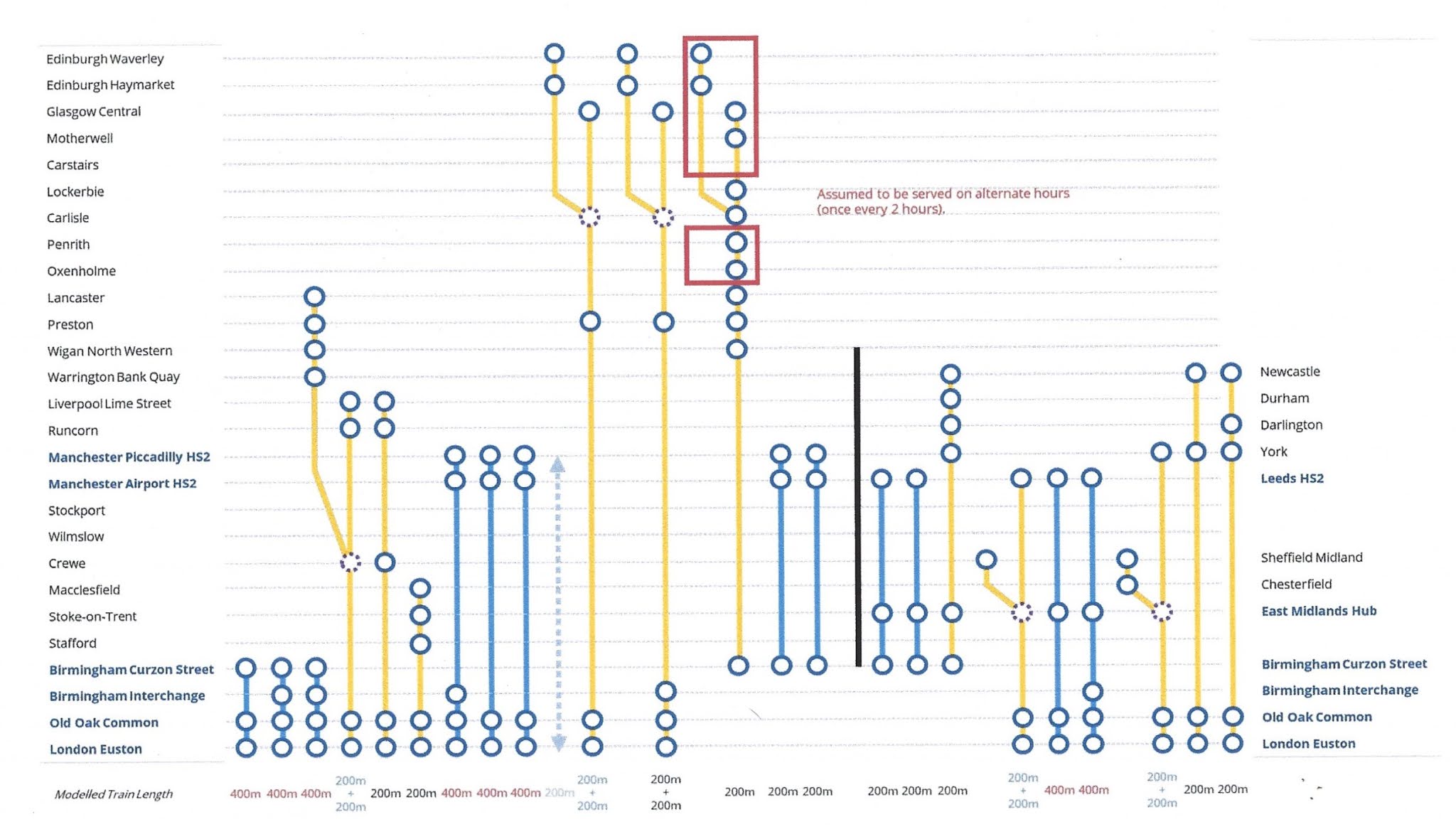
This diagram shows High Speed Two services.
Note.
- Trains to the left of the vertical black line are Phase 1 and those to the right are Phase 2.
- Full-Size trains are shown in blue.
- Classic-Compatible trains are shown in yellow.
- The dotted circles are where trains split and join.
- In the red boxes routes alternate every hour.
Click on the diagram to enlarge it.
Are The Services Incomplete Or Has Someone Left Something Out?
Look at trains 4, 5 and 6.
- Train 4 is a pair of Classic-Compatible trains, which split at Crewe, with one going to Liverpool Lime Street and the other to Lancaster.
- Train 5 is a single Classic-Compatible train, that goes to Liverpool Lime Street.
- Train 6 is a single Classic-Compatible train, that goes to Macclesfield.
As an example, Train 5 could be a pair of Classic-Compatible trains, which split at Crewe, with one going to Liverpool Lime Street and the other to Chester, Llandudno, Bangor and Holyhead. I actually believe that this would be a way of creating a low-carbon route to Dublin, with a zero-carbon high-speed ferry from Holyhead.
What to do with Train 6 is more difficult.
- Stafford and Stoke need to be served by High Speed Two.
- Stafford, Stoke and Macclesfield are not stations with long platforms, so may not be suitable places to split a pair of Classic-Compatible trains.
- Places North of Macclesfield to terminate trains are not numerous and probably only Manchester and Huddersfield may be suitable.
The alternative might be to split a pair of Classic-Compatible trains forming Train 6 at Birmingham Interchange, one going to Stafford, Stoke and Macclesfield and the other going to Blackburn, Blackpool, Crewe, Lancaster, Liverpool or Preston
West Coast Main Line Electro-Diesels On Test
The title of this post, is the same as that of this article on Railway Gazette.
This is the first paragraph.
The first two of 13 Hitachi Class 805 electro-diesel trainsets ordered for Avanti West Coast services are undergoing testing on the West Coast Main Line ahead of entry into service later this year.
These Class 805 trains will go to places like Chester, Bangor and Holyhead via Crewe.
It is interesting to look at various Crewe to London Euston services this morning.
- 0740 – Class 390 train – From Liverpool – One Stop – 1 hour 40 minutes
- 0755 – Class 221 train – From Holyhead – One Stop – 1 hour 40 minutes
- 0832 – Class 390 train – From Manchester – One Stop – 1 hour 37 minutes
- 0844 – Class 390 train – From Glasgow – 1 hour 28 minutes
Note.
- The first field is the four-figure time that the train left Crewe.
- The last field is the journey time between Crewe to London Euston.
- The Class 390 and 805 trains will use electricity to run between Crewe and London Euston, whereas the Class 221 train will use diesel.
- Crewe and London Euston is 158 miles.
- The Glasgow train covers the 158 miles at an average speed of 107.7 mph.
I have some thoughts.
What Will Be The Time For A Class 805 Train Between Crewe And London Euston?
Consider.
- From Crewe, the Class 805 train will be using the electrification to London Euston.
- The Class 390 train can tilt, whereas the Class 805 train can’t!
- The Class 805 train is at least three tonnes lighter per car, than the Class 390 train.
- The lighter weight and possibly more power of the Class 805 trains, will give better acceleration.
- There is twenty-one years of difference in the build dates of the two trains. In that time, I also suspect that Network Rail have improved the track between Crewe and London Euston.
- Norton Bridge junction has been improved to avoid conflicts.
- It would be very convenient for Avanti West Coast and Network Rail, if the performance under electrification of the two trains were similar.
For these reasons, I believe that the performance of a non-stop Crewe And London Euston service using a Class 805 train will be such that it can match that of a Class 390 train.
I would also expect that with a similar stopping pattern between Crewe And London Euston, there would be little to choose between the two trains.
I can see with its better acceleration and lighter weight that the time between Crewe and London Euston will be perhaps a dozen minutes faster than the current time.
Using the electrification will also save a lot of diesel fuel with all its emissions.
Along The North Wales Coast Line
Consider.
- Crewe and Holyhead is 105.5 miles and takes two hours and two minutes in a typical service.
- These figures give an average speed of 52 mph.
- There are six stops, which are scheduled to take a total of ten minutes.
- About half the North Wales Coast Line has a maximum operating speed of 90 mph, but through Chester, Llandudno Junction and West of Bangor, the operating speed is 75 mph or less.
I am fairly sure, that with both the current Class 221 trains and the new Class 805 trains, it will be the track, rather than the train that determines the average speed.
It would therefore appear that if the average speed can be raised by track improvements these time savings could be achieved.
- 60 mph – 105.5 mins – 16.5 mins
- 70 mph – 90 mins – 32.5 mins
- 80 mph – 79 mins – 43 mins
- 90 mph – 70 mins – 52 mins
- 100 mph – 63 mins – 59 mins
- 110 mph – 58 mins – 64 mins
- 120 mph – 53 mins – 69 mins
- 130 mph – 49 mins – 73 mins
- 140 mph – 45 mins – 77 mins
Note.
- The first column is the average speed.
- The second column is the time between Holyhead and Crewe.
- The third column is the saving.
- I suspect that 90 or 100 mph would be the highest possible practical average speed.
- Trains average 100 mph on several long sections of the Great Eastern Main Line.
- I put in the higher speeds to show what is possible, if the North Wales Coast Line were to be converted into a 140 mph electrified line with digital signalling.
Even at these relatively slow speeds compared to High Speed Two, there are considerable time savings to be made, just by improving the tracks.
Incidentally, High Speed Two is quoted in Wikipedia as aiming for a Crewe and London Euston time of 56 minutes, so by averaging 100 mph between Crewe and Holyhead, London Euston and Holyhead could be under two hours.
Batteries And Class 805 Trains
I wouldn’t be surprised that soon after the Class 805 trains are delivered, they could be converted to a version of Hitachi’s Intercity Tri-Mode Battery Train, the specification of which is shown in this Hitachi infographic.

Note.
- I suspect that the batteries will be used to handle regenerative braking on lines without electrification, which will save diesel fuel and carbon emissions.
- The trains accelerate faster, than those they replace.
- The claimed fuel and carbon saving is twenty percent.
- It is intended that these trains will be introduced in 2023.
But Hitachi have not given any predictions of the range of these trains on battery power alone.
However, they do claim a battery range of 56 miles for the Hitachi Regional Battery Train, which is based on similar technology.
These trains could help in speeding the stops between Crewe and Holyhead.
- Batteries would be charged at Holyhead and on the electrification to the South of Crewe.
- At each stop, trains would use a proportion of the power in the battery to accelerate faster and save fuel and cut emissions.
- Battery power would be used in stations for train hotel power.
- Westbound trains would arrive in Holyhead and Southbound trains would arrive in Crewe, with not much power in the battery.
I suspect that, whether diesel or battery power is used, will be controlled by a sophisticated computerised control system.
Electrification Along The North Wales Coast Line
I think this will eventually happen to allow High Speed Two Classic-Compatible trains to run to Chester and along the North Wales Coast Line to Llandudno, Bangor and Holyhead.
But there is no benefit to be gained in electrifying until higher speeds are possible, after track improvements.
I believe these times will be possible with track improvements and the opening of High Speed Two.
- Holyhead and Crewe – Class 805 train and 80 mph average – 79 mins
- Holyhead and Crewe – Class 805 train and 90 mph average – 70 mins
- Holyhead and Crewe – High Speed Two Classic-Compatible train, electrification and 100 mph average – 63 mins
- Crewe and London Euston – Class 805 train – 80 mins
- Crewe and London Euston – High Speed Two Classic-Compatible train – 56 mins
Note, electrification will be needed, to run High Speed Two Classic-Compatible trains along the North Wales Coast Line.
I am confident that these times will be possible.
- Holyhead and London Euston – Class 805 train and 90 mph average along the coast – 2 hours 30 mins
- Holyhead and London Euston – High Speed Two Classic-Compatible train and 100 mph average along the coast – 2 hours
The current time between Holyhead and London Euston is over three hours 45 minutes.
Conclusion
These trains will certainly speed up trains to North Wales.
New Merseyrail Train Runs 135km On Battery
The title of this post, is the same as that of this article on Liverpool Business News.
This paragraph gives the details.
Posting on social media site Linked In, Joaquim Font Canyelles, project leader at Stadler Rail, said: “Our new Merseytravel class 777 IPEMU (Independent Powered Electrical Multiple Unit) proved its strength after running 135 km fully loaded and without external current supply, which is much longer than we expected.
Note that 135 km is 83.9 miles.
These are possible routes, where the battery-electric trains could be deployed.
- Bidston and Wrexham Central – 27.5 miles
- Canada Dock Branch – 4.6 miles
- Chester and Crewe – 21.2 miles
- Chester and Runcorn East – 13 miles
- Ellesmere Port and Runcorn East – 10.8 miles
- Ormskirk and Preston – 15.3 miles
- Hunts Cross and Manchester Oxford Road – 27.1 miles
- Kirkby and Manchester Victoria – 30 miles
- Kirkby and Wigan Wallgate – 12 miles
- Liverpool Lime Street and Chester via Runcorn – 27 miles
- Liverpool Lime Street and Manchester Oxford Road – 31.5 miles
- Southport and Manchester Oxford Road – 37.8 miles
- Southport and Stalybridge – 45.5 miles
- Southport and Wigan Wallgate – 17.4 miles
Note.
- All routes could be done both ways with the exception of Southport and Stalybridge and possibly Southport and Manchester Oxford Road.
- Southport trains to Wigan and Manchester would charge their batteries at Southport.
- Central Liverpool and Wrexham Central would not need the change at Bidston.
- Hunts Cross and Preston via Central Liverpool would not need the change at Ormskirk.
- A Liverpool Lime Street and Manchester Oxford Road service would be possible.
Batteries can add a lot of range to a city’s railway system.
Conclusion
If Merseyrail can get hold of the routes to Crewe, Manchester, Preston and Wrexham, the Liverpool City Region will have one of the best metros for a city of its size.
Heritage Train Company Launches First Class Service In Competition With Avanti West Coast
The title of this post, is the same as that of this article on Business Live.
These are the two introductory paragraphs.
A heritage train company is launching a charter service between London and the North West to help passengers frustrated by Avanti West Coast’s severe disruption.
Crewe-based Locomotive Services Group will begin operating a first class-only charter service to and from London Euston on Friday.
These are more details of the service.
The train’s air-conditioned carriages are restored British Rail Mark 3 stock with three-abreast seating, tables, power points and large windows.
The service will only operate on Fridays for the next three weeks, and will run at 110mph using electric locomotives.
It will depart from Crewe at 2.29pm, running non-stop to arrive at London Euston at 4.12pm.
The train will set off to return north at 5.27pm, calling at Birmingham International, Birmingham New Street, Wolverhampton, Stafford, Crewe and Wilmslow before arriving at Manchester Piccadilly at 8.45pm.
I have a feeling that the Mark 3 coaches, were acquired from Greater Anglia.
Locomotive Services Group, also owns a couple of main-line registered Class 90 locomotives.
I am seriously, thinking of taking one of their trips.
I can travel in Mark 3 and Mark 4 coaches, all Stadler and Hitachi trains, but if I travel in a Class 390 train, the air-conditioning plays havoc with my body.
Avanti West Coast can’t put Class 807 trains on London Euston and Liverpool Lime Street. too soon for me!
Red Wall Commuters To Get Rail Revolution
The title of this post, is the same as that of this article on The Sunday Times.
This is the first paragraph.
Nearly £100 billion will be spent on England’s railways outside London, including the construction of three new high-speed lines that will cut journey times in half.
The paper is also predicting that the Birmingham and Leeds leg of High Speed Two will be scrapped.
The three new high speed lines are.
- Birmingham and East Midlands Parkway
- Leeds and Sheffield
- Manchester and Crewe.
I have felt for some time, that timings between London and Yorkshire can be upgraded almost to High Speed Two levels by upgrading the Midland Main and the East Coast Main Lines.
I shall be doing some calculations, when the schemes are announced on Thursday.
Property Buyers Want Train To Take The Strain, Says Rightmove
The title of this post is the same as that of this article in today’s Times.
Aooarently people are buying houses within an hour’s commute to London, with Chelmsford, Crewe and Sittingbourne being especially popular.
Note.
- Chelmsford will soon be served by a new train fleet.
- Sittingbourne is served by Southeastern’s HighSpeed trains.
- Crewe is served by fast services and will be on High Speed Two, earlier than many places.
Liverpool and Birmingham City Centres are also popular according to the article.
Thoughts On Phase 2a Of High Speed Two
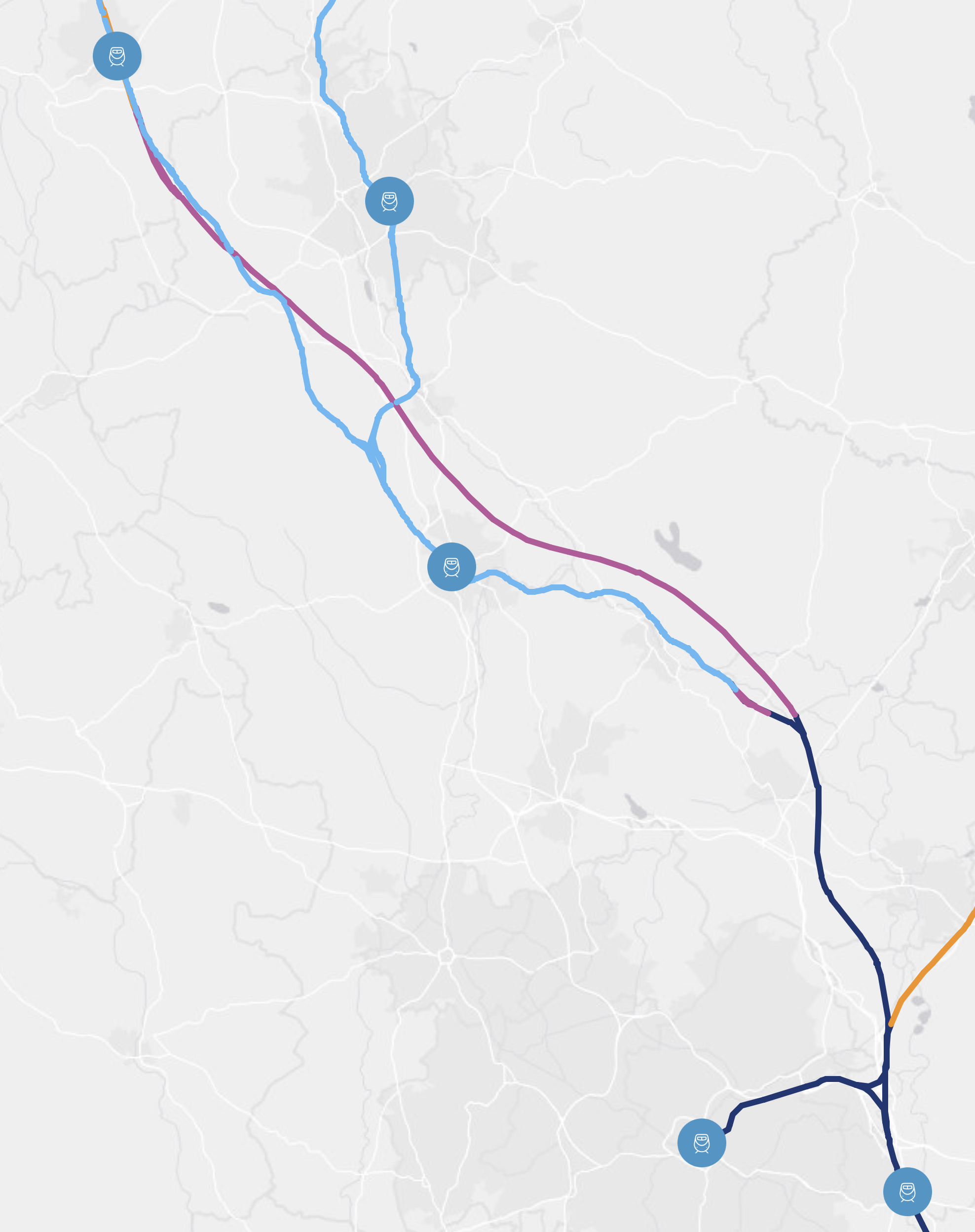
This map shows the route of Phase 2a of High Speed Two.
Note.
- The blue circles are stations.
- From the top, the stations are Crewe, Stoke-on-Trent, Stafford, Birmingham Curzon Street and Birmingham Interchange.
- The lighter blue track is sections of the West Coast Main Line, that will be used by High Speed Two services.
- The darker blue track is Phase 1 of High Speed Two.
- The orange track is Phase 2b of High Speed Two to East Midlands Hub, Leeds and Sheffield.
- The mauve track is Phase 2a of High Speed Two.
This page on the High Speed Two web site, which is entitled Phase 2a: West Midlands To Crewe, says this about the building and opening of Phase 2a.
It will be built at the same time as the line between London and the West Midlands. High speed services will begin operating between London, Birmingham and Crewe between 2029 and 2033.
It is my opinion, to build Phase 1 and Phase 2a together is a good move.
- Crewe is a very well-connected station.
- It will reduce times between Crewe and London Euston by 34 minutes.
But most importantly, it completes a second separate route for the West Coast Main Line between Crewe and London Euston.
Just think what new bypasses and motorways have done for your driving.
These are some thoughts and observations.
West Coast Main Line Benefits
The High Speed Two web page, which is entitled Phase 2a: West Midlands To Crewe, has a section called West Coast Main Line Benefits, where this is said.
Phase 2a unlocks more rail capacity on the West Coast mainline. It will carry six long distance high speed services per hour, freeing up the West Coast Mainline between Lichfield and Crewe. This could see services rise from hourly to half-hourly or better between Crewe and Stoke-on-Trent to Nuneaton, Tamworth, Lichfield and Rugeley, as well as more services from Crewe to Runcorn and Liverpool, as well as via Crewe between North Wales, Chester and London.
It would appear the six long-distance services could be.
- Train 1 – London Euston and Lancaster – Splits and joins with Train 2 at Crewe.
- Train 2 – London Euston and Liverpool – Splits and joins with Train 1 at Crewe.
- Train 3 – London Euston and Liverpool – Single train
- Train 4 – London Euston and Edinburgh/Glasgow – Splits and joins at Carlisle for Edinburgh and Glasgow
- Train 5 – London Euston and Edinburgh/Glasgow – Splits and joins at Carlisle for Edinburgh and Glasgow
- Train 6 – Birmingham Curzon Street and Edinburgh/Glasgow – Serves Edinburgh and Glasgow alternately.
Note that all services use a single or a pair of High Speed Two Classic Compatible trains.
A High Speed Test Route Can Be Created
Consider.
- At the Northern end of the Phase 2a track is Crewe station.
- At the Southern end of the Phase 2a track is Birmingham Interchange station.
- The track between the two end stations will be newly-laid modern high speed track capable of 225 mph running.
- There will be no intermediate stations or Victorian throwbacks like level crossings.
- The only junctions are at the end of the route.
- If the High Speed Two trains are built in this country, there will be a need for somewhere to check them out.
The Phase 2a track will surely make an ideal test track for testing trains and systems and training drivers.
Could The Crewe And Derby Line Become A Much More Important Route?
On the Midlands Connect web site, they have a page, which is entitled Derby-Stoke-Crewe.
This is the introductory paragraph.
Our plans have the potential to increase passenger demand on the corridor by 72%, with faster, more frequent services.
They then give the outline of their plans, which can be summed up as follows.
- Currently, the service is one train per hour (tph) and it takes 79 minutes.
- The service frequency will go to two tph.
- Twenty minutes could be saved on the second service by adjusting calling patterns.
- Improved links at Crewe for High Speed Two. This must have been written before Stafford and Stoke got the High Speed Two service to Macclesfield.
- East Midlands Railway are planning to extend the current Crewe and Derby service to Nottingham.
It seems a safe, and not overly ambitious plan.
These are my thoughts.
The Route
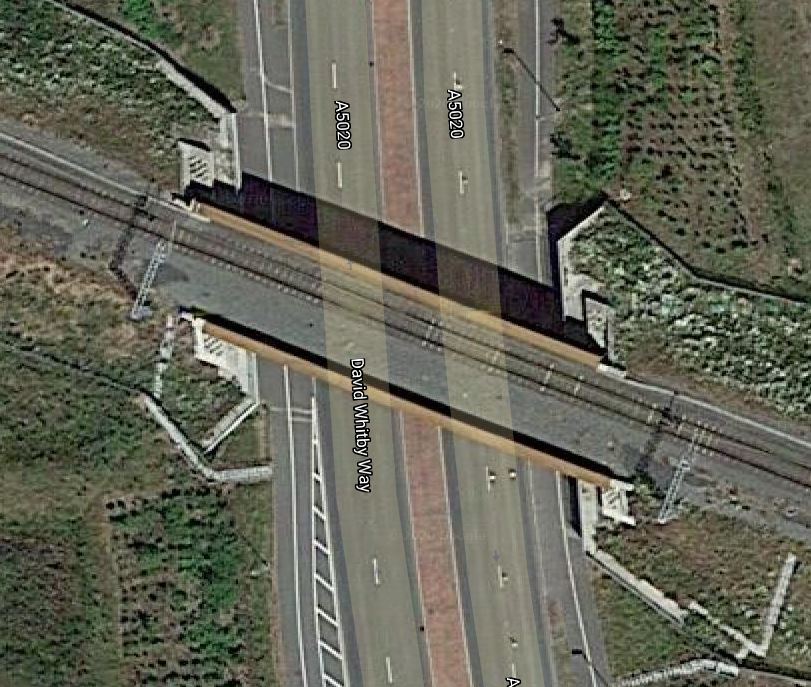
I have flown my virtual helicopter along the route and it appears to be double track all the way, except for a three mile section to the East of Crewe, that British Rail reduced to single track
However, in recent years the A5020 was built under the railway and the new bridge appears to have space for the second track to be restored, as this Google Map shows.
Note.
- The single track appears to be electrified, from the shadows of the gantries at either end of the bridge.
- West Midlands Trains appear to run an electric service between Crewe and Stafford on this route.
- I suspect it’s also used as a diversion route for Avanti West Coast’s Manchester service via Stoke-on-Trent or for train positioning.
Will this route allow High Speed Two trains to run between Stoke-on-Trent and Manchester Piccadilly?
From picture and comments in a rail forum, I suspect that the route could be redoubled fairly easily.
- The electrification runs for about 15.5 miles, between Crewe station and Stoke Junction, which is about half-a-mile on the other side of Stoke-on-Trent station.
- Trains seem to be connected to the electrification for over twenty minutes, so it could be useful for charging a battery train, running between Stoke-n-Trent and Crewe stations.
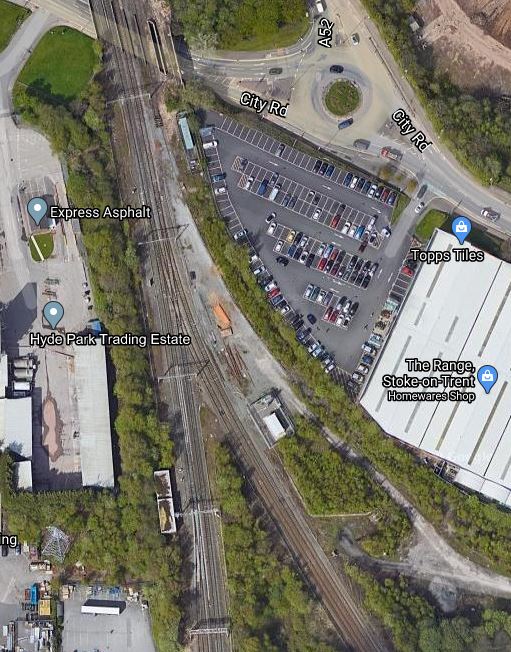
This Google Map shows Stoke Junction.
Note,
- Stoke-on-Trent station is to the North.
- The electrified railway going due South is the West Coast Main Line to Stone and Stafford stations.
- The line without electrification going off in a more South-Easterly direction is the line to Uttoxeter and Derby.
Following the route between Derby and Crewe, these are my observations.
- There is a level crossing at Blythe Bridge station.
- Most of the bridges over the route are modern, so I suspect will accept electrification.
- The route would appear to have a speed limit of 70 mph, but I would suspect that this could be increased somewhat as it doesn’t look too challenging.
- The route is 51 miles long, so a service that takes the current 79 minutes with nine stops, would average 38.7 mph.
- The proposed time of 59 minutes, would average 51.8 mph
I suspect there could be more to come, as the timetable is probably written for a Class 153 train.
A Crewe And Nottingham Service
The Midlands Connect plan says the service will be the following.
- Two tph
- A slow train in 79 minutes.
- A fast train in 59 minutes.
- East Midlands Railway want to extend services to Nottingham.
It could be a fairly simple easy-to-use timetable.
Fast Trains
Consider.
- Derby and Nottingham are 16 miles apart and fastest trains take between 19-22 minutes between the two cities.
- When it opens, all trains would stop at East Midlands Hub station between Nottingham and Derby.
- East Midlands Railway have a fleet that will include forty Class 170 trains.
- I suspect that these 100 mph trains will be able to run between Crewe and Nottingham including the turnround in under 90 minutes.
This would mean that a fast hourly service would need three trains.
Slow Trains
Consider.
- I wouldn’t be surprised to see the slower services continuing as now and not extending to Nottingham.
- 79 minutes is probably a convenient time, which would give a ninety minute time for each leg between Derby and Crewe, when turnround is included.
- Trains would be more of the Class 170 trains.
This would mean that a slow hourly service would need three trains.
Could Battery Electric Trains Be Used?
Consider.
- I think it is likely that the route between Derby and East Midlands Parkway via East Midlands Hub station, will be electrified, in conjunction with Midland Main Line electrification.
- Between Derby and Long Eaton stations via East Midlands Hub station is just under ten miles and takes ten minutes.
- Nottingham and Crewe is 66 miles of which 25 miles in total could be electrified.
- Derby and Crewe is 51 miles of which 15 miles are electrified.
- The longest section without electrification is between Derby station and Stoke Junction, which is 35.5 miles.
Batteries would be charged in the following places.
- Between Long Eaton and Derby stations.
- During turnround at a fully-electrified Derby station.
- Between Stoke-on-Trent and Crewe stations.
- During turnround at a fully-electrified Crewe station.
That’s a lot better than with an electric car.
In Sparking A Revolution, I quoted this Hitachi-specification for a battery-electric train.
- Range – 55-65 miles
- Performance – 90-100 mph
- Recharge – 10 minutes when static
- Routes – Suburban near electrified lines
- Battery Life – 8-10 years
I can’t see any problem with one of these trains or other battery-electric trains with a similar performance, running between Crewe and Nottingham or Derby via Stoke.
Could Hydrogen-Powered Trains Be Used?
I would suspect so, as the Alsthom Coradia iLint runs a similar route in Germany.
Connections To High Speed Two
Midlands Connect noted the route’s link to High Speed Two at Crewe.
But it also has other links to High Speed Two at Stoke-on-Trent and East Midlands Hub stations.
I suspect some stations like Uttoxeter or Alsager will have a choice of fast routes to London or Scotland.
Could Services Be Extended From Crewe?
In Connecting The Powerhouses, I talked about an article in the June 2017 Edition of Modern Railways, which proposed reopening the Midland Railway route between Derby and Manchester.
Some passengers and commentators fell a direct fast link is needed.
When High Speed Two is completed, the main route into Manchester Piccadilly will be a high speed spur from Crewe via Manchester Airport. Current plans include the following services.
- One tph from London Euston via Old Oak Common and Birmingham Interchange.
- Two tph from London Euston via Old Oak Common
- Two tph from Birmingham Curzon Street
Note.
- All services will call at Manchester Airport.
- It is likely that Northern Powerhouse Rail will add six tph to Manchester Piccadilly from Liverpool via Warrington.
- Some services will extend through Manchester Piccadilly to Bradford, Doncaster, Huddersfield, Hull, Leeds, Newcastle, Sheffield and York.
- High Speed lines will probably have a capacity of up to eighteen tph.
The Birmingham Curzon Street, Liverpool and London Euston services would be eleven tph, so there would be more than enough capacity for an hourly train from Nottingham.
What would the service be like?
- It would be between Nottingham and Manchester Piccadilly stations.
- It could call at East Midlands Hub, Derby, Uttoxeter, Stoke-on-Trent, Kidsgrove, Crewe and Manchester Airport stations.
- It would probably be hourly.
Timings could be as follows.
- Nottingham and Manchester Airport – 87 minutes
- Nottingham and Manchester Piccadilly – 91 minutes
- Derby and Manchester Airport – 67 minutes
- Derby and Manchester Piccadilly – 71 minutes
- Stoke-on-Trent and Manchester Airport – 32 minutes
- Stoke-on-Trent and Manchester Piccadilly – 36 minutes
The trains used on this and other local services that might need to use High Speed Two infrastructure would be performing a similar role as that of the Class 395 trains on High Speed One.
Possibilities must include.
- A classic-compatible High Speed Two train.
- A five-car AT-300 train, like East Midlands Railway’s Class 810 trains.
- An updated Class 395 train.
All trains would need a battery capability with a range of 40 miles.
It should also be noted that in Options For High Speed To Hastings, I worked through the options needed to run high speed commuter services to Hastings.
This was the last sentence in that post.
It’s all about selling trains and a company that had a 140 mph or 225 kph high-speed electric train, that could do perhaps 25 miles or 40 kilometres on batteries, would have a valuable addition to their product range.
A train with a range of 50 miles on battery power, would be suitable for the following routes.
- London St. Pancras and Hastings via Ashford International.
- Manchester Piccadilly and Nottingham via Manchester Airport, Crewe, Derby and East Midlands Hub.
- Manchester Piccadilly and Barrow-in-Furness via Manchester Airport, Warrington Bank Quay, Wigan North Western, Preston and Lancaster.
- Manchester Piccadilly and Chester via Manchester Airport and Crewe.
- Manchester Piccadilly and Shrewsbury via Manchester Airport and Crewe.
Charging might be needed at some of the terminal stations.
High Speed Two To The North West Of England
This map clipped from the High Speed Two web site, shows High Speed Two routes in the North West of England.
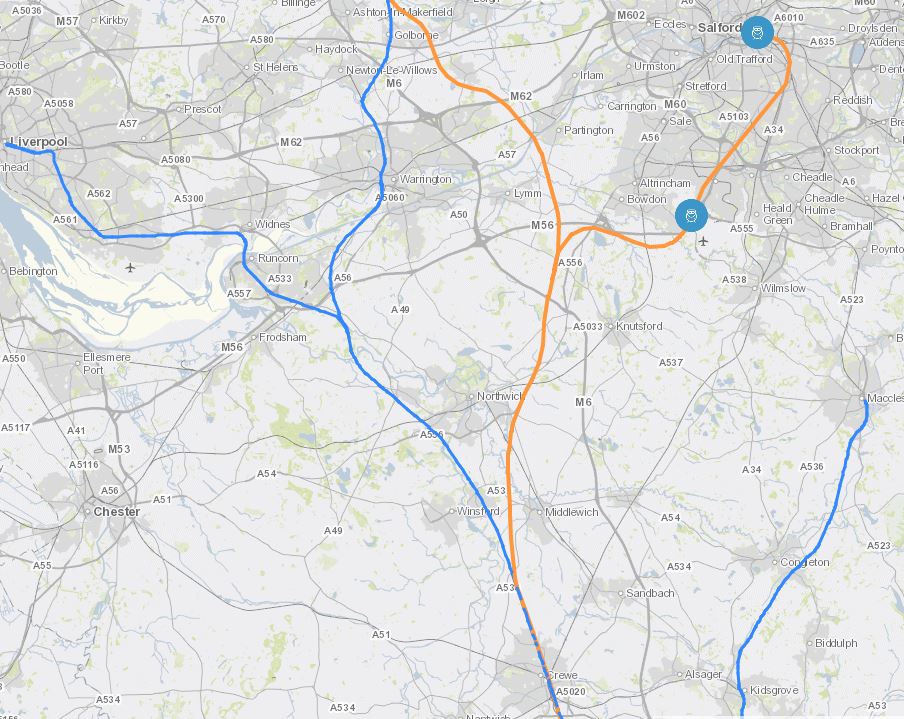
Note.
- When shown in orange, High Speed Two will use new tracks.
- When shown in blue, High Speed Two will use existing tracks.
- New stations are shown as large blue dots.
- High Speed Two and the West Coast Main Line appear to share a corridor through Crewe, before dividing near Walley’s Green.
- High Speed Two loops to the East of the West Coast Main Line and rejoins it South of Wigan between Bryn Gates and Abram Brow.
The route will or might serve the following stations in North West England.
Blackpool North
Blackpool North station is not planned to be served by High Speed Two.
But the station has been recently rebuilt.
- It has a number of platforms, that are capable of handling 200 metre long classic-compatible High Speed Two trains.
- The route to High Speed Two at Preston is fully electrified.
- In a couple of years, it will be connected to Blackpool’s expanding tramway.
- Blackpool would welcome High Speed Two with open arms.
Blackpool North would be an ideal extra destination, if more trains were to be split and joined at Crewe.
But whatever happens, I believe that high speed commuter trains will run from Blackpool North.
- Blackpool and Manchester Piccadilly via Preston, Wigan North Western, Warrington Bank Quay and Manchester Airport.
- Blackpool and Derby via Preston, Wigan North Western, Warrington Bank Quay, Crewe and Stoke-on-Trent.
Blackpool North has the platforms and electrification and it will be used.
Carlisle
Carlisle station is a through station on the current Glasgow service and can handle a nine-car Class 390 train which is over 210 metres long, which means they can handle a 200 metre long, classic-compatible High Speed Two train.
But two tph will be 400 metre London Euston and Edinburgh/Glasgow trains, so platform lengthening will probably be required.
There will be the following trains.
- Birmingham Curzon Street and Carlisle – I tph – 118 minutes
- London Euston and Carlisle – 2 tph – 154 minutes.
After any necessary platform lengthening, Carlisle will be ready and waiting for High Speed Two and will be reached in Phase 1 of the project.
The High Speed Two web site, says Carlisle will be reached in Phase 2b, but as Edinburgh and Glasgow are part of Phase 1, this must be a mistake.
Crewe
Crewe station is at the bottom of the map, just to the right of centre.
The station gets this introduction on this page of the High Speed Two web site.
HS2 services will call at Crewe, where passengers will be able to access the high speed network heading south. Journey times to London will be cut to under an hour. Macclesfield, Stafford and Stoke-on-Trent will also receive HS2 services, spreading the benefits of better connectivity.
The page also says that between five and seven trains per hour (tph) will call at Crewe.
Lancaster
Lancaster station is a through station on the current Glasgow service and can handle a nine-car Class 390 train which is over 210 metres long, which means they can handle a 200 metre long, classic-compatible High Speed Two train.
Lancaster will also be a terminus of 200 metre long classic-compatible High peed Two train from London Euston, so there may need to be refurbishment to handle the larger, if not longer train.
The use of Lancaster as a terminus, would appear to have the following advantages.
- The platform is already there.
- Using Lancaster as a terminal, may reduce the scope of works at Carlisle and Preston.
- The one tph service from London Euston is effectively a High Speed Northern stopper between Lancaster and Crewe, with calls at Warrington Bank Quay, Wigan North Western and Preston stations.
- Lancaster has connections to Barrow-in-Furness, Heysham Port and Morecambe and the scenic Cumbrian Coast and Settle-Carlisle Lines.
- Paces like Barrow-in-Furness. Morecambe and a host of other stations, should save forty-three minutes on journeys to and from London.
I think that Lancaster, is a good place to terminate a service in the North-West of England.
There will be the following trains.
- Birmingham Curzon Street and Lancaster – I tph – 65 minutes
- London Euston and Lancaster – 1 tph – 101 minutes.
After the necessary refurbishment, Lancaster will be ready and waiting for High Speed Two and will be reached in Phase 2b of the project.
But I do feel that Lancaster could be reached in Phase 1 of the project, if necessary works North of Preston and at Lancaster station were planned as an independent project.
Liverpool Lime Street
Liverpool Lime Street station is at the Western edge of the map, at the end of the Liverpool Branch of the West Coast Main Line.
Liverpool gets this headline and brief description on this page of the High Speed Two web site.
The City Region Wants To Deliver a World Class Transport Network
Its ambitious plans would integrate the existing HS2 route and builds on the Northern Powerhouse Rail proposals for high speed, east-west links directly into Liverpool City Centre.
Liverpool has made a good start to prepare for High Speed Two.
- The Grade II Listed; Lime Street station now has lengthened platforms and an improved layout so that it can handle two 200 metre long High Speed Two trains per hour.
- Merseyrail is taking delivery of a fleet of new Class 777 trains to update their suburban network.
- By the time High Speed Two arrives in the city, the suburban network will be larger.
Liverpool is ready and waiting for High Speed Two and will be reached in Phase 1 of the project.
Macclesfield
Macclesfield station is at the Eastern edge of the map, at the end of its own leg of High Speed Two.
The station was the surprise destination added, during the last iteration of High Speed Two.
- The late, great Brian Redhead, who lived in the town would be very pleased.
- The station was rebuilt in 1960 and has three platforms.
- It is planned to have one tph to London Euston via Stoke-on-Trent, Stafford and Old Oak Common.
- The visualisation on this page of the High Speed Two web site, also shows three platforms, but I wouldn’t be surprised to see a fourth added, as the extra platform would add flexibility.
The second surprise for Macclesfield, is that like Liverpool, it will be reached in Phase 1 of the project.
Manchester Airport
Manchester Airport station is the Southern large blue dot at the top of the map.
This page on the High Speed Two web site is rather sparse on information about Manchester Airport station.
I have combined train times given on the web page, with frequencies from an article in the June 2020 Edition of Modern Railways to create this table, which should be valid after the completion of High Speed Two.
- Birmingham Curzon Street and Manchester Airport – 2 tph – 32 minutes
- Birmingham Interchange and Manchester Airport – 1 tph – 29 minutes
- London Euston and Manchester Airport – 3 tph – 63 minutes
- London Old Oak Common and Manchester Airport – 3 tph – 56 minutes
- Manchester Piccadilly and Manchester Airport – 5 tph – 6 minutes
In Changes Signalled For HS2 Route In North, I stated that Northern Powerhouse Rail were proposing the following Liverpool and Manchester service.
Manchester Airport station will be reached in Phase 2b of the project.
- Six tph
- Stops at Manchester Airport and Warrington.
- An end-to-end journey time of 26 minutes.
This would do the following.
- Add a Liverpool and Manchester Airport service with a frequency of 6 tph, that will take 20 minutes.
- Add a Warrington Parkway and Manchester Airport service with a frequency of 6 tph that will take around 10 minutes.
- Increase the frequency between Manchester Piccadilly and Manchester Airport to 11 tph. Or more likely 12 tph.
How many cities have an airport connection running every five minutes using trains running at 125 mph?
As these Liverpool and Manchester services would probably start in places like Hull and Newcastle and come via varied routes that included a selection of Bradford, Doncaster Huddersfield, Leeds and Sheffield, all of the North, that lies to the East of the Pennines will be connected to Manchester Piccadilly, Manchester Airport and Liverpool by high speed trains.
Manchester Piccadilly
Manchester Piccadilly station is the Northern large blue dot at the top of the map.
This page on the High Speed Two web site is rather sparse on information about Manchester Piccadilly station.
Using the same data as before I can create a table of services from Manchester Piccadilly station, where I have included Liverpool and Manchester services, that will be run by Northern Powerhouse Rail.
- Birmingham Curzon Street – 2 tph – 40 minutes
- Birmingham Interchange – 1 tph – 37 minutes
- London Euston – 3 tph – 67 minutes
- London Old Oak Common – 3 tph – 60 minutes
- Manchester Airport – 12 tph – 6 minutes
- Liverpool – 6 tph – 26 minutes
Manchester Piccadilly station will be reached in Phase 2b of the project.
Oxenholme Lake District
Oxenholme Lake District station is a through station on the current Glasgow service and can handle a nine-car Class 390 train which is over 210 metres long, which means they can handle a 200 metre long, classic-compatible High Speed Two train.
There will be the following trains.
- Birmingham Curzon Street and Oxenholm Lake District – I tph – 79 minutes
- London Euston and Oxenholme Lake District – 115 minutes – Change at Preston
Oxenholme Lake District is ready and waiting for High Speed Two and will be reached in Phase 2b of the project.
But I do feel that Oxenholme Lake Districtcould be reached in Phase 1 of the project, if necessary works North of Preston and at Lancaster station were planned as an independent project
Penrith North Lakes
Penrith North Lakes station is a through station on the current Glasgow service and can handle a nine-car Class 390 train which is over 210 metres long, which means they can handle a 200 metre long, classic-compatible High Speed Two train.
There will be the following trains.
- Birmingham Curzon Street and Penrith North Lakes – I tph – 102 minutes
- London Euston and Penrith North Lakes – 138 minutes – Change at Preston
Penrith North Lakes is ready and waiting for High Speed Two and will be reached in Phase 2b of the project.
But I do feel that Penrith North Lakes could be reached in Phase 1 of the project, if necessary works North of Preston and at Lancaster station were planned as an independent project
Preston
Preston station is a through station on the current Glasgow service and can handle a nine-car Class 390 train which is over 210 metres long, which means they can handle a 200 metre long, classic-compatible High Speed Two train.
But two tph will be 400 metre London Euston and Edinburgh/Glasgow trains, so platform lengthening will probably be required.
There will be the following trains.
- Birmingham Curzon Street and Preston – I tph – 50 minutes
- London Euston and Preston – 3 tph – 78 minutes.
After any necessary platform lengthening, Preston will be ready and waiting for High Speed Two and will be reached in Phase 1 of the project.
Runcorn
Runcorn station is a through station on the Liverpool service and can handle a nine-car Class 390 train which is over 210 metres long, which means they can handle a 200 metre long, classic-compatible High Speed Two train.
There will be two tph between London Euston and Runcorn and trains will take 74 minutes.
Runcorn is ready and waiting for High Speed Two and will be reached in Phase 1 of the project.
Stafford
Stafford station is a through station on the Macclesfield service and can handle a nine-car Class 390 train which is over 210 metres long, which means they can handle a 200 metre long, classic-compatible High Speed Two train.
There will be one tph between London Euston and Stafford and trains will take 54 minutes.
Sfafford is ready and waiting for High Speed Two and will be reached in Phase 1 of the project.
Stoke
Stoke station is a through station on the Macclesfield service and can handle a nine-car Class 390 train which is over 210 metres long, which means they can handle a 200 metre long, classic-compatible High Speed Two train.
There will be one tph between London Euston and Stoke and trains will take 71 minutes.
Stoke is ready and waiting for High Speed Two and will be reached in Phase 1 of the project.
Warrington
Warrington Bank Quay station is a through station on the current Glasgow service and can handle a nine-car Class 390 train which is over 210 metres long, which means they can handle a 200 metre long, classic-compatible High Speed Two train.
There will be the following trains.
- Birmingham Curzon Street and Warrington Bank Quay – I tph – 25 minutes
- London Euston and Warrington Bank Quay – 1 tph – 73 minutes.
Warrington Bank Quay is ready and waiting for High Speed Two and will be reached in Phase 1 of the project.
Wigan
Wigan North Western station is a through station on the current Glasgow service and can handle a nine-car Class 390 train which is over 210 metres long, which means they can handle a 200 metre long, classic-compatible High Speed Two train.
There will be the following trains.
- Birmingham Curzon Street and Wigan North Western – I tph – 36 minutes
- London Euston and Wigan North Western – 1 tph – 84 minutes.
Wigan North Western is ready and waiting for High Speed Two and will be reached in Phase 1 of the project.
Could High Speed Two Trains Serve Stoke-on-Trent?
The city of Stoke-on-Trent lobbied hard for High Speed Two to call, but it is going through closer to the West Coast Main Line, which is a few miles to the West.
Current Services
Stoke-on-Trent station is on the Stafford to Manchester branch of the West Coast Main Line.
It is served by two trains per hour (tph) between Euston and Manchester Piccadilly via Milton Keynes Central (1tph), Stoke-on-Trent, Macclesfield (1tph) and Stockport. The fastest journey time is one hour and 24 minutes.
Possible Routes Using High Speed Two
It should be noted that to serve Stafford on the West Coast Main Line, High Speed Two trains will use the West Coast Main Line, rather than High Speed Two between Lichfield and Crewe.
This map clipped from the High Speed Two web site, shows the two routes between Lichfield and Crewe.
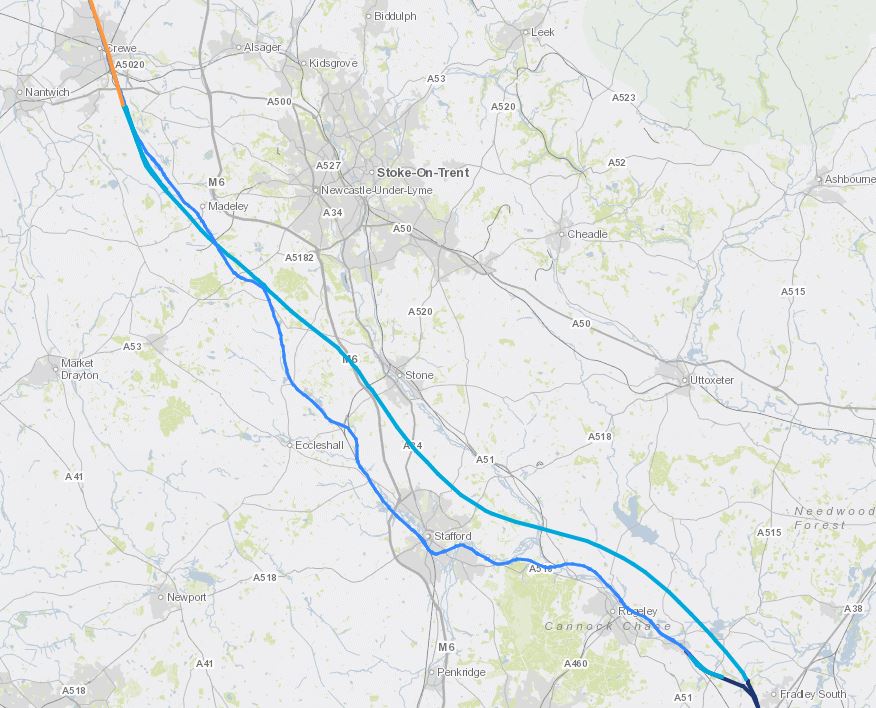
Note.
- The straighter route is the new High Speed Two route.
- The bendy route is the West Coast Main Line.
- The two routes split to the North of the city of Lichfield in the South-East corner of the map.
- Stafford can be seen between the two routes.
- Stoke-on-Trent can be seen to the North-East of the routes.
- The new route through Crewe station is shown in orange.
To give an idea of scale, the West Coast Main Line is about forty miles long between the two junctions at Lichfield and Crewe.
Possible Ways High Speed Two Could Serve Stoke-on-Trent Station
There are several ways that High Speed Two trains can serve Stoke-on-Trent station.
London Euston And Stoke-on-Trent Direct
The simplest way is to run a direct service between London Euston and Stoke-on-Trent
- It would use High Speed Two from Euston to Lichfield, where it would take the Trent Valley Line.
- It would proceed to Stoke-on-Trent via Rugeley Trent Valley and Stone.
I estimate that the service would take one hour and two minutes.
The service could either turnback at Stoke-on-Trent or go on to Crewe, Manchester or some other convenient terminus.
Manchester services might even call at Macclesfield and Stockport, as the current services do now!
Times between London and Manchester by various routes could be.
- Current via Stoke-on-Trent, Macclesfield and Stockport – Two hours and seven minutes.
- Planned using High Speed Two – One hour and seven minutes.
- High Speed Two and current route to Manchester – One hour and forty-one minutes
Manchester will get three tph from London and one from Birmingham, so perhaps one of the four services should go via Stoke-in-Trent.

