The Metropol Parasol In Seville
The Metropol Parasol in Seville, must be one of the worst pieces of architecture and design, I’ve ever seen.


I was also told by a couple, I met beside it, that when it’s hot in summer, the market underneath is not a pleasant place to be.
I should think too, that being made of wood and glue, it could be a bit of a fire risk.
Apparently, though, it was built by a retiring mayor, who wanted to leave his mark on the city. Ken, Boris and the other UK mayors, may have big egos, but I can’t think of any legacy of a mayor, that wasn’t received positively.
Understatement From Network Rail
One of my least favourite station is Manchester Victoria, which looks like it was last deep refurbished and cleaned, when its namesake was on the throne. On the Network Rail page about their plans for the station is this classic phrase.
As anyone who has been to Manchester Victoria on a rainy day can tell you, there is a problem with the roof.
But at least something is being done. They state this about the new roof.
The £16m new roof is likely to be made of ETFE (Ethylene tetrafluoroethylene) – the material used at Manchester Piccadilly station, the Eden Project in Cornwall and the swimming pool built for the 2008 Beijing Olympics, known as the Water Cube. ETFE is lighter, cheaper and lets in more light than glass. It’s also self cleaning, making it an ideal material for roofs.
You do wonder if this material could be used in other places to improve buildings at a more affordable cost than traditional methods.
I’ll look forward to using the new Manchester Victoria station in a few years time.
The Star That Is ARM
I am linking to this article, which has the full speech of ARM’s CEO’s statement giving the Q4 2012 Financial Results. It is a full nine pages long, so it won’t be an easy read. This statement from the first page is very telling.
So let’s start off with the highlights for Q4. Well, Q4 was a fantastic finish to 2012. We saw our continued momentum in licensing and sold 36 licenses in the last quarter. That’s another year of over 100 licenses in the full year.
As someone, who used to put his own intellectual property on someone else’s hardware designs, this number of licences is a significant number, as obviously, the more licences the company signs, the more money it will earn.
I don’t know anything about the technicalities of what ARM does, but judging by the company’s success, it must be pretty damn good. But to me, just as it was for Metier Management Systems with Artemis, when we owned the company, the managers have got the marketing and revenue model right.
In fact, I might argue, that getting that right is more important than getting the product to a hundred percent of your design aims. As obviously, if you are generating lots of money, it is easier to close that last gap in your designs.
So often, I’ve seen wonderful ideas fail, because their revenue model wasn’t designed well enough and doesn’t feed itself back strong enough into product development.
There is another thing that ARM and Metier had in common. ARM is and Metier was considered a almost a crusade or political movement by those that started the companies and those that worked there. The companies that I’ve dealt with or know of, that have had that zeal are hard to come by. My short list would include Apple, Dyson, Rolls-Royce and Zopa. Although, there are one or two architectural or construction companies, that in a few years time, might join them. And don’t underestimate other companies in all sorts of high-tech fields, using an ARM-style of cash-flow model, based on a group of individuals having a unique idea and the determination to see it through.
I can also think of several companies that had everything and then blew it! You could say we did that with Metier by selling out and a lot of other high-tech companies have done the same. And then there’s some that have just lost their way like IBM and Automony.
Sir James Has Got A New Motor
This article on the BBC, looks at a first glance to be about a water tap, with a built in hand dryer, design by Sir James Dyson’s company.
But the most significant thing about it, is the new electric motor. Here’s Sir James Dyson’s view.
Although the minimalistic hybrid water-air tap head is the device’s signature feature, Sir James said that the “secret” of the machine was its motor, which had taken seven years to develop.
Dyson said that its latest motor had taken more than 100 engineers over £26.9m to develop.It uses an electromagnetic field, rather than carbon brushes, to accelerate from standstill to up to 100,000 revolutions per minute within 0.7 seconds. That was about four times the number of revolutions per minute that motors its size typically produced, Sir James said.
The article also says that the motor has a built in computer chip. So is this another of the ubiquitous ARM ones?
Who knows where this type of motor technology will lead?
A Mini Tablet Computer With A Built-In Printer
My little tablet computer, which is a Samsung Tab 2 with a seven inch screen. I use it to answer e-mails, keep a list of tasks and details of my drugs and INR results.
It does the job well, but it doesn’t handle all scenarios.
Say I was an architect working on a new house. I could make notes as I walked round the site and type them up later to give to the builder, who may not be very computer literate. But that is more hassle than I need.
Imagine though being able to write on a pad of paper, perhaps a few centimetres across, with a standard ball point pen and then give the paper copy to the builder. This is how many people work, using Post-it notes for the purpose.
Suppose though, that the pad fitted over the screen of the tablet computer and that could capture what was written as an image, so that when I got back to the office, I could download the various images to my computer for safe keeping.
In the late 1980s, I saw a demonstration of a system, where signatures were captured, that had been written by a standard ball point pen, through a thick pad of paper.
So the technology has existed for some time.
This idea has potential and all of the technology exists somewhere.
As with the double-sided credit card holder, I want one. And I want one now!
Looking For A Double-Sided Card Holder
I spent some time yesterday, looking for a new credit card holder, that meets the specification I laid down in this post.
I was unsuccessful, although an assistant in Selfridges said, he’d got a leather one and used a safety pin clipped in it, to identify the side to use.
The Doors Are Open Again
I came home on a New Bus for London and was pleased to see the back doors were open.
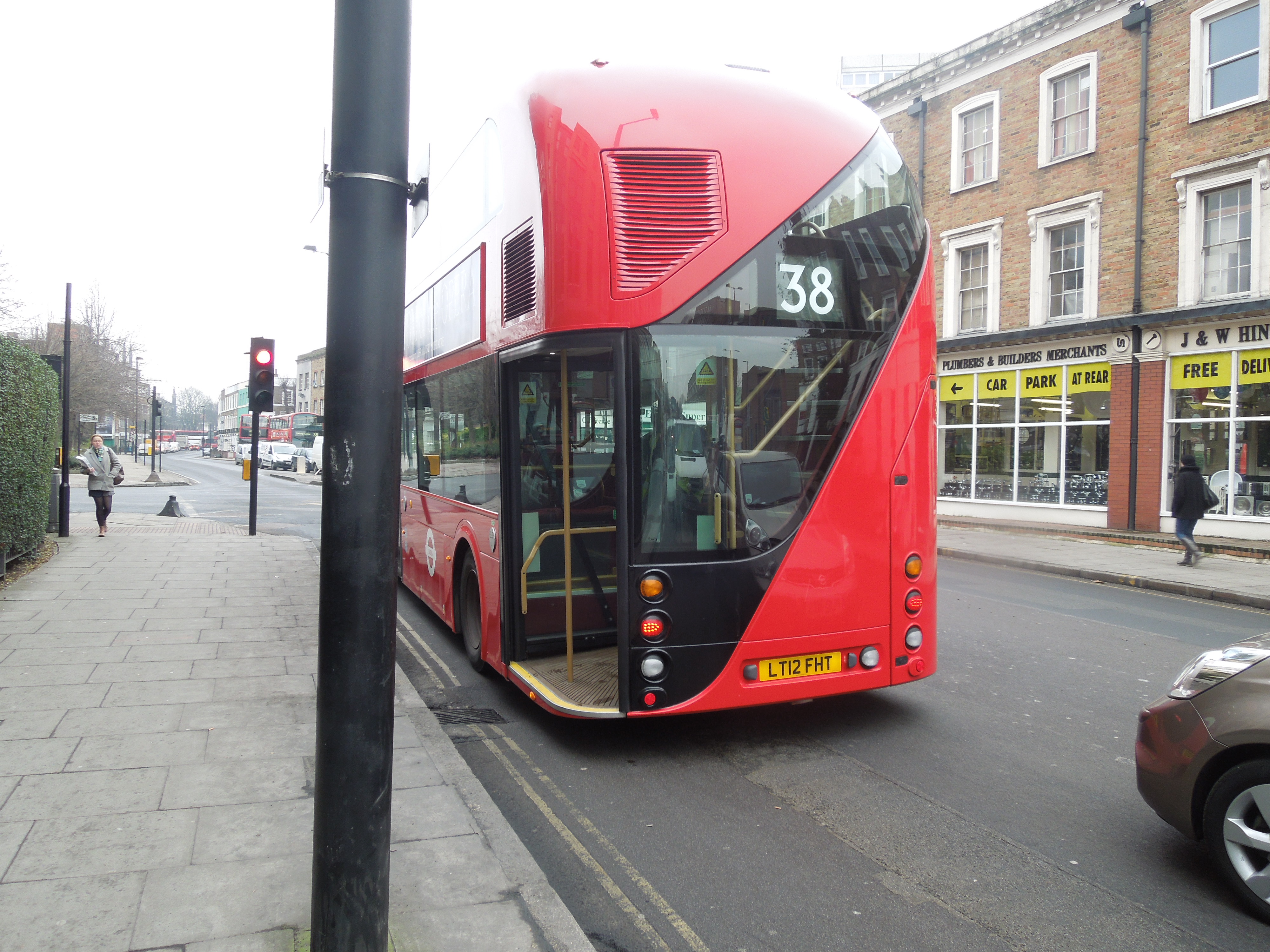
The Doors Are Open Again
The driver/conductor told me, they’d only been shut because of the cold.
This picture also shows one of the nicest feature of the new buses. It has a vertical handrail in the middle of the open platform to hang on to as you enter or exit. It’s just in the correct place for those of all heights.
Some older buses used to have such a handle like this in the middle of the front entrance, but although it was convenient for some passengers, it got in the way of those in wheelchairs or with kids in buggies.
but of course on a New Bus for London, wheelchairs and buggies would never use the rear platform.
Going Back To My Childhood
Well, not really! But this afternoon, I did go back to the northern reaches of the Piccadilly line. The aim was to look at the escalator layout of the stations to see how difficult they would be to upgrade to step-free access, possibly using inclined lifts, as I outlined here.
I joined the line at Manor House station, but didn’t go all the way to Cockfosters, as the last two stations, don’t have escalators. Starting from the end of the line, here’s what I found.
Cockfosters – This station could probably be made step-free by fitting conventional lifts into the structure to access the tunnel under Cockfosters Road. Once in the tunnel, the station is then step-free to the platforms.
Oakwood – Looking at the ends of the various Underground lines, the end station is more often than not step-free. But in the case of the northern end of the Piccadilly line, Oakwood was made step-free rather than Cockfosters.
Southgate – When I mused about fitting an inclined lift at this station in this post, I said it would be a challenging design problem. Southgate is one of the architectural jewels of the line and this picture shows why.
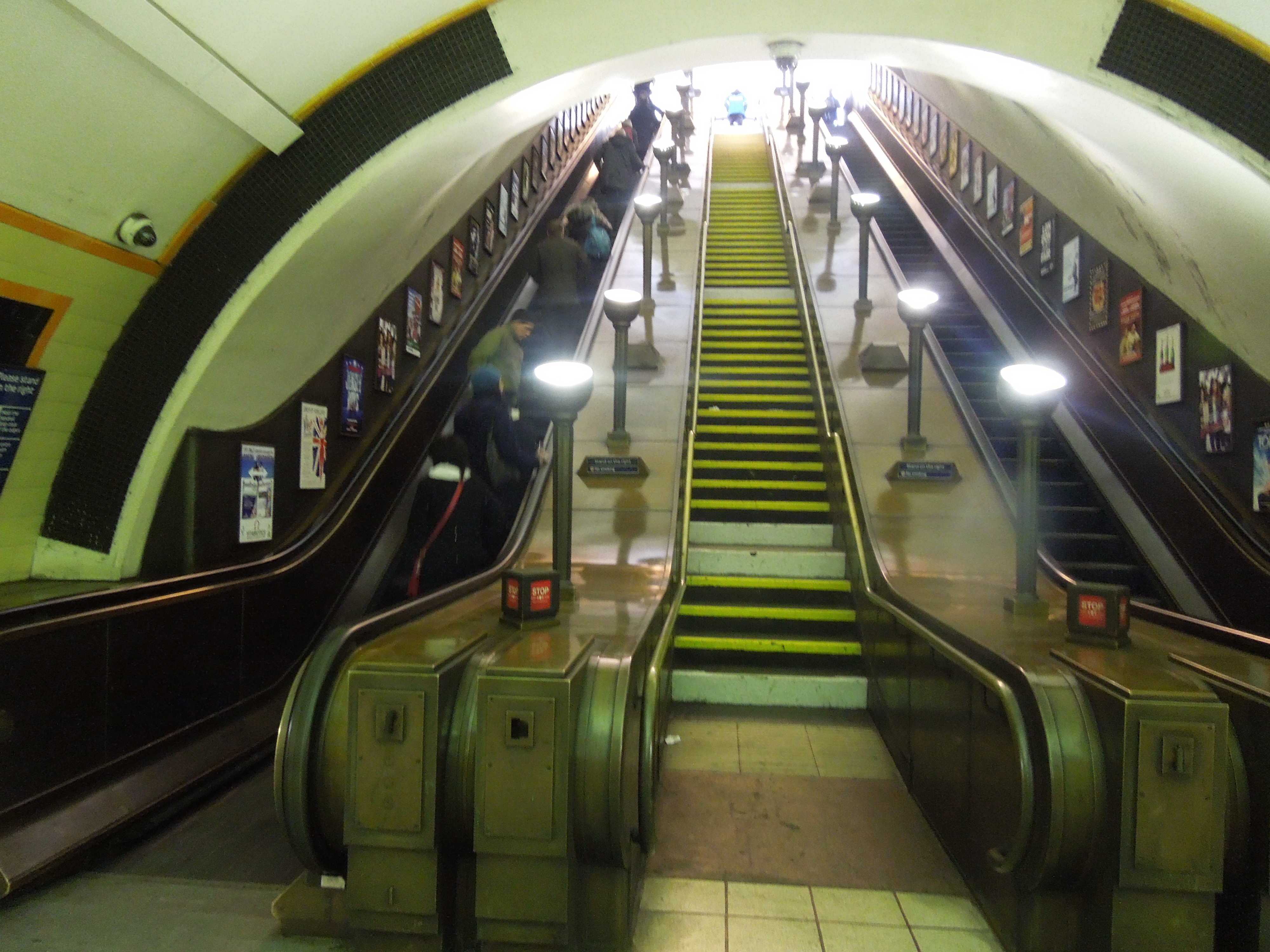
Escalators and Uplighters At Southgate Station
It is a gem of 1930s design and architecture with all that bronze, even if the yellow paint on the stairs in the middle for health and safety reasons, is out of place. The station may not have the original wooden escalators, but someone had the sense to fit modern treads in the old casing, rather than a complete modern escalator.
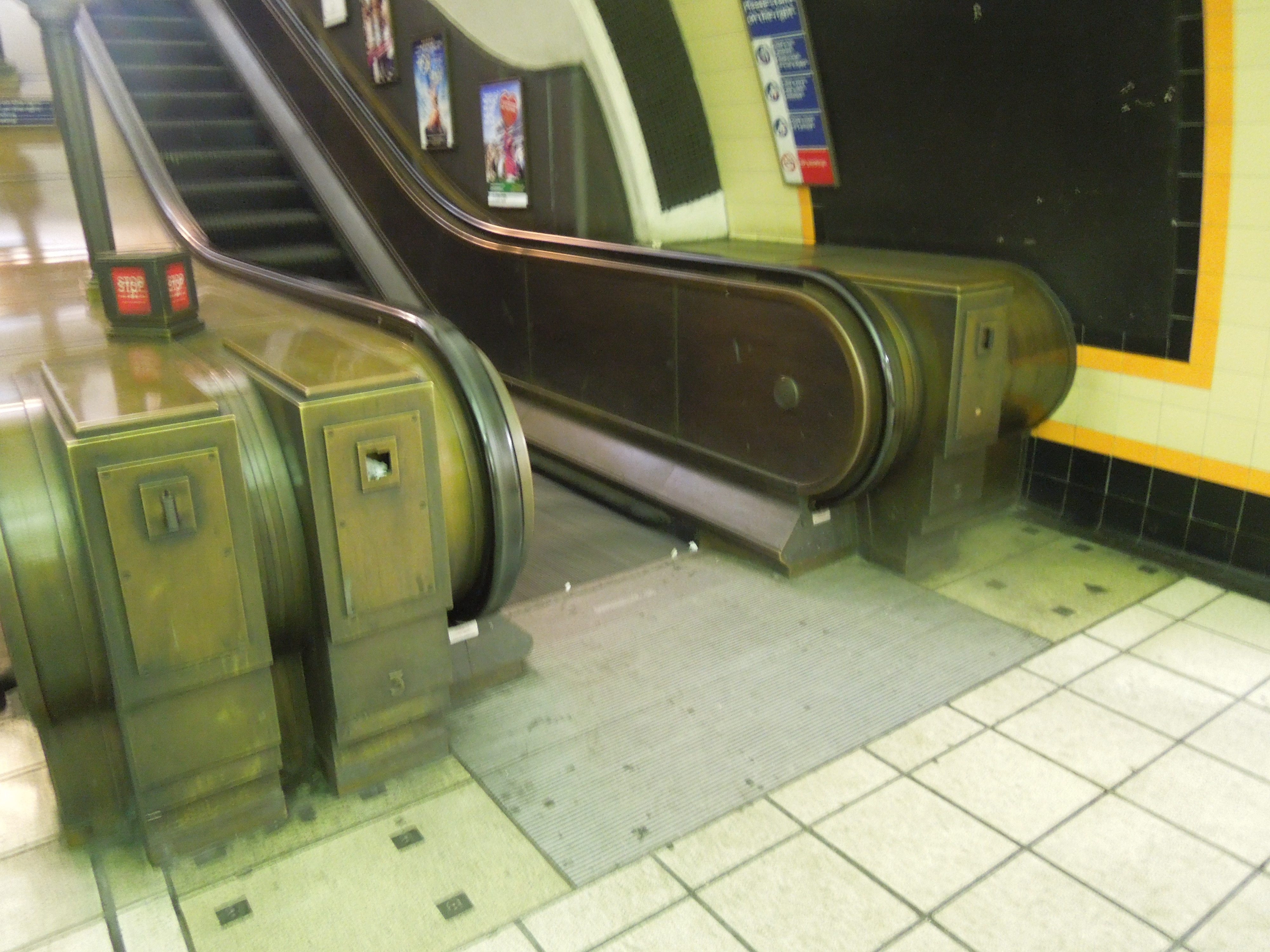
Escalator At Southgate Station
This station could take an inclined lift in the central space, but it would have to be done with enormous sympathy using similar materials to the original Charles Holden design.
There would be two other problems with an inclined lift.
As the station is now, it could easily be converted into an Underground station of several decades ago for making a film, as it was for The End of The Affair. I remember it was strange seeing a film, that had been shot in a place I knew so well.
The heritage lobby would have a field day trying to stop the installation. After all the station has won awards for its restoration over the last few years and it is a Grade II* Listed Building.
But all that adds to making it the sort of challenge, that a good designer would relish.
Arnos Grove – This is a surface station and could be made step-free with the addition of lifts in the same manner used on several stations on the Undergound and Overground network.
Bounds Green – Like Southgate, this station is a two escalator and one staircase station, where the staircase could be replaced with an inclined lift. But it doesn’t have the heritage problems of Southgate, as the station has modern escalators.
Wood Green – This is a three escalator station and step-free access would probably have to be installed, by digging a traditional lift shaft. I say shaft, as I suspect because the running tunnels are fairly wide apart, there is probably somewhere to slot in a shaft that served both platforms by descending into the platform level lobby or a cross tunnel, as was done at Tottenham Hale station.
Turnpike Lane – The problems here are similar to Wood Green, as it is another three escalator station, where a traditional lift would have to be sunk from the booking office to the platform levels. But another problem is that some form of lift would be needed to descend to the booking office level, which is below ground.
Manor House – This is very similar in layout to Turnpike Lane, but it would need lifts at seven exits to the surface to be fully step-free.
Finsbury Park – This is almost a low-level station with steps up to a pedestrian tunnel. Conventional lifts could probably be added without too much difficulty. There is a lot of development going on at this station and it will be interesting to see if the step-free access improves. The last time I visited access wasn’t good.
I think that the difficulty of making some of these stations completely step-free, shows how much our attitudes to those with difficulties getting about has changed since the stations were built in the 1930s. Charles Holden’s stations either had escalators or a short flight of steps, like Cockfosters or Arnos Grove. Compare the equipment at these stations with those on the Jubilee line extension, where all stations are fully step-free. But to be fair to Charles Holden, the Victoria line built thirty years after the Piccadilly line even now has only three step-free stations, Tottenham Hale, Green Park and Brixton stations. The Victoria line station, that I use the most; Highbury and Islington is a maze of tunnels and little short of a complete rebuild will improve matters.
Having looked at Southgate and Bounds Green, I think that an inclined lift could be a excellent idea at these two stations. You wouldn’t rip out the central escalator at Wood Green, Turnpike Lane and Manor House, as it was put in because the number of passengers needed it. But at least these three stations have larger platform tunnels, which must help the installation of a conventional lift.
However, putting in an inclined lift would not only make it easier for those in wheelchairs, with babies in buggies or heavy cases, but it would add to the station’s capacity. One point about an inclined lift, is parties where some need the lift and others don’t, can effectively travel up and down together at the same time, with those who can walk on the adjoining escalator. So the size of an inclined lift, may actually be smaller for the same capacity. It would probably also go up and down almost continuously.
A Design Challenge
It is absolutely essential that the London Underground increases the number of stations that have step-free access.
Southgate station is a station I know well, as I used it many times to go to and from my school. It is one of those stations with three escalator slots, as this picture shows.
The middle one was just an emergency staircase, but this could be converted into an inclined lift, as is proposed at Greenford.
But as Southgate is a Grade II* Listed building, it would have to be installed with a high degree of sensitivity, which would be the design challenge.
But solve it at Southgate and you could solve it on any of the number of stations, that have two escalators and a staircase.
Improving Banking Security
There is an article about the security level of chip and pin on the BBC’s web site. It got me thinking.
I am careful with my bank debit and credit cards and feel that with on-line banking, not enough is done to create a more flexible and much more secure system, by using the power of the servers to make things difficult for a criminal.
Logging In
I always log in from memory, rather than use the little machine that my bank gave me. As the customer number and passwords are not written down anywhere, even with the card and the machine, it would be difficult to log in to my account, unless they had co-operation from someone inside the bank.
There is a big flaw in the bank’s security, in the fact that all the machines are identical, which means criminals only have to get one to use this method of logging in, if they have a stolen debit card and the customer number. I needed a new one and just went into a branch and asked for one. They didn’t ask me any questions, before I got a new one.
I very much like the login system used by Zopa. It is very secure and very simple, and I would suspect most people would not need to write anything down to login first time. Something, you can’t say about many systems I’ve seen.
Restricting Cash Withdrawals
I have never understood why thee is nowhere in your on-line banking account, where you can set parameters about how and where you can draw money out through cash machines.
In a simple case, you might impose limits on the amount of money that could be withdrawn at any one time, or say in a week or month.
I would impose a limit of up to a hundred at any one time. If I needed more, I could always change the limit. You wouldn’t want to make it too complicated, as it would start to get onerous.
Better Bank Statements
When I look at my bank statement on-line, the cash withdrawals, just say how much I’ve withdrawn and the name of the bank. Some of the direct debits are well documented either.
it would be very easy to say give every cash point machine a unique reference, so when you checked the statement, you would quickly notice a transaction that was perhaps done with a cloned card.
The more information you gave customers, the more likely they would be to spot something that wasn’t correct.
An Emergency Pin Number
You hear stories about criminals threatening cash point users and getting them to draw money out. So why not have an emergency pin number, that smallows the card, perhaps gives out a few pounds and then says something like.
This machine as run out of money, please try another machine.
Whatever the system did would have to be carefully thought out, to avoid the criminal taking it out on the victim.
SMS Confirmation Of Bigger Transactions
I’ve never understood, why this couldn’t be done, as any message relating to a purchase you hadn’t made, would give you warning.
I’ve always felt that this would be very effective, even if only a few cards were setup this way. But would criminals take the chance of using a card that was, when it might start an immediate chase.
In some ways, what seems to be sad is that all on-line banking is so similar, when there are so many things that can be done to make the system much more secure for both the bank and its customers.
Banks are just so conservative and don’t innovate. Which is why they’re going to fail even more.
 The Anonymous Widower