Alice, The First All-Electric Passenger Airplane, Prepares To Fly
The title of this post, is the same as this article on CNN.
It looks like the first flight is just weeks away.
This paragraph describes the aircraft and compares it to a Boeing 737.
With battery technology similar to that of an electric car or a cell phone and 30 minutes of charging, the nine-passenger Alice will be able to fly for one hour, and about 440 nautical miles. The plane has a max cruise speed of 250 kts, or 287 miles per hour. For reference, a Boeing 737 has a max cruise speed of 588 miles per hour. The company, focused exclusively on electric air travel, hopes that electric planes that can fit 20 to 40 passengers will be a reality in seven to 10 years.
Fully electric flight on short routes is a lot closer than we think.
Note, that 440 nautical miles will give sufficient range from London to Amsterdam, Belfast, Cork, Frankfurt, Inverness and Paris.
CEO: Alice Electric Commuter Airplane’s First Flight Days Away
The title of this post, is the same as that of this article on Flying Magazine.
The Eviation Alice prototype has certainly been spotted taxiing on the runway and the CEO has said it won’t be long before the first flight.
I have a feeling that this aircraft is going to be a winner.
- It’s got a lightweight structure.
- The aerodynamics look to be right.
- It has received firm orders from quality companies, like Cape Air, DHL and United Airlines.
- It would be the ideal corporate aircraft for the green billionaire who wants a toy!
- It looks sexy like Concorde.
I also think that the range, performance and capacity could fit travel patterns well in the UK and Ireland.
Conclusion
I’m looking forward to my first flight.
‘Spirit of Innovation’ Stakes Claim To Be The World’s Fastest All-Electric Vehicle
The title of this post is the same as that of this press release on the Rolls-Royce web site.
This is the first paragraph.
We believe our all-electric ‘Spirit of Innovation’ aircraft is the world’s fastest all-electric aircraft, setting three new world records. We have submitted data to the Fédération Aéronautique Internationale (FAI) – the World Air Sports Federation who control and certify world aeronautical and astronautical records – that at 15:45 (GMT) on 16 November 2021, the aircraft reached a top speed of 555.9 km/h (345.4 mph) over 3 kilometres, smashing the existing record by 213.04 km/h (132mph). In further runs at the UK Ministry of Defence’s Boscombe Down experimental aircraft testing site, the aircraft achieved 532.1km/h (330 mph) over 15 kilometres – 292.8km/h (182mph) faster than the previous record – and broke the fastest time to climb to 3000 metres by 60 seconds with a time of 202 seconds, according to our data. We hope that the FAI will certify and officially confirm the achievements of the team in the near future.
Rolls-Royce also claim that the maximum speed achieved of 387.4 mph make it the world’s fastest all-electric vehicle.
To put that speed into perspective, it is faster than a Mark V Spitfire, which was powered by a legendary Rolls-Royce Merlin engine. These aircraft were powered by a Merlin 45 engine that generated 1074kW.
By comparison the Spirit of Innovation has a maximum power of just 400 kW.
Why Do It?
This paragraph from the press release gives an explanation.
As well as a stunning technical achievement, the project and world record runs provided important data for our future electric power and propulsion systems for all-electric urban air mobility and hybrid-electric commuter aircraft. The characteristics that ‘air-taxis’ require from batteries, for instance, are very similar to what was developed for the ‘Spirit of Innovation’.
I’ll go with that, as Rolls-Royce seem to be associated with several electric aviation projects.
But I can’t help feeling that there are parallels with the 1930s, when Supermarine and Rolls-Royce teamed up to produce the Supermarine S 6B, that won the Schneider Trophy outright in 1931. It is generally accepted that the knowledge gained at the time helped to design the Spitfire and the Merlin engine.
Wright Electric Announces Plans For 100-Seater Electric Aircraft
The title of this post, is the same as that of this article on Electrive.
It is an article well worth a read about Wright’s plans to convert BAe 146 airliners into electric airlines.
Hydrogen-Powered Aircraft Offer Fresh Perspective For Sustainable Travel
The title of this post, is the same as that of this article on The Engineer.
The article puts forward the view of Jenny Kavanagh, Chief Strategy Officer, Cranfield Aerospace Solutions.
They are developing Project Fresson, which appears to have switched from electric to hydrogen propulsion. In the article Jenny Kavanagh says it is showing more promise and in the Wikipedia entry for Project Fresson, there is a section on hydrogen power, which details the switch.
As the article in The Engineer and the Wikipedia entry for Project Fresson seem to agree, I would assume that that the Wikipedia entry is being updated.
Shocks Away! RAF To Fly Electric Planes
The title of this post is the same as that of this article on The Times.
The RAF is evaluating the Slovenian-built Pipistrel Velis Electro for use as a training aircraft. I learned to fly in a Cessna 150 and the Pipistrel Velis Electro seems to be a modern reincanation of that and similar classic designs.
- It seats two normal people side-by-side.
- It has a high wing.
- It has a fixed tricycle undercarriage.
- It is built from composites, whereas the Cessna was aluminium.
- It seems to have been carefully designed.
- It has full certification.
I would love to have a flight in one.
As the Danish Air Force are already using the aircraft for pilot training, I suspect that it might suit the RAF.
But then there are quite a lot of battery-electric under development and there may be a better one.
But there is no denying that the Pipistrel Velis Electro is a good aircraft to start the procurement process.
Budget 2021: Rishi Sunak Defends Lowering Domestic Air Duty
The title of this post, is the same as that of this article on the BBC.
These are the first two paragraphs.
The chancellor has said his Budget – including tax cuts to air tax – will help the government meet its net zero carbon targets.
Rishi Sunak used his Budget to slash taxes on domestic flights, which is forecast to lead to 400,000 extra air journeys a year.
I think he could have gone further.
It is my belief that the first area of aviation to decarbonise will be the short-haul sector.
We are seeing electric aircraft being developed like the Cessna Electric Caravan, Eviation Alice and Project Fresson.
Perhaps, domestic flights in true zero-carbon aircraft like these should be free of Air Passenger Duty?
It might even speed their introduction.
The FAA Has Begun To Recognize Electric Propulsion During Certification
The title of this post, is the same as that of this article on Simple Flying.
The article also has this sub title.
The FAA has set out its Part 33 certification requirements for MagniX’s electric propulsion units, providing high hopes for the future of electric aircraft
Reading the whole article , indicates that the FAA is taking electric aircraft seriously.
These are my random thoughts on electric flying in the UK and Ireland.
- The UK and Ireland could be one of the heaviest users of electric aircraft.
- There will be electric routes between the UK and Ireland.
- One of the first electric routes will be between London and New quay.
- Smaller cities and towns will develop electric airfields.
Without doubt here in the UK and Ireland, where the two largest of many islands can fit within a five hundred mile circle, electric aviation will be seriously developed for island hopping, longer mainland flights and short flights to the Continent.
Rolls-Royce’s All-Electric ‘Spirit of Innovation’ Takes To The Skies For The First Time
The title of this post, is the same as that of this press release from Rolls-Royce.
This is the first paragraph.
We are pleased to announce the completion of the first flight of our all-electric ‘Spirit of Innovation’ aircraft. At 14:56 (BST) the plane took to the skies propelled by its powerful 400kW (500+hp) electric powertrain with the most power-dense battery pack ever assembled for an aircraft. This is another step towards the plane’s world-record attempt and another milestone on the aviation industry’s journey towards decarbonisation.
Rolls-Royce also published an album of photographs, of which this is one.
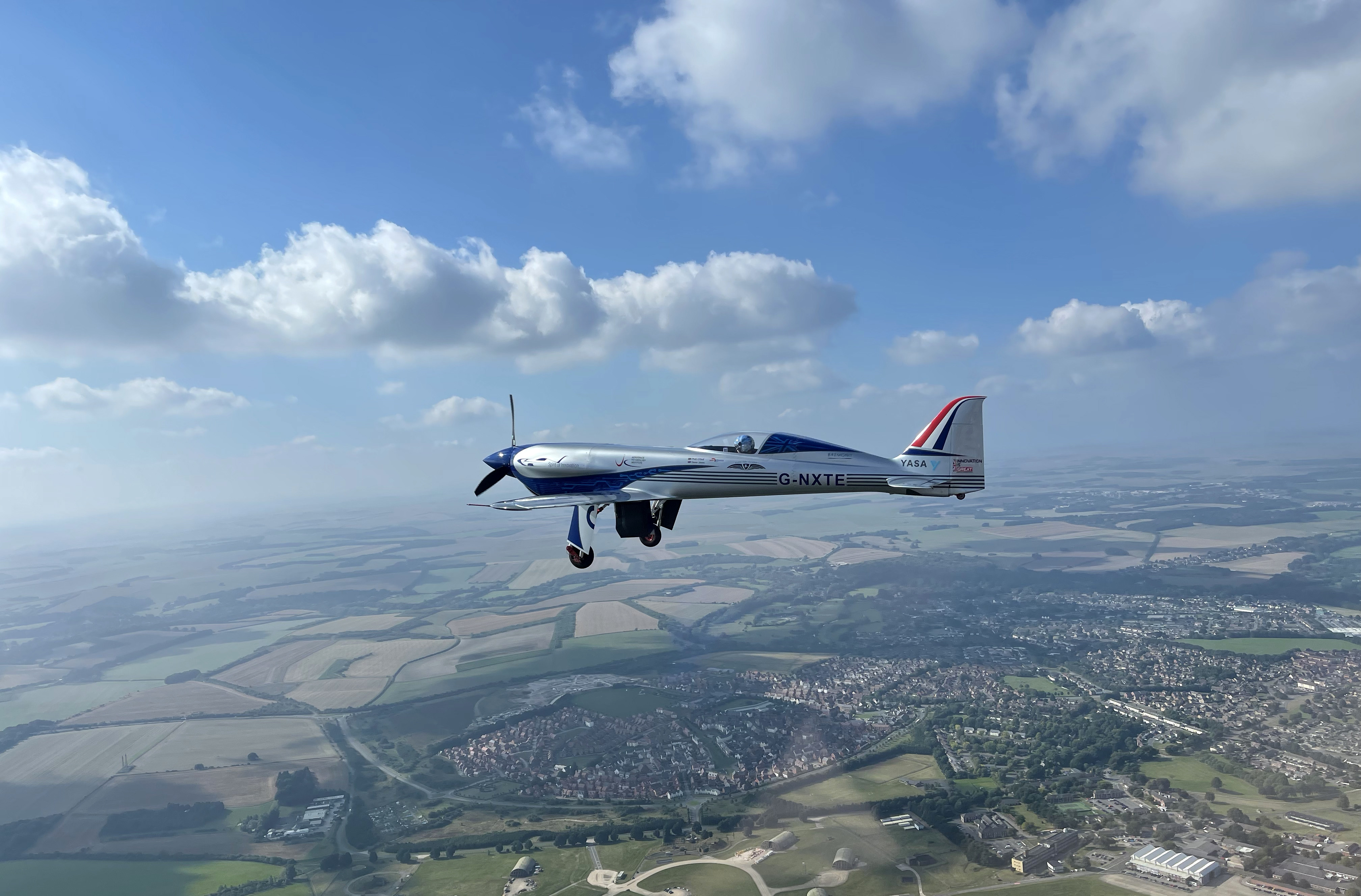
Note that the motor was designed and made by Yasa.
DHL Express Shapes Future For Sustainable Aviation With First Order Of All-Electric Cargo Planes From Eviation
The title of this post, is the same as that of this press release from DHL Express.
They have ordered twelve cargo versions of the Eviation Alice.
- Planes will be flown by a single pilot.
- Each plane will be able to carry 1,200 Kg of cargo.
- Maximum range is up to 815 km.
- Each flight hour will require thirty minutes of charging.
When you consider Stansted and Charles de Gaulle Airports are 260 kilometres apart, these planes would be able to handle a lot of routes.
 The Anonymous Widower