Electrification In East Anglia
East Anglia is very much a backwater as regards rail investment. Of the main lines only the Great Eastern Main Line is fully electrified and the trains on that line are not in the best of states. At least the line is going to be updated to allow refurbished trains to get to Norwich in ninety minutes and Ipswich in under the hour from Liverpool Street.
This speeding up of the easternmost line coupled with the improved links of Cambridge and Peterborough with Thameslink and Shenfield with Crossrail, will show up the rest of East Anglia’s railways for the crap they are.
Yesterday’s tiresome journey to and from Ipswich, illustrated how when there is major work or problems on the Great Eastern Main Line, the secondary routes can’t cope and bus replacements have to be used.
Suppose that the Ipswich to Ely Line together with the Cambridge branch had been electrified, as it should have been some years ago, when the bridges were opened up to take the larger freight containers.
This would have enabled passengers between Ipswich and London to have done the journey a lot easier with a change at Cambridge. Or for planned closures like yesterday, perhaps an hourly service could be run between London and Ipswich via Cambridge. As the part of the Great Eastern Main Line between Ipswich and Norwich was open, they could even have done the full trip with a reversal at Ipswich.
Electrification of the line from Ipswich to Ely and Cambridge, would give other benefits other than the broad one of flexibility, when a need for diversions arises.
1. More and more freight trains are going across Suffolk to and from the port of Felixstowe. At present all are diesel hauled, mainly by noisy and smelly Class 66s.
If there was an all-electric route from Felixstowe to Peterborough, then many of these trains could be hauled by environmentally-friendly and quieter electric locomotives. But that would mean electrifying the Felixstowe branch and the the port.
However, before this extra electrically eventually happens, we will see the arrival of the Class 88 locomotive. This locomotive which can run either using electric or diesel power will probably have sufficient diesel range and power to bridge the non-electrified gaps from Felixstowe to the East Coast Main Line.
2. Capacity on the routes between Ipswich and Cambridge and Ely is severely limited and electrification would enable something a bit larger than the current trains to be used.
3. Cambridge is overflowing with ideas, investment and jobs. But there is a shortage of space for housing where all the people drawn to the area can live.
So an increased capacity line to Ipswich, with hopefully a more frequent service, would surely help out with some of Cambridge’s space problems.
4. An efficient and good rail service between Ipswich and Cambridge, would certainly help development along the line and especially at Bury St. Edmunds and Newmarket. Both towns need stations to fit their increasingly important status.
5. Cambridge is getting a new station at the Science Park, This will not generally effect the line from Ipswich to Cambridge unless an extra curve is built at Ely to allow a direct connection between Ipswich and the new station.
6. Cambridge and possibly Ely are going to become more important rail interchanges, because of Thameslink, the new East West Rail Link and probable improvements in services direct to the Midlands and the North. Difficult journeys like Ipswich-Gatwick will possibly be easier with a simple change at Cambridge.
On the technical side, electrification of the Ipswich to Cambridge Line has a lot going for it, to make it not the most difficult electrification project. There’s no tunnels and the line has recently been upgraded to make the erection of overhead wires fairly easy compared to some other places. The line runs between two electrified main lines across fairly flat country.
There is probably a suitable resource of refurbished trains, like Class 317 or Class 365 that could be used on the line. Concerning the Class 365, which currently only run the Kings Cross to Cambridge, Kings Lynn and Peterborough services, many of which will be replaced by the extended Thameslink, where will these trains end up?
If Ipswich and Cambridge are joined together by an electrified railway, you can just hear the loud cries of unfairness from Norfolk, where the belief is that Norwich always takes precedence over Ipswich. After all Norwich is a city and Ipswich and Bury St. Edmunds are not!
But to be fair, a lot of the reasons for electrifying the Ipswich to Ely Line also apply to the Breckland Line, that links Cambridge and Norwich via Ely.
1. It would give the opportunity to run services direct to London, if the Great Eastern Main Line has to be closed for some reason.
2. It would enable capacity and frequency of trains to be increased.
3. It would help take the pressure off Cambridge.
4. It would help development all along the line.
5. The new Cambridge Science Park station is on the line.
6. Connecting Norfolk to Cambridge for all those ongoing services, would probably be a good thing.
The only factor which is not important on the line is freight.
If Norwich and Ipswich are fully connected to Cambridge and Ely by electrified railways, that only leaves one major line in East Anglia not electrified; the Ely to Peterborough line.
With all that freight going to and from Felixstowe, I can’t believe that this line will not be electrified.
Government Calls For More Strategic Rail Freight Interchanges
Modern Railways is reporting that a government report is calling for the development of Strategic Rail Freight Interchanges (SRFIs). It says this.
A new government report calls for development of Strategic Rail Freight Interchanges (SRFIs) to deal with growth in the rail freight sector and encourage a modal shift from road to rail haulage.
So how many large rail freight interchanges exist in the UK?
An article in Wikipedia called Rail Freight in Great Britain, lists a number of inland freight terminals. Most seem to be small with the exception of Daventry.
Living in London, I have seen the saga of the development of a rail freight terminal at Radlett. But nothing seems to be happening at present and despite the site being granted planning permission in July 2014, this is the sort of project that might not survive the next General Election. Another large freight interchange; the East Midlands Gateway at a site North of East Midlands Airport, appears to be very much opposed by the local residents.
We have a choice in this country. We can either take the freight containers to and from the ports, a trainload at a time or we can move them singly or hundreds of trucks. As at some point for the local distribution and collection, a tuck must be involved, there will be a need for SRFIs, where goods are sold or manufactured. Obviously, in a few cases, as with the Mini plant at Cowley, trains will go into the manufacturing sites.
Bear in mind that schemes like the Felixstowe-Nuneaton Freight Capacity Improvement which will take 225,000 lorries off the road, will increase the need for inland freight terminals and hopefully free up the roads.
But if we are going to have long freight trains winding their way across the country and through London like these vans, we must do a few things to improve life for the neighbours of rail lines. After all, the standard freight motive power of a Class 66 diesel locomotive is a smelly and noisy beast.
- As many freight lines as possible must be electrified and some powerful electric locomotives must be sourced. The Great Western Modernisation and Electric Spine will help, but important freight routes like Felixstowe-Nuneaton must also be electrified.
- In London, the Gospel Oak to Barking Line is being electrified and hopefully, the days of diesel locomotives in the capital are numbered.
- There are also places on cross-country routes like Lincoln, where level crossings and long freight trains, are a big source of annoyance. These points of irritations must be replaced by bypasses or bridges.
There is one important benefit of electric freight services, that has nothing to do with the moving of goods. It is the ability to run more and better passenger services using electric trains. In the next few years, due to the upgrading of existing electric services, there are also quite a few good quality electric trains that can be cascaded and/or refurbished.
As an example, if Felixstowe to Nuneaton were to be electrified, then services from Cambridge, Ely, Ipswich and Stansted to Birmingham could be run by a train like a Class 319. In fact, as that electrification would link to both the East Coast and West Coast Main Lines, other services into East Anglia would be possible.
Electrification Of Manchester To Preston Via Bolton
My trip to Bolton today, beautifully illustrated that the Manchester to Preston line needs to be electrified and the Ordsall Chord needs to be built. This chord would allow trains to serve both Manchester Piccadilly and Victoria stations as they pass through the city.
Trains do run directly between Piccadilly and Horwich Parkway, but going to the match, I did want to take some pictures in Manchester, so I walked to Victoria and got the train from there. Hopefully, when the scheme is fully implemented, all of the stations served by the line will get better connections at Piccadilly to and from the South.
Wikipedia says this about services between Horwich Parkway and Manchester
Northern Rail: there is a half-hourly service Monday to Saturdays northbound to Preston, with hourly extensions to Blackpool North and southbound to Bolton, with trains running alternately to Manchester Piccadilly or Manchester Victoria. An hourly service continues onwards to Stockport and Hazel Grove.
Trans-Pennine Express: one train per hour calls in each direction throughout the day, northbound to Blackpool North and southbound to Manchester Airport.
I think after the Ordsall Chord is built, it is reasonable to assume that a good proportion of the services will call at both Manchester stations. Certainly, it has been stated that Manchester Airport services will do this.
The train I got to the match from Victoria was one of Northern Rail’s better elderly diesel units, but coming back I was in one of TransPennine’s modern Class 185 trains.
After electrification of the line, I suspect there’ll be a bit of a reallocation of routes between the two train companies and most services on the line will be run by refurbished Class 319 trains. These are four carriages to a trainset and they can also be run in eight and twelve coach formations, so they can run services based on the newly-electrified lines in a very flexible manner, suited to the traffic.
I personally think that the train service between Manchester and Blackpool is totally inadequate at just a couple of rather pedestrian trains per hour.
As electrification is likely to bring a raising of speed limits and a larger pool of bigger and much better rolling stock, I would think that in a few years time, the Manchester-Blackpool service will bear no relation to the terrible one it is today.
At present it is not just the Manchester-Liverpool and Manchester-Preston-Routes that are being electrified. In their description of the electrification in this report, Network Rail show this map.
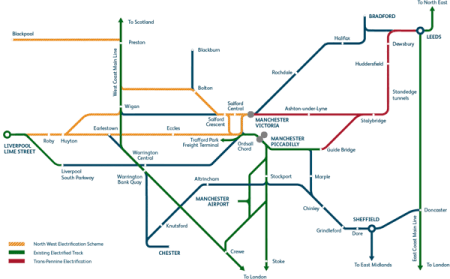
Northern Electrification Map
Note how Wigan-Liverpool via Huyton, Manchester Victoria-Leeds via Huddersfield and Guide Bridge-Stalybridge are also shown as going to be electrified. As is the Windermere Branch Line, which is not shown on this map. All are costed and funded, but there have been a few engineering problems, meaning that the Manchester to Liverpool services didn’t start when they should have done. The problems are reported in the Liverpool Echo.
Network Rail has admitted the long-awaited launch of electric train services between Lime Street and Manchester Victoria and Manchester Airport will now be postponed until next year, possibly as late as February.
The serious delay has been blamed on “unexpected ground conditions and technical issues” encountered while installing the overhead catenary wires on the 184-year-old former Liverpool & Manchester Railway mainline, said Network Rail.
This will only be the start of the revolution.
As there are 86 Class 319 trainsets, that are to be split between the North and the Great Western Main Line, I’m sure that enough sets can be found to run a good service between the following destinations, when the current electrification plans are complete.
- Liverpool-Blackpool
- Liverpool-Lancaster, Carlisle and Scotland
- Liverpool-Leeds/Newcastle via Manchester Victoria
- Manchester-Blackpool
- Preston-Windermere
Services from Liverpool, that go North up the West Coast Main Line, don’t run at present, except to Preston and Blackpool. But if the lines are all electric, subject to the paths being found, I think that one of the operators will run direct services between Liverpool and Glasgow. Failing that Liverpool to Blackpool services will probably be timed to connect with services to both Scotland and the South at Preston. Or perhaps some of the First TransPennine services between Scotland and Manchester , could divide and connect at Preston. But whatever happens travel between Liverpool and Scotland will be a lot easier.
Once electrification gets to Leeds, this will enable services from Manchester and Liverpool to go all the way to Newcastle, opening up more possibilities for new services.
I don’t believe that this will be the end of the development of electric services in the North.
The Class 319 trains currently ply between Bedford and Brighton, which by road is about 120 miles. So they should be capable of serving the slightly shorter distance between Liverpool and Hull. It would seem they are capable of travelling across the North of England reliably. As they are 100 mph electric trains, they certainly wouldn’t be slower on the route than the current Class 185 trains and probably only slightly slower than the new Class 350 trains, that First TransPennine use on Manchester-Scotland services.
In a few months time, electric services between Liverpool and Manchester will commence, probably followed about two years later by electric services from Liverpool and Manchester to Preston and Blackpool.
If the North like their refurbished trains running on electrified lines, it will be hard to resist the pressure to put in more electrification.
If Network Rail can get its act together on electrification, I think that by 2022, the number of electrified lines in the North will be greater than currently planned.
The route from Manchester to Sheffield by the Hope Valley Line will probably be a priority, as when the Midland Main Line from Sheffield to Doncaster, Nottingham and London is electrified in 2020, it will open up all sorts of routes like Liverpool and Manchester to Nottingham and the East Midlands.
If Hull to Leeds and Doncaster is electrified, then this opens up the possibility of electric Liverpool and Manchester to Hull services via Leeds. The BBC has this report about ministers backing the electrification.
The government has backed plans to electrify the Hull to Selby rail line.
Transport Secretary Patrick McLoughlin said he was making £2.5m available to take the project to the next stage
First Hull Trains is planning to spend £94m electrifying 70 miles (112km) of track to improve connections with the wider rail network.
Work is already under way to electrify the line from Manchester to Leeds, York and Selby and is due to be completed by December 2018.
This one will happen, as First Hull Trains wouldn’t spend £94million of their own money, if they didn’t think they’d make a decent return. They are probably trying to get their hands on some of the InterCity225s that will be made redundant by the new Class 800/801 trains.
It is almost if a hundred miles per hour railway across the country is fighting its way to birth by stealth, aided by some refurbished over twenty-years old British Rail rolling stock.
An interesting aside is what will happen to the thirty one InterCity225s. I have heard a rumour that some will be cascaded to the Greater Anglia Main Line to run London to Ipswich and Norwich services currently run by Class 90 locomotives hauling Mark 3 coaches.
I haven’t travelled in an InterCity225 for some months, but the last time I did on a short trip to Peterborough, they did not appear to my untrained eye to be scrapyard fodder yet.
As they are genuine 200 kph high speed trains, could we see them providing fast services from Liverpool to Newcastle and Hull in under two hours? Politicians and comedians may well have poked fun at British Rail for years, but now that we have a UK cash flow shortage, who are stepping up to the plate to help out our impoverished railways? A whole series of British Rail trains like the InterCity 225s and Class 319. No-one should forget the refurbished Class 315, Class 317 and InterCity125s, which will fill other gaps in the bad planning of our railways in theThatcher, Blair and Brown decades.
The only problem with the InterCity225s, is that they may be too long for some of the stations across the Pennines. But solving that is in the grand scheme of things a relatively minor problem for good engineers, architects and construction teams. Also, as they get replaced will some end up on the West Coast Main Line providing direct services to Blackpool?
Once the basic spine across the country is complete and running high-capacity services fast electric services between Blackpool, Liverpool and Manchester, in the West and Leeds, Hull and Newcastle in the East, two things will happen.
Politicians will press Network Rail to create a genuine high speed railway or HS3, across the country, as they love high profile projects, by which they will be remembered.
But more importantly, all of those connecting lines across the North will be prime candidates foe electrification, so they can be home to some more Class 319s.
HS3 will eventually be created, but only when the new electrified service is in need of more capacity.
I think that the electrification in the North is an unstoppable series of projects, that will only finish, when all lines are electrified.
Talking to people on the trains to Bolton yesterday, I don’t think the passengers know how their lives will change, when what is certainly going to be implemented happens.
One very extensive traveller, I met on the train between Manchester Victoria and Horwich Parkway, didn’t realise that the new electric trains in a couple of years would be larger units that the current diesels. He also had travelled on Thameslink to his daughter in South London and actually thought the current trains on that route were pretty good. He hadn’t realised that these would be running after a basic refurbishment all around Manchester.
And then on the trip back to Piccadilly, I met two young ladies, who were coming all the way from Eskdale to see the Who in Manchester. They didn’t kow that the branch to Windermere is going to be upgraded and said that it would have made their journey today a lot easier.
The rail industry in the North needs to spread the word. I have a feeling that the Class 319s, when they start operating in a few months between Liverpool and Manchester will start the process.
Refurbishing A Northern Rail Class 319
There has been a bit of disquiet up North, about the new Liverpool to Manchester electrified service being run by late-1980s vintage Class 319 trains. I took a few pictures in October and they can be seen on this post.
I think it is best to charitably describe the interiors as something designed by a committee of accountants, with a love of pink!
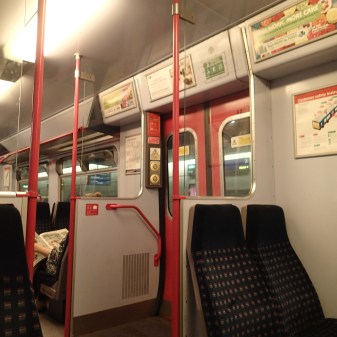
I would use the word dreadful liberally! Now look at this page on the Northern Rail web site and in particular this image.
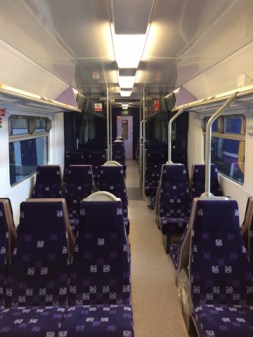
Inside A Northern Rail Class 319
Where’s all the pink gone? Or are Northern Rail applying a liberal use of Photoshop?
I doubt it’s the latter, but it does show how British Rail got the engineering right with the Mark 3 coach, on which the Class 319 is based.
On the page on the Northern Rail website, there’s a time-lapse video of the refurbishment, if you still think it’s all fake.
The proof of the pudding will be in the eating and I can’t wait to ride between Liverpool and Manchester on an electric train.
To be fair to the Class 319, it must be one of the ugliest trains on the UK network and I bet everybody wishes they’d got someone like Kenneth Grange to upsex the front end, as he did for the InterCity 125. But as an old Suffolk horseman said to me.
A good horse is never a bad colour.
The Class 319 is a good train, but the old colour isn’t the best.
Wandering On The Valley Lines
I took some of the Valley Line trains from Cardiff.

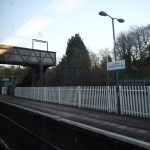

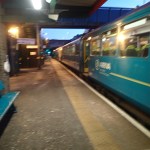
The weather was good, as you could see. I first went up to Risca and then after returning to Cardiff, I took a train up to Bargoed.
On this trip and my previous one some weeks ago, I encountered typical Welsh scenery with lots of clean and tidy stations, many of which were being upgraded with lifts and decent access.
But although the train to Risca was a decent Class 158, the other journeys were done in Pacers with more rattles than a large nursery.
The lines are crying out for electrification and a fleet of much better trains.
Will The Felixstowe Branch Be Electrified?
In the previous post on diesel-hauled freight trains on the Overground, I mentioned Network Rail’s Anglia Route Study.
This study says two things about the Felixstowe Branch.
There will be more double track to increase capacity and it is an aspiration to have two trains per hour on all branch lines from the Great Eastern Main Line.
If the latter is implemented on the Felixstowe branch, it will be a good thing, but it would need another train and the increased frequency would probably be opposed by the port.
If the line were to be electrified, the finding of a reasonable Class 313/315/317 train to work the branch shouldn’t be difficult and it would be faster and with better acceleration than the current Class 153, so it could keep out of the way of the freight trains.
As a lot of the line is to be double tracked, I wouldn’t be surprised if this work, at least makes electrification possible.
I sometimes think, that I can remember reports from the 1950s, saying that London to Ipswich and Norwich together with the Felixstowe branch would be electrified by 1964.
To Stourbridge And Back
I went to Stourbridge today essentially to see the town and the Parry People Mover, but I took these pictures on my way up by Chiltern from Marylebone and back on Virgin to Euston.
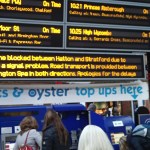
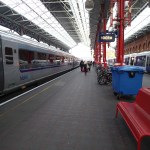
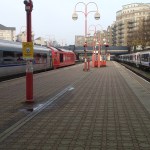
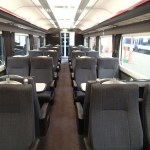
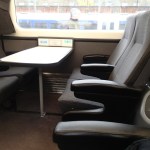
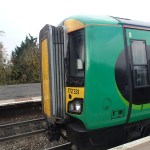
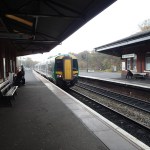
The trips illustrated the best and worst points of the two companies and their trains.
Chiltern has the more comfortable trains, with big windows and free wi-fi, but the journey takes longer.
One small thing that surprised me was the quality of both the Class 172 trains and the stations it passed through, on the way from Birmingham Moor Street to Stourbridge Junction. In some ways though it is a reasonably modern line, as it was only reopened in 1995 as the Jewellery Line Project, which created Birmingham’s cross-city passenger route between Moor Street and Snow Hill. Wikipedia says this about the Birmingham to Worcester via Kiderminster Line, on which Stourbridge Junction is located.
It is a future aspiration of Chiltern Railways and Network Rail to electrify the entire line, including the Chiltern Main Line to London Marylebone.
I’ve always thought that electrification of the Chiltern Line should be done before HS2, so that there is adequate capacity between London and Birmingham, whilst Euston is rebuilt.
Another reason to electrify the Snow Hill Lines sooner rather than later would be so that some of these Class 172 trains could be released for other routes.
How Many Diesel Multiple Units Might We Need?
in this post, I said that I wouldn’t be surprised if some new Class 172 diesel multiple units were ordered.
But how many might we need.
It is best to list all the smaller diesel multiple units that are running on the UK railways, with a few comments and thoughts.
Class 142
There are 96 two-car Class 142 trains. They were built in 1984 and Wikipedia says this about their use.
They were initially built for use on rural branch lines. However, as of September 2011 they are mainly used on busy commuter routes in the major cities in the north of England, with some also in use on local services around Cardiff and on Devon branch lines.
Regular readers of this blog, will know that I don’t have a very high opinion of these trains.
But their biggest problem is that they must be withdrawn by 2020 because of the disability regulations.
However because of the Liverpool-Blackpool-Manchester electrification and the possibility of electrification in the Welsh Valleys by the cut-off date, some of them might find other uses as scrap metal.
Currently Northern Rail has 79 and Arriva Trains Wales has 15, so some may need to be replaced by new diesel multiple units, as electrification won’t probably replace them all.
Class 143
There are 25 two-car Class 143 trains. They were built in 1985 and were refurbished in 2000. Like the Class 142, they will have to be withdrawn because of the disability regulations.
Arriva Trains Wales has 15 working the Welsh Valleys and therefore could be replaced, but the seven ran by First Great Western in the Exeter area, don’t have that happy conclusion.
As electrifying the Exeter local routes is probably a never-never, some new or cascaded stock must be found for these lines.
Class 144
There are 13 two-car and 10 three -car Class 144 trains. They were built in the late 1980s and also will have to be withdrawn.
All work for Northern Rail in the Leeds area on commuter routes. Some of the lines may be electrified by 2020, thus allowing some to proceed quietly to the scrapyard, but others might have to be replaced by new or cascaded trains.
Class 150
There are 135 two-car and 2 three-car Class 150 trains. They were built in the mid-1980s and can spruce up remarkably well, as this one has on the St. Ives branch. But I have been delayed by an unreliable Class 150.
A well-planned refurbishment of these trains could probably limp them on for a few years, provided they all receive the TLC that the unit on the St. Ives branch gets. Moving them to low-traffic routes would also help, as in some instances I’ve been on Class 150s, where two are needed.
Some in the Welsh Valleys and around Liverpool and Manchester, may also be released by electrification, so after updating, they might even be used to send the truly dreadful Class 142, 143 and 144 to the scrapyard.
Class 153
There are 70 of these 1-car Class 153 trains, which were created from Class 155 in the early-1990s.
Their main problem is capacity. When I lived in Suffolk, they used to work Ipswich to Cambridge and still work Ipswich to Felixstowe. But some like this unit on the Transwilts are reasonable transport if there aren’t many passengers.
I’m sure a lot of operators would like a nice refurbished Class 150 instead.
Class 156
There are 114 two-car Class 156 trains, which were built in the late 1980s.
In my view they are a better train than the Class 150 and 153 and there is only one serious problem with them. British Rail didn’t build enough!
Some are now being refurbished, with new disabled toilets.
Class 158 and Class 159
The classes 158 and 159 trains will soldier on for a couple of decades until they are replaced by electrification.
Some might even be replaced on long-distance services by that cavalry of the UK rail network, the InterCity 125.
Conclusion
If I come to a conclusion after all this, it is a complicated problem to decide how many trains are needed.
I think we can assume that the Class 15x will not be directly replaced, except possibly some Class 153. But many, perhaps displaced by electrification, will find themselves replacing 14x Pacers elsewhere.
I can’t do a detailed calculation, as I don’t have all the information. But it does seem that an order for say ten or twenty Class 172 trains from Bombardier could start the biggest game of musical trains ever seen.
Because of all the links, if say five sets were to be delivered before the May 2015 General Election, this could mean that many hard-pressed commuters and train passengers had greatly improved trains around the same time.
Is Blackpool On The Way Up?
In previous visits to Blackpool, I’ve found the place rather depressing and dirty. Generally, I’ve arrived by train, to give myself time to get to the match and then got the first train out afterwards. I have also called Blackpool the most pedestrian-unfriendly resort in the UK.
Also, when I mention I’ve been to Blackpool, like I did once to a lady on a bus in Leeds, I have often got a comment saying no-one goes there now!
But was it the fact that the sun was shining yesterday, that made the place seem so much better. But visitors and residents were adamant that the town had improved in the last few years.
The promenade is so much better and must rate architecturally with some of the best in Europe. Although, I would think that the obvious food offerings, are a bit too gluten-rich for me. If I go again, I might do a bit of searching, to see if anybody can cope.
But living in Dalston, an area of Hackney, that has been transformed by a refreshed North London Line, I would think that Blackpool’s refreshed tramway has done the same for the resort. After all, many of Blackpool’s visitors are like me and not in the best state they could be. Surely, a step-free low-floor tram is one of the best prescriptions, that isn’t available on the NHS.
I think to be fair, we haven’t seen the end of the rise of Blackpool. Just as Liverpool took more than a few years to rise from its nadir, Blackpool won’t get back to the top overnight.
The biggest thing that will happen is connecting the town to the electrified rail network as part of the North West Electrification. Network Rail’s report says this about progress in linking Blackpool to Preston by 2016.
A fully electrified route between Preston and Blackpool will connect the area to the west coast main line, the key rail artery linking the North West with London and Scotland.
We’ve upgraded all 15 bridges whilst carrying out safety improvement work to parapets. Overhead line equipment will be installed in 2015/16.
This electrification should improve the perception of the resort, as refurbished Class 319 trains are so much better and bigger than most of the trains working the line now.
It will also further improve the direct services to Liverpool, Manchester and London.
The tramway should also be linked to Blackpool North station in the next few years, as it should have been years ago. Nothing annoys me more, when I arrive by train in a town or city and find that the buses and/or trams are not connected to the station. Blackpool will rectify this omission, but I hope they get the tram capacity right, as many arriving by train will want to get straight on a tram to perhaps have a sightseeing run up and down the promenade.
One factor affecting the extension of the tramway to Lytham is the Open. Golf has staged its championship four times at Royal Lytham Golf Club in the last twenty-five years. As it last staged an Open in 2012, it should probably be due another. Ansdell and Fairhaven station is close to the course, so if another Open was to be staged at Lytham, then this station would probably play a large part in getting spectators to the event in a carbon-free manner.
I would suspect that Lytham are pushing hard for another Open and they are stressing the 2016-electrification to Preston in their bid. They can probably link an improved train or tram service to the course into the mix as well!
One interesting asset well connected to the trains and the tram is the old Blackpool International Airport, which recently closed. I’m sure that the town will use it to their advantage and I suspect various stakeholders have ideas in mind.
Blackpool has certainly had problems, but I would hope it is now on the rise!
Victoria Gets A Posh Umbrella
Manchester Victoria was a terrible station, with a difficult connection to Manchester Piccadilly. The connection improved with the Metrolink, but as they are now rebuilding Victoria, it’s got worse again. As I’m now familiar with the walking route, I was able to put a couple right about the way to go.
There must be something in the Manchester civic psyche, that likes to confuse people.
But Victoria seems to be getting on with its rebuilding, which includes a posh roof over everything and a new footbridge.
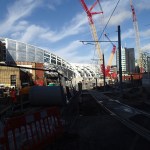
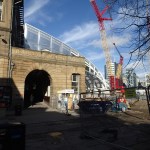

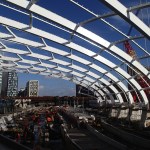
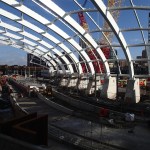
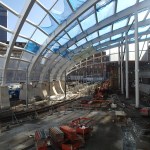
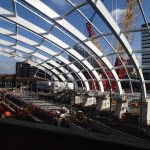
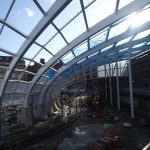
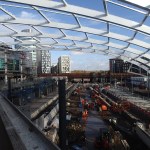


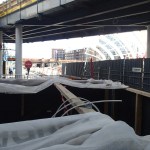
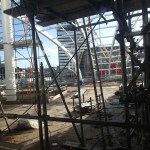
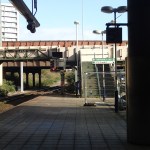
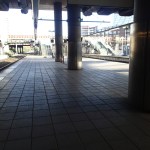
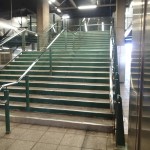
Unfortunately, the electrification to Liverpool Lime Street seems to be having problems and it will be some months before Class 319 electric trains are working the route, hopefully before next spring.
It does look to me, that when complete, anywhere on the tram routes in Manchester will have easy access to the electrified Trans-Pennine links at Manchester Victoria, which could become an architectural icon of the North. You’ll get the tram to Victoria and then totally under the new roof, you’ll go through the ticket gates and across the fully-accessible footbridges to the appropriate platform to await your train.
In addition, those who arrive from London and the South at Piccadilly and are perhaps going on to places like Burnley, Blackburn and Hebden Bridge from Victoria, will have a completely dry route, which is of course important in Manchester, using the trams. The trams must use contactless bank card tickerting though to be compatible with what other cities, like London, are doing.
This is Network Rail’s page on the £44million work.
I think everyone will agree that it’s all a bit different to the concrete crap that British Rail built forty to fifty years ago, like Euston and Manchester Piccadilly, when those with special access needs or advanced age didn’t exist, as everybody was adult and fit as a butcher’s dog.
I can remember meeting a friend in the newly-opened extension to Kings Cross station and looking with amazement at the structure that had been created.
Why shouldn’t other rail stations be given an added wow factor?
Especially now, when we have the architects, computers, techniques and materials to build them in an affordable manner. How many stations could be rebuilt using the same methods as New Cross Gate?
Good stations, like good clean electric trains, have one common problem. They are passenger magnets and very often attract so many extra paying passengers, that we have to expand the system.
I have a feeling that after they see the completed scheme, they’ll be wanting some of their other architectural disasters like Salford Crescent and Oxford Road stations, at least given the treatment that Network Rail have applied at Huyton.
 The Anonymous Widower