Don’t Buy Your New Car from Toro Rosso
I’ve just seen rather a spectacular crash during practice for the Shanghai Grand Prix on the BBC.
Sebastien Buemi escaped unhurt after the front wheels flew off his Toro Rosso car in a dramatic crash unhurt during Chinese Grand Prix practice.
The Swiss, 21, careered off the track at the end of the long back straight, where cars are doing about 194mph.
Buemi, clearly shaken, vented his anger at his team on his return to the pits.
Toro Rosso said the crash had been caused by a failure if the front-right upright, which caused an immediate failure of the same part on the left.
The BBC has a video here.
It would appear to be a pretty bad design failure, as the uprights didn’t seem strong enough.
Experiencing an MRI Scan
I’ve heard from several people that they don’t like MRI scans. My late wife didn’t, as she found them claustrophobic and noisy. I’ve had two; one on my shoulder and the other yesterday on my brain. They are both, but at least in the second, I was able to see out through a mirror. I’ve also had a CT scan in Naples and apart from the technology, that was a similar experience, although less noisy.
So how does an MRI scan work. This is the first paragraph of an excellent article in Wikipedia.
Magnetic resonance imaging (MRI), or nuclear magnetic resonance imaging (NMRI), is primarily a medical imaging technique most commonly used in radiology to visualize detailed internal structure and limited function of the body. MRI provides much greater contrast between the different soft tissues of the body than computed tomography (CT) does, making it especially useful in neurological (brain), musculoskeletal, cardiovascular, and oncological (cancer) imaging. Unlike CT, it uses no ionizing radiation, but uses a powerful magnetic field to align the nuclear magnetization of (usually) hydrogen atoms in water in the body. Radio frequency (RF) fields are used to systematically alter the alignment of this magnetization, causing the hydrogen nuclei to produce a rotating magnetic field detectable by the scanner. This signal can be manipulated by additional magnetic fields to build up enough information to construct an image of the body.
Note that they call the technique by its real name NMRI. It was called that when I worked on an NMR machine in 1969 at ICI Mond Division. I seem to remember that the guy who ran the department, Eddie Clayton, claimed that one day it will be used instead of X-rays. I don’t think he was believed, but then the first images were taken in 1973, so it wasn’t far off.
The Wikipedia article also explains all the noise.
…These fields are created by passing electric currents through solenoids, known as gradient coils. Since these coils are within the bore of the scanner, there will be large forces between them and the main field coils, producing most of the noise that is heard during operation. Without efforts to dampen this noise, it can approach 130 decibels (the human pain threshold) with strong fields.
So it’s just mechanical interaction and not somebody trying to operate on your head with a road drill. I’m partly deaf, or rather I have frequencies missing, so it doesn’t bother me.
But the real power of MRI scans is that show the body in amazing detail that enables problems to really be diagnosed. In the first use of the technique they looked at my shoulder that had given me trouble all my life. They ascertained that there was no serious problem and that exercise rather than surgery was the best way to proceed. That was good news, not like yesterday’s.
But only a few years ago, neither diagnosis would have been possible.
Roof Details at St. Pancras
After the success of the post on Roof Trusses, here are a few details of the roof at St. Pancras.
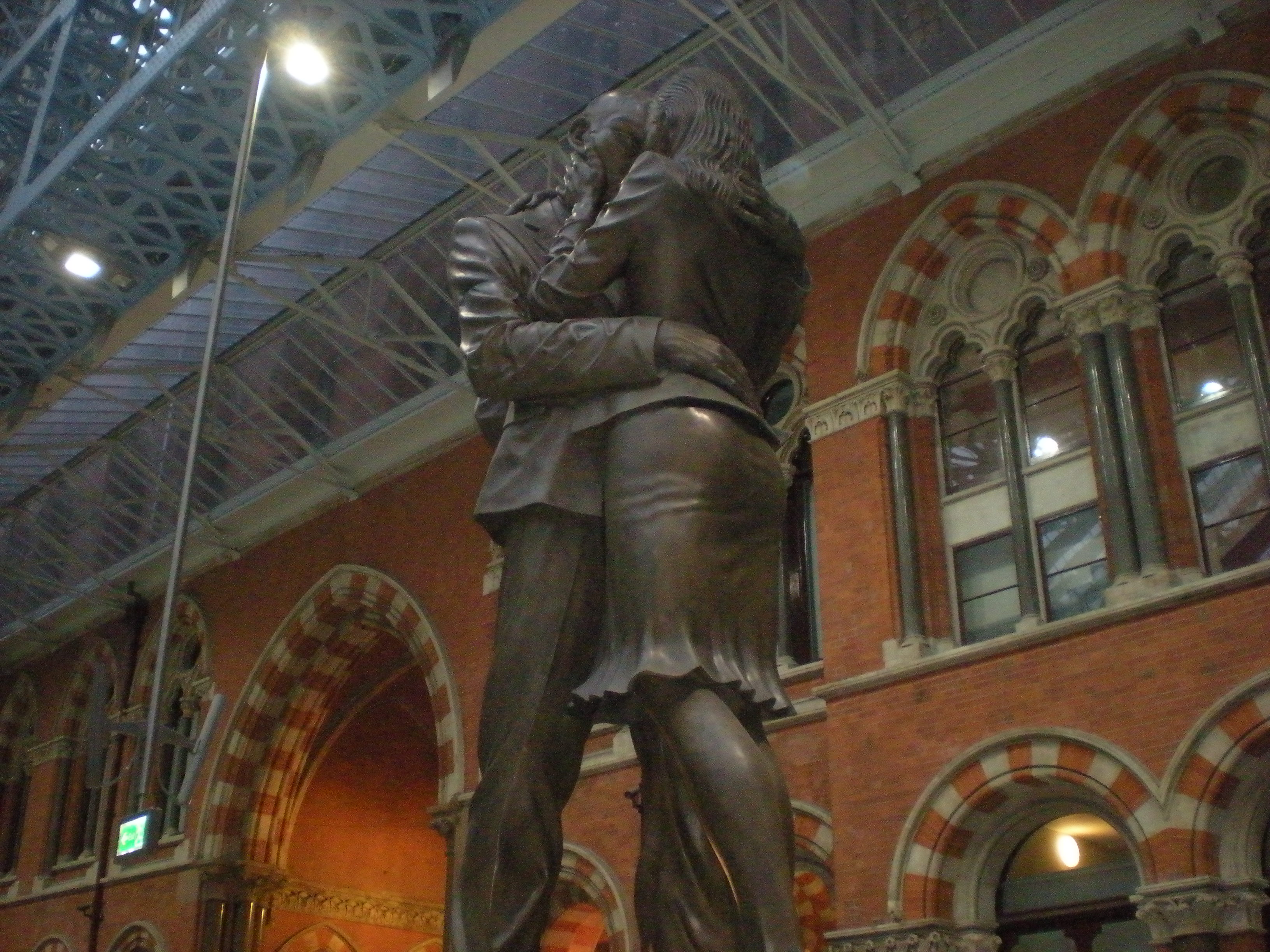
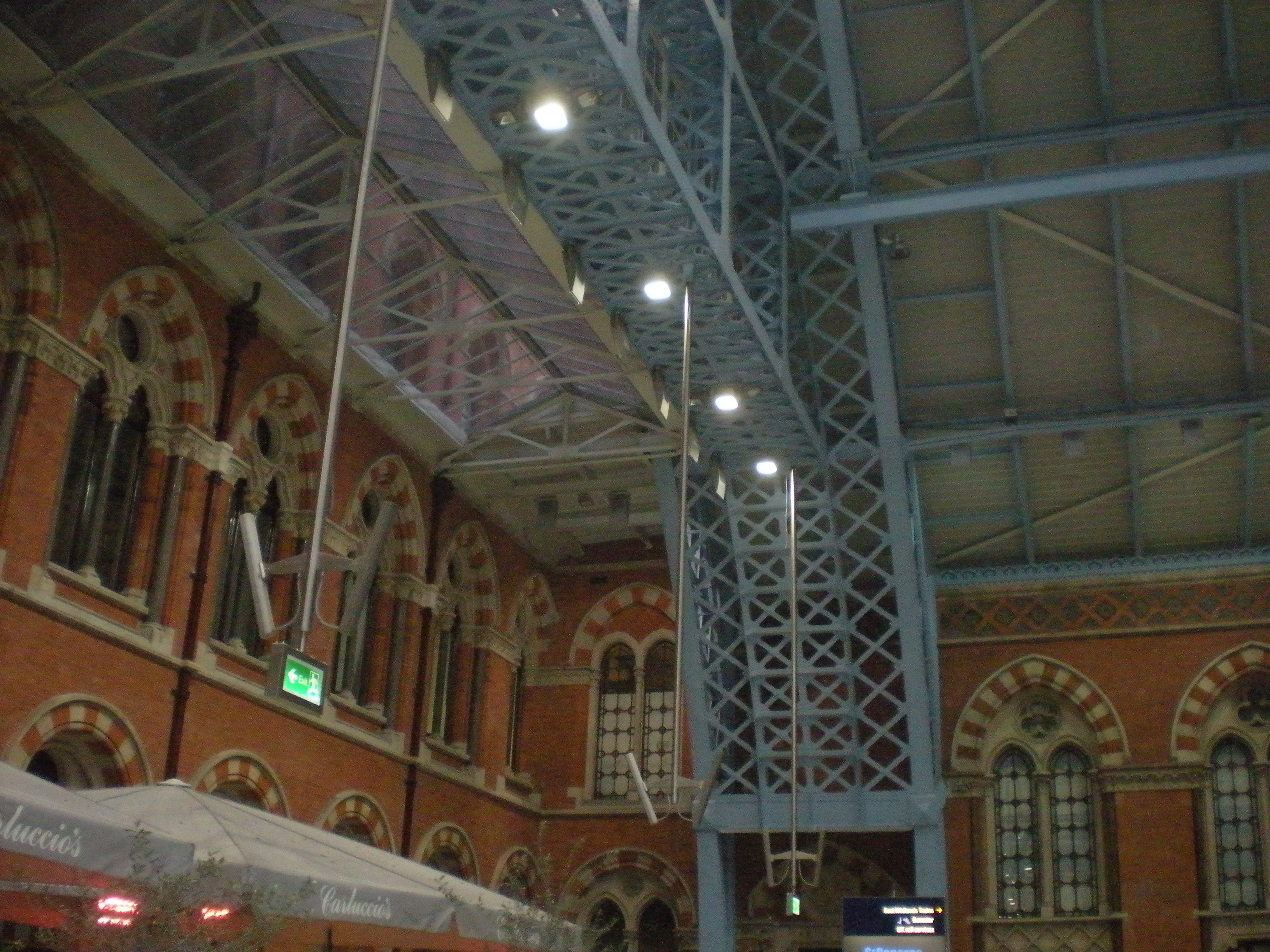
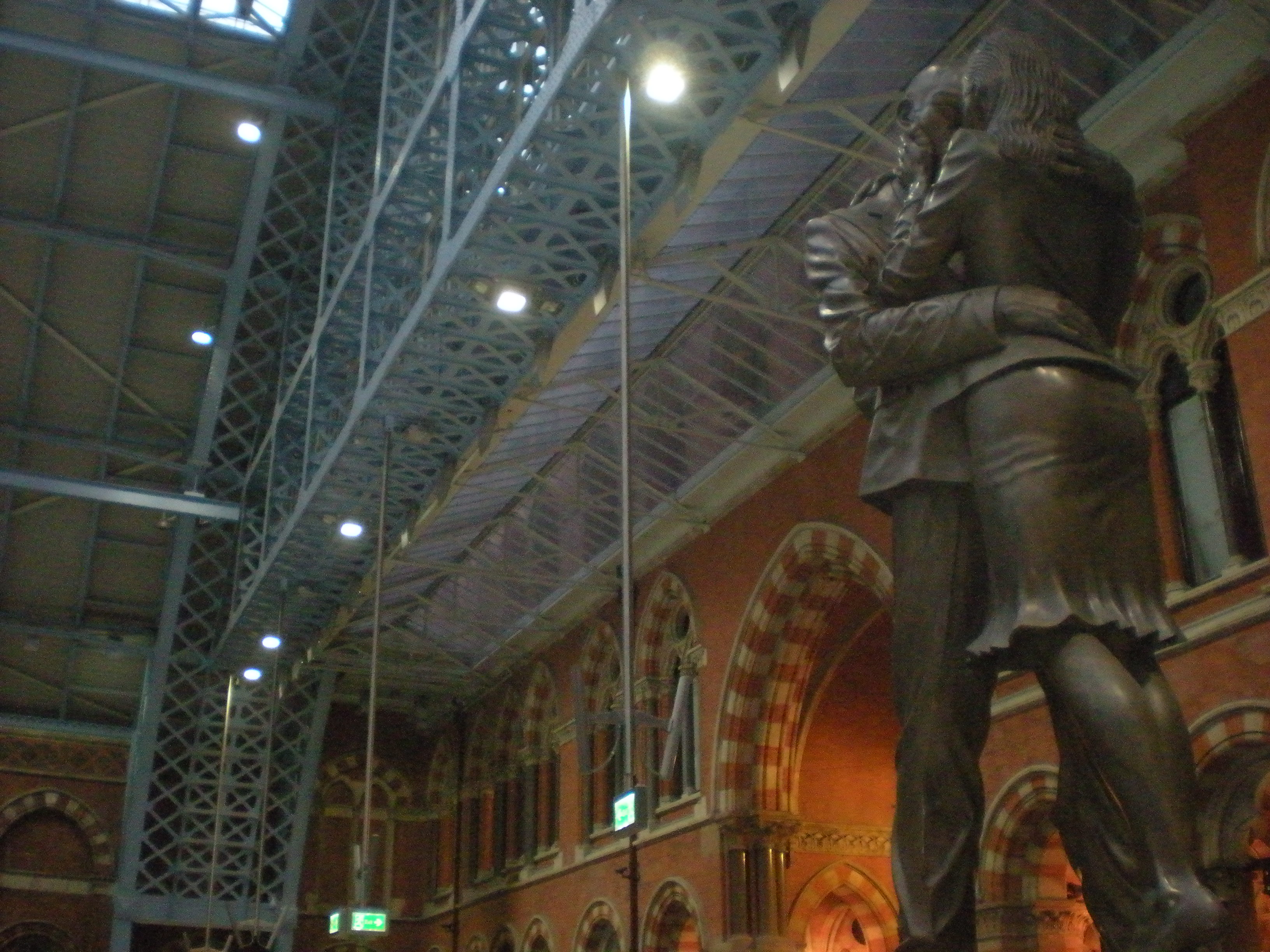
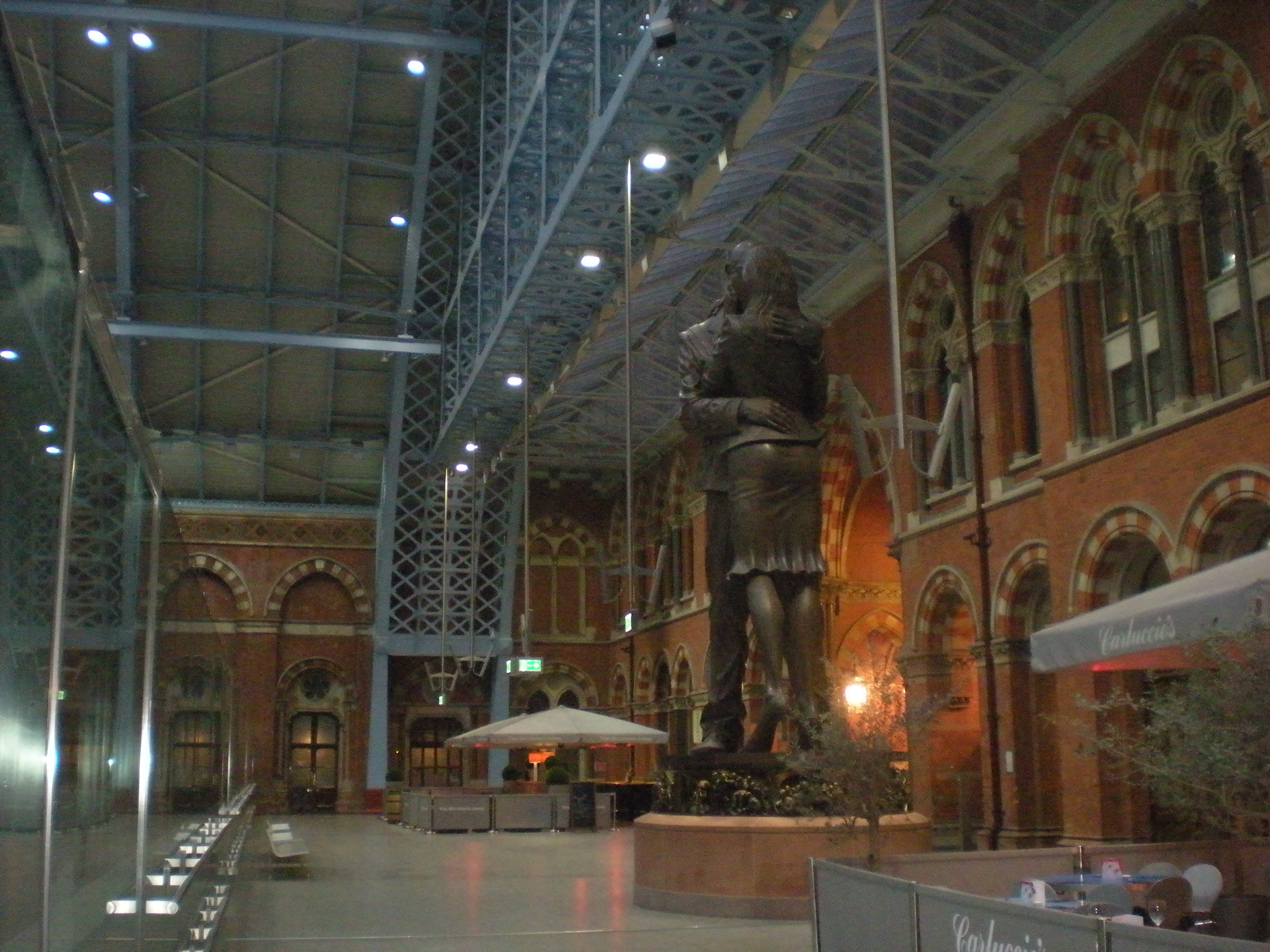

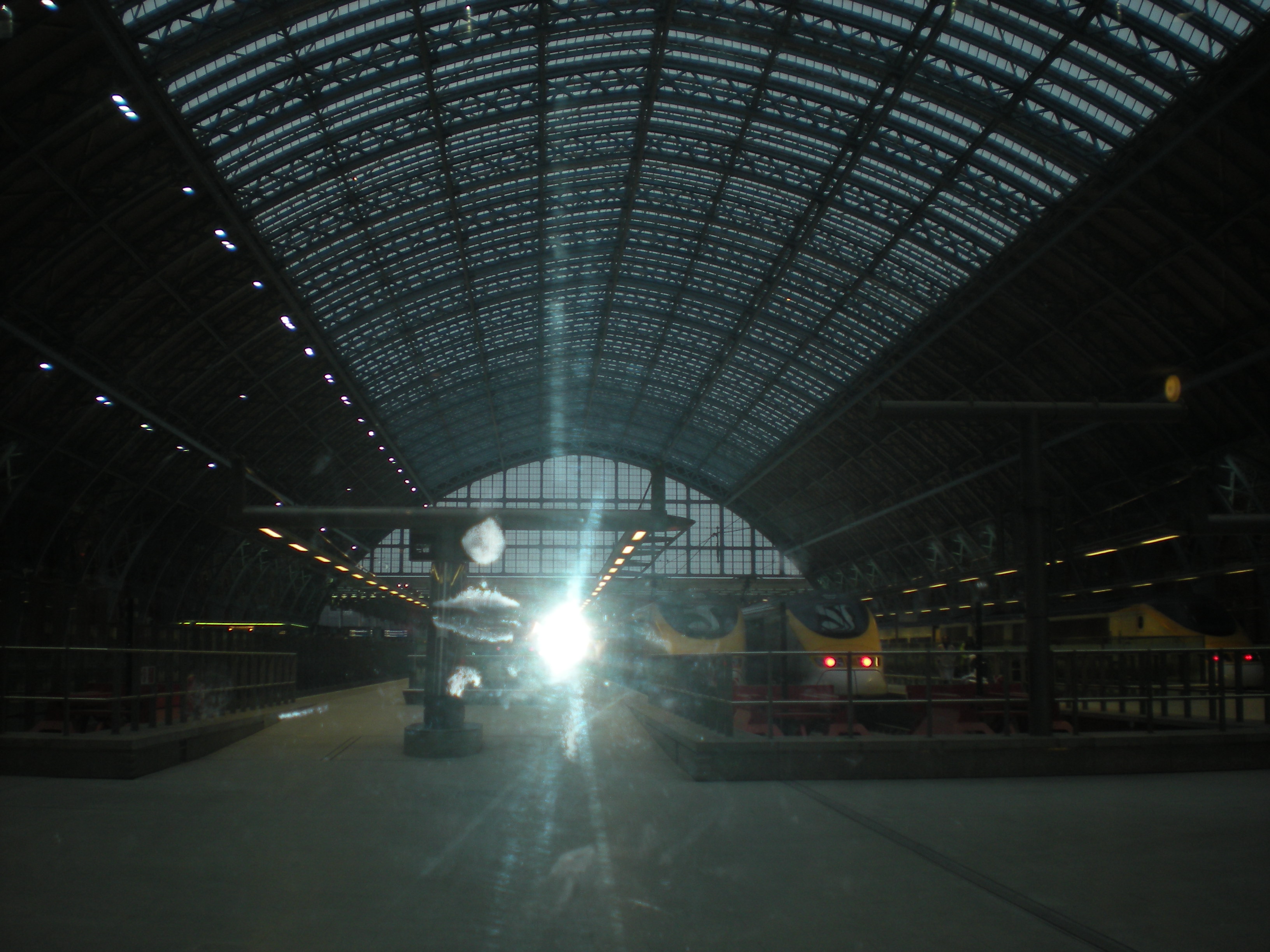
It really is the most spectacular example of Victorian engineering. Apparently, the blue colour is original, but the steam trains soon put paid to that!
Common Sense from The Duke
The Times today carries an article about engineers from the Duke of Edinburgh.
What common sense!
I like this bit.
Yet engineering remains the driving force behind all technological advances, and plays an immensely important part in the improvement in social conditions. Furthermore, it is probably the greatest wealth creator in our whole society.
But how he ends the article is something that all politicians should note.
As the ever-growing human population consumes more and more of the Earth’s natural resources, it is going to take all the ingenuity of inventors, engineers and designers to maintain the rate of improvements in developed societies and to bring better standards of living to more and more people in the less prosperous countries of the world. If this is to be achieved in the 21st century, the challenge will be to make sure that bright young people, whatever their background, who aspire to do something creative and fulfilling with their lives, can achieve their ambition through engineering.
It will be engineers, that get us out the mess we are in.
Not politicians! How much hot air will they be blowing in Copenhagen?
Magnetic Electricity
When I was studying Electrical Engineering at Liverpool University in the 1960s, one of the prize pieces of equipment was a laser. They had been invented only a few years before and the one in the University had cost several thousand pounds. Ideas were being researched for their use in commercial applications.
Now, we all own lots of lasers. Every CD player and computer has at least one and their cost is only a few pence. You see them in bar-code scanners at the supermarket and in many myriad applications from the mundane to the deadly.
So what will be the technology that now is just a scientific curiosity, but in forty years will be as commonplace as the laser is now?
Here’s one! Magnetic electricity.
Will it be the next great scientific advance? Who knows?
60163 Tornado
In some ways one of the aspects of seeing the Winton Train at Boreham, was how professional it all was. Tornado steamed into view at the same speed of all the modern electrics on the line and in a few seconds, she was gone. Are railway engines female like ships?
It was just like how as a child, when I used to see the Streaks (A4 Pacifics) at Oakleigh Park in the late 1950s and 1960s. But then if you read the history of the new-build A1 Pacific, Tornado, you would expect that, as it is just a very professional engineering project, albeit with a rather unusual product.
There was criticism when Tornado was built that this British project had to use a German boiler. Wikipedia says this.
While the manufacturing facilities still existed in Britain to manufacture such a large component, due to the design differences from the originals, the Trust required a supplier with the specific experience of designing, building and certification of steam engine boilers to modern day safety regulations, as required by the European Union’s Pressure Equipment Directive.
In early 2002, the Deutsche Bahn Meiningen Steam Locomotive Works in the former East Germany was identified as a supplier. They possessed the required knowledge as mainline steam operation had continued in East Germany until the mid-1980s, and 70% of its work still involved steam, and they still possessed the powerful plate roller machines.
That to me is a very good reason for using a German boiler. It also cost about the same as a complete rebuild of the boiler of the Flying Scotsman.
In a lot of other areas too, Tornado is modern, in that it can operate under the wires and in a completely safe environment on a modern railway. She also has a modern air braking system.
Let’s hope we see Tornado a lot more in the next few years.
An interesting aside in the Wikipedia article is this.
While Tornado will be limited to 90 mph (140 km/h) on the UK main line, there is a possibility that she could reach higher speeds, if transported to Germany. If she was towed through the Channel Tunnel, according to the Trust, Deutsche Bahn had informed the Trust that Tornado would be allowed to run “as fast as [they] like”.
Perhaps, if there is another Winton train, Tornado could do the whole route!
Wimbledon’s Roof
The new roof at Wimbledon appears to be a success. I say appears, as so far it hasn’t needed to be used and it looks like from the BBC’s weather forecast that it won’t be needed for the start of next week.
There is a good description of the roof on this web page.
Looking at the design as an engineer, it would appear to be simple, unobstructed and does what it is supposed to. I also think that the policy of the All-England Club of not disclosing the cost may work in the designer’s favour, when they repeat the design elsewhere as they surely will.
So so far so good!

