Ocean Winds Enters Lease Agreement With Crown Estate For 1.5 GW Celtic Sea Floating Wind Project
The title of this post, is the same as that of this article on offshoreWIND.biz.
This is the sub-heading.
Ocean Winds has entered into an agreement for lease with the Crown Estate for a 1.5 GW floating offshore wind project, for which the developer secured a site in the Round 5 seabed auction last year.
These two paragraphs add detail to the story.
Offshore Wind Leasing Round 5, the UK’s first dedicated floating wind seabed leasing round, was launched in February 2024, offering three areas. In June 2025, the Crown Estate announced Equinor and Gwynt Glas, a joint venture between EDF and ESB, as preferred developers for two project sites and said it was working to ensure the delivery of the full potential capacity of Round 5, which is up to 4.5 GW.
Equinor and Gwynt Glas entered into lease agreements for their floating wind projects in October 2025 and, the following month, the Crown Estate said Ocean Winds had secured the third floating offshore wind site in the Celtic Sea.
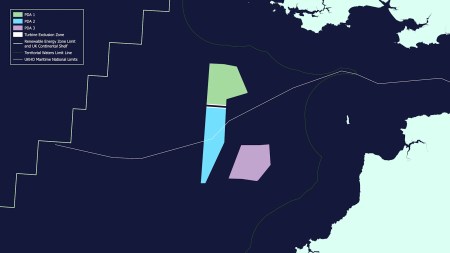
This map shows the three wind farms, that make up the Glynt Glas wind farm.
Note.
- It is expected to be built from and connect to the grid at Port Talbot in South Wales.
- The three sites are expected to be commissioned by the early-to-mid 2030s.
- The elongated white dot to the East of the wind farms would appear to be Lundy Island.
- The large bay to the North of Lundy is Carmarthen Bay with Caldey Island at its West end and Llanelli on its East.
- The Gower separates Swansea Bay from Carmarthen Bay.
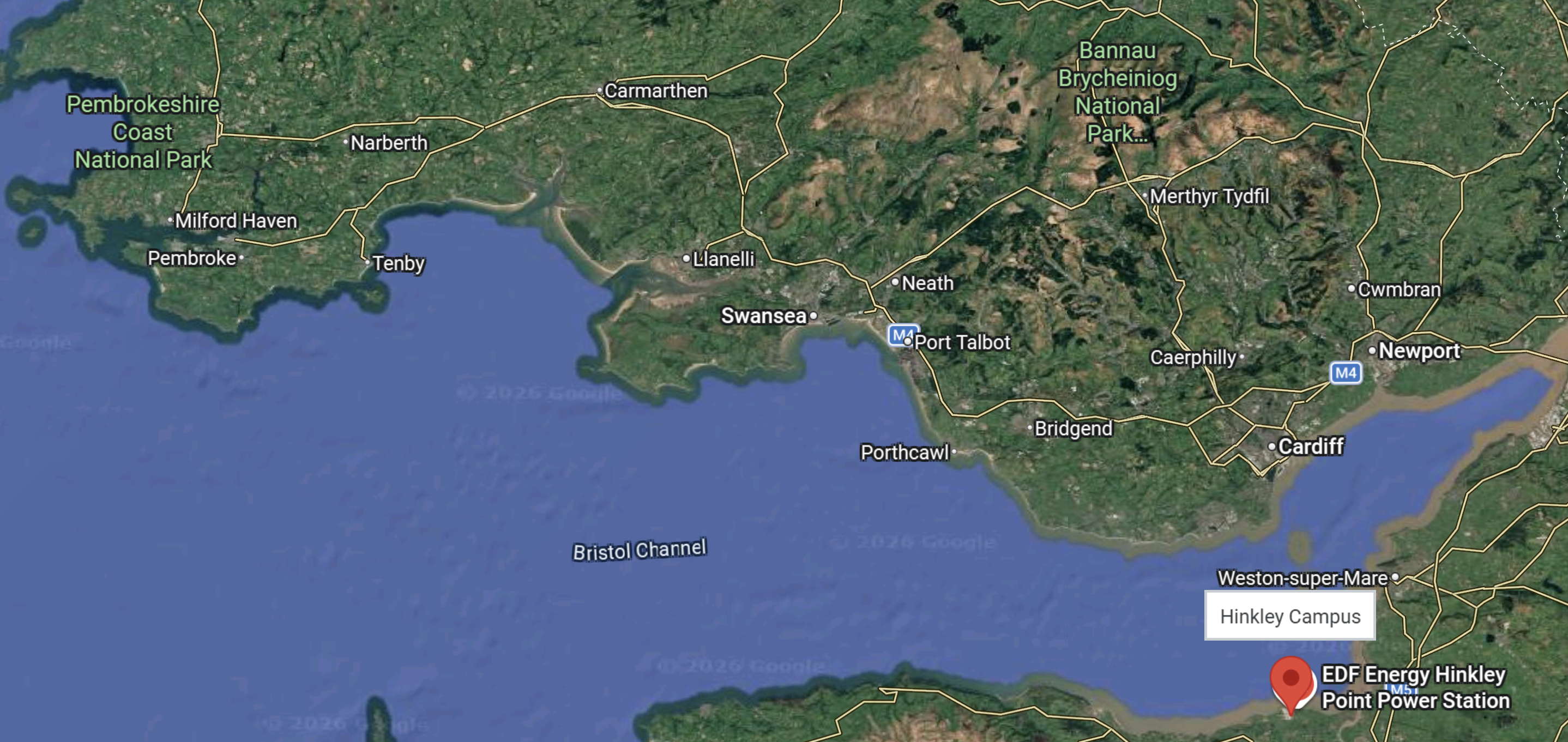
This Google Map shows the Bristol Channel from the wind farms in the West to Cardiff and Hinkley Point.
Note.
- Along the North coast of the Bristol Channel, working from West to East, my 78-year-old eyes can pick out Milford Haven, Pembroke, Caldey Island, Tenby, Llanelli, Swansea, Port Talbot, Porthcawl, BridgendCaerphilly, Cardiff and Newport.
- Coming back along the South Coast, I can see Weston-super-Mare, Hinkley Point C and the tip of Lundy Island in line with Tenby.
- The three sections of Glynt Glas will each generate 1.5 GW, making a total of 4.5 GW.
- Hinkley Point C when completed, will be a 3.26 GW nuclear power station.
- There is also a 2.2 GW gas-fired power station at Pembroke.
Nearly 8 GW of renewable electricity should be enough to convert Port Talbot steelworks to the manufacture of green steel.
How Much Wind Power Is Planned For The Western Approaches?
I asked Google AI, the title of this section and received this answer.
The UK has a target of 50 GW of offshore wind by 2030, with significant projects planned for the Celtic Sea (part of the Western Approaches), which is a key area for 5 GW of floating wind. Total UK offshore wind pipeline capacity exceeds 93 GW, with major developments in this region focusing on floating technology.
Key details regarding wind power in the Western Approaches (specifically the Celtic Sea) include:
Celtic Sea Developments: The area is a primary focus for floating wind projects, designed to capitalize on deep-water potential, with 5 GW of floating wind expected to be deployed across the UK by 2030.
Pipeline and Capacity: The total UK pipeline for offshore wind, which includes the Western Approaches, is 93 GW, and the government is aiming for 43-50 GW of installed offshore capacity by 2030.
Project Status: The region is expected to benefit from the Crown Estate’s leasing rounds aimed at accelerating floating wind, with 15.4 GW of new projects submitted across the UK in 2024.
Wales/South West England Context: Wales has 1.4 GW of projects in the pre-application stage, with some potential for developments off the South West coast.
For more detailed information on specific projects and their development status, you can visit the RenewableUK website and RenewableUK website.
It looks like about 20 GW of offshore wind could be installed in the Western Approaches.
1.1 GW Inch Cape Wind Farm Entering Offshore Construction Phase
The title of this post, is the same as that of this article on offshoreWIND.biz.
This is the sub-heading.
ESB and Red Rock Renewables have reached a financial close on the 1,080 MW Inch Cape offshore wind farm in Scotland, and the project will now progress into its offshore construction phase.
Inch Cape will be a 1.1 GW wind farm, which as this web site/data sheet shows could be capable of generating enough green energy to power more than half of Scotland’s homes.
Highlights from the data sheet include.
- Represents an around £3 billion investment in the UK’s electrical infrastructure
- Will contribute significantly to the UK Government’s target of 50 gigawatts (GW) of offshore wind installed capacity by 2030
- Constitutes 10% of the Scottish Government’s ambition of 11 GW of offshore wind installed by 2030
- As at Q1 2025, has already invested almost £300 million with 300 UK companies (more than £100 million in Scotland with 120 Scottish companies)
- Is set to spend a further (approx.) £700 million with UK supply chain (and create associated direct and indirect jobs)
- Efficient re-use of a brownfield site in East Lothian (of former coal-fired power station) including existing grid capacity and established transmission infrastructure
- The offshore substation is being built by Siemnens and Smulders at Wallsend on Tyneside.
- On track to deliver at least 50% UK content over life cycle of the project
- Will mean large investment in a new facility in the Port of Montrose and more than 50 long-term skilled local jobs
- Once operational the wind farm will reduce carbon emissions by 2.5 million tonnes per year compared to using fossil-fuels.
I like this project.
- It has a capacity of 1.1 GW.
- The turbines are 15 MW Vestas units.
- The connection to the grid is at the site of the demolished Cockenzie coal-fired power station.
- 50 % of the content of the £ 3 million project is British, spread among three hundred companies. That is certainly spreading the money around.
- I calculate that, when the turbines are fully turning, the Inch Cape wind farm will generate £ 44, 201.38 per hour or just over a million pounds per day.
I suspect we will be seeing lots more wind farms like this in the next thirty or forty years.
These are currently under construction.
- Neart Na Gaoithe – Scotland – 450 MW
- Sofia – England – 1400 MW
- Dogger Bank A – England – 1235 MW
- Dogger Bank B – England – 1235 MW
- Dogger Bank C – England – 1218 MW
- Moray West – Scotland – 882 MW
- East Anglia 3 – England – 1372 MW
- Total – 7792 MW
These are pre-construction.
- Hornsea 3 – England – 2852 vMW
- Inch Cape – Scotland – 1080 MW
- Total – 3932 MW
These are proposed wind farms – Contracts for difference Round 4
- Norfolk Boreas – Round 1 – 1380 MW
- Total – 1380 MW
These are proposed wind farms – Contracts for difference Round 6
- Hornsea 4 – England – 2400 MW
- East Anglia 2 – England – 963 MW
- Greeen Volt – Scotland – 400 MW
- Total – 3763 MW
These are proposed wind farms – Early Planning
- East Anglia 1 North – England – 800 MW
- Rampion 2 Extension – England – 1200 MW
- Norfolk Vanguard East – 1380 MW
- Norfolk Vanguard West – 1380 MW
- Dogger Bank South – England – 3000 MW
- Awel y Môr – Wales – 500 MW
- Five Estuaries – England – 353 MW
- North Falls – England – 504 MW
- Dogger Bank D – England – 1320 MW
- Berwick Bank – Scotland – 4100 MW
- Seagreen Phase 1A – Scotland – 500 MW
- Outer Dowsing – England – 1500 MW
- Morecambe – England – 480 MW
- Mona – England – 1500 MW
- Morgan – England – 1500 MW
- Morven – England – 2907 MW
- Ossian – Scotland – 3610 MW
- Bellrock – Scotland – 1200 MW
- CampionWind – Scotland – 2000 MW
- Muir Mhòr – Scotland – 798 MW
- Bowdun – Scotland – 1008 MW
- Ayre – Scotland – 1008 MW
- Broadshore – Scotland – 900 MW
- Caledonia – Scotland – 2000 MW
- Stromar – Scotland – 1000 MW
- MarramWind – Scotland – 3000 MW
- Buchan – Scotland – 960 MW
- West of Orkney – Scotland – 2000 MW
- Havbredey – Scotland – 1500 MW
- N3 Project – Scotland – 495 MW
- Spiorad na Mara – Scotland – 840 MW
- MachairWind – Scotland – 2000 MW
- Sheringham Shoal and Dudgeon Extensions – England – 719 MW
- Llŷr 1 – Wales – 100 MW
- Llŷr 2 – Wales – 100 MW
- Whitecross – England – 100 MW
- Total – 48262 MW
- Grand Total – 57337 MW
57337 MW would have enough electricity left over to replace Germany’s gas.
Irish ESB Joins Northland Power On Two Scottish Offshore Wind Projects
The title of this post, is the same as that of this article on offshoreWIND.biz.
This is the sub-heading.
ESB will acquire a 24.5 per cent interest in Northland Power’s ScotWind projects, the fixed-bottom offshore wind farm Spiorad na Mara and the floating wind project Havbredey. Northland will retain 75.5 per cent in each project and continue to lead their development, construction, and operation
This is the first paragraph.
The companies have signed definitive agreements on ESB’s purchase of project stakes, with all commitments made prior to the agreements to remain in place.
Last month, I wrote ESB Invests In Floating Offshore Wind Mooring Tech. so are they in acquisitive mode?
This map from Cross Estate Scotland shows all the ScotWind contracts.

ESB now lrasr the following stakes in ScotWind.
Their details are as follows.
- 14 – Havbredey – Floating – 1500 MW – 25 %
- 16 – Spiorad na Mara – Fixed – 840 MW – 25 %
- 20 – Unnamed – Floating – 500 MW – 100 %
These figures mean they lease about a GW.
I have my thoughts.
Will There Be A Multi-Purpose Interconnector between Ireland And Scotland?
Nothing has been mentioned yet, but could new wind farms om the future to the West of the Hebrides be connected to both the North of Scotland and the North of Ireland by a multi-purpose interconnector?
Ireland To Develop National Industrial Strategy For Offshore Wind
The title of this post, is the same as that of this article on offshoreWIND.biz.
This is the sub-heading.
Ireland’s Minister for Enterprise, Trade and Employment, Simon Coveney, has announced plans to develop a National Industrial Strategy for Offshore Wind which will set out how Ireland can maximise the economic opportunity arising from the production of offshore wind energy
Ireland’s current objectives for offshore wind are.
- To deliver 5 GW of offshore wind by 2030.
- A further 2 GW of floating wind to be in development by 2030.
- The target for offshore wind could rise to at least 37 GW by 2050.
- There is a target to provide 80 per cent of the country’s electricity to be from renewable sources by 2030.
The government appears to recognise collaborative approach between state and industry is needed.
Nothing is said about co-operation with Northern Ireland or the UK.
This is despite.
- UK and Irish companies like ESB, Flotation Energy, Simply Blue Group and SSE have projects in both countries.
- Irish company; ESB is developing the Malin Sea Wind wind farm in Scottish waters and landing the electricity near Derry City.
- Scottish company; SSE is building biomass power stations in Ireland.
- Some promising waters for wind power are shared between the two countries.
- There are three interconnectors between the two main islands.
I would expect that there could be some multi-purpose interconnectors across the Irish and Celtic Seas.
These would connect windfarms between the islands to both the UK and Ireland. National Grid and TenneT are building the LionLink between England and The Netherlands, which I wrote about in World’s Largest-Of-Its-Kind Power Line To Deliver Clean Power To 1.8m UK Homes And Boost Energy Security.
I very much feel, that there will be a lot of co-operation between the UK and Irish governments as if they work together, the development of Ireland’s offshore wind and that of the West Coast of the UK could be more efficient.
ESB Invests In Floating Offshore Wind Mooring Tech
The title of this post, is the same as that of this article on offshoreWIND.biz.
This is the sub-heading.
Ireland’s Electricity Supply Board (ESB) has announced that it will invest in Dublin Offshore Technology (DOT), a company specialising in floating offshore wind mooring technology
These three paragraphs, outline the new relationship.
DOT has developed a technology solution for floating offshore wind mooring systems which provides significant design improvements for the wind farm, the company said.
The optimised mooring system delivers these benefits using locally-sourced materials tried and tested in the offshore environment with no degradation over the full lifetime of the wind farm, according to the Irish energy company.
By partnering with DOT, ESB will be able to leverage its expertise and resources to accelerate the development and delivery of its floating wind project portfolio.
In 13 Offshore Wind Projects Selected In World’s First Innovation And Targeted Oil & Gas Leasing Round, I wrote about how ESB and DOT were working together on Malin Sea Wind.
This update on the Dublin Offshore web site describes the Malin Sea Wind project.
In the early days of North Sea oil and gas, I saw relationships like these form and blossom. You could argue that the success of the project management system; Artemis, that I wrote, benefitted from close relationships with major oil companies and large international engineering companies.
History is just repeating itself.
Three Shetland ScotWind Projects Announced
The title of this post, is the same as that of this press release on Crown Estate Scotland.
These three paragraphs outline how the leases were allocated.
Three projects will be offered seabed agreements for offshore wind projects following Crown Estate Scotland’s ScotWind clearing process.
The announcement comes as an offshore wind supply chain summit is held in Aberdeen today (22 August) with Sir Ian Wood, chaired by Michael Matheson MSP, Cabinet Secretary for Energy, and including a keynote address by First Minister Nicola Sturgeon MSP.
Clearing saw the ‘NE1’ area east of Shetland made available for ScotWind applicants who met the required standards but who did not secure their chosen location earlier in the leasing process.
I think it was good idea to offer these leases to those bidders that failed to get a lease, the first time around, despite meeting the standards.
- Would it encourage bidders, if they knew that after the expense of setting up a bid, that if they failed, they could have another chance?
- It must also save the Scottish Government time and money checking out bidders.
- How many times have you interviewed several applicants for a job and then found jobs for some of those, that you didn’t choose for the original job?
Let’s hope the philosophy has generated some good extra contracts.
This map from Cross Estate Scotland shows all the contracts.
Note the three new leases numbered 18, 19 and 20 to the East of Shetland, in the North-East corner of the map.
Their details are as follows.
- 18 – Ocean Winds – 500 MW
- 19 – Mainstream Renewable Power – 1800 MW
- 20 – ESB Asset Development – 500 MW
Note.
All are floating wind farms.
- Ocean Winds is a Spanish renewable energy company that is developing the Moray West and Moray East wind farms.
- Mainstream Renewable Power appear to be a well-financed and ambitious company, 75 % owned by Aker.
- ESB Energy appear to be an experienced energy company owned by the Irish state, who operate several wind farms and Carrington gas-fired power station in the UK.
2.8 GW would appear to be a generous second helping.
Ocean Winds and Mainstream Renewable Power
This web page on the Ocean Winds web site, is entitled Ocean Winds Designated Preferred Bidder For Seabed Leases For 2.3 GW Of Floating Projects East Of Shetland, Scotland, contains several snippets of useful information.
- Crown Estate Scotland announced the result of ScotWind Leasing round clearing process, awarding Ocean Winds with two seabed leases for floating offshore wind projects: a 1.8 GW capacity site with partner Mainstream Renewable Power, and another 500 MW capacity site, east of the Shetland Islands.
- Ocean Winds’ international portfolio of projects now reaches 14.5 GW of gross capacity, including 6.1 GW in Scotland.
- Floating wind turbines for the two adjacent sites are confirmed, because of the water depth.
- The partners are committed to developing floating offshore wind on an industrial scale in Scotland, generating local jobs and opportunities in Scotland and the Shetland Islands.
- From the picture on the web page, it looks like WindFloat technology will be used.
- Ocean Winds developed the WindFloat Atlantic project.
Ocean Winds appear to want to go places.
The Shetland HVDC Connection
The Shetland HVDC Connection will connect Shetland to Scotland.
- It will be 160 miles long.
- It will have a capacity of 600 MW.
- It is estimated that it will cost more than £600 million.
- It will allow the 66MW Lerwick power station to close.
- It will be completed in 2024.
I have a feeling that all these numbers don’t add up to a sensible answer.
Consider.
- The three offshore wind farms can generate up to 2800 MW of green electricity.
- With a capacity factor of 50 %, an average of 1400 MW of electricity will be generated.
- The Viking onshore wind farm on Shetland could generate up to 450 MW.
- More wind farms are likely in and around Shetland.
- Lerwick power station can probably power most of the Shetland’s needs.
- Lerwick power station is likely to be closed soon.
- Sullum Voe Terminal has its own 100 MW gas-turbine power station.
- Load is balanced on Shetland by 3MWh of advanced lead-acid batteries.
- Lerwick has a district heating scheme.
If we assume that Shetland’s energy needs are of the order of a few hundred MW, it looks like at times the wind farms will be generating more electricity, than Shetland and the Shetland HVDC Connection can handle.
Various plans have suggested building electrolysers on Shetland to create hydrogen.
Conversion of excess electricity to hydrogen, would have the following advantages.
- The hydrogen could be used for local heavy transport and to replace diesel.
- Hydrogen could be used to fuel a gas turbine back-up power station, when needed.
- Hydrogen could be used for rocket fuel, if use of Shetland as a Spaceport for launching satellites takes off.
Any excess hydrogen could be exported to the rest of the UK or Europe.
 The Anonymous Widower