TetraSpar Demonstrator Floating Wind Turbine Hits 63 Pct Capacity Factor In Norway
The title of this post, is the same as that of this article on offshoreWIND.biz.
This is the sub-heading.
Stiesdal has revealed that its TetraSpar Demonstrator, located in Norway, has reached a capacity factor of 63 per cent.
These three paragraphs give a few more details.
Since its commissioning in late 2021, the TetraSpar Demonstrator has been operational at METCentre in Norway, delivering green energy, gathering data, validating numerical models, supporting research and development projects, and serving as a living laboratory for the development of floating wind technology, said Stiesdal in a recent social media post.
To date, the demonstrator has generated more than 37 GWh of renewable energy, according to the company. The 3.6 MW Siemens Gamesa direct-drive wind turbine and very high wind speeds at the METCentre site combined to yield a capacity factor of 54 per cent, said Stiesdal.
In the first two years of operation, the availability was recorded at 97 per cent and 98.3 per cent, respectively. For 2024, the availability has increased to 99.5 per cent with a capacity factor of almost 63 per cent, according to the company.
I have some further thoughts.
Tetra Offshore Foundations For Any Water Depth
The title of this section, is the same as that of this page on the Siesdal web site.
The page gives a lot of information and says that the TetraSpar can handle water depth of over a thousand metres.
Wind Farm Capacity Factor
The Wikipedia entry for capacity factor says this about the range of wind farm capacity factors.
Wind farms are variable, due to the natural variability of the wind. For a wind farm, the capacity factor is determined by the availability of wind, the swept area of the turbine and the size of the generator. Transmission line capacity and electricity demand also affect the capacity factor. Typical capacity factors of current wind farms are between 25 and 45%. In the United Kingdom during the five year period from 2011 to 2019 the annual capacity factor for wind was over 30%.
From that paragraph, 63 % seems to be extraordinarily good.
Conclusion
The TetraSpar appears to be a powerful concept.
Redevelopment Of Scottish Port Begins As Owner Secures GBP 400 Million For Offshore Wind Upgrade
The title of this post, is the same as that of this article on offshoreWIND.biz.
This is the sub-heading.
Haventus, the owner of the Ardersier Port in the Moray Firth, Scotland, has taken a final investment decision and kicked off construction work on redeveloping the port to serve both fixed-bottom and floating offshore wind projects. The revamped port is expected to open in the second half of 2025.
These are the first two paragraphs.
This month, Haventus was granted a GBP 100 million (approximately 117 million) joint credit facility from the Scottish National Investment Bank and UK Infrastructure Bank with GBP 50 million (approx. EUR 58.5 million) investment from each.
This follows a GBP 300 million (approx. 351 million) investment commitment by the energy investment firm Quantum Capital Group in 2023 when Haventus began the redevelopment of Ardersier Port.
This page on the Haventus web site, gives more details of the Port of Ardersier.
Included are.
- Access channel width – 160 m.
- Access channel depth – 12.4 m.
- Landside area – 350 acres.
- 420m main quay.
- 80 m Ro/Ro capable berth.
- People-friendly midges
- Green Freeport tax site designation
- More space is available if required.
There is also an informative video.
Haventus say they are delivering a world-leading energy transition facility. I can go along with that!
These are my thoughts.
The Location Of The Port of Ardersier
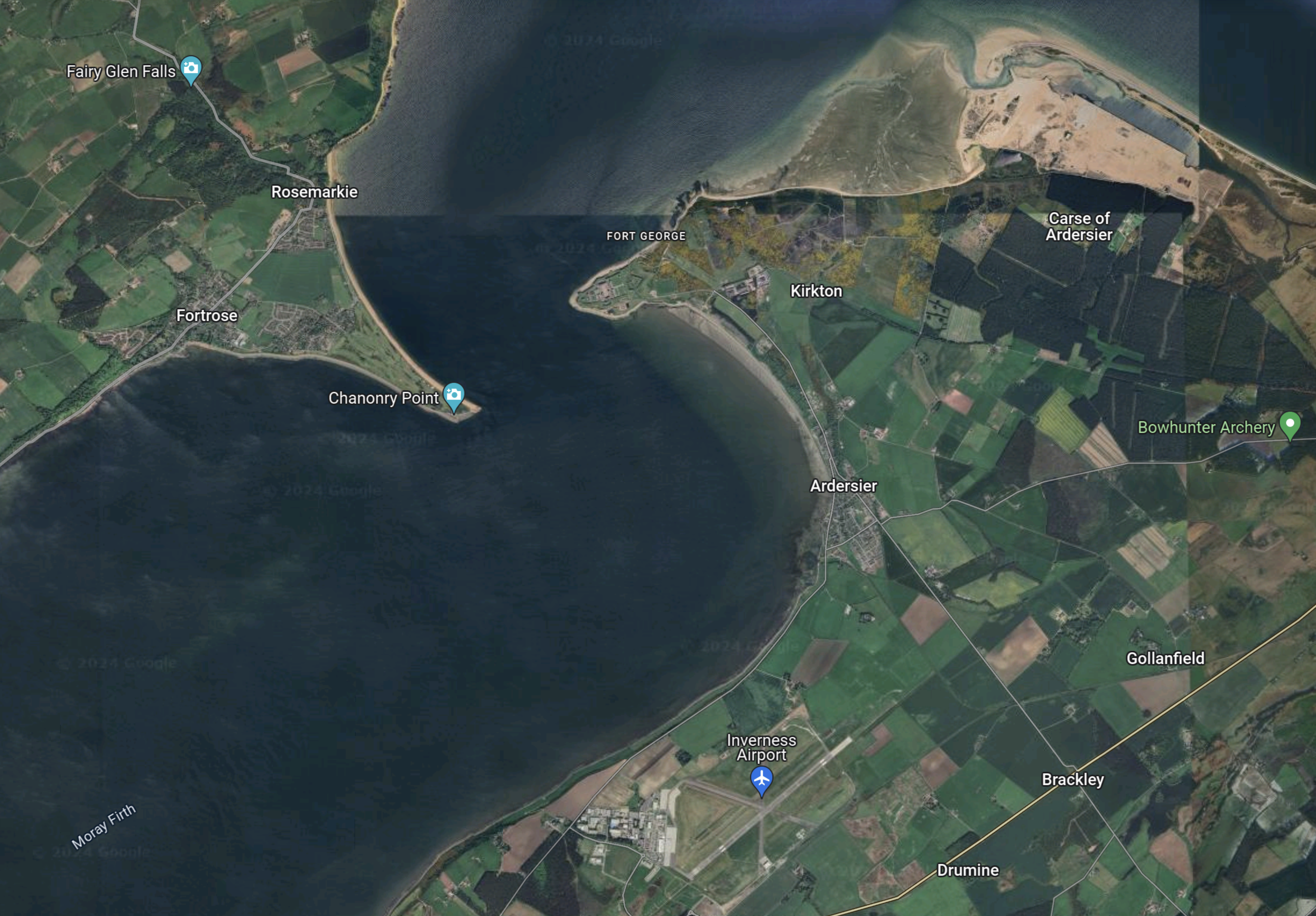
This Google Map shows the location of the Port of Ardersier.
Note.
- The large expanse of water in the middle of the map is Moray Firth.
- The blue arrow at the bottom of the map indicates Inverness Airport.
- Inverness Airport, has a railway station on the Aberdeen and Inverness Line.
- The village of Ardersier is on the the Eastern bank of the Moray Firth
- The Port of Ardersier is in the North-East corner of the map.
The city of Inverness, with a population of around 48,000, is a few miles South-West of the South-West corner of the map.
Which Windfarms Will Be Built And Serviced From The Port Of Ardersier?
This map shows the various ScotWind leases, around the North of Scotland.

The numbers are Scotwind’s lease number in their documents.
These are the Scotwind wind farms to the North-East of Scotland, that could reasonably be assumed to be built and served from the Port of Ardersier.
- 7 – DEME Concessions Wind – 200 km² – 1.0 GW – Floating
- 8 – Falck Renewables Wind – 256 km² – 1.0 GW – Floating
- 9 – Ocean Winds – 429 km² – 1.0 GW – Fixed
- 10 – Falck Renewables Wind – 134 km² – 0.5 GW – Floating
- 11 – Scottish Power Renewables – 684 km² – 3.0 GW – Floating
- 12 – BayWa r.e. UK – 330 km² – 1.0 GW – Floating
These are the Scotwind wind farms to the North-West of Scotland, that could reasonably be assumed to be built and served from the Port of Ardersier.
- 13 – Offshore Wind Power – 657 km² – 2.0 GW – Fixed or Floating
- 14 – Northland Power – 390 km² – 1.5 GW – Floating
- 15 – Magnora – 103 km² – 0.5 GW – Floating
- 16 – Northland Power – 161 km² – 0.8 GW – Floating
These ten wind farms add up to 12.3 GW.
Transport
Consider.
- Obviously, heavy components will be brought in by sea, using the Ro/Ro capable berth or using a crane to unload a barge.
- Personnel will be able to fly in for the day.
- Will some visitors rom London use the Caledonian Sleeper to and from Inverness station to get a full day on site and a good night’s sleep, whilst travelling.
But I do see a problem with local traffic to and from the site.
Hydrogen Buses
This page on the Sizewell C web site, discusses how they will use hydrogen buses.
I could see the Port of Ardersier taking a leaf out of Sizewell C’s book and run hydrogen buses to Inverness, Inverness Airport and other nearby towns.
The North of Scotland certainly won’t be short of green hydrogen to power the buses.
Hydrogen
Conclusion
If you thought that the only useful wind-driven thing to come out of Scotland was bagpipes, you had better think again.
The Port of Ardersier will be the factory and operation and maintenance port for one of the largest offshore wind industries in the world.
Ørsted, Simply Blue, Subsea7 Submit Application For 100 MW Scottish Floating Wind Farm
The title of this post, is the same as that of this article on offshoreWIND.biz.
This is the sub-heading.
Ørsted, Simply Blue Group and Subsea7, through their joint venture partnership in Scotland, have submitted an offshore consent application for the proposed 100 MW Salamander floating offshore wind farm, one of the 13 projects selected in Scotland’s Innovation and Targeted Oil and Gas (INTOG) leasing round.
The article starts with a map that shows the location of the Salamander floating offshore wind farm and it shows how the sea is getting very crowded 35 kilometres off Peterhead.
This map shows the various ScotWind leases, around the North of Scotland.
The numbers are Scotwind’s lease number in their documents.
These are the Scotwind wind farms to the North-East of Scotland.
- 1 – BP Alternative Energy Investments – 859 km² – 2.9 GW – Fixed
- 2 – SSE Renewables – 859 km² – 2.6 GW – Floating
- 3 – Falck Renewables Wind – 280 km² – 1.2 GW – Floating
- 4 – Shell – 860 km² – 2.0 GW – Floating
- 5 – Vattenfall – 200 km² – 0.8 GW – Floating
- 6 – DEME – 187 km² – 1.0 GW – Fixed
- 9 – Ocean Winds – 429 km² – 1.0 GW – Fixed
- 10 – Falck Renewables Wind – 134 km² – 0.5 GW – Floating
- 11 – Scottish Power Renewables – 684 km² – 3.0 GW – Floating
- 12 – BayWa r.e. UK – 330 km² – 1.0 GW – Floating
Note.
- Salamander is located to the South of wind farms 10, 11 and 12 and to the North-West of wind farm 5.
- These windfarms total up to 16 GW.
- 4.9 GW are fixed foundation wind farms.
- 11.1 GW are floating wind farms.
These are my thoughts.
The Salamander Project
In the big scheme of things, the 100 MW Salamander wind farm, is rather a tiddler of a wind farm.
On the Salamander wind farm web site, a section gives the Project Goals.
- Our innovative pre-commercial stepping-stone concept will use novel floating foundations to (i) maximise Scottish content, (ii) enable the Scottish supply chain to gear up for the future floating offshore wind commercial opportunities in ScotWind and (iii) reduce the financial, environmental and technology risks of floating offshore wind.
- The Salamander project will contribute to the Scottish Government and UK Government net-zero targets. The project can contribute to the Scottish government’s target of 11 GW of installed offshore wind by 2030, as well as the UK government’s target of 5 GW of operational floating offshore wind by the same date.
- We are dedicated to developing a sustainable and transformative project, working with the oceans, and enabling communities to benefit from Project Salamander. Therefore, we commit to having a continuous and strong stakeholder and community engagement.
It appears to me, that the Salamander project will be a pathfinder for the 11.1 GW of floating wind farms to be built off Peterhead.
Bringing The Electricity South
National Grid are building four interconnectors between Eastern Scotland and Eastern England.
- Eastern Green Link 1 – Torness and Hawthorn Pit
- Eastern Green Link 2 – Peterhead and Drax
- Eastern Green Link 3 – Westfield and Lincolnshire
- Eastern Green Link 4 – Peterhead and Lincolnshire
Note.
- All interconnectors are 2 GW.
- All interconnectors are offshore for a long part of their route.
- It also appears that National Grid are burying much of the onshore sections.
But the 4 GW of interconnectors will only be able to bring a quarter of the offshore electricity generated in the Peterhead area to the South.
What Will Happen To The Excess Electricity?
Consider.
- There could be 16 GW of planned offshore wind power around Peterhead and North-East Scotland.
- There is only 4 GW of interconnector capacity between Peterhead and Eastern England.
- There is another 6.8 GW of electricity around North-West Scotland.
- There is 2.8 GW of electricity being developed to the East of Shetland.
- The Crown Estate is thinking of increasing the size of some offshore wind farms.
It is likely, that other wind farms will be built in the seas around the North of Scotland.
It appears that the North of Scotland could have at least 20 GW of excess electricity.
Possible solutions would include.
- Developing energy intensive industries like metal refining.
- More interconnectors to Denmark, England, Ireland and Norway.
- Storage of the electricity in giant pumped storage hydroelectric power stations.
- Creation of green hydrogen for export.
Note.
- Aluminium refining has been developed in the North of Scotland before.
- More interconnectors are a possibility, especially as Scotland is developing cable manufacturing capacity.
- Some maps show extra interconnectors between West Scotland and Merseyside.
- At least 70 GWh of pumped storage hydroelectric power stations are being developed along the Great Glen.
- I suspect that the pumped storage hydroelectric power stations could be connected to the wind farms, by cables under the waters of Loch Ness.
But surely, production of green hydrogen for export would be a very good way to go.
- Extra electrolysers could be added as required.
- Because of the interconnectors down both East and West Coasts, electrolysers could be built in England, where there is a large need for hydrogen.
- Hydrogen would be exported initially by tanker ships.
- At some point in the future, it might be viable to build a hydrogen pipeline to connect to the growing European hydrogen network.
The giant pumped storage hydroelectric power stations and the hydrogen electrolysers would be sized to make sure, that no wind power is never wasted.
Conclusion
The 100 MW Salamander floating wind farm may only be small, but it will prove the technology, the manufacturing and the supply chains, so that Scotland can have a second energy boom from the North Sea.
But this boom will certainly last longer than a hundred years.
Octopus Energy Invests In Floating Offshore Wind Tech Company
The title of this post, is the same as that of this article on offshoreWIND.biz.
This is the sub-heading.
Octopus Energy’s generation arm has invested in US-headquartered Ocergy to boost the development of floating offshore wind farms globally.
These are the first three paragraphs.
According to Octopus, Ocergy has an innovative approach to designing and manufacturing floating foundations, reducing the time and cost of building them.
Ocergy is pioneering a hyper-local supply chain approach, working with local manufacturers and creating green jobs in the areas where the wind turbines are installed, said the company.
Further efficiencies are unlocked through Ocergy’s lighter and modular designs which make the turbine foundations easy to transport and assemble at their final destination, according to the press release.
This page on the Ocergy web site contains the press release, mentioned in the article.
These are some sentences from the press release.
- Ocergy, which is headquartered in the US and has operations in France, is pioneering a hyper-local supply chain approach, working with local manufacturers and creating green jobs in the areas where the turbines are installed.
- Further efficiencies are unlocked through Ocergy’s lighter and modular designs which make the turbine foundations easy to transport and assemble at their final destination.
- Floating foundations are used in areas with coastlines that are too deep for foundations that are fixed to the seabed. Around 80% of global offshore wind resources are located in deep waters, underscoring this technology’s vast untapped potential.
- It comes as governments across the globe have set ambitious targets for floating offshore wind. The UK alone is targeting 5 GW of floating offshore wind capacity by 2030.
I certainly like their approach.
believe that innovative designs and streamlined manufacturing will play a large part in installing the large amount of floating wind, that is planned by governments worldwide.
I also believe that because of the repetitive nature of the building of these floating structures, innovative project management software and systems will be developed.
I certainly have my own ideas for that!
BW Ideol Unveils Mass Production-Ready Floating Wind Foundation
The title of this post, is the same as that of this article on offshoreWIND.biz.
This is the sub-heading.
France-based BW Ideol has unveiled its standardised floating foundation product and a blueprint for mass production that could drive costs down across projects.
This is the first paragraph.
With over 22 GW already awarded in Scotland, around 8 GW in the US, and several GW currently being awarded or in the tendering phase elsewhere in the world, the floating wind is now entering an industrialization phase, said BW Ideol.
It looks like the French have come up with a solution that’s needed.
These are previous posts about BW Ideol.
- BW Ideol And Holcim To Explore Use of Low-Carbon Concrete In Floating Offshore Wind
- BW Ideol, ABP To Explore Serial Production Of Floating Wind Foundations At Port Talbot
There is also this video of proposed serial production of BW Ideol floaters at the Port of Ardersier.
This Google Map show the area of Scotland to the North-East of Inverness Airport.

Note.
- Inverness Airport indicated by the red arrow.
- Ardersier village in the middle of the map on the bay.
- Fort George is at the North end of the bay.
The Port of Ardersier is the large slab of concrete in the North-East corner of the map, the Carse of Ardersier marked below it.
BW Ideol are claimining they can build one floater a week or one GW a year.
BW Ideol And Holcim To Explore Use of Low-Carbon Concrete In Floating Offshore Wind
The title of this post, is the same as that of this article on offshoreWIND.biz.
This is the sub-heading.
BW Ideol and Holcim have signed a Memorandum of Understanding (MoU) for a feasibility study on supplying beneficial low-carbon concrete for the floating offshore wind industry, with particular reference to Scotland.
These are the first three paragraphs.
BW Ideol and Holcim aim to collaborate on optimising the supply of the innovative concrete needed for the intended mass production of BW Ideol’s floaters in the Port of Ardersier.
Low-carbon concrete’s advantages as a building material for offshore wind farms include its durability in marine environments, its local availability and its comparatively lower carbon emissions, the companies said.
The collaboration includes developing specific durable maritime low-carbon concrete mixes with enhanced mechanical performance perfectly suited to slipform application.
This is surely a good development.
Europe’s First Commercial-Scale Floating Offshore Wind Farm Secures All Planning Approvals
The title of this post, is the same as that of this article on offshoreWIND.biz.
This is the sub-heading.
Flotation Energy and Vårgrønn, a joint venture between Plenitude (Eni) and HitecVision, have obtained the offshore planning approval for the Green Volt floating wind farm offshore Scotland.
This is the first paragraph.
With onshore consent announced earlier this month, Green Volt has now received all its planning approvals and remains on track to be the first commercial-scale floating offshore wind farm in Europe.
Note.
- This is the Green Volt web site.
- Capacity will be between 300 and 560 MW.
- It should be fully operational by 2029.
- It is an INTOG wind farm designed to decarbonise offshore oil and gas fields.
It will also have the side effect of bringing more gas ashore in the UK, instead of burning it to power the platforms.
Hyundai Heavy Sets Sights On Scottish Floating Offshore Wind
The title of this post, is the same as that of this article on offshoreWIND.biz.
This is the sub-heading.
Major South Korean shipbuilder, HD Hyundai Heavy Industries, has signed a Memorandum of Understanding with two Scottish enterprise agencies which is expected to unlock expertise in the design and manufacture of floating offshore wind substructures.
These are the first three paragraphs.
Scottish Enterprise (SE) and Highlands & Islands Enterprise (HIE) signed the MoU with Hyundai Heavy in Edinburgh, described as a “vote of confidence” in Scotland, committing each other to pursue opportunities for floating offshore wind projects in Scotland.
This is the South Korean company’s first agreement in Europe on floating offshore wind manufacturing.
HD Hyundai Heavy Industries is the world’s largest shipbuilding company and a major manufacturer of equipment such as the floating substructures that form a critical part of the multi-billion offshore wind supply chain.
To say this is a big deal, could be a massive understatement, as my history with large Korean companies could say otherwise.
Around 1980, one of the first prestigious overseas projects, that was managed by Artemis was in Saudi Arabia.
- This may have been something like the King Khaled City, but I can’t be sure.
- Most of the hard work on the project was done by labour imported by Hyundai from South Korea.
After a few years, the Korean running Hyundai’s part of the project returned to Korea and he indicated that he would help us break into the Korean market.
Our salesman; Paul, with responsibility for Korea, who sadly passed away last year, told me this tale of doing business in the country.
Our Korean friend had bought a system for Hyundai in Korea and he organised a meeting for important Korean companies, so that Paul could present the system.
Everything went well, with our friend doing the necessary pieces of translation.
When he had finished, Paul asked if there were any questions.
The most common one was “Can we see the contract?”
Contracts were given out and after a cursory read, the leaders of Korean industry, all started signing the contracts.
So Paul asked our Korean friend, what was going on.
After a brief discussion, Paul was told. “If it’s good enough for Hyundai, it’s good enough for my company!”
And that was how we broke the Korean market.
Conclusion
In UK And South Korea Help Secure Millions For World’s Largest Monopile Factory, I talked about Korean company; SeAH Wind’s new monopile factory on Teesside.
In South Korea, UK Strengthen Offshore Wind Ties, I talk about a developing partnership.
In Mersey Tidal Project And Where It Is Up To Now, I talk about Korean involvement in the Mersey Tidal Project.
The Koreans are coming and Hyundai’s endorsement will help.
SeaTwirl Partners With Local Firm To Bring Vertical-Axis Floating Wind Turbine To Japan
The title of this post, is the same as that of this article on offshoreWIND.biz.
This is the sub-heading.
Sweden-based SeaTwirl has signed a Memorandum of Understanding (MoU) with Sumitomo Corporation Power & Mobility (SCPM) to promote its vertical-axis offshore floating wind turbine in the Japanese market.
These two paragraphs detail the responsibilities.
Under the MoU, SCPM will be responsible for identifying, marketing, negotiating, and contracting potential clients.
The Swedish company will be in charge of promoting and offering the products and services to potential clients.
Note.
- In SeaTwirl And Verlume Join Forces To Drive Decarbonisation Of Offshore Assets, I talk about their MoU with Verlume.
- In SeaTwirl, Kontiki Winds To Explore Powering Oil & Gas Assets With Floating Wind, I talk about their MoU with Kontiki Winds.
SeaTwirl either likes using Memoranda of Understanding (MoU) or their technology is very good.
The article says this about the applicability of SeaTwirl to Japanese waters.
Japan has over 4,000 islands, and according to the Global Wind Energy Council (GWEC), it has approximately 128 GW of fixed-bottom offshore wind potential and 424 GW of floating offshore wind potential.
SeaTwirl said that its vertical-axis wind turbine is well-suited for the conditions in the Japanese offshore environment with its robust and flexible design and high serviceability.
That certainly looks to be a good match and I wonder, if this could end up as a three-way co-operation, with the inclusion of Verlume’s underwater batteries.
Will SeaTwirl and Sumitomo target other island nations or those with lots of islands like Croatia, Greece, the Caribbean, Italy, Micronesia and the Philippines?
Two Ports Advance To Next Stage Of UK Gov Funding For Floating Wind
The title of this post, is the same as this article in Ground Engineering.
This is the sub-heading.
Port Talbot in Wales and Port of Cromarty Firth in Scotland have advanced to the next stage of a government funding scheme to develop port infrastructure that will facilitate floating offshore wind.
These three paragraphs introduce the developments.
The UK Government has agreed that the port expansion projects should progress to the next stage of its floating offshore wind manufacturing investment scheme (FLOWMIS) known as the primary list phase.
Up to £160M of grant funding will be allocated to certain investments in the floating offshore wind sector under the scheme.
The money will go towards funding the basic infrastructure necessary to support the assembly of floating offshore wind turbines. This includes the construction, replacement and upgrade of port infrastructure to accommodate large components such as towers and blades, as well as steel and concrete foundations and mooring cables required for floating offshore wind.
The article also says this about Port Talbot.
The Future Port Talbot project in south Wales would see the port transformed into a major hub for the manufacturing, assembly, and integration of floating offshore wind components for projects in the Celtic Sea.
Associated British Ports (ABP), which owns and operates the port, welcomed the government’s decision.
Note.
- Port Talbot will almost certainly use locally produced steel.
- There appears to be at least 4,832 MW of floating wind to be developed in the Celtic Sea in the next few years.
Port Talbot would be ideally placed to handle both English and Welsh coasts and waters in the Celtic Sea.
The article also says this about the Port of Cromarty Firth.
The Port of Cromarty Firth (PoCF) on the east coast of the Scottish Highlands will undergo a fifth phase of expansion work. This will develop the facilities and infrastructure necessary to enable the port to support offshore wind infrastructure projects off the coast of Scotland.
Over £50M has also been earmarked for the port’s expansion.
There appears to be at least 15,216 MW of floating wind to be developed in Scotland in the next few years.
Both ports seem to have welcomed the funding.
Adding the plans for Scotland and the Celtic Sea together gives a figure of just over 20 GW of floating wind to be developed in the next few years.
Conclusion
Surely, the award of funding for floating wind, is a good way to create a new industry and jobs in these two areas and also perform some sensible levelling-up.
I also suspect that spending £160 million to enable the construction of 20 GW of floating wind farm is a good return on the investment.
 The Anonymous Widower