What Will Boris Do About The Proposed Third Runway At Heathrow?
I have tackled this before in October 2016 in a post called Changing Sides.
This was how I started that post.
There is an interesting article in The Sunday Times today, entitled Boris Retreats In Fight Against Third Runway.
Boris is apparently saying he won’t oppose a third runway at Heathrow, so if anything he’s being consistent in changing horses, just as he did with Michael Gove.
But perhaps more surprisingly, Willie Walsh, the Chief Executive of IAG, who own BA, is quoted as calling Heathrow a fantasy project, which has been gold-plated and inflated by the owners to maximise their returns, at the expense of the airlines.
The paper also says that Gatwick will build a new runway anyway.
Remember, it was written before Theresa May’s government decided to allow Heathrow’s Third Runway.
Since the decision to allow Heathrow to build a Third Runway was made nearly three years ago in October 2016, there have been a lot of changes.
Notably, Boris has gone from Foreign Secretary and an MP in a Heathrow Expansion-opposing constituency to Prime Minister.
As Prime Minister he is supposed to look at the bigger picture.
Unless he’s totally stupid he must have noted the following.
Brexit Has Changed From A Simple Quick Exit Into A Slow And Very Tortuous Process
I would expect an opinion poll would show that the UK population thinks that sorting out Brexit is a much more important problem, than the decision on a new runway in the South East of England.
So will Boris put Heathrow’s Third Runway on the back burner, given the following factors
Gatwick Will Build A Second Runway Anyway
In the Wikipedia entry for Gatwick Airport, there is a section entitled Expansion Proposals, where this is the first paragraph.
Gatwick has been included in a number of reviews of airport capacity in southeastern England. Expansion options have included a third terminal and a second runway, although a 40-year agreement not to build a second runway was made in 1979 with West Sussex County Council. Expanded operations would allow Gatwick to handle more passengers than Heathrow does today, with a new terminal between two wide-spaced runways. This would complement or replace the South Terminal, depending on expected future traffic.
My project management knowledge tells me, that Gatwick could add a second runway and upgrade the terminals in a shorter time, than Heathrow can build a third runway.
But more importantly, Gatwick Airport could build the extra runway and terminal without disruption to airport passengers, aircraft and road traffic on the nearby M23.
Boris’s only problem with Gatwick expansion, is the amount of post he’ll get from Disgusted of Tunbridge Wells.
Disruption Must Be Avoided
Recent timetabling and construction fiascoes on Thameslink and Northern Rail should have sent a message to politicians, that large infrastructure projects must be created without disrupting train or air passengers and road traffic.
Can Heathrow Be Built Without Disrupting Traffic On The M25?
It is interesting to look back at the basic facts at the construction of Heathrow Terminal 5.
- A public enquiry into the project lasted 525 days.
- The terminal sits on a 260 hectare site.
- Construction started in 2002.
- The terminal opened in 2008.
- Construction finisged in 2011.
- The terminal cost £4.2billion.
The construction of Terminal 5, also needed the M25 to be widened and linked to the terminal.
This Google Map shows Heathrow Terminal 5 and its relationship to Heathrow’s current two runways and the M25.
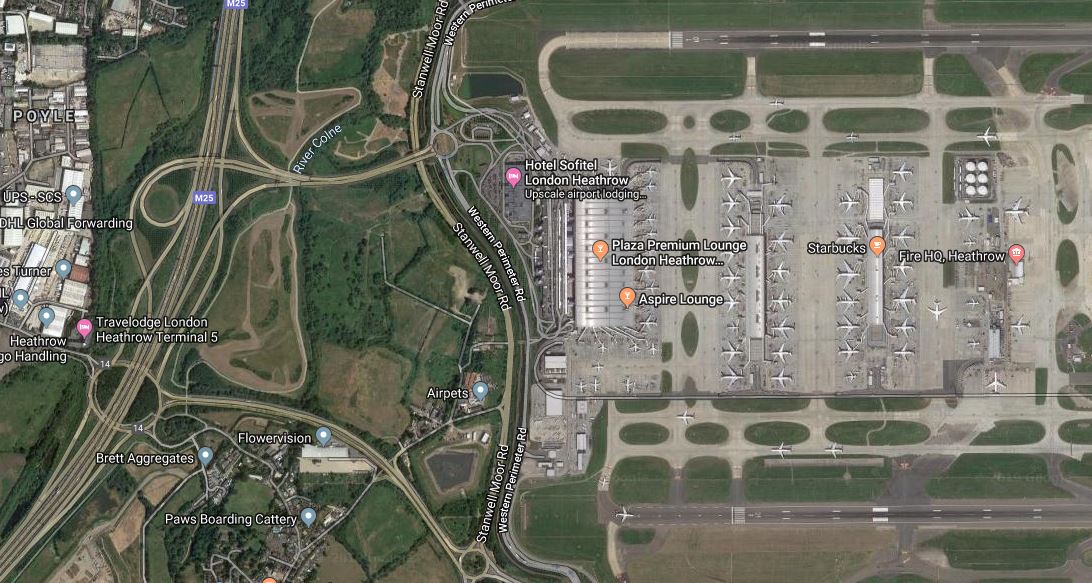
I remember the construction of Terminal 5 well, if only because, I was stuck in or moving slowly along that section of the M25 so many times.
As this immense construction project, is probably in living memory of much of the population of West London, how will they react to the thought of all the disruption, that building the third runway will cause.
Would Uxbridge, throw Boris out, if he approved the building of a third runway at Heathrow?
Heathrow Is A Pollution Blackspot
Various factors mean, that the surroundings of Heathrow are a pollution blackspot, mainly caused by the large number of diesel vehicles on the M4 and M25 motorways and others bringing passengers and goods to the airport.
I believe that any Planning Permission for the third runway, will require Heathrow to do something about the pollution. This could be easier than anybody thinks, as more of us will be using electric vehicles by the time the runway opens.
Heathrow are already proposing their ULEZ or Ulta Low Emission Zone.
Heathrow Rail Access Will Improve
Crossrail will eventually serve Heathrow in a year or so and this will improve rail access to the Airport significantly.
Other rail links are also in prospect.
- The Western Rail Approach to Heathrow could be open by 2024.
- Heathrow Southern Railway could be built.
- The West London Orbital could be built.
The first two would be privately financed.
This better rail access may reduce the traffic and pollution around the airport, but it will make it easier, for passengers to use the airport and traffic will grow.
High Speed Rail
Increasingly, Heathrow and the other London airports, will come under competition from High Speed Rail.
Eurostar has upwards of seventy percent of the London-Paris and London-Brussels passenger markets.
I have travelled a few times from London to Amsterdam on Eurostar and feel that four hours is my limit for comfortable train travel.
I estimate the following journeys would be possible on Eurostar.
- London and Cologne via Brussels in four hours
- London and Bordeaux via Paris in four and a half hours.
- London and Frankfurt in Five hours.
Another competitor to air services out of London will be London and Edinburgh services on the East Coast Main Line, which are being updated with new faster trains and journey times under four hours.
Air Cargo And Heathrow
I looked up air cargo in Wikipedia and these points are there.
- Fifty-percent of all air frieght is belly-cargo on airlines.
- An industry expert estimates that 15-20 tonnes of air cargo is worth 30-40 economy passenger seats, when both are on passenger planes.
- In 2017, the IATA observed a 9% rise in freight tonne kilometres
- Boeing is doubling its 767F production since 2016 to three per month in 2020.
Heathrow dominates the air cargo traffic into and out of the UK and last year it handled 1,788,815 tonnes of cargo, which was a 5.3% increase in tonnage on 2017.
However, it does appear that the second largest cargo airport in the UK; East Midlands, handled about the same amount of freight as Heathrow in April 2018.
There is also the East Midlands Gateway close to that airport, which will be a massive logistics park., with a rail connection.
Perhaps the pressures of the congested Heathrow, with some nudging from the Government could remove the cargo aircraft from the airport to more suitable airports like East Midlands and Doncaster Sheffield.
Manchester Airport Is The Most Important Airport North Of London
Manchester Airport is the busiest Airport after Heathrow and Gatwick and over the next few years it will catch up to a certain extent.
In Changes Signalled For HS2 Route In North, I said this about Manchester Airport’s rail connectivity if High Speed Two and Northern Powerhouse Rail are combined across the Pennines.
If High Speed Two and Northern Powerhouse Rail are developed as laid out in the Transport for the North report, the following cities will be connected to Manchester Airport.
- Birmingham – High Speed Two
- Blackpool – Northern Powerhouse Rail/West Coast Main Line
- Bradford – High Speed Two/Northern Powerhouse Rail
- Carlisle – Northern Powerhouse Rail/West Coast Main Line
- Edinburgh – Northern Powerhouse Rail/East Coast Main Line
- Glasgow – Northern Powerhouse Rail/West Coast Main Line
- Hull – High Speed Two/Northern Powerhouse Rail
- Leeds – High Speed Two/Northern Powerhouse Rail
- London – High Speed Two
- Newcastle -High Speed Two/Northern Powerhouse Rail
- Preston – Northern Powerhouse Rail/West Coast Main Line
- Sheffield – Northern Powerhouse Rail
- Sunderland – Northern Powerhouse Rail
- York – High Speed Two/Northern Powerhouse Rail
Manchester Airport will probably become the most important station in the North with High Speed connections to a large part of England and Scotland.
Heathrow and Gatwick will find they have a very big and well-connected Northern competitor.
Extinction Rebellion And Other Environmental Protesters
Most of the environmental protesters like Extinction Rebellion seem to have focused their attention on Heathrow, where airports are concerned.
They will fight tooth and nail to stop Heathrow’s third runway.
Will Heathrow Get The Planning Permission They Need?
I think that this is the sort of planning decision, that will end up with the Secretary of State for Environment, Food and Rural Affairs; Theresa Villiers.
Her Wikipedia entry says this.
Villiers favours construction of a high-speed rail link from London to Birmingham and Manchester, arguing that flyers could use capacity at airports such as Birmingham International and Manchester International Airport.
She is also quoted as being against a third runway at Heathrow, when she was a member of Davisd Cameron’s cabinet.
Grant Schapps, who is the current Secretary of State for Transport, could be more supportive to Heathrow’s application.
The Mood Of The UK About The Environment
The view of the average UK voter on the environment has changed markedly in the last few years, driven by documentaries, events and politics from around the world.
Boris’s father; Stanley Johnson has written books on the environment and received the Greenpeace Award for Outstanding Services to the Environment, so this could fit with his opposition to a third runway at Heathrow, when he was Mayor of London.
Do Heathrow Airport Have A Plan B?
In Heathrow Plans Runway Over M25 In 30-Year Expansion, I outlined how I thought the runway would be built.
The Times says this about the construction program.
Only the runway would be built by the opening date of early 2026.
Other facilities such as new terminals, car parks, hotels and transit systems would open from 2030, with an expansion of Terminal 5 the priority
This means that the extra runway capacity can be used initially to better accommodate the same number of flights.
Perhaps Plan B would mean changing the order of construction, leaving a space for the third runway and getting Planning Permission to build it in perhaps starting in 2028.
Conclusion
This is a tough one to call and I know what I would do. I would just let it fester until the decision was forced by another factor.
But Boris is the Prime Minister and will have to make a decision!
D
September 1, 2019 Posted by AnonW | Transport/Travel | Boris Johnson, Environment, Flying, Gatwick Airport, Heathrow Airport, Heathrow Southern Railway, Heathrow ULEZ, Manchester Airport, Pollution, Theresa May, Third Runway At Heathrow Airport, Western Rail Approach to Heathrow | 5 Comments
Flights For Sale On Deathtrap’ 737s
The title of this post, is the same as that on an article on the front page of today’s Sunday Times.
Apparently, TUI, United Airlines and some other airlines have booked passengers on Boeing 737 MAX 8 airlines for later in the year.
I certainly won’t fly these airlines until the Boeing 737 MAX scandal is over.
August 18, 2019 Posted by AnonW | Transport/Travel | Boeing 737 MAX, Flying | 7 Comments
Another Problem For The Boeing 737 MAX 8?
This article on the BBC is entitled Russia Bird Strike: Plane Crash-Lands After Hitting Gulls.
The aircraft involved in the accident was an Airbus A321-211, which was flying Ural Airlines Flight 178.
This model of Airbus 311 has CFM56 engines.
So what has that got to do with the Boeing 737 MAX 8?
|Especially as the Boeing aircraft is powered by the successor to the CFM56, the LEAP engine.
This engine is also offered on the latest baby Airbus; the A320neo.
As the Ural Airlines crash was the second bird strike that brought down a baby Airbus after US Airways Flight 1549, I wouldn’t be surprised to see see certification authorities, making sure that this type of aircraft can land safely a double engine failure., providing the plane has enough height.
Airbus seems to have proven, that good airmanship can handle an Airbus A320, when it is flying as a glider.
Given the questioned nature of the design of the computerised controls in a Boeing 737 MAX, the authorities might take a lot of convincing, that these aircraft can be handled safely in similar circumstances.
I think it should also be born in mind, that although the pilot of US Airways Flight 1549i; Chesley Sullenberger was very experienced, the two Russian pilots were much less so, but were still able to carry out a successful emergency landing without any fire and only comparatively minor injuries to those on board.
If you think I’m being alarmist about bird strikes, read the Wikipedia entry for bird strike.
This is a paragraph.
The International Civil Aviation Organization (ICAO) reported 65,139 bird strikes for 2011–14, and the Federal Aviation Authority counted 177,269 wildlife strike reports on civil aircraft between 1990 and 2015, growing 38% in 7 years from 2009 to 2015. Birds accounted for 97%.
We must not get complacent!
I hope that ICAO, the FAA and other authorities are collecting the data on bird strikes in a comprehensive manner and thoroughly analysing it, so that airports with serious problems are identified, so that they can improve their countermeasures.
August 17, 2019 Posted by AnonW | Transport/Travel | Airbus, Boeing 737 MAX, Flying, Safety | Leave a comment
Travelling From Edinburgh To London Next Wednesday
I am going to Scotland for a couple of days and will be returning on Wednesday.
I have just booked a First Class Advance Ticket for £69.30
- I used my Senior Railcard.
- The train leaves at 19:36 and s the last direct train South.
- The train arrives in London at 01:05, which isn’t too late for me, as I can get a taxi home, for a reasonable fare.
- I can even get an all-night bus to the stop round the corner.
- I will be served complimentary snacks on the train.
Out of curiosity, I looked up easyJet
These were possible flights and prices, between Edinburgh and Gatwick Airports.
- 06:05 – 07:35 – 65.55
- 13:40 – 15:20 – £82.72
- 15:35 – 17:15 – £88.78
- 21:15 – 22:45 – £125.14
In addition, I would have to add about a tenner for getting to the Airports and perhaps ninety minutes before and after the flight.
So it looks to me, that my train ticket is better value, quicker and may get me home only an hour or so, later than the last flight, which will be twice the price.
August 17, 2019 Posted by AnonW | Transport/Travel | EasyJet, Edinburgh, Edinburgh Airport, Flying, King's Cross Station, London, Trains | Leave a comment
Would Hydrogen-Powered Aircraft Work For Regional Airports In The UK?
In Stealthy Startup Promises Cheaper Flying Via Renewable Hydrogen, I wrote about ZeroAvia and their plans for hydrogen-powered mini-airliners.
They could power a mini-airliner with the size and performance of the Cessna Caravan, of which well over two thousand have been built for all sorts of purposes. I flew in one, on holiday in Kenya, to get to the Masai Mara.
But could hydrogen-powered mini-airliners, as proposed by ZeroAvia, have applications in the UK?
All around the coast and islands of the UK and Ireland, there are small airfields with commercial services.
- Many commercial services are struggling and some airlines have gone bust.
- Many services are important to sustain the local economy or develop new industries like offshore oil and gas in the past and offshore wind in the future.
- Many of the airports are ex-RAF bases and don’t lack space.
- Some of the airports in this category, that I have visited, don’t lack wind.
I think it would be possible to install a wind or solar power driven hydrogen plant on these airports to support hydrogen-powered mini-airliners providing short feeder services to major airports.
The key to making this structure work would be the range of the hydrogen-powered aircraft.
- Refuelling at the remote airport wouldn’t be a problem.
- Would a major airport welcome a gas tanker refuelling the hydrogen-powered aircraft?
- Could some routes be flown, by only refuelling at the remote airport?
I’m looking forward to my first flight!
August 15, 2019 Posted by AnonW | Transport/Travel | Airports, Flying, Hydrogen, ZeroAvia | 1 Comment
Stealthy Startup Promises Cheaper Flying Via Renewable Hydrogen
The title of this post is the same as an article on IEEE Spectrum.
ZeroAvia are a company that is developing hydrogen-powered aircraft.
They are starting with six to nine seaters like Eivation.
These two paragraphs sum up their philosophy.
By this February, ZeroAvia had assembled its six-seater, 275-kilowatt test plane, and had received FAA experimental flight certification. Miftakhov says the company’s first production powertrains will generate 600-800 kilowatts, which he says is “right in the middle of the power range” for the Pratt & Whitney PT6 turboshaft engines employed on many regional aircraft.
Rather than build airplanes, ZeroAvia plans to lease its powertrain and also supply hydrogen fuel to aircraft manufacturers or airlines. “We’re targeting power levels that are in use today and we are able to utilize the airframes that exist today, with minor modifications,” says Miftakhov.
I like that philosophy.
It will also spin off into other areas.
To make hydrogen-powered aircraft work, ZeroAvia must do the following.
- Design and certify a 600-800 kW powertrain and hydrogen tank with the lightest possible weight.
- Develop a wind and solar powered-infrastructure to produce hydrogen by electrolysis at the point-of-use.
- Provide a complete package to aircraft manufacturers and aircraft operators.
They certainly seem to have assembled a team capable of making the venture take off.
Trucks, buses, construction equipment and trains, both passenger and freight would all benefit from a more efficient powertrain.
The author’s last paragraph is work repeating.
Zero-emissions aircraft, whether battery or hydrogen-powered, may also benefit from a psychological advantage: guilt relief. Concern over climate change is already fueling “flight-shaming” and a resurgence in rail travel in Europe, where trains offer a low-carbon—though sometimes slower—alternative to regional flights.
Read the article!
Conclusion
I like it!
If they achieve their objective of being able to replace the current engine in an existing aircraft, I’ll like it even more.
That would enable pilots to be able to fly the new version of an existing aircraft, after a conversion course.
August 15, 2019 Posted by AnonW | Transport/Travel | Flying, Hydrogen, ZeroAvia | 1 Comment
How The Boeing 737 Max Disaster Looks To A Software Developer
The title of this post is the same as this article on IEEE Spectrm.
It is the best article, I’ve read on the disaster and I agree with nearly every word the writer has written, except perhaps some of his spelling.
Like the author, I am a software developer and I have had over a thousand hours in command of light aircraft, although I don’t fly now!
I have this feeling that this affair, will go down in history as one of the worst business disasters of all time!
I certainly won’t fly in any 737 again! Or at least not for a long time!
August 2, 2019 Posted by AnonW | Business, Computing, Transport/Travel | Boeing 737 MAX, Crap Design, Flying, Software | Leave a comment
Boeing Says It Could Halt Production Of 737 Max After Grounding
The title of this post is the same as that of this article on the Guardian.
This is the first paragraph.
Boeing said it could halt production of the 737 Max jet on Wednesday as it reported the company’s largest ever quarterly loss following two fatal accidents involving the plane.
To my mind, this is a self-inflicted problem caused by trying to stretch a 1960s design too far past the end of its design life.
Boeing realised that they needed a new larger plane and developed the fuel-efficient Class 787 Dreamliner to replace 747s, 767s and 777s.
It was total management failure to not planning to replace the 737 with a smaller plane based on Dreamliner technology.
Will Boeing Solve The 737 MAX Problem?
Compare it with the Class 710 train, that also had software problems that delayed the launch.
- The Class 710 train is a totally new train, with masses of new features, liked by operators, staff and passengers.
- The Train Management and Control System of the Class 710 train was very challenging to design and program.
- If a train fails, it only comes to an embarrassing stop.
On the other hand, the following can be said about the 737 MAX..
- The 737 MAX is an update of a 1960s design.
- The mathematics of the 737 MAX must be challenging.
- The computer system hasn’t been properly designed, programmed and tested.
- If a plane fails, it’s a lot more than an embarrassing stop.
Boeing seem to have made a tragic mistake for airlines, passengers and them,selves.
Engineers will probably solve the software problem,but will that be enough to save the plane?
July 25, 2019 Posted by AnonW | Computing, Transport/Travel | Boeing, Boeing 737 MAX, Class 710 Train, Flying, Software | 1 Comment
Air Travellers To Be Hit By Carbon Charge On All Tickets
The title of this post is the same as that of an article on the front page of today’s copy of The Times.
- The charge would be added to air tickets on an opt-out basis.
- London to New York would have £30 added or £15 with the most fuel-efficient airline.
- London to Madrid would have £25 added.
It is envisaged the charge would also be added to trains, buses and ferries.
These are some of my first thoughts.
- There will be a lot of opposition to any Government trying to enact this policy, as to most people two weeks in the sun in Spain or a long flight to Australia, are more important than the planet.
- Some nations would never enact a policy like this anyway.
- How would a Government force airlines like Air NeckEnd based in some far-off land to show the charge?
- Trummkopf would consider it anti-American
But I believe that the airline industry, airports and the most of the plane and engine builders are brighter than Donald Trump.
- If you look at the vehicle industry, belatedly it is starting to move towards cars with a lower carbon footprint.
- Innovation is also helping to provide alternative solutions, that are bringing vehicles towards a zero-carbon future.
- Companies like Airbus and Rolls-Royce are spending millions of Euros and pounds to design the airlines of the future.
- New entrants into aviation like Eviation with their Alice electric aircraft are on the verge of flying.
- Airliners are getting more efficient with time.
As a simple example take Ryanair with Boeing 737s and easyJet with Airbus A320s.
- Suppose, one airliner had a higher carbon charge on the London to Madrid route.
- Would this make you choose one airline over the other?
- Possibly! But it would certainly make the plane-maker with the least efficient airliners get its act together, or it wouldn’t sell planes.
I believe that a carbon charge could hasten airliners becoming more efficient!
What About Airports?
I have read articles about airports, where they are aiming to make all their ground operations zero-carbon.
This is possible now with electric vehicles and even electric tugs, that can tow a Boeing 747.
So surely, the carbon generated at the airports involved in a flight should also be taken into account and offset.
What About Getting To And From The Airports?
In the UK, Birmingham, Edinburgh, Gatwick, Heathrow, Manchester, Newcastle, Southampton, Southend and Stansted are connected by electric transport systems, but Bristol, East Midlands, Glasgow, Leeds and Liverpool are not!
This should generate an appropriate carbon charge.
Surely too, if you are driving your petrol or diesel car to and from the airport, this should be taken into account.
Conclusion
A fairly-applied carbon charge based on the flight, the airport and getting to the airport would help to drive down carbon emissions due to the application of better technology.
July 22, 2019 Posted by AnonW | Transport/Travel | Airports, carbon Offset, Flying, Global Warming/Zero-Carbon | 1 Comment
Sheffield Region Transport Plan 2019 – Doncaster Sheffield Airport
Sheffield’s plans for Doncaster Sheffield Airport are ambitious.
This is said in the report.
The airport’s proximity to the ECML offers a deliverable short term solution to accelerate the growth hub’s
impact.Doncaster Council, the SCR and the airport’s owner the Peel Group are working alongside Network Rail and TfN to progress delivery of a new ECML station at the airport’s site, through just 4.5 miles of new track off the mainline and rejoining via the existing Doncaster – Lincoln Line running adjacent to the top of the runway.
This Google Map shows the Airport and its relationship to Doncaster.
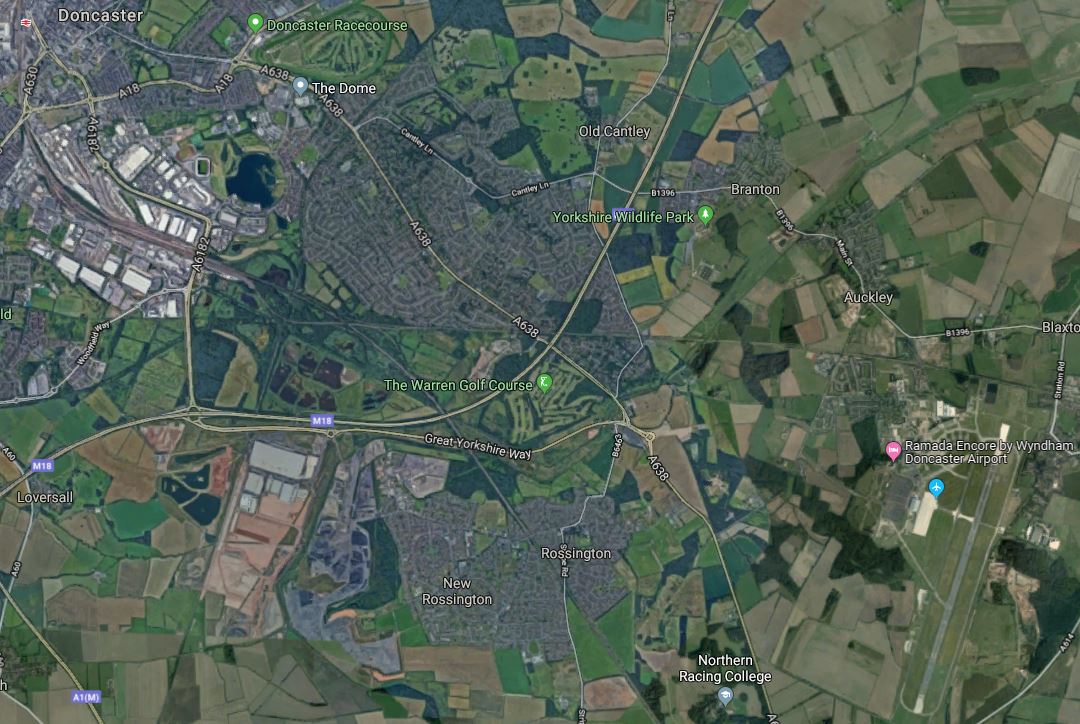
Doncaster is in the North-West corner of the map and the Airport is in the South-East corner.
The Airport has one very long North South runway, which was a designated emergency field for the Space Shuttle, although it was never used.
This Google Map shows the Northern end of the runway and the Doncaster-Lincoln Line running East-West across the runway.
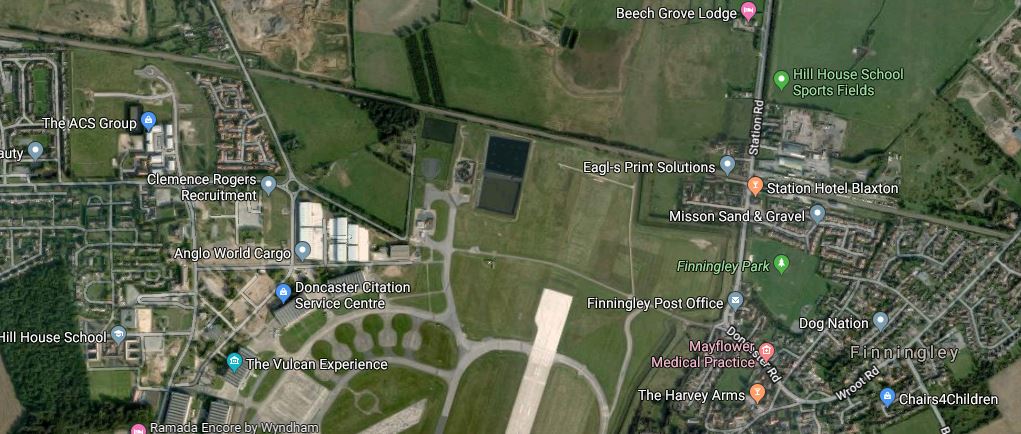
And this Google Map, shows the relationship between the East Coast Main Line (ECML) and the Airport.

The ECML runs diagonally across the Western side of this map, passing to the West of the Northern Racing School, with its oval track.
Looking at the map of the area, I feel that a loop from the ECML could have the following route from South to North.
- Leave the ECML to the South of the Northern Racing School.
- Pass through the Airport parallel to the runway.
- Stop at a station connected to the terminal.
- At the North of the Airport connect to the Doncaster-Lincoln Line.
I think the design could give a lot of scope for services to the Airport.
- Up to four trains per hour between Doncaster and the South.
- Up to four tram-trains per hour to and from Sheffield, via Doncaster and Rotherham.
- Several freight service per hour.
I have clipped this map of services from the report on Sheffield’s plans.

Some points to note.
New Tram-Train Stops
The tram-train extension from Rotherham Parkgate to Doncaster Sheffield Airport via Doncaster has new stations at Lakeside, Bessacarr and terminates at a new station at Bawtry.
Bi-Directional Connection To The Doncaster-Lincoln Line
This is a sensible idea.
- It gives a direct passenger route to and from most of Lincolnshire.
- If the Airport develops a substantial air-freight business, it connects the airport to the freight route between Peterborough and Doncaster, that has recently been created to take freight trains from the ECML.
There is also plenty of space in the flat lands South of the Humber.
Electrification
This is one line that will be electrified, so that the Class 800 trains can use the loop efficiently.
Electrification would also be used by the tram-trains.
The Tram-Trains Don’t Use The East Coast Main Line
Consider.
- Only when they are threading their way through South of Doncaster, will the tram-trains affect the express trains on the ECML.
- The tram-trains may need to reverse at Doncaster.
But I suspect, Network Rail have a cunning plan to run everything efficiently.
Times To And From London And The South
A fast time between Kings Cross and Doncaster-Sheffield Airport is important, if the Airport is to tempt travellers along the ECML to use the Airport.
I reckon, that the following times will be possible.
- London and DSA – 90 minutes
- Peterborough and DSA – 50 minutes
Note that the second time is under half the time it takes to get from Peterborough to Heathrow or Gatwick.
Conclusion
Developing Doncaster Sheffield Airport seems like an excellent idea to me.
July 21, 2019 Posted by AnonW | Transport/Travel | Doncaster Sheffield Airport, East Coast Main Line, Flying, Sheffield Region Transport Plan 2019 | 2 Comments
About This Blog
What this blog will eventually be about I do not know.
But it will be about how I’m coping with the loss of my wife and son to cancer in recent years and how I manage with being a coeliac and recovering from a stroke. It will be about travel, sport, engineering, food, art, computers, large projects and London, that are some of the passions that fill my life.
And hopefully, it will get rid of the lonely times, from which I still suffer.
Why Anonymous? That’s how you feel at times.
Charities
Useful Links
Top Posts
WordPress Admin
-
Join 1,883 other subscribers
Archives
Categories
- Advertising Architecture Art Australia Banks Battery-Electric Trains BBC Buses Cambridge Coeliac/Gluten-Free Construction COVID-19 Crossrail Death Decarbonisation Design Development Docklands Light Railway Driving East Coast Main Line Electrification Elizabeth Line Energy Engineering Entertainment Floating Wind Power Flying Football France Freight Germany Global Warming/Zero-Carbon Good Design Gospel Oak And Barking Line Greater Anglia Great Western Railway Heathrow Airport High Speed Two Highview Power Hydrogen-Powered Trains Innovation Internet Ipswich Town King's Cross Station Law Liverpool London London Overground London Underground Manchester Marks and Spencer Network Rail New Stations Offshore Wind Power Olympics Phones Politics Project Management Religion Research Scotland Shopping Solar Power Stations Step-Free Stroke Television Thameslink The Netherlands Trains United States Walking Weather Wind Power Zopa
Tweets
Tweets by VagueShot


