Moving Towards A Pan-European Locomotive
This article on Global Rail News is entitled Traxx approved for entire DACH region.
The article talks about how the Bombardier Traxx Last Mile locomotive has been approved for Germany, Austria and Switzerland (DACH). The Global Rail News article, says this about the locomotive.
The Last Mile variant, although an electric locomotive, has a low-emission diesel engine and battery on board, allowing it to run on both electrified and non-electrified routes.
One of my first thoughts, was it’s a pity that the standard Traxx is probably two large for the UK’s small loading gauge.
But then I found this article in Railway Gazette, about a proposed UK version of the locomotive. This is said.
Bombardier believes that the Traxx P200 AC UK Bo-Bo electric locomotive fitted with a ‘last mile’ diesel engine would offer ‘a lot of value for money’ for UK operators such as Greater Anglia. Whereas the MkIII coaches used on London – Norwich inter-city services are ‘excellent’ vehicles that may last for another 20 years, the Class 90 locomotives will need to be replaced before that.
Lacchini emphasises that a 25 kV 50 Hz version of the Traxx family suitable for the UK with its small loading gauge will not require a special design to be developed. About 60% of components are common to all versions of the Traxx, one feature being the location of the main traction package in the centre of the locomotive rather than on either side of a central aisle. This makes it relatively easy to build a smaller and narrower version that would fit the UK loading gauge, Lacchini indicated.
It looks to me that Bombadier have designed a powerful family of electric locomotives, that can be used in much of Europe.
With the Class 88 locomotive also due to be delivered soon, it does appear that the UK may have a choice of modern locomtives for freight trains and fast passenger services in the near future.
The Return Of Red Star Parcels
In the 1970s, I used to use Red Star Parcels regularly. As there was no Internet, if I wanted to send a software update of Artemis to London, I’d go into Ipswich, pay a fee to register the parcel with Red Star and they’d put it on the next train to Liverpool Street. I’d phone the train time through and someone in London would pop over to Liverpool Street station and collect it.
C and other lawyers in her Chambers, also used the service to get briefs between London, Colchester, Ipswich and Norwich.
The service worked very well and there is nothing to match it today, except for paying for a courier with a high-speed bike or car.
Perhaps, the best story about Red Star was one that appeared in the Sunday Times.
Parents had bought one of the first Andrews Maclaren baby buggies for their child, but the frame had broken at the back, a day before they were going on holiday. A call to the firm in Derby, told them to Red Star the buggy to Derby station, which they duly did. A few hours later, they were phoned by the company to say that the buggy would arrive in London on the 19:00 train.
The story was true, but you wonder how much was spin on the part of Andrews Maclaren and British Rail.
Network Rail are trying to make their assets sweat. I did see a report a couple of years ago, where Colas Rail and TNT were experimenting with bringing freight trains into Euston for deliveries to shops like Sainsburys and Ryman using electric and low carbon delivery trucks.
A company called InterCity RailFreight is now starting a service using high-speed passenger trains. This is said on their web-site.
We have proven that using passenger trains works – for everything from ultra-time-critical tissue samples delivered to testing laboratories, to fresh seafood carried from fishing boats into the kitchens of top London restaurants.
Not only is our service fast, frequent and reliable – it is cheaper and greener
It sounds very much like the reincarnation of Red Star Parcels.
They are helped by some of the rolling stock that work the services. The InterCity 125s have a generous amount of space in the power car for luggage and some of the driving van trailers used to Norwich can take a copious amount of goods, but what attracted me to the service was this article in Rail Magazine, which is entitled Plans submitted to modify Mk 3s as freight vehicles.
Mark 3 coaches don’t seem to know, when the time is right, to make a dignified exit to the scrapyard.
They would certainly make very good high-speed freight cars for high value goods. We might even see some complete InterCity 125s converted to freight to bring sea food from the far South West or England and the far North of Scotland to places, where they will be consumed.
Could we also see Royal Mail using them as long distance mail and parcel carriers?
Great Western Railway Launches Lobster Class
Great Western Railway serves the best food on a British scheduled train, but this article on Rail News entitled Lobsters ‘take the train’ to London is not a piece of fun. This is an extract.
Live lobsters are now being transported by rail from Cornwall to top London restaurants.
Sending produce by rail will be faster than road, ensuring the lobsters are fresher when they arrive. It will also help to lower carbon emissions by reducing road freight.
Great Western Railways and InterCity RailFreight Ltd will be delivering the lobsters daily on the 1739 Penzance to London Paddington service. WEGO Carbon Neutral Couriers will then take them to their final destination.
It’s good to see innovative uses of resources.
Rail Freight At A Crossroads
I take the headline from this article in Rail Magazine, which is entitled Coal power station closures place rail freight at “important crossroads”.
The article talks about how the closure of coal-fired power stations and the reduction in size of the steel industry, will bring about fundamental changes to the pattern of freight on the railways.
The rail freight industry must develop new markets to take more and more trucks off the roads.
The article says that the industry is looking for government support to improve the East Coast Main Line, the West Coast Main Line and the routes to Felixstowe.
I would also add in the routes that serve the poorly-sited London Gateway, which mean too many noisy and smelly Class 66 locomotives pull freight across North London.
Life is about give-and-take, so it would be wrong to electrify routes that could be used by freight, without the freight companies investing in new electric locomotives.
But Class 66 diesel locomotives are a cheap solution that can go anywhere, that are unloved by those living by rail lines and also by drivers.
Diesel locomotives also mean that they make port and distribution depot operations safer and more efficient. You wouldn’t want idiots with cranes in an area with masses of overhead wires.
Incidentally, the Class 66 locomotives do not meet the current European emission regulations.
But solutions have been designed and are now available.
- The Class 88 locomotive is an electro diesel locomotive, that is primarily an electric locomotive, with a large on-board diesel engine, for use when there is no electrification.
- The TRAXX Last Mile locomotive may also be suitable for some routes, but is probably two big for the small British loading gauge.
I feel that as Vossloh Espana, who make the Class 88, has just been taken over by Stadler, who seem to me to have a reputation for innovation, that the Class 88, may be our best hope for less intrusive freight trains.
It is worth looking at how the Class 88 would help on one route that I know well; Felixstowe to Peterborough and then up the East Coast Main Line to the North.
The route is as follows.
- Felixstowe to Ipswich – A branch line that is not electrified. The Port of Felixstowe have said that they would pay for dualling some of the branch, but they haven’t and have pushed fir the removal of passenger trains from the branch.
- Ipswich to Peterborough – Except for a few miles to Haughley Junction the line is not electrified.
- Peterborough to Doncaster – The East Coast Main Line is electrified, but many freight trains now use the Great Northern Great Eastern Joint Line through Lincoln.
- North of Doncaster – Some routes to Leeds, Newcastle and Scotland are electrified.
So a quick naive look, might say that a Class 88 would be ideal for the route.
But.
- A new Class 88 would probably be more expensive to lease than an old Class 66.
- The Class 66 has a power output of 2,460 kW, whereas the Class 88 has only 700 kW from its diesel.
The freight industry’s preferred option is probably that all routes are electrified, but not at their expense!
But even then there are no new electric locomotives, that fit the UK loading gauge! The freight industry is probably looking jealously at the elderly Class 90 locomotives used for London-Norwich trains and hoping that the line gets electric multiple units.
I’m certain that for cost reasons, the industry would prefer to stick to its beloved Class 66.
I think that London is key to weaning the freight companies away from the dreadful Class 66 locomotives.
When the Gospel Oak to Barking Line has been electrified, London could be in the position to ban Class 66 locomotives from that line and the North London Line, if a few extra pieces of electrification were performed.
But it won’t happen!
I would also like to see the Government make freight companies run locomotives that met the current European regulations.
The LaMiLo Project
Few have heard of the LaMiLo Project, which is an EU funded project to reduce truck traffic and the consequent air pollution in cities.
I hadn’t until half-an-hour ago, although I knew there were experiments going on at Euston.
This page on the London Councils web site, gives more details about the pilot project in London.
In this pilot a freight train was brought into Euston station in the middle of the night and pallets of goods were unloaded on to smaller trucks for onward delivery in Central London.
This is said on the London Councils web site about the pilot.
The pilot has provided outstanding results; it has seen 50,000 items delivered to over 250 councils building, leading to a 46% reduction in the number of vehicle trips and a 45% reduction in kilometres travelled.
It sounds like an idea worth pursuing. Although Nigel Farage would object to the EU involvement.
Where Does The Borders Railway Go Next?
My Borders correspondent, who lives near Selkirk, says that the Borders Railway has been generally well received. Certainly if you search Google News for Borders Railway, you don’t find many problems or complaints, except one about the singing of the National Anthem for the Queen.
A friend in Edinburgh has just told me, that the trains are too crowded at times. So what’s new? New railways are always crowded, especially if they fulfil a need.
The most common articles on the web, are ones like this one from the Border Telegraph, entitled Next Stop Hawick….
So what will effect this line in the next few years and what do I think will happen?
The Me Too Effect
Now that Galashiels has a reliable half-hourly service to Edinburgh, I suspect that the inhabitants South of Tweedbank, will say that if Galashiels and Tweedbank can have this, why can’t Melrose and Hawick?
Cross Border Co-operation
The Borders area of Scotland and the neighbouring area of England are very similar and probably have the same strengths, problems and needs.
In some ways they are very economically linked now.
- Carlisle is economically tied to the Scottish Borders for shopping and transport links.
- Newcastle is a major airport for the area.
- There is even a rail service between Glasgow and Newcastle, that goes via Kilmarnock, Dumfries, Hexham and the Metro Centre.
- Area rail tickets for North West England include Lockerbie.
- Carlisle and Newcastle are the two major places to catch trains to the South, unless you go North to Edinburgh and Glasgow..
Surely this togetherness should be built on to develop the Borderlands, provided the politicians can be kept out of their way, in their offices in London and Edinburgh.
Increasing Railway Capacity Between England And Scotland
At present, the East Coast Main Line and the West Coast Main Line do not provide enough capacity between England and Scotland, for both passengers and freight.
Tourism And Other Economic Effects
I live in the Dalston area of Hackney, which is an area that has been uplifted by the creation of the London Overground from the rather decrepit railways that used to run through the area.
Unless you have lived through the process, most people will not understand how regular trains, running on a frequency of at least two an hour, can bring economic benefits to an area.
The Borderlands, probably have an economic profile not unlike the areas of East Anglia away from the large towns and cities that I know well.
- Both areas are ringed by a series of large towns and cities
- There is a lot of farming.
- There are a lot of tourism-related businesses of all sizes.
- In the summer, visitors take days out into the areas.
- There is a certain amount of specialist manufacture.
- Housing is being developed for those who have retired, who live and work locally and who commute to major towns and cities nearby.
All of these activities will increase the need for better transport links to the major cities that ring the areas.
The latest East Anglian Rail Franchise will mandate the franchisee to provide much better services all over the area and especially on the branch lines.
I can’t believe that the areas on both sides of the Border would not be worth developing in a similar way to that proposed for East Anglia.
Extending The Borders Railway To Melrose, Hawick And Carlisle
Scottish Borders politicians are all in favour of this extension, as are probably the good citizens of the area. My Borders correspondent and his family certainly appear to be.
Just as I have seen an economic uplift in Hackney because of the London Overground, I think it would be unlikely that the Borders Railway running through Melrose and Hawick, would not increase economic activity in the area.
This extension would certainly happen if Scotland stayed in the United Kingdom, as in some ways, this reopening, would help develop tourism in the wider area of the whole Borderlands, the Lake District and North Yorkshire.
Carlisle is probably the big winner in this activity and becomes a city with important or picturesque railway lines going everywhere.
- The West Coast Main Line, links England to Edinburgh and Glasgow.
- The Glasgow And South Western Line to Glasgow via Dumfries and Kilmarnock
- The Settle and Carlisle Line
- The Cumbrian Coast Line around the Lake District to Barrow and Preston
- The Newcastle and Carlisle Line
- The Borders Railway to Edinburgh
The Borders Railway provides the missing link in the railways of the Borderlands.
So when the Scottish politicians discuss the project, they should take into account, the positive affects a complete line would have on England!
Should The Borders Railway Be Electrified?
This question could legitimately by asked about all the other lines meeting at Carlisle, that are not electrified.
But as Carlisle, Edinburgh, Glasgow, Newcastle , Preston and Skipton are all electrified, I suspect all of the Carlisle lines have enough electrification to be run by modern four-car Aventra IPEMU trains, charging their batteries where overhead power is available and running on batteries as needed.
Some of the lines, including possibly the Borders Railway, are probably ready for Aventra IPEMUs now, with a bit of modification to platforms, track and signalling! Some like probably the Cumbria Coast Line would need some electrification or other means to charge the batteries en route.
So the answer to the electrification question must be yes, if Aventra IPEMUs are used.
But it would create a local railway network, as good as any in Europe, in an environmentally-friendly but totally affordable way.
It would be a showpiece of British technology and an attraction to rail enthusiasts from all over the world.
The network also connects to four World Heritage Sites and the Lake District, Hadrian’s Wall and the major cities of Edinburgh, Glasgow and Newcastle.
Would An Extended Borders Railway Provide Extra Capacity Between England And Scotland?
The Borders Railway has a limited number of paths for trains and when a steam special is run, one of the diesel multiple units has to give up its slot. Read various criticisms on Wikipedia.
My scheduling experience, does suggest to me, that if the line was run by the faster and better accelerating electric trains, including Aventra IPEMUs, that this might create some extra capacity on the line.
Unless the line was fully electrified, it wouldn’t be a route for using the electric trains that run up the East and West Coast Main Lines.
But it would be able to take services run by Aventra IPEMUs or any diesel-hauled passenger or freight trains.
These capacity arguments would also apply to the Glasgow and South Western Line, so with a bit of selective electrification and Aventra IPEMUs, some extra capacity might be squeezed in.
I certainly think that a railway time-tabling expert could certainly find some extra capacity.
But it might be overnight freight trains?
Are There Any Branches To The Borders Railway That Could Be Created?
The original Waverley route had several branches including to Peebles and Hexham.
Midlothian Council have also thought about a branch to Penicuik.
Extra branches are up to the economics and the politicians.
Conclusion
In my view, not to extend the Borders Railway to Carlisle by way of Melrose and Hawick, would be total stupidity.
The problem is that despite being totally in Scotland, extending the Borders Railway to Carlisle, has substantial benefits for England too!
What will Nicola think?
Is Coal In Terminal Decline?
I’m no lover of coal, because of all the pollution and carbon dioxide it creates. I’ve also never met anyone from a coal mining family, who would ever want to work in a mine.
So when I look at the latest freight statistics from the Office of Rial and Road, I am rather pleased to see that in the last year coal traffic on UK railways has fallen over the last twelve months, from 1.66 billion net tonne km to 0.64 billion net tonne km (a drop of 61.2%).
As this is mainly imported coal to be burned in coal-fired power stations, I don’t think it is bad for employment. Power stations may be closing, but new ones must be opening to fill the gap in electricity generation.
A Very Wet Stop At Lincoln
I had intended to have a good lunch at Lincoln and go up the hill to look at the cathedral.
But the weather put a stop to that and I just went to see the progress on the two level crossings in the area. This Google Map shows the area of the station and the two crossings that are being given step-free footbridges.
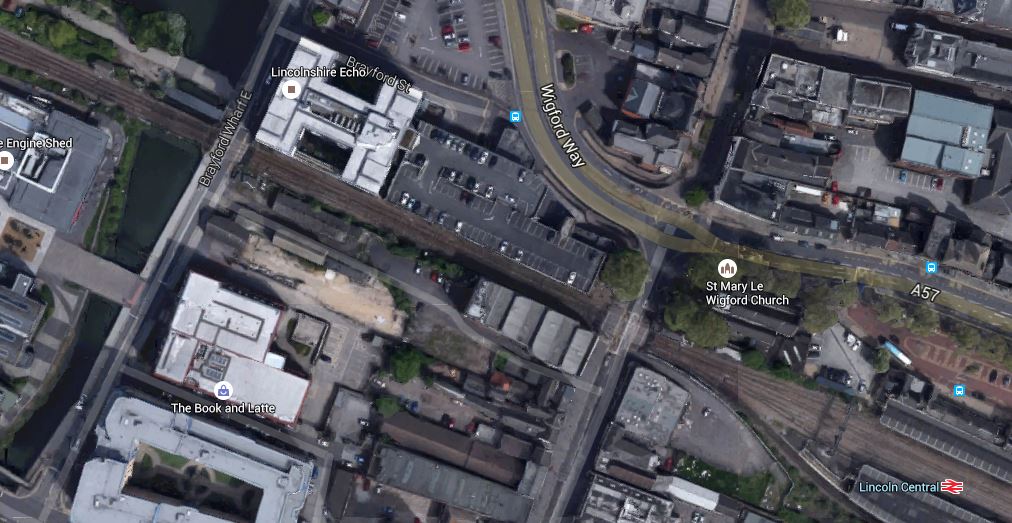
Lincoln Level Crossings
These are some of the pictures I tried to take.









Progress doesn’t seem to be very fast.
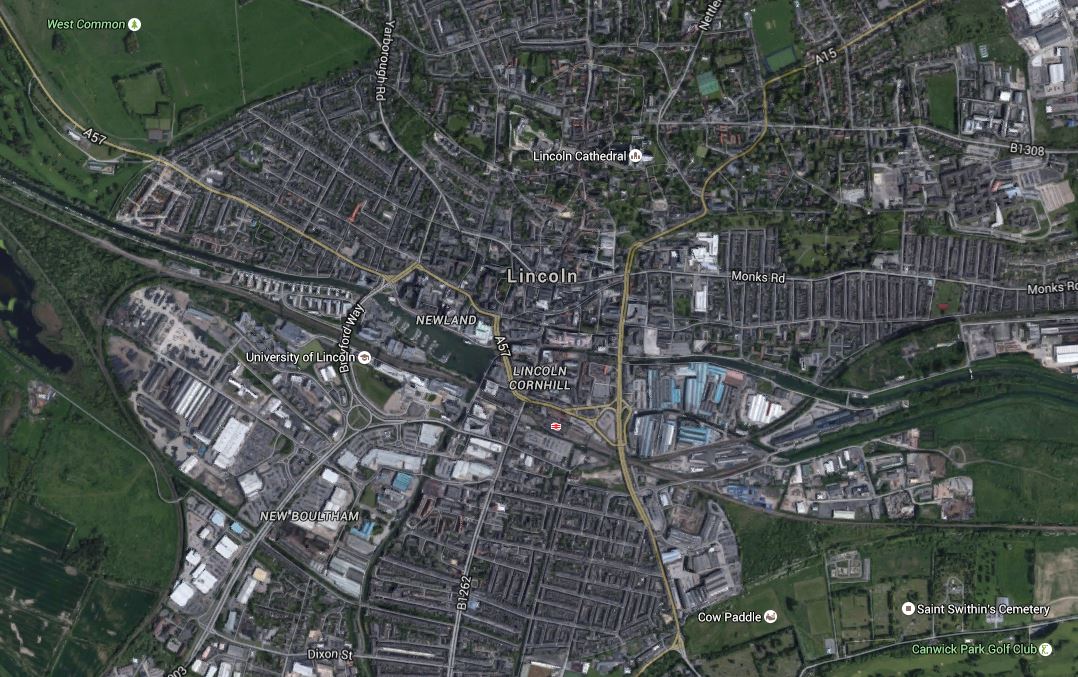
It will be interesting to see if Network Rail’s solution makes things easier. This Google Map shows the southern part of Lincoln.
Lines Through Lincoln
The lines come into the City and through the station on an East-West axis. You can just make out the scar of the Lincoln Avoiding Line, which used to allow trains to by-pass the level crossings. Together with Lincoln St. Marks station, it closed in the 1980s.
According to Wikipedia, train services run between Lincoln and
- Newark North Gate and Leicester via Newark Castle and Nottingham using the Nottingham to Lincoln Line (“Midland line”);
- Sheffield via Retford and direct to Doncaster via the Doncaster to Lincoln Line (“Great Northern and Great Eastern Joint Line”).
- Peterborough via Sleaford via the Peterborough to Lincoln Line (“Great Northern and Great Eastern Joint Line”)
- Grimsby Town via Market Rasen, with occasional journeys to Cleethorpes
Most of these services operate on an hourly or two-hourly basis although some services to places like Nottingham might go to two trains per hour.
There are also once daily services Monday to Saturday to London St Pancras operated by East Midlands Trains and to London Kings Cross operated by Virgin Trains East Coast.
Lines to Doncaster, Newark, Nottingham and Sheffield run to the West and lines to Grimsby, Peterborough, Skegness, Sleaford and Spalding are to the East.
You can understand, why the Route Utilisation Strategy (RUS) for the East Midlands felt that services could be improved by joining services together in Lincoln to free up platform space. At present some Grimsby Town services go though Lincoln to Newark North Gate.
It’s certainly a tricky problem at Lincoln and I can’t help feeling that at some time in the future, there’s going to have to be a solution that takes freight trains away from Lincoln High Street.
What Has The EU Done For UK’s Railways?
I am not a Eurosceptic although like may, I am a bit sceptical about some of the things that the EU does with our money.
An article on the Rail Engineer entitled The Freight Train Of The Future caught my eye.
Susrail is an EU project which aims to create more environmentally freight trains. This is an overview from the article.
SUSTRAIL aims to increase rail freight performance through a whole system approach which involves a number of work packages. The current system was benchmarked (WP1) and duty requirements established (WP2).
Then two parallel but linked packages considered the freight train of the future (WP3) and sustainable track (WP4), after which a business case (WP5) was developed and the new vehicle and track systems were tested (WP6). Thirty-one organisations in twelve countries shared the work for which the project coordinator was Consorzio Train, an Italian consortium of rail research institutions. UK participants were Network Rail (technical coordinator), Tata Steel and the Universities of Newcastle, Leeds, Sheffield and Huddersfield.
Initial benchmarking involved Network Rail and the Universities of Leeds and Newcastle. This analysed three selected freight routes in Bulgaria, Spain and Britain (Southampton and Felixstowe to Warrington).
It is a fascinating article and well worth a read.
But at least the EU is doing something to make freight trains more efficient and less noisy.
It did raise a chuckle, as I read how they were looking at the dynamics of freight wagons. As I remember from the 1960s, the superb dynamics of the InterCity 125 benefited from research done by British Rail, to solve the problem of the large number of freight train derailments of the time.
Before GOBlin Electrification – Crouch Hill
I’d never been to Crouch Hill station before, but I went to take these pictures.


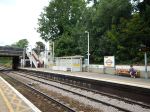


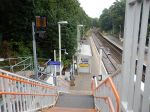




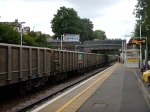
It is another tidy station with fairly long platforms, steep staircases and no lifts. Although unlike Leyton Midland Road, the station is in a cutting, rather than on a viaduct.
My pictures were as you can see interrupted by a dreaded Class 66 locomotive, with all its noise and smell passing through. After electrification, hopefully we’ll see something more environmentally-friendly like an elderly Class 90 or a brand new Class 88 locomotive. Unfortunately, I think we’ll see mainly Class 66s pulling freight trains for some years, as there are so many of them and they seem to be pretty reliable, although unloved by the drivers.
 The Anonymous Widower