The Transformation Starts Here
This article in Rail Magazine is entitled First GWR High Speed Train Off-Lease This Month.
It describes how the first InterCity 125 for ScotRail is leaving Great Western Railway for refurbishment to meet the new regulations coming in on the 1st of January 2020.
What other train in the world, after forty years front-line service, could be given a full upgrade to be made ready for more years of service?
How Long Will It Take Bombardier To Fulfil Their Aventra Orders?
I was reading this article in The Guardian, which is entitled Full speed ahead for train builders as minister pulls plug on electrification, when I found this useful nugget of information, from the General Manager of Bombardier’s Derby plant.
Building trains in an “ergonomically correct” fashion, he says, means completing and testing the carriage’s constituent parts, then assembling them, rather than wiring them up afterwards – and also takes the risk away from a production line which boasts a rate of 25 carriages per week.
It sounds like Bombardier’s engineers have been drinking and swapping ideas, with Toyota’s production engineers a few miles down the road at Burnaston.
But even so 25 carriages a week is an impressive figure, as that is almost three Class 345 trains for Crossrail in a week.
Bombardier have not been producing at that rate until now, as if they had, there would be Aventras in sidings all over the place. In The Class 345 Trains Are More Numerous, I described how I saw four yesterday and Transport for London have said they will have they will have eleven in service by September.
But this is all consistent with not going into full production, until you are sure, that you’ve got everything right, as any prudent company would do!
The Trains On Order
Bombardier have the following orders for Aventras.
- Crossrail – Class 345 – 70 x nine-car – 630 cars – To be delivered in 2015-2018
- London Overground – Class 710 – 45 x four-car – 180 cars – To be delivered in 2017-2018
- Greater Anglia – Class 720 – 89 x five-car – 445 cars – To be delivered in 2018-2020
- Greater Anglia – Class 720 – 22 x ten-car – 220 cars – To be delivered in 2018-2020
- South Western Railways – Class xxx – 30 x five-car – 150 cars – To be delivered in 2019-2020
- South Western Railways – Class xxx – 60 x ten-car – 600 cars – – To be delivered in 2019-2020
- West Midlands Trains – Class xxx – 36 x three-car – 108 cars – To be delivered from 2020
- West Midlands Trains – Class xxx – 45 x five-car – 225 cars – To be delivered from 2021
- c2c – Class xxx – 10 x six-car – 60 cars – To be delivered from 2021
This gives a total of 2,618 cars to be built.
The Building Schedule
Orders 1 and 2 are both directly or indirectly for Transport for London, with Wikipedia stating that the Class 710 trains for the Lea Valley Lines are being stabled at Ilford TMD, where the current Class 345 trains are also stabled, whilst they are being tested between Liverpool Street and |Shenfield stations.
I suspect that this close relationship between the orders means that Bombardier and Transport for London have agreed a delivery schedule, that brings in trains as they are needed. There’s not much point in building Class 345 trains for Crossrail, when some won’t be needed until 2019, if there is a more urgent need for Class 710 trains for the Overground.
To improve matters for Bombardier, Orders 3 and 4 for Greater Anglia, will probably be stabled in part at Ilford TMD.
Bombardier have not only got four substantial initial orders, but because they can all be introduced into service from Ilford TMD, they must have a tremendous advantage in terms of testing, introduction into service, manpower and costs.
So it looks to me that the two London orders will be built first, followed by the Greater Anglia and then the South Western Railways.
The London orders total 810 cars, which would take 32 weeks using Bombardier’s figure of 25 cars per week in The Guardian.
But assuming they started full production on the 1st of August, that gives them seventy-two weeks until the end of 2018, which gives a equired production rate of under twelve cars a week.
Surely, given their past history of building around a couple of thousand Electrostar cars, that must be achievable. Especially, as the modular structure of the Aventra, which has been developed with suppliers, must make building quicker.
The Greater Anglia and South Western Railways orders, which total 1,415 cars, would need to be built in 2019-2020 or lets say a hundred weeks.
So the build rate would be 14 cars a week, which is well below Bombardier’s figure.
The Body Shells
It should also be stated that Bombardier make their body shells at Derby, whereas Hitachi make their’s in Japan and ship them to Newton Aycliffe. This must ease having a high production rate for Bombardier, as for this you must have timely and reliable deliveries.
The Class 345 and 710 trains seem to have different car lengths, so it would appear that their production of body shells is flexible.
Little can be discerned about the production process from the Internet, as articles like this one on Global Rail News, which is entitled Bombardier completes first Crossrail body shell, are short on production details.
If they have a capacity to produce twenty-five body shells a week, I don’t believe that this can be done without the use of sophisticated designs assisted by large amounts of automation, as used in most car and van body production.
I have found this picture of a number of Aventra car body sides on the Internet.
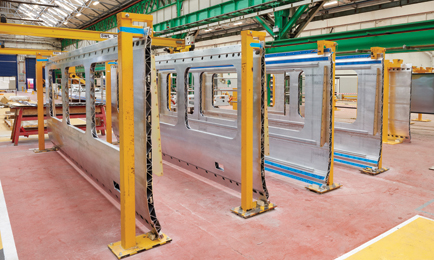
Note the double-skinned nature of the body sides, with reinforcing ribs inside, which must have great strength, light weight and a minimum number of components. I have read somewhere, that Bombardier are extruding aluminium for body components.
All of the holes could then be automatically cut by robots.
The joys of modern manufacturing!
Final Assembley
Modern manufacturing methods, as employed by car companies for years doesn’t mean you have to produce a sequence of identical vehicles on the line. Computer systems make sure all the components to build each car arrive at the right time.
A Class 345 train might have four or five different types of car, so similar methods would be used to speed production of the individual cars.
West Midlands Trains
Abellio, who own Greater Anglia, have decided they want to use Aventras on their new West Midlands Trains franchise.
According to Wikipedia, the new franchise is proposing to introduce the following trains
- 333 new Aventra carriages in three and five-car trains.
- 80 new CAF Civity carriages in two and four-car trains.
Some of the trains are direct replacements for other trains.
- The 36 x three-car Aventras will replace the 26 x three-car Class 323 trains.
- The CAF Civity trains will replace various diesel multiple units around Birmingham.
In some ways the puzzle is that there are 29 x five-car Aventras on order for electrified suburban lines.
Adding up the current and future number of electrified carriages on Birmingham suburban routes, shows that the number of carriages to be used will increase by three times.
New electrification is on the way.
- Chase Line to Rugeley Trent Valley.
- Cross-City Line to Bromsgrove.
But these short schemes won’t need all those trains, unless West Midlands Trains are going to run ten-car trains across Birmingham.
But possibilities exist.
- Electrification further towards places like Nuneaton and Worcester.
- Electrification of the Camp Hill Line across the City Centre.
- Aventras will be using batteries to reach places without electrification.
- Some Aventras could be bi-mode. I discuss the concept of a bi-mode Aventra in Is A Bi-Mode Aventra A Silly Idea?.
All will become clear in the next couple of years.
The West Midlands Trains orders for Aventras total 333 new carriages, which will all be pretty similar to previous orders, except in details like car length, number of cars, top speed and the interiors.
At Bombardier’s quoted production rate of 25 cars per week,l that means they would take jus fourteen weeks to build them, after the design was finalised.
That sounds unbelievable!
c2c
This order is for just sixty carriages, which will be delivered as six x ten-car trains.
This is an extract from c2c’s Press Release.
The Aventra is one of the fastest-selling trains in the UK rail industry, and these new trains will be manufactured at Bombardier’s factory in Derby. Each new train, which will operate in a fixed set of 10-carriages, will include over 900 seats, plus air-conditioning, wifi, plug sockets and three toilets onboard. Each new carriage is larger and contains more seats than on c2c’s current trains, so each 10-carriage new train provides capacity for 15% more passengers onboard compared to a current 12-carriage c2c train.
So three x four-car trains working as a twelve-car train are replaced by one ten-car train, which results in.
- A modern instead of a twenty-year-old train.
- 15% more capacity.
- Wi-fi and plug sockets.
- Better passenger experience.
- Two cabs instead of six.
- Fixed-formation trains don’t have end gangways.
- Twenty bogies instead of twenty-four.
Revenue per train will surely increase, but electricity and maintenance costs will also decrease.
So the accountants get a double dose of pleasure!
c2c also hint that more new trains are on thew way.
But as they are also reported to have extended the lease on their Class 387 trains, they have excellent cover whilst waiting for delivery of new Aventras.
Currently, they have the equivalent of 25 x twelve-car trains with a few spares.
So a complete train replacement if they like the Aventras, will probably be something like another twenty to thirty trains.
This would seem to be a very low-risk plan!
The New South Eastern Franchise
The needs of the current South Eastern and West Midlands franchises are surprisingly similar.
- High speed running on HS1 and the West Coast Main Line.
- Suburban services in city networks; London and Birmingham.
- A few short branch lines.
- Some lines without electrification.
- An ageing fleet without wi-fi.
So could we be seeing a mass fleet replacement with Aventras, as in West Midlands Trains.
Note that one of the bidders for this franchise is the same consortium of Abellio, East Japan Railway Company and Mitsui, who successfully bid for West Midlands Trains.
Abellio bought a large number of Aventras for Greater Anglia and helped develop battery power for the trains.
So could we be seeing a large number of Aventras added to the fleet for the South Eastern franchise?
Currently, the franchise runs 824 Electrostar and 674 Networker carriages.
To replace the Networkers would be 27 weeks of production at Bombardier’s rate of 25 carriages a day.
The South Eastern franchise also needs more high speed trains for HS1. I can’t believe that Bombardier couldn’t achieve a top speed of 140 mph with an Aventra. They probably will have a solution for covering the line between Ashford and Hastings. My money’s is on some form of energy storage.
Conclusion
Bombardier would not quote the capability of being able to make 25 trains per week to a newspaper like the Guardian, if they didn’t know it was possible.
But to meet the deliveries needed by the four initial customers, probably needs about half the quoted production rate, which is the sort of conservative thinking I like.
This gives Bombardier the float to sort out production problems or non-delivery of sub-assemblies outside of their control.
But it would also give them the capacity to fit in other orders. Suppose Crossrail decided to extend to Gravesend or Southend and needed another five Class 345 trains, then in theory, that is only two days production, provided the suppliers can deliver.
The UK’s railways are going to be full of Aventras.
Toilets In Class 345 Trains
I visited this topic in Do Crossrail Trains Need Toilets? over two years ago, when I said this.
Surely, a much better and more affordable solution would be to update the ribbon maps in all Underground and Crossrail trains to show if the station had toilets, in the same way, they show the step free access. Some extra signs on stations showing the status and location of toilets would also be a good idea.
Incidentally on the Essex and Reading legs of Crossrail, several of the stations already have decent toilets. Getting off a train and catching the next one, to have a relaxed toilet break, is probably not a huge delay, due to the high frequency of the trains.
London has a chance to set high standards in this area, without putting toilets on any trains.
My views haven’t changed, but I do think that now the Aventra is in limited service, I can speculate further.
Walk-through Trains, First Class And Toilets
London now has five walk-through trains.
- Class 378 trains on the London Overground.
- S Stock on the London Underground
- Class 700 trains on Thameslink.
- Class 707 trains on South West Trains
- Class 345 trains on Crossrail.
In some ways the Class 700 train is the odd train out, as it has both First Class seating and toilets.
It should also be noted that Greater Anglia’s new Class 720 trains don’t have First Class, but it appears they have toilets.
Walk-through trains are an undoubted success, as any Overground or Underground passenger will confirm, after seeing the way other passengers move around the train to both get a seat and be able to make a convenient exit.
First Class causes problems, as it blocks off this passenger circulation, unless it as one end of the train. But this means that First Class passengers might have a long walk to their seat at the wrong end of the day.
I wonder if walk-through trains encourage passengers to not use First Class, as the freedom to circulate in Standard Class makes the travel experience better.
It will be interesting to see how posh commuters from Frinton take to Greater Anglia’s new Class 720 trains.
Another problem of First Class sitting at one end of the train, is that if toilet provision is made, there must be a toilet near to First Class.
So if you don’t have First Class in a train up to perhaps ten cars, you can get away with perhaps a universal access toilet and a standard one.
From comments I get, most people seem to like the Class 395 trains or Javelins, that work the Highspeed services to Kent. These trains are six-car, with no First Class and two toilets.
So are these trains setting the standard for the Greater Anglia’s Class 720 trains?
Toilets On Class 345 Trains
The initial layout of Crossrail with terminals at Abbey Wood, Heathrow, Reading and Shenfield, has a longest journey from Reading to Shenfield of 102 minutes according to the Crossrail web site. But there are toilet facilities at Reading and Shenfield.
However, there is the possibility, that Crossrail trains may serve other terminals like Gravesend, High Wycombe, Southend and Tring.
Tring to Southend would be a journey of two hours, so a toilet is probably a necessity.
The current Class 345 trains have been designed to be nine-car units, although at present they are running as seven cars because of platform length issues at Liverpool Street.
I’ve read somewhere that Crossrail has been designed so that the trains can be increased to ten cars, if there should be a need for more capacity.
- Platforms have been lengthened to at least two hundred metres.
- All stations seem to have been updated for a large number of passengers.
- Lengthening from seven to nine cars is obviously a simple matter.
- A similar lengthening of the Class 378 trains was not a major exercise.
So surely, it would be a simple matter to slot in a car with a toilet.
So perhaps we might see an extra tenth car added to Class 345 trains, that is tailored to the route, as this ability to add and remove cars, is a feature of all Aventras.
Hitachi’s Class 800 trains also have the capability, as I suspect every well-designed train has.
The Ultimate Airport Train
Imagine a tenth car on Heathrow services.
- Disabled toilet.
- Ticket machine.
- Visitor information and shop.
- Space for large luggage.
The mind boggles!
Conclusion
If an operator wanted Aventras with a disco car, I’m sure Bombardier would oblige! At a price!
How A Sketch On A Piece Of Paper Became An £85m Rail Bridge
The title of this post is the same as an article on inews, which describes the design process for the bridge over the Irwell in Manchester, which is the centrepiece of the Ordsall Chord.
It is a fascinating insight into the design of what could become Manchester’s new icon.
An Exciting New Aventra
The title of this post is the title of an article in Rail Engineer.
It is actually dated the 31st of January 2014, so you might think it is out of date.
But surely, with the first Aventras appearing in service, now is the time to revisit.
I found the article this morning by accident and it is a fascinating read, Especially when you consider the article was written before the train had received any orders. Bombardier had actually just missed out on the Thameslink order, which resulted in the Class 700 trains.
A Blank Sheet Of Paper
The loss of the Thameslink order allowed Bombardier to start from scratch.
This paragraph indicates one of their start points.
And then we looked at it and thought we’ve also got depot engineers from Strathclyde to Surrey, all over the place, all looking after these trains in the field. How are they performing? Is there something we can do better there?
As the article says Aventra was reborn after Thameslink!
They also talked extensively to possible customers.
Suppliers
Suppliers were invited on board and given space with the design team in a new Design Office in Derby.
This paragraph described how everyone worked together.
We basically started from scratch, and in a completely different way. It isn’t engineering-led any more. It’s a joint collaboration of our depot people, our manufacturing guys, procurement and engineering.
I would describe it as a project-led structure similar to one that ICI used to use in the 1960s.
I wrote my first scheduling program to allocate the office space needed.
A Modular Approach For The Future
Each Electrostar had been different to the previous, but this sums up the Aventra philosophy.
Aventra will be a single modular product, capable of being easily modified for different applications but in each case referring back to the core design. So whether the actual class will be a 90mph metro train or a 125mph main-line express, it will have the same systems and components as its basis. In fact, Jon thinks that the distinctions are becoming blurred anyway.
They had looked forward ten years.
Away From The Wires
Aventra will be an electric train, but what happens, when the wires run out?
This was their solution.
So plans were made for an Aventra that could run away from the wires, using batteries or other forms of energy storage. “We call it an independently powered EMU, but it’s effectively an EMU that you could put the pantograph down and it will run on the energy storage to a point say 50 miles away. There it can recharge by putting the pantograph back up briefly in a terminus before it comes back.
I rode the prototype in public service in January 2015!
I was totally convinced that Bombardier’s battery trains have not even the smallest touch of Mickey Mouse!
Although the experience was magical!
Bombardier’s Iron Bird
Bombardier have borrowed the Iron Bird concept from the plane-makers.
This is an extract.
A leaf has been taken out of the aircraft designers’ handbook. They use something termed an Iron Bird – basically an aeroplane without wings – to test new systems.
Bombardier’s Iron Bird is a train without bogies. However, it does contain control systems, wiring looms and other bits of kit and it is being assembled at Derby.
I think that this shows, that they are not against borrowing other concepts from other industries.
The Most Affordable Train
The article describes how the train was designed to give the best whole life cost.
This sentence sums up the philosophy.
It’s actually about a 50/50 split between the whole life cost and the first capital cost. That makes it a bit more difficult because we’ve got be competitive on the first practical cost, but additionally we have to offer a really high availability, strong reliability, combined with much better energy consumption and less track damage.
As someone, who used to own a finance company, that leased trucks and other expensive equipment, the product described is the sort of product that leasing companies love. If the train is economical to run, if the first train operating company goes bust, you’ll still have an asset that other train operating companies will fight over.
Trains are also a predictable long-term investment, as well-built efficient trains have a thirty or forty year lifetime.
In my view the big winner of a train like this is the manufacturer, as they’ll get happy owners, train operating companies and passengers, which must lead to repeat orders.
Conclusion
I’ve never ridden a more well-designed, comfortable, smooth and quiet suburban electric train, than the Class 345 train in trial service on the Shenfield Metro, anywhere in the UK or Europe.
Waterloo Upgrade August 2017 – Mid-Platform Entrance/Exit On Platforms 23/24 At Waterloo Station
These pictures show the mid-platform entrance/exit on Platforms 23/24 at Waterloo station.
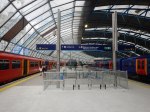

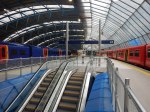
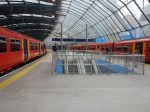
Note.
- This mid-platform entrance/exit must mean that Platforms 20 to 24 effectively have a double-deck gate line.
- Access is also to the Waterloo and City Line.
This article in Rail Engineer, which is entitled Waterloo and South West Route Upgrade, says this.
Improvements in access to the Bakerloo, Northern and Jubilee tube lines from platforms 1/2 and 3/4 and from the former International terminal.
These pictures were taken at 09:30 at the end of the Peak.



When finished it looks like it will be impressive.
Will the access on Platforms 1/2 and 3/4 be double-escalator like this access on the former International platforms?
As I indicated in Waterloo’s Wide Platforms, the design of the older platforms isn’t cramped, so it could be possible.
Incidentally, I couldn’t see any lifts on Platforms 23/24, but these structures behind the grey hoardings could be for lifts.
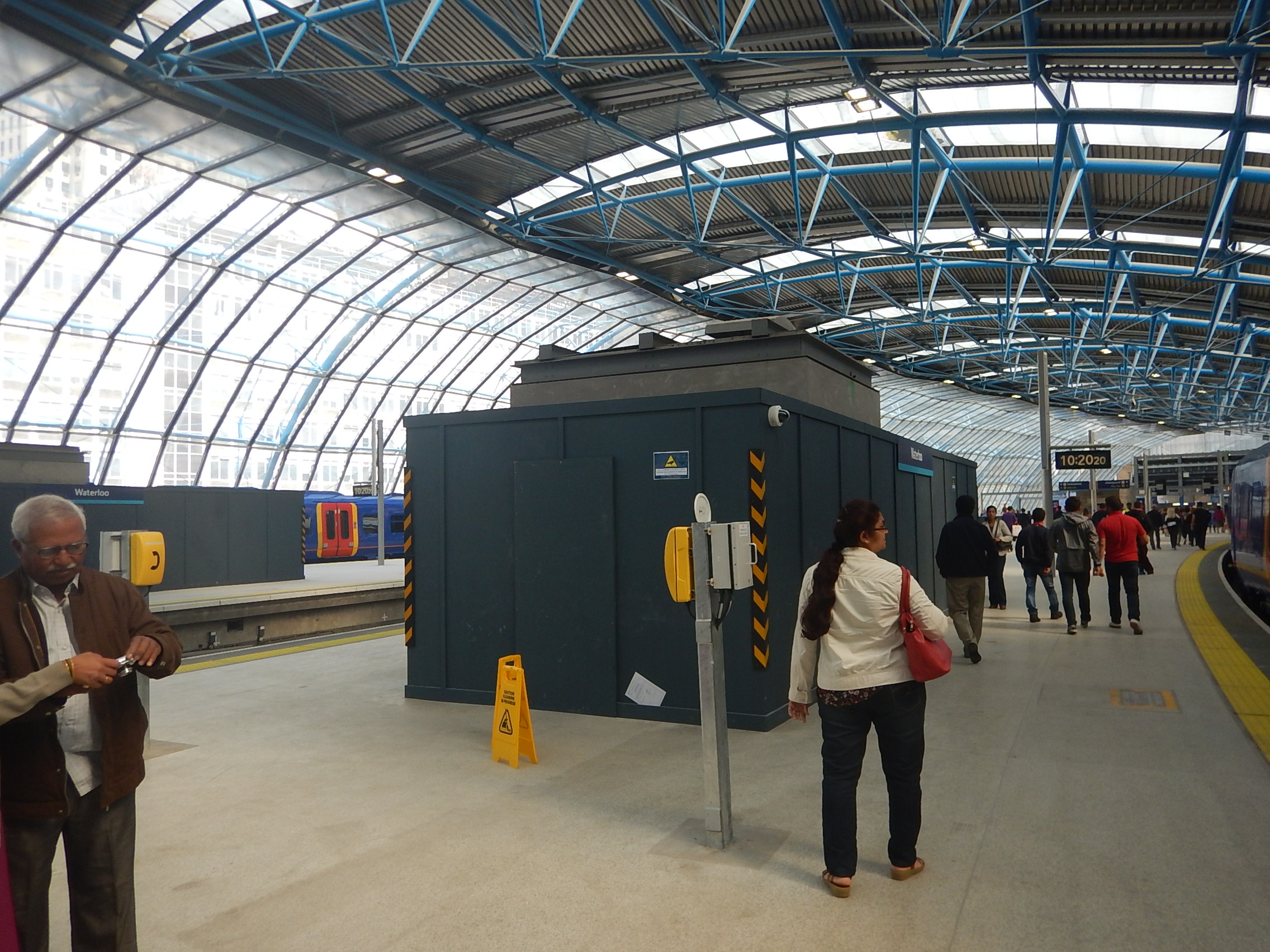
Will there be any platforms in the UK with better step-free access?
And it’s not as if the platforms are for an exotic destination like Cardiff, Huddersfield or Norwich, although I suspect services will go to the regal delights of Windsor! Will Liz be amused?
Waterloo Upgrade August 2017 – Waterloo’s Wide Platforms
These pictures compare the platforms at Waterloo station.
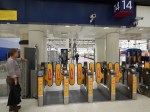
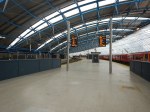
The pictures are shown in increasing platform number order.
Platforms 5 to 14 are in the old part of the station, which was opened in 1922, whilst Platforms 20 to 24 are in the former International station.
Surprisingly, the platforms in the old part of the station seem to be fairly generous in width compared to say those in other London terminals.
They are not much narrower than those built for Eurostar in 1994.
Note that it appears that the old platforms have around five to seven gates per platform, as the space allows, whereas the new ones have thirty gates for the five platforms.
As gates are reversible, that surely is enough to cope with the Peak, especially as there is a mid-platform entrance/exit on some platforms to the Underground.
I suspect the platforms can cope with a whole battalion of guardsmen complete with full kit, all arriving at the same time!
The 10:35 From Liverpool Street To Shenfield
I took these pictures on the untimetabled 10:35 TfL Rail service between Liverpool Street and Shenfield stations and on the return to Liverpool Street.


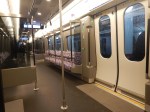
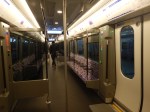


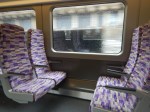
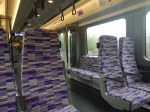

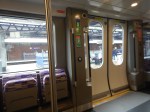


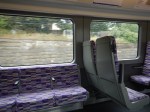
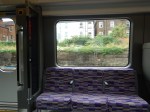


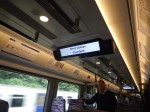


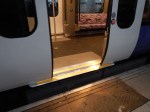

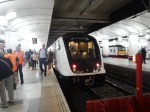
As you can see it is a new Class 345 train.
There were a lot of Crossrail and Transport for London staff about, talking to passengers.
These are my thoughts on various issues.
Ride Quality
This is up with the best or the legendary British Rail Mark 3 coach, which was designed in the 1960s.
One of the Crossrail staff was wearing stiletto heels close to four inches and she was walking up-and-down with no difficulty.
For someone who suffered a bad stroke, my balance is good and I had no difficulty walking along the seven-car train.
Cabin Height And Width
I don’t know how Bombardier have done it, but the cabin seems higher and wider than any other train I’ve ridden in the UK.
Next time, I ride one, I’ll take a couple of tall guys and a tape measure.
Information
The current on-train information is simple, but then as I suspect the screens are software driven, any degree of required complication can be added.
I don’t know whether it is deliberate but everything is large and easy to read. There is also no maps or exhortations about security.
Long may it stay that way!
Simple is efficient!
Seats
Not everybody was completely satisfied with the seats, but I found them much more comfortable than those in the Class 700 trains on Thameslink.
There were some good points.
- The sets of four seats were arranged as they were in the original InterCity 125 around a large window.
- The metro-style seating had a wide aisle in the middle, that would satisfy a basketball team.
- An amply-proportioned man, thought the seats comfortable.
- Most seats had well-designed armrests.
- There was plenty of space under the seats for airline-size carry-on baggage or a labrador.
On the other hand, there were no cupholders, tables or litter bins. But there aren’t any on the Class 378 trains or London Underground‘s S Stock.
Entry And Exit
I feel that trains should be a level step across from the platform.
This train wasn’t as good as a Class 378 train on many Overground stations, but it was better than some.
As many Crossrail stations will be one train type only there is probably scope to get this better.
I regularly see a lady in a simple wheel-chair on the Overground and I feel she would probably be able to wheel herself in and out, which she does at Dalston Junction station with ease.
It should be noted that each coach has three sets of wide double doors and a large lobby, so perhaps a mother with triplets and a baby in a buggy would find entry easier than any train on the Underground.
Walking Up And Down The Train
I found this very easy on a train that was no more than a third full, as it was an extra service to introduce the train to passengers.
There were numerous hand-holds and vertical rails in the centre of the lobbies. Unlike on some trains in France, Italy or Germany, the rails were very simple. They also borrowed heavily from the Overground’s Class 378 trains.
Wi-Fi And 4G
I didn’t try the wi-fi, as it is not something I use very often.
But I was getting a strong 4G signal all the way to and from Shenfield. Was this direct or was I picking up a booster in the train? I suspect it was the latter at some points close to Liverpool Street.
Windows
The windows on the train are large and well-positioned.
The simple seat and window layout, seems to appeal to all classes of rail user.
A Train For Families
When Celia and I had three children under three, with two able to toddle-along (they had too!) and the youngest in his McClaren, I could imagine us taking a train from Barbican station to perhaps go shopping on Oxford Street, sitting in one of those set of four seats by that large window.
A Train For Commuters
The Class 378 trains of the Overground cram them in and the metro layout of much of the Class 345 train will accommodate large numbers of commuters.
I would question, if there are enough seats, but the proof should be apparent by the end of the year, as eleven of the current seven-car trains will be in service between Liverpool Street and Shenfield.
For the full Crossrail service, they will be lengthened to nine cars and there is a possibility of adding a tenth.
A Train For Shoppers
If say, I’d been to Eastfield at Stratford and was coming back to Moorgate heavily loaded with shopping to get a bus home, I could probably put some bags under the seat. Try that on the Underground!
A Train For The Not-So-Young
From what I saw today, I couldn’t make too many observations, as the train wasn’t crowded, but the few older travellers that I did see were smiling at the experience.
A Train For The Disabled
As I’m not disabled, I can’t comment and would love to hear from those who are.
A Train For The Tall
Compared to other trains in London, the headroom seemed to be generous, but then I didn’t see anybody who was much more than six foot.
A Train For The Airport
Class 345 trains will serve Heathrow Airport. I feel they will cope, as the metro layout of the Class 378 trains, seems to accommodate large cases well!
Comparison With A Class 700 Train
The Thameslink Class 700 trains are designed for running over a longer distance at a higher speed and they have toilets.
But for a thirty minute journey through a busy part of London, there is no doubt in my mind, as to which train I would choose.
The Class 345 train, with its large windows, more comfortable seating, space for bags, uncluttered views and the appearance of more space, is undoubtedly in my view a better designed train.
Incidentally, for every metre of a nine-car Class 345 train, 7.31 passengers can be accommodated, as opposed to 7.07 in an eight-car Class 700 train.
I think we can put all this comparison down to Derby 1 – Krefeld 0!
Comparison With A Class 387 Train
The trains will be compared with Bombadier’s last Electrostar, the Class 387 train, which will be in service with GWR between Paddington and Reading, alongside the Class 345 train.
Passengers will be able to take whichever train they want on this route.
Will they choose the Class 387 train, with its tables, very comfortable seats and toilets or the Class 345 train?
I’d choose the Class 387 train, as I like to lay out my newspaper for reading.
No matter what happens Derby wins again.
Moving Forward On Approach To Liverpool Street
I was surprised how many people walked to the front as we approached Liverpool Street.
But were they only demonstrating the Londoners’ ducking and diving ability of getting to the right place for exit.
Regular passengers on regular routes will anticipate their stops and I will be interested to see how much passenger behaviour increases the capacity of the train.
Conclusion
This first Aventra feels like it is a very good train.
Consider how Bombardier improved the Electrostar since it was first produced in 1999.
So what will an Aventra be like in 2035?
The Go-Anywhere Express Parcel And Pallet Carrier (HSPT)
In the June 2017 Edition of Modern Railways there is an article entitled Freight, Not All Doom And Gloom, which talks about high-value parcel carriers. The article says this.
Think about all those 1980s units that are soon to be made redundant, especially the ones with wide doorways. You could forklift in pallets and move them by hand trolley inside the vehicle (forklift tines would not fit an HST’s doors).
A Class 150 parcels unit, anyone?
There are other reasons for not using a High Speed Train.
- ScotRail and Great Western Railway have better uses for the trains moving passengers around in style.
- Their 125 mph capability and large windows might come in handy for heritage tourism.
- They are diesel trains and some might not like to hear them thundering through the countryside in the middle of the night.
As to the Class 150 train, it has a few disadvantages.
- It is only two-cars.
- It has a 75 mph operating speed.
- It is diesel-powered, which probably means regular refuelling.
But also like all Mark 3-based stock it scrubs up well as I wrote in What Train Is This?
I would refurbish the whole fleet and use them on short branch lines to provide a quality service, where a two or four-car train was all that was needed.
So what would be the specification of an ideal Go-Anywhere Express Parcel and Pallet Carrier?
I was going to call it a GAEPPC in this post, but that’s rather a mouthful, so I’ll call it a High Speed Parcel Train or High Speed Pallet Train, which in recognition of its more famous big brother will be called a HSPT.
For the specification, it might be a good idea to start with the Class 325 train. This is the first paragraph of the train’s Wikipedia entry.
The British Rail Class 325 is a 4-car dual-voltage 25 kV alternating current (AC) or 750 V direct current (DC) electric multiple unit (EMU) train used for postal train services. While the Class 325 bears a resemblance to the Networker series of DMUs and EMUs, they are based on the Class 319 EMU. The Class 325 was British Rail’s newest unit to take over parcels workings on electrified lines.
The requirement might have changed since the 1990s, but the basic specification would be similar.
- Four-cars
- 100 mph operating speed.
- 25 KVAC overhead or 750 VDC third rail operation.
- The ability to run as four-, eight- and twelve-car trains.
- It would be available in a range of colours and not just red!
In addition, it would need wide doors for pallets.
It would also be nice, if the HSPT could run on lines without electrification.
Look at this picture of a Class 321 train.
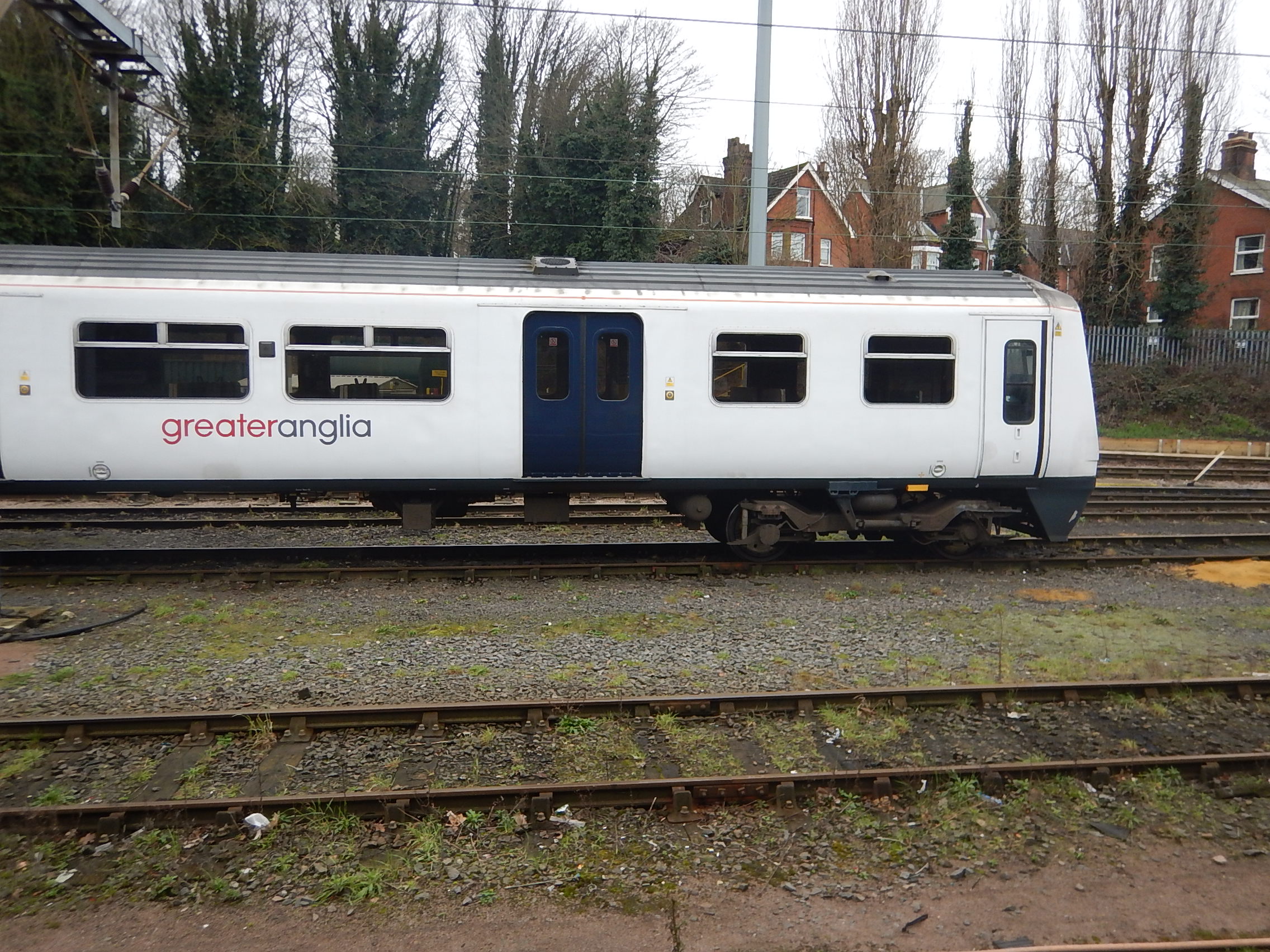
Would a standard size 1200 x 1000 pallet go through this door?
This morning, I measured the door on a Class 378 train and it was about 1700 mm. wide. So yes!
Once inside the systems used in cargo aircraft could be used to arrange the pallets.
Consider, these facts about Class 321 trains.
- They are four-car electric multiple units, that can also run as eight and twelve car units.
- They can operate at 100 mph.
- They are dual voltage units, if required.
- There are 117 of the trains, of which over a hundred will be released by Greater Anglia and will need a new caring owner.
- The interior may be wide enough to put two standard pallets side-by-side.
- They are based on Mark 3 steel carriages, so are built to take punishment.
In Could There Be A Class 321 Flex Train?, I speculated as to whether these trains could be fitted with underfloor diesel engines as in the Class 319 Flex train. After the news reports in the June 2017 Edition of Modern railways, which I reported on in The Class 319 Flex Units To Be Class 769, I’m now convinced that converting other types of train like Class 455 and Class 321 trains is feasible and that the train refurbishing companies are going to be extremely busy.
I have a feeling that Class 319 trains will not be converted to HSPTs, as they seem to be very much in demand to carry more valuable cargo – Namely fare-paying passengers!
But fit diesel engines under a Class 321 train and I think it would make a HSPT, that could travel on nearly every mile of the UK rail network and quite a few miles on heritage railways too!
A Freight Terminal For An HSPT
As the Class 321 train has been designed for passengers, it lines up reasonably well with most of the station platforms in the UK.
So at its simplest a freight terminal for a HSPT could just be a station platform, where a fork lift truck could lift pallets in and out.The freight handling facilities would be designed appropriately.
Supermarket Deliveries
I also think, that if a HSPT were available, it could attract the attention of the big supermarket groups.
In The LaMiLo Project, I described how goods were brought into Euston station in the middle of the night for onward delivery.
If it cuts costs, the supermarket groups will use this method to get goods from their central warehouses to perhaps the centres of our largest cities.
Get the design right and I suspect the supermarkets’ large delivery trolley will just roll between the train and the last-mile truck, which ideally would be a zero-emission vehicle.
In some of the larger out-of-town superstores, the train could even stop alongside the store and goods and trolleys could be wheeled in and out.
This Google Map shows Morrisons at Ipswich.
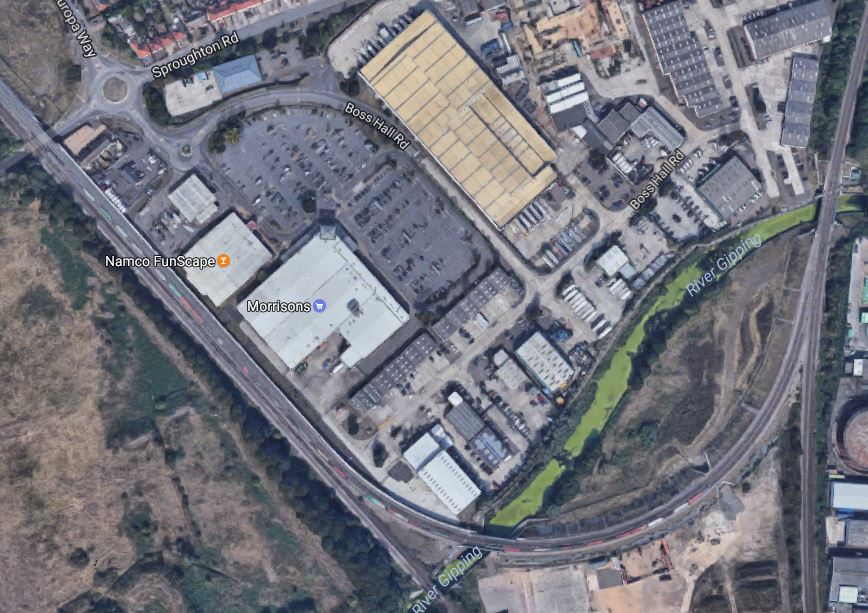
The store lies alongside the Great Eastern Main Line.
Surely, the ultimate would be if the goods were to be transported on the trains in driverless electric trolleys, which when the doors were opened, automatically came out of the trains and into the store.
Supermarket groups like to emphasise their green credentials.
Surely, doing daily deliveries to major stores by train, wouldn’t annoy anybody. |Except perhaps Donald Trump, but he’s an aberration on the upward march of scientifically-correct living.
Just-In-Time Deliveries
To take Toyota as an example, in the UK, cars are built near Derby, and the engines are built near Shotton in North Wales.
Reasons for the two separate sites are probably down to availability of the right workforce and Government subsidy.
I’m not sure, but I suspect currently in Toyota’s case, engines are moved across the country by truck, but if there was a HSPT, with a capacity of around a hundred and fifty standard pallets would manufacturing companies use them to move goods from one factory to another?
It should be said in Toyota’s case the rail lines at both Derby and Shotton are not electrified, but if the train could run on its own diesel power, it wouldn’t matter.
Refrigerated Deliveries
There probably wouldn’t be much demand now, but in the future bringing Scottish meat and seafood to London might make a refrigerated HSPT viable.
Deliveries To And From Remote Parts Of The UK
It is very difficult to get freight between certain parts of the UK and say Birmingham, London and the South-Eastern half of England.
Perishable products from Cornwall are now sent to London in the large space in the locomotives of the High Speed Trains. Plymouth, which is in Devon, to London takes nearly four hours and I suspect that a HSPT could do it in perhaps an hour longer.
But it would go between specialist terminals at both ends of the journey, so it would be a much easier service to use for both sender and receiver.
Another article in the same June 2017 Edition of Modern Railways is entitled Caithness Sleeper Plan Set Out.
This is said in the article.
Another possibility would be to convey freight on the sleeper trains with HiTrans suggesting the ability to carry four 40-foot and two 20-foot boxes on twin wagons could provide welcome products and parcels northwards and locally-produced food southwards.
A disadvantage of this idea would be that passengers would be required to vacate sleeping berths immediately on arrival at Edinburgh, so that containers could continue to a freight terminal.
The HSPT would go direct to a suitable terminal. In remote places like Caithness, this would probably be the local station, which had been suitably modified, so that fork lift trucks could move pallets into and out of the train.
One-Off Deliveries
Provided a load can be put on a pallet, the train can move it, if there is a fork lift available at both ends of the route.
It would be wrong to speculate what sort of one-off deliveries are performed, as some will be truly unusual.
Disaster Relief
On the worldwide scale we don’t get serious natural disasters in the UK, but every year there are storms, floods, bridge collapses and other emergencies, where it is necessary to get supplies quickly to places that are difficult to reach by road, but easy by rail. If the supplies were to be put on pallets and loaded onto a HSPT, it might be easier to get them to where they are needed for unloading using a fork lift or even by hand.
International Deliveries
I am sure that Class 319 and Class 321 trains can be made compatible with Continental railway networks. In fact two Class 319 trains, were the first to pass through the Channel Tunnel.
Post-Brexit will we see high value cargoes transported by the trainload, as this would surely simplify the paperwork?
What value of Scotch whisky could you get in a four-car train?
Expect Amazon to be first in the queue for International Deliveries!
Imagine a corgo aircraft coming into the UK, at either Doncaster Sheffield or Manston Airports, with cargo containers or pallets for all over the UK, that were designed for quick loading onto an HSPT.
Conclusion
There is definitely a market for a HSPT.
If it does come about, it will be yet another tribute to the magnificent Mark 3 design!
 The Anonymous Widower